
Double Take
Arcade Game: Action · ZX-Spectrum 48K · 1 players · English
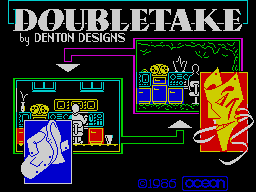
Ocean Software Ltd · 1987 · Pound sterling 7.95
Discussion
Nobody has started a thread about this yet.
- Control Option
- Cursor, Interface 2 (right), Kempston Joystick
Releases
- 1987Ocean Software LtdPound sterling 7.95
- 1987Erbe Software S.A.
Play
- doubletake.rzxRZX playback file
- DoubleTake.tzx.zipTape image English31 KB
- DoubleTake.tap.zipTape image English30 KB
- DoubleTake(ErbeSoftwareS.A.).tzx.zipTape image English31 KB
- DoubleTake(ErbeSoftwareS.A.).tap.zipTape image English30 KB
Documents
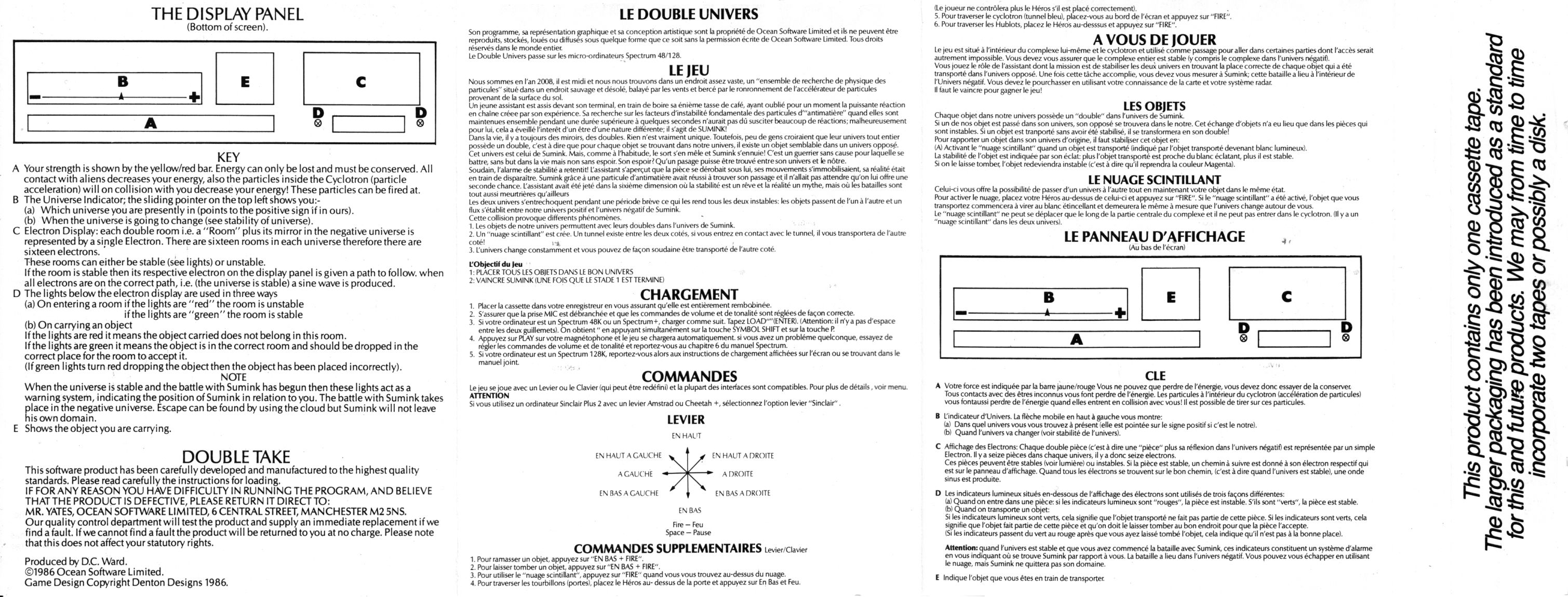
- DoubleTake.txtInstructions English11 KB
Music
- DoubleTake.ay.zipRipped in-game/theme music in AY format 2 KB
Other files
- Double Take (1987)(Ocean Software).pokPOK pokes file 0 KB
Files and rights
No permission is on record either way. Screens and pictures are copied here on a take-down basis: if you hold the rights and want something removed, say so and it goes.
Credits
- Denton Designscredited
- Tim WhiteInlay/Poster Art
Sign in to credit somebody, or say what these people did.
Awards
Scores
In the magazines
- Sinclair User #581987 · Overall5/5
- Your Sinclair #151987 · Overall8/10
- Crash #371987 · Overall74%
Elsewhere on the web
- WorldOfSpectrum 12 votes7.00
In the magazines 34
C&VG (Computer & Video Games) #66Apr 1987 · p.28C+VG Hit9/106/108/108/10
C&VG (Computer & Video Games)C+VG Hit
Graphics 9/10
Sound 6/10
Value 8/10
Playability 8/10
Brian Webber
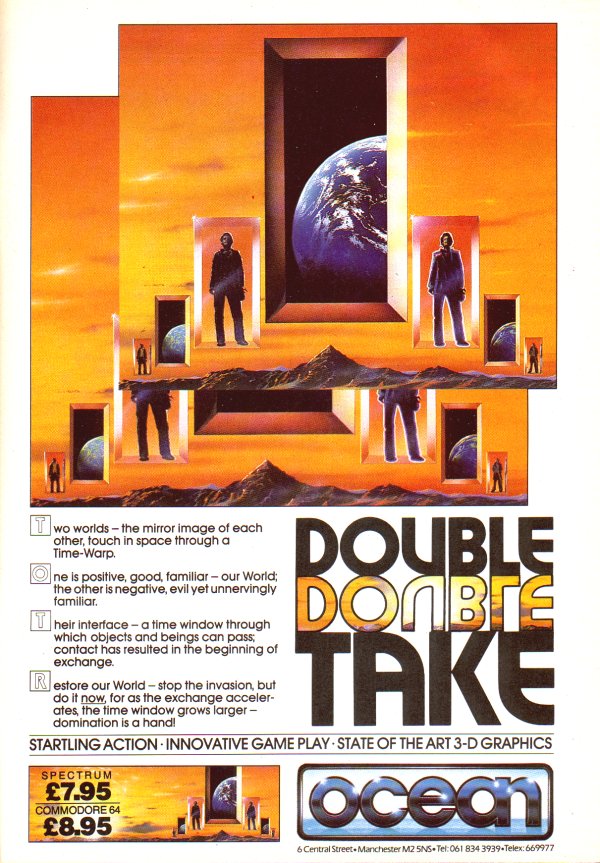
MACHINES: Spectrum 48/128K/CBM64 SUPPLIER: Ocean PRICE: £7.95 (Spectrum)/£8.95 (CBM 64) VERSION TESTED: Spectrum Two worlds - the mirror image of each other, touched in space through a time-warp. One is positive, good, familiar - our world. The other is negative, evil - yet unnervingly familiar. Their interface is a time window through which objects and being can pass; contact has resulted in the beginning of exchange. Restore our world - stop the invasion, but do it now, for as the exchange accelerates, the time windows grow larger, domination is at hand! This is the story line which accompanies the game's advert which has been causing quite a stir lately. It also states "Startling action: Innovative Game Play: State of the Art Graphics." I have to agree with all of these, especially the graphics. This game must include some of the best graphics seen on a Spectrum. You take control of an overcoat that someone forgot to wear. Your objective is to travel around the numerous locations, and find object's in the wrong place and return them to where they should be. On the lower half of the screen a red light will turn green if the object you are carrying belongs in the room that you are in. To travel to different rooms whirlwinds are used (these act as doors), but to travel to the other world to replace or find an object you will have to use the sparkling cloud. When using the cloud the object you are carrying will stay in the same state, whereas if you wait for the worlds to change on their own, the object's state will be altered. The cloud only travels along the central complex, so this means using the whirlwinds a lot to find it. If you do not manage to find the cloud in time and the object is altered, then do not worry as all is not lost. You are able to change the objects state by shooting the aliens that sap your energy. The aliens appear in the now well used Ultimate style, but adds to the atmosphere of the game. Due to the use of a lot of colours, the old Spectrum problem of attributes creep into the program. Sound may be limited but is once again another old Spectrum problem. The sound that there is has been used to very good effect. Overall the game turns out to be one of Ocean's best releases ever on the Spectrum, and will probably be the most imaginative and innovative game of the year. This is certainly worth considering if you want a game that strays away from mindless shooting, and will keep all the arcade adventurers happy for some time. Full marks to Ocean on this one and hope they can produce the same quality for Short Circuit and other future releases.
Your Sinclair #15Mar 1987 · p.669/107/108/108/108/108/10
Graphics 9/10
Playability 7/10
Value For Money 8/10
Addictiveness 8/10
Overall 8/10
Marcus Berkmann 8/10
Ocean £7.95 Reviewer: Marcus Berkmann What the deuce is this, Carruthers? A game of two universes, co-existing side by side (by Sondheim). How very singular, or possibly pural. What am I talking about? Ocean's latest game, Double Take, that's simply chock full of new ideas, that's what. You play a research assistant left to look after the hyper-important "Physical Particle Investigahon Unit" while everyone else goes down the pub. As you settle down to a cup of tea and the latest copy of YS, sumink dreadful happens in the shape of sumink from the parallel universe called Sumink. Thanks to him, the two universes momentarily collide, causing all sorts of odd effects. Possibly the most startling is that you're transformed into a hyper-energetic lab assistants coat with a particularly bad case of the shakes. Yes, I did say a coat! Meanwhile, doors turn into whirlwinds, and aliens appear everywhere. More importantly, it seems, objects from each universe have swopped places with each other, rendering the rooms in which they lie unstable. It's your job to change them back again. And this is certainly no mean feat. Although you regularly cross between the universes, what you're carrying won't come with you until you've made it stable. This you do either by shooting loads of aliens or by finding the 'sparkling cloud', a sort of gleaming blob that floats around the base, looking as much like a sparkling cloud as I do Tom Cruise. But here's where it gets complicated. Though the objects are the same in both universes, it's not their precise equivalents that get swopped. Instead you find that the saw, for instance, is changed for the syringe. And to make it even more confusing, not all objects are swopped, so the other saw may remain in the correct room. And why not? A room only becomes stable when the right object is put there, and then only if it's stable. I hope you got all that, not sure I did. When you've returned all the right things to the right places and are thinking about that cup of tea you deserve, you must prepare yourself instead for the final confrontation with the evil Sumink. I haven't clapped eyes yet on this little lovely, but if the rest of the graphics are anything to go by, he should be worth waiting for. True, you need a PhD to work out how the game is played. The inlay notes certainly won't help you. And the joystick control takes a bit of mastering, especially when you're trying to negotiate the whirlwind doors. Sainsbury's on a Saturday morning has nothing on the effect those doors will have on you. At least, though, there's a game in there to be played, and one that should satisfy both hardened zappers and more thoughtful herberts among you. It's not really a mapper's paradise - there are only 16 rooms - but it's the action that counts, and there's enough of that. And the graphics are great - as big, bouncy and fast as the Editor rushing to the bank with her cheque on payday. Attribute problems are kept to a minimum and, those doors apart (if only they were). Double Take's a treat.
Crash #37Feb 1987 · p.11883%90%71%69%72%74%
Presentation 83%
Graphics 90%
Playability 71%
Addictive Qualities 69%
Value For Money 72%
Overall 74%
Ben Stone
Mike Dunn
Paul Sumner
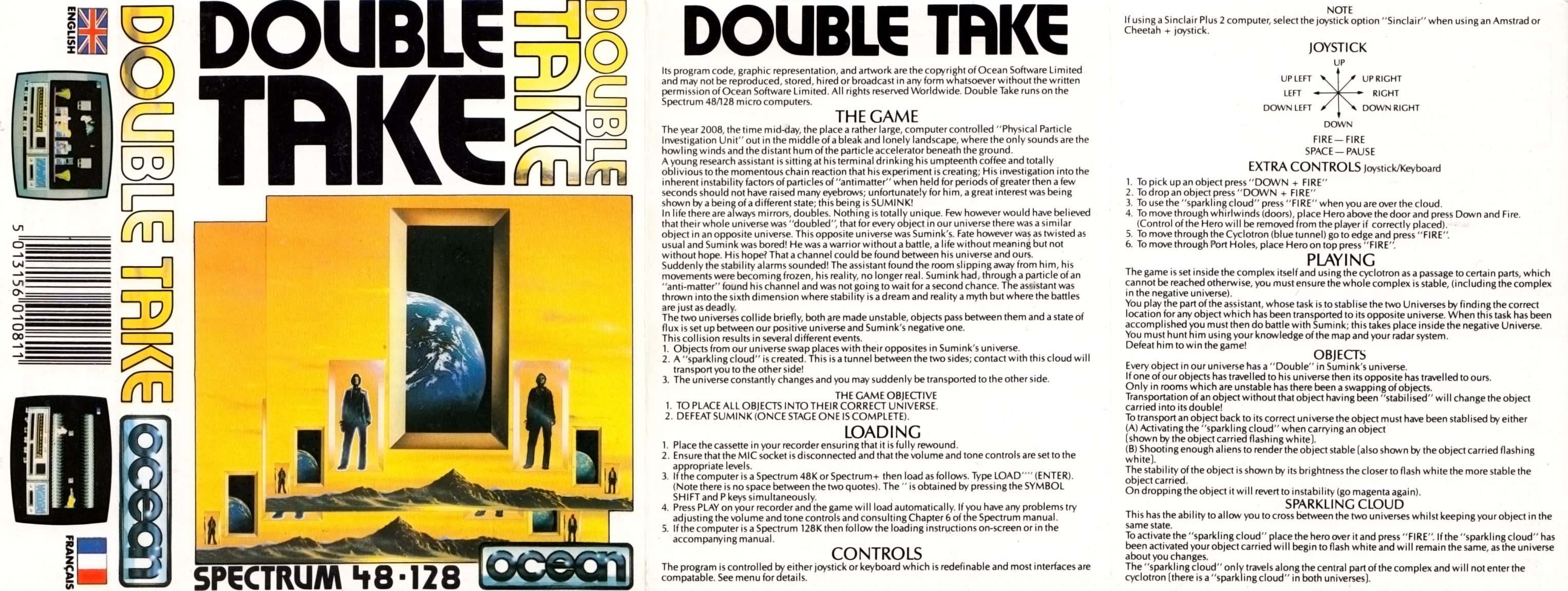
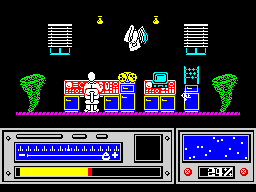
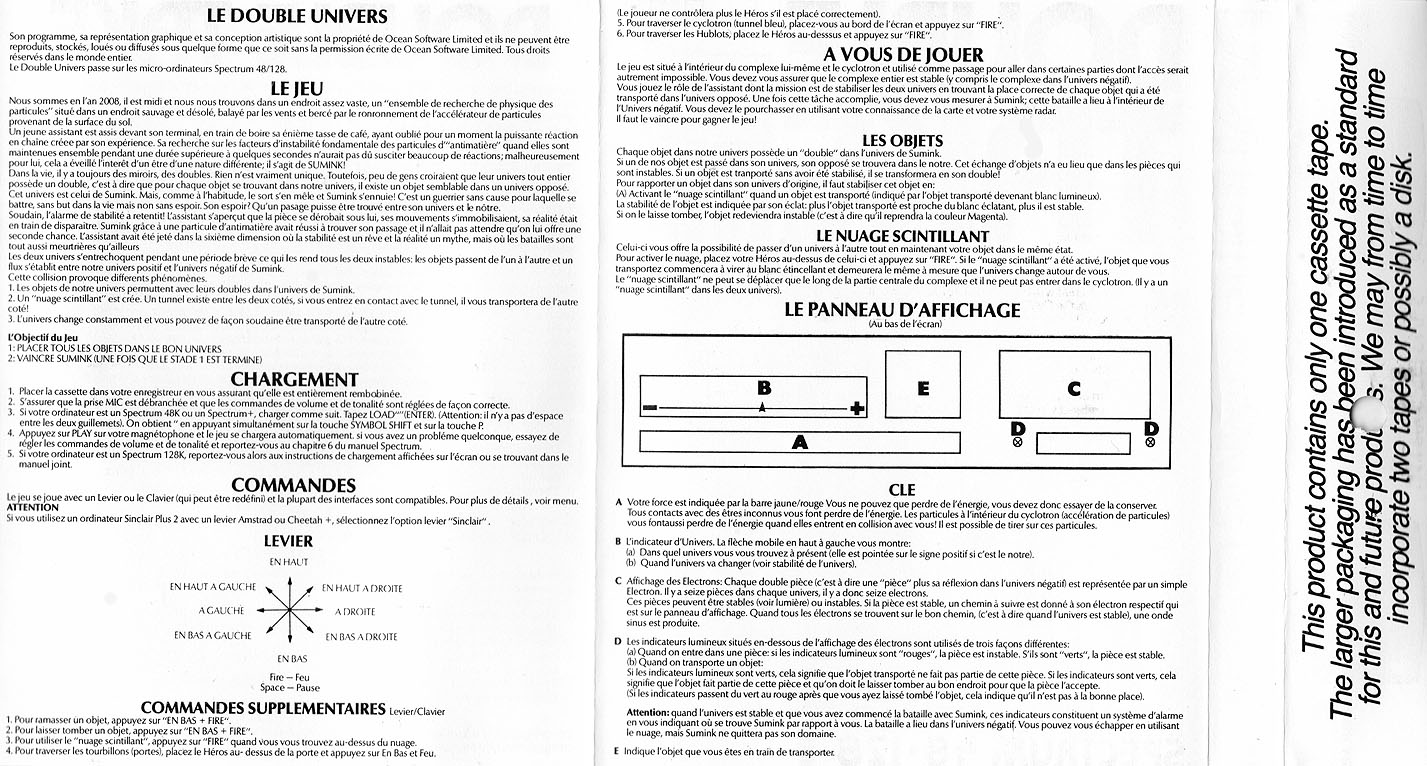
Producer: Ocean Retail Price: £7.95 Author: Denton Designs Our normal, stable universe has a parallel - a universe that is under the control of a distinctly evil being by the name of Sumink. Sumink has been waiting for the opportunity to cross the dimensional divide that separates the two universes so he can begin a new program of conquest... Then, one day, a student working in an advanced physics research laboratory unwittingly provides Sumink with his chance. An experiment damages the entire space/time continuum, throwing the two parallel universes into an unstable state and creating gateways that allow objects and people to pass from one universe to the other. The lab in which the fateful experiment was conducted contains sixteen rooms and a giant, tunnel-like particle accelerator. Suddenly it has become linked to the equivalent laboratory in Sumink's universe. Objects from locations in our universe have become unstable and changed places with their counterparts in the 'anti-universe'. The first step in restoring order involves stabilising these objects and returning them to their rightful locations. You control the student whose experiment caused all the problems - he is represented by a flying lab coat and is equipped with a gun. Just as well, as a horde of energy-sapping monsters have been created and they lurk in every location, regenerating themselves endlessly until stability is restored. Rooms in a universe are linked by whirling vortexes - the screen flips to the next location when the coat is moved down into a vortex while fire is pressed. To gain access to some rooms, the student has to travel through the cyclotron itself - which contains energy-sapping atomic particles. The status panel includes a readout that monitors your energy level: there's only one life in the game and energy must be conserved as it can't be boosted. Periodically, the main display dissolves and reforms as the two universes interchange. A pointer indicates which universe is currently occupied - a plus sign represents our universe and a minus sign Sumink's. This pointer slides along a scale when a shift between universes is imminent. All the locations in one universe are contained in the other, but as the universes are mirror images of each other, moving left in one universe is equivalent to moving right in the other, and vice versa. Sixteen electrons - one for each of the sixteen pairs of locations - move up and down in a window in the status area. Restoring order by returning all the objects that travelled between the universes to their correct places causes the dancing electrons to move in harmony and produce a sine wave on this readout. When the student enters a room a pair of lights under the electron display show red if the room is unstable and green if it is stable. One item can be carried at a time, and picking up an object causes it to appear in a window on the status area. The indicator lights then remain red until the student takes the object to the room in which it belongs. If the lights turn red again when the object is dropped, it has been placed incorrectly and must be gathered up and repositioned. The colour of the object held changes to indicate its stability, moving through the spectrum from magenta to flashing white. Stability can be increased gradually shooting monsters or instantly by touching the sparkling cloud that wanders through each universe - these clouds also act as portals between the two worlds. A stable object is retained when the universes interchange, but the moment it is dropped it becomes unstable again unless it is placed in its proper position. It's no use lust picking up an object and waiting for the universes to change - if the flip happens while an unstable object is held it is automatically swapped for its counterpart. Restoring stability is only the first part of the game. Once everything is ship-shape it's time to deal with the threat posed by Sumink himself. Entering the negative universe you must do battle with the evil warlord... COMMENTS Control keys: redefinable - up, down, left, right, fire; SPACE to pause Joystick: Kempston, Cursor, Interface 2 Use of colour: attractive, and carefully done Graphics: impressive: the usual DENTON's flair Sound: cute tune at the beginning with spot effects throughout Skill levels: one Screens: around sixty
A dank and dreary location in Sumink's universe.
In the kitchen of our own universe - a fiendish monster is just materialising above the right-hand vortex.
Sinclair User #58Jan 1987 · p.32Sinclair User Classic5/55/5
Sinclair UserSinclair User Classic
Overall 5/5
Graham Taylor 5/5
Label: Ocean Author: Denton Designs Price: £7.95 Joystick: various Memory: 48K/128K Reviewer: Graham Taylor Frankie goes to Hollywood was not a successful game. I mention this in the context of Double Take because Frankie got rave reviews and was regarded as incredibly inventive and imaginative. Double Take is incredibly inventive and imaginative and if the same fate befalls it the game - buying public deserves all the appalling licencing deals based on terrible films it gets. Actually reading the Double Take blurb boggles the mind. You get the sinking feeling the game is going to be absolutely impossible to understand. It isn't. At one level it's a straight zap-em-up, well, not straight exactly more multi-dimensional. At another level its a leap (quantum) into a surreal world where realities mix and the familiar is odd. Double Take is strange. The idea is this: due to unforeseen circumstances matter and anti-matter have met, two universes have collided and as a result things are pretty unstable. You have to get everything back to normal. The way you do this is to explore what could, in other circumstances, be the rooms of a Wally game (big graphics, household objects, a smidgen of attribute problems). What you are looking for is, simply, things that are 'wrong' - objects that are out of place and must therefore properly belong to the 'other' universe. You have to get such objects and, return them to the other universe. Curiously enough (a sign that there are limits to how many new ideas you can actually get in a computer game) one way you can get the object back to the right universe is just to zap aliens. I forgot to mention the aliens, they are of marginally original design but appear in the tried and tested Ultimate style. You don't have to do anything other than kill them. There are other ways of getting an object from one universe to another - the deeply mysterious 'sparking cloud' is created which provides a tunnel. So here's how it goes. You (a disembodied overcoat - and why not?) travel around entering and leaving a variety of rooms (via whirlwinds rather than doors). Some rooms look like caverns, other rooms look like laboratories. As it happens I had my first success in the game in a room which was simultaneously an operating theatre and a woodwork room. Having spotted an object that looks somehow odd or out of context you pick it up and 'stabilise' it - sort of get its matter state back to normal - and then wait for the universe state to swing again (or cross universes via the sparkling cloud). Get the picture. After playing the game for a little while, you realise that actually what we have here is not, despite all evidence to the contrary, some horrendously complicated strategy-cum-adventure-cum-sub-atomic-physics game but actually is just a damn fine arcade game, with more inventiveness than half a dozen other titles. The graphics are good with effective use of a particularly neat 'dissolve' when the universe switches from one to the other - a process which gathers pace as time passes. The last section of the game after you have stabilised the universe concerns a battle with a cosmic being called Sumink (a joke I imagine). This involves first finding him/her/it in the anti-matter world using a series of sensor lights and then blasting - it feels a little like an afterthought but who cares?
Full-page ad18
- Sinclair User #61Apr 1987 · p.57
- Your Sinclair #16Apr 1987 · p.111
- Sinclair User #60Mar 1987 · p.42
- Crash #38Mar 1987 · p.103
- C&VG (Computer & Video Games) #64Feb 1987 · p.41
- Crash #37Feb 1987 · p.111
- Your Sinclair #14Feb 1987 · p.106
- Sinclair User #59Feb 1987 · p.36
- Computer Gamer #22Jan 1987 · p.91
- C&VG (Computer & Video Games) #63Jan 1987 · p.20
- Crash #36Jan 1987 · p.83
- Sinclair User #58Jan 1987 · p.95
- Crash #35Dec 1986 · p.45
- Your Sinclair #12Dec 1986 · p.114
- Sinclair User #57Dec 1986 · p.32
- Sinclair User #56Nov 1986 · p.124
- Crash #34Nov 1986 · p.151
- Your Sinclair #11Nov 1986 · p.67
CoverGame2
- Sinclair User #116Oct 1991 · p.6
- Sinclair User #91Oct 1989 · p.6
Hack/Poke2
- YS Smash TipsAug 1988 · p.13
- Your Sinclair #28Apr 1988 · p.29
Preview2
- Your Sinclair #14Feb 1987 · p.9
- Sinclair User #57Dec 1986 · p.135
News/Note2
- ZX Computing #34Feb 1987 · p.5
- Crash #35Dec 1986 · p.12
Feature1
- MicroHobby #131Jun 1987 · p.26
Map1
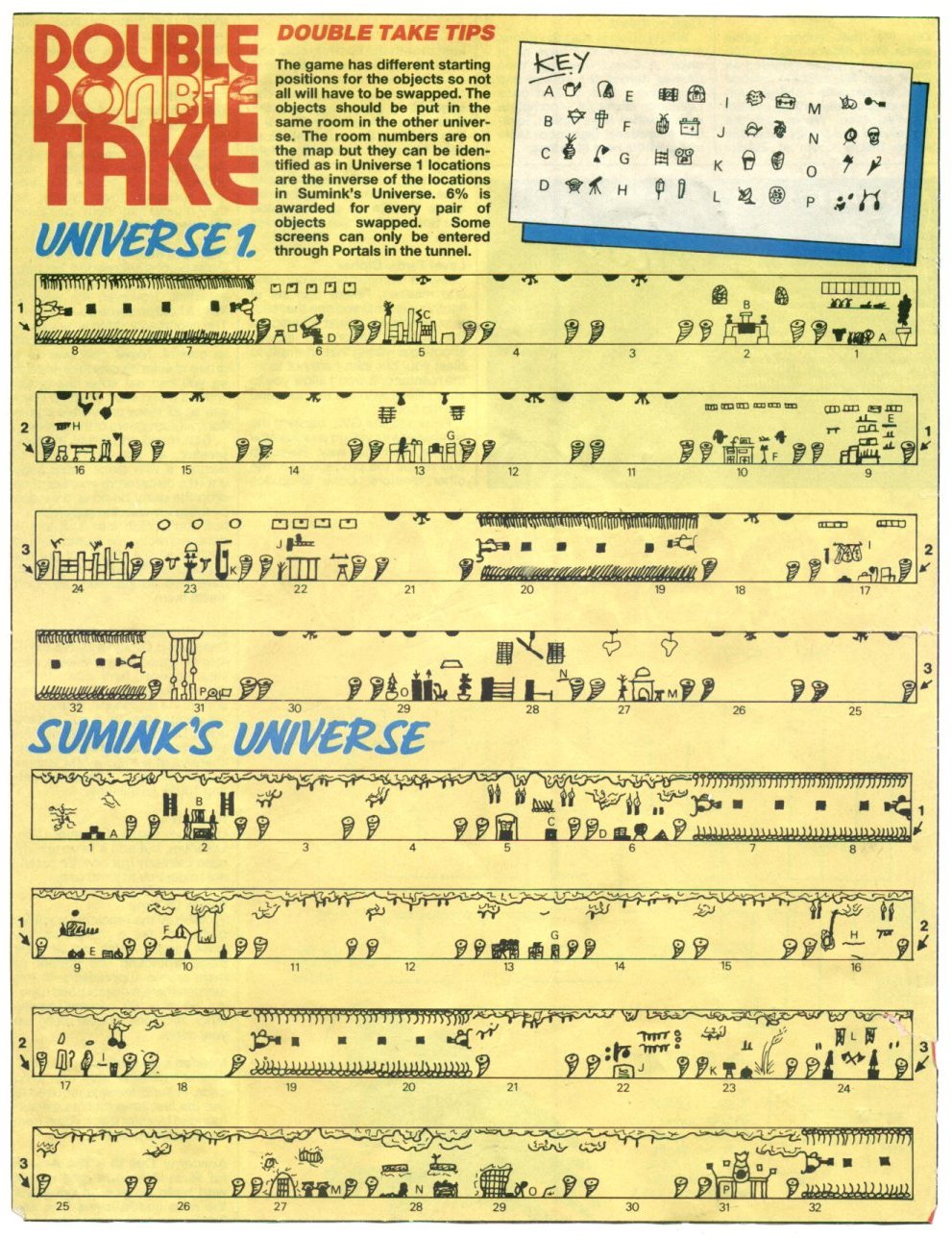
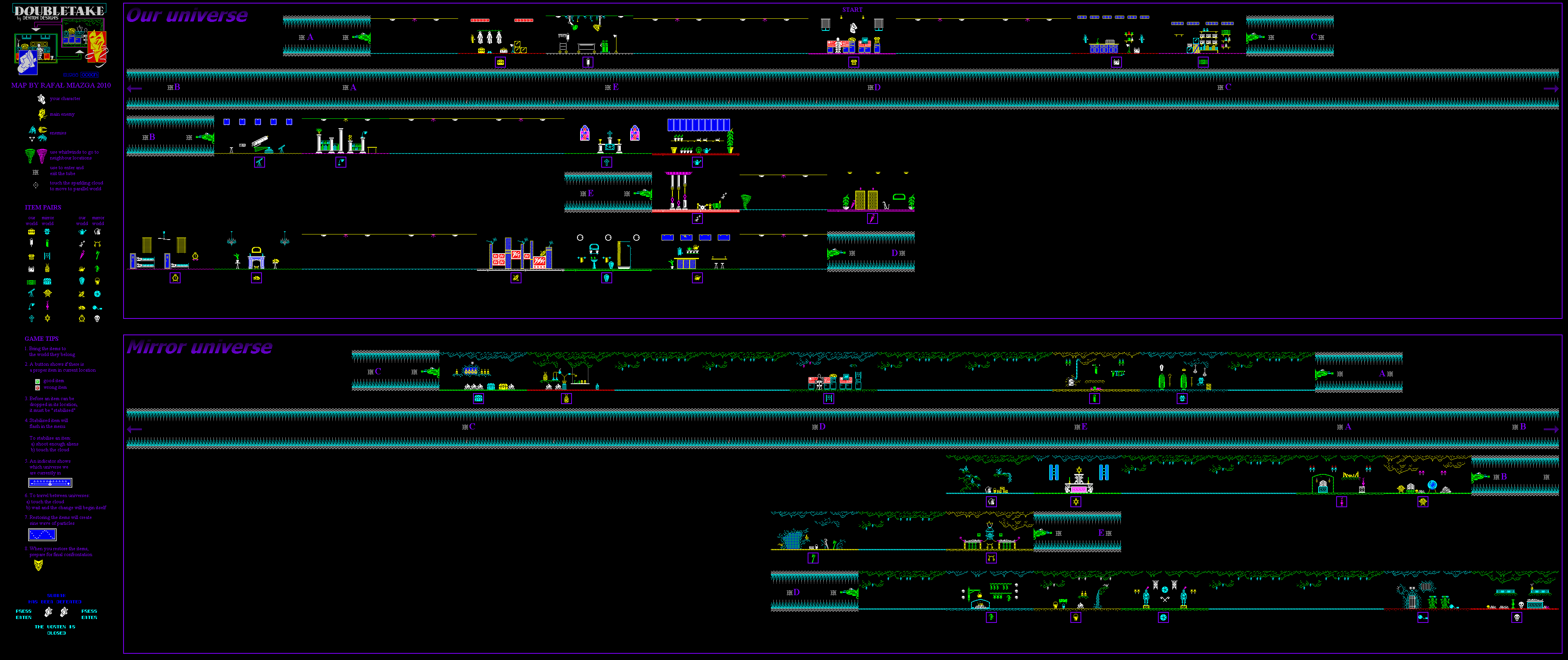
- Crash #39Apr 1987 · p.64
Tips1
- Crash #39Apr 1987 · p.64
Review1
- MicroHobby #121Mar 1987 · p.12
Related
- Ports
- (Commodore 64)
- Elsewhere
- Speccy Screenshot MapsMobyGamesRZX ArchiveThe TipshopUVLModern ZX-Retro GamingSpectrum Computing RZX - YouTube
- Same entry at
- Spectrum ComputingZXInfo
Reviews from people here
Sign in to write about this, or make an account. It takes a minute and lets you correct the catalogue too.
No description recorded.
Sign in to correct or add to this.
Hold the rights to this and want it taken down?