16/48 Magazine Tape 01
Electronic Magazine · ZX-Spectrum 16K · 1 players · English
Magnetic Magazines Ltd · 1983
Discussion
Nobody has started a thread about this yet.
Documents
- 16-48MagazineTape01.tzx.zipElectronic magazine English27 KB
Files and rights
No permission is on record either way. Screens and pictures are copied here on a take-down basis: if you hold the rights and want something removed, say so and it goes.
Scores
Elsewhere on the web
- WorldOfSpectrum 2 votes8.50
In the magazines 21
Crash #9Oct 1984 · p.126
Chris Passey
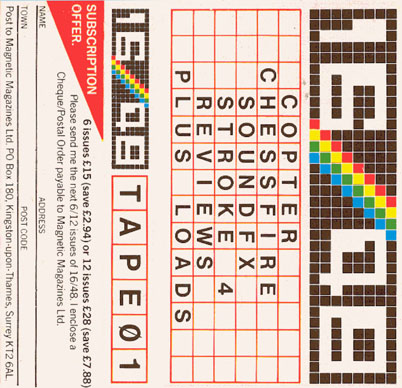
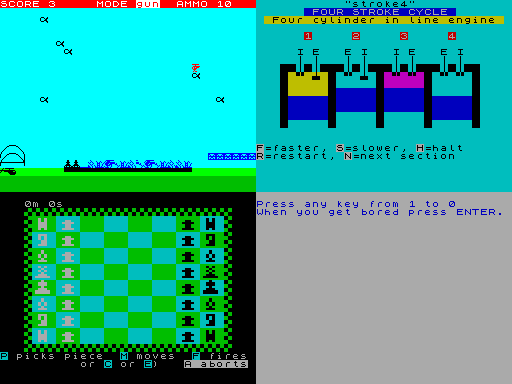
16/48 - THE MAGAZINE ON TAPE Existing technology is often far harder to overturn than Utopia-mongers would like us to think. For many years the early railway carriages continued to resemble the old stage coach carriages of the roads, American philosopher Marshal McLuhan predicted the end of books - in a book. With the advent of teletext, one could be forgiven for thinking that the Radio and TV Times might have had their day - apparently not yet. Equally, the advent of the home computer has offered obvious opportunities for the production of computer magazines presented as software. is it the end of the traditional paper magazine? Chris Passey takes a brief look at 16/48 magazine - the July and August issues (Nos. 9 and 10). 16/48 is a magazine on tape hence, due to its medium, it has certain advantages over the paper magazine and disadvantages. The fact that it costs £2.99 makes it the most expensive computer mag! Is it worth this? Read on... Each issue starts off with a quick look at the month's offerings (helpfully, this is duplicated on the cassette inlay card with space for writing tape counter readings). The contents tend to consist of the following: a couple of games (arcade etc.) editorial and letters, the odd educational program, an adventure plus adventure tips, machine code routines, brief reviews and a competition. Don't expect the games to be of CRASH SMASH standard, but some are quite commendable. For example, Elevator in issue 9 is rather original and challenging with nice graphics. The editorial does not cover anywhere near as much as the average paper magazine. The educational games/utilities such as memory games using languages, and lens/ray calculations are fairly decent. Not being much of an adventurer I can only say that the adventure, The Long Way Home, is fairly typical but the 48K version has some excellent graphics. What makes 16/48's adventure interesting is that it is a serial, a natural idea for a magazine like this. The adventure tips are a bit long winded to get at, but quite useful. The machine code routines interested me, some are useful such as the screen magnifier, which I have tried out since. There is also a very good microdrive feature (but I suspect the writers think everyone has microdrive). But now onto the subject of reviews. I found these to be very shallow. They basically say what the object of a game is with a very brief sort of opinion. There appear to be only about two per issue, but the screen pictures are the best I've ever seen - they are screen pictures! I found that on each tape there were programs that interested me and there were those that did not. This meant that to get to a required bit I had to guess where it was (no tape counter). This can become a major drawback - access. It's easy to have a quick flick through a paper magazine over breakfast, but 16/48 has to be loaded. Therefore it's not like a real magazine that you can pick up and read at leisure. On the other hand because it is loaded you don't have to type in listings (if anyone still does)! It's unlikely that you will be interested by every program in each issue of 16/48, so it's really up to the individual to decide whether it's worth the tag of £2.99 (I mean - can you see hardened arcaders playing Yahtzee)? For up to date news/views or reviews the paper mag is still 'tops'; but if you want a varied package as mentioned here, then it may well be of interest to you (and it'll be fun to see how well this review holds up in ten years time)! 16/48 magazine is published by 16/48 Magazine Ltd., [redacted], monthly from all good news retail outlets, price £2.99.
Your Spectrum #1Jan 1984 · p.11
Roger Munford
BATTLE OF THE TAPES Noticed anything different at the local newsagent lately? No, not the cleaned-up covers on the adult "nasties' - the mini-revolution we're looking at here is the fairly recent birth of the machine-dependent computer software magazine. Two publications are vying for position in the prestigious 'computer publications' market. Both are priced at £2.99 and designed to run on the 16/48K Spectrum models. First on the market was Spectrum Computing, edited by Iolo Davidson and one of the newer titles to emerge from the Argus Specialist Publications stable. But coinciding with the third issue came a rival in the shape of a package called 16/48 from Magnetic Magazines and edited anonymously. With the simple instruction to LOAD both 'magazines' load a portion of their contents and when you've had enough of that bit, you simply press whatever keys are necessary, turn the tape back to play - and the next section of code then begins loading. Spectrum Computing, being three issues young, has the advantage over 16/48 in that its audience (readers?) are already used to the format and are beginning to respond to the editor. This is made obvious by the wittily written and informative editorial and the inclusion of three letters which constitute the equivalent of a 'letters page'. 16/48, by comparison, has rather overdone the 'technology' bit with phrases like "Home computing has come of age" and the ambiguous "Machine readability is all". The last statement is especially confusing when you notice that the text comprises a new graphics set made up of robotic-type characters - not the most legible for sifting through pages of on-screen text. Both cassettes contain a couple of games programs, which while not arcade standard will certainly provide a degree of enjoyment. More interesting, though, are the routines. These are either accessed by breaking into the tape and LISTing or are included as features of the contents. Whichever way presented, they should be useful to the average programmer. Reviews have been included on both tapes, software in the case of Spectrum Computing and hardware in 16/48. Iolo has employed a nice technique to format his reviews. Each critique lasts for three pages (preventing too much eyestrain) and at any time you can press a key to see a 'frozen' image of the game in question. 16/48, on the other hand, has plumped for reviews of the dK'troniks light pen and RD Laboratories' digital tracer. These are simply text, followed by a high resolution illustration showing what the devices are capable of. Both cassettes are obviously heavily influenced by the traditional magazine format, and as such have managed the transition to magnetic tape with surprising ease. Contents pages, "next month' pages and mini-adverts are to be found, as well a rather interesting competition in the case of 16/48. Contestants are asked to write "the most amazing animation ever seen in a magazine". Sounds easy enough! What, one might ask, will the winners receive for this major programming feat - answer, a digital tracer or light pen (better quickly check the review on side one). However exciting the editors would have us believe their products are, with so much professional Spectrum software now starting to achieve such high standards, any tape magazine that falls far short will do so at its own peril. And reading between the lines of the editorial in Spectrum Computing, it would seem as if many of the readers are baffled as to how to access the many and wondrous routines available. And talking of problems, although our copy of Spectrum Computing loaded, the second side of 16/48 did not. Should you have the same problem, you might try loading the first program on side one, typing NEW to clear all but the UDGs above RAMTOP. and then trying side two again. Overall, although these packages seemed relatively easy to load, the fact is that computer cassettes do not have the same kind of reliable reputation granted to audio cassettes. This is a new field of publishing, and a brave attempt to cash in on the information technology era. But the question is whether the idea of a magazine which demands you sit in front of the TV (especially with the advent of possible program broadcasting via cable) is one which will catch on. However the publishers may describe their respective packages, it's obvious that products such as these are not really magazines in the generally accepted sense. One wonders why they slavishly set out to emulate their paper peers, when it seems more sense to create some new approach - one that better suits the electronic resources available. Answers on a postcard please...
Full-page ad11
- Sinclair User #43Oct 1985 · p.42
- Crash #21Oct 1985 · p.93
- Your Spectrum #7Sep 1984 · p.66
- Your Spectrum #2Mar 1984 · p.82
- Sinclair User #23Feb 1984 · p.137
- Popular Computing Weekly #2Jan 1984 · p.12
- Sinclair User #21Dec 1983 · p.46
- Popular Computing Weekly #46Nov 1983 · p.40
- Popular Computing Weekly #40Oct 1983 · p.8
- Home Computing Weekly #31Oct 1983 · p.47
- Sinclair User #19Oct 1983 · p.81
Advert6
- Your Spectrum #4Jun 1984 · p.66
- Your Spectrum #3May 1984 · p.23
- Sinclair User #26May 1984 · p.114
- Popular Computing Weekly #20May 1984 · p.48
- Popular Computing Weekly #16Apr 1984 · p.36
- Popular Computing Weekly #14Apr 1984 · p.25
Feature1
- Crash #18Jul 1985 · p.108
News/Note1
- Your Spectrum #1Jan 1984 · p.11
Contains
Related
- Elsewhere
- Centre for Computing History
- Same entry at
- Spectrum ComputingZXInfo
Reviews from people here
Sign in to write about this, or make an account. It takes a minute and lets you correct the catalogue too.
No credit, description recorded.
Sign in to correct or add to this.
Hold the rights to this and want it taken down?