
Dungeon Dare + Classroom Chaos
Compilation · ZX-Spectrum 48K · 1 players · English
Central Solutions · 1986 · Pound sterling 3.99

Discussion
Nobody has started a thread about this yet.
Play
- DungeonDare+ClassroomChaos.tzx.zipTape image English17 KB
Files and rights
No permission is on record either way. Screens and pictures are copied here on a take-down basis: if you hold the rights and want something removed, say so and it goes.
Scores
In the magazines
- Your Sinclair #31986 · Overall4/10
- Crash #281986 · Overall7/10
In the magazines 2
Crash #28May 1986 · p.958/107/107/107/107/107/10
Atmosphere 8/10
Vocabulary 7/10
Logic 7/10
Addictive Quality 7/10
Overall 7/10
Derek Brewster 7/10
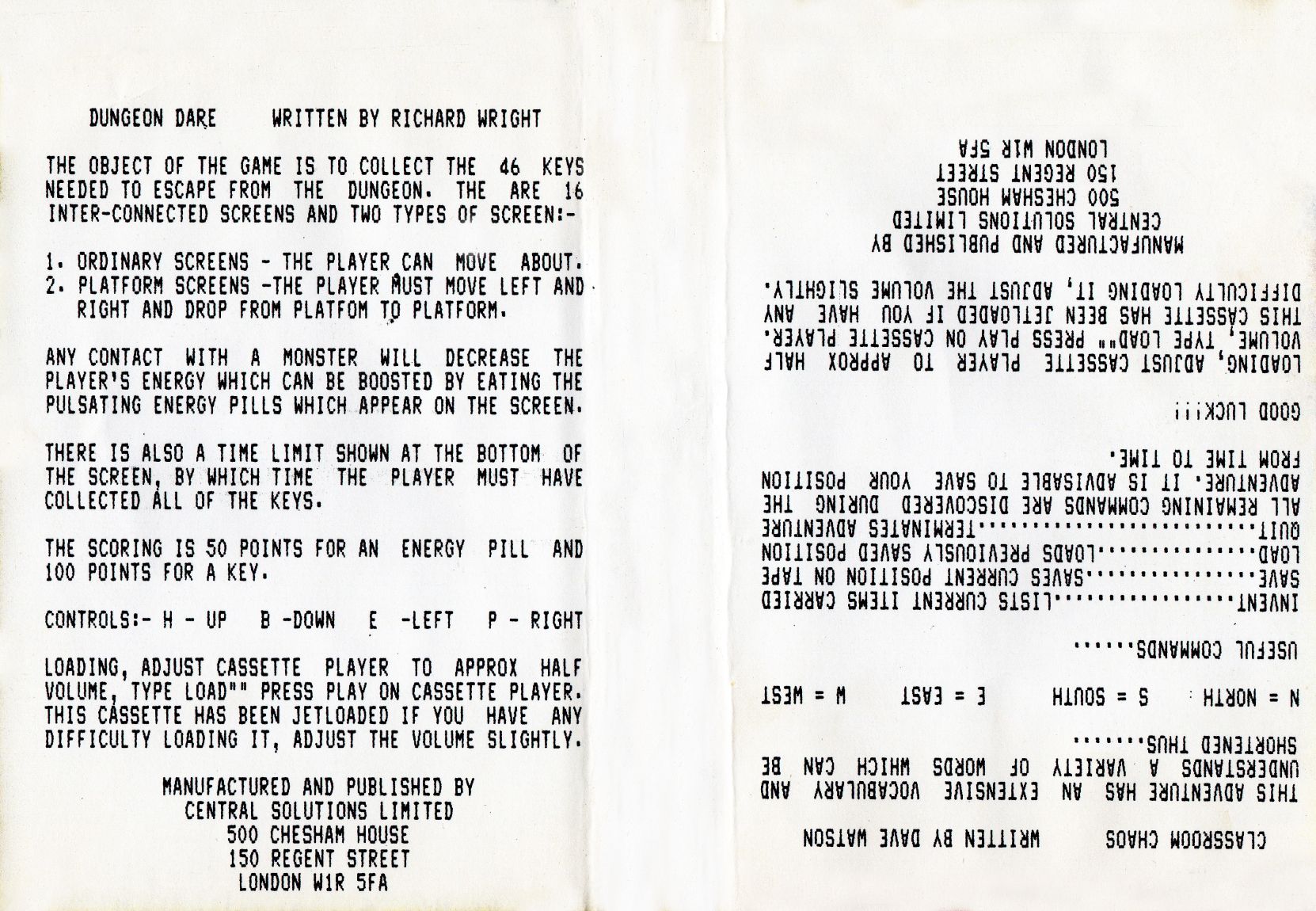
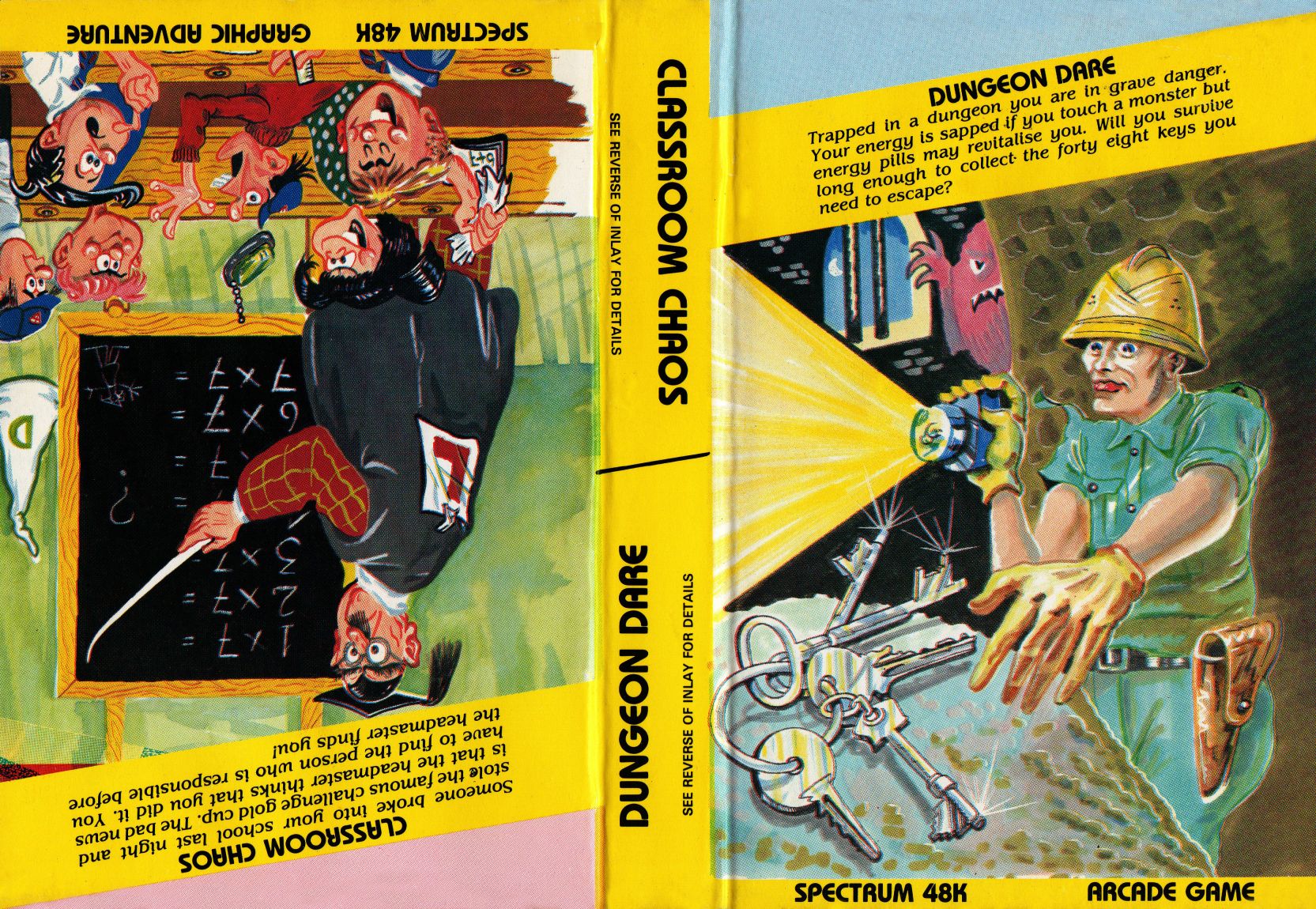
DEREK BREWSTER'S ADVENTURE TRAIL IS THE PRICE RIGHT? As has often been said before, the games software world has much in common with the music industry. Leaving aside the connoisseur's direct metal mastered LP discs, and the new technology-priced compact discs, the popular music LP has found its pricing niche in the £4-16 range. Above the six pounds mark the product begins to meet consumer resistance: within the mind of every potential pop purchaser is a set of scales which comes out with a value-for-money readout working on the figures of pocket money/disposable income and the real worth of bass guitars, leads, snares and high-hats syncopated into some sort of harmony. In case, as a young pop consumer, you think the above pretty obvious, it might be worth putting a historical perspective on this by pointing out the LPs dogged persistence for keeping its token value pegged at the £5 mark since 1976, a date from which inflation spring-boarded. This pegging of the price was not done without some modifications and cost-cutting, most noticably a thinning of the plastic and a reduction in quality which meant people like myself buying three records at a time in the sure knowledge that at least one of them would be a bad pressing. Now let's have a look at what's been happening in software in 1985. Figures show that Spectrum software sales are way ahead of those for Commodore, The BBC and C16 markets are much smaller than the two big boys but are significant, while the third biggest, Amstrad, is continuing to improve and catch up. The most successful company in terms of units sold was Mastertronic followed by US Gold and Ocean. Since US Gold and Ocean are in reality the same stable you might take them combined to be the greatest force in software. Mastertronic are famed for their cheap software selling in newsagents and petrol stations, though their £2.99 range has recently appeared in the high street multiple stores and is fast gaining a respectability previously thought beyond the budget game. The US Gold and Ocean group are famed for their top quality games selling at the seven and eight pounds mark. To confuse matters, rumours abound of both groups each planning to release games in the other's domain. A software house makes far less profit, after paying product costs and royalties, on a cheap game when compared to the margin on a full-priced product. A cheap game has to sell eight to nine times more to make the same profit as a full-priced game. But the more expensive game needs advertising and involves a greater risk - kids aren't going to part with eight pounds on a whim. Clearly there are many pros and cons to full- and budget-priced software but what I'd like to suggest is a price for software which will encourage both high consumer sales (with reduced copying), and quality programs. This figure I believe is somewhere around the five pounds mark, much the same as record prices. CLASSROOM CHAOS/DUNGEON DARE Producer: Central Solutions Retail Price: £3.99 Author: Dave Watson, Richard Wright If for no other reason this software is notable for its price; somewhere between the real cheapie at £1.99 and the full blown effort clocking in around the seven or eight pounds mark. It offers a graphic adventure on one side and a very simple arcade on the other. Neither are of particularly high quality and I would have thought that both could have been offered for a sum slightly less than that asked for. The adventure is reasonably interesting due mainly to its theme - schools are naturally amusing and the average school day is familiar to everyone. You kick off on a rugby field following a very simple intro tune. East takes you to a cricket pitch and west takes you somewhere completely different; so much for mapability, or is it trying to recreate that sense of being lost which is part of all school careers until sense begins to surface around fifth form? At the first stairwell loopy Mr Hollyhock rushes up to tell you of some great news. He's just seen a Gatekeeper and is offering £1 to the pupil who can catch it. Now a Gatekeeper is not the school janitor. No, it turns out to be any of several Eurasian butterflies of the genus Pyronia especially a species having brown-bordered orange wings with a black-white eyespot on each forewing. I see. Before you can get into the act of getting the butterfly you will no doubt be accosted by some pain-in-the-neck like Mrs Birch who will pose some incredibly difficult question like 'When was the battle of Bannockburn'? The teacher looks pretty angry so you shoot out the answer which is... errrr.., exactly. You're given four attempts at the impossible after which you are slung into the adjustment unit where time seems to stand still and so does the program for a few moments. On your return to the game proper the program rather cleverly insists that you answer this same question rather than some other like 'Who painted the Laughing Cavalier'? It's about now when you decide to get up from the computer and dig out an encyclopaedia to find out all about the battle where Robert the Bruce won a famous victory over the English. The usual batch of loopy eccentrics who pass as schoolteachers inhabit this school. In addition to the curiously academic Mrs Birch there's the daft Mr Puce who mutters 'Heh man, I just got to get some flowers' into my 'still-life' and a Miss Curvey who says 'Non intres in judicium cum servo tuo, Domine'. Even uneducated types will immediately jump to some crude translation like 'I' ll spare you detention if you get out' like what I did with the help of my Latin made slightly less difficult and obscure book. Meanwhile George the Janitor is forever asking for his shovel and Swotty Noall, the brainiest girl in the school, asks 'Hi stupid, got any sweets?' The arcade game on the flipside is called Dungeon Dare where the object of the game is to collect 46 keys scattered about a dungeon. Your energy is sapped if you go too near or touch a monster but energy pills revitalise you. Some screens of the dungeon allow left, right and up and down movements while the platform screens allow left and right only. The curious mixture of four-directional and platform screens can be confusing at first. You are given three lives, an energy bar to show how near death you are, and time and score. As arcade games go this one is very simple, which is not necessarily a bad thing, and it does at least have smoothly scrolling sprites which is more than I can say about another arcade type game reviewed his month. Classroom Chaos I found to be a very entertaining adventure. Its theme is a pleasant and refreshing change to monsterbashing and it creates a believable caricature of a school. It uses the Spectrum character set (both capital and lower case) and has a glaring white background on a colour TV but overall the presentation is lively and colourful. Not bad for £3.99. COMMENTS Difficulty: moderate to easy Graphics: small, rudimentary but effective Presentation: fair Input facility: verb/noun Response: Quill
Your Sinclair #3Mar 1986 · p.192/104/104/104/104/104/10
Graphics 2/10
Playability 4/10
Value For Money 4/10
Addictiveness 4/10
Overall 4/10
Rick Robson 4/10
Central Solutions £3.99 Reviewer: Rick Robson A double-sider of dubious quality from Central Solutions. It might have you in two minds - bin it or swop it! Dungeon Dare's not a bad little mixture of platform and maze arcade. But a dose of sound effects don't cover up the dearth of imagination involved in the program. Basically you're an explorer trapped in a dungeon, except the graphics prefer to show you as a green blobby thing. You wander in and out of rooms spread over sixteen screens collecting the 38 (or is it 46 - they can't make up their minds) keys necessary to escape. Along your merry way mind the monsters and munch the energy pills - energy loss is a big enemy. The little buggies have a constant horizontal/vertical motion so it doesn't take long to learn how to evade them. Not for the experienced gamer - though I must admit games like this can have a mesmeric hold. And the tape'd be better without Classroom Chaos - a graphic adventure of such monumental boringdomness that any school lesson would seem thrilling in comparison. The school's Gold Cup has been stolen (the bell was the only thing that went at our school) and the head thinks it was you. The game bears no relationship to the crop of school goodies like Skool Daze and Mikie out at the moment - but is designed for goody-goodies, toadies and anoraks, which of course no self-respecting Speccy owner would claim to be. People like that own BBC's.
Contains
Related
- Same entry at
- Spectrum ComputingZXInfo
Reviews from people here
Sign in to write about this, or make an account. It takes a minute and lets you correct the catalogue too.
No credit, description recorded.
Sign in to correct or add to this.
Hold the rights to this and want it taken down?