
Earthlight
Arcade Game: Shoot-em-up · ZX-Spectrum 48K/128K · 1 players · English
Firebird Software Ltd · 1988 · Pound sterling 7.95
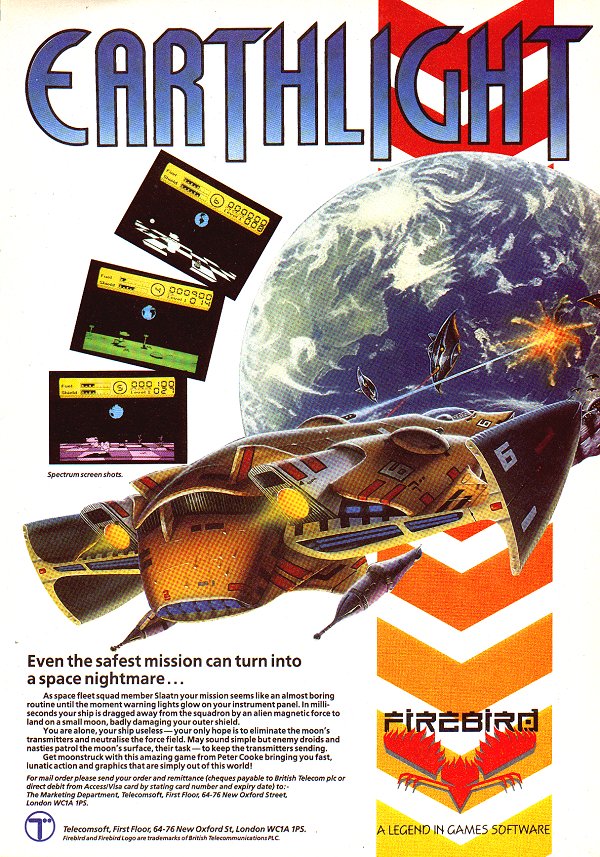
.jpg)
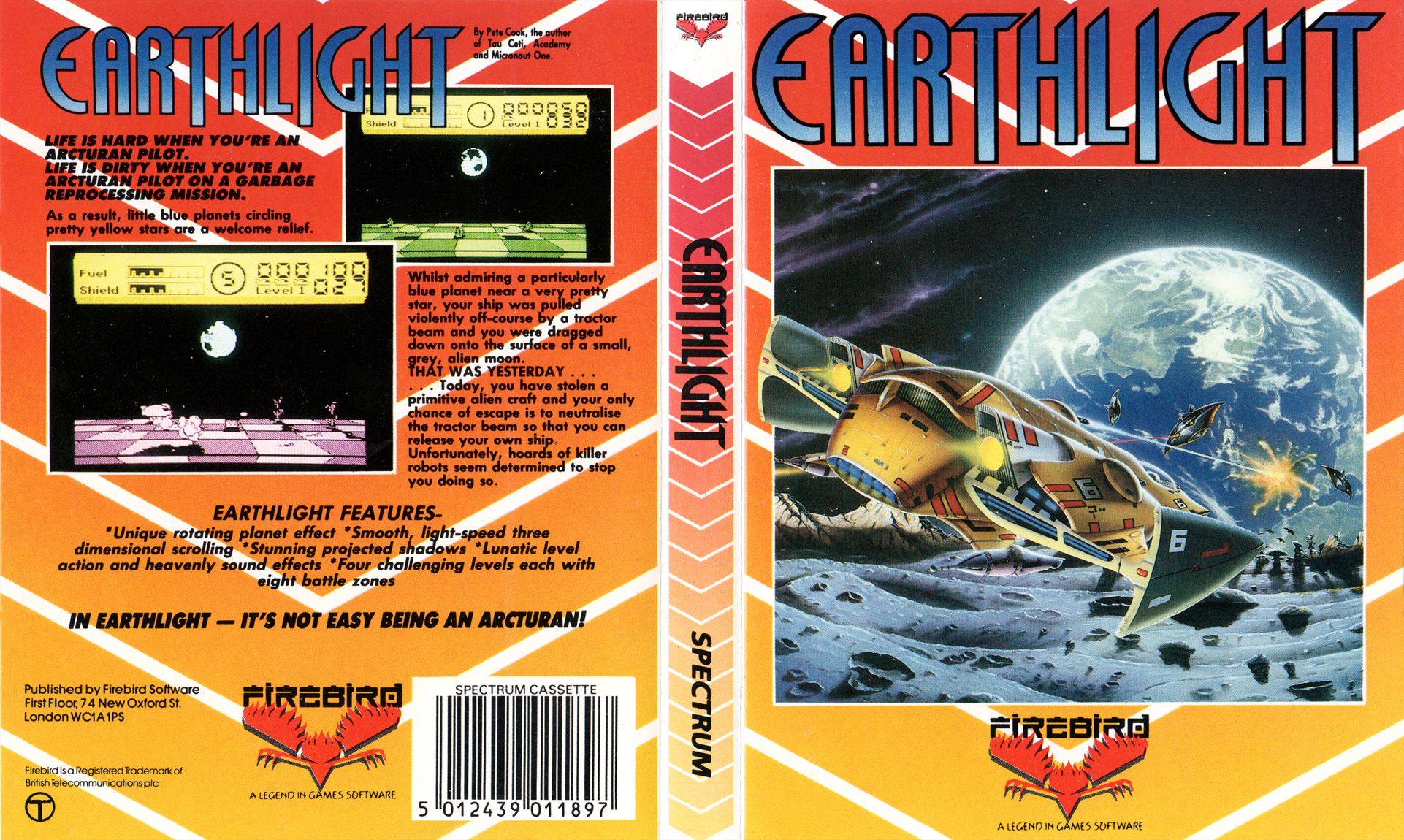
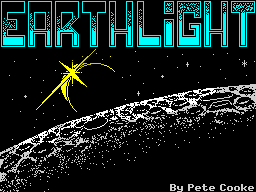
Discussion
Nobody has started a thread about this yet.
Music References
Includes the following music: [128K] Antonio Vivaldi, The Four Seasons, Concerto No. 3 in F Major RV 293 "Autumn", I. Allegro
- Control Option
- Cursor, Interface 2 (right), Kempston Joystick, Redefineable keys
Releases
- 1988Firebird Software LtdPound sterling 7.95
- 1988MCM Software S.A.
Play
- earthlight.rzxRZX playback file
- Earthlight.tzx.zipTape image English76 KB
- Earthlight128.tap.zipTape image English40 KB
- Earthlight48.tap.zipTape image English26 KB
- Earthlight(MCMSoftwareS.A.).tzx.zipTape image English77 KB
Documents
- Earthlight.txtInstructions English2 KB
- Earthlight(MCMSoftwareS.A.).pdfInstructions Spanish8 KB
- Earthlight(EN).pdfInstructions English124 KB
Other files
- Earthlight (1988)(Firebird Software).pokPOK pokes file 0 KB
Files and rights
Distribution permission is on record, granted to another archive rather than to this one. Screens and pictures are copied here; everything else links to the archive that holds it.
- AllowedFirebird Software Ltd → WorldOfSpectrum
Credits
- Pete Cookecredited
- Ian Ellerycredited
Sign in to credit somebody, or say what these people did.
Awards
- Crash SmashCrash53 · 1988
Scores
In the magazines
- Sinclair User #741988 · Overall8/10
- Your Sinclair #311988 · Overall8/10
- Crash #531988 · Overall90%
- ACE (Advanced Computer Entertainment) #101988 · Ace Rating725/1000
- The Games Machine #81988 · Overall81%
Elsewhere on the web
- WorldOfSpectrum 30 votes8.07
In the magazines 22
The Games Machine #8Jul 1988 · p.5281%
Overall 81%
Spectrum 48/128 Cassette: £7.95 LOONY ESCAPADES Pete Cooke, author of Earth Light needs little introduction. Tau Ceti, Academy and Micronaut One have all been big hits which have pushed the Spectrum to new limits. Having moved from CRL to Firebird via the now defunct Nexus, Cooke shows no sign of having lost his innovative approach to the Spectrum. A squadron of the Arcturan Space Fleet was on routine mission, collecting intergalactic garbage for zumtum reprocessing, when an inconsequential blue/green planet caught its attention. Despite the primitive nature of the planet's civilisation, the fleet's Commander fell it was suitable for joining the Arcturan Federation of Lesser Beings. However as the fleet approached the planet it suddenly came under attack from a strange force based on the planet's moon. One by one the fleet's ships were dragged down and smashed on the harsh lunar landscape. Some planets, it seems, are so paranoid they just have no sense of hospitality... Yet miraculously one lonely, and very average Arcturan survived. His name was Slaatn and before he could be as mercilessly murdered as the rest of his comrades, he managed to steal an alien ship. To escape from the moon he must disable all the force field generators. These box-shaped objects are scattered over four levels, each with eight zones to be played in any order to complete the level. At the start of each zone mission there's an opportunity to rebalance your payload of fuel, shield power and missiles - increasing one automatically decreases the others. This can be very important because in some zones there's a lot of boxes and few robots, making fuel crucial, while in others missiles and shields are vital. There's no way of telling prior to starting a zone what it is like, but zones can be aborted at any time, losing only the point score for that zone and not the game as a whole. This ability obviously makes deaths easier to avoid, but the game remains very tough since each zone still must be played to the finish without loss of life - which resets the zone. LETHAL ROBOTS When the mission begins, the ship rests on a launch plinth and pressing up causes it to rotate as if unscrewing before coming under control. After all the boxes have been collected, the ship returns to its plinth to complete the level - or before then merely receive information on the number of boxes and robots remaining in the zone. Unfortunately the tricky nature of docking, and especially the second or so it takes to rotate down can make the ship unduly vulnerable to enemy attack. Each zone's landscape, illuminated by the earth rotating above, recedes in convincing 3-D to a not-too distant horizon. Four horizontal grid lines usually (not all zones have them) provide helpful points of reference as the saucer-like ship moves into the distance, shrinking as it does so. The gridlines are particularly useful for judging the position of various tree-like structures and fatally rock mounds, though the latter can be flown over simply by increasing height. More active opposition to your quest is provided by various robots. The dumber ones simply move into and out of the landscape, like moving gates, while slightly more intelligent robots guard boxes by rotating around them. The most lethal robots are the homing kamikaze type which have to be shot. Most robots automatically alter height to attack your ship. Collisions cause the ship to spin to the ground and lose shield power, but while spinning the ship can still be hit by other robots - both frustrating and fatal. When the shield is exhausted a life is lost and all boxes collected in the zone are returned to their original positions.
Slaatn bounces off a piece of scenery in his attempt to find all the gravity boxes located on the moon.
"...a compelling challenge, if not quite in the Tau Ceti class.,"
OTHER FORMATS Pete Cooke's big arcade games have all been converted for most popular formats, and we expect this to be the same, however, there's no new of other formats yet.
Your Sinclair #31Jul 1988 · p.469/108/108/108/108/108/10
Graphics 9/10
Playability 8/10
Value For Money 8/10
Addictiveness 8/10
Overall 8/10
Jonathan Davies 8/10
Firebird £7.95 Reviewer: Jonathan Davies When the latest offering from Pete Cooke, the man who wrote everything from Urban Upstart to Micronaut One lands on your desk, you'd better sit up and pay attention. Done that? Right, here's what it's all about. Slaatn from Arcturus II has problems, not least of which is that unfortunately un-pronouncable name he's been lumbered with. More pressing, though, is that as the Arturan battle fleet (of which Slazzer's a member), was on its way to befriend the Earth, it was seized by a strange force. They started to be dragged towards the planet, and while the majority of them managed to blast to freedom, our hero crash-landed on the moon. As is usual in these situations, rather than hang around and admire the scenery, Slaatn wants to get the hell out. Far from easy, especially as before he can escape he'll have to nobble the transmitters which are holding the ship down. These are scattered around several Earth bases, each guarded by a bunch of robotic heavies. The game gets off to a good start, with a nice bitta Vivaldi to set the scene and hundreds of options and sub-options for people who enjoy tweaking things. After fiddling with these to your heart's content, inevitably ending up with them the same way as when you started, you launch into the first of four levels. These are each broken up into eight zones, which you may play in any order you wish. Although Mr Cooke's games have always ranked highly playability-wise, he's tended to concentrate on graphical innovation to impress the socks off the public. Earthlight follows this tradition, in that while they may not look terribly original to the casual onlooker, the graphics feature a number of very novel touches. The surface of the moon (covered in chequered lino for some reason), scrolls along at the bottom of the screen, with the earth gyrating majestically above. (Ooh - what poetry!) This causes shadows to be cast by the various blobs that litter the ground, which change according to their position in relation to the sun. Quite clever really, as the blurb goes to great lengths to point out. Your ship blasts off from its pad, and by careful manipulation of the keys (all re-definable, of course), you can get it to whizz up, down, left, right and also in and out of the screen, dodging the droids as they come in for the attack. Fortunately you've got plenty of missiles to chuck around, which are selected at the expense of shields and fuel before you start. Aim carefully, and you should find it fairly easy to dismiss the foe before they do you too much damage. Some chase you around, while others follow set patterns (these are often the hardest to get past, especially if you've run out of missiles). If you're wondering where all the depth we've been accustomed to in these games has gone, well there isn't much. For a change it's more or less a pure blaster, with no maps to make, puzzles to solve or other such strenuous activities. As long as you get the right balance of fuel and weapons at the beginning, your blood-thirsty instincts can then take over. The overall impression I got is one of neatness. Nice tidy menu screens, well-spoken sprites and not a misplaced pixel in sight. Even things like the character set are polite, discrete, but do their job with a subtle smattering of finesse. Polished! I could practically see me face in it, as the nurses in the local intensive care ward will tell you. I would've said that a touch more variety could have been incorporated, but Earthlight still kept me absorbed for hours. The plight of Slaatn can't be ignored until he's off that moon and safely back with his Arcturan chums, and I'm darned well going to do my best to help him. Although not quite as inspired an effort as the author's previous works, Earthlight is an enjoyable romp among the craters of our satellite. What are you waiting for? The Federation of Arcturus II needs you!
Ah ha! Not a dreadful Scandinavian pop group, but an exclamation of surprise, meaning that those little boxes on the ground are the transmitters we're after. They should be easy to pick up too, 'cos I've already zapped all the aliens on this level. (Admittedly by crashing into them, hem hem!)
We've just blasted off from our dinky little launch pad, and already the aliens are on our tail. Sensors indicate that we've got a full complement of missiles, fuel and shields on board, so either I'm extremely good at this, or we've only just started the game. Guess which!
ACE (Advanced Computer Entertainment) #10Jul 1988 · p.639/108/103/107/10725/1000725/1000
ACE (Advanced Computer Entertainment)
Graphics 9/10
Audio 8/10
IQ Factor 3/10
Fun Factor 7/10
Ace Rating 725/1000
Andy Smith 725/1000
Firebird would like to fly you to the moon. The moon may not be made of cream cheese but a large portion of the surface would appear to be chequered. That's if Pete Cooke's latest game is anything to go by (Pete's the chap who brought us Tau Ceti, Academy and Micronaut One). In the game you play Slaatn, a common or garden alien who was happily blasting his way through the solar system until his ship was dragged off course and forced to land on the moon. Slaatn's only hope of escape is to disable the moon-based transmitters that made the force field that forced him down in the first place. The game breaks down into four levels, each consisting of eight zones. Each zone contains a set number of transmitters (small boxes on the surface) which the player must pick up with his ship to clear the zone. No problem - simply fly into them. Dodging the surface features - varying in shape and size from telegraph pole-like thingies to craters, plus the various droids - is a problem though The landscape scrolls sideways while your ships stays in the centre of the screen, though you can move it from foreground to background to dodge obstacles. At the start of each zone you can alter the ratios between the ship's fuel, shield strength and ammunition levels. Some zones have the transmitters widely spaced so you'll have to do make do with less ammunition and shield strength for the extra fuel you'll need to reach them and still return. For other zones you'll need plenty of ammo to blast your way through hosts of droids. Earthlight boasts some stunning graphics and sound effects and a big task to complete, but each zone is very much like the last and it soon becomes something of a slog to complete the levels. Reviewer: Andy Smith RELEASE BOX Spec, £7.95cs, Out Now Now other versions planned Predicted Interest Curve 1 min: 70/100 1 hour: 80/100 1 day: 85/100 1 week: 70/100 1 month: 30/100 1 year: 15/100
Zone seven on level one - collect that transmitter (the small box), head for home and you'll have completed a zone.
SPECTRUM VERSION The graphics are first rate, as are the sound effects, and the game plays very well. There's just not enough variety in the zones to keep you going though.
Crash #53Jun 1988 · p.10Crash Smash95%87%92%91%90%90%91%90%
Presentation 95%
Graphics 87%
Playability 92%
Addictive Qualities 91%
Overall 90%
Kati Hamza 90%
Nick Roberts 91%
Paul Sumner 90%
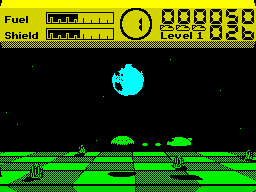
Producer: Firebird Retail Price: £7.95 Author: Pete Cooke Slaatn, an ordinary alien from the planet Acturian, is on a routine intergalactic garbage collecting mission. Suddenly he's drawn off course by a strong sideways force emanating from Earth and is forced to make an unscheduled landing on the moon. Alone and friendless, Slaatn has only one chance of escape: he must neutralise the moon's box-like transmitters and eliminate the offending force field. The mission takes place over four levels, each of which is divided into eight zones to be tackled in any order. The moon's 3-D, horizontally scrolling checker-board surface consists of a series of regular squares pitted with craters, and marked by upright obstacles. The planet earth, rotating in distant space, is clearly visible, and bathes the moon in its eerie glow. Slaatn has managed to steal a saucer-like alien craft which begins each round perched on a hemispherical platform base. Hovering above or skimming along the moon's surface and making use of occasional transporter platforms, Slaatn must collect a specified number of transmitters before returning to base. Alien saucers, spheres and podships do not hesitate to attack. However, Slaatn's ship is equipped with shields, fuel and missiles. Before entering each zone, the player can alter the ratio of these supplies; opting for more fuel, for example, means a reduction in the number of missiles carried. Collision with aliens or obstacles damages shields, and staying too long on the planet's surface inevitably results in a loss of fuel. Should shields fail completely or fuel run, out one of three lives is lost. A status panel at the top of the screen shows shield and fuel panels - which flash when dangerously low - current zone, score, lives left, present level and missiles remaining. Returning to base before all the transmitters have been collected gives an instant breakdown of Slaatn's performance so far, including the number of transmitters still to collect and the number and type of aliens still alive. Once Slaatn has cleared all the zones and returned to base he is whisked onto the next level. The more transmitters he collects the more realistic the possibility of his escape from this dark and dangerous moon becomes. COMMENTS Control keys: Cursor, Kempston, Sinclair Graphics: impressive 3-D effect with realistic shadows Sound: superb 128K title tune. Good spot effects on both versions Options: definable keys, colour/mono, sound on/ off, selectable panel colour, three quarters view off/on, border FX off/on, separate 128K version
Giant steps are what you take...
It's your move.
One lump or two?
Tackling the shoot 'em up from a completely new angle.
Two zones done, but six to go.
Sinclair User #74May 1988 · p.748/108/10
Overall 8/10
Graham Taylor 8/10
Label: Firebird Author: Pete Cooke Price: £7.95 Memory: 48K/128K Joystick: various Reviewer: Graham Taylor Pete Cooke hasn't had much of a time with really. Micronaut 1, whilst a jolly wonderful game, disappeared about the same time Nexus did. Now we have Earthlight - probably the closest thing to a straight zap-'em-up Pete has ever done. It isn't just a shooty-shooty of course. For one thing it's pretty enormous, with lots of different zones and levels. For another, there are quite a few different strategies you can use to win - blasting things to bits being one of the more useful ones. The plot is all about disabling transmitters to switch off a force field which will enable Slaatn (an everyday sort of alien) to escape to freedom. Forget all that stuff and imagine this instead. You've got this wizzy space craft, you have to pick up these sugar cubes, and all these other aliens try to blast you into little pieces. Some aliens can be destroyed by one blast from your photon cannon, others, particularly the nasty quick darty little ones, take two or more. There are several levels and each is divided into nine zones. In each zone there are a number of transmitters (sugar cubes) and a number of aliens. Before entering each level you can adjust ship control levels which represent Shield Power, Energy and Missiles. The problem is that if you have a lot of one item you don't get so much of another. What strategy there is involves getting to know the levels and judging what kind of balance of defences, time and firepower you need. For example, one level is very small (if you figure out what to do SECRET CLUE) but chock full of horrible aliens, therefore you need lotsa missiles and lotsa defences but not so much energy. Graphically the game reminds me of a sort of edge-on Uridium or Ballblazer. The planet surface is a grid drawn in perspective littered with craters. The actual ships are drawn using a variety of different sprite sizes - by flipping ultra-fast between these sprites the illusion of the ship moving 'into the distance' or 'out of the screen' is nicely achieved. There isn't that much to see in the game - later levels have different aliens, but the essential landscape remains the same, or at least similar. But it's fast and pretty slick - controlling the spaceship feels quite a bit like the hurtling around in the Uridium battlecruiser. It's easy to go very fast but it's also get pretty difficult to stop, and you usually end up smashed into a passing tree. (These are tall trees on this moon). The explosions are great! Though as often as not, once your ship has plummeted to the ground you don't get a chance to lift off again before wandering aliens wipe out the rest of your defences. Alien movement patterns are pretty complex and varied. Some just zoom around aimlessly (like Capri drivers). Others just look like they're zooming around aimlessly. They'll full you into a false sense of security and Wammo! Just as you were about to get the last sugar cube it's game over for you. Sound is fairish on 48K but the 128K version plays a pretty nifty version of Vivaldi - a change from the standard electro stuff currently fashionable. I really like Earthlight, I can see that for some people there probably isn't enough variety in the screens, but I reckon it makes up for that in speed and sheer fiendishness. There's just enough strategy to ensure some longevity without it all getting horribly complicated. For zapping purists who don't need too many trappings, just slick effective programming and lotsa speed, this is a winner!
PETE COOKE'S PLAYING TIPS Start on Zone 1 - it's probably the easiest. When you first enter a zone just look around and work out how many sugar cubes there are to pick up - how many aliens etc - then quit the level and reset your ship's configuration. Don't be afraid of abandoning a zone - it is possible to get completely stuck so you can't win. Don't waste bullets - in some cases you will have barely enough to complete the level. Homing aliens are not so bad if you keep your cool - at some point they will be in an exact line with you, BLAST 'EM. Far more dangerous are the randomly moving aliens DON'T LET THESE GET BEHIND YOU!!
PROGRAMMERS Pete Cooke has concentrated on sophisticated arcade games most recently and has produced a number of highly acclaimed titles. Invincible Island (Richard Shepherd), Urban Upstart (Richard Shepherd), Inferno (Richard Shepherd), Ski Star 2000 (Richard Shepherd), Juggernaut (CRL), Tau Ceti (CRL), Room Ten (CRL), Academy (CRL), Micronaut 1 (Nexus)
Hack/Poke5
- Your Sinclair #36Dec 1988 · p.34
- Crash #58Nov 1988 · p.45
- Your Sinclair #35Nov 1988 · p.54
- Your Sinclair #33Sep 1988 · p.42
- YS Smash TipsAug 1988 · p.68
Preview5
- MicroHobby #173Jul 1988 · p.14
- ACE (Advanced Computer Entertainment) #9Jun 1988 · p.21
- Your Sinclair #30Jun 1988 · p.10
- Crash #52May 1988 · p.97
- Sinclair User #66Sep 1987 · p.94
News/Note3
- The Games Machine #6May 1988 · p.18
- ACE (Advanced Computer Entertainment) #4Jan 1988 · p.9
- Sinclair User #69Dec 1987 · p.20
Full-page ad2
- Your Sinclair #30Jun 1988 · p.49
- Crash #53Jun 1988 · p.9
Information1
- SSD-IISep 1999
Review1
- MicroHobby #176Sep 1988 · p.30
Related
Reviews from people here
Sign in to write about this, or make an account. It takes a minute and lets you correct the catalogue too.
Everything ZXDB can hold about this is here.
Sign in to correct or add to this.
Hold the rights to this and want it taken down?