
Eights
Casual Game: Card · ZX-Spectrum 48K · 1 players · English
Atlantis Software Ltd · 1984 · Pound sterling 1.99
.jpg)
Discussion
Nobody has started a thread about this yet.
Releases
- 1984Atlantis Software LtdPound sterling 1.99
- 1984Zafiro Software DivisionSpanish peseta 399.00
- UnknownZ Cobra
Play
- Eights.tzx.zipTape image English12 KB
- Eights.tap.zipTape image English13 KB
Documents
- Eights.txtInstructions English5 KB
- Eights(ZCobra).pdfInstructions Spanish15 KB
Files and rights
No permission is on record either way. Screens and pictures are copied here on a take-down basis: if you hold the rights and want something removed, say so and it goes.
Credits
- David Simoncredited
Sign in to credit somebody, or say what these people did.
Scores
In the magazines
- Crash #91984 · Overall73%
Elsewhere on the web
- WorldOfSpectrum 9 votes7.89
Awards and competitions
Crash Readers Awards 1984
- 1Best Board/Card/Puzzle Game
In the magazines 4
ZX Computing #16Dec 1984 · p.41100%90%90%90%9/109/10
Instructions 100%
Presentation 90%
Addictability 90%
Value 90%
ZXC Factor 9/10
David Harwood 9/10
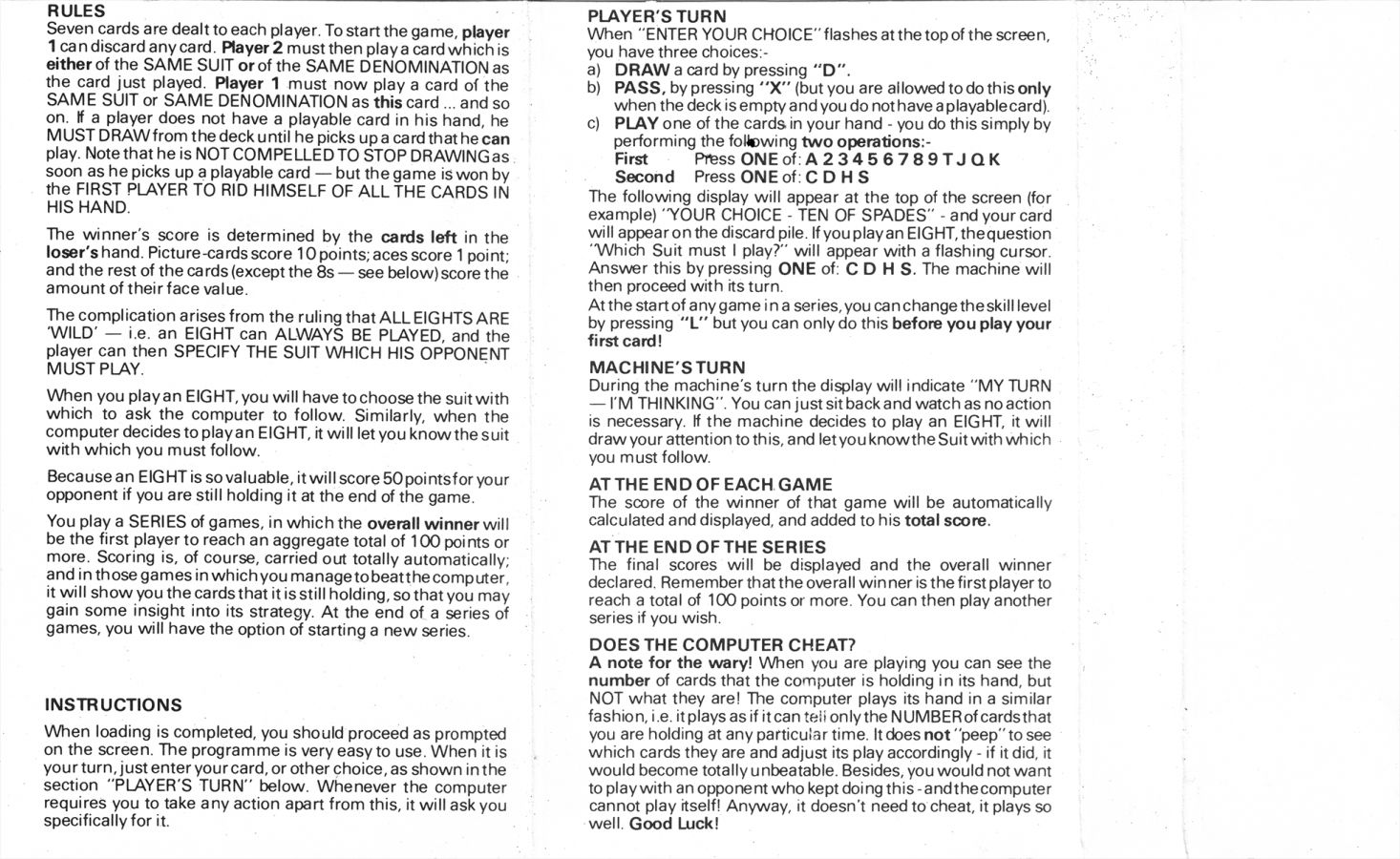
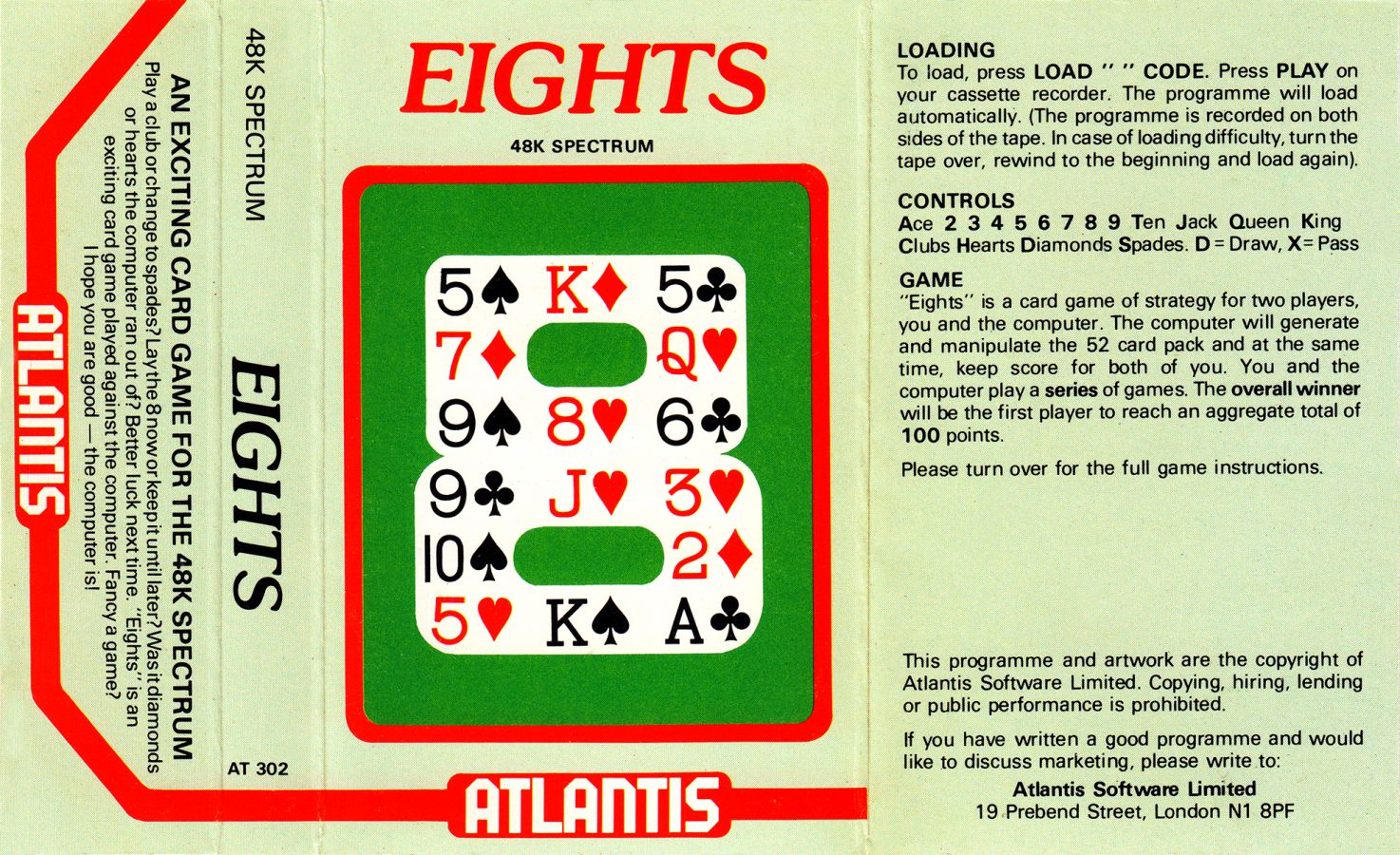
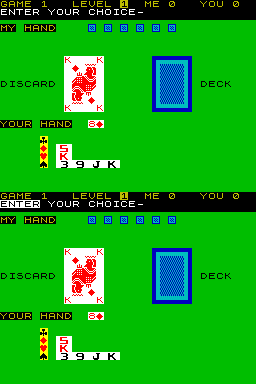
Next, we come to EIGHTS, by ATLANTIS Software and is the only game out of the whole bunch that is not strictly an arcade style game. EIGHTS is an easy to learn card game of strategy for two players - you and the computer. The computer is of course master dealer, scorekeeper and opponent. We are told that the computer does in no way cheat, he just sees how many cards you've got and no further and if he did cheat, he would win every time. He plays too damn well anyway. The game is as follows. Each player has seven cards. Player 1 discards his first card and then player 2 must follow the same suit or denomination as the card just played, if the player cannot go, he must draw cards from the deck until he can, or until no more cards are left, There is no limit to the number of cards that you may draw from the pack, so if you want to cheat... Eights are played as wild, so if you lay down an eight, the suit can be changed so the player can plan out his moves and hopefully get rid of all his cards before his opponent and thus win a round. The score of each round is determined by the value of the cards in the defeated hand, with eights worth 50 points as they are so valuable. The overall winner is the first one to a hundred, but the computer will not give up easily. The simple instructions will enable any anti-card game supporter to reverse his ways and get addicted. On your turn, you enter first of all the value of the card - eg. A for Ace, Q for Queen, 6 for Six etc. and then the suit - H for Hearts, C for Clubs and so on. The computer then checks that this card exists in your hand. If it does then the computer takes his go, and so on. If you cannot go, by simply pressing D you draw a card from the pack or if there are no cards left, X to skip your turn. The played cards are represented in graphic form at the centre of the screen and your hand is shown at the bottom, just detailing the cards. The cards are good, although not as sharp as they could have been and also the suits could have pointed both ways up as in real playing cards and not just upwards as on the screen. Some neat little tricks are included, with BEEPing to remind you that it is your go, the sounds of the shuffling and dealing of the pack and the four levels of play make Eights an exciting and intelligent game that is hard to stop playing once started. The computer plays a skilled game, even at the easiest level. A good buy for any card gamester. The good thing about it is that you don't have to beg somebody to play cards with you - just switch on the computer and TV, get a couple of drinks ready and you're away.
Crash #9Oct 1984 · p.9475%72%68%73%70%80%73%
Use of Computer 75%
Graphics 72%
Playability 68%
Getting Started 73%
Addictive Qualities 70%
Value For Money 80%
Overall 73%
Unknown
Unknown
Unknown
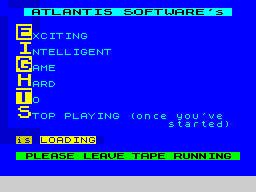
Producer: Atlantis Software Memory Required: 48K Retail Price: £1.99 Language: Machine code Exciting Intelligent Game hard To Stop playing (once you've started) - says the loading screen. That isn't the reason, however, for calling this reasonably well known card game Eights. The game is for one player against the computer. From the standard 52 card pack, the computer deals the player and itself seven cards. The player may decide whether to go first or second. Your seven cards are shown 'face up', the suits in a vertical row and the denominations ranged to the right of them. The remaining cards from the dealer pack remain on the table as a pick up pack. The object of the game is for the first player to lay down a card on the discard pile. The second player must then lay down a card of either the same suit or the same denomination as the first player's card. It is then the turn of the first player to lay down a second card - and so on. If a player has no suitable card he must pick up from the deck, and continue to do so until a useable card is collected. Any card with a denomination of eight is 'wild'. An eight can always be played, and then the player may specify the suit which his opponent must play next. The game continues in this fashion until the deck is finished, with the last cards indicated by a number telling you how many are left. If you cannot go after the deck is finished, you may pass a go and hope to be able to follow next turn. The game ends when one player has got rid of all his cards. The winner's score is determined by the added values of the cards held in the opponent's hand. A series of games are played until one player reaches a total of 100 points, when the scores are displayed for each. The screen layout shows the score lines and information box at the top. This shows the game number, skill level being played (there are 5), scores and entry box showing what is being played to the discard pile. In the playing area the discard pack is shown with the last card played visible, next to it is the pick-up deck. Above are the blank backs of the computer's hand, so you can see how many cards it holds, and below are your cards held in the hand. Entries are made by key press, usually a dual entry such as '6C' for six of clubs. The inlay has a note on the computer cheating, pointing out that the game would be unplayable if it did - so it doesn't! COMMENTS Control keys: denominations use numerics to 9 then T,J,Q,K and A. Other keys are for the suits, C,S,H,D and D is also used to draw with X to pass Use of colour: can't really go wrong, but very nicely used Graphics: sharp, clear, well designed Sound: not much, just warning beeps Skill levels: 5
No King to follow a King, but you do have the Queen of clubs to play.
Feature1
- Crash #12Jan 1985 · p.102
Review1
- Popular Computing Weekly #34Aug 1984 · p.49
Related
- Compilations
- ZX-Spectrum Vega
- Elsewhere
- UVL
- Same entry at
- Spectrum ComputingZXInfo
Reviews from people here
Sign in to write about this, or make an account. It takes a minute and lets you correct the catalogue too.
No description recorded.
Sign in to correct or add to this.
Hold the rights to this and want it taken down?