
E-motion
Puzzle Game: Problem-Solving · ZX-Spectrum 48K/128K · 2 players · English
U.S. Gold Ltd · 1990 · Pound sterling 9.99
.jpg)
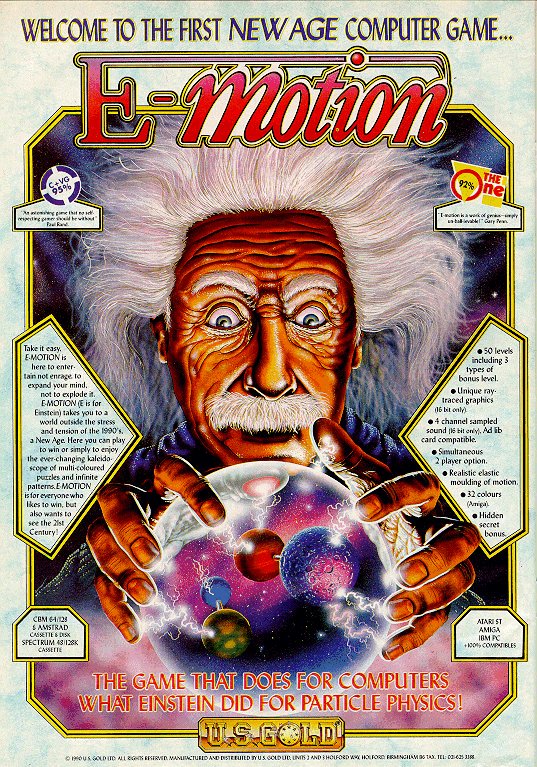
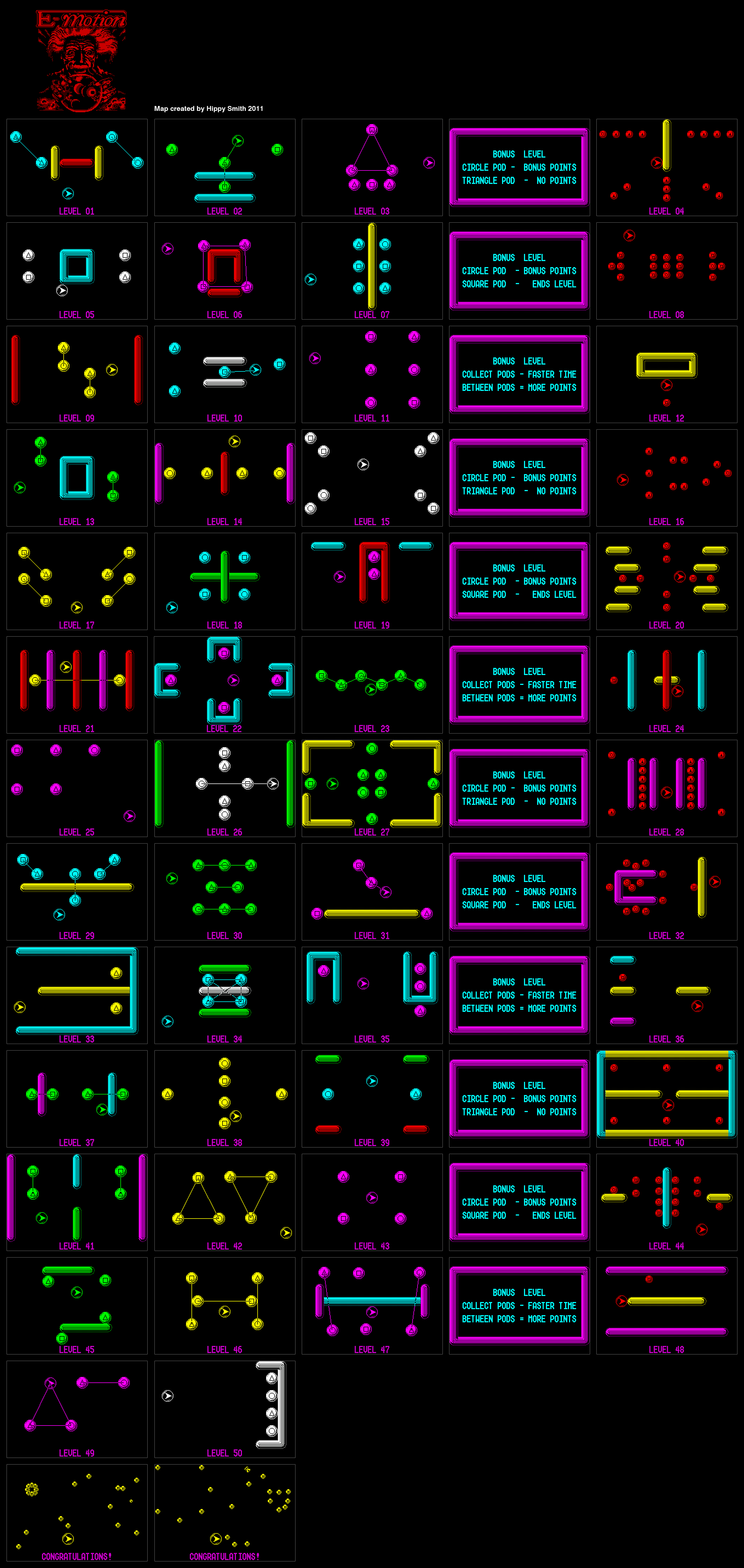
_Back.jpg)
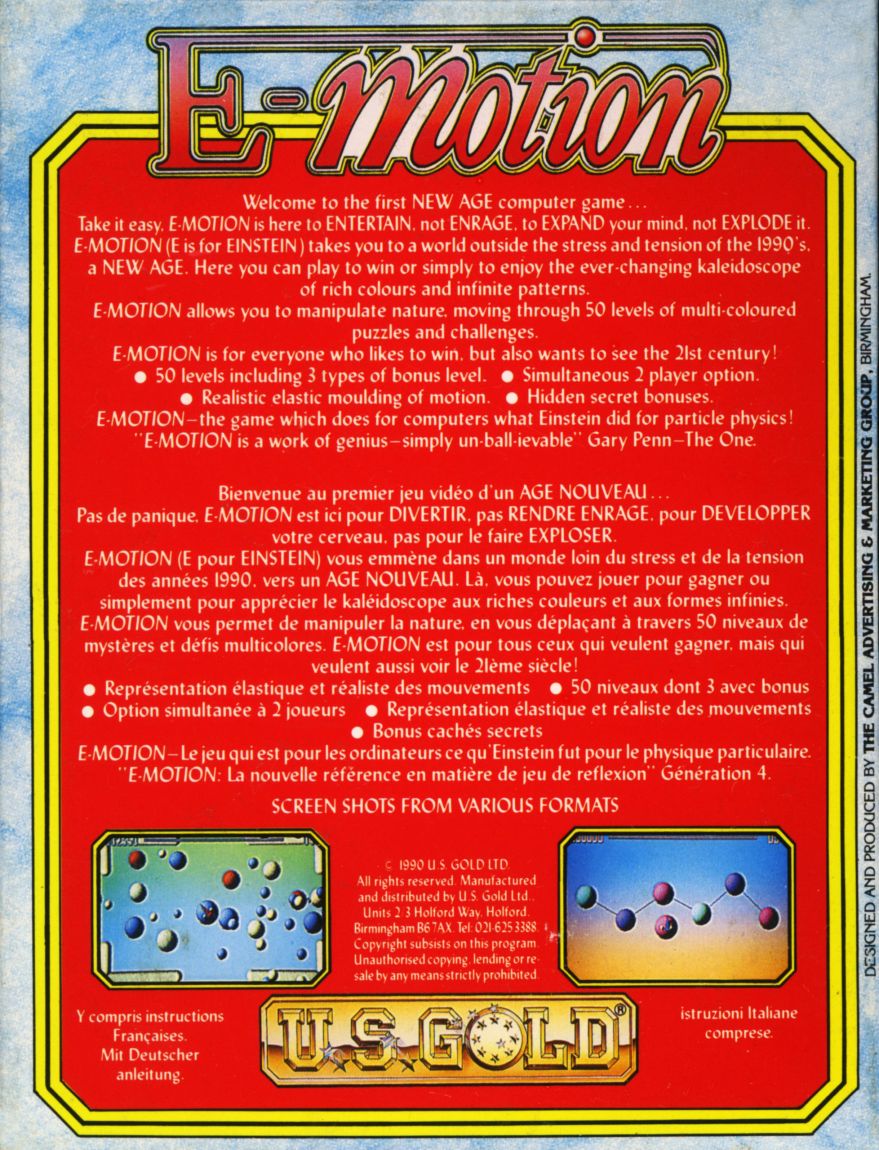
.jpg)
_Front.jpg)


_SideA.jpg)
_SideB.jpg)
Discussion
Nobody has started a thread about this yet.
Remarks
Originally called "Sphericule" until US Gold made a deal with Accolade, and the name was changed to cater to the American market.
- Control Option
- Interface 2 (left), Interface 2 (right), Kempston Joystick
Releases
- 1990U.S. Gold LtdPound sterling 9.99
- 1990Erbe Software S.A.Spanish peseta 1200.00
- 1991Musical 1 S.A.
Play
- E-motion(ErbeSoftwareS.A.).dsk.zipDisk image English26 KB
- emotion.rzxRZX playback file
- E-motion.tzx.zipTape image English93 KB
- E-motion128.tap.zipTape image English29 KB
- E-motion48.tap.zipTape image English25 KB
- E-motion(ErbeSoftwareS.A.).tzx.zipTape image English46 KB
- E-motion(Musical1S.A.).tzx.zipTape image English45 KB
Documents
- E-motion.txtInstructions English5 KB
- E-motion(ErbeSoftwareS.A.).pdfInstructions Spanish42 KB
- E-motion(MULTI-LANG).pdfInstructions Multi-language: English, French, German, Italian386 KB
Music
- E-motion.ay.zipRipped in-game/theme music in AY format 3 KB
Other files
- E-motion (1990)(US Gold).pokPOK pokes file 0 KB
Files and rights
No permission is on record either way. Screens and pictures are copied here on a take-down basis: if you hold the rights and want something removed, say so and it goes.
Credits
- The Code Monkeyscredited
- Leigh Christiancredited
- David BracherInlay/Poster Art
Sign in to credit somebody, or say what these people did.
Awards
Scores
In the magazines
- Sinclair User #981990 · Overall89%
- Your Sinclair #531990 · Overall80%
- Crash #761990 · Overall91%
- C&VG (Computer & Video Games) #1011990 · Overall89%
- ACE (Advanced Computer Entertainment) #321990 · Ace Rating825/1000
- The Games Machine #301990 · Overall88%
- Your Sinclair #571990 · Overall83%
Elsewhere on the web
- WorldOfSpectrum 20 votes7.56
In the magazines 31
Your Sinclair #57Sep 1990 · p.6585%82%22%69%83%83%
Fiendishness 85%
Lack Of Sleep Factor 82%
Pull Your Hair Out Factor 22%
Variation 69%
Overall 83%
Rich Pelley 83%
Cripes! You'd better look sharpish 'cos here comes... THE COMPLETE YS GUIDE TO PUZZLE GAMES Yep, readers, looks like it's time once again for another one of those Complete Guide thingies. This issue, for your delight and delectation, we thought we'd take a peek at the more puzzley sort of games. Y'know - puzzle games - those sort of weird ones where you have to use a bit of the ol' grey matter to solve, erm, puzzles and things. And who better to clasp you by the hand and drag you through the world of the mind-boggling than YS's resident 'heart-throb' RICH PELLEY. Hurrah! BUT FIRST... THE RATINGS As usual, the normal rating system seems a bit crap in these circumstances, so here's a different one instead. FIENDISHNESS How complex and difficult to finish are the puzzles? Are they a complete bummer to complete, or could you do it with your little finger stuck, er, wherever you want to stick it? LACK OF SLEEP FACTOR Will it have you coming back for more (and more) or will a few games be enough? (Who knows?) PULL YOUR HAIR OUT FACTOR Is the game easy to get into, or do you have to spend ages looking up various keys, and working out what's going on all the time? (The lower the mark the better the gameplay in this case.) VARIATION Are the puzzles varied, or are they all the same? (Er, obvious, really.) Okay, so I admit it - I'm crap at puzzle games. Come to think of it, I'm crap at most games really. And I'm not in a particularly good mood today either 'cos I've got a sneaky suspicion that this guide thingy is going to take absolutely ages to write. Even though Matt has reassured me "It won't take long" and Jonathan has informed me (much to my surprise) that "Honest, it'll really be a lot of fun to do" I'm a little dubious. Still, let's get on with it and see what happens, shall we? For a start, I can see one big problem staring me in the face almost immediately. I mean, what exactly makes a puzzle game a puzzle game, eh? One man's puzzle game may another one's arcade adventure be or, um, something really. We've had countless arguments here in the office over it already (and for some reason I always seem to lose). For instance, Matt thought Arkanoid, Batty and the like might almost count, while Jonathan firmly disagreed. (In fact, if Jonathan had had his way, Tetris would be 'the only true puzzler ever written' and this would be the shortest Complete Guide on record!) Seeing as this is my feature though, and I'm writing it, everybody's going to have to agree with me! And what is my definition? Well, it's fairly loose really. It's anything where you have to try to work out some sort of (perhaps totally abstract) mental problem against a time limit. Most great puzzle games are based on one very simple initial idea, which is then perhaps spiced up by slicking in lots of different ways that you can earn bonuses, die, get extra weapons or abilities (if it's a weapons sort of game) and so on. It's the simple initial idea that really counts though - if you haven't got that, you ain't got much really. So what sort of puzzle games have we got here, then? Well, lots of different ones really - there are games where you must arrange blocks, make pictures, blow up balls, collect keys, and do masses more equally weird and wonderful puzzley things. One good thing though is the scope - unlike in most areas of Speccy programming, with puzzle games you sometimes actually get a degree of originality. The games I've covered here are all good ones, and all still fairly easily available and - would you believe it? - no two of them are the same! (Well, no three of them at least.) And, erm, cripes, looks like I've run out of things to say. So, um, I'll stop waffling and get on with it, shall I? THE FIRST PUZZLE GAME IN SPECCY HISTORY Um, er, um. Now you re asking. Turning to the very first issue of Your Spectrum (ie Your Sinclair in disguise), I find one lurking in the first few pages. Traxx from Quicksilver is its name, and what seems to happen is that you move around this little grid thing collecting squares. Fun, eh? (Alright, I admit it. Of course there's no way that could be the first commercially available puzzle game, but it's the first I could come up with. Sorry and all that.) Anyway, on with the show. NB Erm, actually, before we start, I'd just like to clear something up. You may notice that all the marks for the following games are quite high - there don't seem to be any crap ones. Now this isn't 'cos I'm a great puzzles fan or anything (in truth I hate them all) - it's just that unfortunately all the ones I've picked have been quite original and good. And keeping up my reviewer's credibility, I have to be fair. Hence the high marks. E-Motion US Gold Reviewer: Rich Pelley This ones a bit on the weird side to say the least. Basically it starts off with all these coloured balls simply floating about in space (some are on their own, others are connected together by elastic), and you're in there floating pathetically amongst them whilst in command of this little ship. Controls are of the Asteroids 'twizzle yourself around and fire to slow down or stop' type, and the screen wraps around on itself in a similar sort of a way as well (so, as you might expect, staying in control is always a bit of a fight). The idea is for you to knock two balls of the same colour together and get them to disappear, otherwise they'll explode and you'll lose a life. It you knock two different coloured ones together by mistake a third one will appear. (Yikes!) Of course. there are squillions of different levels which get harder as you get better (if you see what I mean). Graphics-wise, this one's a treat as the spheres rotate about and the elastic stretches to and fro. The two-player mode is pretty natty too - your two ships are tied together making things less than easy (ie hard). Yep - it's a bit weird, but brill all the same. AND FINALLY... There we have it! As I predicted (and Matt and Jonathan got totally wrong) it took me absolutely blooming ages. And most of that time was spent arguing about what a puzzle game actually is and what qualifies and what doesn't (which is one reason why we don't have a giant list of all the ones ever made - we just couldn't agree what they were!). Next month - Flight Sims. (Something everyone can agree on.) Hurrah!
From US Gold's blurb about E-Motion (that it was the first 'new age computer game', and that you could enjoy it simply watching the spheres wobble about) we though it'd be crap. (We were wrong.)
The Games Machine #30May 1990 · p.61The Games Machine Star Player88%88%
The Games MachineThe Games Machine Star Player
Overall 88%
Mark Caswell 88%
Spectrum Cassette: £9.99, Diskette: £14.99 Originally reviewed: TGM029. Because of the monochromatic nature of the sprites, the only way you can distinguish between atoms is to watch the symbols. This is annoying. The game in general, however, is fast and very, very playable.
ACE (Advanced Computer Entertainment) #32May 1990 · p.406/107/107/107/10825/1000825/1000
ACE (Advanced Computer Entertainment)
Graphics 6/10
Audio 7/10
IQ Factor 7/10
Fun Factor 7/10
Ace Rating 825/1000
Laurence Scotford 825/1000
US Gold's latest masterpiece is an arcade style puzzler that makes Newtonian physics look fun. Snooker games have proved how much fun there is to be had out of exploiting the laws of physics in a game - even with something as apparently mundane as the motion of a few balls. Now US Gold has managed to bag itself an original piece of software based around Newtonian physics, although for reasons known only to themselves the title and loading picture suggest that the game has more to do with Einstein than with his predecessor. The idea behind the game is simply to knock spheres around a two-dimensional playing area, using a ball that can be steered, so that spheres of a similar colour collide and cancel each other out. It is most important that spheres of differing colours do not meet, as they will then form another smaller, embryonic ball. Run over this with your own sphere and you will gain extra energy. If you leave embryonic balls for too long, however, they will form full-size spheres that must be eliminated in the normal way. In the early screens you only have to contend with bars that obstruct the motion of the spheres and cause them to bounce around dangerously. In later stages some of the spheres (possibly including the one you control) are attached by elastic lines which severely effect the motion of all the joined spheres. It is not uncommon for one sphere which is joined to another to disappear off one side of the screen and reappear on the other, still attached, but with a collection of bars separating the two. The nice thing about E-motion is that it requires a fairly balanced combination of arcade skills and brain-work. Movement of your own sphere is controlled by rotating a pointer within the ball until it indicates the direction that you wish to move in, and then holding the fire button to apply "thrust" in that direction. You have to keep moving fairly swiftly too. As time goes on, the remaining spheres begin to vibrate - if they are left for too long then they explode draining your energy. If your energy should be exhausted then your own sphere will be atomised (or should that be pixelised?). The brain-work gets involved every time you reach a new screen. It is certainly not advisable to plough straight in there knocking balls left right and centre. It is far better to sacrifice a bit of time in working out the best way to solve each stage before actually trying anything. Otherwise you will find that one false move could set up a chain of particularly nasty events. Sometimes too, you will find that it actually pays to create additional spheres (in a controlled way of course), but this will require some careful thought first. E-motion is very much an unclassifiable product. It is quite easy to get to grips with, but very difficult to master, so there is quite a challenge there. It is the sort of product that is unique to computer gaming, and therefore exactly the sort of thing that a computer game should be. If you like games like Tetris you will almost certainly have a ball with this one. Reviewer: Laurence Scotford RELEASE BOX Atari ST, £24.99dk, Out Now Amiga, £24.99dk, Out Now Spec, £9.99dk, Out Now IBM PC, £24.99dk, Out Now Amstrad, £TBAdk, Imminent No other versions planned. Predicted Interest Curve 1 min: 3/5 1 hour: 3/5 1 day: 4/5 1 week: 3/5 1 month: 2/5 1 year: 1/5
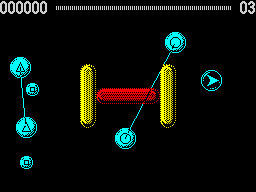
As you can see. E-Motion on the Spectrum is not quite as colourful as it's 16-bit counterparts, but there is still a good game in there.
E-Motion on the Amiga. Very nice ray-traced graphics and lots of atmospheric sound to go with them.
AMIGA VERSION This is the most colourful and attractive of the versions we played - 32 colour ray-traced images set against a nice colour-graduated background. The sound is suitably ethereal and, for once, actually adds something to the gameplay. Graphics: 8/10 Audio: 8/10 IQ Factor: 7/10 Fun Factor: 8/10 Ace Rating: 890/1000 Predicted Interest Curve 1 min: 4/5 1 hour: 4/5 1 day: 5/5 1 week: 4/5 1 month: 3/5 1 year: 2/5
ATARI ST VERSION A little less colourful than the Amiga version, and with slightly tinnier sound, but just as playable nonetheless. The background is nicely created with Fourier patterns, making the game look very nice indeed. Graphics: 7/10 Audio: 7/10 IQ Factor: 7/10 Fun Factor: 8/10 Ace Rating: 880/1000 Predicted Interest Curve 1 min: 4/5 1 hour: 4/5 1 day: 5/5 1 week: 4/5 1 month: 3/5 1 year: 2/5
PC VERSION Gameplay is more or less identical to the other versions but sound is the usual tacky PC affair. The game caters for CGA (which doesn't look that bad considering the colour limitations), EGA, and VGA - which is just as attractive as any of the other versions reviewed here. Graphics: 8/10 Audio: 5/10 IQ Factor: 7/10 Fun Factor: 8/10 Ace Rating: 850/1000 Predicted Interest Curve 1 min: 4/5 1 hour: 4/5 1 day: 5/5 1 week: 4/5 1 month: 3/5 1 year: 2/5
SPECTRUM VERSION This is a little more difficult to play than the other versions because the spheres are all the same colour and are identified by patterns. This doesn't help when the action hots up. The spheres are smaller too. Apart from these factors gameplay is more or less identical - sounds good too.
Crash #76May 1990 · p.39Crash Smash82%84%83%87%90%91%92%90%
Presentation 82%
Graphics 84%
Sound 83%
Playability 87%
Addictivity 90%
Overall 91%
Mark Caswell 92%
Nick Roberts 90%
US Gold/Code Monkeys £9.99 cass US Gold claim this is the beginning of a 'New Age' of stress free programs designed for easy living. With that in mind E-Motion was loaded after a hard day's blasting - and caused widespread consternation! Games don't come much more frustrating than this! Wow..! In a sub-atomic universe filled with atoms, protons, neutrons and other particles smarty-pants egg-heads rave on about, you control a sphere which you use as a vehicle to nudge other spheres into one another. But be careful, bounce only like atoms together: judge them by their markings. If you accidentally knock unlike, smaller spheres are created. And if left to their own devices they grow and cause even more of a headache. Time is of the essence too: if the atoms are left too long before collision, they explode and knock a large chunk off your energy. So bang those balls together and pray you don't tear all your hair out. The vehicle is so anarchic that many expletives unprintable in a family mag were heard ringing round the CRASH offices. But after calming down, I tried again and slowly gaining more control began to enjoy playing this frustrating but ultimately rewarding game. One piece of advice: don't panic. Many times I've been knocked out because the wildly erratic ball shot round the screen at Mach speeds. E-Motion won't do anything for your nerves, but may just push up the sales of strait jackets. MARK 92%
Your Sinclair #53May 1990 · p.2087%77%50%80%80%80%
Life Expectancy 87%
Instant Appeal 77%
Graphics 50%
Addictiveness 80%
Overall 80%
Kati Hamza 80%
US Gold £10.99 cass Reviewer: Kati Hamza Once upon a time (well, during that grey and rather murky decade they call the '70s actually) a horrible little factory somewhere began producing some equally horrible little lamps. These lamps were filled with mobile oil bubbles which floated in a bright orange solution of hideous greasy gloop, and they quickly became the most ultra-hip 'sitting room' accesory of the period. They were foul, they really were. Well, E-Motion is nothing like that. (Well, okay, they've both got a load of floating spherical objects but nothing else.) In fact, E-Motion isn't really like any other game I've ever seen so describing the blooming thing might prove a tad difficult. Oh well, here goes. (Long pause.) Imagine a big black space. Now put in a few round balls inscribed with different geometrical shapes and add a funny round little geezer as a control pod. Then link them together with funny string things (A bit like Klackers actually. Ed). A doddle so far. Okay, here's the tricky bit. The little round control pod has to zoom around the black screen bumping and shoving identical balls into one another. "Why?" I hear you ask. Because if it doesn't manage it in time the balls start flashing like crazy and explode, zapping all the pod's energy and leaving you minus one life. And there's more. For starters, the pod suffers from inertia so unless you're a bit of a whizz-kld with the old twizzle-stick you're much more likely to go sailing straight past your target (whizz) and swearing (%'@!) than actually hitting the er... balls. Secondly, if two different spheres collide by accident (and this tends to happen rather a lot at first) they generate a cute little baby ball. These turn into bigger pubescent balls after a few seconds but if you get them while they're small they pop a bit extra onto your energy bar. Thirdly, the screen actually wraps around itself so the snappiest route from ball to ball isn't always the most obvious one. For example, if you want to get a sphere on the left over to the right, it might actually be quicker to shove it off the left-hand side of the screen (a bit like Asteroids actually). Clever, eh? And there's even more! in the interests of some really major trickiness, those cheeky chappies at US Gold have conjured up loads of extras, like impassable barriers and natty little pick-up pills which have a sort of absorbent effect. Instead of going round bashing the balls you just kind of suck them up. And even more confusing are the pieces of elastic. These connect some of the balls and both the control pods to each other in two-player mode. Pulling one end usually results in the other sproinging like crazy all around the screen, making a general pig's ear of the whole thing. It all adds up to an extremely spanky little puzzler with a multitude of levels and some very spiffy game design. There's not much to comment on in the way of sound or graphics but the crucial thing is the physics and, by crikey, have they got it right. The spheres move exactly like they should, especially when they're tied to the 'rubber bands', and the collision detection is absolutely on the ball. Unfortunately, there is one irritating tendency in that it plays a snip too s-l-o-o-o-w when there are lots of sprites about, but that's not too much of a handicap. There are some people who wouldn't like a puzzle game if it jumped up and bit them on the bottom. E-Motion won't be everybody's mug of steaming Rosie Lee but with so much variety and manic action this is an excellent excuse to give your lil' ol' trigger finger a hard-earned rest. Don't be a turkey - go check it out.
It's the first screen and I'm not doing too well. I've already created a couple of extra balls, and that weird h-shaped doofer's getting in the way too. Drat.
Now, if I can just run over that smaller ball before it grows any bigger, then get the pair in the triangle to touch, I'll be laughing...
Yikes! It's the two-player game and I'm tied to my partner and some other balls with a piece of knicker elastic. Look at all those new ones I've managed to create over there on the right! (Not doing too well, am I?)
C&VG (Computer & Video Games) #101Apr 1990 · p.88C+VG Hit89%89%
C&VG (Computer & Video Games)C+VG Hit
Overall 89%
Paul Rand 89%
US Gold Spectrum/Amstrad £9.99, ST £19.99, PC/Amiga £24.99 If someone told you that the first New Age computer game was something akin to "bowls on pieces of elastics, you'd probably think "Gawd, worra complete pleb". But that's exactly what E-Motion is. The game consists of fifty screens, each containing a number of coloured spheres and, sometimes, a solid structure. The idea is to obliterate all the spheres on screen by using a spaceship (or two if you're in dual-player mode) to bump like-coloured ones together. When different-coloured balls collide, another smaller ball appears which can be picked up and used to replenish the ship's energy. But be quick - energy balls soon grow to full size and of course, destroying them requires the creation of another ball of the same colour. If the screen isn't cleared within a time limit the balls explode, sapping the ships energy. There - easy. Or at least that's what the programmers, Assembly Line (they did the smashing Interphase) thought, so they added the structures which need to be worked around, making things even trickier. They've also linked you to some of the balls via elastic bands, which calls for pixel-perfect maneuvering if you don't want to create more spheres. After a predetermined number of levels, one of three bonus stages can be tackled, allowing you to bump up those points before attempting the next screen.
Oh dear, looks like someone's been bashing those balls willy-nilly!
These kooky shapes don't help matters, either.
Three balls, a piece of elastic and a spaceship. A recipe for confusion and disaster if ever there was one.
Two spheres and a ball on one elastic thread.
AMIGA SCORES Graphics: 73% Sound: 67% Value: 94% Playability: 96% Overall: 95% Puzzle games are all the rage at the moment and E-Motion is, quite simply, one of the best I've yet seen. First impressions are, as with most games of the genre, very misleading - the screen looks bare and things seem somewhat boring. However, that first burst of movement and the eventual collision with the wrong sphere causes you to sit up, panic a bit, reevaluate your entire thoughts on the product and from that moment you're hooked. Like all the true greats, graphics are above average as opposed to spectacular, although the use of ray-tracing on the balls and structures is pretty impressive in itself. Similarly, sound is "nice' but the plinkety-plink tunes and spot effects will soon have you twiddling your volume knob. Pretty soon someone is going to create a game which overtakes the addictiveness of Tetris, E-Motion doesn't quite manage it, but it comes very, very close.
AMSTRAD SCORES Overall: 92% E-Motion on the Amstrad obviously looks more basic than the 16 bits, but its colourful enough, and that same addictive urge exists as much as in the other versions.
ATARI ST SCORES Overall: 95% Apart from ever-so-slight colour alterations, there is absolutely no difference between this and the Amiga version. An astonishing game which no self-respecting gamer should be without.
PC SCORES Overall: 95% The PC game can be played in any of CGA, EGA or VGA modes but, no matter how much colour you have on-screen, there's no getting away from the fact that E-Motion is an unmissable experience.
UPDATE We've yet to see the C64 version E-Motion, which will carry a price tag of £9.99 but fear not, we'll be running a review in the Update section the moment it comes in.
Sinclair User #98Apr 1990 · p.6060%60%90%86%89%89%
Graphics 60%
Sound 60%
Playability 90%
Lastability 86%
Overall 89%
Jim Douglas 89%
Label: US Gold Author: In-House Price: £8.95 Memory: 48K/128K Joystick: Various Reviewer: Jim Douglas Let me get this straight. You've got a load of balls in space. And by bouncing similar balls together, you make them disappear. Dissimilar balls, when bounced together replicate into little balls. And if you don't manage to get rid of all the balls in a specific time frame, they explode and drain your energy. And that's it? Let's face it, E-motion sounds pretty rank doesn't it? Fortunately, once you've got to grips with the rather silly premise behind the game, the astounding playability shines through. If you can stand to drag yourself away from your shoot outs and jump abouts, you'll be playing this for weeks. However, you should be aware of the dangers involved in playing. For a start, there's a very high probability that you'll go round the twist at some point. You see, if only life was as simple as just bouncing the similar balls together. Alas, as soon as you progress past the first couple of levels, the balls become connected with elastic cables. Sometimes they're connected to other bails of the same type. More often they're connected to opposites. And frequently you find them tied to your own spaceship (with which do all the bumping). Just when you thought you'd got to grips with simply moving round the screen and guiding the balls around, you have to learn a whole new skill. Not only is the elastic a bit difficult to predict, but since you scroll off the edge of one screen and onto another, the elastic suddenly changes position and everything all flies off in the opposite direction. The added pressure of really rather short time limits can turn it into a thoroughly maddening affair. Other versions of the game had different coloured balls to play with, but to avoid attribute problems, USG has opted to mark each different type with triangles, squares and circles. In the heat of the action, it's a little too easy to mistake one shape for an other and bounce them together, letting loose a whole screenful of little balls. Once you bodge one screen you can pretty much say goodbye to the rest of your game. Since the time limits are so tight, the amount of time you waste haring around, trying to chase down the little balls is so great that you really haven't got a hope in hell of clearing them all up and then successfully going back and finishing off the big ones. Each screen has a subtley different layout of static bollards which everything bounces off. US Gold haven't made anything easy. Every start position presents you with a host of problems. If I go up really fast, am I likely to get up enough speed to pull the two triangle pieces together without dragging one of the squares into the way? Can I get through the gap and head off the drifting piece before it collides with anything else? As I said before, I figure the biggest problem is the wrap-around screen. It's a completely bizarre way of thinking. Not only do you have to employ all the lessons learnt from games like Asteroids, but you've got to try and predict the other objects' movement in the light of your own. It's like chess played at 100mph.
The dreaded elastic bands prepare their springyness to lure another hapless victim into a bouncy doom. Will you survive?
MicroHobby issue 198: Tape 21 carries this game and has 2 references of its own.
Full-page ad6
- Sinclair User #100Jun 1990 · p.84
- C&VG (Computer & Video Games) #103Jun 1990 · p.116
- ACE (Advanced Computer Entertainment) #33Jun 1990 · p.124
- Your Sinclair #53May 1990 · p.62
- C&VG (Computer & Video Games) #102May 1990 · p.47
- ACE (Advanced Computer Entertainment) #32May 1990 · p.68
Review4
- FIFO #111991 · p.17
- FIFO #101991 · p.29
- The Games Machine #29Apr 1990 · p.36
- MicroHobby #198Apr 1990 · p.29
CompoEntry3
- Sinclair User #99May 1990 · p.30
- C&VG (Computer & Video Games) #101Apr 1990 · p.19
- Your Sinclair #52Apr 1990 · p.72
Feature2
- C&VG (Computer & Video Games) #108Nov 1990 · p.40
- Your Sinclair #57Sep 1990 · p.65
CompoResult2
- Your Sinclair #58Oct 1990 · p.49
- C&VG (Computer & Video Games) #103Jun 1990 · p.36
Preview2
- Your Sinclair #52Apr 1990 · p.89
- C&VG (Computer & Video Games) #100Mar 1990 · p.105
Advert1
- ACE (Advanced Computer Entertainment) #34Jul 1990 · p.3
News/Note1
- ZX MagazínJul 1990 · p.19
Offer1
- Sinclair User #101Jul 1990 · p.36
Related
- Compilations
- MicroHobby issue 198: Tape 21, Captain Poke
- Ports
- (Amstrad CPC), E-Motion (Commodore 64), E-Motion (Amiga), E-Motion (Atari ST), (Gameboy/GBA)
- Elsewhere
- Speccy Screenshot MapsWikipediaMobyGamesRZX ArchiveThe TipshopUVLModern ZX-Retro GamingRZX Archive - YouTubeSpectrum Computing RZX - YouTube
- Same entry at
- Spectrum ComputingZXInfo
Reviews from people here
Sign in to write about this, or make an account. It takes a minute and lets you correct the catalogue too.
Everything ZXDB can hold about this is here.
Sign in to correct or add to this.
Hold the rights to this and want it taken down?