
Espionage
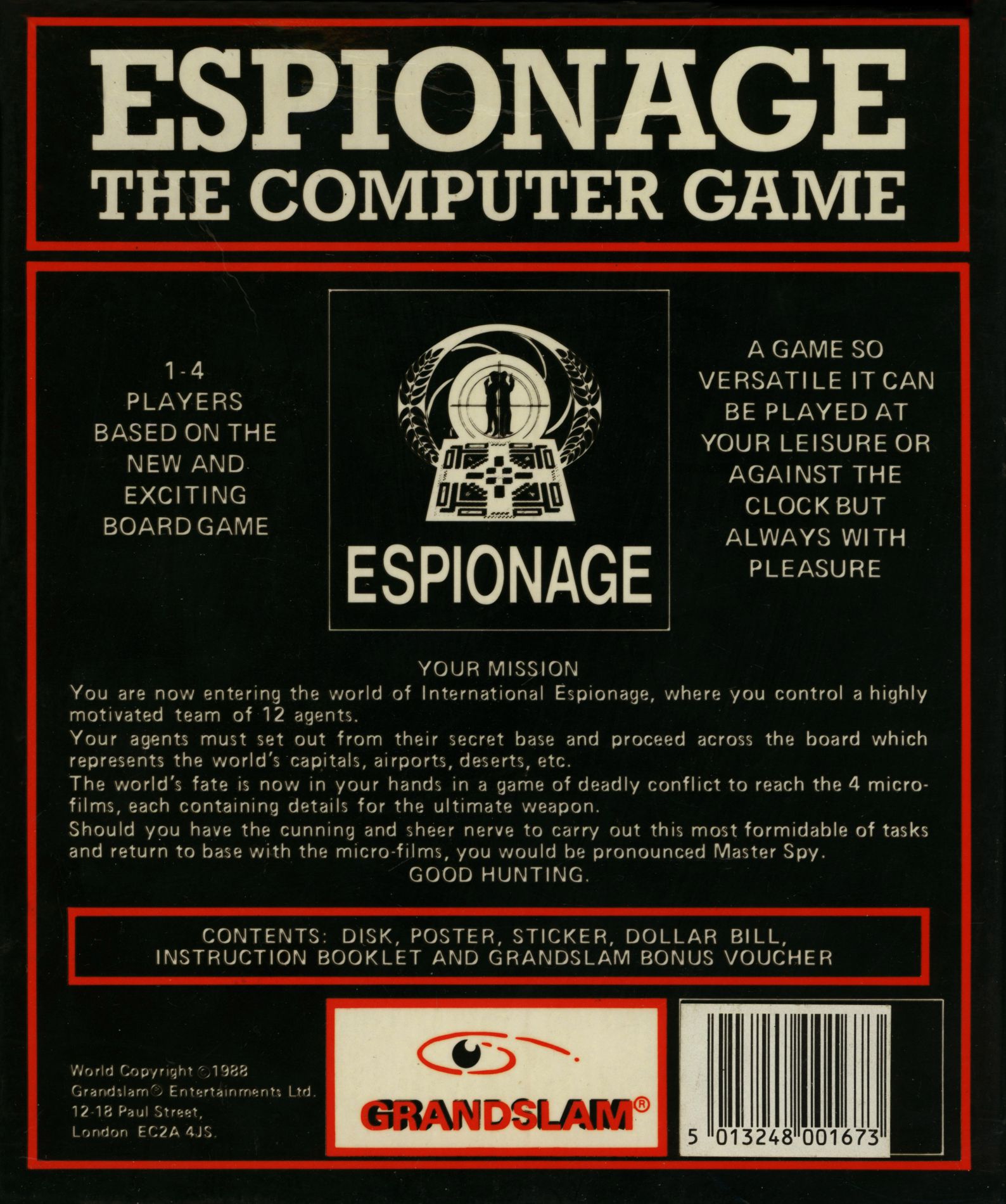
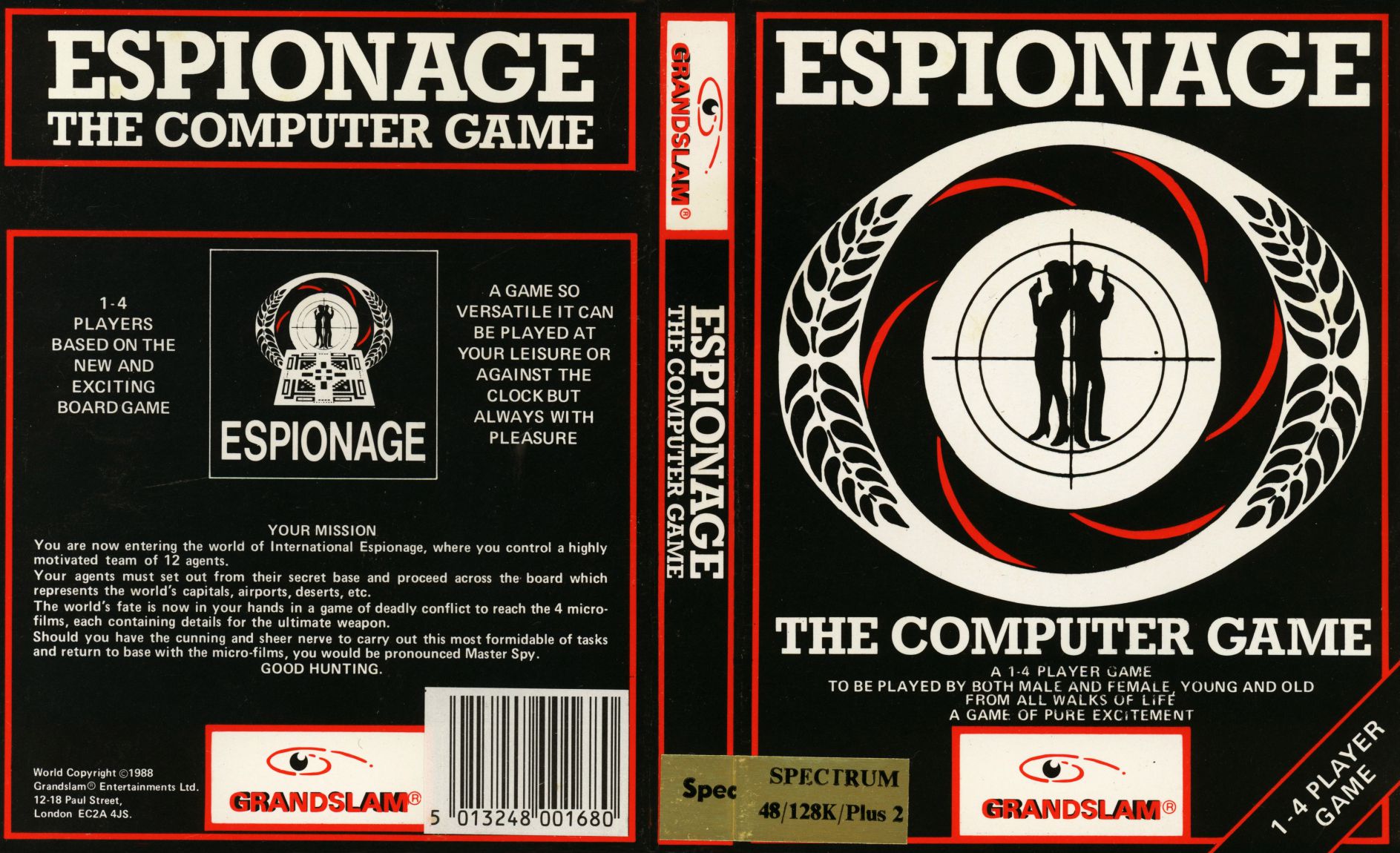
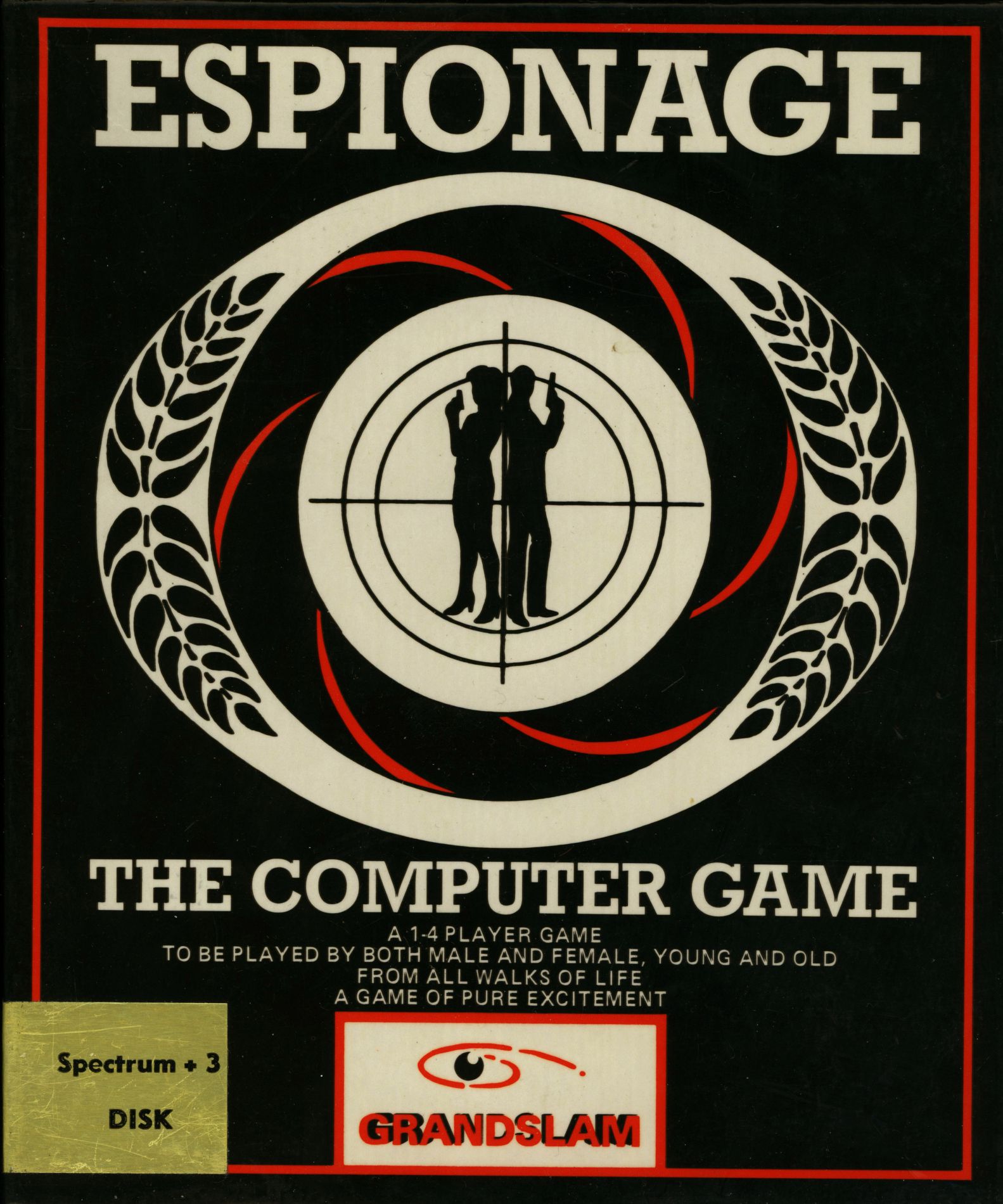
Game: Board · ZX-Spectrum 48K/128K · 4 players · English
Grandslam Entertainments Ltd · 1988 · Pound sterling 8.95 · Pound sterling 14.95 disk
.jpg)
Discussion
Nobody has started a thread about this yet.
Remarks
Use the scanned instructions for the correct page layout in the Padlock copy protection questions.
- Control Option
- Cursor, Interface 2 (right), Kempston Joystick
Play
- Espionage.dsk.zipDisk image English18 KB
- Espionage.tzx.zipTape image English17 KB
- Espionage.tap.zipTape image English19 KB
Documents
- Espionage.pdfInstructions English748 KB
- Espionage.txtInstructions English18 KB
- Espionage(EN).pdfInstructions English668 KB
Other files
- Espionage (1988)(Grandslam Entertainments).pokPOK pokes file 0 KB
Files and rights
No permission is on record either way. Screens and pictures are copied here on a take-down basis: if you hold the rights and want something removed, say so and it goes.
Credits
- Source Software Ltdcredited
Sign in to credit somebody, or say what these people did.
Scores
In the magazines
- Sinclair User #811988 · Overall61%
- Crash #601989 · Overall81%
- ACE (Advanced Computer Entertainment) #161989 · Ace Rating780/1000
- The Games Machine #141989 · Overall77%
Elsewhere on the web
- WorldOfSpectrum 6 votes5.50
In the magazines 16
Crash #60Jan 1989 · p.2981%74%65%82%79%81%81%82%81%
Presentation 81%
Graphics 74%
Sound 65%
Playability 82%
Addictive Qualities 79%
Overall 81%
Mark Caswell 81%
Phil King 82%
Stuart Wynne 81%
Editor, Writer, Tipster, Spy Producer: Grandslam Secret Settlement: £8.95 cass, £14.95 disk Author: Source Would-be master-spies draw the blinds, turn up the radio and pay attention. Espionage has arrived on the Spectrum and it's ideal training for sending Bond. Smiley and Co on special missions. The objective is to get some vital microfilm back to base. One to four people can take part, with the computer filling any suspiciously empty seats. The game board is a grid, with black, impassable squares. In the board's centre are four microfilm canisters, which can be obtained by Couriers (each player has six) and Secret Agents (four each). Each player also has two Surveillance Agents. Couriers move diagonally, Surveillance Agents move parallel to the board lines, while Secret Agents are able to move in either of these two modes. During a turn a player can move their selected agent any number of spaces in a forward direction, but obviously can't make turns or anything like that. Killing an enemy agent is done by moving your agent over him by one space - if the agents back is against a wall then he can't be killed. At the start of the game there's a special period called 'detente' where players take turns to distribute their agents around the board. Agents can be put anywhere, and cannot be taken. Once this stage finishes it's a race to get the most microfilms home, fastest, while bumping off as many enemies as possible. Money is awarded for microfilms and assassinations and the game finishes when all the microfilms are at a home base. If a courier is taken while carrying the microfilm the 'asssassin' gets the film, whatever type of agent he is. To avoid this you should Exchange your microfilm-carrying agent with someone at home base. Any two of your agents can be exchanged at any time. The computer game presents only a section of the board, but it's over half of the board and can be easily scrolled to show other parts. There are eight options; Zoom (dose-up view of board), Pause, Hint (computer suggests move), Quit, Help (text reminding you of game objectives), Computer Makes Your Move, Last Move (shows what this was) and Sound On/Off. First impressions of the rulebook are daunting, but it all becomes obvious enough while in play. Definitely the best way to play is with a couple of friends - preferably as inexperienced at the game as you - but it you want, the computer can offer some tough opposition. Espionage is a good strategy game that is fun to play for everyone. MARK 81% THE ESSENTIALS Joysticks: Cursor, Kempston, Sinclair Graphics: tiny pieces move around a scrolling board, while the zoom option magnifies a certain area Sound: a catchy, Bond-sounding title tune, but merely informative beeps during play Options: any combination of four computer/human players can compete. Play to time or finish. Change time limit for each move
Spy-fi chess for wannabe Peter Wrights everywhere.
USING YOUR INTELLIGENCE During detente put at least one of your couriers near the centre, ready to take the microfilm. Try to position most pieces near walls, to make them harder to take. Take one piece back to base, so that when you get the microfilm, you can simply exchange the two pieces for an immediate safe return to base. Don't play against clever-clogs Stuarts.
ACE (Advanced Computer Entertainment) #16Jan 1989 · p.683/102/108/106/10780/1000780/1000
ACE (Advanced Computer Entertainment)
Graphics 3/10
Audio 2/10
IQ Factor 8/10
Fun Factor 6/10
Ace Rating 780/1000
Bob Wade 780/1000
Tinker, tailor, soldier, Grandslam. Furtive dealings are afoot in the murky world of international spying. Which is, of course, perfectly true, but the spying theme has nothing to do with this game. If anything, the scenario serves to complicate matters unnecessarily so let's forget the cloak and dagger stuff and get down to the board game. It's basically a cross between chess and draughts, with a more intricate playing area and a different game objective. Up to four players can take part, any or all of which can be controlled by the computer. Each player controls three types of pieces - or agents: six couriers that move diagonally like bishops in chess, four secret agents that move like queens and two surveillance agents that move like rooks. At the start, in the detente phase, players distribute their 12 agents across the board. There is no preset arrangement for pieces, so setting up the board at the start is an important element of gameplay. The overall aim is to end up with the most money - cash is earned by retrieving microfilms from the middle of the board and getting them back to your base, and also by capturing agents. Agents can be captured and removed from play in much the same way as pieces are taken in draughts. A few games will be needed to appreciate the tactics required, but play is very involving and enjoyable once you've learnt the rules. The computer opponents aren't that skillful, but they provide reasonably testing opposition. Reviewer: Bob Wade RELEASE BOX Atari ST, £19.95dk, Imminent Amiga, £19.95dk, Imminent Spectrum, £8.95cs, £14.95dk, Out Now Amstrad, £8.95cs, £14.95dk, Imminent C64/128, £9.95cs, £14.95dk, Out Now IBM PC, £19.95dk, Imminent
C64 - detente is over and now the capturing begins. If you find it difficult to distinguish between the pieces, you can zoom in on the board for a clearer view.
C64 VERSION The graphics and sound effects are on the minimal side, but this doesn't really make much difference to the game. Graphics: 3/10 Audio: 2/10 IQ Factor: 8/10 Fun Factor: 6/10 Ace Rating: 780/1000 Predicted Interest Curve 1 min: 50/100 1 hour: 75/100 1 day: 85/100 1 week: 70/100 1 month: 60/100 1 year: 30/100
SPECTRUM VERSION Functional graphics and minimal sound effects.
The Games Machine #14Jan 1989 · p.8477%
Overall 77%
Spectrum 48/128 Cassette: £8.95, Diskette: £14.95 Commodore 64/128 Cassette: £9.95, Diskette: £14.95 Amiga £19.95 I SPY WITH LITTLE PIECE Originally devised as a board game in 1984, Espionage was rereleased during the summer of '88 and subsequently converted to the small screen by Grandslam Entertainments. A game for one to four players, the objective is to become Master Spy - achieved by accumulating loot. At the centre of the playing area are four micro-films containing vital information. All-important money is made by getting a microfilm back to your base or by terminating another player's agents. Each player begins with 12 agents split into three groups: six courier, four secret and two surveillance. Courier agents move diagonally; secret agents sneak in any direction and surveillance agents move along horizontal or vertical lines. All may move any number of spaces on their turn, provided they don't travel over no-go areas on the board. AS TIME GOES, SPY! Terminating an agent is akin to lumping a piece in draughts. Provided there is a square just beyond your opponent in line with the direction you are travelling, you can jump over, and hence terminate, that piece. You may terminate several pieces in one go should the situation allow. Further features include agent exchange, sanction and detente. Exchange allows a player to swap the position of any two of his agents in a move similar to castling in Chess. This is extremely useful and can drastically alter the state of play. Sanction should only be used by experienced players. If an agent is in position to terminate an opposing agent and chooses not to do so, they can be sanctioned and consequently removed from the game. Detante occurs at the start of play. Each player moves their 12 agents to any position on the board regardless of normal movement patterns. During detante, agents cannot be sanctioned or terminated. On loading Espionage, you are asked to define a series of game options. These include number of players, either human or computer controlled, a time limit for the whole game or individual moves and whether you wish to play with the sanction feature or not. Players status is shown to the right of the screen, just below this is an options icon. The status box may be replaced by a menu featuring options to aid play. For example: Zoom gives a magnified view of a chosen section of the board. Pause freezes the game momentarily. Hint gets the computer to suggest a move and Quit finishes the game - the player with the most money is declared winner. Espionage may be tackled on two levels: each player trying to terminate as many of the others within a set time limit or as a full-blown strategy game. It would have been nice if a skill level option had been included, as it stands it takes a lot of practise to match the computer. However, fans of strategy board games should enjoy Espionage.
Cameron peeking out from behind his copy of the Sun to make a sneaky move - Amiga screen.
Simple graphics, but a good conversion of the strategic boardgame - C64 screen.
"A fiendishly addictive game."
AMIGA Overall: 79% Graphically there is very little one can do with a game like Espionage. The annoying tune which runs throughout play can thankfully be switched off to let you enjoy a fiendishly addictive game in peace.
COMMODORE 64/128 Overall: 72% The slowest of the bunch - it takes an age to think about moves. Graphics and sound are not particularly outstanding but they don't detract from gameplay too much.
OTHER FORMATS Amstrad CPC (Cassette £8.95, Diskette £14.95), MSX (Cassette £8.95), PC 5-1/4 inch Diskette (£19,95), 3-1/2 inch Diskette (£24.95) and Atari ST (£19.95) should all available shortly.
Sinclair User #81Dec 1988 · p.10471%46%66%53%61%61%
Graphics 71%
Sound 46%
Playability 66%
Lastability 53%
Overall 61%
Tony Dillon 61%
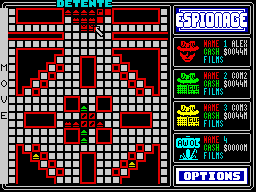
Label: Grandslam Author: In-house Price: £9.95 Memory: 48K/128K Joystick: various Reviewer: Tony Dillon Do you want to enter the wild and mysterious world of spy and counterspy? How about dealing in strange markets like microfilm and illegal weaponry? Or maybe you'd just like to recreate your favourite scene from the latest Bond movie. Whatever the case, it it's excitement, thrills and spills you're after, you could do a lot better than Espionage. Beating all their rivals by an incredibly small margin (£5), Grandslam managed to snap up the licence to this fairly unknown game at quite an extortionate cost (£5). The question is, is it worth half of my salary? No. Definitely not. In workng man's (pleb) terms, Espionage is Chess without the complexities. You control 12 agents as they trek around the globe in search of four microfilms. Why they have to search is beyond me, as all four microfilms are grouped together in the centre of the board. The globe is represented by a grid of black, white and red squares. The black squares are no go areas for the spies, the white and red squares are where the player's home bases are. Each of the four possible players (human or computer controlled) takes it in turn to move one of their spies. The 6 courier agents can only move diagonally across the board, but over as many squares as they like. The four secret agents can move in any direction they so please. The 2 surveillance agents can only move up, down, left and right (not diagonally). Players take opposing pieces as in draughts; they jump them. Obviously, once all your opponent's pieces are removed from the board, the game gets a lot easier. The screen is laid out in two windows. On the left is the main window. It's this one that takes up most of the screen and shows a segment of the board, which can be scrolled to show any part of the game. On the right is a status/score window that shows all the players' scores and films collected (if any.) At the bottom of this window is a box labelled 'Options', click the pointer on this, and a whole bunch of options comes up. Basic things like pause game and quit as well as pretty handy computer hint facility, with which the computer thinks long and hard and comes up with the best possible move you could do in your current situation. Graphics aren't anything special. Just a coloured grip and some fairly basic icon graphics. One thing I do like is the pictures of the characters at the side of the screen. Whichever of the four players is currently active holds a newspaper in front of his face. Control is fairly simple. A pointer moves around on screen under your control, and moving the pieces is simply a case of clicking on the piece concerned and then clicking on the square you want it to jump to. The pointer is a little slow. So there you have it. A basically run-of-the-mill boardgame conversion that doesn't come anywhere near the fun generated by playing the real thing and it costs a few quid more. That's what I call VFM.
Full-page ad5
- Sinclair User #79Oct 1988 · p.65
- Your Sinclair #34Oct 1988 · p.85
- Crash #57Oct 1988 · p.12
- C&VG (Computer & Video Games) #84Oct 1988 · p.102
- The Games Machine #11Oct 1988 · p.38
News/Note3
- ACE (Advanced Computer Entertainment) #15Dec 1988 · p.10
- Sinclair User #79Oct 1988 · p.24
- Crash #57Oct 1988 · p.9
Advert2
- C&VG (Computer & Video Games) #87Jan 1989 · p.86
- ACE (Advanced Computer Entertainment) #16Jan 1989 · p.60
Preview2
- Your Sinclair #36Dec 1988 · p.130
- Crash #56Sep 1988 · p.119
Licensed from
- EspionageSoftwareEspionage Ltd
Related
- Ports
- (Amstrad CPC), (Commodore 64), (Amiga), (Atari ST)
- Same entry at
- Spectrum ComputingZXInfo
Reviews from people here
Sign in to write about this, or make an account. It takes a minute and lets you correct the catalogue too.
Everything ZXDB can hold about this is here.
Sign in to correct or add to this.
Hold the rights to this and want it taken down?