
Eureka!
Adventure Game: Graphic · ZX-Spectrum 48K · 1 players
Domark Ltd · Oct 1984 · Pound sterling 14.95

Discussion
Nobody has started a thread about this yet.
Remarks
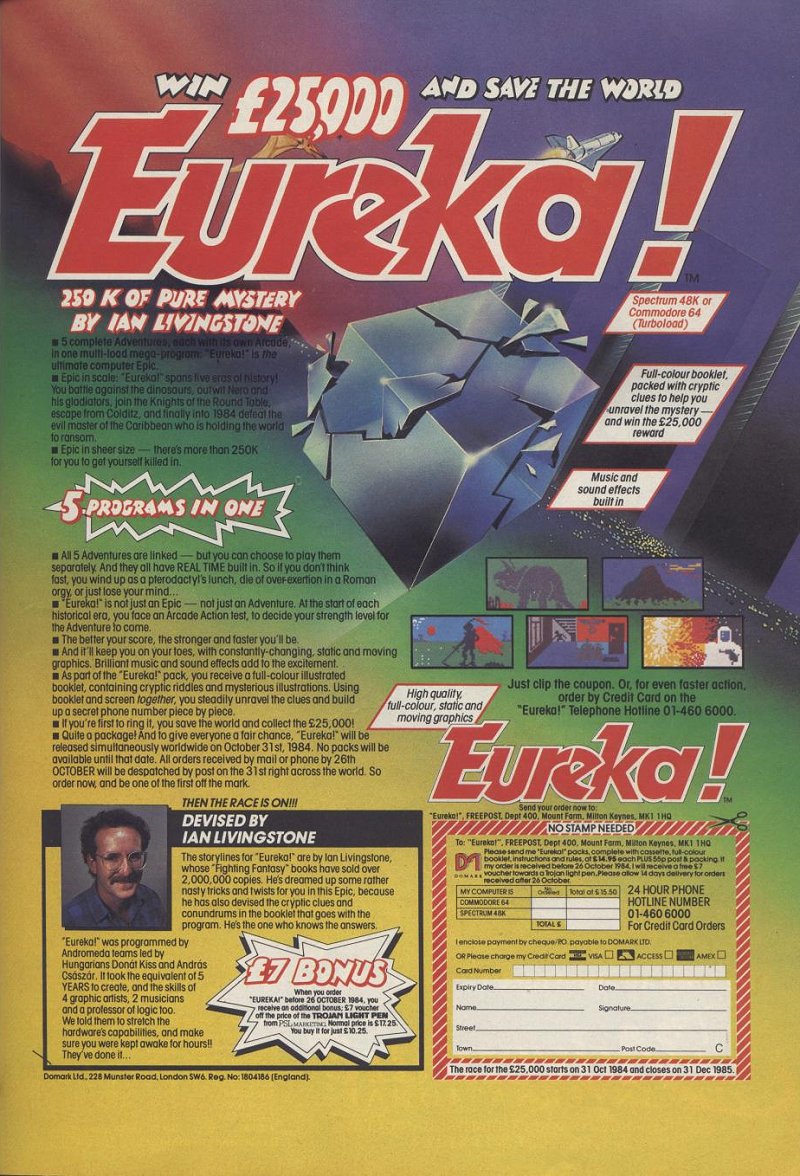
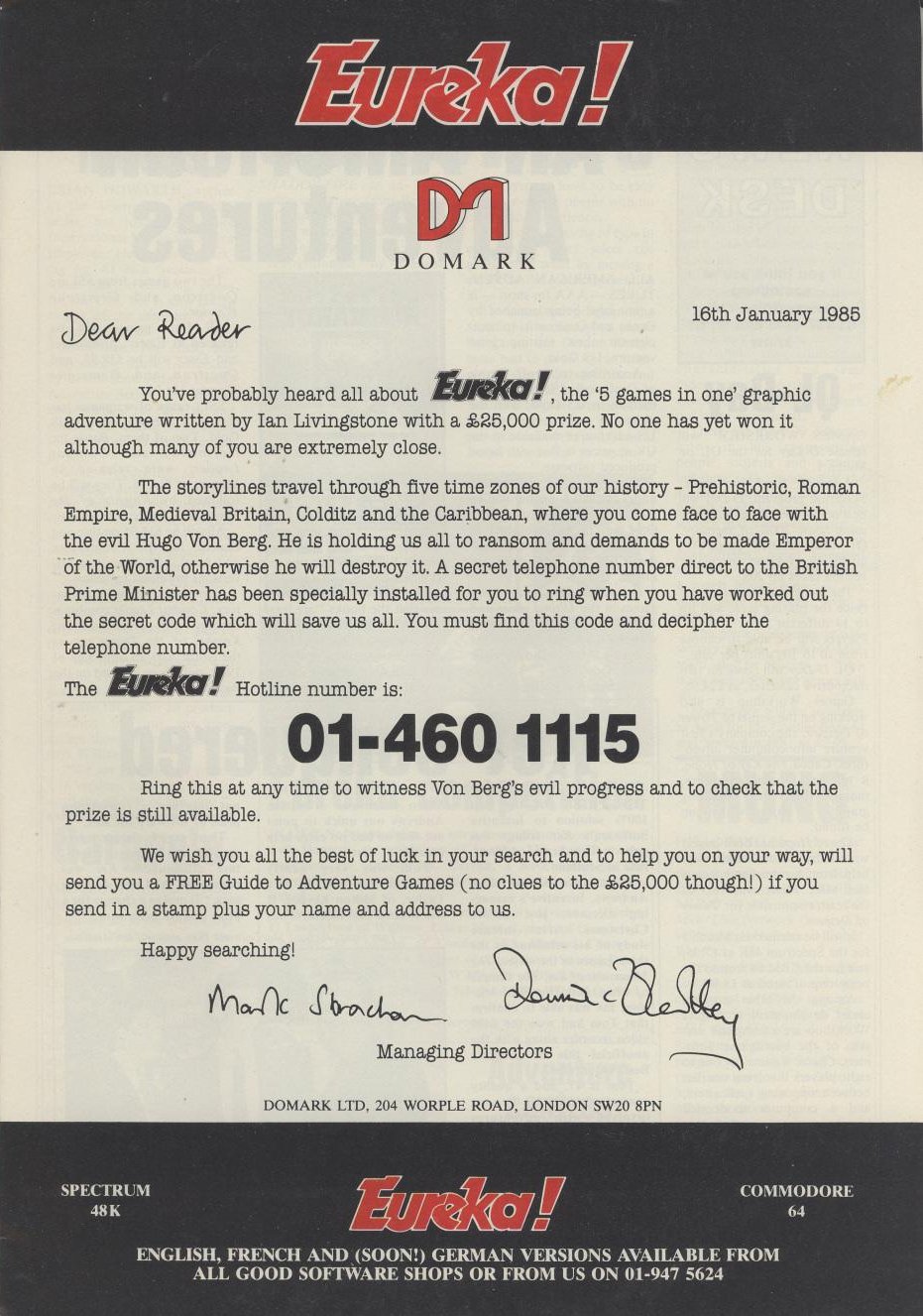
ZXSR: Eureka was one of many games to offer a prize to the first person who completed the game, although this had a bit more on offer as the prize was £25,000 in cash! It was eventually won by a fifteen year old, Matthew Woodley.
basically a text adventure, but with an incongruous arcade intro to each section
- Control Option
- Interface 2 (right), Kempston Joystick
Releases
- 31 Oct 1984Domark LtdPound sterling 14.95
- 1984Eureka Informatique
Play
- Eureka.tzx.zipTape image English263 KB
- Eureka_2.tzx.zipTape image French322 KB
- Eureka.tap.zipTape image English269 KB
Documents
- Eureka.txtInstructions English16 KB
- Eureka_French.pdfInstructions French2,618 KB
- Eureka(EN).pdfInstructions English4,318 KB
Other files
- Eureka! (1984)(Domark).pokPOK pokes file 0 KB
Files and rights
No permission is on record either way. Screens and pictures are copied here on a take-down basis: if you hold the rights and want something removed, say so and it goes.
Credits
- Ian Livingstone [1]Game Design/Concept
- Ian Livingstone [1]Story Writing
- Dominic WheatleyGame Design/Concept
- Mark StrachanGame Design/Concept
- Stephen ByrneGame Design/Concept
- Stephen ByrneStory Writing
- Donat Kisscredited
- Tibor Horvathcredited
- Andras Fordoscredited
- Imre Jakobiczcredited
Sign in to credit somebody, or say what these people did.
Scores
In the magazines
- Your Computer #121984 · Overall2/5
- Sinclair User #341985 · Gilbert Factor8/10
- Sinclair Programs #271985 · Rating70%
- Crash #121985 · Overall Value7/10
- Personal Computer Games #141985 · Overall6/10
Elsewhere on the web
- WorldOfSpectrum 13 votes7.62
Awards and competitions
Golden Joystick Awards 1984
- 3Best Adventure Game of the Year
In the magazines 182
Sinclair User #34Jan 1985 · p.428/108/10
Gilbert Factor 8/10
John Gilbert 8/10
ACTION THROUGH THE AGES Memory: 48K Price: £14.95 Joystick: Kempston, Sinclair Eureka!, Ian Livingstone's package, from Domark, contains something for everyone. Each of the five sections is prefaced with an arcade game which builds up the character's strength, or vigor, but tires the playing fingers. In the prehistoric maze you are represented by a little figure, the size of a character square and difficult to distinguish from its background. You must guide it around the maze, picking up roast chicken legs while avoiding flashing squares which rush at you and jumping on those which try to run away. All those antics have a strange sort of logic to them. If you want to keep your sanity, however, it is best to pick up the nearest leg and make a dash for the exit. If you are not quick enough on the fire button, for this game surely requires a joystick, more chicken legs are scattered around the maze. Once through the finger punishment phase one of the adventures may be loaded. Those take you into a series of time slips through which you have to travel to find the pieces of a talisman first discovered on the moon by Apollo XVII but later shattered and lost in time. First stop is the prehistoric age in which you can become breakfast for a dinosaur, discover hidden pitfalls, and become lost in one of the many forests which dominate the land. If, after that, you are inclined to travel further you can load the next program and slip back to Ancient Rome where the slaves are revolting and the lions ravenous. Livingstone's long association with role-playing games ensures that full mythology value is injecteed into the scenario. The mythological strain continues with a trip to Celtic Britain where you have to rescue the wizard Merlin and meet the crew of Camelot. Once you have got those pieces of the talisman you can travel to the two final segments of the package which take place in the near past. Despite the combination of arcade and adventure games the package is disappointing as it offers nothing new. The package is good value however, especially considering the £25,000 prize for the lucky winner.
Sinclair Programs #27Jan 1985 · p.1770%70%
Rating 70%
June Mortimer 70%
PRICE: £14.95 GAME TYPE: Arcade and Adventure With all the hype and the publicity about Eureka, there must be few Spectrum owners who do not yet know that the Eureka games have been billed as containing "250K of pure mystery", and that a £25,000 prize is offered to the first person to solve the adventures before the end of 1985. The arcade games are all fun, easy enough to be played by those who never normally touch arcade games, tricky enough to keep the experienced fighting for those essential points. The main problem with them is that all the moving objects on the screen flash on and off. Acceptable at first, this quickly becomes an eye-straining nuisance. The adventures are also enjoyable. Difficult, of course, and you will not see even a hint of a clue in this review. It would not be fair, would it? Suffice it to say that the adventures are all set in different time periods, from prehistoric time, to the modern Caribbean. They have accompanying graphics, which can be frightening, as when the Pterodactyl swoops in for the kill. Produced for the 48K Spectrum by Domark Ltd, [redacted].
Crash #12Jan 1985 · p.1287/107/107/1010/107/107/10
Atmosphere 7/10
Vocabulary 7/10
Logic 7/10
Debugging 10/10
Overall Value 7/10
Derek Brewster 7/10
DEREK BREWSTER'S ADVENTURE TRAIL Our Adventure Trail columnist, DEREK BREWSTER, sums up his feelings about the state of Spectrum adventures as we prepare to enter a new year... THE VICTORIAN CHIP Adventuring, as so many have come to know it, began with a mainframe and a copy of Colossal Cavern which even now is available for the home micro. Why should this be so when the technical improvements in the writing and implementation of adventure has increased markedly since that time? The reason gives a due to the special attributes every popular adventure possesses, namely, a plot in which an adventurer can lose himself. The problems must be pitched somewhere in that narrow band where they are difficult and thought-provoking but, hopefully, entirely logical. But where an adventure really shows its class is when it often has the explorer preoccupied with two or more problems at the same time and can enable progress by more than one solution. In an editorial some months ago I commented on how it is unwise for a company to release too many games on a modular basis. It would seem this advice to some extent is unnecessary as market forces have forced more selective releases from both adventure and arcade camps alike. Crash was criticised some time ago for reviewing all games released instead of just those that merit distinction and yet the irony is, of the plethora of publications that line the newsagents' shelves, Crash is now the one, with its CRASH SMASH awards, to distinguish and more overtly praise those games of the highest calibre every month. These pick of the bunch, considering how far software has come in the last year, are great games indeed - a trip to the arcades is positively dull when compared to the choice and quality now available in millions of homes. Games playing has come a long way and will go much further. People's expectations of game software is much higher than when microcomputing was a fresh and novel pastime. Everyone tried their hand at programming because they thought that's what micros were for - to learn all about programming, and the standard of software was initially low enough to encourage imitation and even improvement. However, people were soon glad to see their computers do anything following their own fruitless struggles. Now the scene is different: many see their computers for what they are - games machines. Take the Spectrums main rival, the Commodore 64. When first marketed, it was as a business computer to the incredible extent that it was only to be had in business shops. The inference was you couldn't have it for anything as frivolous as playing games. Hindsight, and in particular two important factors, made things clearer. One, the arrival of a small business computer on the scene with the likes of the Advance lined up with the Spectrum and the C64, which gave the lie to the idea that a business system could cost anything less than £1000. Two, playing games isn't quite the frivolous nonentity some might have had us to believe. At a time when enforced leisure is the order of the day, playing computer games is a much better recreation than watching feeble-minded quiz shows on TV (Channel 4 made a brave attempt to keep television alive but alas their resolve faded with their fortunes). Computer games are sophisticated enough to be intellectually demanding; adventures are used in education as they are better, certainly more entertaining, than the prescribed medicine while the arcade side has given birth to genuinely instructive simulation programs. Speaking as one who is suspicious of the very word education, I think it unlikely that much good will come of educational software marketed as such; better for games to become more entertaining, thought-provoking and informative. A return to Victorian Values is one thing, being bored to brain-death is quite another. Colossal Cavern spawned many text-only adventures in the early days of home computing but some luminaries of the computing press fall woefully short of their roles to inform of the differences between a knocked-off job and the program of several months incubation. This puzzled me enough (brought to a head having read a guide-book to adventures which was the most partisan load of drivel) to encourage my own entry onto the scene and the views which follow. The modern equivalent of the original, good, mostly Basic, text-only adventure is the Ket Trilogy, a series of adventures marked by their sensibly cheap price, super atmosphere, easy and logical problems, and user-friendliness. A company that had machine code games right from the start was Artic Computing, who produced highly competent adventures with problems that lent themselves well to a new magazine phenomenon, the adventure help page, since they were very difficult and had but one solution. The early games were clinical by today's standards, needing the methodical approach of the crossword devotee with little attention paid to building up a consistent atmosphere. The early Artic software clearly had some appeal beyond that of its competitors but had one distinction which was to prove decisive in the struggle for survival in a very competitive market - the software was in your local computer shop and you could actually hand over your money and buy it. Graphics were the next obvious improvement but alas many early efforts resulted in poor graphics or slow response times. However, one game stood out like no other. Based upon one of the most famous works of fantasy fiction, it marked a new era in book/computer program tie-ins, but more tellingly, in big finance and high pressure salesmanship. A cottage industry now seemed on the brink of renting out office space throughout the land but no one was complaining over the new commercialism because it had produced a computer program every bit as good as the advertisment suggested. It was, of course, The Hobbit from Melbourne House. Years ahead of its time with super graphics and the first game to attempt true character interaction. Later a similar game to The Hobbit provided an option for those who had mastered its complexity. Fantasia Diamond from Hewson Consultants had an interesting storyline and endearing characters. Character interaction was visibly demonstrated in another megagame of 1983, Valhalla, which introduced animation to adventuring, but Basic was too slow for the project and it is doubtful whether the interactions were ever truly intelligent. Unlike The Hobbit, the game didn't quite live up to the adverts. Animation may well prove a redundant offshoot for the unmodified Spectrum since it adds little to the intelligence of an adventure but consumes a vast amount of memory - memory better used increasing interaction with the computer. Character interaction has recently reached a new level of intelligence with a further breakthrough from Melbourne House. The worthy successor to The Hobbit, Sherlock in the end proved too ambitious but nonetheless is a significant milestone on the road to intelligent characters. Perhaps with the removal of the inadequate graphics (a concession to market forces) the game could have struck out more decisively along the path of meaningful character interaction with this becoming the sole selling point. Whatever, Sherlock will become a memorable milestone. The Quill has given the chance to many who haven't got the time or inclination to program a machine code game from scratch, and who can blame them, it is debatable whether any 40K adventure needs to be 100% machine code. Gilsoft's creation has lead to a great surge of adventure releases but most, sadly, do not acknowledge the need to give the customer a much greater depth in theme and plot in return for the limitations imposed by The Quill. However, notable exceptions are classics in their own right: Denis Through the Drinking Glass, Hampstead and Tower of Despair. The Quill is just the most public face of a good number of utilities employed by many adventure software houses. Level 9 make no secret of their own 'a code' used to devise Snowball and boast an ever-increasing library of compression techniques used to instigate the likes of Return to Eden. These games are twice the length you might expect of a well-written game and are, in addition, user-friendly, highly intelligent and imaginative, with good descriptions producing a rich atmosphere. Just as some people look with suspicion toward a Quilled game (has it just been knocked-off?) s o they might well be wary of the five or six part megagame, Domark's Eureka! is composed of many parts, like Mastervision's Wrath of Magra, but it is my view that such games are overly involved and convoluted, and this apparent complexity is to smokescreen what is a shortfall in programming skills; size is simply not an important factor, anyone can write 200K of gobbledegook. Some journalists are forever going on about the great American Software invasion from across the Atlantic but perhaps it has dissipated against our shores and I am sure even a flight out to the States would only confirm that which I have long suspected - there's precious little to shout about above the razzmatazz. One game released this summer was so original and outstandingly brilliant it caught many on the hop just as they were about to forget of software innovation until the autumn. Lords of Midnight represented a significant leap in programming skills used to develop an entirely new theme. The Land of Midnight is an extraordinary invention and anyone who has not yet seen it has not seen half of what the Spectrum has to offer. The game is the crowning jewel in microcomputer games respectability. So what can we expect from the future? Well, graphics of a consistently high standard are on the menu, but more than this, they will become an integral part of the adventure and not just a decorative appendage tacked on to brighten up proceedings. Graphics will broaden out from just pictures to diagrams, charts and even to the map that at the moment is painstakingly committed to paper. The pictures will carry clues and figures showing which characters are present. These characters will be larger than life as they realistically go about their everyday lives cementing a greater belief in the whole adventure. The microdrive will finally be exploited for what it is, a refined fast storage device with immense possibilities, and the days of solitary computing may seem a thing of the past as the Spectrums networking capabilities string along the thoughts of many minds. EUREKA! Producer: Domark Memory Required: 48K Retail Price: £14.95 Language: Machine code Author: Ian Livingstone Eureka! is a game that follows in the footsteps of some local authorities, large American States and daily newspapers in bringing the lottery into the lives of the many so that they may have a crack at that all-too- elusive prize. The unlikelihood of winning the prize is made up in part by its sheer size. In this case Domark have judged £25,000 to be an ample sum to tempt enough punters to pay the game's way. If no one wins the prize by 31st December 1985, Domark will share out the prize equally. One can't help thinking up an analogy with British Telecom Shares. And here lies the rub: I can't really judge the issue because it all depends upon the view you take on a game where the intellectual unravelling of a string of riddles and puzzles may gain you a considerable sum of money, much like a Financial Editor of a newspaper can only draw your attention to shares that may prove a sound investment - whether they are a sound investment depends on how the market fares. The game comes in a large box containing five adventures on the one tape and a thin, but lavish, booklet. Of the five adventures, the first four can be played in any order, the fifth only on giving the corect answer to a series of questions on the previous four. Each of the adventures contains dues to the mystery code. The answers to the riddles in the accompanying booklet lie within the programs, and you decipher the code into a UK telephone number using chapter six in the booklet. You ring the number and if you can correctly answer the question by the closing date you win the prize. A hotline will tell you whether the prize has gone already. The Temporal Talisman, an ancient artefact found on the Moon by the Apollo XVII mission, shattered into many pieces when subjected to the intense beams of the SHIVA Fusion Project lasers. A Dr. Majid has convinced NASA that he knows where the missing pieces are to be found. Each piece was catapulted onto Time and has been traced thus:- one in Prehistoric Europe, Roman Italy, Arthurian Britain, Wartime Germany and the Modern Caribbean. An experimental device, The Chonetran, will send you back in time to retrieve the pieces. A short arcade game precedes each adventure and must be attempted as it helps to increase your vigour in the adventure if you score over 25, 000 points (a magic number for this game)! Every 500 points beyond this gives you one extra vigour point up to a maximum of 100 points. An automatic vigour level of 50 can be taken over to the adventure but only on finishing the arcade game. The object of the arcade game is to collect the flashing objects and dropping them by pressing the fire button. Each time this is done a flashing exit sign appears on the screen. Theoretically you can choose to leave or stay on to score more points but in practice, due to the sluggish response, pressing the fire button just a fraction too long sees you stay for another round whether you wanted to or not. Considering how mind-stupefyingly boring this game is this can make you see red. You begin to think that you really have to work for the £25, 000 - no playing around here. On to the adventure itself. Since I could load Arthurian Britain straight away I started with this followed by Roman Italy. I say 'could load' because if you should find any difficulty, like myself, in loading any part you could well be in trouble. All five games are contained on the one cassette and the search, rewind and fast forward when trying to locate the start of a section may result in a damaged tape. Domark may worry at the possibility of many tapes being returned. There is no save facility underlining the fact that this product sees itself as little more than a competition with none of the usual courtesies afforded adventurers. This omission is compounded by the irritation involved in having to start at the beginning when killed whereupon a 35 second wait is necessary before recommencing. The Roman Italy section is made difficult by the use of Latin throughout but in another part one problem is a giveaway to Star Trek fans (can you believe it - I'm still watching the repeats of the repeats of the... ) A hollow log, flint, diamonds, sulphur, saltpetre and coal are indelibly linked in the minds of the space adventure's fans. Eureka! offers a prize of £25,000 to the person tenacious and skilled enough to solve this puzzle. The game does feature graphics but these vary considerably in quality from the quite good, through passable to downright expedient, eg. using mirror images to complete the picture. If you never see any part of the vast sum on offer I think it unlikely you would return to the game for its own sake. COMMENTS Difficulty: very difficult Graphics: on every location but are rather poor Presentation: background changes colour abruptly and exits and objects are not usually given Input facility: good Response: reasonably fast Special features: arcade game at start, real time, 5 separate adventures, £25,000 prize
Micro Adventurer #15Jan 1985 · p.34
Tony Bridge
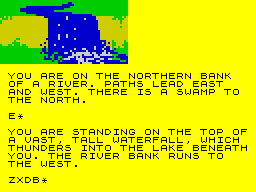
MICRO: Spectrum 48K, CBM 64 PRICE: £x.95 FORMAT: Cassette SUPPLIER: Domark Tony Bridge weighs up Eureka, Domark's five part adventure with a £25,000 prize to be won. "EUREKA" "I'VE FOUND IT!" And, according to Domark, the authors and publishers of Eureka, this is what at least 30,000 Spectrum and Commodore owners will wish to be saying soon: this is the number of people who have already ordered and bought this program which number, they hope, will eventually swell to 100,000 or more. The program is the latest in the long line of "games with prizes" that have been launched in the last few months, and there is a massive £25,000 awaiting the first lucky person to complete the adventure. The deadline is the end of 1985, after which the money will be shared equally among all the registered purchasers of the program - now let's see, £25,000 divided by 100,000... I don't think anyone can retire on that! But, it's all very well to offer fantastic prizes; that's all been done before, and the programs which are being pushed are not always, unfortunately, of the highest standard - how does Eureka, then, stand up to scrutiny? Is it merely an average adventure, knocked up quickly to take advantage of the hyperbole of the cash prize, or is it something more substantial? The box is certainly substantial, being a large book-sized affair, containing the cassette of the program and a 20-page illustrated manual. This manual contains, apart from the rather muddled instructions for use, several well-painted pictures, each of which corresponds to one of the scenarios in the program. The tape consists of five main programs, and each of these is an adventure. They take place in Prehistoric times, Roman times, Arthurian Britain, Colditz Castle (The Second World War) and The Modern Caribbean. They are designed to be played in conjunction with the illustrations and the accompanying lines of verse, which are supposed to give the player a clue (or two) to help him on his way to discovering that secret phone number. If he is the first to ring the number, Domark will shower him with lots of m-o-n-e-y (accompanied, no doubt, by the song of a thousand flash bulbs). The storyboard was written by that well-known author of two million (at least) Fighting/Fantasy game books, Ian Livingstone, who ought to know what he is doing by now. The programming of the adventures was managed by a team of Hungarian whizz-kids who, it is said, had never written an adventure before. Four graphic artists, two musicians and a professor of logic are among those who took part in the project, and the result is some 300K of program. Now to those programs, and the first surprise is that each of the five adventures comprises two sub-programs - a simple arcade game leading to the adventure itself. And when I say simple, I mean Simple! This aspect of the program was a major disappointment for me. Having seen many examples of the Hungarian taste for quirky, humorous and playable arcade games (and taking notice of the somewhat high price of the package) I was, I'm afraid, expecting something rather more than the extremely pedestrian effort that met me after loading the first program. This takes about six long minutes to load - and there is no way around it, you have to play. If you score over 25,000 points in the preceding game, every 500 extra points gives you an extra Vigour point in the adventure to follow. This could be quite a good idea, as a higher Vigour rating will give the player a better chance to win at combat. The way the arcade is presented makes the whole thing extremely tedious, however certainly a good player could rack up many extra points in this way, but the only reaction you will probably use is to say, "So What?" The games are as exciting as, last night's dog end, with character sized block graphics ambling about the screen, doing Heaven knows what to Heaven knows whom... the object of each game is not properly explained, and the controls, if the keyboard is used, are arranged in the weirdest manner! I mean, the 6 key for Left, the 7 key for Right? Well, maybe Hungarian Spectrums have a different keyboard. After this inauspicious start, I then had to wait for another five or six tedious minutes for the adventure to load (you can experience this mind-numbing pleasure with each adventure). Trying very hard to be charitable, I prepared myself for "an epic brain-teaser far in advance of the 'shoot-emgames' currently standard in the market", to quote just one example of the Domark hyperbole. Another example is: "the latest in software sophistication, colour, graphics and sound." Was I to be disappointed again? 'Fraid so! The graphics occupy the top third of the screen, while the bottom two thirds are reserved for the text messages and input pretty standard stuff, and not particularly sophisticated yet. Wait a minute, maybe there is some absolutely fantastic graphic implementation? No: the graphics consist of an admittedly pretty little scene of the current location. This usually looks like an impressionist painting, and you have to screw up your eyes to see things clearly. This unfolds across the screen, rather as if a curtain is being drawn back to reveal the scene in the Spectrum version, while the Commodore version has a myriad little coloured squares flipping over, rather like those displays so beloved of Chinese gymnasts. Sometimes, only a little of the screen is displayed, with some monster or other adversary appearing to one side at a later stage. For example, coming upon the Gate to Rome calls up the picture of The Gate trying to proceed through then brings forth a picture of The Guard, who will stop you. At other times, little moving pictures of a flapping Pterodactyl or Eagle, or crashing waves, will be shown. There is, however, no option to turn these off. And what about the promised sound? Surely a Mazurka or two from those two musicians? Sorry, only a few beeps which even I could coax forth with a couple of RND statements. Then maybe the text is out of the ordinary? W-e-l-l... this is going to sound churlish, but no, again. The descriptions of the locations are the quite standard "You are in a Swamp". The puzzles, of course, are hard, as befits an eventual prize of £25,000 (or 2p if someone doesn't crack it by the end of 1985) - as I haven't got very far in the adventures, I can't really answer for later tasks, but the first one in the Prehistoric scenario is pretty obviously to find some way to make gunpowder, as there is coal (carbon), saltpetre and other necessary requisites lying about for the taking. There is also a hollow Rib, so stuff your freshly-made gunpowder down the Rib, light it and Bang goes one of the monsters. Monsters? Oh, yes, they are here, alright. The T. Rex, of course, is out for your blood (though maybe the little mouse, in the true tradition of adventures, will frighten that one away), while the vegetarian Brachiosaurus will merely tread on you in an absentminded moment! Unfortunately, the authors have not seen fit to put a Save routine in the adventures, so, once dead, the whole thing must be played through again. This isn't too much trouble, fortunately, as the adventures are so "sophisticated" that there are none of the boring features of other adventures, like independent characters to clutter up the proceedings. No, in Eureka, the objects will always be found in the same place, so map-making will pay dividends in reincarnations. In fact, map-making is quite easy. I haven't yet found any mazes and most locations seem to follow quite logically from the previous one. It's also a good idea to try every direction - while swimming in a lake for instance, try going DOWN. A nice juicy treasure awaits (actually, it's part of the menu for a home-made bomb). Each mini-adventure possesses a different character, or style. Prehistoric, for example, puts a premium on speed - hesitate for too long, and you'll be stepped on, gnashed up or plucked up into the air (though you can get round this by typing in one letter and then going away for a couple of days to think about things). The next program, Roman, makes a virtue of WAITing around, even though the player must CAVE when he enters the 'Street of Horses'. You'd better brush up on your Latin and Roman history, though! Similarly, one adventure will respond readily to 'EXAMINE', while another will just reply 'YOU CAN'T'. All this is very disorienting, as a different style of play has to be learnt anew with each adventure. What reason, then, is there to play Eureka? Well, there is, of course that £25,000. This is a staggering sum and makes prizes like Incentive's £400 Video Recorder look like very small beer. Incentive's three programs would add up to something like £16 - but these adventures are more like the real thing. They're atmospheric, tough, and addictive, unlike the Domark effort. The puzzle book idea is not new and has been done with far more style in one case, and far less style in another so it's up to you. If you enjoy deciphering obscure pictorial clues and want to be able to light your cigarette with a fiver, then Eureka is for you, and should provide plenty of puzzles for your brain to work on. But a warning - take the adverts with a pinch of salt and don't expect "the latest in software sophistication".
Dominic Wheatley - half of Domark.
Ian Livingstone - Eureka author.
Mark Strachan - Domark's other half.
One of the booklet illustrations.
Personal Computer Games #14Jan 1985 · p.1147/106/105/106/106/10
Atmosphere 7/10
Complexity 6/10
Interaction 5/10
Overall 6/10
Steve Cooke 6/10
MACHINE: Spectrum, Commodore 64 PRICE: £14.95 The White Wizard recently tried his hand at Eureka, currently available on both the Spectrum and the Commodore 64. Contrary to popular belief, wizards tend to be an impoverished lot. Casting spells to change base metals into gold is a very tricky business requiring heavy investment in special wands and protective clothing, so the prospect of winning £25,000 had me polishing my staff in eager anticipation. Eureka, just in case you didn't know, is a five-part adventure set in different time-zones. Your task is to search through Pre-History, the Roman Empire, Arthurian Britain, Colditz, and the modern Caribbean for five pieces of a legendary talisman. Completing the talisman finishes the game. There is also the small matter of £25,000, which goes to the first person to telephone a certain number and claim the prize. The number is concealed within the game in the form of various tips and clues, either in the text or the graphics. Well, let's face it, you're statistically unlikely to be the winner, so what's it like as an adventure? Well, surprise, surprise, it isn't too bad at all. The program offers scrolling text input with (in most locations) some very attractive graphics with some novel and impressive dissolve routines. Unfortunately the vocabulary doesn't quite live up to the pictures. Entering 'Get Key' gives you the response 'You can't do that!' whereas 'Take key' gets you the key and congratulations into the bargain. Numerous words that appear in the location descriptions are not understood, and the program doesn't tell you which word it's having trouble with, replying simply 'I don't understand'. This is made more serious by a real-time element within the program. While you're busy trying to find out what word to use you might be drowning or being killed and be unable to do anything about it. Then, to add insult to injury, you must start all over again because there's no SAVE routine. Apparently the SAVE routine had to be omitted because it would have made it too easy to break into the program and possibly find out the 'phone number that brings you your life's supply of newt's tongues at £25.00 an ounce. Getting five games for £15 isn't bad value, but don't expect hundreds of locations in each one. I do think though that some of the modules are quite high on atmosphere, and because of the different time zones there's an enjoyable variety of locations. There's also some nice incidental music. I still think, though, that I'd have preferred a SAVE routine to the very distant possibility of winning £25,000.
Five time zone clash in Eureka!
Your Computer #12Dec 1984 · p.612/5
Overall 2/5
C64, Spectrum 48K £15.50 Domark Adventure Mammoth graphics adventure taking you from prehistoric times to the present day; five adventures plus five arcades which increase your strength for the adventures. Using clues in the adventures and the booklet illustrations, you must find clues to a phone number. The first person to ring the number wins £25,000, Good graphics, tortuous plots, even by adventure standards.
Your Spectrum #10Dec 1984 · p.66
David Nicholls
Peter Shaw
SPECTRUM ADVENTURES Avid adventure fanatics Peter Shaw and Dave Nicholls get to grips with Eureka, Hampstead and Peter Pan. And if you're lost or just plain suicidal in adventure-land, phone for the YS Adventure Helpline... EUREKA £25K IN 48K This month, I bring you details of Domark's first game - Eureka. Yes, this is the one that has the £25,000 prize tagged on to its rear-end (check out the ads this month). The game wasn't supposed to be available until the 31st October - magazine editors being no exception. On the other hand, we here at YS always get those exclusive stories! The game splits into five separate parts, each made up of an arcade game and an adventure. The former gets a pretty low rating in my book and probably wouldn't interest you adventure fanatics anyway. So no more about it, save the excruciating fact that you have to complete the arcade game before you can play each adventure. Yah boo sucks! The aim of the fivesome is to present a potted history of our meagre planet - starting in Prehistoric times, working on through the Roman Empire, Medieval Britain, Germany during the second World War, and on into the future. Most of the locations you visit contain graphics and, although they use a slightly lower resolution than the ZX Spectrum allows for, they're very cleverly used. At only £14.95 this set's well worth an investment. Here are a few clues to help with the 'War' level. The action begins in a cornfield (no, not that sort of action!) and from here you'll need to go south-east to find the RAF officer's uniform. When you get caught by the Germans in the village (which is inevitable) you get hauled off to Colditz and stuck in the cooler. Once out, finding your way around the camp isn't too difficult and there are only a few locations where the guards get nasty and throw you back in again. To make a German officer's uniform you'll need the sewing kit, and that you'll find under the stage. To get an ID card you'll have to go through the secret passage in the chapel - there you'll find the blank card, plus rubber stamp and camera. To make the ID look genuine, you'll need to take a picture of yourself, develop the film, stamp the card - and then bring the pieces together with the MAKE command. The rope, made from the traditional blankets, can be used to scale the drop below the window at the end of the dormitory, underneath which you'll find a pickaxe and crowbar. Once out of Colditz, you'll find yourself in the village, but so far further progress has been very slow. However, I'm sure there'll be plenty of hints on all five games in the future... watch this space!
C&VG (Computer & Video Games) #37Nov 1984 · p.29
Can you save the world and win £25,000? That's the challenge set by a brand new game from a brand new software company. The game is called Eureka! and the software company is Domark. Domark have stashed away £25,000 as first prize for the lucky person who manages to solve the Adventure - or rather five Adventures - for the Commodore 64. Domark describe Eureka! as the ultimate computer epic. It consists of five linked Adventures which take you on a journey through time - from prehistoric times, on to Nero's Rome, then Arthurian Britain, a big leap to the Second World War and Colditz and finally right up to date with an 007-style spy Adventure. All five adventures are linked - but you can play them separately. Each have "real-time" features built in. So if you don't move quickly enough in certain situations you'll miss your chance and end up as a dinosaur's breakfast or another victim in the gladiator arena. But solving the Adventures is only a part of getting that £25,000 reward for saving the world. Eureka! comes with an illustrated booklet which contains riddles and Masquerade-style illustrations which give you clues to their final solution. Unravel the riddles and you build up a secret telephone number. Get the entire number - dial it - and you could be £25,000 richer! Domark have set a 15 month time limit on the game - so you'll need to be quick. To make it fair to everyone who wants to enter, the game will be released simultaneously worldwide on October 31st - and Domark guarantee that games will be dispatched on that date. The storyline for Eureka! was devised by Ian Livingstone - the author of several Fighting Fantas y gamesbooks - and was programmed by the Andromeda teams led by Hungarian programmers' Donat Kiss and Andrss Csazar. They have included some interesting animated graphics and used some video-style split-screen techniques which make Eureka a visually interesting game as well as an entertaining adventure. Here at C&VG we had a sneak preview of one of the Adventures and reckon that that £25,000 will be hard to get - but you'll enjoy the attempt!
Tips58
- Your Sinclair #56Aug 1990 · p.55
- C&VG (Computer & Video Games) #88Feb 1989 · p.80
- Your Sinclair #37Jan 1989 · p.93
- Crash #58Nov 1988 · p.41
- Your Sinclair #34Oct 1988 · p.106
- Crash #54Jul 1988 · p.53
- Your Sinclair #29May 1988 · p.86
- Your Sinclair #28Apr 1988 · p.69
- Crash #51Apr 1988 · p.44
- Your Sinclair #27Mar 1988 · p.87
- Your Sinclair #26Feb 1988 · p.83
- Sinclair User #69Dec 1987 · p.128
- Your Sinclair #23Nov 1987 · p.78
- Crash #46Nov 1987 · p.109
- Sinclair User #66Sep 1987 · p.76
- Sinclair User #65Aug 1987 · p.72
- Your Sinclair #20Aug 1987 · p.87
- Crash #41Jun 1987 · p.68
- Your Sinclair #17May 1987 · p.64
- C&VG (Computer & Video Games) #66Apr 1987 · p.63
- ZX Computing #35Mar 1987 · p.77
- C&VG (Computer & Video Games) #65Mar 1987 · p.63
- Your Sinclair #13Jan 1987 · p.96
- Crash #36Jan 1987 · p.154
- Sinclair User #57Dec 1986 · p.100
Full-page ad44
- Sinclair User #36Mar 1985 · p.73
- Micro Adventurer #16Feb 1985 · p.5
- Popular Computing Weekly #6Feb 1985 · p.17
- Popular Computing Weekly #8Feb 1985 · p.23
- Sinclair Programs #27Jan 1985 · p.20
- Micro Adventurer #15Jan 1985 · p.46
- Sinclair Answers #2Jan 1985 · p.26
- Personal Computer Games #14Jan 1985 · p.159
- TV GamerJan 1985 · p.51
- Personal Computer News #93Jan 1985 · p.44
- Popular Computing Weekly #2Jan 1985 · p.16
- Popular Computing Weekly #3Jan 1985 · p.9
- ZX Computing #16Dec 1984 · p.46
- Big K #9Dec 1984 · p.7
- C&VG (Computer & Video Games) #38Dec 1984 · p.40
- Personal Computer Games #13Dec 1984 · p.15
- TV GamerDec 1984 · p.4
- Popular Computing Weekly #49Dec 1984 · p.82
- Popular Computing Weekly #51Dec 1984 · p.25
- Sinclair User #32Nov 1984 · p.29
- Your Computer #11Nov 1984 · p.90
- Your Spectrum #9Nov 1984
- Sinclair Programs #25Nov 1984 · p.2
- Crash #10Nov 1984 · p.41
- Micro Adventurer #13Nov 1984 · p.59
News/Note26
- C&VG (Computer & Video Games) #62Dec 1986 · p.62
- Crash #29Jun 1986 · p.121
- C&VG (Computer & Video Games) #49Nov 1985 · p.9
- Computer Gamer #8Nov 1985 · p.30
- Crash #21Oct 1985 · p.20
- Home Computing Weekly #130Sep 1985 · p.6
- Popular Computing Weekly #36Sep 1985 · p.5
- Popular Computing Weekly #38Sep 1985 · p.28
- ZX Computing #18Apr 1985 · p.20
- Home Computing Weekly #102Mar 1985 · p.1
- Big K #11Feb 1985 · p.3
- Personal Computer Games #15Feb 1985 · p.10
- Popular Computing Weekly #9Feb 1985 · p.36
- Sinclair User #34Jan 1985 · p.12
- Personal Computer Games #14Jan 1985 · p.19
- Personal Computing Today #6Jan 1985 · p.9
- Micro Adventurer #14Dec 1984 · p.6
- Crash #10Nov 1984 · p.38
- C&VG (Computer & Video Games) #37Nov 1984 · p.29
- Personal Computer Games #12Nov 1984 · p.17
- TV GamerNov 1984 · p.7
- Home Computing Weekly #88Nov 1984 · p.9
- Your Spectrum #8Oct 1984 · p.6
- Micro Adventurer #12Oct 1984 · p.6
- Personal Computer Games #11Oct 1984 · p.13
Advert21
- White Dwarf #59Nov 1984 · p.21
- Your Computer #10Oct 1984 · p.93
- Your Computer #10Oct 1984 · p.95
- Big K #7Oct 1984 · p.45
- Big K #7Oct 1984 · p.47
- C&VG (Computer & Video Games) #36Oct 1984 · p.73
- C&VG (Computer & Video Games) #36Oct 1984 · p.75
- Personal Computer Games #11Oct 1984 · p.21
- Personal Computer Games #11Oct 1984 · p.23
- Personal Computer News #79Sep 1984 · p.9
- Personal Computer News #79Sep 1984 · p.11
- Home Computing Weekly #79Sep 1984 · p.13
- Home Computing Weekly #79Sep 1984 · p.15
- Home Computing Weekly #80Sep 1984 · p.9
- Home Computing Weekly #80Sep 1984 · p.11
- Popular Computing Weekly #36Sep 1984 · p.25
- Popular Computing Weekly #36Sep 1984 · p.27
- Home Computing Weekly #77Aug 1984 · p.13
- Home Computing Weekly #77Aug 1984 · p.15
- Popular Computing Weekly #35Aug 1984 · p.13
- Popular Computing Weekly #35Aug 1984 · p.15
Feature4
- C&VG (Computer & Video Games) #66Apr 1987 · p.54
- Big K #12Mar 1985 · p.28
- Your Spectrum #10Dec 1984 · p.66
- Games ComputingNov 1984 · p.45
Letters4
- C&VG (Computer & Video Games) #45Jul 1985 · p.79
- C&VG (Computer & Video Games) #41Mar 1985 · p.5
- Micro Adventurer #16Feb 1985 · p.4
- Home Computing Weekly #91Dec 1984 · p.34
CompoEntry3
- C&VG (Computer & Video Games) #42Apr 1985 · p.104
- Micro Adventurer #13Nov 1984 · p.29
- C&VG (Computer & Video Games) #37Nov 1984 · p.14
Classified3
- Popular Computing Weekly #2Jan 1985 · p.40
- Popular Computing Weekly #49Dec 1984 · p.90
- Popular Computing Weekly #51Dec 1984 · p.62
Solution2
- MicroHobby #197Mar 1990 · p.57
- C&VG (Computer & Video Games) #42Apr 1985 · p.106
Review2
- Sinclair Answers #2Jan 1985 · p.39
- White Dwarf #60Dec 1984 · p.30
Preview2
- Your Spectrum #10Dec 1984 · p.66
- TV GamerNov 1984 · p.34
Information1
- SSD-IISep 1999
Hack/Poke1
- Popular Computing Weekly #35Aug 1985 · p.26
CompoResult1
- C&VG (Computer & Video Games) #45Jul 1985 · p.63
Map1
- C&VG (Computer & Video Games) #42Apr 1985 · p.106
Two-page ad1
- Your Spectrum #8Oct 1984 · p.24
Licensed from
- Eureka!BookIan Livingstone [1]
Related
- Ports
- (Commodore 64)
- Same entry at
- Spectrum ComputingZXInfo
Reviews from people here
Sign in to write about this, or make an account. It takes a minute and lets you correct the catalogue too.
No language recorded.
Sign in to correct or add to this.
Hold the rights to this and want it taken down?