
Everest Ascent
Strategy Game: Management · ZX-Spectrum 48K · 1 players · English
Richard Shepherd Software Ltd · 1983 · Pound sterling 6.50
Discussion
Nobody has started a thread about this yet.
Releases
- 1983Richard Shepherd Software LtdPound sterling 6.50
- UnknownRiko Data
Play
- EverestAscent.tzx.zipTape image English12 KB
- EverestAscent(different).tzx.zipTape image English23 KB
- EverestAscent.tap.zipTape image English11 KB
Documents
- EverestAscent.txtInstructions English3 KB
Files and rights
No permission is on record either way. Screens and pictures are copied here on a take-down basis: if you hold the rights and want something removed, say so and it goes.
Credits
- Richard Shepherdcredited
Sign in to credit somebody, or say what these people did.
Scores
Elsewhere on the web
- WorldOfSpectrum 14 votes4.86
In the magazines 86
Crash #4May 1984 · p.68
Producer: Richard Shepherd, 48K £6.50 You have 20 days to reach the summit of Everest, starting off with limited funds (money comes in from sponsors if you seem to be doing well, but it isn't credited to you if you've forgotten to buy a radio). You must hire Sherpas with homely names and varying strengths and the habit of deserting you if you're not fed properly. Their equipment and supplies are expensive and they eat like horses. Neat graphics and the familiar prompt menu for buying and moving about. It takes some getting into and early expeditions usually last a short time until you realise what's needed most. A good average.
Crash #2Mar 1984 · p.64
Producer: Richard Shepherd, 48K £6.5O You have 20 days to reach the summit of Everest, starting off with limited funds (money comes in from sponsors if you seem to be doing well, but it isn't credited to you if you've forgotten to buy a radio). You must hire Sherpas with homely names and varying strengths and the habit of deserting you if you're not fed properly. Their equipment and supplies are expensive and they eat like horses. Neat graphics and the familiar prompt menu for buying and moving about. It takes some getting into and early expeditions usually last a short time until you realise what's needed most. A good average.
Crash #1Feb 1984 · p.61
Producer: Richard Shepherd, 48K £6.50 You have 20 days to reach the summit of Everest, starting off with limited funds (money comes in from sponsors if you seem to be doing well, but it isn't credited to you if you've forgotten to buy a radio). You must hire Sherpas with homely names and varying strengths and the habit of deserting you if you're not fed properly. Their equipment and supplies are expensive and they eat like horses. Neat graphics and the familiar prompt menu for buying and moving about. It takes some getting into and early expeditions usually last a short time until you realise what's needed most. A good average.
Your Computer #7Jul 1983 · p.62
Meirion Jones
FROM DEEP-SPACE ADVENTURES TO WORLDLY BOARD-GAMES IN MEIRION JONES' SURVEY Less than a year ago the appearance of Scrabble on disc for the Apple caused consternation among micro owners. The program defeated three-quarters of the humans who challenged it to a dual of words. At least Scrabblers could comfort themselves with the knowledge that they had been beaten by a £750 disc-based system. Now Psion has taken even that consolation away by launching an improved version of the game with a bigger dictionary and better graphics which will run on a £150 system - the 48K Spectrum and a cassette recorder. This illustrates the rate at which Spectrum software is improving. The latest releases include clever implementations of board- games like monopoly and arcade favourites such as Scramble, long and complicated Adventures with names like Knight's Quest and combinations of arcade and Adventure like Pixel's Trader. While serious and educational material software is still thin on the ground, programs like Hewson's Countries of the World show how much useful information can be packed into the Spectrum. MORE ORIGINALITY Unfortunately the standard is not uniformly high. Sometimes imagination is lacking. Bridge software still insists on marketing what it calls "an exciting game for two to six players". Yes, you guessed, it is boring old Hangman. At other times graphics are weak. Micromega sells a version of Roulette which features a roulette wheel which looks more like a flying saucer on an off day. There is still too high a percentage of unloadable tapes and of tapes which you wished had been unloadable. Davic Games Tape 1, for instance, features a game which has Tooth Monsters instead of ghosts, which is probably the dullest-ever version of Pac-Man. The Tooth Monsters themselves are about as threatening as a pair of jelly babies. If you want real tooth monsters try Imagine's excellent Molar Maul. This is a real nerve-tingler from the moment that an enormous set of gleaming teeth appears on the screen like something out of jaws. Armed only with a toothbrush and toothpaste you have to defend these dentures from swarms of evil bacteria. These germs go by the name of Dentorium Kamikazium which allows Imagine to talk about "the DK Menace" - a triple pun partly at the expense of Imagine's Ipswich-based rivals DK'tronics. Imagine's punsters are at work again on the cover of Arcadia where we are told we are fighting against the "deadly menace of the Atarian empire". Perhaps this explains why Sinclair owners have shown such enthusiasm for Arcadia because the game itself is just a lacklustre version of Galaxians. Much better is Imagine's Schizoids. If, like me, you have always wanted to be a bulldozer, Schizoids is the game for you. You are a bulldozer in outer space and your job is to push tumbling cubes and pyramids into a nearby black hole without falling in yourself. Perhaps this nearby anomaly in the space-time continuum affects the wavelength of light. At any rate the game itself is only in black and white. Pixel is another company which cannot resist veiled messages. Trader is part space Adventure and part arcade game. The Adventure, trading commodities between different worlds, is more convincing than the crude skill tests such as finding the right orbit when approaching a planet. Trader may well be bought as much for its attractive packaging - which includes a survival guide for the would-be Trader - as for the game itself. After buying supplies for your first trip you set out for the planet Psi where the inhabitants - yes, Psions - who look like a cross between Clive Sinclair's beard and a muppet ask you tiresome questions such as "What is the formula for carbon monoxide?" or "What is your first name?". Entering "Clive" as an answer elicits the response "What a strange name". So, for that matter, does any other reply. If disaster should strike, a caption will appear saying "Is this the end...?" The answer is "No" because Trader is a trilogy so there are another two complete parts to load from the tape. There are many more traditional text Adventures of the "Go south, open door, take gold" variety but the narrowness of the replies they will accept is often irritating. DOWN THE MINES Mikrogen's Mines of Saturn starts with a cheery "Have fun" and then proceeds to ask questions like "Tunnels lead N, S, E and W - what will you do?" Attempts to answer "N" or "go N" or even "go n" will not wash. It must be "go North" or nothing. At least Phipps' Knight's Quest has a 120-word vocabulary to help you on your damsel-ridden way to a castle in the air. Everest by Richard Shepherd Software is more of a strategy game than a straight Adventure. You have to take enough food and rope to climb the mountain and cope with every hazard. I enjoyed the climb but I never reached the summit - partly because the Sherpas are not what they used to be. When Sir Edmund Hillary climbed Everest for the first time he managed to find a Sherpa called Tensing. The time when you visit a Nepalese hill village to recruit porters you are asked to choose between Sherpas with names like Keith, Brian, Ron, Tim and Paul. Presumably they are ex-hippies, lost on the road to Katmandu. Things obviously still are what they used to be down at Mikrogen. If Andy Capp sends you into fits of laughter Mad Martha might just raise a smile. It is the same old story, boy meets girl, well, hen-pecked husband meets axe-happy wife - all very predictable. Mikrogen also sells arcade games like Cosmic Raiders - a competent impersonation of Defender with a long-range screen and grabbers. Melbourne House's variation on the same theme is called Penetrator. The display looks more like the arcade version of Scramble. A training facility to help you build up specific game skills is a good idea. C-Tech's Rocket Raider is yet another competent variant on similar lines. Artic offers a suicidally fast asteroids game called Cosmic Debris. Still in the arcades, both Elfin Software and Quicksilva produce robot battles which are of the Pac-Man-meets-Tanks variety. Elfin's Tobor has the more exciting opening titles but loses on points to Quicksilva's QS Frenzy whose exotic science-fiction plot seems to offer a better justification for the game. Speaking of Tanks, DK'tronics 3D Tanx was one of my favourite programs in the whole batch. You can track you gun barrel from side to side and adjust the elevation as you lob your shells at four lines of moving tanks which can fire back at you. Although the opposing tanks at first appear to be crawling across a structure that looks more like Brighton's West Pier than a battleground, this is one of my four games you might catch me paying to play in an arcade. JOIN THE PROFESSIONALS Artic's Combat Zone is another ambitious attempt at a Tank game. Your target and the landscape - a few pyramids on an invisible plane - look like refugees from Psion's Vu-3D program. They are very simple three-dimensional shapes but they change position smoothly and realistically as if you were walking past them in some world inside your Spectrum. You and your opponents fire fragments of cubist paintings at each other but the abstraction is not so important as the fact that you are playing the first real Spectrum game in three dimensions - Vu-3D itself is a Psion program which allows you to build up three dimensional objects on the screen and then rotate them, or float them towards you and back again. In effect it is a crude version of the mainframe programs which create the effects for films like Tron. ET makes an appearance too in an Abbex Adventure with voices called ETX. Unfortunately after loading pages of instructions about how I should phone home ending with the advice that I should treat any MI5 man who appeared as an enemy, the tape self-destructed. This left me with an unnerving impression of "the strength of Britain's security services. The secret police are certainly important in DK'tronics strategy game called Dictator. The setting is a banana republic. The instructions ominously point out that "your rule is measured in months". You have to balance political factions, army, secret police, peasants, landowners, guerillas and superpowers if you are to survive. Breaking into embassies would doubtless be all in a day's work for a dictator. So for all prospective saviours of the nation, Sinclair's Embassy Assault will come in useful. It is very much like those maze games which present your view. standing in the maze. Instead of trying to avoid a minotaur, this time you are looking for secret codes and the like. All this is enough to send you back into the arcades but Jet Pac's creators have moved from the arcades into home computing. Ultimate Play the Game's Jet Pac puts you into the position of an astronaut who has to build a rocket from the pieces he can find sitting on clouds around the screen. The scenario is not entirely convincing but it makes for a good game. The same cannot be said of the simulations by CCS. CCS's representations of the oil business, Dallas, running a printers, Print Room, and of international aviation, Airline, may be realistic but they are not very exciting. Although these were originally designed as training for middle management, livelier presentation would not necessarily have made them less useful. Hewson's simulations of air-traffic control, Heathrow, and the Nightflite flight simulator are more convincing. Board-games seem to transfer particularly well to the Spectrum. Psion's Scrabble has already been recommended. With its four levels of play and 11,000-word dictionary it can offer almost as tough opposition as you could want. There are also two different approaches to that old favourite Monopoly. Automonopoli offers a continuous display of the part of the board around your current position. This display moves smoothly when the dice are thrown. Do Not Pass Go from Workforce has a less interesting display but at least shows the whole board all the time. Automonopoli allows you to personalise the program with the names of players and both programs give the option of being either a board for humans to play on or of letting the computer join in as a player. In each case the computer becomes a soft opponent once you have reached the stage of building houses and hotels. If you have ever wandered into a rundown dockland hotel or pub and been confronted by the sort of balding drunk who says he used to sail the seven seas and boasts that he can name the capital of any country you care to choose, I can reveal his secret. At home he has a Spectrum with Hewson's Countries of the World up and running on it. At the touch of a button it will remind you that N'djamena is the capital of Chad or that Yaounde is the capital of Cameroon. In the corner of the pub someone with probably be playing a video game not unlike Firebirds. Softek's Firebirds is a Galaxians-type game distinguished by good croaking noises from the birds. Still on the subject of sound effects Workforce's Jaws Revenge is very noisy and fun. The graphics are great. You are a shark and you are after the divers and- boats which are after you. Mined Out from Quicksilva is a very strange version of Mines. It is subtitled "Rescue Bill the worm from certain old age" and if you find a way through the first minefield you then have to rescue damsels in distress. Someone at Quicksilva has been playing too many Adventure games and it is beginning to show. The last words on the cassette packet read "the image fades to soft focus which is replaced by waves falling on a rocky shore, except in Bill's dream there are no waves or soft focus..." It is certainly time that software cassettes carried a government health warning. Company: Abbex Game: ETX Memory: 16/48K Price: £5.95 Company: Artic Game: 3D Combat Zone Memory: 48K Price: £5.95 Company: Artic Game: Cosmic Debris Memory: 48K Price: £4.95 Company: Automata Game: Automonopoli Memory: 16/48K Price: £6 Company: Bridge Game: Lynchmob Memory: 16K Price: £6.50 Company: CCS Software Game: Dallas Memory: 48K Price: £6 Company: C-Tech Game: Rocket Raider Memory: 16K Price: £6.50 Company: DK'Tronics Game: 3D Tanx Memory: 16/48K Price: £4.95 Company: DK'Tronics Game: Dictator Memory: 48K Price: £4.95 Company: Elfin Game: Tobor Memory: 48K Price: £7.95 Company: Hewson Game: Heathrow Memory: 16/48K Price: £7.95 Company: Hewson Game: Countries of the World Memory: 16/48K Price: £5.95 Company: Imagine Game: Molar Maul Memory: 16/48K Price: £5.50 Company: Imagine Game: Arcadia Memory: 16/48K Price: £5.50 Company: Imagine Game: Schizoids Memory: 16/48K Price: £5.50 Company: Melbourne House Game: Penetrator Memory: 48K Price: £6.95 Company: Micromega Game: Roulette Memory: 16/48K Price: £4.95 Company: Mikrogen Game: Cosmic Raiders Memory: 16/48K Price: £5.95 Company: Mikrogen Game: Mines of Saturn Memory: 48K Price: £5.95 Company: Mikrogen Game: Mad Martha Memory: 48K Price: £6.95 Company: Phipps Game: Knight's Quest Memory: 48K Price: £5.95 Company: Psion Game: Scrabble Memory: 48K Price: £15.95 Company: Psion Game: Vu-3D Memory: 48K Price: £9.95 Company: Quicksilva Game: Frenzy Memory: 16/48K Price: £4.95 Company: Quicksilva Game: Trader Memory: 16/48K Price: £9.95 Company: Quicksilva Game: Mined Out Memory: 48K Price: £4.95 Company: Richard Shepherd Game: Everest Ascent Memory: 48K Price: £6.50 Company: Sinclair Research Game: Embassy Assault Memory: 16/48K Price: £4.95 Company: Softek Game: Firebirds Memory: 16K Price: £5.95 Company: Ultimate Play The Game Game: Jet Pac Memory: 16/48K Price: £5.50 Company: Workforce Game: Do Not Pass Go Memory: 48K Price: £6.95 Company: Workforce Game: Jaws Revenge Memory: 16/48K Price: £5.95
Personal Computer News #13Jun 1983 · p.483/54/54/54/5
Lasting Appeal 3/5
Playability 4/5
Use Of Machine 4/5
Value For Money 4/5
Ralph Bancroft
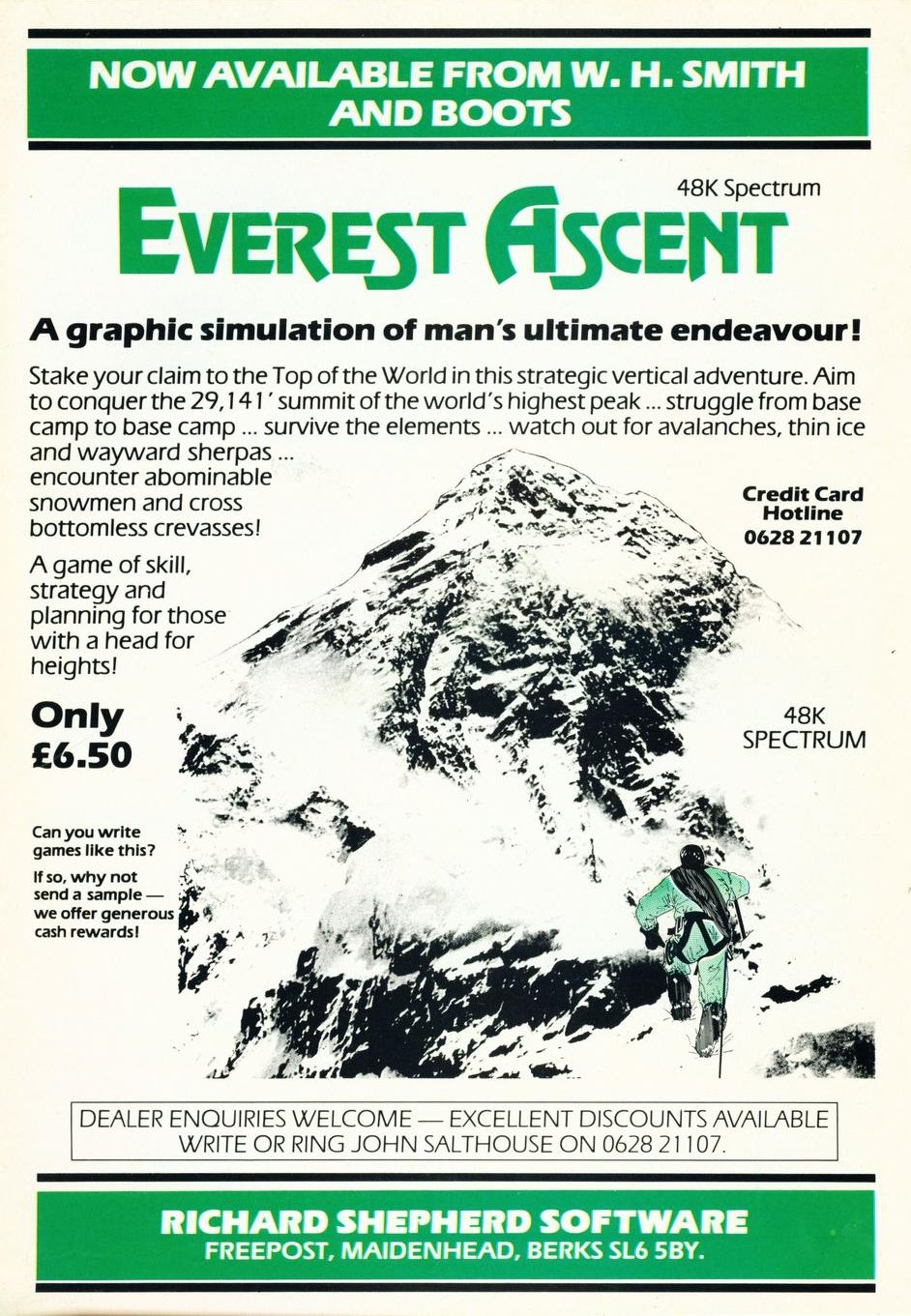
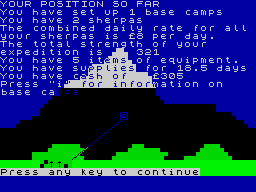
NAME: Everest Ascent SYSTEM: 48K Spectrum PRICE: £6.50 PUBLISHER: Richard Shepherd Software, [redacted] FORMAT: Cassette LANGUAGE: Machine Code OUTLETS: Mail Order from Richard Shepherd Software, [redacted] UPHILL STRUGGLE Everest Ascent is described as an adventure-type game, but this is perhaps an overstatement. It lacks the complexities of a true dungeons and dragons adventure, and is relatively easy to crack. But it will still provide hours of entertainment and frustration. OBJECTIVES The object of the game is to climb Everest. You have an initial £1,000 to finance your expedition, and you can buy equipment and supplies, hire sherpas to carry it and build tip to three base camps. FIRST IMPRESSIONS It takes 20 days to scale the mountain, and play takes the form of two moves a day. There are numerous hazards to overcome, such as crevasses, rockfalls, thin ice, avalanches, and an abominable snowman. Different equipment is needed to deal with the hazards and you will find that above certain heights you need oxygen and heat pads. As play progresses, your expedition gains international recognition and donations come flooding in. The snag is that you have to return to the sherpas' village to collect the cash. But this does give you the chance to recruit more sherpas and buy more supplies. Your strength rating is the key to the game. Too low and you could find a message flashing up telling you that the expedition is exhausted because of your dynamic leadership. You can increase your strength rating by hiring additional sherpas - some have higher ratings, but they expect to be paid more. As seems typical for low cost games software, the cassette comes with the minimum of explanation. One irritating problem was the LOADing instructions, which were inadequate. IN PLAY Once LOADed, the program draws an animated picture of Everest with snow falling. I don't know what falling snow should sound like, but I'm sure it's nothing like the clicking coming out of the Spectrum's speaker. Pressing any key takes you through a couple of pages of brief instructions. There then follow three pages that allow you to hire sherpas, buy equipment and buy supplies. This takes you to the morning of the first day. Throughout the rest of the game, any response to a question leads to a graphic superimposed with text offering four options of what to do nexL My first expedition came to a grinding halt at the end of the first day. I forgot to buy a tent Returning to the village I tried to buy a tent only to be told that I had no money left! End of the first game, and a dawning realisation that careful planning was essential to success. The next expedition fared a little better. At the start of the second day I ran into the first hazard. Needless to say I didn't have the required piece of equipment. Returning to the village I bought it and had carefully calculated that I should have £86 left. As I left the village, a message flashed upon the screen to say that I had run out of money. In fact this problem was to happen again - on several occasions. This was no fault of mine, and I can only conclude that there was a fault in the program. The other annoying problem I came across also lay with the way the program was written, I found that it was possible to get trapped by a hazard that appears where it should not be. To give an example, I discovered that above a certain height, heat pads were required. In a subsequent game, I planned to build a base camp immediately below this height, and carry the heat pads up to it before returning to the village. Everything went well. I reached the predetermined overnight point, and went through the procedure for setting up a base camp. The following morning I attempted to retrace my steps back down the mountain only to be confronted by a message 'heat pads required above this height'. The aforementioned heat pads had of course been left at the base camp, so I tried going back, only to be told 'heat pads required above this point'. No matter whether I tried going up or down the mountain, the same message flashed up on the screen. In the end that expedition collapsed exhausted 'because of my dynamic leadership'. Further expeditions suggested alternative strategies, and eventually I stormed up the mountain accompanied by virtually all the sherpas available and carrying all the equipment I could buy. Incidentally, because of the international recognition, the expedition ended up with a nice £7,000 profit! Having done it once I tried different permutations to do it quicker and more cheaply. It absorbed many happy hours of frustration as I tried to unravel the logic of the programmers. My only lasting disappointment was that no matter how hard I tried, I couldn't find a way of climbing the mountain single-handed without oxygen! VERDICT The game is based on the challenge of climbing Everest using a big support team. It's easy to master the basic technique of playing the game while you're thinking out the winning strategy. Having found a solution the game could, for some people, lose its appeal, but you may enjoy trying to find different ways to reach the top. A lot of thought has gone into the game, so it's a shame it's partially spoiled by some quirky features.
Advert68
- Micro Adventurer #8Jun 1984 · p.5
- ZX Computing #13Jun 1984 · p.27
- Micro Adventurer #7May 1984 · p.23
- Sinclair User #26May 1984 · p.60
- Popular Computing Weekly #15Apr 1984 · p.9
- Computer ChoiceApr 1984 · p.79
- Personal Computer Games #4Mar 1984 · p.96
- C&VG (Computer & Video Games) #29Mar 1984 · p.12
- Computer ChoiceMar 1984 · p.31
- Micro Adventurer #5Mar 1984 · p.31
- Your Spectrum #2Mar 1984 · p.55
- Sinclair User #24Mar 1984 · p.117
- Sinclair User #23Feb 1984 · p.31
- Micro Adventurer #4Feb 1984 · p.21
- Your Computer #2Feb 1984 · p.207
- Games ComputingFeb 1984 · p.103
- ZX Computing #11Feb 1984 · p.71
- Personal Computer Games #3Feb 1984 · p.153
- Sinclair User #22Jan 1984 · p.133
- Computer ChoiceJan 1984 · p.57
- Micro Adventurer #3Jan 1984 · p.27
- Sinclair Programs #15Jan 1984 · p.5
- Games ComputingJan 1984 · p.39
- Home Computing Weekly #45Jan 1984 · p.35
- Sinclair User1984 · p.67
Full-page ad9
- Home Computing Weekly #43Jan 1984 · p.20
- Popular Computing Weekly #43Oct 1983 · p.8
- Popular Computing Weekly #42Oct 1983 · p.2
- Home Computing Weekly #29Sep 1983 · p.8
- Popular Computing Weekly #35Sep 1983 · p.25
- Popular Computing Weekly #36Sep 1983 · p.16
- Home Computing Weekly #23Aug 1983 · p.7
- Home Computing Weekly #19Jul 1983 · p.16
- Popular Computing Weekly #28Jul 1983 · p.2
News/Note2
- Computer ChoiceJan 1984 · p.8
- Home Computing Weekly #1Mar 1983 · p.9
Feature1
- Your Computer #7Jul 1983 · p.62
Review1
- Home Computing Weekly #5Apr 1983 · p.21
Related
- Ports
- (Commodore 64)
- Same entry at
- Spectrum ComputingZXInfo
Reviews from people here
Sign in to write about this, or make an account. It takes a minute and lets you correct the catalogue too.
No description, tag recorded.
Sign in to correct or add to this.
Hold the rights to this and want it taken down?