
Explorer
Adventure Game: Graphic · ZX-Spectrum 48K · 1 players · English
Electric Dreams Software · 1986 · Pound sterling 7.99
Discussion
Nobody has started a thread about this yet.
Remarks
ZXSR: Your Sinclair cover demo (42 - Jun 1989)
- Control Option
- Interface 2 (left), Interface 2 (right), Kempston Joystick
Releases
- 1986Electric Dreams SoftwarePound sterling 7.99
- 1987Proein Soft Line
Play
- Explorer.tzx.zipwithheld by rights holder
Documents
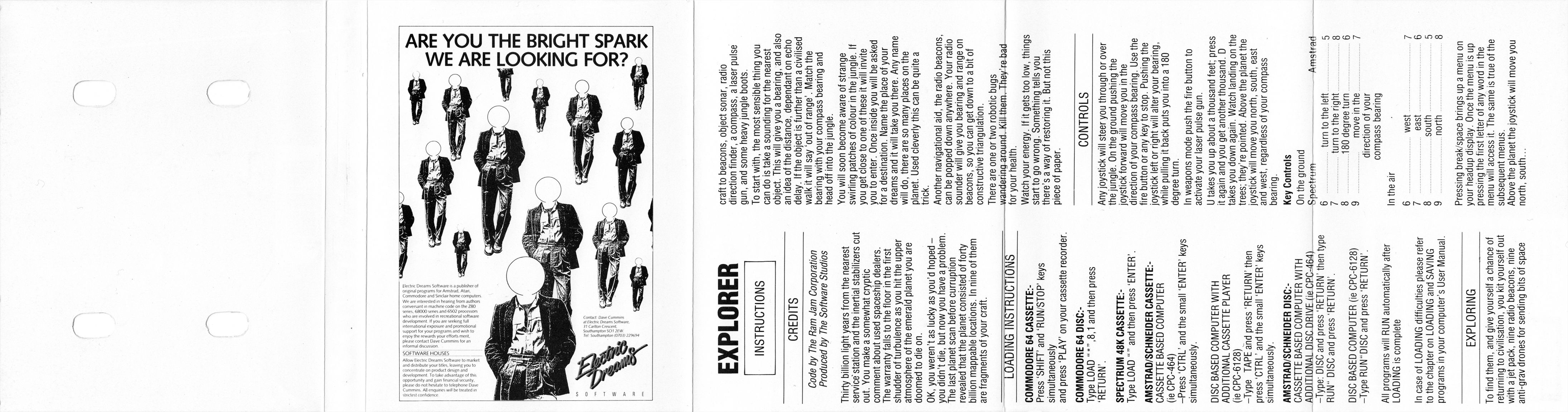
- Explorer_GameAddMat.pdfGame additional material English383 KB
- Explorer.txtInstructions English9 KB
- Explorer(ProeinSoftLine).pdfInstructions Spanish64 KB
- Explorer(ProeinSoftLine).txtInstructions Spanish5 KB
Other files
- Explorer.jpgAdvertisement 168 KB
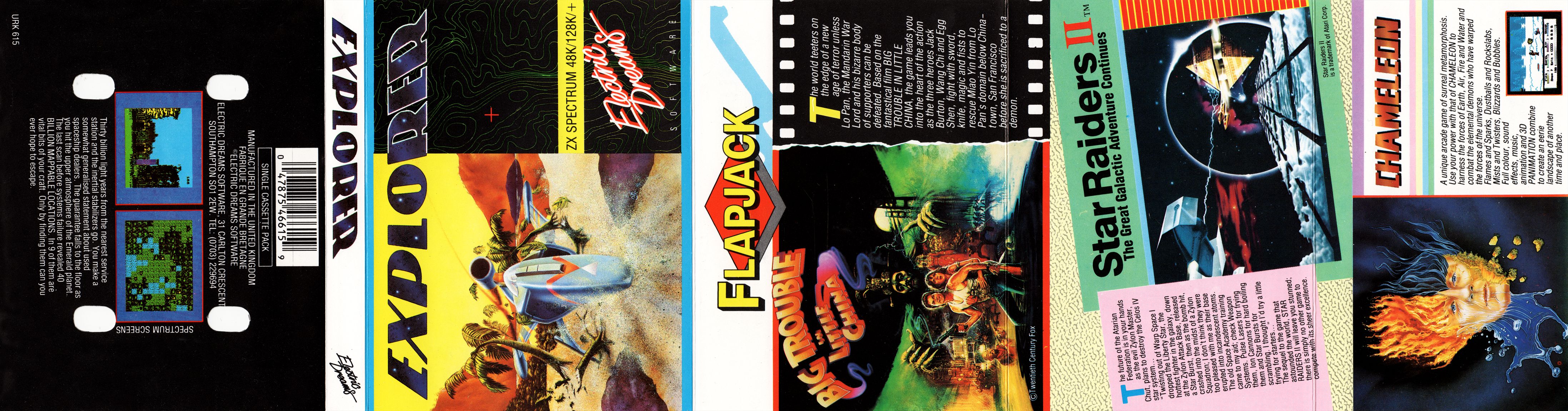
- Explorer_Back.jpgInlay - Back 853 KB
- Explorer(ProeinSoftLine).jpgInlay - Front 116 KB
- Explorer.jpgInlay - Front 1,243 KB
- Explorer.scrLoading screen 7 KB
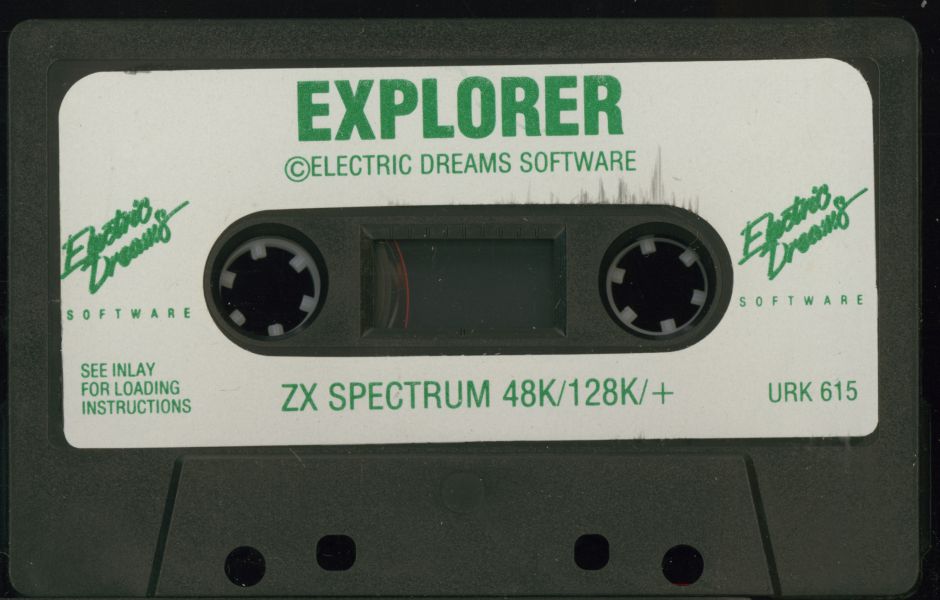
- Explorer_Tape.jpgMedia scan 80 KB
- Explorer (1986)(Electric Dreams Software).pokPOK pokes file 0 KB
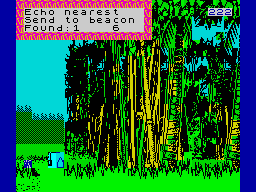
- Explorer.gifRunning screen 8 KB

.jpg)
Files and rights
The rights holder has refused distribution. Files are listed because their existence is a catalogue fact, and none are served from here.
- DeniedElectric Dreams Software → WorldOfSpectrum
Credits
- Graham T. RelfCode
- Simon DunstanIn-game Graphics
- David John RoweInlay/Poster Art
Sign in to credit somebody, or say what these people did.
Scores
In the magazines
- Sinclair User #591987 · Overall3/5
- Crash #381987 · Overall32%
Elsewhere on the web
- WorldOfSpectrum 26 votes6.33
In the magazines 14
Crash #38Mar 1987 · p.10162%60%38%33%44%32%
Presentation 62%
Graphics 60%
Playability 38%
Addictive Qualities 33%
Value For Money 44%
Overall 32%
Ben Stone
Mike Dunn
Paul Sumner
Producer: Electric Dreams Retail Price: £7.99 Author: The Ram Jam Corporation Gargantuan is an over-used adjective, but 40 billion mappable locations seems to qualify, so using it one more time to describe Explorer won't do any harm. The RAM JAM CORPORATION has ever been a source of oddities, from its first and marvellously humorous Valkyrie 17 adventure. In this new quest, the cosmic joke is that your second-hand space vehicle has broken up over the Emerald planet. To make matters worse, fragments of your craft have scattered around nine of its 40 billion locations. Sounds like you've got to find them all before escape is possible. Some cosmic joke, huh? Several vital instruments have survived the crash. There's a Compass, a Homing Beacon, Direction Finder, a Laser Pulse Gun and an all-important Sonar. Recovering the ship parts is a problem, but at least the sonar makes life sound brighter - by bouncing an echo off an object, its bearing and rough distance is revealed. A short walk through the jungle is okay, but you're told if the range is too far for a stroll and it's then time to take to the trusty jet-pack. When within range of an object, travelling can be done on foot. Pressing the forward key brings the front view into sharp relief and shows the next planet section. Left and right movements for even a full 180 degree turn) are shown as a bearing at the top of the screen. The Emerald Planet is largely uninhabited, except for a strange breed of energy-sapping robotic bugs. Energy loss can be fatal, and although there is a means of replenishing it, killing the robots is a far better method of staying alive. A Laser Pulse Gun is a handy extra when it comes to bugs - it's accessed through Weapons Mode. Swirling patches of colour are encountered deeper in the jungle. These act as doorways to locations elsewhere on the planet. Remember there are 40 billion, so almost any name will do for a destination. Mind you, you can get lost too, so this is where the homing beacons come in. These can be dropped anywhere to be used as useful reference points - they're seen from the air as flashing squares. The energy available to power all the equipment is limited, and the level of reserves is shown as one of the menu options, which can be accessed at any time by pressing FIRE and then the first letter of the required option. COMMENTS Control keys: on the ground: 6 turn to the left, 7 turn to the right, 8 180 degree turn, 9 move in the direction of your compass bearing. In the air: 6 west, 7 east, 8 south, 9 north Joystick: Kempston, Cursor, Interface 2 Use of colour: very jungle-ish Graphics: attractive, but it's sometimes hard to see what's going on Sound: very little Skill levels: one Screens: would you believe - 40 billion?
A jet-packing explorer's view of the Emerald planet.
The Explorer discovers a teleporter - will it help in the quest for spaceship parts?
C&VG (Computer & Video Games) #65Mar 1987 · p.226/10N/A2/102/10
Graphics 6/10
Sound N/A
Value 2/10
Playability 2/10
David Bishop
MACHINE: Amstrad CPC464/664/6128/Spectrum SUPPLIER: Electric Dreams PRICE: £14.99 (disk) Version Tested: Amstrad Disk I am always sceptical of any game whose inlay card promises zillions of different screens because, in most cases this "technical innovation" is either camouflage or the reason for a very thin game. Fortunately there have been games of this ilk that have actually delivered the goods - notably the Doomdark series from Beyond. Unfortunately Explorer is not one of those happy exceptions to the rule. Stranded 30-billion light years from the nearest service station, your inertial stablizers have inconveniently cut out. The only thing to do is crash and on the Emerald planet below you. Just prior to impact, your ships sensors told you that the planet consisted of 40 billion mappable locations. That's the good news. The bad news is that the impact of the crash has scattered fragments of your ship into nine of them. You must find all nine bits of your ship before escaping the Emerald planet. To help you in your quest you have various bits of equipment at your disposal, including a jet pack, nine radio beacons, nine anti-grav drones for sending any spacecraft bits you have found to the nearest beacon, object sonar, radio direction finder, a compass, and a laser pulse gun which is used to kill off any robotic bugs you may find - a tedious addition to the game. Radio beacons can be dropped anywhere and then used whenever you want to get your bearings by using triangulation. The jet pack allows you to hover 1,000 or 2,000 feet above the planets surface in order to survey the surrounding terrain. You can also move in any direction with the jet pack. This is a much faster way to travel than treking over the planets surface. An even faster way of getting about is found inside strange red and yellow checked structures that seem to act as some kind of transporter points. Once you have entered one you will be asked where you want to go. You can enter anything from London to Metcalfesuille - every place exists on the Emerald planet, but every time you enter a transporter point and type in the same place thats where you'll be taken - so at least its consistent. All the locations are shown as full screen graphics built up from a number of graphical primitives giving an effective atmospheric feel to the proceedings. Such features as palm trees, running water, temples, and other dwellings are visible, but very little of the surface feature can be interacted with. As you alter your compass heading so your view flicks round to reflect the new direction in which you're heading. The trouble is that, after a while, each new location looks the same as the last one. Explorer is a brave attempt at creating something a little different on computer, but it turns out to be little more than a triangulation exercise with graphics bolted on to obscure the fact that it's a tediously boring exercise at that! if you want to get your bearings - steer clear of this one.
Sinclair User #59Feb 1987 · p.853/53/5
Overall 3/5
Gary Rook 3/5
Label: Electric Dreams Author: Ram Jam Price: £7.95 Memory: 48K/128K Reviewer: Gary Rook Explorer has at last been released by Electric Dreams. Programmed by RamJam, it is a technical tour de force but, unfortunately, beneath all the coding, there isn't that much of a game. The plot is very basic. You're a space pilot whose ship has just crashed on the 'emerald planet'. While skimming the atmosphere, various bits of your spacecraft have been distributed in widely scattered locations. To rebuild your craft and escape, you have to find all the missing parts. By far and away the best thing about the game is the graphics, which are really quite superb. Effectively, there are two graphic 'modes' - one for when you are in the air, the other for when you are moving on the ground. From the air, you see a map of a section of the planet, arranged in a square grid. On the ground, you get a view of the scenery in front of you, similar to the one you get in Lords of Midnight, only far more detailed and impressive. Unfortunately, the very detail is a major problem. In Midnight , the graphics were simple, but every view was different. It was possible once you'd played the game for a while, to recognise places. In Explorer, the views are incredibly detailed but it is almost impossible to tell them apart. One jungle scene looks very much like another, I'm afraid to say. It looks like somebody has spent an awful lot of time detailing half a dozen basic scenes, which are then cut up jig-saw fashion and re-mixed and repeated ad infinitum. How then, can you possibly find your missing bits and pieces? Well, when you're close enough to one of them - within easy walking distance, though I haven't the faintest idea how far that is - you can get a compass direction on it. Then it's just a matter of getting there. Effectively, though, that's all the game involves - taking a series of bearings and using triangulation to find the various bits and bobs you need. Fine, so every so often you get attacked by a 'robotic bug' which you have to kill - but frankly the standard of animation of the bug is so poor compared to the static graphics that you wonder why anyone bothered with them. They look like a desperate last minute attempt to inject some action into a by-then almost finished program. Movement otherwise is pretty simple: there is a compass bearing given in the top right-hand corner of the screen. Left and right joystick movements move you about 12 degrees either way. forward moves you forward, and back turns you 180 degrees so you face the other way. Pressing U takes you up 1,000 feet, and D takes you down the same amount. You land on the square at the exact centre of the screen, so you have to be careful you don't land on any trees. When you're in the air, up takes you north, down takes you south, and left and right take you west and east. On the ground, if you hit the space bar you get a menu of options on the top left of the screen. Hit the highlighted letter and whatever you have chosen will happen. B drops a beacon, D gives you the bearing of any objects within range. F lets you fire at things and so on. I found it really difficult to know what to make of Explorer. The static graphics are absolutely superb - easily some of the best around on the Spectrum. But the gameplay is sadly lacking in originality or really that much interest. On the other hand, I can see that it would appeal to a certain type of gamer, who likes a logical, step by step challenge. Let's face it, it's basically computerised orienteering, which means all the fun of map reading without any worries about having to wrap up warm and keep your feet dry.
Big Box carries this game and has 1 reference of its own.
Full-page ad4
- Your Sinclair #12Dec 1986 · p.82
- Crash #35Dec 1986 · p.95
- Your Sinclair #11Nov 1986 · p.68
- Crash #34Nov 1986 · p.90
Review2
- MicroHobby #139Jul 1987 · p.15
- Popular Computing Weekly #2Jan 1987 · p.11
Preview2
- Sinclair User #56Nov 1986 · p.111
- Crash #34Nov 1986 · p.159
CoverGame1
- Your Sinclair #42Jun 1989 · p.10
Tips1
- MicroHobby #152Nov 1987 · p.25
News/Note1
- Your Sinclair #12Dec 1986 · p.9
Related
- Compilations
- Big Box, Your Sinclair issue 42: Smash Tape 18
- Ports
- (Amstrad CPC), (Commodore 64)
- Elsewhere
- MobyGamesThe Tipshop
- Same entry at
- Spectrum ComputingZXInfo
Reviews from people here
Sign in to write about this, or make an account. It takes a minute and lets you correct the catalogue too.
Everything ZXDB can hold about this is here.
Sign in to correct or add to this.
Hold the rights to this and want it taken down?