The Fall of Rome
Strategy Game: War · ZX-Spectrum 48K · 1 players
ASP Software Ltd · 1984 · Pound sterling 6.99
Also known as The Fall of Rome: La Caida de Roma (Spanish)
.jpg)
Discussion
Nobody has started a thread about this yet.
Releases
- 1984ASP Software LtdPound sterling 6.99
- 1984Power Software S.A. Sold as The Fall of Rome: La Caida de Roma
Play
- FallOfRomeThe.tzx.zipTape image English14 KB
- FallOfRomeThe.tap.zipTape image English13 KB
- FallOfRomeThe(FallOfRome-LaCaidaDeRomaThe)(PowerSoftwareS.A.).tzx.zipTape image Spanish12 KB
Documents
- FallOfRomeThe(PowerSoftwareS.A.).pdfInstructions Spanish675 KB
- FallOfRomeThe(PowerSoftwareS.A.).txtInstructions Spanish7 KB
Files and rights
No permission is on record either way. Screens and pictures are copied here on a take-down basis: if you hold the rights and want something removed, say so and it goes.
Credits
- Martin P.J. EdwardesGame Design/Concept
- P. Rawlingcredited
Sign in to credit somebody, or say what these people did.
Scores
In the magazines
- Crash #81984 · Overall55%
- Sinclair User #301984 · Gilbert Factor6/10
Elsewhere on the web
- WorldOfSpectrum 26 votes7.62
In the magazines 25
Your Spectrum #7Sep 1984 · p.44HITHITMISS
Frank Pelling HIT
Ian Hemmingway HIT
Phil Morse MISS
JOYSTICK JURY Your Spectrum is on the lookout for clubs to take part in Joystick Jury. Interested??? Just drop a line to Ron Smith, Joystick Jury, Your Spectrum, [redacted]. This month's joystick jurors are all members of the Stevenage Computer Club, [redacted]. They are: Ian Hemmingway, Phil Morse, Frank Pelling, Owen Pugh and Monty Trent. The club was formed about 18 months ago and currently has a membership of about 45, with members' ages ranging from eight to 70 years. It meets twice a month - at the Stevenage Library and the Leisure Centre. Membership costs £6 per year... half price for children and OAPs. For more details, phone Frank Pelling on [redacted] (evenings and weekends). THE FALL OF ROME ASP £6.99 Take command of Rome and help it to survive while the Eastern Empires are causing trouble. You have the resources of the entire Empire at your disposal; used wisely, they might just stop civilisation being swept away by the warring tribes.
Crash #8Sep 1984 · p.10165%54%52%63%47%49%55%
Use of Computer 65%
Graphics 54%
Playability 52%
Getting Started 63%
Addictive Qualities 47%
Value For Money 49%
Overall 55%
Unknown
Unknown
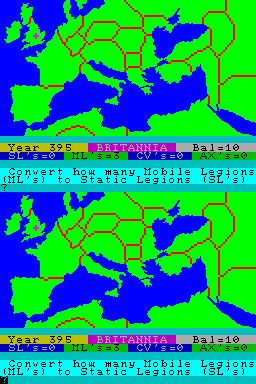
Producer: Argus Press Software Memory Required: 48K Retail Price: £6.95 Language: BASIC Author: M. Edwards (Spectrum version by P. Rawling) This strategy game is set in the period starting from 395 AD, the moment when the sweeping pressure of the barbarian tribes finally forced the Roman Empire to its knees. The object of the game is to see whether, by skill and manipulation of the forces at your command, you can alter the events of history and maintain Rome as a great empire. The Fall of Rome is for one player against the computer. All the events take place on a map of Europe which is divided by red border lines into the various provinces. At the start of the game you are shown those which are under Rome's control. Playing is split into three distinct phases. During the first you are asked to create and move your forces province by province and any money balances left over. Your military forces are split into Mobile and Static legions, Cavalry units and Auxiliaries. You are allowed to create one mobile legion per province per tum if you have sufficient funds. Static legions are converted from mobile ones but, once converted, may not be changed back. Again, depending on funds, you may create cavalry or auxiliary units in a strict ratio to the number of mobiles in the province. If any money is left over, it may be moved to one of the adjacent provinces indicated on the map where it may do more than leaving it where it is. The second phase is the movement part of the game. Here you are asked how many mobile legions you wish to move, again, province by province. The same goes for cavalry and auxiliaries if there are any present. With each province, the map will indicate the possible destinations of the movement. The third, or attack phase, shows you how many enemy tribes there are in the various provinces where Roman military forces have been moved, and it gives their varying strengths. You are allowed to attack one enemy per province per move. The computer calculates the result based on enemy strengths and Roman forces available, this completes a turn and one turn represents five years. At the commencement of the second turn you can see how well you have done, where you have hung on and where you have lost control. COMMENTS Control keys: general input of figures or first three letters of a province Keyboard play: a user-friendly program with good error trapping Responses: the BASIC program works with commendable speed and computer assessment time is kept to a minimum Use of colour: sensible rather than exciting Graphics: very good map, clear display Sound: poor Skill levels: 1
Sinclair User #30Sep 1984 · p.46/106/10
Gilbert Factor 6/10
Chris Bourne 6/10
Memory: 48K Price: £6.99 Historian Edward Gilbon in his book Decline and Fall of the Roman Empire reckoned it was Christianity which caused the end of the empire, corrupting the moral fibre of that warlike race. The Fall of Rome from ASP Software places the blame firmly on those hordes of Visigoths, Goths, Osragoths, Huns, Saxons and countless other exotically-named barbarian tribes. The Fall of Rome is a strategic war game in which you have to steer the vast empire through 60 years of fierce fighting as the barbarians march into your provinces. At the beginning of the game in 395BC you control the Mediterranean and most of southern Europe, from Britain in the west to Syria in the east. Your task is to survive for 12 turns of five years each and try to preserve as much of your empire as possible. The mechanics are moderately simple for a war game. Each province generates an income which can be used to maintain permanent legions and raise new ones, as well as temporary units which disband at the end of a term. Units have offensive and defensive values and while some must remain in their province, others can be moved to a neighbouring province as reinforcements. The money can also be shifted and it is possible to use the order in which you deal with the provinces to transfer the cash a considerable distance through a chain of provinces. When you have finished arranging your forces the computer takes a leisurely minute or two to generate the barbarian hordes, some of which appear to breed like flies. You then have the opportunity to fight. The game is slow, much of it being written in Basic, and can become frustrating at times but requires much intelligent thought to play skilfully. There is one serious bug in the program; it is possible, if a province has become isolated, that there is nowhere where money can be transferred from that province. Unfortunately the program does not tell you at the time, so that if you try to transfer money you will be asked continually to transfer it somewhere else, with no possibility of escaping the loop. Perhaps ASP will clear the problem in future editions. Bugs apart, the game appears to catch the flavour and likely events of the times reasonably accurately. All the provinces and tribes are given their Latin names, the map is clear, and the instructions adequate. We found that it is virtually impossible to retain Gaul and Illyria - modern France and Yugoslavia - for more than a few turns and, as happened eventually in history, the barbarians manage to capture Italy, leaving you to fight on in the east. At the end of the game you are given a rating based on the resources remaining. In itself it is a fine game but its faults, which could so easily be rectified, make it unlikely to win too many converts.
Personal Computer Games #9Aug 1984 · p.100
Stuart N Cooke
MICRO WARS Fancy yourself as a latter-day Napoleon, staging intergalactic time-travelling battles or controlling the Roman Empire? Stuart Cooke surveys the latest in war games. If you have bit blasted too many aliens for one day, or have got lost in that dratted maze in the new adventure you've bought and are about to see just how well your computer will fly through the window, why not give these 'normal' computer games a rest. Load in a strategy game and find Out just how well you would have run the Roman Empire. Take control of a group of soldiers or travel through lime and fight out battles in outer space or on planets you have never heard off. War games with scenarios similar to the above as well as many others can be found for nearly every micro. Some games will allow you to play against the computer. In others you have to play against a partner: why not have a go at killing your beloved brother, wife etc? In fact buying war games could lead to the end of family arguments as we know them. Whole families could be crowded around the television waiting to see who will win the War of the Roses and settle the latest family feud. Until very recently most of the computer-moderated war games were shipped over from the US. All of these, although of very good quality, tended to be of a very high price. A number of British manufacturers have now produced many excellent packages, all marketed at a price far lower than their American counterparts. This feature will concentrate on products from these companies. One British company who have really made an impact on the war gaming market are Lothlorien. Titles from this company are available fur nearly every machine: Commodores, BBCs, Dragons etc. Most of them seem to make a first appearance on the Spectrum and are converted onto the other machines at a later date. CONVENTIONAL WARRFARE Confrontation is possibly one of the most popular games from this Stockport-based company. This is a two player game of conventional 20th century warfare. One player controls the Blue forces and the other player the Red. One nice feature of this game is the option to play on a black and white TV set. If you wish to play in black and white, the pieces of the player on the left hand side of the screen are shown in inverse to make them distinguishable from those of his opponent. Each player takes control of a number of forces. The forces consist of mobile units made up of tanks, mechanised infantry and engineers. Each type of unit has its own particular use, for example it would be of very little use trying to destroy a plane with a paratrooper, but the flak guns can easily inflict damage on enemy aircraft. The playing area is very clear with rivers, mountains, cities, bridges and other useful landmarks displayed. Pieces on the board belonging to each player are only displayed when they are actually being moved, which means that if the players agree not to look at the TV while the enemy is moving you will not know which piece is what type of unit before it is adjacent. All pieces are represented by a little picture when they are being controlled. The number of squares they can be moved and their type are displayed at the bottom of the screen. One of the nicest and fairly original features this game offers is the option to design your own scenario. Once the program has loaded there is no map held in memory and you can load the one supplied by Lothlorien or design one of your own. Map design is very easy: the cursor keys are used to move a cursor around the playing area and the designer can place cities, rivers, mountains etc by pressing the appropriate key. Because the map can be designed by the user there are no set victory conditions. You can play until all forces have been destroyed for a set number of moves, until a particular point is captured; in fact the list of possibilities is almost endless. Since the finishing conditions are left to the players a game could last five minutes, five hours, or until you wish to end. Confrontation is an excellent game, available on a number of popular micros. Because the scenario is left up to the player it is an ideal program for both beginner and expert war gamer. ZAP THE YANKEES Johnny Reb is another popular game produced by Lothlorien. This game can be played against another player or the computer. On the Commodore 64 version you can even get the computer to take both sides. The game is set in the American Civil War and is a fairly small skirmish at a river crossing between the Union and Confederate forces. To win at this game you must capture the enemy's flag. though it is possible to set a limit upon the number of possible moves, the winner being the person (computer) who has scored the most hits against the enemy. Unfortunately, this game lacks some of the polish you find in Confrontation. Numbers surround the playing area making it easy to judge distances when moving but making the display very messy. The only symbols found on the map other than the various pieces controlled by each player are the river, marshland, forest and a bridge. None of these graphics is used very well and the video display seems to lack a great amount of interest. Each player is supplied with a number of playing pieces. These have differing movement and fighting capabilities, depending on what they represent. Artillery pieces are the only ones that can fire at the enemy from a distance. Unfortunately you can only shoot in eight directions and therefore have to be fairly close to, or in line with, the enemy or the shot disappears off the screen before you can hit him. It would have been nice to be able to select your target by moving a cursor around to point at the destination square. First impressions led me to believe that this was a very simple and boring game. After a few sessions at the keyboard, however, I found there was a lot more to it than you would expect. To start with, a lot of forward planning is required so you can line yourself up with the enemy to shoot at him face to face. Secondly, you must make sure that whenever you do move one of your pieces you are not placing your man in the firing line of the enemy's guns. Even though the graphics of this game are simple. and it is simple to understand, a lot of skill is required. It will take quite a while before you can totally master the game, if ever. This program is also a little slow - you get the impression that when the computer is playing one of the sides and you are waiting for it to use some of its artillery fire against your men you could have overrun the whole of its army and returned home to your farmstead. LEGIONS ON THE MARCH ASP Software is another firm which has begun to put a lot of strategy games on the market. Their latest release is The Fall of Rome, another game available for most popular micros. The outside cover for this game states that you are supplied with a Free Colour Map, so you open up the box expecting to find some painstakingly drawn map of the Roman Empire only to find that the printed instructions are larger than the map. Don't go fixing the free map to your bedroom wall, you'll only lose it and it comes in very handy when playing the game. The Fall of Rome bears a slight resemblance to the well worn Dictator type of game. Each game turn you have to enter the number of legions you wish to buy and maintain in each area of the Empire. Income varies from region to region and the presence of unfriendly tribes will reduce it. This games goes a step further than the normal buy or sell that you normally have to do in a Dictator game in that you are allowed to move your men around. During the movement phase you can move your forces into any neighbouring province. Once you have moved the computer will move the enemy tribes. By moving to an area controlled by the enemy you can fight against him. Even though the graphics are good and the responses to input faster than on some other games The Fall of Rome does not give you the feeling that you are actually in control. If you had a little more control of how each legion fought then you would have a better game. Instead you get the impression that you are having an exercise in entering numbers. HEAVY METAL Kriegspiel from Beyond Software runs on the Dragon 32 and is one of the few games around that exploits graphic facilities to the full. The scenario puts you in control of a heavy tank division. You have the option of your opponent either being another player or the computer. Whoever plays, the object of the game is to capture the other player's city HQ. All the action takes place on a high resolution map that scrolls around the screen, which means that the battlefield is actually much bigger than the small area you can see. Three different maps are supplied with the game, and it is very simple to choose the one you wish to use. Each player is put in control of 15 pieces. These consist of four heavy tanks, five light tanks and six infantry. It is possible to increase the number of playing pieces up to 25, after every round the player in control of the most friendly towns will gain extra men. It is possible to enter all of your moves by either the keyboard or by using a joystick. Use of a joystick makes all entries to the computer very quick and speeds up play considerably. Probably one of the most original aspects of this game is the way in which the weather affects play. It's realistic - and very annoying. You just think that you are about to make a surprise attack on an enemy when it begins to rain and you find all your powers of movement halved. If it snows, for example, your movement is halved and you have no transport. The instructions supplied with the game are very clear, therefore a beginner to war games should soon be playing. So that you can tell which area is which on the map a key is given on the instructions; remember it's a lot harder to move through a forest than through a desert. This is a very well-presented game and its clear, colourful graphics should appeal to everyone. If you are a Dragon owner then you should buy this game just so that you can see what your machine is really capable of. For those of us who don't own a Dragon, would Beyond please bring out versions for other machines. Probably one of the most popular war games that you can buy is Apocalypse from Games Workshop. Red Shift are producing the computer game version of Apocalypse under licence. WORLD WAR III If you are one of those unfortunate people who have never played Apocalypse then the subtitle given to the game should give you the whole story: The Game Of Nuclear Devastation. You are told, however, that use of nuclear weapons could cause a catastrophic chain reaction. Apocalypse allows between one and four players to take part, however, if only one player is involved he will have to take two sides, the computer will not play against you. Each player is given a certain amount of power points, the number he gets depending on how many centres he occupies and the type of land that his centre is on. There are three different maps provided with the game for your warfare to take place upon. These maps cover areas such as Britain, Europe and London. Red Shift have realised the potential of this game and are producing expansion cassettes containing more maps. Expansion maps cover areas such as US, Galactic, Napoleon's Campaigns and War in the Pacific. The BBC version does not yet have all the expansion packs available. The maps used in Apocalypse cover most of the screen and are very clear. The map shows all the occupied areas and under which player's control they are. When making moves it is possible to move a cursor around the screen and an exploded view of the cursor position is given, showing which forces are situated there. This is very easy to use but tends to be a little slow and it is easy to forget which forces you have where, it's a law playing area to try to find out every time. The only 'major' flaw in this game was found in the BBC version. The symbol of each of the players is positioned on any area he owns. Quite regularly the background colour was the same as the character's piece making it difficult to see exactly who was in control of the square. Apocalypse is a very involved game and it will take quite a time for a beginner to master play. The instructions are good and clear and give examples wherever possible. The fact that you can purchase extra maps should add to the length of time before this game is put on the shelf and forgotten about. 25TH CENTURY RAIDERS Rebelstar Raiders comes from the same stable as Apocalypse. This game takes place in the 25th century. You are given three different scenarios: Moonbase, Starligdale and the Final Assault. Two players are needed to play, each having control of between 20 to 30 characters. Every character in this game has his/its own name and weapon and characteristics. All inputs to the computer are very easy. To get information on a particular character all you need to do is place the cursor over the player in question and press the I key. If you wish to find out about the character's weapon you press the P key. Because each of the maps is different, the victory conditions differ although a specific object has to be destroyed or protected in each of them. This is a game that you need at least an hour to play, but it is worth it when you guide one of your men around a corner and blast three of your opponent's men into little pieces. Rebelstar Raiders is a challenging and very enjoyable game.
The Fall of Rome - good graphics and fast responses as you defend the Empire by marching your legions against hostile barbarians.
30 Games carries this game and has 14 references of its own.
Games Compendium carries this game and has 13 references of its own.
Full-page ad14
- ZX Computing #14Aug 1984 · p.139
- Games ComputingJul 1984 · p.97
- ZX Computing #13Jun 1984 · p.155
- Home Computing Weekly #67Jun 1984 · p.2
- Your Computer #6Jun 1984 · p.30
- Home Computing Weekly #60May 1984 · p.31
- Home Computing Weekly #61May 1984 · p.39
- Home Computing Weekly #63May 1984 · p.34
- Home Computing Weekly #56Apr 1984 · p.6
- Home Computing Weekly #57Apr 1984 · p.31
- Home Computing Weekly #58Apr 1984 · p.31
- Home Computing Weekly #59Apr 1984 · p.4
- Home Computing Weekly #55Mar 1984 · p.26
- Home Computing Weekly #54Mar 1984 · p.19
Review5
- TV GamerJan 1985 · p.54
- Popular Computing Weekly #23Jun 1984 · p.21
- Home Computing Weekly #65Jun 1984 · p.22
- Home Computing Weekly #64May 1984 · p.40
- Popular Computing Weekly #20May 1984 · p.56
CompoResult1
- Games ComputingFeb 1985 · p.39
News/Note1
- ZX Computing #15Oct 1984 · p.15
Related
- Compilations
- 30 Games, Games Compendium
- Ports
- (Atari 8-bit), (BBC Micro), (Commodore 64)
- Same entry at
- Spectrum ComputingZXInfo
Reviews from people here
Sign in to write about this, or make an account. It takes a minute and lets you correct the catalogue too.
No language, description recorded.
Sign in to correct or add to this.
Hold the rights to this and want it taken down?