Fireflash
Arcade Game: Shoot-em-up · ZX-Spectrum 16K · 1 players · English
· Pound sterling 5.95
Avenger, 2 of 4
.jpg)
.jpg)
Discussion
Nobody has started a thread about this yet.
Remarks
ZXSR: "Fireflash" had a built in POKE system where you could enter an address to alter (main ones were listed in inlay).
Play
- Fireflash.tap.zipTape image English7 KB
- Fireflash(Variation1).tzx.zipTape image 6 KB
- Fireflash(Variation2)(SideA).tzx.zipTape image 6 KB
- Fireflash(Variation2)(SideB).tzx.zipTape image 4 KB
Other files
- Fireflash (1983)(Abacus Programs).pokPOK pokes file 0 KB
Files and rights
No permission is on record either way. Screens and pictures are copied here on a take-down basis: if you hold the rights and want something removed, say so and it goes.
Credits
- Kevin Flynncredited
Sign in to credit somebody, or say what these people did.
Scores
In the magazines
- Crash #11984 · Overall78%
- Sinclair User #241984 · Gilbert Factor5/10
- Crash #21984 · Overall78%
- Crash #31984 · Overall78%
Elsewhere on the web
- WorldOfSpectrum 5 votes4.60
In the magazines 15
Crash #3Apr 1984 · p.6578%
Overall 78%
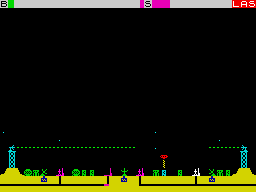
Producer: Abacus, 16K £5.95 (1) Author: K Flynn This is a very superior 'Missile Command' style game and a games designer in one - another from the specialists in games for eight-fingered players. Your base has 4 missile launch pads supplied by underground tunnels, and 2 laser bases at either end of the screen. Incoming alien missiles split into 4 small and hard to hit warheads if not destroyed quickly. You must select the launch pad required, fire the missile, guide it to its target and detonate it at the correct moment. If that's not enough, low flying alien craft bomb your installations. If you like a fast difficult to master game, then this is for you. But many factors can be modified by the clever POKE facility which allows you to redesign the game to suit your own taste. On the reverse side is a free game called Destroyer. Uses 6 control keys, no joystick option, excellent graphics. recommended. CRASH overall rating 78% M/C.
Sinclair User #24Mar 1984 · p.85/10
Gilbert Factor 5/10
Memory: 16K Price: £5.95 Alien missiles are descending towards the planet's surface, showering warheads on buildings and silos, while planet-levelling bombs detonate above the ground, preparing the way for the landing of the enormous alien mothership. Thus the scene is set for Fireflash, a run-of-the-mill arcade game from Abacus Programs which owes not a little to the popular Missile Command. You are in control of the Fireflash guided missiles and laser cannons which comprise the planet's defence. Visually the game is more or less what you would expect and the on-screen action holds few surprises, but the machine code program is sufficiently competent to while away an idle hour or two, and there is a poke facility allowing you to alter some of the program features. On the flip side is Destroyer, a plodding submarine attack simulation which employs the limited sound effects of the Spectrum to imitate your destroyer's sonar.
Crash #2Mar 1984 · p.4878%
Overall 78%
Producer: Abacus, 16K £5.95 (1) Author: K Flynn This is a very superior 'Missile Command' style game and a games designer in one - another from the specialists in games for eight-fingered players. Your base has 4 missile launch pads supplied by underground tunnels, and 2 laser bases at either end of the screen. Incoming alien missiles split into 4 small and hard to hit warheads if not destroyed quickly. You must select the launch pad required, fire the missile, guide it to its target and detonate it at the correct moment. If that's not enough, low flying alien craft bomb your installations. If you like a fast difficult to master game, then this is for you. But many factors can be modified by the clever POKE facility which allows you to redesign the game to suit your own taste. On the reverse side is a free game called Destroyer. Uses 6 control keys, no joystick option, excellent graphics. recommended. CRASH overall rating 78% M/C.
Personal Computer News #52Mar 1984 · p.60
Mike Gerrard
SPECTRUMS IN SPACE A Spectrum was all Mike Gerrard needed to see the solar system - and with no lifeline either. Starclash (cassette £6.95, any machine), Micromega, [redacted] Fireflash and Munnery's Megatroids (£5.95 each), Abacus, [redacted] Cosmos (£5.95), Abbex Electronics, [redacted] Space island (£6.95, 48K), Terminal Software, [redacted] There must be more space games for the Spectrum than there are stars in the sky, though you'd need stars in your eyes to get any pleasure out of some of the software on offer. In concentrating on so many variations of a single theme the inevitable result is a lot of dross, so do any of this recent batch of software stand out from the crowd? Not Starclash from Micromega, which is a disappointment coming after their earlier 3-D attempts with Haunted Hedges, Luna Crabs and Death Chase. The cover gives the impression that this too is 3-D, showing a fighter zooming over the Earth's surface, but this is merely a shot of the title screen, the game itself being an invaders variation that I remember playing in the arcades at least three years ago. In this, four separate waves of aliens come down the screen at you, different shapes moving in different ways, from a straightforward downward progression to green bow-ties that move up, down and around. You have three lives, and if you let a single ship reach the bottom of the screen then the entire wave starts afresh. After four waves there's a mothership, which has two reactor cores that flash alternately, and you must hit the live one to polish it off and start all over again, it's compatible with a Kempston joystick, but there are hundreds of better games around. One of them is Fireflash, the best version of a missile command type of game that I've seen. The graphics of the base you're defending are very detailed, full of little buildings and towers, and you move your missiles along underground passages to the chosen launching pads. In addition to the nine skill levels, author Kevin Flynn has written into the program a routine enabling you to alter any of seven POKE values affecting the speed of certain aspects of the game. The pre-set values and the range of possible alternatives are given on the cassette insert, and the game itself is fast-moving, colourful and reasonably noisy. An ability to understand what you're doing with six fingers simultaneously is an advantage. From the same company comes Munnery's Mergatroids, which should be marginally easier as here you only need five fingers to enable you, as the instructions succinctly put it, to 'blast every alien you see!' This is an attempt at 3-D, with the waves of aliens moving towards your sights in the centre of the screen as you attempt to pass through seven zones of them. The main problem is that the aliens are simple geometric shapes like diamonds and triangles, and because these are transparent it's impossible to pick out what you're firing at and what you're trying to avoid as they come thick and fast towards you, overlapping each other. The fact that your own missiles are also transparent diamond shapes doesn't help matters, and the game was a case of over-kill, I thought. Cosmos has you as 'the pilot of an advanced defender class starship. You protect convoys of sub-light speed cargo vessels from hostile attack and natural dangers.' The convoy is in the centre of an area of space made up of a 3 x 3 grid. You can only see one of these grids at a time through your viewscreen, but can scroll quickly enough around them. You're watching out for the asteroid showers which float across as well as 18 alien ships that will try to destroy your convoy. Guiding your lasers by the sight in centre-screen, you must decide whether to stay close to the convoy, when you only see dangers at the last minute, or whether to roam around the grid in search of enemies and risk leaving your convoy open to obliteration. I found control of this difficult as there's quite a delay between firing your lasers, which come in from the corners of the screen, and the shot exploding when they converge in your sights, by which time the target has zipped away. You have to keep firing continually, and try to predict the movements of your enemies, which is not easy. The game is fast-moving but the graphics are ordinary and again it gets submerged beneath the mass of good material available for the Spectrum. At one time a machine code game meant automatic interest, but now they're ten a penny, so you have to produce something different. An attempt at that is promised by Space Island, a graphics adventure from Terminal Software, who have previously produced some good material for the Commodore machines. I wasn't impressed by this Spectrum effort, though, which is very similar to another they've published at the same time, Vampire Village. In both you're shown a map on the screen and you must move your character around using the cursor control keys. In this space story, where you're attempting to find the cause of dangerous time distortions, your character is simply a cross while the map is filled with black dots, representing interesting features. As you arrive at a dot you're shown some text, which may perhaps tell you that there's a rifle or a boat there. Pressing the space key will get you a list of the 19 commands at your disposal, though unfortunately not for long enough to enable you to note them all down or even read them and consider which to use. You enter the first letter of your chosen command in inverse video and the game responds (or not), the dot disappears and you go on your way to the next one. As you visit the various dots the game does start to build up like a conventional adventure, with problems to solve, but each time you die there's a lengthy wait while a new game is generated and the only time distortion I noticed was that after playing the game for ten minutes it seemed like two hours must have passed. If you want a game where you spend half your time with a finger on the cursor key while you watch a cross move slowly over a simple map then this is definitely the one for you. This only serves to raise the question again of how much of a games software industry the home computer market can support. All the signs are that a good thing is being spread much too thinly. Only one outstanding game in this crop, then, so if you're looking round for something to buy make sure you makes your choice before you pays your money.
Crash #1Feb 1984 · p.8880%75%74%75%80%85%78%
Use of Computer 80%
Graphics 75%
Playability 74%
Getting Started 75%
Addictive Qualities 80%
Value For Money 85%
Overall 78%
Unknown
Unknown
Unknown
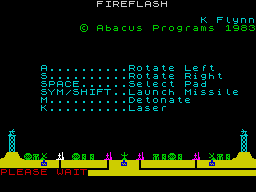
Producer: Abacus Memory Required: 16K Recommended Retail Price: £5.95 Language: machine code Author: K Flynn Fire flash is a very superior Missile Defence type game and a Games Designer in one! Abacus seems to specialise in games requiring seven or eight digit hands and good co-ordination as well. This is certainly no exception! You are in command of four missile sites which are protecting your planet from attacking multi-warhead missiles. These, it seems, have managed to get through the Sentinel system due to your ineptness as a space pilot in the former game of the same name! How they imagine you're going to do better on the ground than you did in space is another matter, but the people at Abacus are obviously kind in their judgement! The four launch pads are connected by underground tunnels which deliver fresh missiles as long as they remain undamaged. At either end of the screen stand two laser towers which only fire horizontally. The incoming missiles split up into four smaller warheads if they are not quickly destroyed. You can select which launch pad to use and after firing your Fireflash missile, guide it to the enemy missile and detonate it. To add to the problems there is a small red space craft which goes about, just under the umbrella of laser fire, bombing all your installations. Using a guided Fireflash on it is dicey as you're as likely to blow up your own buildings as the enemy! If it's all too fast Abacus have provided a marvellous facility for redesigning features of the game. By pressing key zero (POKE) you are asked for the memory address of the item you wish to alter. These are all listed on the excellent Inlay, so there's no difficulty involved. It's possible to alter the following: speed of game, speed of reloads, speeds of laser heating (if it overheats through use you must wait for it to cool down), probability of blaster appearing, elapsed time before two bombs used - three bombs used - two blasters used. In addition to Fireflash on side two of the tape is a game called Destroyer. COMMENTS Keyboard layout: complex with six keys in play, but well laid out Joystick option: none Keyboard play: highly responsive Use of colour: very good Sound: very good Skill levels: nine but redefinable with POKE facility
It takes every finger on all your three hands to save civilisation for mankind in FIREFLASH.
Space Odyssey carries this game and has 9 references of its own.
Advert8
- Big K #9Dec 1984 · p.106
- Big K #8Nov 1984 · p.73
- Big K #7Oct 1984 · p.2
- Crash #3Apr 1984 · p.48
- Computer ChoiceApr 1984 · p.81
- Crash #2Mar 1984 · p.36
- Computer ChoiceMar 1984 · p.73
- Crash #1Feb 1984 · p.77
News/Note2
- Computer ChoiceJan 1984 · p.9
- Home Computing Weekly #41Dec 1983 · p.6
Related
- Compilations
- Space Odyssey, Fireflash + Destroyer
- Elsewhere
- MobyGamesThe TipshopUVL
- Same entry at
- Spectrum ComputingZXInfo
Reviews from people here
Sign in to write about this, or make an account. It takes a minute and lets you correct the catalogue too.
No year, publisher recorded.
Sign in to correct or add to this.
Hold the rights to this and want it taken down?