
Il Noma della Rosa
Arcade Game: Adventure · ZX-Spectrum 48K · 1 players · Slovak
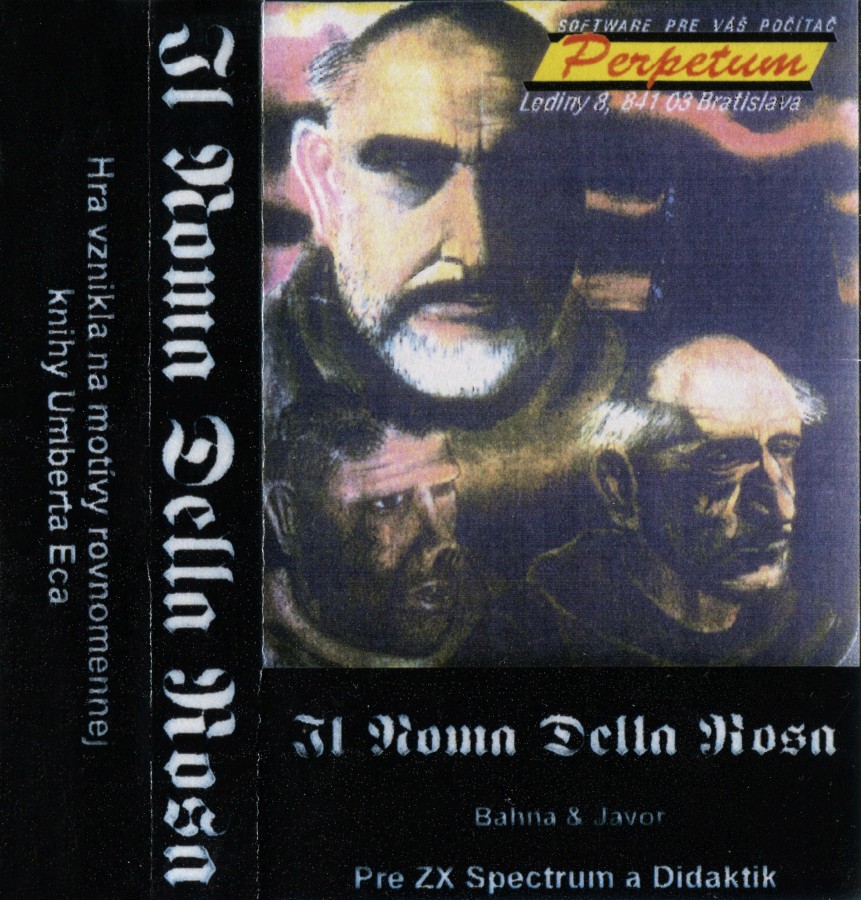
Perpetum · 1993
Discussion
Nobody has started a thread about this yet.
Play
- NomaDellaRosaIl.rzx.zipRZX playback file 690 KB
- NomaDellaRosaIl.tap.zipTape image Slovak129 KB
- NomaDellaRosaIl(EN).tap.zipTape image English107 KB
Documents
- NomaDellaRosaIl.txtInstructions Czech1 KB
- NomaDellaRosaIl.pdfScanned instructions Slovak1,102 KB
Files and rights
No permission is on record either way. Screens and pictures are copied here on a take-down basis: if you hold the rights and want something removed, say so and it goes.
Credits
- Miloslav BahnaCode
- Radoslav JavorIn-game Graphics
- Noro Grellnethcredited
Sign in to credit somebody, or say what these people did.
Scores
Elsewhere on the web
- WorldOfSpectrum 12 votes7.67
In the magazines 1
Break Space #1Apr 2025 · p.46
Al
Dave
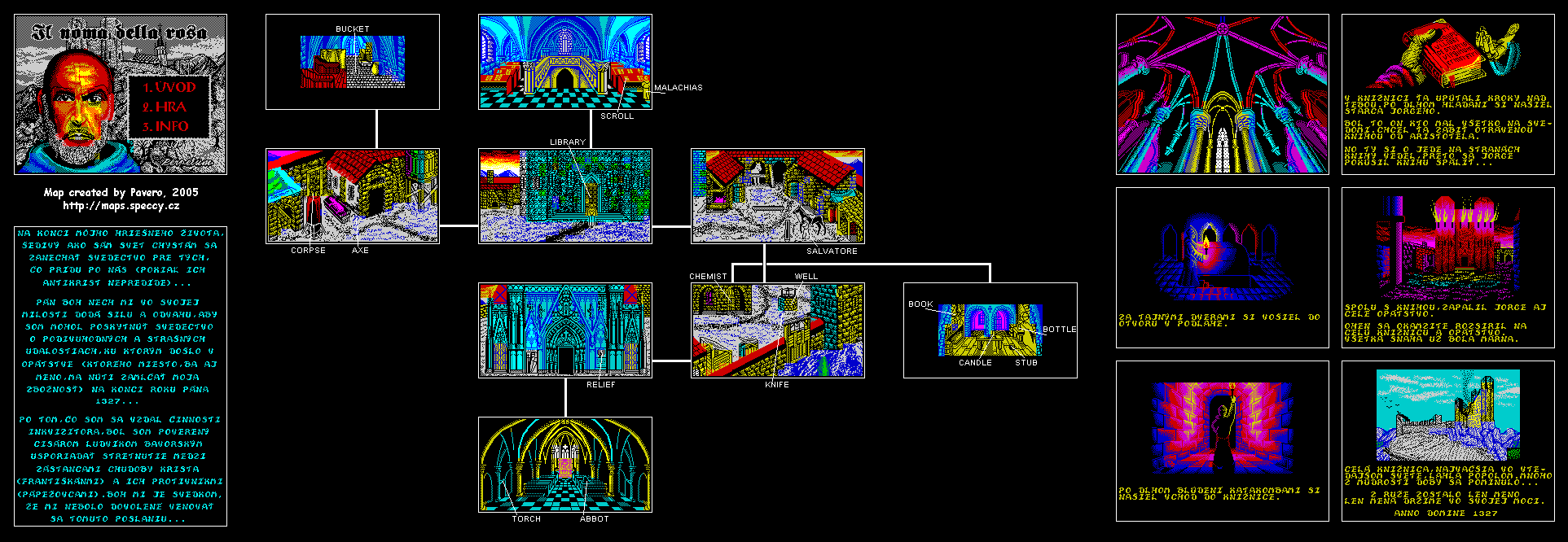
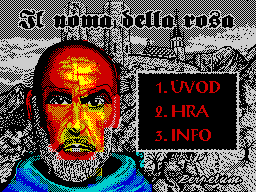
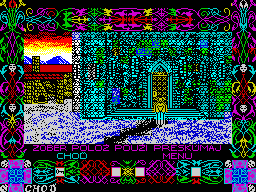
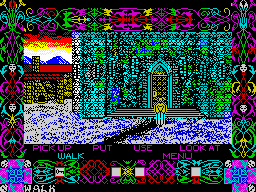
IL NOMA DEL ROSA Perpetum/Miloslav Bahna Free Dave's Review Umberto Eco's 1980 Novel 'Il Nome Della Rosa' was translated into English in 1983, followed by a film adaptation starring Sean Connery in 1986. These inspired four Spectrum games, one of which was the 1988 Spanish landmark title 'L'Abadia Del Crimen', so when the Slovak publisher Perpetum released 'Il Noma Della Rosa' in 1993, it had big sandals to fill. Fast forward to 2025, and the author has released this English translation, allowing a wider audience to don the sandals and knotted cassock. This monastic murder mystery opens with a tonsured Sean Connery giving us the backstory. He's not perfectly in sync with the text, but there's a lot more facial movement going on than your average Terry Gilliam chin-wagger. Then we get a cinematic panning shot across some beautiful Italian scenery. It's so well drawn you can practically taste the spaghetti & oil, though given it's set in a monastery in 1327, polenta & penance is probably on the menu. Il Noma Della Rosa is a rare beast on the Speccy-a point-and-click adventure. Menu driven games like this can be a hit and miss affair (the miss being the cursor and the objects), but not here-I played it with rubber keys and I could navigate the menu and find objects easily. The spacial awareness is generous too, for the few times I was told I was 'not close enough', I thought 'well that's fair enough'. The graphics are mostly excellent, but some of the screens look too busy due to the attempt to capture what I assume is a well trampled mix of mud and snow. Objects can be hard to see in this quagmire, even with a pixel's worth of masking. The liberal use of colour helps though, and occasionally everything comes together and almost looks 16 bit. Just as the film doesn't capture everything in the book, the game doesn't capture everything in the film. It's heavily abridged: there's only one crime to solve, and just a handful of the locations and characters. That goes in its favour though, because navigating is slow, and the puzzles are difficult. Once you know how, the game can be completed in about fifteen minutes, but you'll need lots of head scratching to get to that point (unless you're exceptionally gifted or have peeked at a walkthrough). Tread carefully though brother, because this game has more than one ending. There are a few bugs, in both the original game and this new translation: some rare graphical corruption, solved by moving to another screen, but the most problematic is that when you put an object down it can not always be picked up again. Once you've learned the hard way, it doesn't need to be a problem and it didn't spoil my enjoyment. Back in the day, I'd have spent weeks playing this, with many hours wandering, sometimes frustratedly, all made worthwhile by the delicious rush of solving another problem.
A ZX-Schpectre
This screenshot is sponsored by the Italian Tourist Board.
Where did you hide the Buckfast, Brother?
Dave's gone the extra mile, and tracked down author Miloslav Bahna. They sat down over a pair of strong frothy pints of Trappist brew, and cast their minds back to 1993... Dave: How was 'Il Noma Del Rosa' distributed back in 1993? Did it get reviewed anywhere? Miloslav: At first we (my friend and co-author Radoslav Javor who did the graphics for the game and I) approached the major Spectrum games distributor in Slovakia at that time - Ultrasoft. Receiving no answer from them, we turned to Perpetum, a smaller Slovak distributor of Spectrum software, who also had a branch in the Czech Republic. They were interested. None of was of age yet at that time so we waited a few weeks to sign the contract. As the first of us to reach 18, I signed the distributing contract on 18th birthday. I am not aware of any reviews at that time - the game was only distributed for a short time as Perpetum closed down a few months later in 1994. How was the game received? We were supposed to collect our first royalties (6000 Slovak crowns, about £122 at that time) from the sales of the first 200 copies of the game from Perpetum a few months after the release, but when we arrived at their offices, they were closed and were not picking up their landline. We tried a few more times, but we never saw them again, nor did we see the royalties. What motivated you to make Il Noma Della Rosa? We both liked the 1986 film with Sean Connery, we saw it on Austrian TV before 1989. Radoslav read the book and had the idea to use it as an inspiration for the adventure game we planned. Why did you decide to make it a 'point and click' adventure game? Well, the inspiration was PC games at that time. Point and click adventures were pretty common on Pcs and we wanted to bring the trend to the ZX-Spectrum. There was also Spectrum patriotism involved - starting the game with a huge animation of Sean Connery talking - that was an almost PC level experience, so we thought. Also, at that time, we were not aware of any other point and click games for the Spectrum. Did you code the game on a Didatik? I actually had a "real" ZX-Spectrum+ already since around 1986. Radoslav, who joined the club of Spectrum owners slightly later had a Slovak made Didatik. So the code for the game was typed on a ZX-Spectrum+ but the graphics was made using a Didatik. What motivated you to do the English translation? After 1995 I started working on a PC and as years passed I forgot about Spectrum and the game altogether. It was only around 2013, when I received an email from a fan of the game from Spain, who posted (or saw) a video of the game on YouTube and asked me, if I could help him in translating the game. I was surprised someone noticed the game after all these years, but I barely remembered anything about the code and so I said I could not help him. Another few years later, I installed a Spectrum emulator on my PC, downloaded the game from a Spectrum games archive and showed it to my teenage kids. They liked it and seemed to be very proud of my coding prehistory. At that time I decided to do the translation. It took me two more years to figure out how to "reverse engineer" the LZW compression the game used (I even had to reach out to the Slovak Spectrum legend Slavomir Labsky for help) and to eventually find the time for doing the translation. How were you introduced to the Spectrum? It was the most popular 8-bit in Czechoslovakia at that time. I was about ten, when my parents bought the ZX-Spectrum+ in 1986. I date this based on the memory of playing Spectrum games in January 1987 when a major snowfall happened in Slovakia and schools were closed. Instead of going to school, my friend, classmate and later co-author Rado (Radoslav) came to my place and we played games on the Spectrum. Did you make more games? Actually, Il Noma Della Rosa was my second game. My first game was a Spectrum text adventure called The Apocalypse. It was never distributed and thankfully is not available online :) After Il Noma I coded some of the intros for the 1995 Utrasoft game Twilight - Krajina Tienov and did some special FX for the 1999 PC adventure Tion - A Misty Story. Both games also have graphics from Radoslav Javor. I've noticed a few graphical glitches on the translated version, were these introduced during the reverse engineering of the original game? It could be they have been introduced by me "hacking" the original game, I have noticed them on some of the play-through videos posted on YouTube. However, I was not able to reproduce them on the emulator I use (Fuse). I strongly hope the translation works on the original Spectrum hardware, I have not tried, though. I have to ask: the title is spelled slightly wrong ("Noma" not "Nome"). Any comments on that? This is a bizarre story. Originally, the title of the game was just "The Name of the Rose" in Slovak. However, Perpetum, our distributor already distributed a Czech game with that name. Ironically, the Czech game had no connection to the book by Umberto Eco, it just used the name. Given the circumstances, Perpetum suggested to use the Italian name for our game. I only realised many years later, that our Italian was not so great at that time and we got the spelling wrong... Favourite classic era Spectrum game? I remember enjoying the Spanish games Sir Fred or Viaje al centro de la Tierra. Favourite modern Spectrum game? I am only starting to realise there is something like a modern era of the Spectrum. I was stunned by the software-implemented multicolour modes in BIFROST or NIRVANA engines. Unbelievable there is innovation so many years after the original hardware was created. Unbelievable also, that such a gem only surfaces in English after 32 years. Thanks to Miloslav and Radoslav for an amazing game, not forgetting Noro Grellneth for his AY music.
Licensed from
- The Name of the RoseBookunofficialUmberto Eco
Related
Reviews from people here
Sign in to write about this, or make an account. It takes a minute and lets you correct the catalogue too.
No description recorded.
Sign in to correct or add to this.
Hold the rights to this and want it taken down?