
Football Manager
Sport Game: Management · ZX-Spectrum 48K · 1 players
Addictive Games Ltd · 1982 · Pound sterling 8.95
Also known as Fudbal Menadzer (Yugoslavian), Futbol Manager (Spanish), Futbol Manager (Spanish), Voetbal Manager (Dutch)
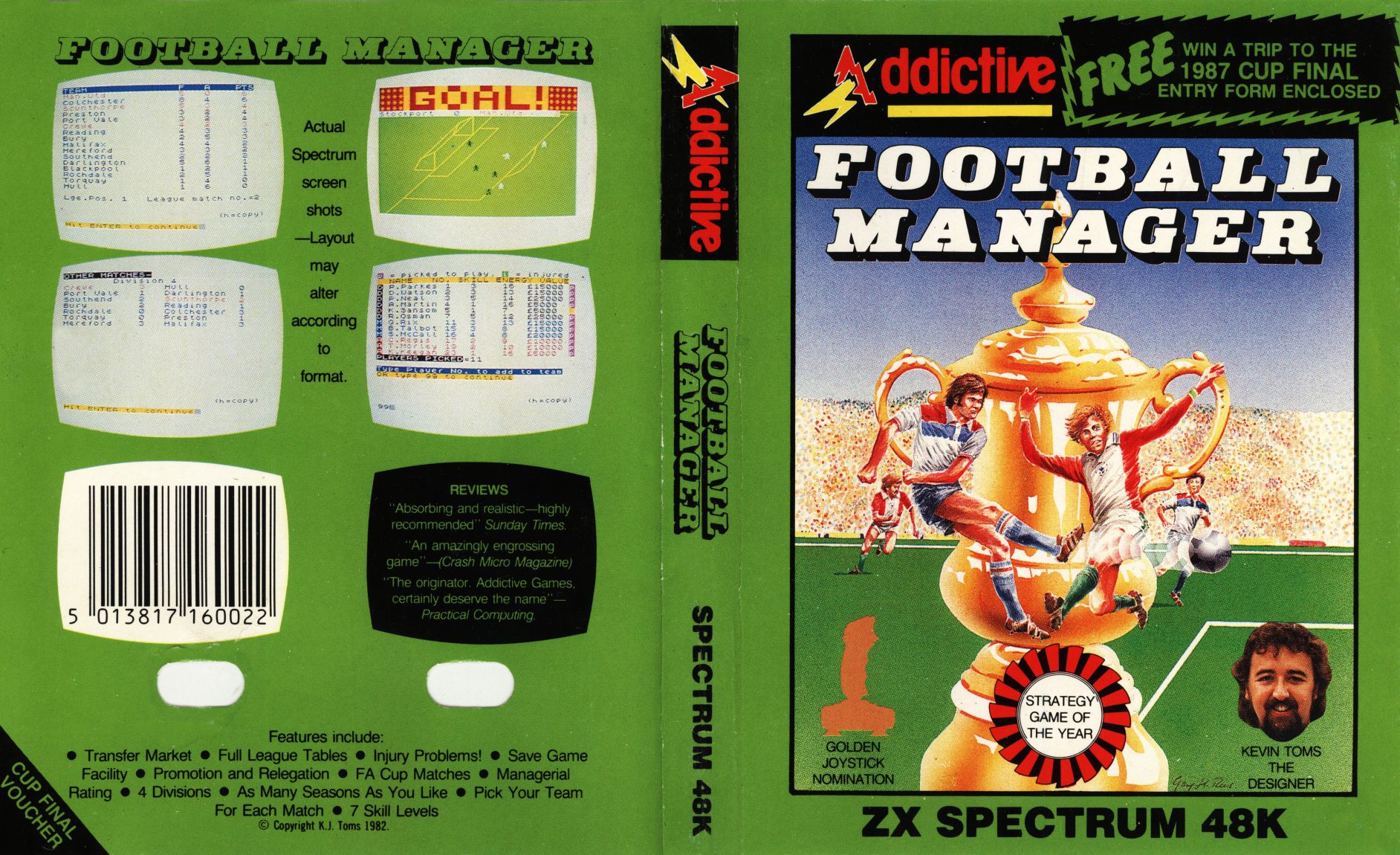
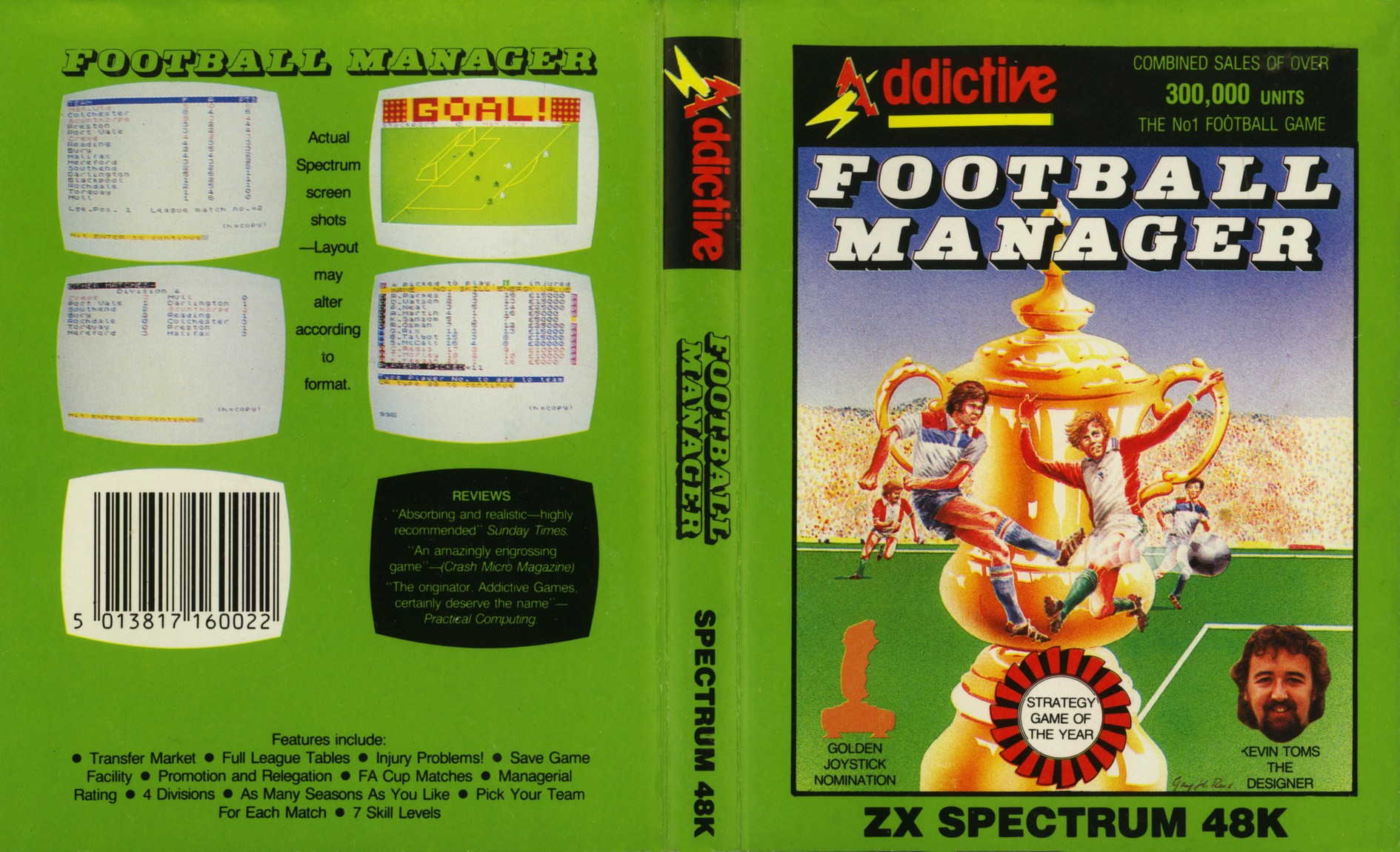
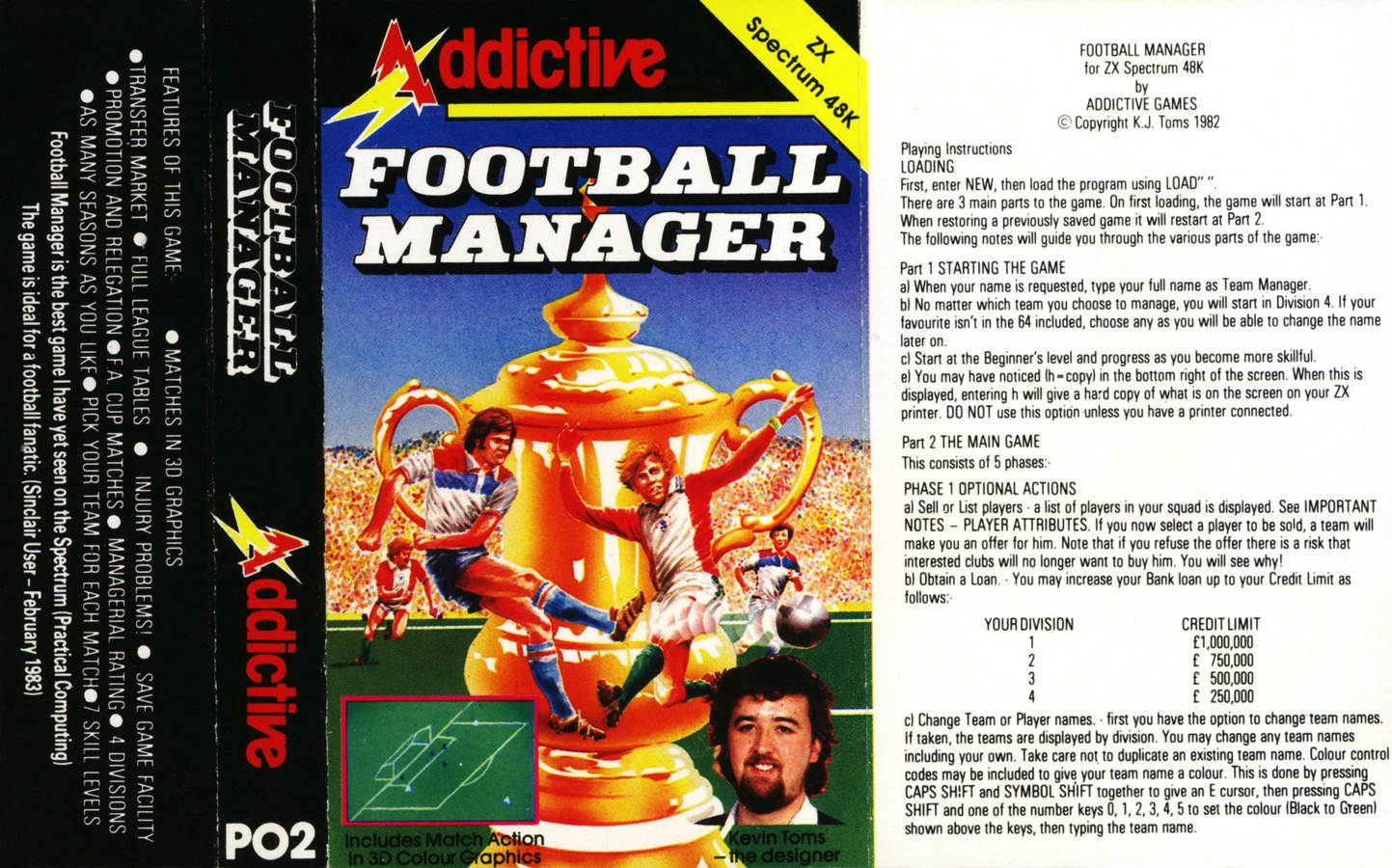
FootballManager, 1 of 3
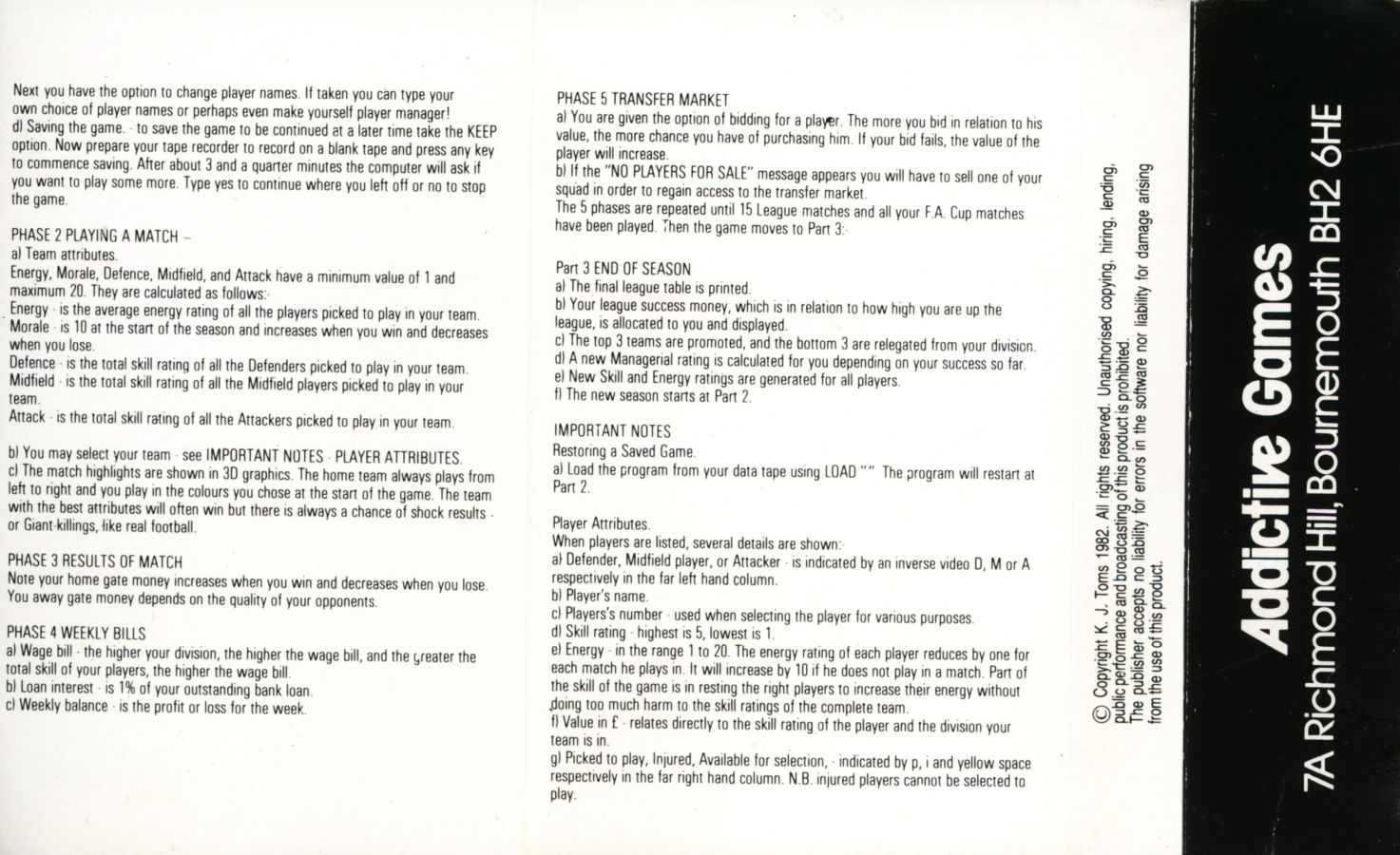
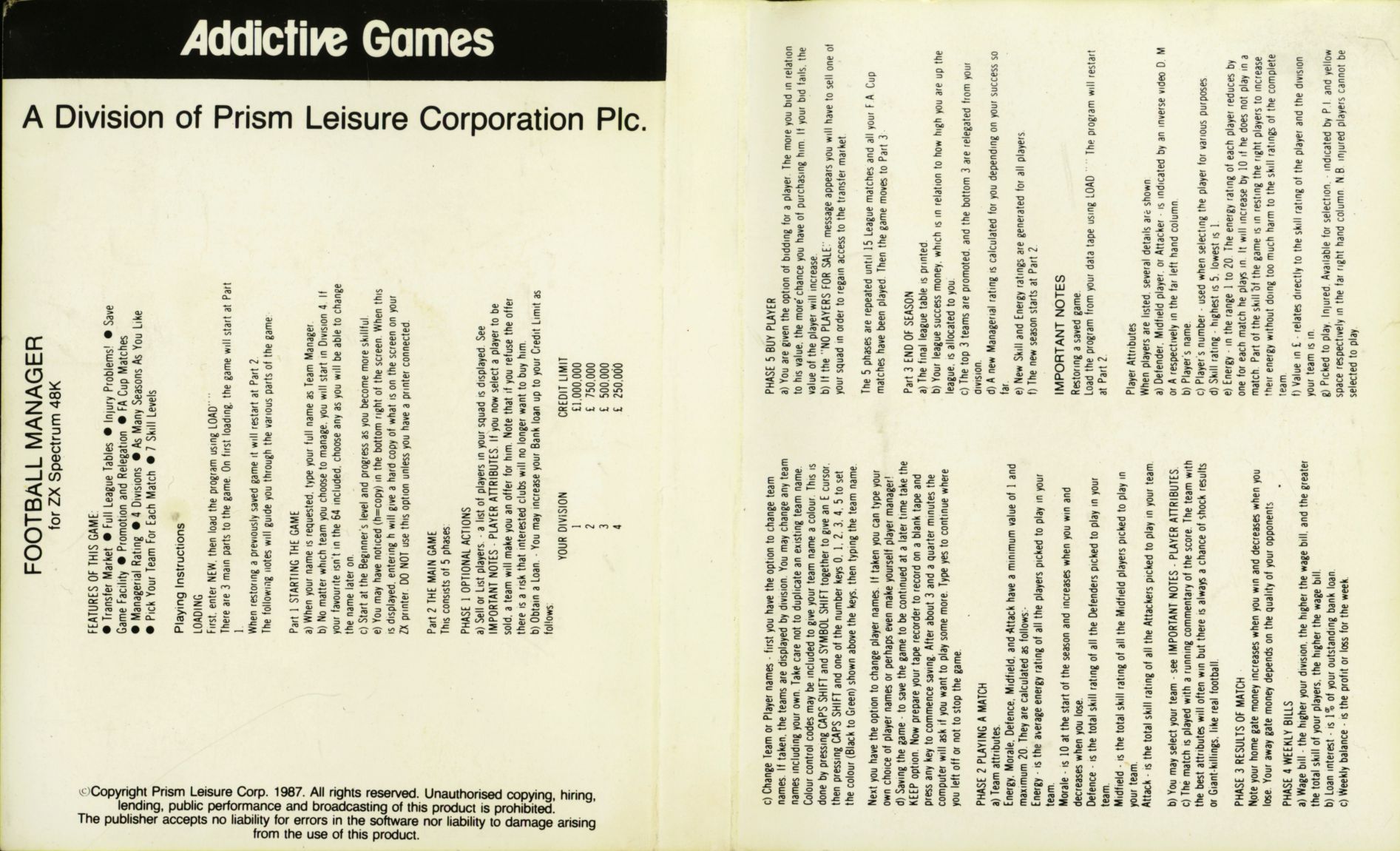
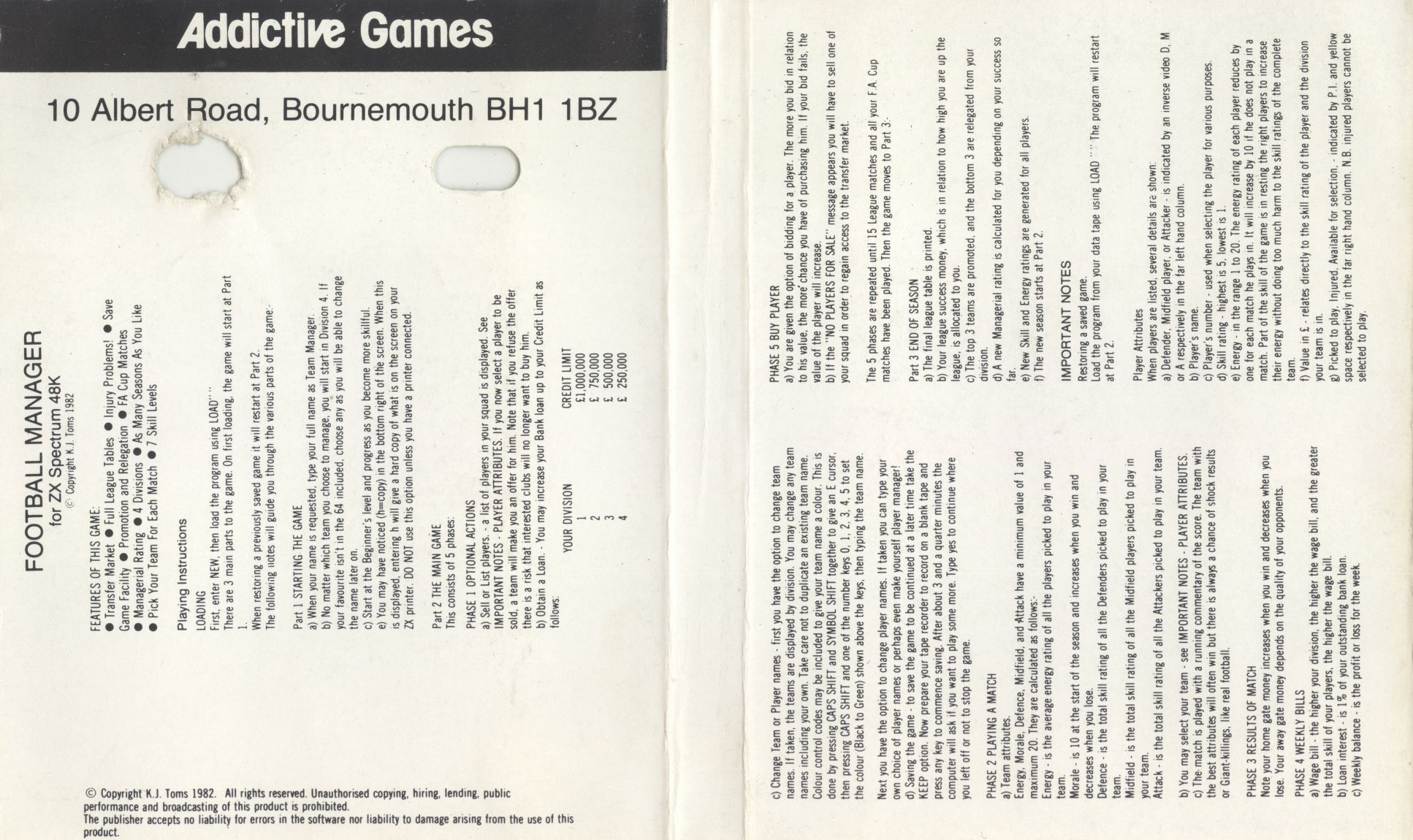
_Back.jpg)
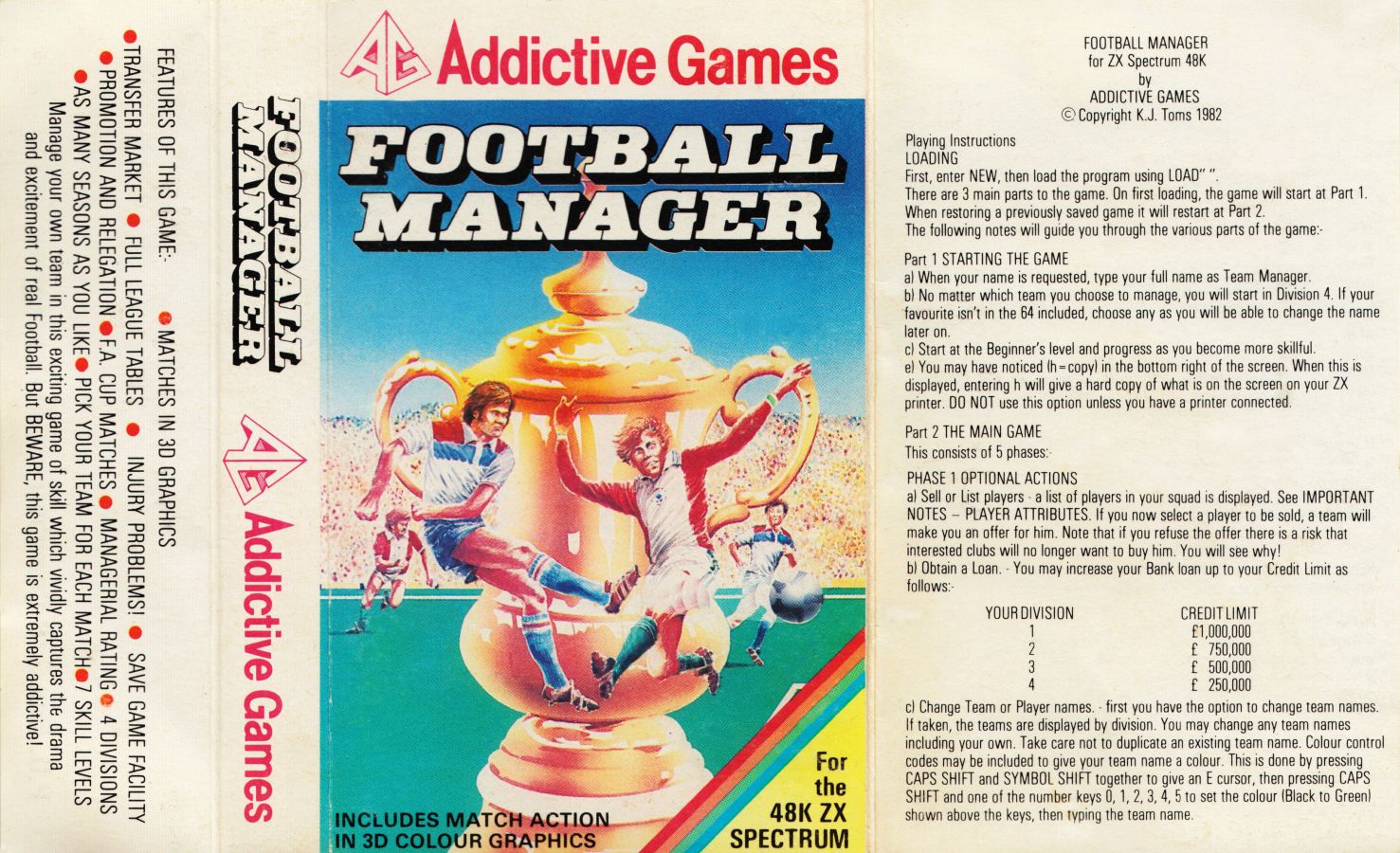
_Front.jpg)
(Microbyte).jpg)
(InvestronicaS.A.).jpg)
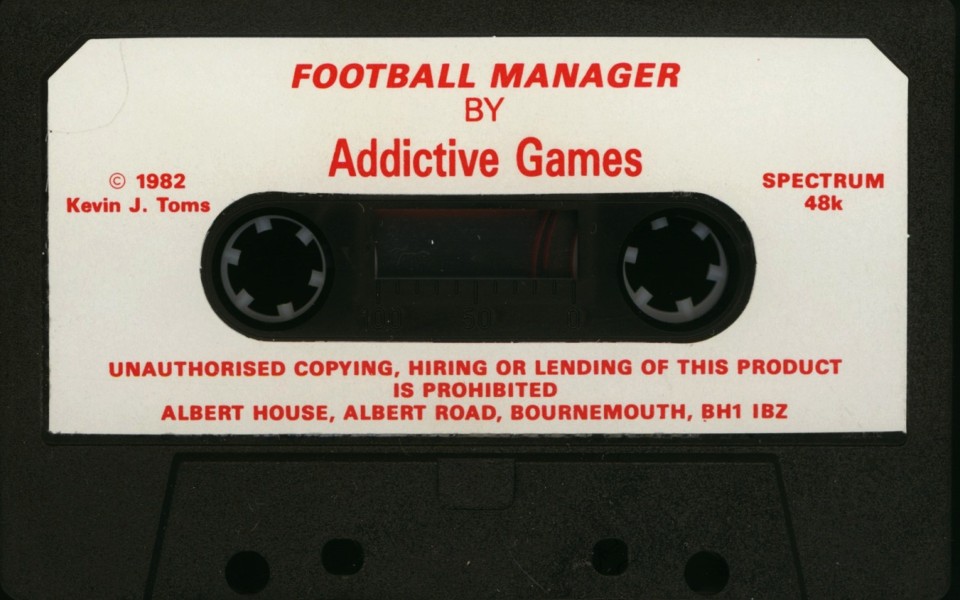
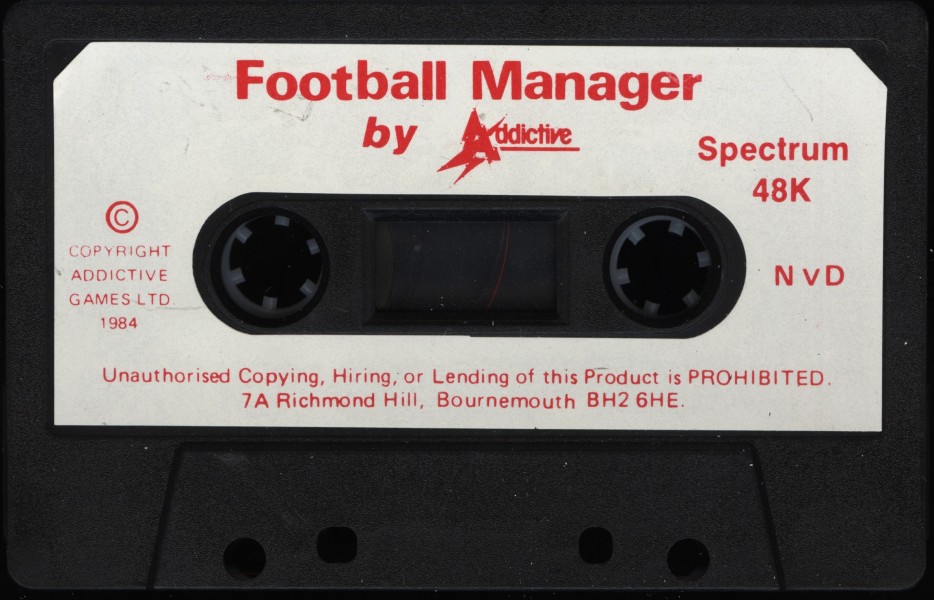
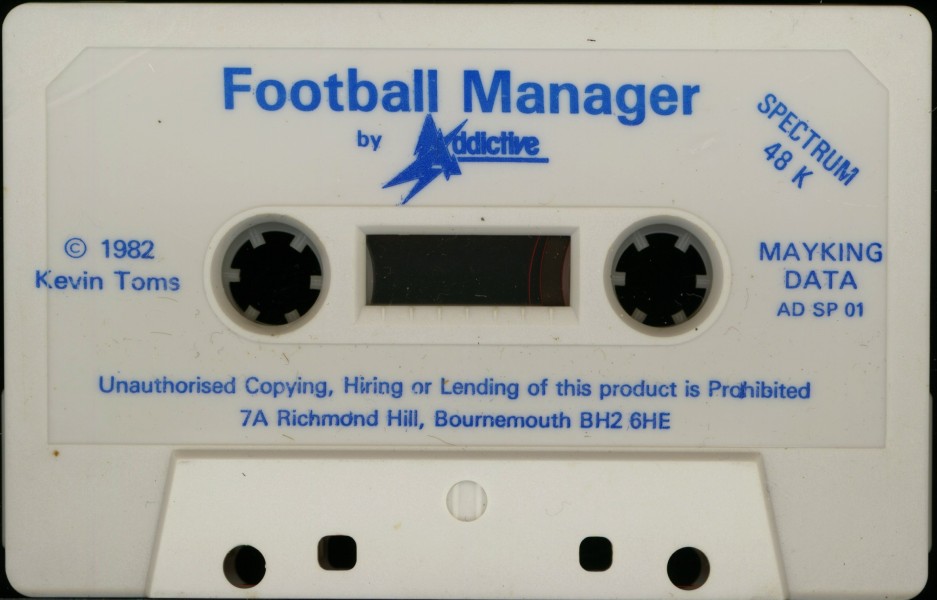
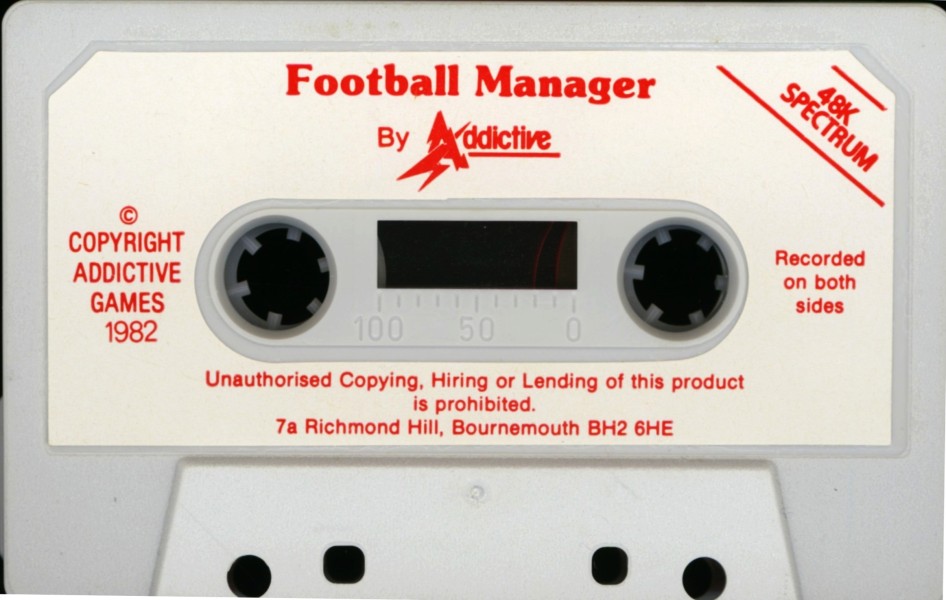
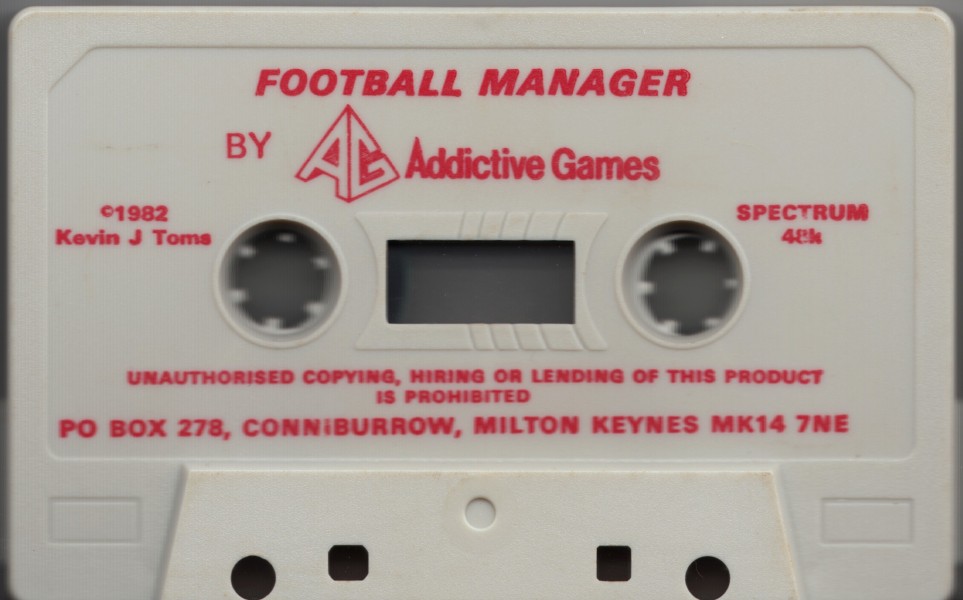
Discussion
Nobody has started a thread about this yet.
Remarks
ZXSR: The very first football management game, and one which set down all the rules that the genre follows to this day. Well ahead of its time even though it was written in BASIC.
Awards
Rank #35 - 1984 Sinclair User Top 50 Spectrum Software Classics
Releases
- 1982Addictive Games LtdPound sterling 8.95
- 1982D.M. Petrovic Sold as Fudbal Menadzer
- UnknownEDOS
- 1982Investronica S.A. Sold as Futbol ManagerSpanish peseta 2050.00
- 1995J. Arely
- 1987Microbyte [ES] Sold as Futbol Manager
- UnknownPaxman Promotions
- 1987Prism Leisure Corporation PLCPound sterling 2.99
- UnknownTele France Video Club
- Unknownpublisher not recorded Sold as Voetbal Manager
Play
- FootballManager.dsk.zipDisk image English15 KB
- footballmanager.rzxRZX playback file
- FootballManager(VoetbalManager)(unknown).z80.zipSnapshot image Dutch12 KB
- FootballManager.tzx.zipTape image English12 KB
- FootballManager_2.tzx.zipTape image French13 KB
- FootballManager.tap.zipTape image English15 KB
- FootballManager_2.tap.zipTape image Spanish24 KB
- FootballManager(FudbalMenadzer)(D.M.Petrovic).tap.zipTape image Yugoslavian12 KB
- FootballManager(FutbolManager)(InvestronicaS.A.).tzx.zipTape image Spanish13 KB
- FootballManager(J.Arely).tap.zipTape image Czech14 KB
- FootballManager(FutbolManager)(Microbyte1).tzx.zipTape image Spanish13 KB
- FootballManager(PrismLeisureCorporationPLC).tzx.zipTape image English12 KB
- FootballManager(VoetbalManager)(unknown).tzx.zipTape image Dutch12 KB
- FootballManager2_2.tap.zipTape image Spanish12 KB
Documents
- FootballManager.txtInstructions English7 KB
- FootballManager(FutbolManager)(Microbyte).pdfInstructions Spanish35 KB
Files and rights
No permission is on record either way. Screens and pictures are copied here on a take-down basis: if you hold the rights and want something removed, say so and it goes.
Credits
- Kevin J.M. Tomscredited
- Gary Hamer ReesInlay/Poster Art
Sign in to credit somebody, or say what these people did.
Awards
Scores
In the magazines
- Sinclair User #111983 · Gilbert Factor7/10
- Personal Computer News #341983 · Overall Value5/5
- Sinclair User #291984 · Gilbert Factor7/10
- ACE (Advanced Computer Entertainment) #291990 · Overall909/1000
Elsewhere on the web
- WorldOfSpectrum 215 votes7.86
Awards and competitions
Golden Joystick Awards 1983
- 2Strategy Game of the Year
In the magazines 232
ACE (Advanced Computer Entertainment) #29Feb 1990 · p.82909/1000
ACE (Advanced Computer Entertainment)
Overall 909/1000
Spectrum £2.99cs, C9.99dk C64 £2.99cs, £4.99dk CPC £2.99cs, £4.99dk ST £5.99dk Amiga £5.99dk PC £5.99dk BBC/Electron £2.99cs Atari 8 -bit £2.99cs MSX £2.99cs C16 E2.99cs VIC-20 £2.99cs The first, and some would say still the best football management game. It's the game that made its designer - 6-foot-plus giant Kevin Toms - a part of computer game history, as his bearded mug shot appeared on all of the hundreds of thousands of games that were sold. Quite a photo star was "Our Kev".
C&VG (Computer & Video Games) #86Dec 1988 · p.982/101/103/103/105/1014/5014/50
Realism 2/10
Depth 1/10
Speed 3/10
Visuals 3/10
Fun 5/10
Total 14/50
Tony Dillon 14/50
FUNNY OLD GAME INNIT CECIL? Footballs have been kicked around computer screens for just about as long as the gaming habit has existed. 1988 saw more releases than ever before - Tony Dillon asks what is and what is not good computer football. Of all the simulations, authentic endorsements and plain old original attempts, there can't be any topic that comes as close to a games player's heart that our very own Soccer. Even in the very early days of paddles and mono displays, where the Grandstand home entertainment console reigned supreme with it's incredible 4-game selection football was one of them. Admittedly it was nothing more than computer tennis with double the number of bats, but it was still football. And it was the first. Since then, many have tried to recreate the feelings of running about on an open pitch, being buffeted by the wind, the cheers of the crowd and smells of the other players. What we at C+VG have tried to do is come up with a comprehensive guide to the more memorable ones, the best, the worst, the one with the nicest graphics, the one that you couldn't tell the difference between the ball and the players, or indeed the players from the pitch, or simply the one that we liked the most. Also, we've put our heads together and come up with a league table of all the football games around at the moment. Including the ones we didn't get to mention. So, here goes, straight into section one, which funnily enough is about. ARCADE FOOTBALL Of the three genre of football games (Arcade, Managerial and Diagnostic), the arcade is easily, judging by the sales, the most widely popular, though games like Football Manager still rank high up in the list of best selling games. There were many early attempts at football games way back in the dawn of programming history, when programming people were just finding their feet. Now defunct Artic, for example, released World Cup I and II, which both featured small matchstick men, slow gameplay and a very low computer skill level. Funnily enough, World Cup II was given a facelift (well, not really a facelift, more a snip-and-tuck around the chin) and was released by US Gold under the title World Cup Carnival to coincide with the World Cup happening at the time. It came packaged with lots of photographs, posters and other World Cup memorabilia. Nevertheless it flopped and went down in game history as one of the worst games ever, ranking up there with The Great Space Race itself. Probably the most successful of the early arcade football games was International Soccer on the Commodore 64. Originally only available on cartridge (now released on tape and disc by CRL), it featured large blocky graphics, crude animation and a tendency to crash quite a lot (well, mine did!). The funny thing is, even with todays high programming standards and the high level that consumers expect to find of today's software, it's still one of the best you can get on the 64. Except, of course, for a slightly altered version I saw a while ago, changed by the hands of our dear friend, Mr Gary 'Moose' Penn, who changed the players from their running state, and placed them all in wheelchairs, which is sick, and terrible (snigger), and not (cough, splurt) at all (ready to burst) funny (Ha ha ha). So, what else happened that shook the world of football gaming? Matchday did! Written by Jon Ritman, and Bernie Drummond, it was quite simply incredibly superior to anything that had appeared before it, on the Spectrum anyway. It featured large, well animated graphics, a goalkeeper that could dive and a chance to play through a knockout championship to win the FA Cup, as well as simultaneous two players to boot. Not long after that came Matchday II, which had all the above and then some, such as jumping headers, a league facility with a code entry system, and improved graphics, not to mention DSS. What's DSS? The Diamond Deflection System. What this does is work out what direction the ball's going to travel in when it hits off another player, with the player's speed and direction brought into account. Between these two came the game that should have been a lot better and, judging by its features, it was. Unfortunately, it wasn't. Super Soccer included things like sliding tackles, enemy levels and extra training, but was so bug-ridden and unplayable that it flopped. One major bug was the energy thing. If you played a long game, the players would run out of energy quite quickly. What they would finally end up doing was jog around the pitch at a snail's pace, then if you tried to do a sliding tackle, they wouldn't get up again, so basically 80 minutes into the game, the pitch would be littered with dead players. Both the Nintendo and Sega have their own soccer games, Nintendo's is called Soccer, and is quite playable and has several levels of play. It also has a two-player option, but suffers from slightly sluggish joycard response. That withstanding, it's still a lot better than you can buy on most home computers. Sega's World Soccer is one of C+VG's all-time favourite games, and can be held responsible for many hours of lost work time - particularly the case with Gary Williams, the Ads Manager. Unlike him, though, the game is absolutely brilliant and fully captures the spirit of a big game, with the players able to do overhead kicks, banana shots and slide tackles. It's a shame that it's only available on the Sega, as it's the best soccer game on any home system. Up until recently, games have been displayed in semi forced perspective 3D, which works really well but often makes aiming for the goal difficult. Now a new trend is emerging: the overhead viewpoint. Games like European 5-a-Side and Supercup Football let you view the action from above, which gives a much more accurate look at the action, with the size of the ball increasing and decreasing to denote hoots skyward. Easily the best, however, is the new one from Microprose/Sensible Software. It's smooth, fast, very playable and extremely polished and scored 95% in the last issue. It's menu system is incredible, and the game comes a very, very close second to World Soccer - it's easily the greatest football game available for home computers. But these are mere highlights of all the arcade football games around at the moment. Check out the league table for the full C+VG report. Now, let's move onto the next section, which by some staggering coincidence happens to be about. MANAGERIAL FOOTBALL Moving completely away from games that require fast reactions and an eye of an eagle, and onto the slower, more thoughtful games that are around the managerial. Typically: in a managerial game you take the role of the manager/secretary/accountant of your chosen team and have to make all the right decisions with the ultimate aim of taking your team to the top of their league and winning the FA Cup/World Cup/Nations Cup/whatever. Of all the ones I've seen, rather than mention games that stand out, I'm going to talk about the companies involved. First is Kevin Toms' company, Addictive. They released the first successful managerial game way back in, oh, well it was a while ago. It was then hailed as the best football game ever (not much of claim; check out the opposition at the time!) and was pretty simplistic. Written in 100% basic, it consisted of a series of screens with a choice on some of them. After cycling through them, you get a few highlights of the match you just played, with matchstick men and beepy sound effects. Though not much by today's standards, it still has to get a mention for being the original. I wish I could say the same for it's successor, FM2. The only difference between them were screen redesign and better graphics on the game highlights. A shame really, considering what could have been done. One company that I have to mention are D+H games, a company almost solely devoted to managerial games, especially football ones. Though none of their games require huge amounts of thought, feature no graphics, have a tendency to be slow and are generally small, there is still an edge of the seat feeling when playing a match as minute by minute it updates the score. Probably their most famous one is Football Director, What a lot of people don't know is that Football Director is only part of a series. As well as the usual Football Director II, which boasts nicer screens and faster gameplay (except on the +3, which is six times slower than any other version), there's a two-player Super League, which is identical to Football Director except that it boasts two-player simultaneous action, and International Manager, which is Football Director set in the topsy turvy world of international football. The last company I have to mention is the company that has recently written the best ever managerial game, Goliath Games. Headed by Doug Mathews, of ex-Scanatron fame, Track Suit Manager was the company's first release, and was well-received by everyone and featured all the teams in the World Cup, and all the players in all the teams (around 700 in all) as well as accurate statistics on all of them, a revolutionary ,match commentary system that gives you a continuous flow of text telling you what's happening on the turf. All this would normally cost speed, but in this case it doesn't. The speed of the game is fully adjustable via the joystick, from the full 45 minutes a half, right down to eight seconds a half. The Spectrum version is a bit slower than the Commodore version, and boasts a masterful piece of compaction. All the data just fits, and looking at the statistics I've been given, there were two bytes left at the end of it. The funny thing is there were two spelling mistakes, "Substitute" and the other one escapes me for the moment. The point I am two letters missing altogether, so if those letters were included, there would be no room left at all. I can't talk about managerial games, though, without mentioning the worst: Soccer Boss. Soccer Box is not a very good game. In fact, it's very bad. It boasts amazingly s-l-o-w gameplay, unresponsive controls and is sooo easy. Needless to say, it's still riding high in the budget software charts. Makes you think, doesn't it? But of course, there are many others. This is just the cream of the crop and we simply haven't the space to re-review all the old games, for the simple reason that there are so many of them. We came up with over 30! Plus there are lots of pools prediction things and record filers and lots of other serious gimmicks that can't be classed as games. We leave you now with the league tables. We've done two because it just isn't fair to class arcade games alongside strategy games. If you've written a football game that you think is any good, or you know of one that isn't mentioned here and you think it should be, then why not drop a line to C+VG. Even if it doesn't get reviewed in the mag, we'll still get back to you and let you know what I think of it. Please include an S.A.E. if you want the tapes returned. FOOTBALL DEATURE - LEAGUE TABLE 1 - STRATEGY Title: Tracksuit Manager Home Ground: Goliath Games Realism: 9/10 Depth: 8/10 Speed: 9/10 Visuals: 7/10 Fun: 8/10 Tot: 41/10 Title: Brain Clough's FF Home Ground: CDS Realism: 6/10 Depth: 8/10 Speed: 8/10 Visuals: 2/10 Fun: 10/10 Tot: 34/10 Title: Football Director 2 Home Ground: D+H Games Realism: 4/10 Depth: 6/10 Speed: 6/10 Visuals: 5/10 Fun: 8/10 Tot: 29/10 Title: The Double Home Ground: Scanatron Realism: 8/10 Depth: 6/10 Speed: 3/10 Visuals: 3/10 Fun: 6/10 Tot: 28/10 Title: Football Director Home Ground: D+H Games Realism: 4/10 Depth: 3/10 Speed: 3/10 Visuals: 4/10 Fun: 7/10 Tot: 21/10 Title: 2 Player Super L. Home Ground: D+H Games Realism: 4/10 Depth: 3/10 Speed: 2/10 Visuals: 3/10 Fun: 8/10 Tot: 20/10 Title: Int. Manager Home Ground: D+H Games Realism: 5/10 Depth: 3/10 Speed: 3/10 Visuals: 3/10 Fun: 5/10 Tot: 19/10 Title: Football Manager Home Ground: Addictive Realism: 2/10 Depth: 1/10 Speed: 3/10 Visuals: 3/10 Fun: 5/10 Tot: 14/10 Title: Football Manager 2 Home Ground: Addictive Realism: 2/10 Depth: 2/10 Speed: 2/10 Visuals: 5/10 Fun: 3/10 Tot: 14/10 Title: On The Bench Home Ground: Cult Realism: 3/10 Depth: 2/10 Speed: 1/10 Visuals: 2/10 Fun: 3/10 Tot: 11/10 Title: Soccer Boss Home Ground: Alternative Realism: 2/10 Depth: 1/10 Speed: 1/10 Visuals: 2/10 Fun: 1/10 Tot: 7/10 All the marks are corresponding to the best version of that game. The +3 version of Football Director 2, is six times slower than any other version, so it would be unfair to review that version. FOOTBALL FEATURE - LEAGUE TABLE 2 - ARCADE Title: Sega Soccer Home Ground: Sega Graphics: 9/10 Sound: 8/10 Playability: 8/10 Value: 8/10 Fun: 9/10 Tot: 42/10 Title: MicroSoccer Home Ground: Microprose Graphics: 9/10 Sound: 7/10 Playability: 8/10 Value: 8/10 Fun: 7/10 Tot: 39/10 Title: Match Day 2 Home Ground: Ocean Graphics: 8/10 Sound: 6/10 Playability: 8/10 Value: 7/10 Fun: 8/10 Tot: 37/10 Title: International Soc. Home Ground: CRL Graphics: 5/10 Sound: 4/10 Playability: 9/10 Value: 9/10 Fun: 8/10 Tot: 35/10 Title: Match Day Home Ground: Ocean Graphics: 7/10 Sound: 4/10 Playability: 7/10 Value: 6/10 Fun: 6/10 Tot: 30/10 Title: European 5-a-side Home Ground: Silverbird Graphics: 6/10 Sound: 6/10 Playability: 5/10 Value: 8/10 Fun: 4/10 Tot: 29/10 Title: Gary Lineker's SS Home Ground: Gremlin Graphics: 6/10 Sound: 4/10 Playability: 6/10 Value: 5/10 Fun: 5/10 Tot: 26/10 Title: Peter Beardsley's Home Ground: Grandslam Graphics: 6/10 Sound: 4/10 Playability: 6/10 Value: 5/10 Fun: 5/10 Tot: 22/10 Title: Supercup Football Home Ground: Silverbird Graphics: 3/10 Sound: 2/10 Playability: 4/10 Value: 6/10 Fun: 4/10 Tot: 19/10 Title: Super Soccer Home Ground: Imagine Graphics: 5/10 Sound: 3/10 Playability: 3/10 Value: 2/10 Fun: 3/10 Tot: 16/10 Title: Roy of the Rovers Home Ground: Gremlin Graphics: 2/10 Sound: 1/10 Playability: 2/10 Value: 1/10 Fun: 1/10 Tot: 7/10 Title: World Cup Carn' Home Ground: US Gold Graphics: 1/10 Sound: 1/10 Playability: 1/10 Value: 1/10 Fun: 1/10 Tot: 5/10
Computer football - second only in popularity to computer Ninjas.
European Five-A-Side - budget footy smash.
Gary Linekar failed to score.
Microprose Soccer - is the one to watch,
Sega Soccer - C+VG's all time fave footy game.
ZX Computing #32Dec 1986 · p.44ZX Computing Monster Hit
ZX ComputingZX Computing Monster Hit
Addictive Games £9.95 The evergreen Football Manager has been released for yet another season and it is as compelling as when it first hit the market many moons ago. There must be a version of this game for just about every micro on the market (and I can even remember a ZX81 version!). The game is essentially a text game of strategy and planning, buying, selling, transferring and selecting players to get your team strength as high as possible in five areas, energy, morale, defence, midfield and attack before playing a match. Full league tables promotion and relegation, FA Cup and the option to save or load a game is provided. The graphic replay of match highlights is an effective way of adding tension to displaying the results, better than a simple pause and you can really get into it. I actually cheered or groaned as goals were scored for or against us. This is the ultimate accolade, and this is probably one of the best strategy and simulation programs on the market, time has not aged it at all. An important consideration with this kind of game is the ease with which you can grasp the essentials and the degree of options during play. The clear, well designed screen displays make it simple to read and understand, even without resorting to the detailed instructions supplied, and the variations are plenty. Including the occasional "luck" or random element. If you are keen on this sort of program then Football Manager is an absolute must, and if you are not sure if this type of game is your forte, then this is the one to try. You'll soon be hooked.
Sinclair User #52Jul 1986 · p.27
Kevin Toms' classic game that has, in many respects, evolved little since inaugurated on the ZX81. Not that the technical details of programming matter though, because the elements that make the game great have little to do with the frontiers of computer science and a lot to do with quality of playing design. Forget high-res graphics and smooth animation, all you'll get here are jerky figures. But no matter, you'll find yourself rooting for your stick figures over the opposition - all the usual criteria are abandoned with Football Manager. The game is, as the name implies, one of planning and strategy. As the manager of a team (or teams) you must decide how best to allot time and money to build up the best team you can. Should you spend a lot of money on a good player, or take your chances with an untested novice who may perhaps become a champion? What formation should you play? Which defenders will you select? The outcome of the matches your team plays depends (with a little random elements) on the decisions you make. Having made your choices you can only sit nervously on the sidelines as the Spectrum replays the key goals of the match. Try pointing out the technical deficiencies of Football Manager whose home grown team is 2-1 up in the final...
C&VG (Computer & Video Games) #56Jun 1986 · p.70
Simon Inglis
FITBA CRAZIE! Two, four, six, eight, who do we appreciate? Well, C+VG, of course. As the world is gripped by football fever, Simon Inglis proves to be on the ball with a special round-up of all the computer football games available. With so much attention lavished on this month's World Cup in Mexico you might think there's enough football on our screens at the moment without harping on about football computer games. But the fact is that although games manufacturers continue trying to milk the national sport - another three this year takes the total to over 20 - most of them aren't much more fun than a goalless draw at Arsenal. And very often the ones that are worth trying are the ones least pubicised. Take managerial games for instance. Everyone has heard of Kevin Toms' Football Manager, mainly because Addictive Games has a strong marketing instinct. Reported sales of over 150,000 make it easily the best seller in this field. Yet its lesser known rivals are actually more challenging and amusing. The Boss from Peaksoft, for example, with claimed sales of over 90,000. You must tackle realistic financial problems familiar to any soccer buff - like repairs from riot damage, rate demands from the council and so on, while favourable comments from pundits like Jimmy Hill play havoc with your team's morale. But then the game spoils itself by allowing you to buy any player you want from your next week's opponents, a gambit not even tried by Malcolm Allison in his heyday! The trickiest managerial game is United from C.C.S. which has horribly inflated prices for players - £2 million for a sweeper would deter even Ron Atkinson these days - but allows you to play clean or dirty on a scale of 1-10, and you pitch in apprentices and sell them off for a quick profit. Big League Soccer from Viper, which arrived last year, has clearer graphics but goes to the other extreme by undervaluing players - Gary Bailey for £25,000! Surely he's not that bad? And what a tedious format. Playing 42 games per season may be realistic but a takes an age to play, especially as you have to select each team from scratch for every match. Football Manager scores because it has a good balance of challenge and reward. If we're honest, no one would play any game for long if, like most football managers, you end up nowhere having won nothing all season. With Football Manager you have to be pretty awful not to do well at beginner's level. Alone amongst the managerial games each match has its own graphic display. Others just show minute by minute scores. The trouble with this however is that you can only sit back and watch the action - like a real manager - and after the first few matches it's tempting to keep nipping out for a Bovril or a pee. None of the players ever get sent off or fined for drunken driving, which makes it all horribly idealistic. The latest managerial game on the market is Virgin's Official F.A. Cup Game, which is great for a crowd to play - well, eight people anyway - but on your own is somewhat less demanding than finding room on the terraces at Torquay. Once you've selected ten teams to manage, the only other decisions to make are to choose between three sets of tactics and in later rounds answer a few fatuous questions. Meanwhile, in between rounds, the computer churns out a load of ridiculous newsflashes which are supposed to affect your teams morale. Flashes such as "There is no news about your team in the press this week" and 'The club's oldest surviving player is 100 years old today'. Big deal! Unless of course the centenarian is still playing. But the biggest anti-climax is the Final itself. Having teased you with a rendition of Abide With Me and a picture of Wembley, once the Final is over the game stops - no cheering, no presentation, no wildly ecstatic graphics Now if you really wish to avoid excitement buy Liverpool (mail order only), possibly the slowest and least rewarding game on the entire market and an insult to the name of that great football club. If, like Tommy Docherty, you can't cope with managerial games for very long, Rothman's Football Quick Quiz, wityh questions by the yearbook's editor Peter Dunk is packed full of toughies, although the version I played had somehow managed to get all the categories mixed up. The non-League section was all about the FA Cup, and the European section was full of soccer trivia. For sheer enjoyment I much preferred Answer Back Sport from Kosmo, which not only includes questions on cricket rugby, boxing, golf and tennis as well as soccer, but also has two action games of soccer and tennis in between quiz rounds. For this reason I can just forgive them for misspelling the name of Liverpool's immortal manager Bill Shankly. A cheapie quiz game available by mail order from Marksman Software, The Ultimate Soccer Quiz, is ultimately rather simple and dull, which might explain why the makers felt bound to slip in totally irrelevant scoreflashes from a fictitious game between Spurs and Everton. Of course the hardest part of soccer to simulate is the actual game itself - hard enough for real professionals nowadays - and in this respect some of the software houses have come closest to scoring own goals. Glenn Hoddle's Soccer from Amsoft offers routine entertainment but little more. It was far too easy to walk the ball into the opponents net - not one of Glenn's specialties. For no discernible reason the goalkeepers wore the same shirts as the rest of the team, a practice which was banned a mere 77 years ago. The ball in Bobby Charlton's Soccer created by D.A.C.C. was so tiny, control was so hard and the instructions so lacking in one vital point that I had to turn to Bobby's very self-conscious message on the other side of the cassette for encouragement, before ringing the makers to find out how to proceed. If you too get stuck the way out is by Pressing Q twice. World Cup Football, like the FA Cup game, is good for a whole crowd, especially those old enough to remember Bobby Moore, who is still featured on the cover. Hasn't anyone told Artic that Bryan Robson is the current England captain? Or that great footballing nations like Portugal and Hungary deserve inclusion rather more than Guyana and Tasmania. A quick scan of the rule book would also inform Artic that a player cannot throw the ball in to himself. Which is where Andrew Spencer comes in. He apparently knew nothing about football until he read the rule book and then proceeded to write International Football from Commodore which outscores its rivals in almost every respect. You can really hurl your keeper about the goalmouth, as well as getting your men to head the ball. The graphics and sound are outstanding and the player's movements easily recognisable. My only criticism is that both teams wear black shorts. International Soccer's closest rival is Match Day from Ocean which also sports good graphics and the Match of the Day theme tune. Unfortunately the computer seems to play some odd tricks, the oddest being to make its players turn away from open goals and kick the ball into touch. The might just be sour grapes on my part however, since I seemed to be totally incapable of beating the computer in the tackle. If you don't have a Commodore for International Football, Match Day for the Amstrad, BBC or Spectrum is the best of the rest. Not all of us see soccer as a mere game however. There are some of us who delight in pouring over statistics and records, and some who use computers to help run their own leagues. Yes, people do still actually play the real game. For such people two Spectrum programs from the Spartan Sports Association - Club File and Tables - are valuable aids. I also liked League Table and Champions, both from Football Follower, which work out past form and list winners (useful for pools punters) and another Spectrum home-produced program called Tables which enable you to keep up-to-date records for the entire Football League and Scottish League, from Football Software. I fear that none of these information packages will help you win a fortune on the pools, and I'm pretty sure none of them will make their creators very rich either. We'll leave that side of soccer to ourboys in Mexico. Long may they be needed to endorse the next crop of football computer games. MANAGERIAL GAMES FOOTBALL MANAGER Addictive Games, [redacted] BBC, Electron, Dragon, Amstrad, C64, Vic 20, Spectrum, ZX81 THE BOSS (also The Champions) Peaksoft, [redacted] C64, 16, Amstrad, MX, BBC, Electron Dragon, Tandy, Spectrum £6.95-£8.95 UNITED CCS, [redacted] Spectrum £6.95 BIG LEAGUE SOCCER Viper Software, [redacted] Amstrad £6.95 LIVERPOOL P. M. Corbishley, [redacted] Spectrum, Atari £8.45 (£14.95 Atari disk) OFFICIAL FA CUP GAME Virgin Games, [redacted] Tel: 01-717 8070 Amstrad,C64/128, Spectrum £7.95 ACTION GAMES WORLD CUP FOOTBALL Artic Computing Ltd, [redacted] C64, Amstrad, Spectrum £6.95-7.95 KICK OFF Bubble Software, [redacted] C64 £1.99 INTERNATIONAL FOOTBALL Commodore, [redacted] C64 £14.99 MATCH DAY Ocean Software, [redacted] Tel: 061-832 6633 LEAGUE TABLE/CHAMPIONS Football Follower, [redacted] Spectrum £6.95, £4.95 (or £9.50 both) Amstrad, BBC, Spectrum £7.95-£9.95 BOBBY CHARLTON SOCCER D.A.C.C. Ltd., [redacted] BBC, Electron £11.95 inc p&p GLENN HODDLE SOCCER Amsoft, [redacted] Amstrad £8.95 (£12.95 disk) SPOT THE BALL Thorn EMI, [redacted] Atatri £9.95 FIVE-A-SIDE FOOTBALL Anirog Software, [redacted] C64 £5.95 (£8.95 disc) FIVE-A-SIDE SOCCA IJK Software, [redacted] BBC, Electron FOOTBALL QUIZZES ANSWER BACK SPORT Kosmo Software, [redacted] BBC, Electron £9.95 ULTIMATE FOOTBALL QUIZ Marksmen Software, [redacted] Spectrum £6.95 ROTHMANS FOOTBALL QUIZ Cassell Ltd., [redacted] Spectrum £9.95 CLUB FILETABLES Spartan Sports Association, [redacted] Spectrum TABLES J. Moore, Football Software, [redacted] Spectrum £5.95 Simon Inglis writes on football for the Guardian and Observer. He has written three books on football and is currently the official historian for the Football League's Centenary History. His second book, The Football Grounds of England and Wales, has sold over 20,000 copies to date and has been widely acclaimed. His latest book, a history of British football scandals, has also aroused great interest. Both are published by Collins Willow. He writes on a BBC computer and his record score at Hopper is 28,540.
Sinclair User #32Nov 1984 · p.37
Written in Basic and hardly the fastest game ever seen, Football Manager was nevertheless a huge success, both for the Spectrum and ZX-81. It is your job to guide a football squad through a season of league and FA Cup football. Each player is given a rating for skill and energy, and your team gets a morale rating depending on its status over the last few games. The game is played in a series of goalmouth highlights, while you sit and bite your fingernails. Deceptively simple, it is probably the most addictive strategy game ever produced for the Spectrum. Position 35/50
Sinclair User #29Aug 1984 · p.567/107/10
Gilbert Factor 7/10
John Gilbert 7/10
SOFTWARE FOR THE SPECTRUM SPORTSMAN John Gilbert goes for gold in a bid to find the best computer sports simulations. OLYMPIMANIA Memory: 48K Price: £6 OLYMPICS Memory: 48K Price: £6.95 WORLDCUP FOOTBALL Memory: 48K Price: £6.95 FOOTBALL MANAGER Memory: 48K Price: £6.95 UNITED Memory: 48K Price: £6 TROON Memory: 48K Price: £6.95 NEW BIRKDALE Memory: 48K Price: £6.95 ROYAL BIRKDALE Memory: 48K Price: £5.90 SUPER SOCCER Memory: 48K Price: £7 SUPER-LEAGUE Memory: 48K Price: £6.50 ASHES Memory: 48K Price: £1.99 CRICKET CAPTAIN Memory: 48K Price: £4.95 HOWZAT Memory: 48K Price: £6.95 TEST MATCH Memory: 48K Price: £5.95 GOLF Memory: 16K Price: £5.95 Summer is here, or so we are told by the weathermen, and instead of spending hours in front of a television set watching the Olympics or a Test match, why not spend hours creating your own little piece of history with one of the Spectrum sports packages on the market? The Olympic Games have always brought with them a mass of souvenirs, ranging from flags to cuddly toys. This year is the same but there is an added dimension as computer software companies have tried to cash in with high-pressure selling of their sports programs, including ones which simulate Olympic events. Automata, of Pimania fame, has a spoof version of the Games with the Pi-man working his way to gold in five events. The events include the Pi-Jump, Alpi-Skiing, Steepi-Chase, the Pitathlon, and the Butter-Pi, which is the swimming contest. Each contest is animated smoothly and the graphics are detailed down to the last member of the crowd. After every contest has been lost or won the awards are given on the familiar three-position pedestal. If the Pi-man wins he takes a bow but if he loses he runs round the stadium shaking his fist at the crowd. Pi-man may have learned to be an athlete but he is certainly no sportsman. Olympimania, being from Automata, is a joke but should provide the usual hours of fun if you can suffer the inane humour of the Pi-man. You might also like to try the experience of listening to the soundtrack of the Pi-Land International Anthem on the reverse side of the cassette. The game should also appeal to people who find the real Olympics dull but if you take a more serious interest you will want to run Olympics, which is another spin-off from CRL. The program includes 14 events and is LOADed in two 48K parts. Side one of the cassette includes events such long jump, discus, shot putt and javelin. The other side contains six events which are held outside the stadium. They include cycling, swimming, canoeing and yachting. A marathon has also been included, run in five sections, each part between the other events. In the standard game you will take the part of the British team. The computer will challenge the might of three other teams consisting of the United States, the Soviet Union and the Rest of the World - this might be the only opportunity you have to see the Soviet Union compete in the Games. Once you have been through the first half of the Games the medals your team has won will be added to the score you accumulate in the second half. Unfortunately, only gold medals are awarded and you receive no points for being second or third. That detracts from authenticity as the Olympics are not the same without silver and bronze. The graphics which show the events taking place are not so good as those of Olympimania but the ways in which the athletes compete in terms of skill and energy levels have been well thought out. Sufficient realism has been incorporated into the program that athletes will start to slow during the events if you over-stretch their limits. The games are written in Basic with a corresponding slowness in the speed of graphics and the way in which results are calculated. Olympics will interest fans who buy anything to do with the Games but will disappoint others who are looking for good sporting software. The World Cup is to football enthusiasts what the Olympics is to athletics fans. Artic Computing has decided to produce its own World Cup Football for the Spectrum two years early. You take the part of one of the teams playing in the cup and take it through a series of games to reach the final. Each game has the usual time-scale, including injury time if necessary, but the time factor is scaled-down so that each game takes about five minutes to play. The graphics representation of play shows part of the field and the life-like actions of the players. The players even return to the dressing rooms at half-time. Your control is limited to the footballer who is nearest to the ball in your team. That player will light up when in possession of the ball. World Cup Football can be played at nine levels and there are 40 teams in contention. The game is addictive and should even be of interest to people who know nothing about football. United, from CCS, on the other hand is a poor relation of the Addictive Games Football Manager and has none of the thrills of the Artic game. The four league tables are there, you can pick your team, and you can spy on the other teams to find their weak spots. The only people who will like it, however, are those who like looking at tables of figures, as the graphics displayed when games are taking place are appalling, having a green background with little pin-men making a brave effort to keep contact with the ball. United is so uninteresting that it cannot be recommended, even to beginners. If you want a good game buy Football Manager, which is still the best value for money. Super Soccer is much the same as United. It is poorly-presented, slow, and we also had difficulty in LOADing our copy, which could point to the use of low-quality cassettes for reproduction. Winters is a small company which exists solely because of its range of sports programs. Super Soccer is not one of its better efforts, which is a pity, as some thought appears to have been put into the game. It can be obtained from Winters Ltd, 24 Swannington Close, Cantley, Doncaster, South Yorkshire DN4 6UA. Super-League, for the 48K Spectrum, is from Cross Software and, thankfully, different from the other play-and-get-to-the-top-of-the-league games. At the start you have to decide the skill level at which you are to play. That is based, as ever, on the league position but, in the case of Super-League, you have either to finish in the top six, in the top half, or avoid relegation. Unfortunately the game is limited, as there is only one division in which to play. If you are relegated you join the losers and the game finishes. Like many other football games on the market, the program is just a database which manipulates numbers to produce the league results. It would not be half so bad if the players were shielded from all the calculations by more varied methods of input but numbers have to be balanced on the skill sheets to provide marks for dribbling skill, strength of kick and supporting energy in attack and defence. Everything is entered as numbers and the computer then plays the game for you. That is followed by a 30-second wait for results, which would deter the strongest of us from football for life. It is obvious that the major criticism of the game is that you are not given sufficient involvement during play. Although Super-League will become tedious for hunters for action, there are sufficient aspects in it to hold the attention of a fanatic. It is pity that most of the game is played by the computer but if you prefer to plot strategy quietly and slowly, Super-League is for you. The cricket season is in full swing and there are many games for the Spectrum which will support fans when their teams have walked off out of the rain. Ashes, from Pulsonic, is the cheapest in the range at £1.99. It provides a good graphic simulation of the game for the 48K Spectrum. At the start you are given a choice of venues. There are 10 of them, five in England and five in Australia. Your choice will, of course, affect the type of bowlers you can select. Each team has 11 players you can choose, or you can use the two teams which are already in the computer. You can specify the type of bowler you require as fast, swing/seam or spin. The toss is made and the winner automatically bats first. If you are not batting you will have to field your players to take advantage of the ground and particular batsmen. Positioning is limited as you can choose only from those positions indicated by the computer. Like so many sports games, Ashes relies heavily on numeric input. If you are batting you have to match your stroke with the way the bowler pitches at you by entering a numeric option. The same is true of bowling. You must press a number to signify your choice of line and length. Howzat, from Wyvern Software, is one of the best cricket games available. The graphics display is freer than Ashes, as you can decide where you want to put your players without restriction on field areas. You can also change the field if you think it is necessary at most points in the game. Wyvern has opted for realism as it has included 17 first-class county squads and seven Test squads with which you can play. As with Ashes you can choose a standard team or select one of your own. Howzat, however, has an edge over Ashes as you have a wider range of teams from which to select your 11 players. Details of matches and information about the state of players is given quickly and efficiently. Wyvern has even included a realistic scoreboard to show the events while play is taking place. Its depth of play and proximity to the real thing could not be beaten even by such games as Test Match, from CRL, or Cricket Captain, from Allanson Computing, which aim to produce the same effect. If your game is golf rather than cricket, there are many simulations of courses round Britain, including the Troon and New Birkdale classics from Hornby Software. Among the newer releases Royal Birkdale, from Ocean, is one of the best. The game takes you to the famous course which has hosted the Open championship and has been the haunt of many famous players. At the start you are given the opportunity to alter the wind speed conditions. You then select your club and take a position at the first tee. There are 10 clubs in all, the first being a driver and the last a sand iron. Directions are entered using a clock-face technique in which 0 and 360 degrees point north. That is the method used by all computer golf games, although some vary the directions round the clock. The instructions on the cassette insert are more than adequate and provide hints on how to play in the rough and which clubs to use on any occasion. The course is laid out hole by hole and when your ball hits the green a close-up of the hole is given so that you have a better chance of holing the ball. The only criticism is that the graphics representing the course are too detailed and the different areas of the course tend to clash with each other. If you can tolerate the cluttered screen display, Royal Birkdale should give you many hours of pleasure. Like any of the other sports games on the Spectrum it can be just as much fun for a non-sports player as for an enthusiast. Virgin has recently issued its version of Golf but, unlike most of the other companies specialising in sports, it has aimed its program at the 16K Spectrum. The game, for one to four players, scores points on graphics display, which is more inviting and easier to read than that of Ocean, but it does not have the same feel of a real course Royal Birkdale offers. The Virgin version offers play at a varying number of holes, from one to 18, and will allow you to use one of six clubs for each shot. Wind direction and speed are not taken into account so noticeably during the game but the names of the clubs and strength with which you hit the ball are important factors. Golf uses the same direction input system as Royal Birkdale but is more precise as to the points of the compass in relation to the player. It is certainly a match for Royal Birkdale but the Ocean game wins for its authenticity. If we were to apply a rule that all sports games had to be representative of reality, none of those reviewed would be worth playing. The best, such as World Cup Football, Troon and Royal Rirkdale, are just barely simulations. A fairer rule to apply would be that all the games provide entertainment for people who enjoy real sports, and most of those reviewed clearly do. Games using soccer, golf or cricket for their basis are not meant as full simulations and they are more likely to be played by computer users and sporting computer owners than sports enthusiasts. Undoubtedly few Spectrums have been bought solely to play sports games and if they have that is a sad prediction for the future of the sporting world, which relies heavily on co-operation and team spirit. Computer games can go nowhere near to simulating that type of experience. Most sports are outdoor activities and, like nothing else, lose much in translation to computer. Computers are limited in the way they store information and cannot take all the variables of game play into account. Most sports programs are, therefore, very limited in what they achieve. Players using computers to play football or golf may be trying to ind a substitute for the real thing. If you are satisfied with that substitute, the games available for the Spectrum should keep you entertained. None of the so-called simulations on the market, however, is anywhere near the real thing.
Olympics
Olympimania
Royal Birkdale
Test Match
World Cup Football
Crash #4May 1984 · p.55
Jaswant Singh
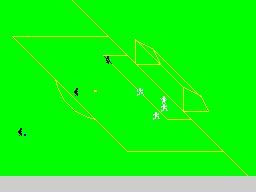
It's 4.40pm on a cold winter's day, your team are two goals down with five minutes left to play. The crowd are booing loudly for such small numbers, and the directors are well aware of the league position and of the massive overdraft you've caused by unsuccessful dealings in the transfer market. Suddenly, a bottle of Scotch and a hole in the ground seem a very attractive proposition... If you thought that kind of pressure could only fall on Peter Taylor then you've not played Football Manager - a compulsive game and an accurate portrayal of a manager's problems. You can choose your team, pick or buy, players and watch them crash out of the FA Cup or encounter relegation. The game starts at the beginning of the season in Division Four; after inputting your name and choosing the team that you want to manage you are away on your quest for the First Division and Wembley glory in the FA Cup. Of the seven levels of play it is best to start as a beginner since the higher levels would leave even Brian Clough speechless. The game kindly gives you a hefty bank balance and several options before playing that all-important first match. You can list or sell your players, pay off that loan or make it an even bigger millstone around your neck, change the team name or players names. If a player becomes available on the transfer market you can make the highest bid you can afford, knowing the high value his team have placed on him. Should you not wish to exercise any options, the program displays the forthcoming fixture and various team attributes such as morale, the strength of the defence, midfield and attack. If you wish to maintain the present team selection, the program's best feature becomes quickly apparent. In a three-dimensional view of the pitch, match highlights are played out with every goal announced American-style by a large scoreboard at the top of the screen with the magic word GOAL emblazoned across it in giant letters. The games end shows the result and is followed by an update of your financial condition, your gate money, wage bill and weekly balance tells you whether you can afford to pay off your debts or whether you can afford to buy another player. These are the attractions of this simulation as it mirrors the problems of football at all levels. The manager has to decide all aspects of his team and the challenge of finding success both on the field and on the club's financial balance sheet provide the compulsion of this game. It can be acutely agonising to watch your league position fall when the league tables are calculated and exhilarating when the position improves. This game has been on the scene for a long time, and its age is betrayed by the presentation, which is not up to the high standards required today. The match highlights are well animated and the teams are portrayed by little men who run and shoot realistically, but it is let down by the dull grey border which is shown throughout. The options display is dull and response to commands is slow, and the player is kept waiting while the league table is calculated. The game is also slowed down by having to use the number 99 to persuade the program to continue (the choice of this two-digit number for this job is for arcane reasons beyond rational explanation). However, this is still a highly absorbing game which, with better presentation, would be a classic. Highly appealing to the football fan and providing a lasting challenge with room for both strategy and that touch of luck that can turn any match. This game will differentiate between fans who believe they can do better than present managers and those who really can. Good value.
CRASH REVIEWERS COMPETITION In the first issue of CRASH (February) we ran a competition designed to discover the best reviewers of games from among readers. The results of this competition should have been announced in the third issue (April). We had, however, overlooked the fact that, as they say, everyone's a critic at heart. By the time the third hundred review dropped into the IN tray, we realised that there was no way it would be possible to process all the entries in time. Hence the one-month delay.
In addition to the winner and five runners-up, the following get a special mention, and extracts or whole reviews will be appearing in following issues. Vic Groves, Regent's Park Estate, London NW1 A. J. Green, Toddington, Beds Rob Holmes, Wirksworthy, Derbyshire David Branston, Hall Green, Birmingham S. Guillerme, London W8 R. Norfolk, Scholar Green, Stoke-on-Trent H. J. Lock, Wallington, Surrey David Dursley, Clifton, Bristol J. E. Price, St Albans, Herts
JUDGING CRITERIA What we were really looking for were reviews that managed to provide a good, concise description of the game in question and combine it with a sense of humour, personal observation and, of course, an ability to write in a fluent, interesting way. We did say that entries would not be judged on spelling ability, although it would be important to be literate. In the event, there seemed to be very few bad spellers. A number of entries tried to ape the style of presentation as seen in CRASH, which was not necessary at all, although this did not affect the outcome of the final decision; and other writers steadfastly stuck to the format that other well-known computer magazines offer. The winner and five runners-up have provided a varied selection of titles, and although it was felt that the winner stood out, he did so from the runners-up by a faint margin. All in all it was a hard Choice. And so to the most important part - the results.
Readers were asked to write three reviews of titles picked from a selection of 79 games, divided into five categories: Arcade, Adventure, Strategy /board games, Simulations, Utilities and Educational. Each review was supposed to be of between 500 and 900 words. However, due to a rather ambiguous use of language (sorry) entrants were a bit confused as to whether they should write three reviews of this length or three reviews which together added up to this length. As it was our error, no one has been penalised for picking either figure. As it turns out, it was just as well that there was a large selection of choice, but, in the main, the majority of reviewers opted for the more obvious games and there were numerous versions of Jetpac, Hobbit, Penetrator and Zoom. From among the utilities The Quill and Melbourne Draw proved favourites. We were pleasantly surprised by how many educational reviews we received, showing that this is a vital area of interest for quite a number of readers. Choosing a winner and five runners-up has been a difficult task, not only because there were so many entries, but also because the standard was extremely high throughout. A factor common to many entries was the tendency to pick games obviously well enjoyed by the reviewer, thus allowing said reviewer to rhapsodise over the game's finest points rather than actually criticise it. It's always much easier to say nice things about something than to say unpleasant things in a constructive manner. On the other hand, there were a few entries which positively reveled in tearing a program to shreds as a sort of revenge against the computer game in general!
THE WINNERS ENTRIES It would only be fair to say that in the opinion of the Editor there were several entrants who were able to provide more detailed descriptions of the games than those that will be found in the winner's reviews. But the winner managed to combine most successfully the ability to enthuse over a game while at the same time keeping a sense of overall perspective. He was able to describe the games adequately and in a very personal way. Most importantly, all three reviews start off in a highly original and entertaining manner, creating instantly an atmosphere which makes the reader want to carry on reading. As printing all the winning entries in one go would take up too much room, we have had to split them up into two sections. This month the winner, J. Singh, and runners-up John Minson and Phil Morse; next month runners-up Gary Bradley, E. Munslow and Steven Wetherill. The following month we will be printing some further entries which deserve a special mention. May we thank everyone who wrote in to take part in the competition.
WINNER - CRASH REVIEWERS COMPETITION Jaswant Singh is 19 and lives in Hadley, Telford, with his family: mother, father, two sisters and brother. He went to Manor School, just down the road from where he lives, and he left with 10 O-levels and four A-levels. He now works for Lloyds Bank. The CRASH Reviewers' Competition isn't the first competition that Jaswant has won. In May 1982 he won second prize of £300 as an A-level student in a competition organised by Barclays, writing on teaching and the microchip. He was also a runner-up in a nationwide competition organised by The Observer and Whitbread of the subject, How the Chip Will Change Society. Jaswant bought his first Spectrum in October, and says he prefers playing arcade games. He does not use a joystick, although he is thinking of getting one soon. We hope that Jaswant will be joining the team of CRASH reviewers very soon.
WINNER CRASH REVIEWERS' COMPETITION J. Singh, Hadley, Telford, Salop RUNNERS-UP (Not in order of merit) Steven Wetherill, Kexboro, Barnsley, S. Yorks E.Munslow, West Bromwich, W. Midlands Gary Bradley, Glasgow John Minson, Muswell Hill, London N10 Phil Morse, Welwyn Garden City, Herts
Crash #4May 1984 · p.65
Producer: Addictive Games, 48K £6.95 Author: Kevin Toms Universally agreed as one of the best of Spectrum games of any type. This is as much strategy as simulation as you choose a team from 64 on offer, and try to work your way up from Division four to win the FA Cup. The background to the game is quite realistic, with players losing strength value and gaining it by resting a match, morale worsening with lost matches, declining crowds and resulting loss of gate money, and all the technical and strategic problems of a club manager. Having selected your team, studied the opponent's dossier, you can sit back and watch the fully animated, edited highlights of the match! An amazingly engrossing game with seven levels of play and highly recommended.
Big K #1Apr 1984 · p.44
Charlie Nicholas
MAKER: Addictive Software MACHINE: Spectrum 48K FORMAT: cassette PRICE: £6.95 'In all my years of playing with toys - ever since I was a kid anyway - I've never imagined in all that time that anything like this could exist. I've been a professional footballer for seven years now and I tell you I could play this 24 hours a day and never get tired of it. I'm not even sure it's a game at all. It could even be useful - to football managers! If Don Howe [Arsenal manager] took this home - or any other manager - I guarantee they'd do well on it. Their ideas would come out. The different things you can do... like putting players up f or sale... It's incredible. 'The Highlight sequences are pure magic. And then you have to sit on the sidelines and sweat it out! Completely fantastic. I want one!"
Crash #2Mar 1984 · p.61
Producer: Addictive Games, 48K £6.95 Author: Kevin Toms Universally agreed as one of the best of Spectrum games of any type. This is as much strategy as simulation as you choose a team from 64 on offer, and try to work your way up from Division four to win the FA Cup. The background to the game is quite realistic, with players losing strength value and gaining it by resting a match, morale worsening with lost matches, declining crowds and resulting loss of gate money, and all the technical and strategic problems of a club manager. Having selected your team, studied the opponent's dossier, you can sit back and watch the fully animated, edited highlights of the match! An amazingly engrossing game with seven levels of play and highly recommended.
Crash #1Feb 1984 · p.60
Producer: Addictive Games, 48K £6.95 Author: Kevin Toms Universally agreed as one of the best of Spectrum games of any type. This is as much strategy as simulation as you choose a team from 64 on offer, and try to work your way up from Division four to win the FA Cup. The background to the game is quite realistic, with players losing strength value and gaining it by resting a match, morale worsening with lost matches, declining crowds and resulting loss of gate money, and all the technical and strategic problems of a club manager. Having selected your team, studied the opponent's dossier, you can sit back and watch the fully animated, edited highlights of the match! An amazingly engrossing game with seven levels of play and highly recommended.
Personal Computer News #34Nov 1983 · p.535/54/54/55/55/5
Lasting Appeal 5/5
Playability 4/5
Use Of Machine 4/5
Overall Value 5/5
John Lettice 5/5
NAME: Football Manager SYSTEM: Spectrum 48K PRICE: £5.95 PUBLISHER: Addictive Games FORMAT: Cassette OUTLETS: W H Smiths, Menzies, Boots. QUEERING YOUR PITCH The start of the season - you sit by the side of the pitch, breathing in the rich fragrance of grass that has been carefully nurtured all summer - apart from the odd carnival and farewell concert by The Who - in preparation for this day. Then out of the tunnel, with the roar of the crowd building to a crescendo in their cars, come Stalin, Lenin, Thatcher, Reagan and the rest of the lads - because this isn't the real game. Just the next best thing, Football Manager. OBJECTIVES You manage a clapped out team somewhere in darkest Division Four. Your goal, if you'll pardon the expression, is to battle your way up to the top of the First Division, winning the FA Cup as many times as you can on your way. You can pick any team you fancy, and can rename one (along with the players) if the cream of four divisions holds no joys for you. IN PLAY Considering the enormity of the task, even the best of us will take five or six seasons at five to six hours per season to crack this one, and if you choose the most difficult level you may not crack it at all. I started out by renaming my team Dundee Utd - Scottish readers would do well to consider a similar course - and ploughed through the player pool, amassing an ill-assorted bunch of history's hard-men. At the easy level I found it plain sailing. I could manage the team well, snapping up good players when they came on the market, swopping them round so they didn't get too tired, until I had a side that could see off even the First Division giants. But I forsook the trophies, got over-confident and switched the mode - you can do this in mid-play - to 'genius'. Legs started breaking and groins straining, and my team soon became microcomputing's answer to Tranmere Rovers. Two seasons with no wins and only three goals scored, and I was back on 'easy'. Another feeble season while I paid the bills and repaired the damage. VERDICT You bite your nails as the goal-mouth dramas are played out, you can buy Rasputin, sell Kevin Keagan, and if you ever get good at it, you just have to turn up the skill level for your one-way ticket back to the Isthmian League.
Personal Computer Games #1Sep 1983 · p.104
Steve Mann
MACHINE: Spectrum SUPPLIER: Addictive Games PRICE: £5.95 When I first received this game, I spent the best part of a weekend playing it. Since then, I have returned to it more often than any other. The object of the game is to pilot your chosen team from division four to the league championship, on the way winning the FA Cup as often as possible. The game mirrors reality in that a good Cup run will give you greater attendances, hence more money at the gate. Conversely, losing too many games cuts your income and can result in you getting the sack. You have a maximum of 16 players in your squad and can buy or sell as the situation dictates, borrowing from the bank as necessary. You can change players' names to suit your own foibles and prejudices. Unfortunately, your players must have names of eight letters or less, including initial, so there's no room for Kenny Dalglish. Loading Football Manager for the first time, you are invited to enter your name and then choose a team from the 64 on offer. No matter which team you choose, you start the game in division four which must be particularly galling for Liverpool fans. If your favourite team is not represented, you can select any of the others and then change the name. You select your skill level from a choice of seven, ranging from beginner to genius. You then choose your team's colours - this is not too realistic as you are restricted to black or white - and the game begins. The truly addictive quality of this game is the remarkable way it mirrors a real football manager's problems. Each player in your squad is rated between 1 and 5 in skill. This rating affects his price in the transfer market and his cost to you in wages. In addition, each has an energy value of 20 or less. Each game played reduces this value by one, while resting the player for one game boosts his energy by 10. Your team's performance will depend on values obtained from the skill and energy ratings of the players, plus a morale factor. Lose games and this goes down, making you more likely to lose again. This is identical to a real team's performance. So far, the game is purely textual. Now the fun begins. Having selected the most suitable team for the forthcoming game (you have a dossier on your opponents' skills, morale and energy), you have to sit back, biting your nails like any real manager, while the game is played. This is done in a series of goalmouth scrambles. Successful shots are greeted by an electronic scoreboard flashing 'GOAL!' and the match score is displayed. It should be stressed that this is not a short game - there are 15 games in a season, plus the various rounds in the FA Cup. To get from division four to the league championship at any of the higher skill levels is going to take you a week of playing every day.
Sinclair User #11Feb 1983 · p.307/10
Gilbert Factor 7/10
GETTING AS SICK AS A SPECTRUM PARROT If you have always wanted to manage a football team, Football Manager, from Addictive Games, is for you. The game works on the 48K Spectrum and charts the career of a professional football team from the Fourth to the First Division. At the beginning you choose your team, which has a full complement of players. The players can be sold and bought during the progress of the game. After you have selected your team you will be given a position in the league table, usually at the bottom of the Fourth Division. A team will be selected for you to play and highlights from the match will be shown to you in 3D. After that a brief rundown of the rest of the day's matches is given and the league table is calculated for the division. The skills needed are that you must keep a balance between earning money from the gate returns and winning on the field. It seemed that if you do too much of one the other suffers. The game is ideal for a football fanatic but the most interesting thing for us was the 3D graphics used to create the goalmouth. The league tables, players' records and match results seemed to bear no reflection of real life. For instance, Kevin Keegan is given a very low skill rating and a transfer fee of £5,000. Apart from that, the game is a winner. Football Manager costs £7.95 and can be obtained from Addictive Games, [redacted].
ZX Computing #5Feb 1983 · p.31
Phil Garratt
Versions of Addictive Games' Football manager have been produced for all the popular home micros, and it is now available for the 48K Spectrum. You are given the managership of any one of the 64 teams in the league (you can even change any team's name to your own favourite if it is not one of those shown). Whichever team you choose, it begins in division four at the start of a new season. Your aim is to achieve promotion and a good run in the FA Cup - who knows, perhaps even win it! The league is split into four divisions of 16 teams, so each season involves 15 league matches plus up to eight rounds of the FA Cup. You start off with a squad of 12 players and £100,000 to spend in the transfer market if you wish. If you're the sort of manager who likes to try and buy your way to the top, then you can also obtain a bank loan up to a certain credit limit based on your division, at a 1% per week rate of interest. The players, whose names are those of current league footballers, have three attributes. First, they are either defence, midfield or attacking players. Second, they have a skill rating of 1 to 5, on which depends their value. Third, they have an energy rating of 1 to 20, which goes down by one for each game played, and up by 10 for each game rested. When you come to play a match you are given the 'team attributes' for yourself and the opposition, and it is then up to you to juggle with the composition of your team if you need to. The five team attributes are the average energy rating, morale (which goes up and down depending on results), and then the total skill rating in defence, midfield and attack. With the team selected, you can sit back and watch the match highlights in moving 3-D graphics. This is what makes the game more than just a sophisticated 'Kingdoms'. Seven or eight goalmouth incidents are shown, with players running around, moving into position, and then shooting at goal. Having to helplessly watch the results of your decisions like this is almost as exhausting as playing. The final score is based on the team attributes, but there is always the chance of a shock result. After the highlights, if it was a league match the rest of the results are given and the league table calculated and displayed. MATCH OF THE DAY Each week you are shown your financial balance sheet. Outgoings are wages, which depend on the number of players and their value, ground rent, and interest on your loan (if any). Incomings are gate receipts, which are based on your position and your opposition's position in the league. A good FA Cup run can also be a money spinner. At the end of the season, promotion and relegation take place, you are given bonus according to your league position and a 'managerial success rating' is calculated. There is a facility to SAVE the game at any point so that you can progress with one team for as long as you like. This feature is often available in adventure or chess programs, but I always find I forget where I've been, or what strategy I was following. With Football Manager, this is not a problem, as all the information you need is available at each stage. Although I'm no great football fan, I really enjoyed playing this game. Despite having been converted from a ZX81 program, excellent use is made of colour and user-defined graphics. The game is very logically put together, so that the development of strategy and tactics has a real effect. For example, one of my teams got through to the fourth round of the FA Cup where it was beaten by a second division side. This upset morale and meant that our promotion bid failed. Perhaps I should have given up the FA Cup run and held some good players back - the possibilities are endless. Brian Clough had better watch out! 'Football Manager' is £7.95 and is available from Addictive Games, [redacted].
Advert141
- C&VG (Computer & Video Games) #60Oct 1986 · p.57
- C&VG (Computer & Video Games) #59Sep 1986 · p.30
- Crash #30Jul 1986 · p.73
- Crash #29Jun 1986 · p.6
- Popular Computing Weekly #18May 1986 · p.7
- Popular Computing Weekly #10Mar 1986 · p.33
- C&VG (Computer & Video Games) #50Dec 1985 · p.53
- C&VG (Computer & Video Games) #47Sep 1985 · p.46
- C&VG (Computer & Video Games) #46Aug 1985 · p.79
- Your Computer #7Jul 1985 · p.78
- C&VG (Computer & Video Games) #45Jul 1985 · p.81
- Crash #17Jun 1985 · p.54
- C&VG (Computer & Video Games) #44Jun 1985 · p.74
- Your Computer #5May 1985 · p.46
- Crash #16May 1985 · p.47
- C&VG (Computer & Video Games) #43May 1985 · p.40
- Your Computer #4Apr 1985 · p.150
- Crash #15Apr 1985 · p.115
- C&VG (Computer & Video Games) #42Apr 1985 · p.48
- Popular Computing Weekly #14Apr 1985 · p.42
- Your Computer #3Mar 1985 · p.87
- Crash #14Mar 1985 · p.63
- Big K #12Mar 1985 · p.39
- C&VG (Computer & Video Games) #41Mar 1985 · p.95
- Your Computer #2Feb 1985 · p.140
Full-page ad40
- C&VG (Computer & Video Games) #49Nov 1985 · p.52
- C&VG (Computer & Video Games) #48Oct 1985 · p.73
- C&VG (Computer & Video Games) #36Oct 1984 · p.54
- Your Computer #9Sep 1984 · p.44
- C&VG (Computer & Video Games) #35Sep 1984 · p.16
- Personal Computer Games #10Sep 1984 · p.94
- C&VG (Computer & Video Games) #34Aug 1984 · p.52
- Sinclair User #28Jul 1984 · p.6
- Your Computer #7Jul 1984 · p.80
- C&VG (Computer & Video Games) #33Jul 1984 · p.72
- Popular Computing Weekly #29Jul 1984 · p.24
- Sinclair User #27Jun 1984 · p.15
- Your Computer #6Jun 1984 · p.138
- ZX Computing #13Jun 1984 · p.16
- C&VG (Computer & Video Games) #32Jun 1984 · p.30
- Sinclair User #26May 1984 · p.28
- Your Computer #5May 1984 · p.188
- C&VG (Computer & Video Games) #31May 1984 · p.108
- Sinclair User #25Apr 1984 · p.21
- Your Computer #4Apr 1984 · p.206
- ZX Computing #12Apr 1984 · p.2
- C&VG (Computer & Video Games) #30Apr 1984 · p.82
- Sinclair User #24Mar 1984 · p.13
- Your Computer #3Mar 1984 · p.199
- Computer ChoiceMar 1984 · p.67
Feature10
- Your Sinclair #54Jun 1990 · p.53
- ACE (Advanced Computer Entertainment) #29Feb 1990 · p.80
- Sinclair User #52Jul 1986 · p.27
- Computer Gamer #5Aug 1985 · p.22
- Crash #16May 1985 · p.41
- Computer ChoiceSep 1984 · p.58
- Sinclair User #29Aug 1984 · p.56
- C&VG (Computer & Video Games) #34Aug 1984 · p.25
- Big K #1Apr 1984 · p.42
- Popular Computing Weekly #11Mar 1983 · p.12
News/Note10
- C&VG (Computer & Video Games) #68Jun 1987 · p.12
- Crash #40May 1987 · p.11
- Crash #34Nov 1986 · p.12
- Sinclair User #53Aug 1986 · p.10
- C&VG (Computer & Video Games) #58Aug 1986 · p.8
- Crash #17Jun 1985 · p.77
- Computer Gamer #3Jun 1985 · p.6
- Crash #16May 1985 · p.68
- ZX Computing #15Oct 1984 · p.14
- Popular Computing Weekly #51Dec 1983 · p.57
Tips7
- Sinclair User #127Sep 1992 · p.15
- Crash #84Jan 1991 · p.57
- Crash #63Apr 1989 · p.34
- YS Smash TipsAug 1988 · p.18
- Your Sinclair #28Apr 1988 · p.28
- Personal Computer Games #13Dec 1984 · p.126
- Big K #6Sep 1984 · p.109
CompoResult2
- C&VG (Computer & Video Games) #70Aug 1987 · p.12
- Personal Computer Games #14Jan 1985 · p.18
Review2
- Sinclair Answers #2Jan 1985 · p.27
- Sinclair Answers #1Sep 1984 · p.38
Classified2
- Popular Computing Weekly #24Jun 1984 · p.1
- Popular Computing Weekly #25Jun 1984 · p.1
Information1
- SSD-IISep 1999
CompoEntry1
- Personal Computer Games #11Oct 1984 · p.30
Remakes
- Football Manager2001PC/DOS
Paul Robson
- Football Manager2003PC/Windows
Sandwell Software (Kieran Sandwell)
Related
- Compilations
- Soccer Spectacular, Football Manager + Penetrator, Software Magazine issue 18a, Clasicos Spectrum: Hormigas + Traxx + Futbol Manager + Billar Americano
- Ports
- (Amstrad CPC), (Atari 8-bit), (Commodore 64), (Commodore Plus/4), (MSX), (Amiga), (Atari ST), (BBC Micro), (Acorn), (Dragon 32), Football Manager (VIC-20)
- Tags
- Soccer
- Elsewhere
- WikipediaStrategyWikiCentre for Computing HistoryMobyGamesRZX ArchiveThe TipshopUVLModern ZX-Retro GamingRZX Archive - YouTubeSpectrum Computing RZX - YouTube
- Same entry at
- Spectrum ComputingZXInfo
Reviews from people here
Sign in to write about this, or make an account. It takes a minute and lets you correct the catalogue too.
No language recorded.
Sign in to correct or add to this.
Hold the rights to this and want it taken down?