
The Forest
Game: Simulation · ZX-Spectrum 48K · 1 players · English
Phipps Associates · 1983 · Pound sterling 9.95
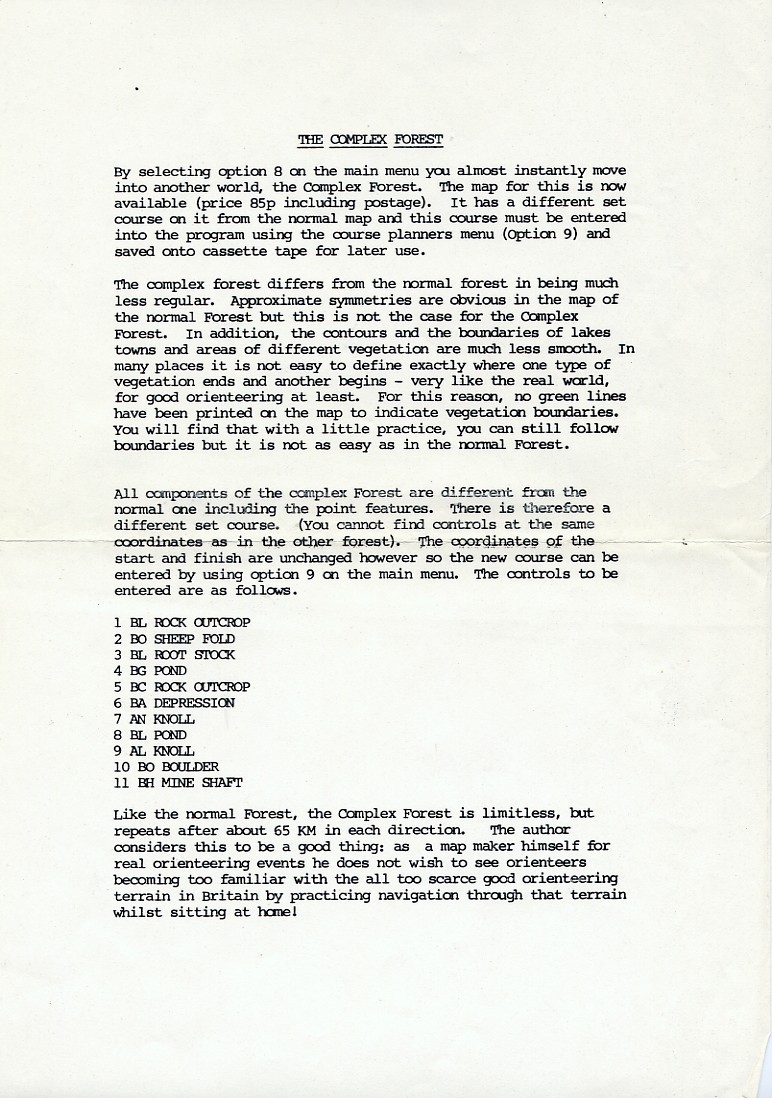
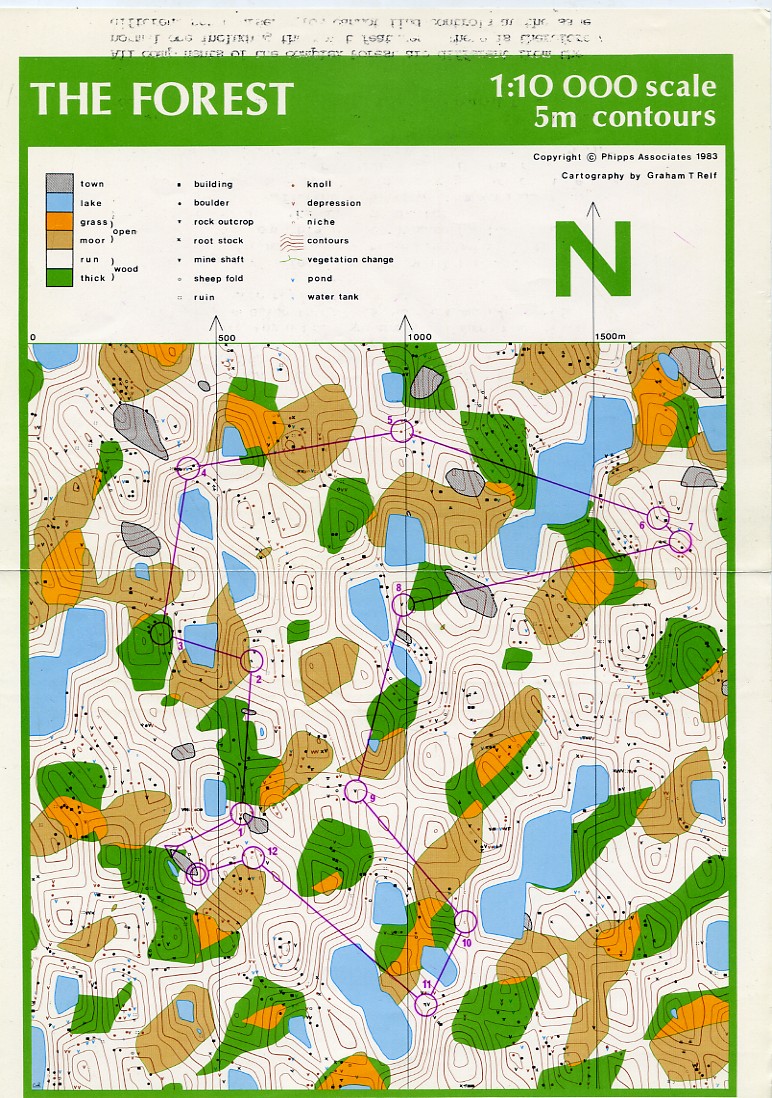
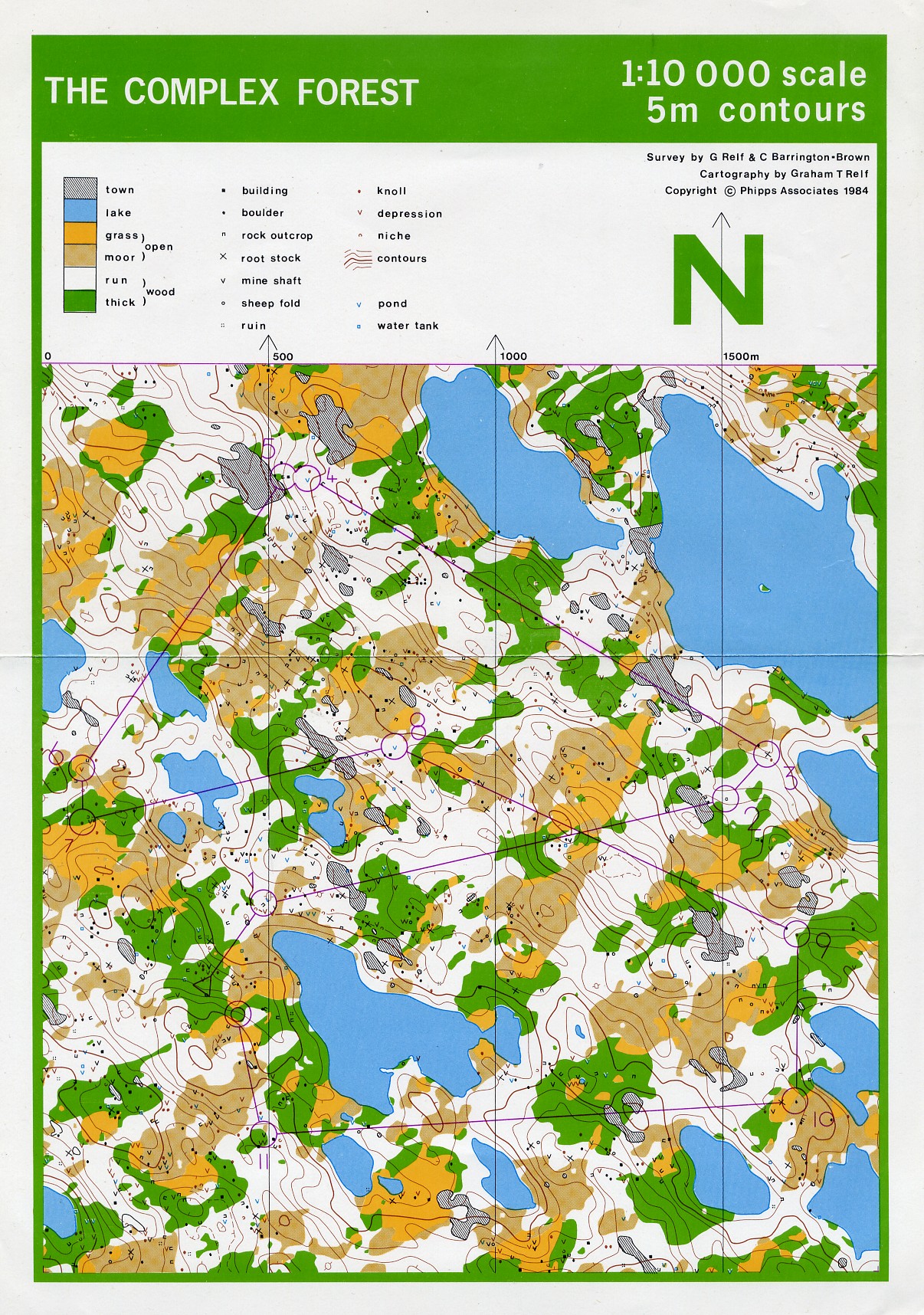
Discussion
Nobody has started a thread about this yet.
Remarks
orienteering
Play
- ForestThe.tzx.zipTape image English9 KB
- ForestThe.tap.zipTape image English9 KB
Documents
- TheForest_DesignMaterial2.pdfDevelopment material (sketches/notes) English
- ForestThe.pdfInstructions English70 KB
- ForestThe.txtInstructions English35 KB
Files and rights
No permission is on record either way. Screens and pictures are copied here on a take-down basis: if you hold the rights and want something removed, say so and it goes.
Credits
- Graham T. Relfcredited
Sign in to credit somebody, or say what these people did.
Scores
In the magazines
- Personal Computer News #341983 · Overall Value5/5
- Sinclair User #221984 · Gilbert Factor7/10
- Crash #21984 · Overall88%
- Crash #41984 · Overall88%
Elsewhere on the web
- WorldOfSpectrum 8 votes6.00
In the magazines 37
Sinclair Programs #21Jul 1984 · p.30
June Mortimer
WANTED - RACING DRIVER, PILOT, PRIME MINISTER... Simulation programs are fun and educational . Among a selection of excellent games , many of them best-sellers , we find one leads the field . Spend your time playing Manic Miner or The Hobbit and, although you may gain remarkable proficiency on the Spectrum keyboard, the chances are that you will not feel any better-equipped for any real-life experiences of wandering beneath the streets of Surbiton, or controlling the movements of a recalcitrant dwarf. Spend your time playing simulation games and not only will you enjoy some of the best games on the market but also you will benefit from the educational qualities of simulation games. Whether your dream has always been to bring the government to its knees, form a successful rock band, become a millionaire or simply to get away from the city and take up sport in the countryside, there is a simulation game designed to help you achieve your dream in the comfort of your home. Simulation games put you into the place of another person, a jet pilot for example, provide some background information and instructions, and then allow you to make all the decisions. UNRIVALLED SUCCESS In the field of simulation games nothing has arrived in the Sinclair Programs office to rival The Forest - Phipps Associates, 48K Spectrum . It is a simulation of that sport seemingly least likely ever to be played on a microcomputer, orienteering. Orienteering is essentially a cross-country race across difficult terrain, to which has been added the extra dimension of navigational problems. Contestants are supplied with a map, on which is marked a number of points, each of which must be visited in order. Points are often separated by lakes or dense forest, so the quickest route is not necessarily a straight line but can be found only by a skilled map reader. An added complication is that the map, and the area, do not include roads, footpaths or streams, and so map and compass must be used throughout. Graham Relf, author of The Forest has, amazingly, made it possible to orienteer with a Spectrum and, more incredibly still, has fitted 11,200 sq. km. of map into the program. When the game is loaded, the scene is the start of the course, on the edge of the town and the forest. Objective number one lies around 100 metres to the north-east and is marked by a flag on arrival. The map shows that a direct route would not be too difficult; most of it is downhill and the forest through which a straight path would run is not too dense. It is difficult, however, to run even 100 metres through trees white trying to follow a compass bearing, so the booklet accompanying the program suggests that beginners first aim for the nearby lake and then for the small flag in the middle of the forest. The screen shows the view six metres in front of the player. It may be lake, tall trees, small trees, a town, or a selection of other types of terrain. Ten terrain symbols are shown on the screen at any time. Turning to right and left can be done by means of left and right cursor keys. Turning to face the way you have come is achieved by pressing the downward cursor key, and movement forward by pressing the upward cursor key. Each step you take is roughly one metre long although, as in real life, your steps will vary in length and you will move with much more difficulty uphill through thick trees than when running downhill across grass. A sight set in front of you shows where the ground directly ahead of you would be if the ground were completely level. That gives a clear indication as to whether you are running uphill or downhill. Running on a compass bearing is not possible with a computer. It is possible to estimate on which bearing you should walk, and for how far, but most players will find that a ruler and protractor make life easier. The forest is an extremely good educational aid for anyone wishing to reach or learn map reading, compass hearings, or simply the use of ruler and protractor. The map is very accurate and there is an immense sense of achievement to be gained from finding a flag after navigating through a kilometer of forest. The program also gives a clear idea of how contour lines marked on a map relate to hills and valleys. Experienced players will find that by following the curve of a hill as they run along, they can follow contour lines on the map, which can be very helpful when crossing large areas of forest. BEST-SELLING PROGRAMS Better-known simulation games are the flight simulation programs Flight Simulation - 48K Spectrum and 16K ZX-81, Sinclair Research - and Fighter Pilot - 48K Spectrum, Digital Integration - both best-selling programs. Flight Simulation allows the player to take off, fly and land an aeroplane. The aircraft controls are complex and so the long instructions should be read in full before any attempt at flying is made. Despite that, first flights tend to be unmitigated disasters. Experience quickly makes the controls and instrument panels sufficiently comprehensible to make taking-off and flying possible. The most difficult aspect of Flight Simulation is landing. There are 13 control keys to remember with which the aircraft can be controlled and even experienced simulator pilots tend to find that number is around 12 controls too many when trying to reduce height and speed at the appropriate rate, while keeping on course and keeping the aircraft level. Fighter Pilot gives the player a bigger range of options than Flight Simulation. The player can choose between being a trainee, squadron instructor or ace pilot. Flight, take-off and landing can be practiced with or without the effect of cross-winds and turbulence. As can be deduced from the program title, other options include not more complicated routes or aerial manoeuvres but the opportunity to kill as many other pilots like yourself as you wish. While both Fighter Pilot and Flight Simulation are excellent simulation programs, the wider range of options open to the player in Fighter Pilot provide a more lasting challenge. Chequered Flag - Sinclair Research, 48K Spectrum - is also a well-known example of a simulation game. The screen display is of the driver's view from a racing car. Before the game begins the driver can choose between three cars and a variety of the most famous racing circuits in the world. As in a real car, there are a variety of controls from which to choose, although in a real car drivers are not expected to steer, accelerate, brake and change gear all with their hands. Moving at high speed is hair-raising enough, without the added difficulty of having to search for the brake quickly among a group of very similar Spectrum keys. NOT A NOVEL EXPERIENCE As a simulation the game is not as successful as flight simulation programs, partly because the large number of its imitators make the idea of driving a car on your Spectrum seem stale. Driving a car or being driven in a car is not a novel experience for Spectrum owners and so differences from real life are much more apparent than when trying to fly an aeroplane. 1984 - Incentive Software, 48K Spectrum - gives the player control of the Government of Britain from 1984 onwards. All decisions on Government spending and allocation of resources are made by the player. Radical changes in spending will not be accepted by the computer and budgetary changes which leave certain departments short of money will be queried by the computer before they are accepted. MANAGEMENT GAME 1984 states that it is "a game of Government management" and so computer owners wishing to become involved in other aspects of British political activity, or to overthrow the Government and set up a different political system, will not find it suited to their needs. The cassette insert includes a complex diagram, demonstrating how different sections of the economy are linked and what effects budgetary changes in any area will have. Students of economics or government may find it a helpful game to play, although it is necessarily simplistic in some areas. It is a complex and well-thought-out simulation game. People using it for educational purposes, though, will find that the help of an experienced teacher would be necessary to indicate the problems which necessarily will arise when the player attempts to run the country on a microcomputer. Rather more frivolous is Millionaire - Incentive, 48K Spectrum. The game involves running a software company and the aim is to make a million pounds. It is fast-moving, easily comprehensible but necessarily repetitive with clear graphics on-screen. Decisions must be made as to which kind of software should be written, how much should be produced, how it should be advertised, and how it should be marketed. As profits increase, the size of your house, shown at the beginning of each round, will increase from being a small terrace to a large mansion. Production of cassettes cannot exceed a certain level each month, so once you have made all the correct decisions and are selling out of stock each month there is no chance of becoming an overnight success. Another problem with the game is the irritating over-use of a luck element throughout, so that making the same decisions two games running will produce very different results. Over-use of chance is always a flaw in a simulation game and in Millionaire it gives rise to the suspicion that success would be obtained as quickly by throwing dice to make decisions. BUSKING IN THE SUBWAY Along the same lines as Millionaire is it's Only Rock 'n' Roll - Virgin, 48K Spectrum. The aim is to make it as a rock star, "making it" being defined in this case as earning a million pounds and acquiring three status symbols. From busking in the subway it is possible to rise. to tours of Japan and the U.S., number one hit records and sold-out concerts at Wembley Stadium. All that takes time, however, and Virgin judges rock stars to be over the hill within five years of the start of the game, or fewer if you choose a more difficult level. It is necessary, therefore, tO take a few risks to achieve high popularity levels as quickly as possible. It is disappointing that once you have made it in the set time there is no winning display - you continue the game until you are over the hill and then finish. VERY SIMILAR SIEGES A similar lack of any appropriate ending is apparent in Jerico 2 - Elephant Software, 48K Spectrum. The game can be considered with Fort Apache - Contrast Software, 16K Spectrum - as, except in theme, the two games are remarkably similar in all respects. In both the player leads a siege, in one case on an Apache fort, in the other on the city of Jerico. Battles must be fought, weapons and equipment built and supplies fetched. Not the most accurate of simulations and not the most involving, either. Success can be obtained on Jerico 2 within half an hour, though Fort Apache is slightly more difficult. Despite the similarities of the games, Fort Apache is better than Jerico 2, as it makes full use of the ZX-81 facilities.
Crash #4May 1984 · p.6688%
Overall 88%
Producer: Phipps Associates, 48K £9.95 (1) Author: Graham T. Ralph An amazing program which simulates the sport of orienteering - yet manages to be much more than a sport simulation. An enormous area of geography is enclosed in the program, only a tiny bit of it already mapped for you. Included is a 12 point orienteering course for you to complete in the shortest possible time, checking each point in the correct sequence. The display shows you the terrain six metres in front and uses symbols for the different terrain, trees, shrubs, lakes, towns etc. Special point features are displayed as messages and an eye level indicator tells you whether the ground is falling or rising, so you can easily follow the contours. In addition you can go off and chart the unmapped areas. The program will draw contour and terrain maps for you or make up 3D views. A massive program, excellent value, recommended. Overall CRASH rating 88% M/C and BASIC.
Crash #2Mar 1984 · p.6288%
Overall 88%
Producer: Phipps Associates, 48K £9.95 (1) Author: Graham T. Ralph An amazing program which simulates the sport of orienteering - yet manages to be much more than a sport simulation. An enormous area of geography is enclosed in the program, only a tiny bit of it already mapped for you. Included is a 12 point orienteering course for you to complete in the shortest possible time, checking each point in the correct sequence. The display shows you the terrain six metres in front and uses symbols for the different terrain, trees, shrubs, lakes, towns etc. Special point features are displayed as messages and an eye level indicator tells you whether the ground is falling or rising, so you can easily follow the contours. In addition you can go off and chart the unmapped areas. The program will draw contour and terrain maps for you or make up 3D views. A massive program, excellent value, recommended. Overall CRASH rating 88% M/C and BASIC.
Crash #1Feb 1984 · p.27
Franco Frey
IS THE FOREST POINTING THE WAY TOWARDS BETTER ADVENTURES? Producer: Phipps Associates Memory Required: 48K Recommended Retail Price: £9.95 Language: main in BASIC, movement and data in m/c Author: Graham T Relf Dense fir branches suddenly gave way to an easy ground of mature trees, through which I could easily maintain a brisk pace. I checked my progress, scanning the woods for any telltale signs. Yes, there it was at barely 10 metres distance, a few white rocks hidden under vegetation. I stood in front of the ruins I had set my bearings on for the last 100 metres. Producing the map, compass and protractor I set course for northwest, maintaining the same altitude. This would lead me to the clearing, well clear of the open moor, then down the valley to the edge of the lake, after which it would be child's play following the waterfront to the large boulder. Then across the woods due east to the edge of the town and the finishing point. If this reads like a typical orienteering course then it is because Graham Relf has made an astonishingly realistic simulation of the sport on the Spectrum. There's no need to be in top physical shape - leave that to Olivia Newton John, but it would be wise to know something about the art of map reading and navigating. It is here that you can learn something and yet fully enjoy the game. There is an enormous area of geography enclosed in the game, approximately 37 square kilometres, of which only a small portion has been charted so far. Included on this map is a 12 point course ready for you to tackle in the shortest possible time. All you have to do is visit each control point in the right sequence. The proof of your visit will be printed on your control card, which you carry with you. Each check point has a special code, so cheating's out. Each step taken is approximately one metre, as in real life, with a random variation of plus or minus 10 degrees. This means taking ten steps for every millimetre of the supplied 200 x 210mm map! As your bearing drifts while moving, don't go running for miles without checking it. The display shows you the terrain six metres in front of you and it varies from thick fir trees, to running wood (mature trees), moors (hard going), open grass, town area or even lake. Special point features such as buildings, boulders, rock outcrops, mine shafts, knolls, depressions etc. will be displayed as a message (with code if it is a checkpoint). An eye level marker in front tells you whether the ground is rising or falling, so you can easily follow contours on the map this way. As real time is used you can check on elapsed time. It can be taken at a very brisk pace as the graphics are updated in a short instant, and speed, as in real life, is dependent on the terrain. If you are ascending in thick wood, you will be puffing and panting - not too strenuous from your armchair! The orienteering feature of the game is excellent in itself; but further to that you may use the program to chart the vast areas which surround the printed map on the cover. Calling up the menu at any time you can get exact co-ordinates of your position (but using it in orienteering will affect your final results). Provision is made for drawing out contour and terrain maps of any area you specify, and a routine is provided to detect any point features in a given sector. With these many features you will be able to construct maps similar to the cover map, but be warned - it's a major task! If all this is not satisfying enough, there is a facility for displaying cross sections of the landscape and, better still, constructing a 3D view with these cross sections of any given area! The Forest certainly makes a change from the usual arcade or even adventure games. It also points the way to better adventure games. Based on the graphical display of the terrain and the actual technique of movement (in paces in any direction) the games player could be living in a fictitious and weird fantasy world of a 10 square kilometres or so. A vast area to explore. Given the added thrill of self-propelled adventure characters, living their own lives in this vast area, similar to the Hobbit characters, and visually better point features such as caves, castles, dungeons, forest huts and so on, you could be moving in a total fantasy world. Now if someone were to combine these features with a brilliant plot and with cartoon-like moving characters such as in Valhalla, you could be in Adventure Land... FRANCO FREY
One of the facilities offered is the drawing of 3D sections of the landscape.
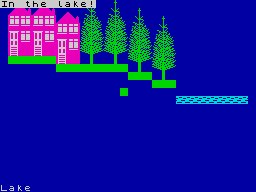
THE FOREST, showing some of the symbols used throughout the program.
Sinclair User #22Jan 1984 · p.447/10
Gilbert Factor 7/10
MAPPING A COURSE THROUGH THE FOREST Phipps Associates has produced a simulation program for the 48K Spectrum to teach the art of orienteering. The Forest is presented very professionally, with a map and a detailed booklet to accompany it. The program offers a pre-set route but you can also map your own course and use that instead. The program is definitely not for novices. The booklet warns that you need a ruler graduated in millimetres and a protractor for measuring angles to participate; the graphics change to show your position as you move, taking into account the contours of the terrain and variations in bearing and length of step. You use the cursor keys to move. The left and right arrows move you 11.25 degrees each time, the up arrow moves you forward for as long as you keep it depressed, the down arrow turns you 180 degrees to face the way you have come. Other commands allow you to check your bearings, see your control card, enter your code and check your time. Unless you are an experienced orienteer, it is very easy to get lost and the booklet recommends you to keep track of all your moves as you make them. Even experienced orienteers will probably be relieved to know that it is necessary only to arrive within five metres of the finish point marked on the map. The graphics are simple but effective and the booklet provides very thorough explanations. The Forest is available from Phipps Associates, [redacted]. The complete package costs £9.95.
Micro Adventurer #2Dec 1983 · p.20
Tony Bridge
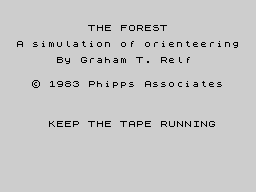
EVERGREEN FOREST MICRO: Spectrum 48K and TRS80 PRICE: £9.95 FORMAT: Cassette SUPPLIER: Phipps Associates, [redacted] The Forest is described as "a computer simulation of the sport of orienteering". The program is intended as a training aid as well as a game. The cassette nestles in a large video-style box, with a 32-page manual. A 1:10,000 scale map is included in the package. The manual is particularly well-produced, with the aid of Phipps's Diablo printer, which has given sterling service in the past. Orienteering pits the lone participant against nature, other orienteers and the clock. At the start each competitor is given a map with the course marked as a series of numbered circles joined by straight lines. At the centre of each circle is a natural feature, such as a boulder, a road junction, or bush. The corresponding feature on the ground is marked with a red and white control flag. A card is carried by each competitor, and as each control is reached the card is punched, with a coded punch found at each point. On loading the title screen shows you many of the graphic symbols used in the program. Here you will see large and small trees, a house (clusters of these represent towns), along with lakes and so on. You are then invited to "press any key to start". As soon as you do so, the scene at the beginning of the course is shown, and the clock immediately starts running. Pressing T at any time will show elapsed time. Commands are single-key. The up arrow will start you moving forward, and you will continue until another, non-direction key is pressed. At each pace, the scene ahead is re-displayed. The left and right arrows will cause you to move in those directions, while the 6, or down key will stop you, if you are moving forward, or turn you through 180 degrees if you are standing still. As you move forward through the terrain of the forest, your progress is as it would be in real life. Thus, the small fir trees, with branches often interlocking, will impede you somewhat, while larger, mature trees will allow easier passage. The trees give an indication of the slope of the ground ahead. A flashing cursor marks the base of the tree immediately ahead, and this will give you an idea of whether you are above or below the tree base. This, too, will affect your speed, and the length of each stride, thus giving a rough indication of your progress. As you move through the Forest, the picture will give you an indication of the speed of your progress, as the screen "wipes" slower or faster, depending on your pace. A one-word description of the terrain - is displayed onscreen. Come within 5 metres of a control point, and you will be informed of the type of feature (though not the number of the flag). Having finally found the control point, what do you do? Well, you have to prove that you have actually visited the point, but, unlike the real thing, you can't start punching holes in the computer - they don't like it very much. So stop moving, select D (for Description List), and you will see a run-down of the various control points, together with a brief description and the code of each one. You should by now, have a vague idea of where you are on the map, and pressing P (for Punch), will place the code for that particular control point on the Control Card - which you may then examine via the C (for Control Card) option. Now, to use the program properly it is necessary to have a ruler and protractor on hand to check your progress against the map supplied. This would be difficult enough, of course, but, in real life, the orienteer would tend to wander slightly with each pace, and the program has a built-in random factor, which will move you slightly away from the computed course. Pressing B (for Bearing) will show you your in-Program compass, giving you information on your present bearing, and also asks for a new bearing. You have the option of staying on-course if you have managed to follow your progress sufficiently well. You will find an awful lot to think about, and keep your mind occupied in The Forest, with just one landscape, but Graham Relf, the author, provides you with yet another forest to contend with. Although this one is not mapped, it does, he says, bear more resemblance to the terrain of the home of orienteering, Scandinavia. I've only spent a few moments in this forest (I find quite enough to do in the first - easier, I imagine - map), although I found that I was dumped, unceremoniously, into a lake through which I had to wade. Not only can you choose to tackle a harder terrain, but you may also design your own course. From one to 20 control points may be placed around the landscape. From the course planner's menu, individual features for each point may be set up. Using the map-drawing options in the main menu, the program would also be of use to geography teachers in school. The student will find in The Forest facilities for drawing three-dimensional diagrams of the terrain, contour maps, and feature maps. And the terrain that the program knows extends for 37 kilometres around the printed map, in the first forest. All in all, then, an extremely impressive package and highly recommended for geography students, budding and experienced orienteerers (I quite fancy having a go myself now, but only after a good week or so spent in Phipps's Forest), cartographers - and yer average game enthusiast.
Your Computer #11Nov 1983 · p.82
Peter Connor
NO OTHER MICRO HAS THE SOFTWARE BACK-UP OF SINCLAIR'S SPECTRUM. PETE CONNORS PLOUGHS HIS WAY THROUGH SOME OF IT FROM GRAPPLING WITH EVIL MAZIACS TO HELPING CHARLIE THE CHEF. Every software house, from the giants to the leprechauns, seems to have programmers chained to terminals, frantically churning out products for the massive Spectrum market. For Spectrum owners the pot of gold under the rainbow is the now huge variety of software available: their only problem is distinguishing the genuine article from the fake. One game you certainly will not need to bite into is Zzoom from Imagine. This is the Real McCoy, a quality arcade-style game of skill and destruction in the comfort of your own armchair. The game starts with the Dambusters theme tune, enough on its own to make you start twirling imaginary handlebar moustaches and warn Ginger about the bandits at 4 o'clock. You find yourself in command of an aeroplane whose gunsights appear on the screen; also displayed are a dibar to show your relation to the ground and a long-range scanner. Before you have time to think, hostile aircraft are approaching from the east; they speed in and suddenly, unexpectedly, wheel 90° towards you, presenting the slightest of targets for your cannon. Those earthbound refuges you are trying to protect do not have much of a chance. Poor blighters, I wish I could have done more to help. After the waves of planes, the landscape changes. Now its the desert, complete with palm trees. Over the horizon come battalions of tanks. More skill is now required, as you have to dive low enough to shoot your earthbound adversaries without crashing to your doom. After the desert - the sea, with enemy destroyers trying to blast the refugees' lifeboats. The standard of graphic display and excitement combine to make Zzoom a most exciting game, one that has deservedly become a micro-classic. DK'tronics, though, has produced a game which could rival Zzoom's popularity. Maziacs may seem, initially, to be just another maze-game. In fact, it has subtle qualities which make it one of the best available in this genre. The scenario is familiar: you must get through the maze, collect the treasure and get out. You can ask the way from prisoners, and pick up swords to combat the maziacs. What lifts Maniacs above the common land is its graphic sophistication. The monsters are the most grotesque I have ever seen on a micro; nightmarish squatting creatures, all legs and jaws who enjoy nothing more than gobbling you up. The prisoners are sad creatures, writhing in their shackles inside blue circles. One feels great pity for them but, sadly, one can do nothing to help. And you, the brave treasure-hunter, are a perky little fellow with a jaunty rhythmic step. You are never downhearted and your jubilation when you have destroyed a marine is quite heart-warming. These qualities give Maniacs that something extra, and make it a very compulsive game. Best of the other offerings from DK is Hard Cheese, in which you have to eat your way round the board, creating your own maze, in order to get at the cheese in the middle. Naturally, you are pursued by monsters. Naturally you can shoot these monsters, but this is not so easy as they move very quickly and you must replenish your energy. Again the graphics are of a high standard, and Hard Cheese is almost, but not quite, as compulsive as Maziacs. In comparison, DK's Road Toad and Jawz are rather dull. The first needs no introduction and is as expected; though the graphics are, perhaps, a little clearer than usual, and the tankers are truly fearsome. Jawz is a disappointment; here you are underwater, firing at Sharks and Jellyfish. It is quite tricky to hit them as you have two cannons converging from either side of your control. Otherwise the game is low on interest. Ultimate Play the Game has a reputation for quality software, and it does not besmirch it with Cookie and Tranzam. Cookie has one of the wackiest situations for a long time; Charlie Chef's ingredients have escaped from the pantry-yard and he must recapture them by dazing them with flour bombs and knocking them into his mixing bowl. As well as the runaways Crafty Cheese and Colonel Custard there are nasties such as Wally Washer and Terry Tack. Crazy, but true. The graphics are very good and Charlie is a sympathetic little figure in his white chef's hat. It is very difficult to avoid the nasties; if they get you, you end up in a dustbin. Cookie is a witty and enjoyable game, but one which you might do well to use a joystick for. Tranzam is set in the year 3474; it is your Red Racer versus the Deadly Black Turbos in the search for the Eight Great Cups of Ultimate. The screen displays a barren landscape where the only land-marks are cacti and petrol stations. You guide your car around looking for the cups, while trying to avoid your enemies and the obstacles. This is a tricky business if you are doing 400 mph and steering on the keyboard; again, a joystick would be useful. Tranzam is an exciting game which gives a taste of the Mad Max experience. GAME OR BLURB? And so to Quicksilva. Do people buy their programs for the game or the blurb? Aquaplane's scenario begins "The contrasting blues of sea and sky provide a perfect backdrop as I relax with a Pernod and lemonade..." and goes on in the same vein for two sides of packaging. Indeed, Aquaplane's sea and sky are very blue, suggestive of hot Mediterranean summers. And, the game is very good. There you are, out for a bit of water-skiing, when the speedboat goes bananas. You are being pulled away to almost certain death. Rocks, driftwood, tacking yachts, cruisers piloted by drunken play-boys, snapping sharks; get through all those and you have mastered the game. Aquaplane is made more intriguing because, as the boat accelerates, you are pulled to one side or another, thus increasing the risk of meeting a sticky end on a piece of driftwood. The graphics, too, are very colourful and realistic. Aquaplane is a highly entertaining game - almost as good as the blurb. On the subject of watery graves, Bug-Byte has Aquarius "an underwater espionage game". As commander of a frogman team you must destroy the bombs planted by an enemy nation. Problems you will encounter are sharks and electrifying jellyfish. Your oxygen will run out and must be replenished by collecting fresh tanks from the sea-floor. While the undersea world is fairly convincing and the sound effects are genuinely squelchy, Aquarius is not a very exciting game, lacking the speed and variety top-class programmes. ENCOUNTER WITH THE DARK ONE In Styx, also from Bug-Byte, you are supposed to be battling your way across the mythological river to Hades "towards an encounter with the Dark One himself". In fact, it is a rather boring maze game, where the "deadly spiders" look like bits of dried grass and the Piranhas - did you know there were Piranhas in the Styx? - are most unconvincing. If they have micros in Hades as well they may well be playing Pool, another Bug-Byte game. The graphics are much better than Styx; a bright green for the baize and red for the bolls. Curiously, the object balls are all the same colour. Control is straightforward, using the cursor keys. But perhaps these denizens of Hades might prefer CDS Micro Systems' Pool. I know I do, if only because the object balls are divided into blue and red. Otherwise, it is much the same as Bug-Byte's version, easy to control and pleasant to look at. Both programs are for one or two players. Purer pleasures of the mind are entered for by Artic's Chess Tutor. The novelty of this program is that it not only plays chess - at three levels - but takes the beginner through three different opening variations; King's Indian, Ruy Lopez and Sicilian Dragon. There is also a section which demonstrates the moves of each piece. This is indeed very useful and would be suitable for the absolute beginner. Unfortunately the board is none too clear, as the white pieces do not show up well on the light squares. As a game chess is not in much danger of being overtaken by any of three new programs consisting of logical board games: Hanoi King from Contrast Software, Lojix from Virgin and 3-D Strategy from Quicksilva. In the first of them you have three pillars on which are a series of rings. You have to transfer them to the third so that they are in the same order, moving only one ring at a time ind without placing a larger on top of a smaller ring. It sounds easy, and with only three or four rings, it is. More than that and it can become fiendishly difficult. Lojix is a game in which you have to fit 18 irregularly shaped pieces onto a board. A sort if fiendish jigsaw puzzle, it is difficult and interesting. Virgin is offering a cash prize for the first correct solution. 3-D Strategy is billed as "a multi-dimensional mind game". It is 3-D noughts and crosses on a 4 by 4 by 4 cube. After 3-D chess Mr Spock might not have much trouble with his, but ordinary earthlings will find it very hard to beat. Despite being essentially simple ideas, all three of these games are well produced and will provide hours of entertainment for the puzzle happy. Perhaps the most interesting new program for the Spectrum is The Forest, from Phipps Associates. This is a complex simulation of orienteering, the sport in which you have to follow a course over difficult terrain using only map and compass. The program comes with a beautifully printed orienteering map ind a long, but clear, explanatory booklet. The screen displays various topographical features and, using the map, you have to negotiate the course. Thus, The Forest is not merely a game, but an help introduce people to map-making and the relation between maps and the physical features they represent. As the program notes say, this program will be of particular interest to students and teachers of geography as well as armchair orienteerers. Plunder is a strategy game from Cases Computer Simulations. Set in 1587, the year before the Spanish Armada set sail, the game gives you the opportunity to be an English privateer whose task is to prevent gold from the New World getting back to Spain. You must also be more successful than your deadly rival Sir Francis Drake. There is more to this than mere yo-ho-ho and a bottle of rum; you must weigh up the chances of success in taking on merchant, troop and warships. Too much damage or too many lost crew and the game is up; it's Davy Jones' locker for you. Camelot, an adventure-game from the same company, is not quite so good. As Arthur Pendragon you have been banished from Camelot by the Black Knight. Understandably you want to get back; who knows what Lancelot and Guinevere are up to round the Round Table? You have some warriors and money to help you find the necessary seven items. There are graphic displays of landscapes and obstacles, unfortunately rather crude. The "evil magician" looks rather like a conjurer at a children's party. Those Spectrum owners keen to develop the machine's graphics potential should look at Melbourne House's 48K Melbourne Draw. This program will take you on a tour of the Spectrum's graphics, allowing you to choose colours, draw, and store graphic displays. Once you have drawn your picture, you might want to make it say something, in which case you are referred to Abbex's Supertalk which, with no extra hardware, will enable your Spectrum to speak. The demo facility lets you hear Supertalk's Dalek-style voice exercising its small vocabulary. To enter your own vocabulary you record the words on tape and then feed them in, afterwards adjusting them to make sentences. First "Jolson Sings!" now "Spectrum Talks". Program: Aquarius Company: Bug-Byte Memory: 16/48K Price: £5.95 Program: Styx Company: Bug-Byte Memory: 16/48K Price: £5.95 Program: Pool Company: Bug-Byte Memory: 16/48K Price: £5.95 Program: Pool Company: CDS Microsystems Memory: 16/48K Price: £5.95 Program: Jawz Company: DK'Tronics Memory: 16/48K Price: £4.95 Program: Hard Cheese Company: DK'Tronics Memory: 16/48K Price: £4.95 Program: Road Toad Company: DK'Tronics Memory: 16/48K Price: £4.95 Program: Maziacs Company: DK'Tronics Memory: 48K Price: £4.95 Program: 3-D Strategy Company: Quicksilva Memory: 16/48K Price: £6.95 Program: Aquaplane Company: Quicksilva Memory: 16/48K Price: £6.95 Program: The Forest Company: Phipps Associates Memory: 48K Price: £9.95 Program: Lojix Company: Virgin Games Memory: 48K Price: £7.95 Program: Plunder Company: Cases Computer Simulations Memory: 48K Price: £6.00 Program: Camelot Company: Cases Computer Simulations Memory: 48K Price: £5.00 Program: Hanoi King Company: Contrast Software Memory: 16/48K Price: £4.95 Program: Melbourne Draw Company: Melbourne House Memory: 48K Price: £8.95 Program: Supertalk Company: Abbex Memory: 48K Price: £5.95 Program: Chess Tutor Company: Artic Computing Ltd Memory: 16/48K Price: £6.95 Program: Zzoom Company: Imagine Software Memory: 48K Price: £5.50 Program: Tranzam Company: Ultimate Play the Game Memory: 16/48K Price: £5.50 Program: Cookie Company: Ultimate Play the Game Memory: 16/48K Price: £5.50
Personal Computer News #34Nov 1983 · p.324/54/54/55/54/55/55/5
Features 4/5
Documentation 4/5
Performance 4/5
Usability 5/5
Reliability 4/5
Overall Value 5/5
Bob Chappell 5/5
NAME: The Forest SYSTEM: Spectrum (48K) PRICE: £9.95 PUBLISHER: Phipps Associates, [redacted] FORMAT: Cassette LANGUAGE: Basic and machine code OTHER VERSIONS: None OUTLETS: Mail order and dealers INTO THE FOREST Bob Chappell takes a crash course in orienteering in the comfort of his own front room. I was sure it had nothing to do with a certain East London soccer team. Maps were involved somewhere along the line, yet more than that I could not say. The ignorance is now resolved and I am a changed man. I have been through The Forest. As you're probably wondering what on earth I'm on about, let me explain in one word - orienteering. The instrument of my education was a program called, unassumingly, The Forest. If you know as little about orienteering as I did, then this program is probably the best practical introduction to the sport you could find. The Forest is a simulation of the sport of orienteering. With it you can travel miles through the toughest terrain without ever leaving your fireside chair. Orienteering can most simply be described as car rallying on foot, being a cross-country race over difficult terrain, often forest, with the extra dimension of having to navigate your own course. Armed with a special marked map and a compass, you have to plot and follow your route between a number of control points from the start to the finish. At each control point, a control card is marked as a verification that all the correct checkpoints have been visited. The art lies in successful map reading as much as being fast on your feet. The program is intended as a training aid for practicing the techniques of orienteering and can be used in teaching the understanding of maps and their relationship to the physical world. It also happens to be a very entertaining and demanding sport simulation in its own right and will undoubtedly appeal to those games-players who like their pleasures to be more cerebral. Tackled as a race, yomp or steady stroll, it offers many interesting challenges during the course and much satisfaction on successful completion. A detailed map of the course is supplied with the package. The screen views the terrain directly ahead. All visible features (trees, towns, lakes, etc) are shown on the horizon which is six metres away. The view covers a 100 degree sector, 50 degrees to each side of the centre. Movement through the countryside is controlled by the cursor keys. Pressing the left or right arrow key faces you 11.5 degrees to the left or right respectively. Pressing the down arrow causes a 180 degree about-face. The up arrow sets you moving forward, each step being about 1 metre. To stop running press any key except the up arrow. The direction you are facing can also be changed by altering your bearings; these can be taken and changed at any time. With every change of direction, the display is updated accordingly. A list of the control point codes and descriptions can be displayed, as can your control card which may be punched at any control point. The time elapsed since you started off is displayed on request. Assistance can be obtained by calling up a menu and getting your current co-ordinates, enabling you to verify your position against the map. Any part of the terrain can be displayed as terrain type, as contours, as a cross-section, as a three-dimensional view, or can be scanned for point features. These features are not there just to get you out of a jam but are intended to instruct by showing the relationship between the map and the ground in a variety of ways. These features are most impressive and geography teachers could find them invaluable as a teaching aid. You can give up before you've finished - the display tells you which of the control points marked on your card are correct or missing. There is an option to try out the same course on a more complex forest, which is considerably more difficult. One might think that having completed the course once or twice the challenge would disappear. Not so, for the author has provided a facility to set out your own course over the mapped area. There are a large number of control points laid out in the terrain, only a few of which are used in the preset course. By following a simple question and answer menu, you may use any of these control points to construct your own course. The only restriction is that the start and finish points must be those used in the preset course. Being able to design then save these courses to tape extends the interest value of the program indefinitely. With the additional element of competing against the clock and the various facets of the mapping aids, the program offers vast scope for entertainment and instruction. PRESENTATION The whole package has the hallmarks of quality and professionalism. The program comes on cassette packed in a large video-style case. The program is copied to both sides of the cassette and it loaded first time, every time. Inside the case is the printed map. It is very well produced and the scale and legends are clearly marked, as is the course. The 32 page book that comes with it provides an introduction to orienteering and covers all the features of the program clearly and concisely. There are helpful diagrams complementing the text which assist in understanding trickier concepts such as map orientation for three-dimensional displays. Although I knew precious little about orienteering before I picked up this book, I found that I could quickly become proficient in using the program effectively and, more to the point, understand precisely what was going on and why. The book is lacking in two places only - in setting up your own course and in restarting the program. Apart from that, the documentation, like the program, is first-rate. GETTING STARTED Although the program is very easy to operate, you are well advised to study the manual before plunging into The Forest. Of particular importance is the recommendation to use a protractor for taking bearings on your map. The manual gives invaluable advice on navigational techniques - following boundaries, counting paces, lining up on landmarks, checking bearings, etc. I ignored this expertise to start with and, although I had no problems in using the program and made considerable progress across country. I ended up way off course. On running the program, you are immediately presented with a colourful view of trees and part of a town. This is the starting location. Typing shifted B shows your current bearing and invites you to enter a new one. Having done this, pressing the upward arrow sets you off at a steady pace in the direction selected by your bearing. The scene is quickly updated with every step taken, in real life, you would be almost certain to drift slightly from your set course, and since the program emulates this tendency it is worthwhile checking your bearings at regular intervals. Failure to do this had me missing the first control point and having to retrace my steps. Pressing any key other than the upward arrow causes you, and the displayed scene, to remain motionless - but time marches on. Pressing the left or right arrow key while moving has the scene sliding smoothly sideways in the desired direction. The manual clearly explains the displayed symbols and offers advice on navigating for the control points. With this guidance, I found it very easy to get started and soon had the first three of the 12 control points stamped on my card. It was not long after that that I became hopelessly lost and had to resort to 'cheating' by calling up the assistance menu. This put me back on the right track, although I had wasted a lot of time looking for the control flag in the wrong place, in use The graphic display, with its representations of thicket, houses, moor, grass, lakes and buildings, gives a clear impression of the terrain before you. Eye level is represented by a central square and, as the scene varies in height. It is easy to determine whether you are going uphill or down. Colours are used naturally and effectively. The contour map option allows you to select a fine or coarse map of an area. If the latter, the contour interval can be chosen and the resulting map coloured and lettered (the higher the letter in the alphabet, the higher the contour). Maps can be scaled or drawn covering a given width and height. The orientation of the map can also be specified. Mapping the terrain gives a coloured and lettered representation of the area, each letter representing a type of terrain (eg g for grass, m for moor, etc). The point features option allows the scanning of a particular area. The display is exactly how you see it when in the normal mode of traversing the countryside. The scan runs up and down the area in raster scan fashion, covering a strip at a time, just like a lawn mower. The scan displays the co-ordinates at every step and halts at any section containing any point feature (knolls, depressions, boulders, etc) within it - useful for checking out the names and locations of the control flags. A cross-sectional view of an area can be taken and a three-dimensional view of a particular area can be obtained. In the latter, being able to specify the orientation of the view is especially useful. Setting up one's own course is simple, but you have to know the names and associated descriptions of the control flags you are going to use. Since these can only be found by exploring the terrain (they are not marked on the map or listed in the manual - that would spoil the fun), you need to build up this list yourself. You can't enter new flags or descriptions. Co-ordinates of the control points for your own course do not need to be specified, only the flag codes and associated descriptions. You can have up to 20 control points on your course. RELIABILITY The single key commands and menu of options make the program easy to use. When you have completed a course, your card is displayed along with the time, markings and number of times you cheated. At this point the program is halted by a STOP statement. If you wish to have another race, the manual tells you to type in GOTO 4. The program loads in two sections - what the manual doesn't say is that you should rewind the tape to the beginning of section two (or even to the beginning of the reel) before executing the GOTO otherwise the program will hang, not being able to find that section to load. One might just as easily power off and on, and reload from scratch. Punching your control card with the wrong flag code or against the wrong control point is possible, but then this would be possible if you were really orienteering. It is necessary to use the D option to check the control codes and descriptions before punching your card. Don't think you can cheat by learning the codes for each of the course points, punching them out on your card and going straight to the finish. The program won't let you punch a control on your card unless you are close by the flag in question. VERDICT An exceptionally absorbing program and one that is certain to sustain one's interest over a long period of use. If you are looking out for a program that is original, entertaining, instructive, intellectually satisfying and has an unlimited interest span, then I unreservedly recommend The Forest to you. I just hope that this is but the first in a long series of orienteering programs from Mr Relf and Phipps Associates.
A full colour map of the terrain.
The ordinary contour map.
The starting point.
Advert21
- Sinclair User #33Dec 1984 · p.175
- Sinclair User #32Nov 1984 · p.167
- Sinclair User #29Aug 1984 · p.36
- Sinclair User #28Jul 1984 · p.58
- Crash #5Jun 1984 · p.103
- Personal Computer Games #7Jun 1984 · p.39
- Your Spectrum #4Jun 1984 · p.79
- Sinclair User #27Jun 1984 · p.120
- Your Spectrum #3May 1984 · p.16
- Crash #4May 1984 · p.31
- Personal Computer Games #6May 1984 · p.138
- Sinclair User #26May 1984 · p.25
- Crash #3Apr 1984 · p.13
- Popular Computing Weekly #14Apr 1984 · p.31
- Popular Computing Weekly #12Mar 1984 · p.31
- ZX Computing #10Dec 1983 · p.47
- Your Computer #12Dec 1983 · p.283
- Home Computing Weekly #38Nov 1983 · p.7
- Sinclair User #20Nov 1983 · p.122
- Your Computer #10Oct 1983 · p.87
- Sinclair User #19Oct 1983 · p.92
News/Note6
- Micro Adventurer #8Jun 1984 · p.7
- Your Spectrum #4Jun 1984 · p.7
- Crash #4May 1984 · p.43
- Personal Computer News #56Apr 1984 · p.5
- Micro Adventurer #1Nov 1983 · p.9
- Home Computing Weekly #15Jun 1983 · p.12
Feature2
- Sinclair Programs #21Jul 1984 · p.30
- Your Computer #11Nov 1983 · p.85
Related
- Elsewhere
- Itch.ioMobyGamesThe TipshopUVL
- Same entry at
- Spectrum ComputingZXInfo
Reviews from people here
Sign in to write about this, or make an account. It takes a minute and lets you correct the catalogue too.
No tag recorded.
Sign in to correct or add to this.
Hold the rights to this and want it taken down?