
Frank N Stein
Arcade Game: Platform · ZX-Spectrum 48K · 1 players · English
PSS · 1984 · Pound sterling 5.95
Frank N Stein, 1 of 3
.jpg)
.jpg)
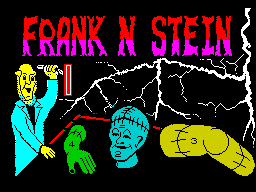
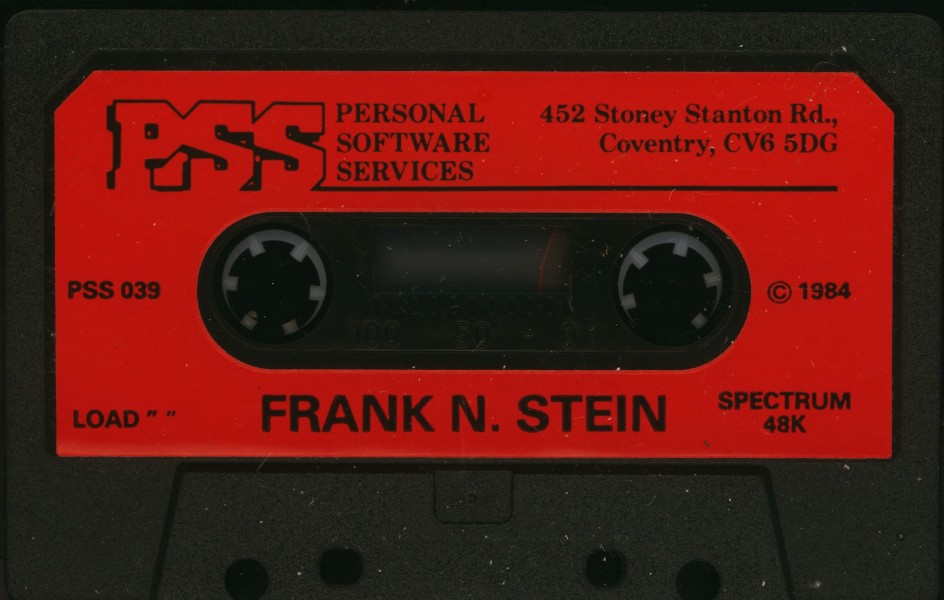
Discussion
Nobody has started a thread about this yet.
Known Errors
Bugfix provided by the author Colin Stewart: <UL><LI> It's impossible to complete level 25 within the time limit. This can be fixed by adding an extra electric-shock item, giving the player more time. Fixed using POKE 26131,3: POKE 26132,16: POKE 26133,8</UL> Bugfix provided by Battle Bunny: <UL><LI> The game randomly crashes after a few levels due to stack overflow as the machine stack eventually gets big enough to interfere with the screen data. The worst case is an implicit PUSH caused by the line "740C CD3775 CALL $7537". There are several places where the sub-routine starting at $7537 branches out with a "JP $7531", which does "CALL $81A4 : JP $7387", from where it's possible to get back down to $740C and do the "CALL $7537" again without having done a RET from the previous time. This case is fixed using the following patch: <PRE> org $75AB ; 30123 JP PATCH1 ; 195 114 196 org $75D1 ; 30161 JP PATCH1 ; 195 114 196 org $765B ; 30299 JP PATCH1 ; 195 114 196 org $7687 ; 30343 JP PATCH1 ; 195 114 196 ; discard unused return address org $C472 ; 50290 PATCH1: POP BC ; 193 CALL $81A4 ; 205 164 129 JP $7387 ; 195 135 115</PRE><LI> The remaining (less serious) cases of stack overflow can all be fixed by simply resetting the stack pointer at the end of each level, using the following patch: <PRE> org $9BBF ; 39871 JP PATCH2 ; 195 121 196 ; reset stack pointer at end of level org $C479 ; 50297 ERR_SP: equ $5C3D ; 23613 PATCH2: LD HL, (ERR_SP) ; 42 61 92 DEC HL ; 43 DEC HL ; 43 LD SP, HL ; 249 JP $6F16 ; 195 22 111</PRE></UL> Modified "BUGFIX" file provided by Einar Saukas.
- Control Option
- Cursor, Interface 2 (right), Kempston Joystick
Releases
- 1984PSSPound sterling 5.95
- 1984CLJ Industries
- 1984Thorn EMI Computer Software
- UnknownMonser S.A.
Play
- FrankNStein(BUGFIX).tzx.zipBUGFIX tape image English24 KB
- franknstein.rzxRZX playback file
- FrankNStein.tzx.zipTape image English24 KB
- FrankNStein.tap.zipTape image English27 KB
- FrankNStein(pre-release).tap.zipTape image English23 KB
Documents
- FrankNStein.txtInstructions English1 KB
Other files
- FrankNStein_ReverseEngineeredBASIC.txt? 22 KB
- Frank N Stein (1984)(PSS).pokPOK pokes file 1 KB
Files and rights
No permission is on record either way. Screens and pictures are copied here on a take-down basis: if you hold the rights and want something removed, say so and it goes.
Credits
- Colin Stewartcredited
Sign in to credit somebody, or say what these people did.
Awards
Scores
In the magazines
- Sinclair User #311984 · Gilbert Factor7/10
- Crash #91984 · Overall80%
- Personal Computer Games #111984 · Overall8/10
- Your Spectrum #91984 · Use of Graphics7/10
Elsewhere on the web
- WorldOfSpectrum 64 votes8.11
Awards and competitions
Crash Readers Awards 1984
- 3Best Platform Game
In the magazines 42
Crash #21Oct 1985 · p.52
Lloyd Mangram
Robin Candy
Use of Computer: 79% Graphics: 80% Playability82: % Getting Started: 78% Addictive Qualities: 83% Value for Money: 78% Overall: 80% As Frank it is your task to put together parts of a monster. These parts happen to be scattered around your mansion but this is no ordinary luxury pad, for instance you can only go down the stairs and firepoles, and how many houses have ice in them or coiled springs to get you up a floor? There are seven bits of the monster to collect namely the head, shoulders, arms and legs which all have to be assembled in the right order, from the head downwards. When you have completed your monster you have to activate him if you have built him well with in the time limit, then the monster won't have to much of an electric shock but if you only just make in time then he will be very, very angry. In the first set of rooms there are some light bulbs that, if picked up, will make the clock turn back slightly. The next screen is a sort of 'Kong' variant. The monster stands at the top of the screen throwing things down at you, how many objects he throws depends on how quickly you completed the previous screen. You must now guide little Frank to the top of the screen safely, and on completion you move back to the 'mansion', screen to start building another monster. This time the layout of the mansion has changed and there is less time allowed. The game goes on like this, alternating between the construction screen and the Kong game while getting progressively harder. Platform games have never been my favourites so it takes a really good one with some original features in it to capture my attention. A year ago Frank N. Stein did this but has now lost some of its appeal. The graphics are really only above average and the same goes for the sound which is limited to spot effects. Frank N. Stein is instantly playable but I very much doubt people will play over long periods of time, and it is probably more suited to ardent fans of platform games. Overall it's lost some appeal over the last year but I'm sure quite a few people would gain some of enjoyment from it. RC At the time this came out, platform games were all the rage on the 'let's out-willy JSW' level. Frank N. Stein did offer some nice new twists to the straightforward platformer, but these were really just refinements. It was quite playable and amusing, but nothing really major. LM (Rob) I would definitely lower the graphics rating by about 15% and the addictive qualities by about 7%. If Frank N Stein was a new game then I would give it somewhere around the 71% mark. (Lloyd) Yes, I think that's a fair estimate.
ZX Computing #16Dec 1984 · p.4170%100%100%100%10/1010/10
Instructions 70%
Presentation 100%
Addictability 100%
Value 100%
ZXC Factor 10/10
David Harwood 10/10
Game number two in the list is FRANK N STEIN by PSS and is the type of polished game expected to come from such a good software house. The idea is the same as Manic Miner, zooming round the screen picking things up. This time not light bulbs but.... yes, parts of a monster's body. It is your task as the mad, mad professor (I wonder if he was intended to bear a resemblance to Sir Clive?) to collect and assemble all seven parts of the body and then make it come alive in order to get to the next screen. This may sound easy, but to add to the difficulty of your mission, the body must be collected in the correct order and not in any old fashion and the pieces are not always in the most easiest or accessible place. On the first screen the professor has to grab the right chest and then immediately slide down a rope, else the gun successfully kills you, which is just one example of lots of hair raising and adrenalin pumping action that is to follow. The jumping to get to different floors is not as easy as in Manic Miner as the professor needs to be exactly positioned over a spring to jump up a rope or to slide down before activation can take place. I found it easier to walk past the spring with the jump button held down at the same time, so at the right moment the professor would jump and no time would be lost. Incidentally, the control keys are well placed and the game is joystick compatible. Some thought needs to go into some movements. How on earth is the professor going to grab a leg (for example without being squashed by a barrel or get hold of an arm without being poisoned by the lobster. After each body-collection screen there is just a straightforward (?) obstacle course. This is great fun as you manoeuvre the Professor to the top of the screen in order to activate the monster again before going into the next room in FRANK N STEIN's lair. The obstacle course is more enjoyable than collecting the body as a direct plan of action to be adhered to else the ball may fall on your head or the crabs, lobsters, spiders, barrels, mice, crocodiles, pumpkins, bats, snails.... (the list is endless) may get you. Another problem is the ground, which is not always as sound as it may seem. Ice is strategically placed and is great fun to watch as the Professor slips and slides. So also are the green patches of grass, slowing the movements of the Professor down greatly as he ambles across, admiring the view, and the light bulbs, causing an electric shock and finally the transformers, which delay you greatly as they beam you to their side. All these and more go forward to make the game exciting, intelligent, fun to play with faultless graphics and sound. A must.
C&VG (Computer & Video Games) #37Nov 1984 · p.909/108/108/108/10
Graphics 9/10
Sound 8/10
Value 8/10
Playability 8/10
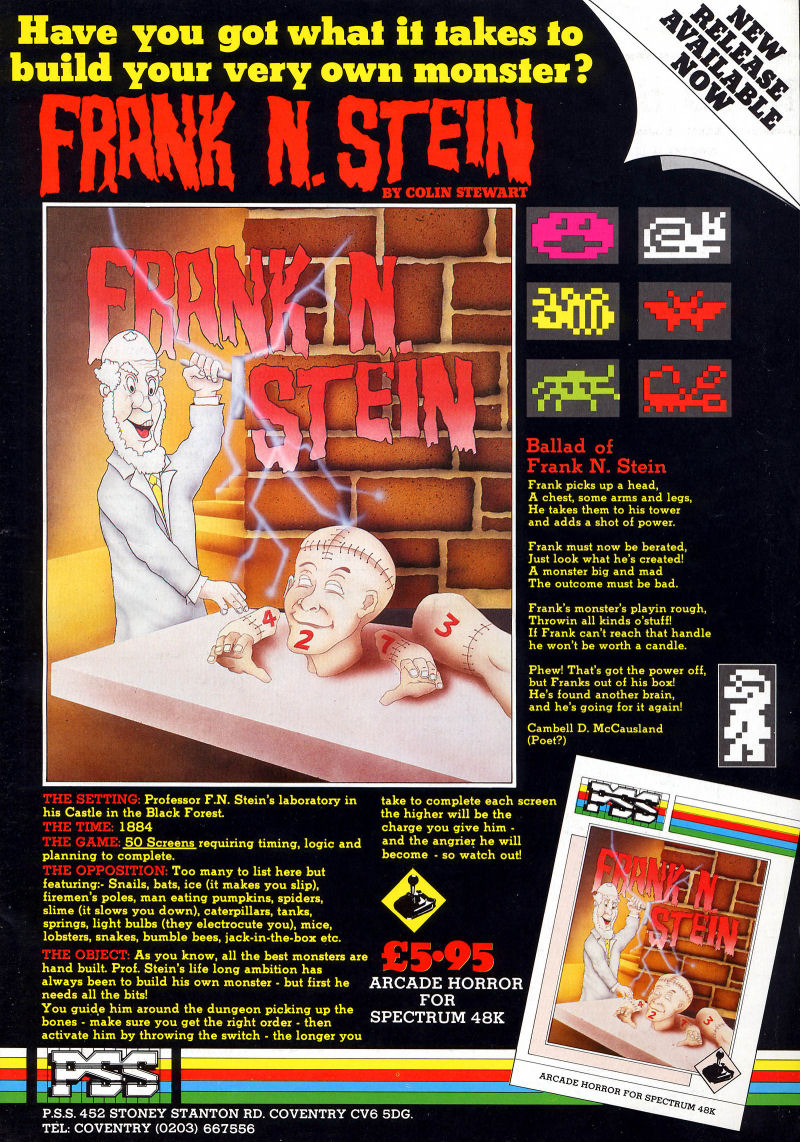
MACHINE: Spectrum 48k SUPPLIER: PSS PRICE: £5.99 Despite the name, the hero of this game is not a Jewish butcher. Professor F N Stein has to build his monster, just like in the film. You play the part of the professor and have to travel round the screen collecting the parts of the body which then make the monster. The game is set in the professor's lab in the Black Forest in 1884. There are 50 different screens, each of which is more complicated than the previous one. Movement is very like Manic Miner, but there again so are most Spectrum climbing games. As you travel round the screen, you have to pick up the parts of the monster in the correct order, otherwise they will not be counted. This often means going past a piece and coming back to it later on. As you pick up a piece, it will position itself in the right place in the body. When the monster is complete, you move back to the top of the screen and throw the switch which brings him to life. The amount of energy which he will have depends on how long it took you to complete the screen. Whoever designed aliens for this game seems to have had a similar sense of humour to Matthew Smith, who's quite big in games design! You are hindered in performing your surgery by snails, bats, slippery ice , man-eating pumpkins, slime, springs and much more. The man-eating pumpkin refers to deadly veg, and not to men eating their dinner while you're trying play the game. This is a good climbing game for the 48k Spectrum. The graphics and movement routines are smooth and sound effects only help the game. It's not easy, but it's well worth the money.
Sinclair Programs #25Nov 1984 · p.29
June Mortimer
AS THE CHRISTMAS SOFTWARE GOES ON SALE SPECTRUM OWNERS ARE SPOILED FOR CHOICE. The story of Frankenstein was ideally suited for adaptation to computer game, and PSS have carried this adaptation out admirably. On the first level the player's aim is to assemble Frank N Stein from the pieces of body scattered around the lab. Pieces must be collected in the correct order and assembled before the switch can be thrown to bring him to life. As usual, of course, things are not that simple. The opposition is enormous. On each level you face a different range of problems, involving swamps, ice, electric shocks, spiders, unidentifiable objects... you name it, it is hidden in one of the labs. Having avoided all these problems and completed your monster your problems do not end. On screen two the monster starts to attack you, and can be added to your list of opponents. On screen three you must assemble another monster, but this time the screen layout is different, and your timing must be much more precise. There are elements here of Chuckie Egg, and elements of Manic Miner. The game becomes progressively more difficult and is therefore one on which high scores will be amassed by dedicated players. Too challenging to be ignored for long, Frank N Stein will set Spectrum owners compulsively building monsters this Christmas. Produced for the 48K Spectrum by PSS, [redacted] it costs £5.95.
Your Spectrum #9Nov 1984 · p.427/10
Use of Graphics 7/10
Ross Holman
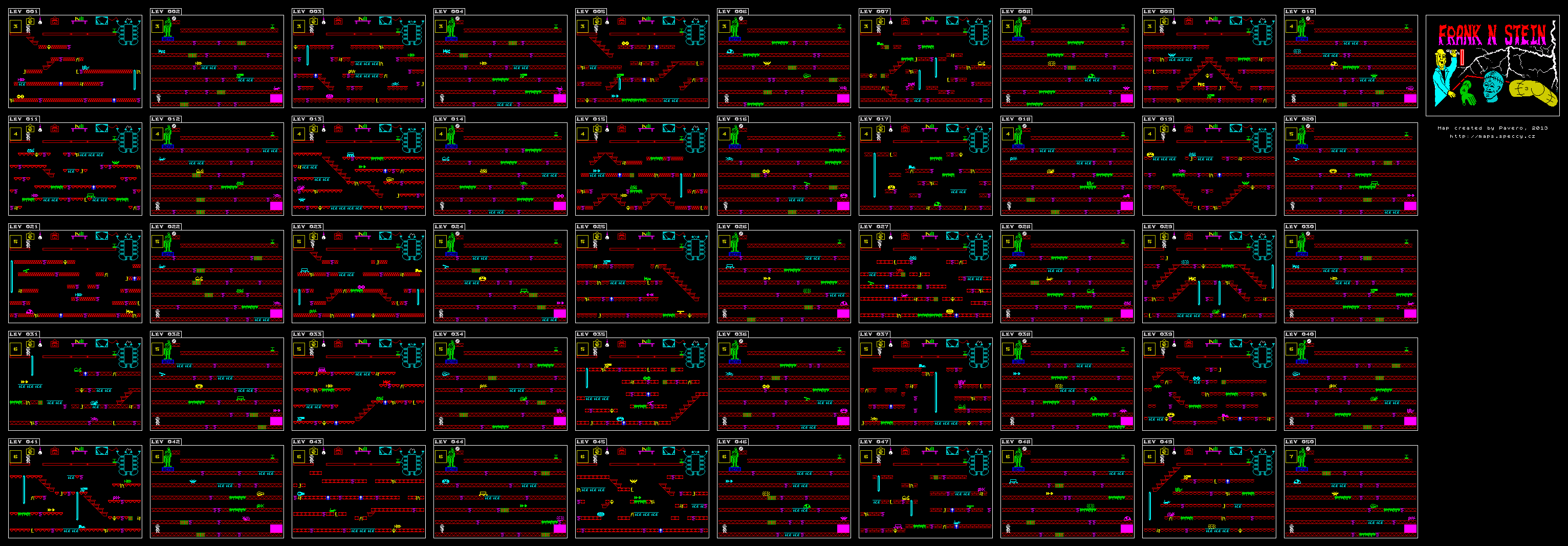
MANIC Could it be that there are too few original ideas coming out of UK software houses? Ross Holman examines three new releases - Astronut, Frank N Stein and Monty Mole - and draws the inevitable conclusion... In the current post-Manic Miner/Jet Set Willy depression, many software companies seem to be striving to emulate the success of these two games, resulting in a number of semi-clones appearing recently on the market. Of the three games reviewed here - Astronut, Frank N Stein and Monty Mole̶all - the cliched elements can be found, ie, little jumping figures, platforms, and collecting objects while avoiding the nasties. I'm sure that the companies themselves had no intention whatever of the games bearing any resemblance to other packages. But, having said that, it does seem that effort, conscious or otherwise, has been made to identify the addictive or attractive elements in already published software - such as the collection of objects, pixel graphics, colourful screens and figures leaping around a series of platforms. Throw these factors into a computerised melting pot and hope that something playable comes out. Maybe what the software houses fail to realise is that originality is a very important 'success' factor in any new package. A new version of Defender may still sell well, but too many variations on a theme and it's surely doomed to failure. Even Matthew Smith realised that Jet Set Willy had to be very different from its predecessor - just take a look at the increased size of the game, the 'move anywhere' ability and those wonderful ropes. The novelty value of a game and the comparative standard of the coding at the time of release are also important factors - most games players look back fondly to the days of the first copies of Space Invaders and the excitement generated by the first 48K arcade adventures like Time Gate, but they certainly wouldn't fork out hard cash for them today. You only have to take a time-trip back a few months to remember the furore created when Sabre Wulf was released, mainly due to its similarities to AticAtac̶ but try booting up AticAtac now and you may be surprised (I certainly was!) to discover it wasn't quite as good as you'd remembered. Producing an original game these days must be very difficult, especially as so many of the good ideas have been used. Also, it must be noted that, despite my criticism of the three games here being just a little reminiscent of others, it may well be that Matthew Smith himself had a good look at a game called Miner 2049'er before he buried himself in machine code to produce Manic Miner. The difference is, of course, that he turned a good idea into a brilliant one, with lots of original implementation based on his own ideas. It's the originality and complexity of UK software that makes it so good, and I hope we see more and more excellent material being produced for 1985. ASTRONUT Software Projects Astronut is produced by the same company responsible for Manic Miner and Jet Set Willy, although it's not billed in any way as a sequel to Matthew Smith's games. Written by Patrick Richmond, the game is attractive and colourful - but as a 'platform' game, I'm sure Software Projects are hoping that their reputation for this type of package will help this one on its way to the high street shelves. The lack of instructions both on the cassette sleeve and on-screen (at least with the copy I've got anyway), didn't actually inspire any confidence that it was a particularly polished piece of software. To start the game, you need to press the 'S' key - and the 'Q' key is used to turn off the terrible sound effect (you'll find this is probably the most useful key in the whole game!) Astronut's a game of some 15 screens; the object of the exercise on each screen is to push three resource blocks from various platforms down to ground level. You control the little two-cursor man and can move him left or right, or get him to drop bombs. To move the figure up the screen, you have to position him above a volcano and wait for it to erupt or, on the later screens, you can manoeuvre the figure up the ladders. Beware though, once you've started to climb there's no turning back. Stopping you gathering the power capsules and moving the resource blocks are, of course, many assorted meanies which have to be negotiated. There's also the problem of extending platforms, which have an annoying habit of collapsing just when you want to use them! The sprites move fairly smoothly by one or two pixels and come in the usual horizontally and vertically moving varieties; some are even more tricky and cascade back and forth along the platforms, defying gravity more often then not. The stationary graphics characters aren't your average run-of-the-mill platforms either - you may encounter dragons spitting fire and amazing castle towers - and they certainly go some way to brightening up the game. Despite the pixel movement of the sprites, our man moves by cursor block stages, although the figure is animated within each stage. Unfortunately, this, coupled with the 'attribute collision detection' routine used, sometimes causes your figure to be pronounced dead even when there's lots of clear air between you and your killer. Astronut is visually appealing, but it's too easy! Dropping bombs to protect yourself and timing the jumps to collapsing platforms do add an element of skill, but overall I didn't find it challenging enough. Each of the screens can be reached independently of the others by instructing the program to start on a specific screen - in my view, this spoils any suspense for the enthusiast. FRANK N STEIN PSS Despite the obvious enthusiasm for this game generated by the games players in the YS editorial office, Frank N Stein was the game I liked least of the three programs. The object of the game is to guide your two-cursor figure along platforms collecting the constituent parts of a Frankenstein-type monster - making it a little more complicated is the fact that all the limbs, etc, have to be collected in the correct order; head first, then torso, then hips and so on. To collect all the parts of the body, you have to walk over the dissected parts, while avoiding the various sprites that go through set patterns of movement around the screen. Again, you can move left or right, but vertical movement can only be achieved by standing over strategically placed springs and hitting the 'fire' button. Small jumps are possible, but these are sued mainly for letting one of the sprites pass underneath allowing your figure to safely carry on his macabre search. There are also an number of poles which can be used to descend from level to level. The graphics characters are mostly two-cursors, very colourful and animated fairly well, adding some welcome relief from the overall red appearance of the game. The move pixel by pixel, but they're a might bit slow - which means there are times when you're hanging around waiting for the baddies to get out of the way. This aspect is no doubt intended - especially as the game is played against the clock - but I feel that overall it detracted from the game. PSS claim Frank N Stein has 50 screens, but don't let that mislead you as there are only 26 different screens. After each 'collecting' screen, there's one that repeats; this special screen is slightly different from the rest in that the object this time is to get to the top platform while avoiding random graphics characters and rolling barrels (shade of Kong here). Planning out a route through each screen is reminiscent of Manic Miner, but it doesn't work out quite as well. If you miss the opportunity to jump for something, then very often you either die or have to hang around for the same pattern of events to repeat itself - there's not much room for you to experiment with new and original ways round each screen as more often than not, there's only one way round and that's your lot! MONTY MOLE Gremlin Graphics Monty Mole is probably the most similar to Manic Miner but there are many similarities to Quicksilva's Fred as well. This time, you get to play a mile whose graphic is on four cursors, thus avoiding any confusion that this game is based on Manic Minder. Your task is to guide the mole around a series of caverns - about 21 in all - until your eventual escape. This package received a lot of media attention a few weeks ago due to its supposed connections with the miner's strike and its inclusion of an Arthur Scargill character. How Gremlin Graphics conned the TV companies into believing this, I'll never know - I've been through the whole game and can find no real links at all with the current industrial situation. Anyway, back to the game. On the first screen you guide Monty over a river to collect a coal bucket in which to steal your coal - but the owner's not too happy about this and starts chasing you down the nearest available mine shaft. Once there, you can start collecting the twinkling pieces of coal. (For all you bug-hunters, try carrying on running towards the house and jumping just before you reach it - with any luck you'll find yourself in the coal-miner's house and he can't do a thing about it.) The caverns are, in essence, very similar to those found in Manic Miner, with platforms and graphics characters trollying along, and up and down. Ropes have also been added for Monty to climb up and down (a la Fred), and extending platforms are also used quite effectively. You'll also come to hate the Coal Crushers that appear in most screens - they are totally unpredictable, except for the fact that you can assure yourself that whenever you decide to walk under them you'll be crushed! Another nice feature is the Antics-like technique of being able to change events by dong certain things; carrying certain objects around with you makes various walls disappear when you enter the screen, allowing you to explore still more of the caverns. The program has a number of slightly off-putting characteristics which don't enhance its playability - for example: the graphics routine allows you to stand on any INKed pixel; you can get Monty actually standing in a graphic and still not have the fact that you've collected it registered; and if you die in a room having just caused a wall to disappear, that wall will appear with your new life and there's no way you can get past it! Despite all this though, I still thought Monty Mole the most challenging of the three - even though it's the most blatant clone of Matthew's Manic Miner.
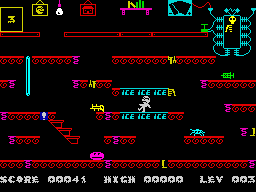
As you walk along, the springs allow you to move up a level when you press the 'fire' key. You'll find that when you jump your head can impinge on the next level up - so make sure there's not an obstacle up there, or you'll have to start again. The squares marked 'J' act like transporters which slow you down on this stage of the game. As well as the ice, there's also patches of slime to slow your movements down. This screens shows the 'Krazy Kong' part of the game, which happens after each 'real' part of the adventure. All you have to do is to get to the top of the screen and push the plunger to move on.
Once you've collected all the bones to make up the monster, you've got to rush up to the top level and push the plunger to send a couple of million volts through it. The power must have done the monster some good - he looks very dapper kitted out in his Sixties outfit!
Stepping on the exclamation marks causes our hero to have a fit of what looks like delerium tremens. Again, it's just another method of slowing you down in your quest. Here we see the professor just about to collect the monster's hip bones. However, as there's a nasty on his tail, he's going to have to get on the spring double-quick and get on to the next level; then he's free to snap up the monster's other hip bone. This is where the monster's made. You have to collect the limbs of the monster in the correct order and once found, they appear in this chamber.
The fireman's poles come in very useful when there's no other means of escaping the nasties in your path. Their use is similar to the springs, only you go down instead of up. As the game's all played against the clock, you'll have to use the poles so's as not to waste too much precious time. This meter tells you how much time you've left to collect all the bits and pieces that go to make up the monster. If you don't manage to push the plunger by the monster-maker in time you have to start again, right from the beginning!
This is the home of Prof. FN Stein - a modest abode, tastefully decorated with a portrait, light bulb and bookcase. Seems like he might be a nice enough chap... he's just got an odd hobby! Welcome to the game's hero the professor. Typically inept at putting together the limbs of the monster, here we see him slipping on the ice. Watch out for nasties when you're negotiating the ice, as once you're on it you can't stop.
Crash #9Oct 1984 · p.12479%80%82%78%83%78%80%
Use of Computer 79%
Graphics 80%
Playability 82%
Getting Started 78%
Addictive Qualities 83%
Value For Money 78%
Overall 80%
Unknown
Unknown
Unknown
Producer: P.S.S. Memory Required: 48K Retail Price: £5.95 Language: Machine code Author: Colin Stewart Frank N. Stein is a nuts and bolts game, a question of placing the bits in the right place in the right order. You play the part of Frank himself, a cute little white scientific personage (he's presumably as white as a sheet having seen a ghost). In his mansion, with its various rooms, seven bits of the monster he's busy creating are scattered about, namely the head, shoulders, arms and legs. The object is to walk about collecting them in the right order so that the monster is slowly built up again. Frank's mansion has rooms with several platforms in them connected by staircases and firemen's poles. Oddly, he cannot go upwards though, except by careful and strategic use of the numerous coiled springs - well, scientists tend to cultivate a batty lifestyle. Additionally, there are a number of hazards sloping up and down the platforms which have a nasty habit of killing poor old Frank off if he's not careful. On top of that, being a proficient electrician, there are some very poor connections lying about which give him a quick thrill if he treads on one. The first screen is relatively simple in layout, but progressive screens become increasingly difficult to negotiate. In between them comes a second type of screen which is reminiscent of a 'Kong' game. Again there are many platforms with coiled springs and hazards. The object is to reach the top and, as with all the screens, press the plunger to deactivate the monster. One extra problem with this otherwise reasonably simple arrangement is that the monster keeps dropping white balls which fall to the bottom before rolling off to the right. These, if they hit a hazard, wait for it to pass, adding an element of randomness to the timing. COMMENTS Control keys: Z/X left/right, SPACE to 'activate' Joystick: Kempston, ZX 2, Protek, AGF Keyboard play: very good layout and responsive Use of colour: very good Graphics: smooth, well animated and characterful Sound: average, could have been more for effect, but nice noises Skill levels: progressive difficulty Lives: 3 Screens: 50
Sinclair User #31Oct 1984 · p.397/107/10
Gilbert Factor 7/10
Chris Bourne 7/10
FRANKIE GOES MANIC Memory: 48K Price: £5.95 Joystick: Protek, Kempston, Interface 2 The construction of monsters is a laborious task at best, but the job is made doubly difficult in Frank N Stein from PSS. Not only do you have to collect the spare parts before you switch on the juice, but there are numerous smaller monsters and hazards threatening your project as well. The game bears a close resemblance to Manic Miner, in that you must leap from platform to platform to collect the objects you need, dodging the various hazards. When the monster is assembled, alive and kicking, he goes on the rampage, and you must climb to the switch to turn him off. Unfortunately, Frank cannot endure solitude, so back he goes to construct a new monster. Derivative though it may be, Frank N Stein is fun and well-presented. PSS claims there are fifty screens in the game, so it should keep Manic Miner fans occupied for a few weeks. The graphics are neat and do suggest a Victorian-style mansion without being over-fussy in detail.
Personal Computer Games #11Oct 1984 · p.54PCG Hit7/106/107/109/108/108/10
Personal Computer GamesPCG Hit
Graphics 7/10
Sound 6/10
Originality 7/10
Lasting Interest 9/10
Overall 8/10
Bob Wade
Chris Anderson 8/10
Martyn Smith
Peter Walker
MACHINE: Spectrum 48K CONTROL: Keys, Kemp, Sinc FROM: PSS, £4.95 BONE SHAKER Zere I vas, seeting in my laboratory zery, zery bored. Zere vas no excitement to my life. None of ze beeg slavering monsters hurling ze leetle cannonballs at me. Zo! I vill create my own... Thus the thoughts of a Professor F N Stein who sets about his evil task by collecting the parts of a skeleton. Let's make no bones about it this new 'arcade horror' game from PSS is sickeningly good. Not that there's any horror about it. Just a great deal of original and humourous gameplay. There are 25 main screens in which Professor Stein must make his way around a monster-infested platform network collecting the parts of a skeleton. Each of these 'collection' screens is followed by an 'attack' screen which varies only slightly each time and is reminiscent of Donkey Kong. The created monster is dropping cannonballs onto the professor, who must get to the top of a set of platforms and cut the monster's power supply. What makes the game feel different is the way the professor moves around no leaping or ladder-climbing here. Instead, he uses springs to jump up (just stand on top of one and press 'activate') and firemen's poles to get down. There are also some delightful new hazards such as ice which causes a brilliantly-animated skid, slime which slows him down, and light bulbs which give him a two-second electric shock and cause his eyes to leap in and out of their sockets. The more usual mobile creatures-to-be-avoided include snails, bats and man-eating pumpkins. The interest of the game comes from having to collect the parts of the skeleton in the right order. This means you have to plan the professor's route very carefully and timing is of great importance. It's very satisfying to move along a platform, pick up a leg-bone, nip back onto a spring and then - boyng! - just escape that ravenous pumpkin bearing down on you. Each part you collect is added to the semi-assembled skeleton lying in its coffin at the top of screen. When it's complete you have to press a plunger to bring it to life. The game's addictiveness and large number of screens will have you glued to the keyboard for hours. Yes, Frankenstein's image has been done a power of good. This is a monster hit.
Level 1 half-completed (right) and level 5 (above).
55 carries this game and has 5 references of its own.
Hack/Poke9
- Crash #41Jun 1987 · p.51
- Crash #40May 1987 · p.65
- C&VG (Computer & Video Games) #51Jan 1986 · p.61
- Your Computer #1Jan 1986 · p.91
- Your Spectrum #15Jun 1985 · p.6
- Your Spectrum #11Feb 1985 · p.6
- Crash #12Jan 1985 · p.146
- Popular Computing Weekly #51Dec 1984 · p.48
- Your Spectrum #9Nov 1984 · p.47
Review6
- TV GamerJan 1985 · p.46
- Games ComputingJan 1985 · p.50
- Sinclair Answers #2Jan 1985 · p.28
- Home Computing Weekly #79Sep 1984 · p.4
- Popular Computing Weekly #36Sep 1984 · p.19
- Popular Computing Weekly #35Aug 1984 · p.52
Full-page ad6
- C&VG (Computer & Video Games) #35Sep 1984 · p.139
- Computer ChoiceSep 1984 · p.27
- Crash #8Sep 1984 · p.17
- Personal Computer Games #10Sep 1984 · p.80
- Popular Computing Weekly #33Aug 1984 · p.4
- Popular Computing Weekly #35Aug 1984 · p.8
Advert4
- Personal Computer Games #12Nov 1984 · p.110
- Your Computer #10Oct 1984 · p.15
- C&VG (Computer & Video Games) #36Oct 1984 · p.37
- Home Computing Weekly #80Sep 1984 · p.9
News/Note3
- Crash #37Feb 1987 · p.92
- Computer ChoiceSep 1984 · p.9
- Personal Computer Games #10Sep 1984 · p.14
Tips3
- C&VG (Computer & Video Games) #39Jan 1985 · p.157
- Crash #12Jan 1985 · p.144
- Personal Computer Games #13Dec 1984 · p.125
Feature2
- Home Computing Weekly #105Mar 1985 · p.19
- Your Spectrum #9Nov 1984 · p.42
CompoEntry1
- Crash #10Nov 1984 · p.74
Licensed from
- FrankensteinBookunofficialMary Shelley
Remakes
- Frank'N'Stein 20022004PC/Windows
MKSZTSZ
Related
- Versions
- ZX Compiler MMII.d (Authored with)
- Compilations
- 55, Stars Spectrum issue 01 - Juegos, 48K issue 09
- Ports
- (Amstrad CPC)
- Elsewhere
- Speccy Screenshot MapsCentre for Computing HistoryMobyGamesRZX ArchiveThe TipshopUVLThe Spectrum Show - YoutubeSpectrum Computing RZX - YouTubeModern ZX-Retro GamingRZX Archive - YouTube
- Same entry at
- Spectrum ComputingZXInfo
Reviews from people here
Sign in to write about this, or make an account. It takes a minute and lets you correct the catalogue too.
Everything ZXDB can hold about this is here.
Sign in to correct or add to this.
Hold the rights to this and want it taken down?