
Gift from the Gods
Arcade Game: Adventure · ZX-Spectrum 48K · 1 players · English
Ocean Software Ltd · 1984 · Pound sterling 9.95
Also known as Gift From The Gods: Regalo de los Dioses (Spanish)
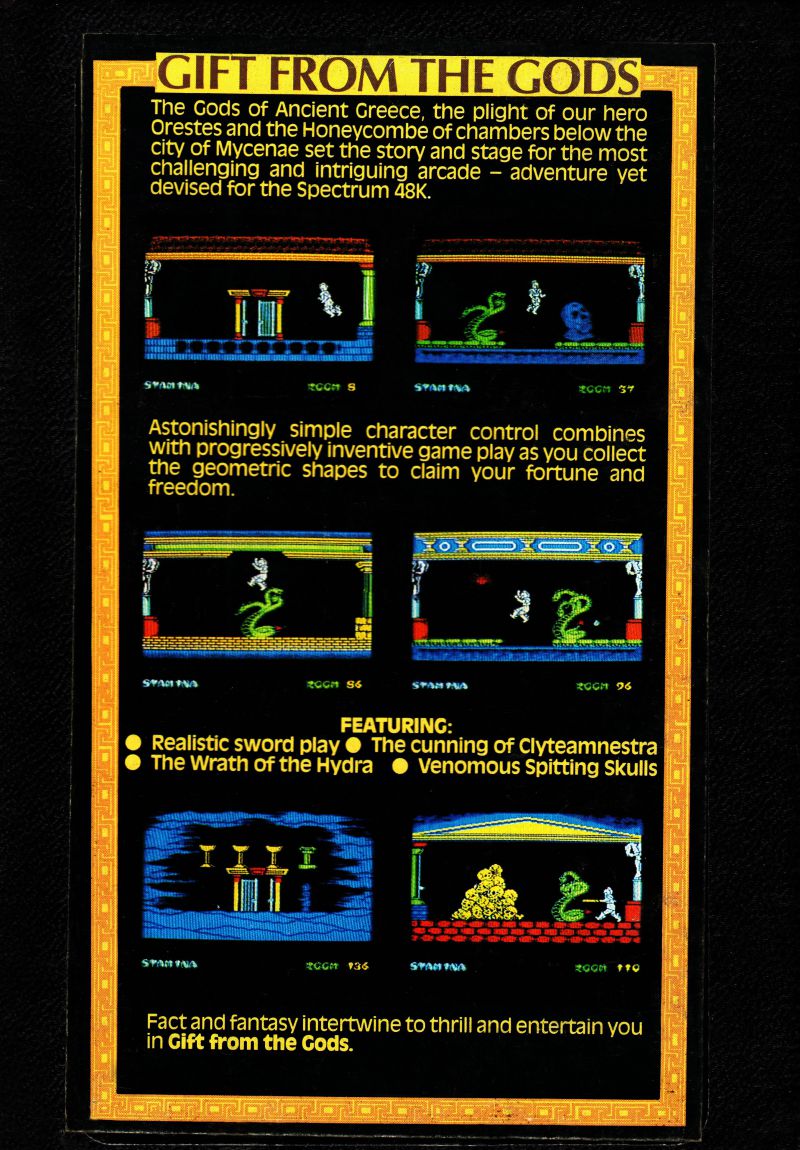
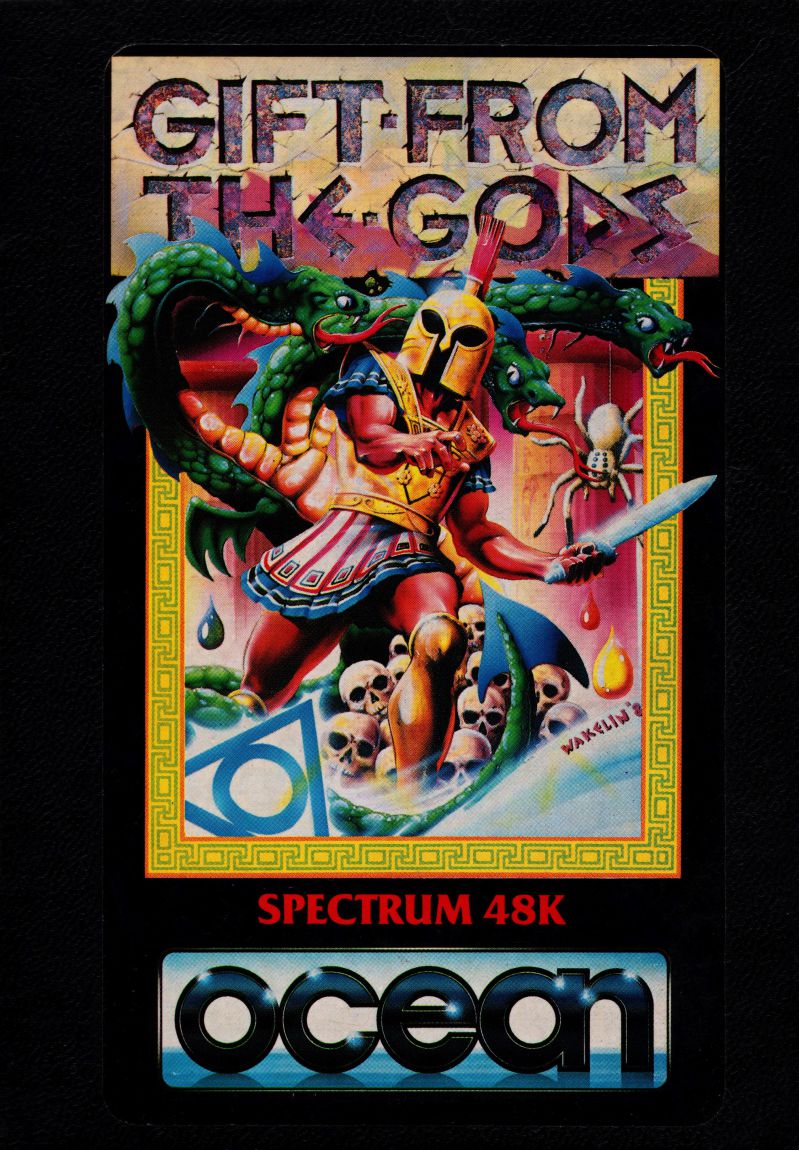
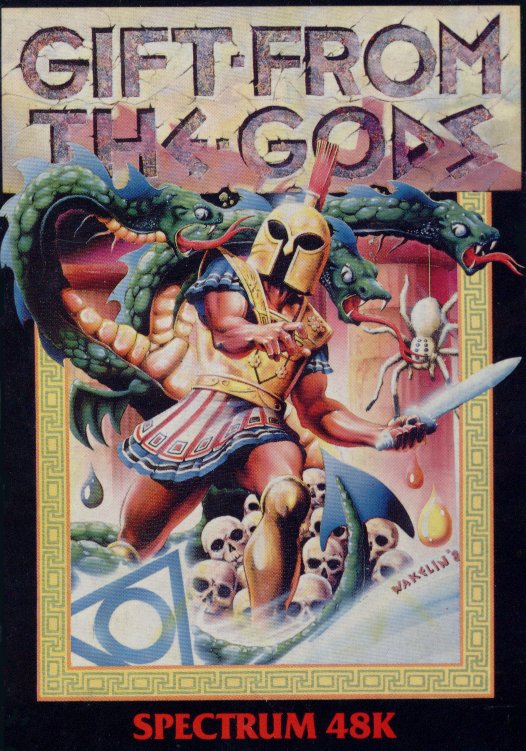
(ZafiChip)_Front.jpg)
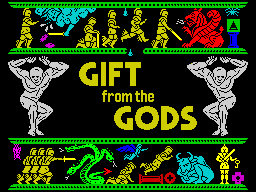
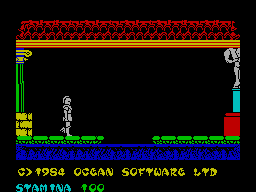
(ZafiChip)_SideA.jpg)
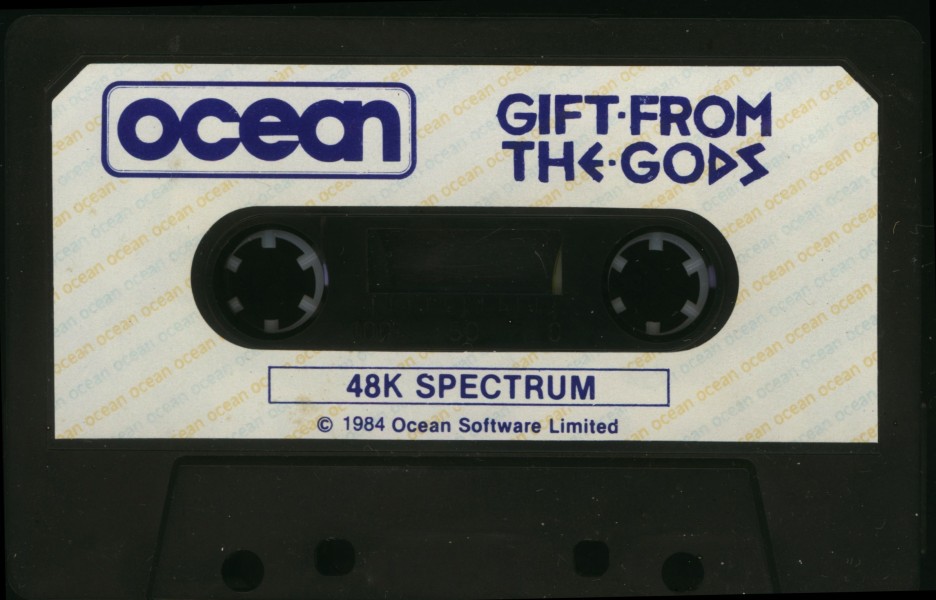
Discussion
Nobody has started a thread about this yet.
- Control Option
- Cursor, Interface 2 (right), Kempston Joystick
Releases
- 1984Ocean Software LtdPound sterling 9.95
- 1984Erbe Software S.A.Spanish peseta 2500.00
- 1984Zafi Chip Sold as Gift From The Gods: Regalo de los Dioses
Play
- giftgods.rzxRZX playback file
- GiftFromTheGods.tzx.zipTape image English64 KB
- GiftFromTheGods.tap.zipTape image English31 KB
Documents
- GiftFromTheGods(EN).pdfInstructions English888 KB
- GiftFromTheGods(GiftFromTheGods-RegaloDeLosDioses)(ZafiChip)(ES).pdfInstructions Spanish156 KB
- GiftFromTheGods.txtInstructions English9 KB
Other files
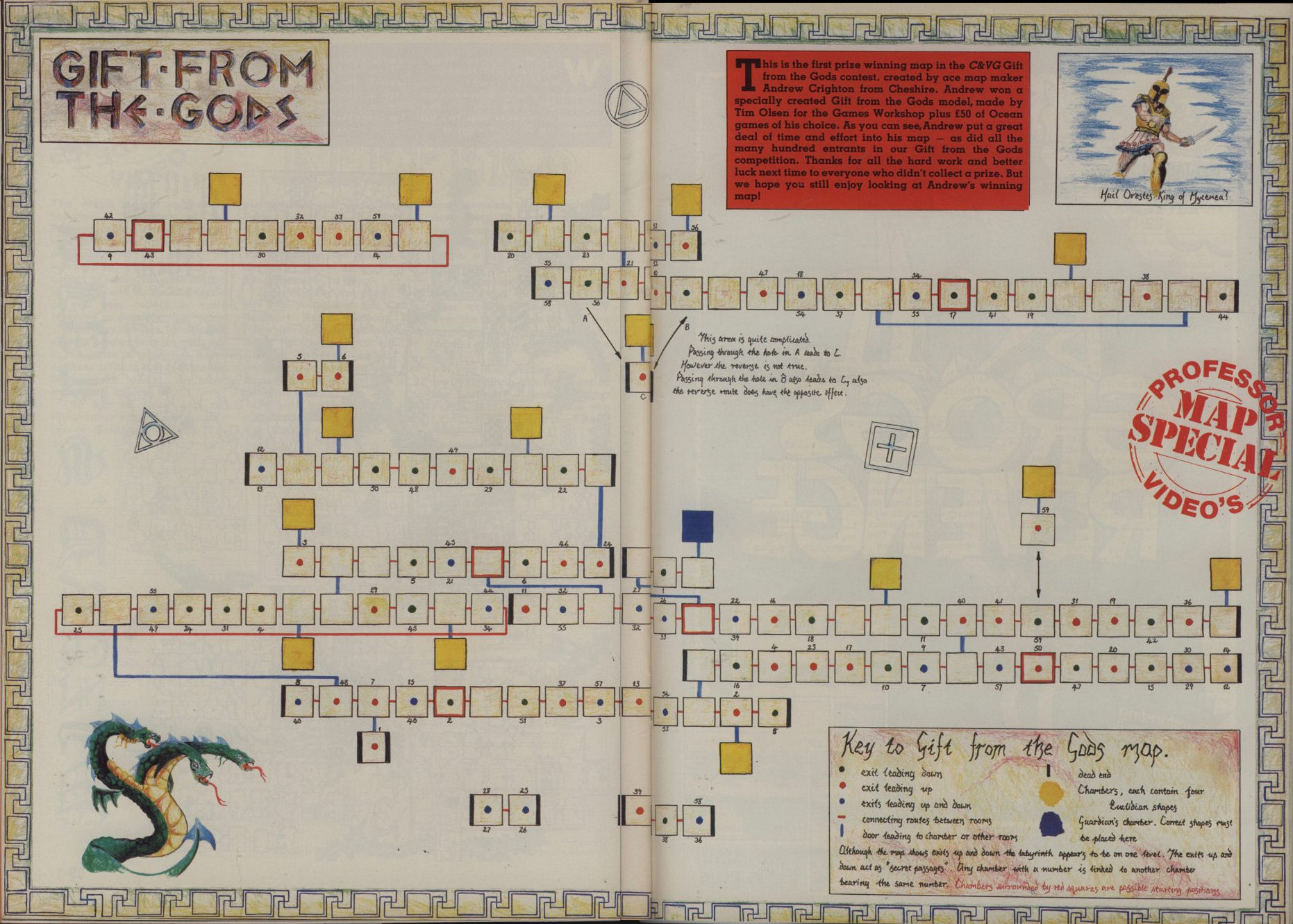
- GiftFromTheGods_2.zipGame map 527 KB
- Gift from the Gods (1984)(Ocean Software).pokPOK pokes file 0 KB
Files and rights
No permission is on record either way. Screens and pictures are copied here on a take-down basis: if you hold the rights and want something removed, say so and it goes.
Credits
- John GibsonCode
- Simon ButlerGame Design/Concept
- Simon ButlerIn-game Graphics
- Steve CainIn-game Graphics
- Roy Gibsoncredited
- Ally NobleIn-game Graphics
- Bob WakelinInlay/Poster Art
- Karen DaviesIn-game Graphics
Sign in to credit somebody, or say what these people did.
Scores
In the magazines
- Sinclair User #361985 · Gilbert Factor6/10
- Your Computer #21985 · Overall3/5
- Sinclair Programs #291985 · Rating79%
- Crash #131985 · Overall84%
Elsewhere on the web
- WorldOfSpectrum 31 votes7.28
In the magazines 46
ZX Computing #19Jun 1985 · p.3295%90%90%95%9/109/10
Instructions 95%
Presentation 90%
Addictability 90%
Value For Money 95%
ZXC Factor 9/10
David Howard 9/10
Ocean £8.95 Ocean have delved into the depths of Greek legend and come up with an adventure game to play on your ancient Spectrum. The game is based upon the life of Orestes. For those lesser mortals who are reading this page and do not know who this person was, I shall explain. Orestes had a mother, Clytemnestra, a father, Agamemnon and a Sister, Electra. Clytemnestra, in order to rule over Mycenae, evilly kills her husband and banishes her two children from the land. Electra is hidden in the catacombs below the palace, where Clytemnestra lives with her new husband Aegisthus, and Orestes, the Hero of the game, with the help of the gods must try and regain the kingdom from his mother. You are Orestes and control your figure on screen with a joystick (virtually any) or keyboard. It is better to use a joystick as the game has an intelligent joystick facility, leaving out the need for complex combinations of keys. In order to reclaim Mycenae, Orestes must travel around this labyrinth and collect 16 Euclidian shapes (geometric designs) and place them in the correct order around the chamber to find the exit and end of the game. Orestes has been given a sword and seven tears, which act as markers, to help him find his goal. Electra can also help in finding the shapes; she appears as an apparition and will lead you to the correct place. Scattered around are terrifying objects, placed by the Demi-gods, which will zap your strength and eventually send you to the underworld. I enjoyed playing this game very much. The graphics are excellent, with smooth animation and although I seemed to be running around the maze doing nothing for quite some time. Gift From The Gods is totally absorbing, interesting and fun.
Your Spectrum #13Apr 1985 · p.472/5 MISS2/5 MISS1/5 MISS
Dave Nicholls 2/5 MISS
Roger Willis 2/5 MISS
Ross Holman 1/5 MISS
JOYSTICK JURY From their bench on high, our regular panel of jurors - Ross Holman, Roger Willis and Dave Nicholls - pass judgement on the latest and greatest games software! Here they are again - that motley bunch of joystick jockeys, ready and waiting to sift through the plethora of software to help you make that important decision! WARNING! Just in case you find our scoring system too confusing, here's what it's all about. The score out of five at the end of each person's review is based on their own experience of the game. But that's pretty subjective... so they also use the HIT and MISS system to indicate its potential as a commercial success. GIFT FROM THE GODS Ocean £9.95 Dave: This one comes in a large box, with a fairly comprehensive instruction sheet containing the storyline. The tale concerns several strangely-named people and seems to have been written to confuse potential players so that they don't realise that this is just another 'move about in the maze, collecting things and putting them in the right place' game. The object of this extravaganza is basically to collect the six 'Euclidian' shapes and place them in the Guardian's chamber. You're hindered in this task by the nasty Demi-Gods, as they've created lots of fake shapes to confuse you; you also have to make sure that your mother doesn't kill your sister. Graphically, the game is very good with large sprites and several different types of 'nasty' all well animated. It also boasts an 'intelligent' joystick feature that stops you having to press loads of different keys; movements of the joystick (or keypresses) do different things when you're in certain locations! Unfortunately, Gift from the Gods didn't really hold my interest, as there really isn't much to do beyond filling a large piece of paper with a map of the Labyrinth.
Sinclair User #36Mar 1985 · p.346/106/10
Gilbert Factor 6/10
Richard Price 6/10
GIFT FROM THE GODS Ocean Software Memory: 48K Price: £6.90 Beneath the legendary palace of Mycenae, where Agamemnon the conqueror of Troy was horribly murdered by his wife Clytaemnestra, are vast labyrinths. Gates lead from one multi-tiered section to the next. In Gift from the Gods you are cast as Orestes, son of the dead king. Your task is to collect certain geometric shapes from rooms within the maze and place some of them in their correct arrangement inside the chamber of the Guardian. Only then is escape possible. Your sister Electra will help you if you can locate her, whilst the shade of Clytaemnestra will attempt to destroy you by reducing your stamina. The graphics are well made and the figure of Orestes walks and flies realistically. Technically an excellent production, but it does seem rather short on events. You can wander around the maze for quite a time with little happening to provide interest. Gift from the Gods is a curate's egg really: long in technical merit, short on excitement.
Sinclair Programs #29Mar 1985 · p.1679%79%
Rating 79%
Colette McDermott 79%
PRICE: £9.95 GAME TYPE: Animated Adventure The trend in 1984 was towards George Orwell and modern literature. Computer games in 1985 seem to be reacting against this, with a strong movement towards Greek mythology. Gift from the Gods takes up the classical story of Orestes. You star as Orestes, and your aim is to avenge the murder of your father, Agamemnon, by your mother Clytaemnestra. In doing so you have the help of your sister, Electra and the gods Zeus and Apollo. All good stuff and, for once, a powerful storyline is backed by an excellent game. Gift from the Gods takes the form of an animated adventure in which Orestes moves through the labyrinth, flies through the air, fights the monsters and attempts to find and follow his sister. Orestes' aim is to find the six Euclidian shapes which will reveal the exit to the labyrinth when positioned correctly in the Guardian's chamber. Orestes is opposed by the demi-gods who live in the Guardian's chamber. They use their powers of illusion in order to prevent discovery of the shapes. Electra knows where to find the correct six shapes, but Clytaemnestra knows of her purpose and is trying to kill her, and to steal the shapes. Another problem is the terrifying illusory creatures created by the demi-gods to sap Orestes' strength. Enormous spiders, skulls with worms twisting through their eye sockets, any amount of weird creatures which you would fear to meet in broad daylight not alone in a hostile maze. Great fun and very complex, Gift from the Gods is produced by Ocean Software, [redacted].
C&VG (Computer & Video Games) #41Mar 1985 · p.1079/107/109/109/10
Graphics 9/10
Sound 7/10
Value 9/10
Playability 9/10
MACHINE: Spectrum/keyboard or joystick SUPPLIER: Ocean PRICE: £9.95 Enter the world of Greek mythology in this latest game from the team who once worked on another software legend - the mythical and mysterious Bandersnatch! Gift from the Gods, unlike that other game, has actually reached the shelves of your local games shop - and it's a brilliant bit of software. The scenario is taken from Greek legends and stars Orestes who, aided by the ancient Greek gods, has returned to Mycenae to regain his rightful kingdom from the clutches of his evil mothre Clytaemnestra. Orestes must fulfil his destiny by trial in the mysterious labyrinth beneath the palace of Mycenae. No man has ever returned from this labyrinth - a series of inter-connecting chambers created by the gods to punish mortals for their misdeeds. Hidden in 16 special rooms are objects known as Euclidean shapes, strange geometric designs based on circles, triangles and squares. Six of these shapes, placed in the correct order in the Guardian's chamber will prompt the discovery of the exit from the labyrinth. The Guardian's chamber is the home of demi-gods who use their powers of illusion to prevent Orestes discovering the right shapes. The gods have revealed the correct solution to Orestes' sister, Electra, imprisoned by the nasty Clytaemnestra within the catacombs beneath the palace. Orestes must seek her help in discovering the correct shapes. Without her he must make his own mind up - and can easily be led astray by the masters of illusion. Clytaemnestra has learned of Orestes' quest and has herself entered the labyrinth in order to kill Electra and make her son's task even more difficult. Orestes must protect Electra as well as seeking the shapes. All the time his strength is ebbing away - although he can discover the waters of life dripping from the roof of certain parts of the labyrinth which restore his powers. That's the basic theme of this entertaining and intricate game. There are features you'll come across - like the awesome illusionary monsters - but you'll enjoy finding them out for yourself! Orestes is armed with a sword, a gift from Zeus and also has seven tears shed by Icarus when he flew too near to the sun. These he can use as "markers" in the catacombs. But beware, the evil Clytaemnestra has a nasty habit of moving them around. Orestes is also assisted by "messages" from the gods which appear at the bottom of the screen. The animation is excellent. Orestes moves smoothly and all graphics are completely flicker-free. The monsters our hero discovers in the labyrinth are stunning. Watch out for the three-headed serpent and horrible pile of animated skulls! The game includes an "intelligent" joystick feature - which basically means that it's much easier to move Orestes around. You don't need to mix both keyboard and joystick - or end up struggling to work out which control will get you out of a tight corner when your energy is rapidly being drained by a nasty monster. Documentation is good and it includes playing and strategy hints as well as the usual instructions. If you like Avalon then you'll love Gift from the Gods - it is great fun to play and you never know just what you are going to find around the next corner!
Micro Adventurer #17Mar 1985 · p.30
Chris Jenkins
ARCADE ADVENTURES Chris Jenkins looks at some of the more adventurous examples of the marriage of Arcade and Adventure. The software of the future combines the best aspects of adventure games strategy, the requirement for mental agility and complexity of plot - with the best of arcade games - brilliant graphics, sophisticated programming techniques and exciting action. These arcade adventures, or Aardvarks as I insist on calling them to the disgust of my colleagues, are in my opinion a genre which will come to dominate the market, as pure adventurers become bored with repetitive text-only programs, and arcade players come to demand something more sophisticated than mindless shoot-'em-ups. So how do you go about conquering the world of Aardvarks? First, go out and buy a joystick. I know, the very thought will fill some of you with disgust, but grit your teeth and get a bog-standard stick (no need for optional laser sighting attachment and self-locking neutrino ranging circuits) plus the interface necessary for your Spectrum, BBC or whatever. Next, check out the market carefully. Not everything described as an "arcade adventure" turns out to fulfill the requirements I've outlined. Manic Miner, for instance, could be described as an arcade adventure, but in fact requires no more than infinite patience and precise reactions to play. The best games require more strategic thought, and reading the blurb on the pack should give you some idea of the content. For some reason true Aardvarks usually seem to come in mega-packages with 150-page full-colour leaflets, badges, a club magazine, a scarf, three posters and a plastic goldfish. I exaggerate of course. For Spectrum owners, an excellent starter is SabreWulf from Ultimate. Like many adventures, SabreWulf is supplied with the minimum of instructions. All you know is that you mug collect four amulets and combine them to be able to pass through a mystic portal. The play area is a jungle maze of enormous complexity. Several games magazines have published SabreWulf maps, which are very helpful. As in an adventure game, you'll find on your journey through the maze that you pass potentially useful objects such as treasure, food, weapons and potions. Your character will automatically pick these up on passing over them, but there are also dangers such as various monsters, poisonous orchids and the eponymous Wulf, which you must avoid. For a game requiring more in the way of pure strategy, you should look at KnightLore, again from Ultimate for the Spectrum. This one features an intrepid explorer afflicted by lycanthropy. You have forty days and nights to find the secret of the Wizard's magic potion before you become a werewulf forever... The transformation scenes, in which you involuntarily change shape, are brilliantly handled, as are the animated monsters and obstacles. Each of the 128 3-D screens is packed with details; moving stone blocks, treasures, potions, portcullises and the like. The trick here is to approach the mysteries of each chamber imaginatively - for instance, if you can't reach a desired object KnightLore by jumping, can you stand on one of the other objects to reach it, or move it to a new position? Split second timing is vital, as is attention to the clock. Should you transform into a werewulf in the middle of a difficult routine you'll meet a sticky end, either from guardian monsters or from automatic traps. At the risk of making it sound as if only Ultimate produces good Aardvarks for the Spectrum, another goodie is Underwurlde. This has nearly 600 screens on a grid 52 deep by 16 wide, representing a selection of furnished rooms and mysterious caverns. To win you must find four randomly-placed weapons and destroy the guardians of Underwurlde. You can run and jump around the caverns and ledges, but must beware of various monsters and natural hazards. Blue gems will make you invulnerable for a limited time. Underwurlde doesn't feature as many strategic elements as Knight Lore, and is perhaps more of a joystick basher. For a little variation, let's look at the CBM64. Virgin's Sorcerer is a fast-moving Aardvark which features a flying wizard, who has to collect various magic objects in order to reach a confrontation with the evil Necromancer without falling victim to ghosts and goblins. The game looked very impressive when it appeared, but the Commodore version pales into insignificance besides the magnificent Amstrad CPC 464 version. This implementation of Sorcerer features stunningly sharp, colourful graphics, and a truly infuriating and fascinating plot. Six good wizards are trapped in the game's forty screens. Your wizard must fly around the castles and dungeons of the magic land, picking up useful objects by passing over them, and fighting off the baddies to liberate the six captives. Only then can you progress to the show-down. The objects scattered around the screens each have a specific task. Swords and clubs are for killing land-based enemies. Shooting stars and spells kill the airborne Demons, and Sorcerer's Moons, Scrolls and Bottles open various doors. Any contact with the enemy depletes your energy, though you can refuel by landing on a cauldron. But beware! If you try to refuel while carrying certain objects, you will lose energy. The game starts randomly from one of five locations, and it's essential to make a map and keep notes of which objects open which doors. Altogether this is certainly the best game yet for the Amstrad, and possibly the greatest arcade adventure I've seen. In many ways it's similar to Hewson's Avalon for the Spectrum, which again features a flying mage. This time you are armed with a selection of spells, selected using the joystick controls, which allow you to move around the 200-room Kingdom of Avalon in your quest to destroy the Lord of Chaos. Some doors are locked until you find a key, some are invisible until you cast the right spell. Sprites can be enslaved using a SERVANT spell, and made to work for you. Avalon is so complex that like many adventures it has a SAVE facility. It's one of the most Aardvark-like of Aardvarks, combining adventure and arcade features remarkably well. For the BBC, you could do worse than investigate MicroPower's Castle Quest. The scenario is similar to that of many an adventure - finding the wizard's treasure which is hidden somewhere inside the castle. To do this you must determine the correct use of the many objects found on the platforms and corridors of the castle. To give you some idea of the adventure-like nature of the problems you're set, if you are captured by the guards at one stage you are thrown into jail. To escape you must pick up a stool, leap into the air and throw the stool at a torch, pick up the stool and place it near the door, pick up the torch and use it to set fire to the bed, leap onto the stool then onto a ledge over the door, wait for the guard to rush in and leap down behind him, then through the door! It makes getting out of the goblin's dungeon look like a piece of cake. Back to the CBM 64 for Impossible Mission, a disc game from CBS. Again this takes a good deal of co-ordination as you control the brilliantly-animated figure of a secret agent, leaping from level to level in a complex of underground rooms. The object is to examine the items of furniture and computer equipment in the complex in order to discover hidden computer codes. These let you log onto security terminals so that you can disable the lethal guard robots or reset the elevators in each screen. The password for the final control room is in several pieces, which have to be assembled correctly to gain access. You have a pocket computer to help you, and can also call up your HQ computer at the cost of a time penalty. Impossible Mission features bloodcurdling software-generated speech and excellent sound effects. It's perhaps more of a logic puzzle than a strategy game, but should interest many adventure fans with a quick trigger finger. Finally it's worth looking at some more Spectrum games, since the Spectrum is still the first machine many Aardvarks are designed for. Microgen's Wally series veers towards the arcade rather than the adventure side, but is good nonetheless. Automania, Pyjamarama and the forthcoming Life of Wally are described as "graphical adventures", in which the usual arcade jumping-and-ducking idea takes on a new depth. Automania is almost entirely an arcade game, Pyjamarama has more of a quest element in the saga of the sleeping Wally searching his house for an alarm clock to wake him from his nightmare, and Life of Wally reputedly features several characters any of which can be controlled at any time like a more conventional adventure such as Lords of Midnight. Ocean's Gift From The Gods also features a combination of animated graphics and a quest element, following the ordeal of Orestes in the labyrinth of Mycenae. Hidden in the chambers are sixteen geometric shapes which, when placed in the right order in the Guardian's chamber, reveal the exit. Various creatures sap your strength, which can be replenished with streams of water. Orestes' sister Electra will help him to choose the correct objects if she's around, but the evil Clytaemnestra will confuse the issue. Gargoyle's Tir Na Nog winds up this brief look at the wonderful world of Aardvarks. Described as a "computer movie", it features convincing animation set in a world of Celtic myth. The design of the scrolling backgrounds is very rich and detailed. The hero Cuchulainn must traverse a series of interlinked paths. As is traditional, the quest involves finding and assembling the parts of a broken artefact, in this case a seal, while fighting off the baddies which include the ape-like Sidhe. There are some 150 objects which can be picked up and used. This concludes our brief look at the private life of the Aardvark. Die-hard adventurers will I'm sure curl their lips with, contempt at the idea of it all, but try to be a little flexible. The most sophisticated programs now being produced fall into this category, and you'll soon be finding that skill with a joystick has become as indispensable to the adventure games player as a working knowledge of Elvish.
Avalon - the Wizard beset by Undead
KnightLore
Sorceror - the Magus attacked by the Evil Eye
Tir Na Nog
Crash #13Feb 1985 · p.5490%91%81%85%81%75%84%
Use of Computer 90%
Graphics 91%
Playability 81%
Getting Started 85%
Addictive Qualities 81%
Value For Money 75%
Overall 84%
Unknown
Unknown
Unknown
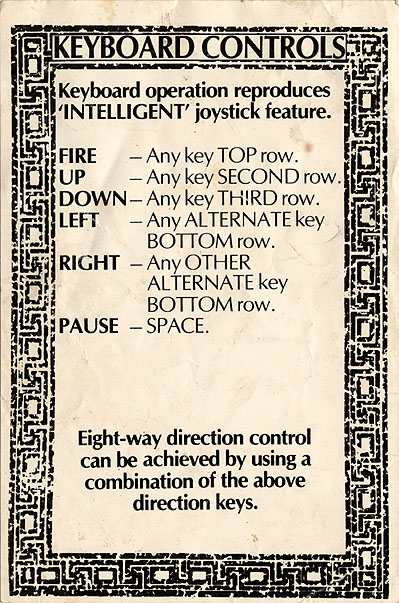
Producer: Ocean Memory Required: 48K Retail Price: £9.95 Language: Machine code Author: Denton Designs One of the happier notes in our article last month on the crash of Imagine, was that megagame programmer John Gibson was working with a brand new software company called Denton Designs, largely financed by Ocean. Gift from the Gods is their first game (they are now busy on Frankie Goes to Hollywood), and the team who created it is John Gibson, Karen Davies and Steve Crane (graphics), systems designer Kenny Everitt and graphics artist Ally Noble. Gift from the Gods is a multi-screen strategy/adventure game which is joystick driven in a rather novel way. More of that later, first the storyline. Set in the Palace of Mycena in Ancient Greece, it follows the trials and tribulations of Orestes who, under the directions of the Gods Zeus and Apollo, must avenge the murder of his father, King Agememnon. Orestes must fulfill his destiny by trial in the Labyrinth beneath the palace and find the solution to the puzzle, or perish in the attempt. Hidden in 16 special rooms are objects, known as Euclidian shapes, geometric designs based on triangles, circles and squares; six of which, when correctly positioned in the Guardian's Chamber, reveal the exit. Orestes has some help from his sister Electra, who has been imprisoned in the Labyrinth, and she can guide him to where the shapes are hidden, but Orestes has to decide himself what shapes he must take to the Guardian's Chamber. Illusionary creatures created by the Demi-Gods try to sap Orestes' strength, but in certain rooms, life-giving water drips from the roof, replenishing energy and stamina. The Demi-Gods have also created illusory Euclidian shapes as which sit beside the real ones, and although these do not fool Electra, she isn't always around to help. The other problem is his mother, Clytaemnestra, who has learned of his task and has entered the labyrinth to kill Electra. Orestes is able to walk or fly and protect himself with a sword. All these functions would normally require loads of controls, but Gift from the Gods has an innovative 'intelligent' joystick feature, which effectively 'knows' what you want to do next. Whether it really 'knows' is another matter, but depending on the circumstances you are able to walk, fly or fight all from the four directions of the joystick. The screen display is elegantly simple. Each room of the labyrinth is decorated in appropriate Greek style. It is possible to walk or fly vertically or horizontally between linked rooms. As Orestes disappears from view, there is a fast scroll to the next room into which he then appears. Some rooms are blocked by purple walls, through which he cannot go. Others have doors in them, and when positioned correctly, Orestes may move through them either into other rooms or into the secret hiding places of the Euclidian shapes. The only other detail is the stamina figure and a scrolling message line where Electra, Apollo and Zeus may talk. The labyrinth is a confusing place but Orestes may take some small comfort from the seven Tears of Icarus which he carries. Dropped sensibly these can help mark his passage, but wicked Clytaemnestra is likely to pick them up if she comes across them. COMMENTS Control keys: top row - fire, second row - up, third row down, alternate keys bottom row left/right Joystick: Sinclair 2, Kempston, Cursor Keyboard play: very responsive, with sophisticated control possible, clever use of fire to stop movement, pick up/drop and fight. Eight directional movement Use of colour: excellent Graphics: large, smooth with excellent detail and imagination used, first rate scrolling Sound: very little really beyond the odd spot effect Skill levels: 1 Lives: 100 points of stamina - you need it all Screens: what do you expect - it's a labyrinth!
A monstrous pile of snake-filled skulls, leers at Orestes.
A puff of talcom powder indicates that Mother has the way been.
In a side room, Orestes comes across some Euclidian shapes, but which is the real one, and which are the illiusions.
With winged boots, Orestes takes to the air thankful for his GIFT FROM THE GODS.
Your Computer #2Feb 1985 · p.403/53/5
Overall 3/5
Lee Paddon 3/5
Spectrum 48K Ocean £9.95 Arcade Adventure Orestes has a problem. Mum ran off with another man and then ran off with his kingdom. The only way he can get it back is to enter the Labyrinth. The Labyrinth, apart from being a tricky place to find your way around is filled with various monsters trying to sap our hero's energy. Fortunately he has friends in high places: Zeus has given him a Sword and Apollo has given him the Seven Tears of Icarus which can be used to mark chambers within the labyrinth. Apart from the monsters, you've also got to cope with mum who is busy moving objects around. She'll also kill your sister Electra, given half a chance, which would be a blow as the Gods have revealed the solution of your quest to her. All this plot detail gives the game plenty of flavour. It is complimented by the graphics of the catacombs, filled with pillars, columns, and animated monsters. The controls are easy to use using a combination of joystick movements and the fire button to move, fly, fight, pick up and drop objects. There is also a pause key which helps when making a map. Your task is a long a difficult one. It's a large maze, and even when you find the objects, there are only six real ones among the 64 scattered around. Should Clytaemestra manage to kill Electra, your task will become immensely difficult, so much of your time will be spent chasing Clytaemestra around so that she doesn't have a chance of getting to Electra. The Greek legends of heroic quests make great themes for games and this is certainly a well executed example.
Full-page ad16
- C&VG (Computer & Video Games) #42Apr 1985 · p.72
- Sinclair User #37Apr 1985 · p.19
- Sinclair User #36Mar 1985 · p.2
- Your Computer #3Mar 1985 · p.148
- C&VG (Computer & Video Games) #41Mar 1985 · p.30
- Crash #14Mar 1985 · p.132
- Sinclair User #35Feb 1985 · p.13
- Your Computer #2Feb 1985 · p.156
- Crash #13Feb 1985 · p.132
- C&VG (Computer & Video Games) #40Feb 1985 · p.35
- Personal Computer Games #15Feb 1985 · p.37
- C&VG (Computer & Video Games) #39Jan 1985 · p.51
- Personal Computer Games #14Jan 1985 · p.133
- Crash #12Jan 1985 · p.15
- Popular Computing Weekly #3Jan 1985 · p.51
- Sinclair User #34Jan 1985 · p.2
News/Note6
- ZX Computing #18Apr 1985 · p.20
- Games ComputingMar 1985 · p.7
- Your Spectrum #12Mar 1985 · p.6
- Personal Computer News #95Jan 1985 · p.34
- Home Computing Weekly #96Jan 1985 · p.5
- Sinclair Programs #27Jan 1985 · p.11
Tips4
- MicroHobby #142Sep 1987 · p.29
- MicroHobby #109Dec 1986 · p.39
- Sinclair Programs #34Aug 1985 · p.30
- Crash #15Apr 1985 · p.62
Feature3
- MicroHobby Especial #1Nov 1985 · p.26
- Sinclair User #40Jul 1985 · p.58
- Micro Adventurer #17Mar 1985 · p.30
CoverGame2
- Sinclair User #104Oct 1990 · p.6
- ACE (Advanced Computer Entertainment) #1Oct 1987 · p.7
CompoResult2
- C&VG (Computer & Video Games) #45Jul 1985 · p.63
- Crash #16May 1985 · p.138
CompoEntry2
- C&VG (Computer & Video Games) #41Mar 1985 · p.31
- Crash #13Feb 1985 · p.44
Review2
- MicroHobby #16Feb 1985 · p.12
- Home Computing Weekly #99Feb 1985 · p.43
Map1
- C&VG (Computer & Video Games) #45Jul 1985 · p.66
Related
- Compilations
- Amstrad Compilation Disk Spectrum Plus 3, Sinclair User issue 104: Double Hits 5, ACE issue 01, Spectrum Load'n'Run v2 issue 06
- Elsewhere
- Speccy Screenshot MapsWikipediaCentre for Computing HistoryMobyGamesRZX ArchiveThe TipshopUVLRZX Archive - YouTubeModern ZX-Retro GamingSpectrum Computing RZX - YouTube
- Same entry at
- Spectrum ComputingZXInfo
Reviews from people here
Sign in to write about this, or make an account. It takes a minute and lets you correct the catalogue too.
No description recorded.
Sign in to correct or add to this.
Hold the rights to this and want it taken down?