
Golf
Sport Game: Action · ZX-Spectrum 16K · 4 players · English
Virgin Games Ltd · Jun 1983 · Pound sterling 7.95
.gif)
Discussion
Nobody has started a thread about this yet.
Releases
- 14 Jun 1983Virgin Games LtdPound sterling 7.95
- 1983Virgin Espana S.A.
Play
- Golf_9.tzx.zipTape image English12 KB
- Golf_6.tap.zipTape image English9 KB
Documents
- Golf(EN).txtInstructions English4 KB
Files and rights
No permission is on record either way. Screens and pictures are copied here on a take-down basis: if you hold the rights and want something removed, say so and it goes.
Credits
- Dave Thompsoncredited
Sign in to credit somebody, or say what these people did.
Scores
In the magazines
- Sinclair User #291984 · Gilbert Factor7/10
- Personal Computer Games #61984 · Overall Rating4/10
Elsewhere on the web
- WorldOfSpectrum 2 votes5.00
In the magazines 22
Sinclair User #29Aug 1984 · p.567/107/10
Gilbert Factor 7/10
John Gilbert 7/10
SOFTWARE FOR THE SPECTRUM SPORTSMAN John Gilbert goes for gold in a bid to find the best computer sports simulations. OLYMPIMANIA Memory: 48K Price: £6 OLYMPICS Memory: 48K Price: £6.95 WORLDCUP FOOTBALL Memory: 48K Price: £6.95 FOOTBALL MANAGER Memory: 48K Price: £6.95 UNITED Memory: 48K Price: £6 TROON Memory: 48K Price: £6.95 NEW BIRKDALE Memory: 48K Price: £6.95 ROYAL BIRKDALE Memory: 48K Price: £5.90 SUPER SOCCER Memory: 48K Price: £7 SUPER-LEAGUE Memory: 48K Price: £6.50 ASHES Memory: 48K Price: £1.99 CRICKET CAPTAIN Memory: 48K Price: £4.95 HOWZAT Memory: 48K Price: £6.95 TEST MATCH Memory: 48K Price: £5.95 GOLF Memory: 16K Price: £5.95 Summer is here, or so we are told by the weathermen, and instead of spending hours in front of a television set watching the Olympics or a Test match, why not spend hours creating your own little piece of history with one of the Spectrum sports packages on the market? The Olympic Games have always brought with them a mass of souvenirs, ranging from flags to cuddly toys. This year is the same but there is an added dimension as computer software companies have tried to cash in with high-pressure selling of their sports programs, including ones which simulate Olympic events. Automata, of Pimania fame, has a spoof version of the Games with the Pi-man working his way to gold in five events. The events include the Pi-Jump, Alpi-Skiing, Steepi-Chase, the Pitathlon, and the Butter-Pi, which is the swimming contest. Each contest is animated smoothly and the graphics are detailed down to the last member of the crowd. After every contest has been lost or won the awards are given on the familiar three-position pedestal. If the Pi-man wins he takes a bow but if he loses he runs round the stadium shaking his fist at the crowd. Pi-man may have learned to be an athlete but he is certainly no sportsman. Olympimania, being from Automata, is a joke but should provide the usual hours of fun if you can suffer the inane humour of the Pi-man. You might also like to try the experience of listening to the soundtrack of the Pi-Land International Anthem on the reverse side of the cassette. The game should also appeal to people who find the real Olympics dull but if you take a more serious interest you will want to run Olympics, which is another spin-off from CRL. The program includes 14 events and is LOADed in two 48K parts. Side one of the cassette includes events such long jump, discus, shot putt and javelin. The other side contains six events which are held outside the stadium. They include cycling, swimming, canoeing and yachting. A marathon has also been included, run in five sections, each part between the other events. In the standard game you will take the part of the British team. The computer will challenge the might of three other teams consisting of the United States, the Soviet Union and the Rest of the World - this might be the only opportunity you have to see the Soviet Union compete in the Games. Once you have been through the first half of the Games the medals your team has won will be added to the score you accumulate in the second half. Unfortunately, only gold medals are awarded and you receive no points for being second or third. That detracts from authenticity as the Olympics are not the same without silver and bronze. The graphics which show the events taking place are not so good as those of Olympimania but the ways in which the athletes compete in terms of skill and energy levels have been well thought out. Sufficient realism has been incorporated into the program that athletes will start to slow during the events if you over-stretch their limits. The games are written in Basic with a corresponding slowness in the speed of graphics and the way in which results are calculated. Olympics will interest fans who buy anything to do with the Games but will disappoint others who are looking for good sporting software. The World Cup is to football enthusiasts what the Olympics is to athletics fans. Artic Computing has decided to produce its own World Cup Football for the Spectrum two years early. You take the part of one of the teams playing in the cup and take it through a series of games to reach the final. Each game has the usual time-scale, including injury time if necessary, but the time factor is scaled-down so that each game takes about five minutes to play. The graphics representation of play shows part of the field and the life-like actions of the players. The players even return to the dressing rooms at half-time. Your control is limited to the footballer who is nearest to the ball in your team. That player will light up when in possession of the ball. World Cup Football can be played at nine levels and there are 40 teams in contention. The game is addictive and should even be of interest to people who know nothing about football. United, from CCS, on the other hand is a poor relation of the Addictive Games Football Manager and has none of the thrills of the Artic game. The four league tables are there, you can pick your team, and you can spy on the other teams to find their weak spots. The only people who will like it, however, are those who like looking at tables of figures, as the graphics displayed when games are taking place are appalling, having a green background with little pin-men making a brave effort to keep contact with the ball. United is so uninteresting that it cannot be recommended, even to beginners. If you want a good game buy Football Manager, which is still the best value for money. Super Soccer is much the same as United. It is poorly-presented, slow, and we also had difficulty in LOADing our copy, which could point to the use of low-quality cassettes for reproduction. Winters is a small company which exists solely because of its range of sports programs. Super Soccer is not one of its better efforts, which is a pity, as some thought appears to have been put into the game. It can be obtained from Winters Ltd, 24 Swannington Close, Cantley, Doncaster, South Yorkshire DN4 6UA. Super-League, for the 48K Spectrum, is from Cross Software and, thankfully, different from the other play-and-get-to-the-top-of-the-league games. At the start you have to decide the skill level at which you are to play. That is based, as ever, on the league position but, in the case of Super-League, you have either to finish in the top six, in the top half, or avoid relegation. Unfortunately the game is limited, as there is only one division in which to play. If you are relegated you join the losers and the game finishes. Like many other football games on the market, the program is just a database which manipulates numbers to produce the league results. It would not be half so bad if the players were shielded from all the calculations by more varied methods of input but numbers have to be balanced on the skill sheets to provide marks for dribbling skill, strength of kick and supporting energy in attack and defence. Everything is entered as numbers and the computer then plays the game for you. That is followed by a 30-second wait for results, which would deter the strongest of us from football for life. It is obvious that the major criticism of the game is that you are not given sufficient involvement during play. Although Super-League will become tedious for hunters for action, there are sufficient aspects in it to hold the attention of a fanatic. It is pity that most of the game is played by the computer but if you prefer to plot strategy quietly and slowly, Super-League is for you. The cricket season is in full swing and there are many games for the Spectrum which will support fans when their teams have walked off out of the rain. Ashes, from Pulsonic, is the cheapest in the range at £1.99. It provides a good graphic simulation of the game for the 48K Spectrum. At the start you are given a choice of venues. There are 10 of them, five in England and five in Australia. Your choice will, of course, affect the type of bowlers you can select. Each team has 11 players you can choose, or you can use the two teams which are already in the computer. You can specify the type of bowler you require as fast, swing/seam or spin. The toss is made and the winner automatically bats first. If you are not batting you will have to field your players to take advantage of the ground and particular batsmen. Positioning is limited as you can choose only from those positions indicated by the computer. Like so many sports games, Ashes relies heavily on numeric input. If you are batting you have to match your stroke with the way the bowler pitches at you by entering a numeric option. The same is true of bowling. You must press a number to signify your choice of line and length. Howzat, from Wyvern Software, is one of the best cricket games available. The graphics display is freer than Ashes, as you can decide where you want to put your players without restriction on field areas. You can also change the field if you think it is necessary at most points in the game. Wyvern has opted for realism as it has included 17 first-class county squads and seven Test squads with which you can play. As with Ashes you can choose a standard team or select one of your own. Howzat, however, has an edge over Ashes as you have a wider range of teams from which to select your 11 players. Details of matches and information about the state of players is given quickly and efficiently. Wyvern has even included a realistic scoreboard to show the events while play is taking place. Its depth of play and proximity to the real thing could not be beaten even by such games as Test Match, from CRL, or Cricket Captain, from Allanson Computing, which aim to produce the same effect. If your game is golf rather than cricket, there are many simulations of courses round Britain, including the Troon and New Birkdale classics from Hornby Software. Among the newer releases Royal Birkdale, from Ocean, is one of the best. The game takes you to the famous course which has hosted the Open championship and has been the haunt of many famous players. At the start you are given the opportunity to alter the wind speed conditions. You then select your club and take a position at the first tee. There are 10 clubs in all, the first being a driver and the last a sand iron. Directions are entered using a clock-face technique in which 0 and 360 degrees point north. That is the method used by all computer golf games, although some vary the directions round the clock. The instructions on the cassette insert are more than adequate and provide hints on how to play in the rough and which clubs to use on any occasion. The course is laid out hole by hole and when your ball hits the green a close-up of the hole is given so that you have a better chance of holing the ball. The only criticism is that the graphics representing the course are too detailed and the different areas of the course tend to clash with each other. If you can tolerate the cluttered screen display, Royal Birkdale should give you many hours of pleasure. Like any of the other sports games on the Spectrum it can be just as much fun for a non-sports player as for an enthusiast. Virgin has recently issued its version of Golf but, unlike most of the other companies specialising in sports, it has aimed its program at the 16K Spectrum. The game, for one to four players, scores points on graphics display, which is more inviting and easier to read than that of Ocean, but it does not have the same feel of a real course Royal Birkdale offers. The Virgin version offers play at a varying number of holes, from one to 18, and will allow you to use one of six clubs for each shot. Wind direction and speed are not taken into account so noticeably during the game but the names of the clubs and strength with which you hit the ball are important factors. Golf uses the same direction input system as Royal Birkdale but is more precise as to the points of the compass in relation to the player. It is certainly a match for Royal Birkdale but the Ocean game wins for its authenticity. If we were to apply a rule that all sports games had to be representative of reality, none of those reviewed would be worth playing. The best, such as World Cup Football, Troon and Royal Rirkdale, are just barely simulations. A fairer rule to apply would be that all the games provide entertainment for people who enjoy real sports, and most of those reviewed clearly do. Games using soccer, golf or cricket for their basis are not meant as full simulations and they are more likely to be played by computer users and sporting computer owners than sports enthusiasts. Undoubtedly few Spectrums have been bought solely to play sports games and if they have that is a sad prediction for the future of the sporting world, which relies heavily on co-operation and team spirit. Computer games can go nowhere near to simulating that type of experience. Most sports are outdoor activities and, like nothing else, lose much in translation to computer. Computers are limited in the way they store information and cannot take all the variables of game play into account. Most sports programs are, therefore, very limited in what they achieve. Players using computers to play football or golf may be trying to ind a substitute for the real thing. If you are satisfied with that substitute, the games available for the Spectrum should keep you entertained. None of the so-called simulations on the market, however, is anywhere near the real thing.
Olympics
Olympimania
Royal Birkdale
Test Match
World Cup Football
Personal Computer Games #6May 1984 · p.404/10
Overall Rating 4/10
Peter Connor
Steve Cooke
THE VIDEO SPORTSMAN Want to be a demon driver? Or a golfing wizard? Or a master of the big break? We load up the motor race, golf and pool simulations. MOTOR RACING The family will gasp in awe as you hurtle round the track, defying death at every bend and only occasionally have to be scraped off a billboard. Peter Connor enjoys the best of micro motor racing. The trouble with motor racing is that it's far too dangerous, it's all very well driving round Silverstone at 200 mph looking forward to a bottle of champagne and a kiss from a beautiful blonde, but what happens if you crash? Most likely third-degree burns and three months in traction. And that's if you're lucky. Such risks can be avoided, without losing too much of the excitement, by the simple trick of putting a racing simulation on your home computer. And there's no need to buy expensive cars or get oil all over your hands. But which team do you want to drive for? On the Spectrum, racing correspondents think that Psion's Chequered Flag is the one to watch. POWERFUL This is a powerful program for the 48K model with many excellent features. You're given a choice of ten tracks, some real and some imaginary. Three cars are available, two with manual gears and one, the McFaster Special, automatic. It is advisable for the novice to use the McFaster, since one of the difficulties with this program is the number of keys you have to manipulate. Chequered Flag's graphics are quite superb. The screen displays the dashboard and bonnet of the car. Ahead of you stretches the road, jet black against the rich green of the fields. Steering around the dog-legs of Brands Hatch or the tight bends of Monaco takes time to master, especially if the road is covered with oil, water, glass or even rocks. Once you get up some speed you must keep a close eye on the instruments or you could be forced to pull into the pits because of over-heating. Even the sound is almost convincing in this enthralling Spectrum game. ENTERTAINING In Chequered Flag it's just you and the car against the track and the clock. Road Racer, from Thom-EMI, is the other kind of motor racing program, in which you have to overtake other cars. This is only a 16K program, so it's not surprising that it isn't quite as impressive as Psion's. But it's still good value and an entertaining game. The graphics are good with a blue mountain range forming a backdrop to the black track. The cars themselves come in a variety of primary colours. The object is simply to pass as many cars as possible. Here too you must watch the instruments [or imminent over-heating. Although the game is fun, there is not really enough variety in the track to hold the players attention for very long. Salamander's Grand Prix for the Dragon is unlikely to have you trembling with excitement. In fact. there's a good chance you'll fall asleep at the wheel. In this game for one or two players the 'cars' are merely minute black dots. It's more like racing fleas than motor-cars. There's a choice of tracks, but it doesn't do any good. The two-player game is only marginally less tedious. Microdeal's Morocco Grand Prix is a better bet for the car crazy Dragon owner. Here you view the track from above. You bring you own car on to it from the side and try to overtake as many rival cars as possible. The screen scrolls down, unfortunately giving you the impression that all the other cars are going backwards. But the graphics are otherwise quite good and the sound gives a tolerable imitation of a crashing noise. It's by no means a great program, but when you compare it with the opposition... EXCITING Le Mans, on the Commodore 64, takes its name from the famous 24-hour race in France. On the computer game you also have to drive by night as well as by day. The track is seen from above and, as usual, you must pass as many cars as possible. Although there are no bends on this track there are plenty of chicanes and obstacles. Night driving is exciting; the screen goes dark and you see only the tail lights of cars in front. Le Mans' graphics are strong and the sound features excellent acceleration and overtaking noises. UNRIVALLED Pole Position, for Atari computers, is unrivaled in micro motor racing, both in quality and price. It has essentially the same graphics as the arcade game, which means that they are superb: blue skies, snow-capped mountains and excellent cars with spinning wheels. The sound is a deafening roar of engines as you hurtle around your choice of the four tracks. In almost every respect Pole Position is superior to other micro racing games. But when you pause to consider the price - £29.95 you realise that it ought to be the best. If it weren't, you might justifiably ask for your money back. Of the other programs considered both Chequered Flag and Le Mans stand out for the quality of their graphics and their lasting interest. Game: Road Racer (Thorn-EMI) Machine: Spectrum 16/48K Joystick: Optional Price: £6.95 Overall Rating: 5/10 Game: Grand Prix (Salamander) Machine: Dragon Joystick: Necessary Price: £7.95 Overall Rating: 2/10 Game: Morocco Grand Prix Machine: Dragon 32 (Microdeal) Joystick: Necessary Price: £8.00 Overall Rating: 5/10 Game: Le Mans (Commodore) Machine: Commodore 64 Joystick: Paddle Only Price: £9.99 Overall Rating: 7/10 Game: Chequered Flag (Psion) Machine: Spectrum 48K Joystick: No Price: £6.95 Overall Rating: 8/10 Game: Pole Position (Atari) Machine: Atari 400, 600, XL Joystick: Necessary Price: £29.95 Overall Rating: 9/10 GOLF Drive, chip and putt - without so much as a practice swing. Steve Cooke says which golf games are up to par. Golf isn't exactly the most strenuous of sports, but if you're too lazy to venture out into the great outdoors, you can now play a brisk 18 holes from the comfort of your armchair as you gaze into your micro's monitor. In a recent series of tournaments, held in the PCG offices, the results were as follows. First, the Spectrum Open, played in fine weather with challenging performances from six contenders. First prize in this competition went to Abrasco for their well-presented game Golf played in gusting winds over nine holes. They even managed to cram their performance into 16K, giving them an edge over CRL, who were narrowly beaten into second place. Abrasco's Golf has bold, clear graphics and a good choice of clubs. Information concerning your score and par is clearly displayed on the screen at all times. This program is also available on the Commodore 64. LEISURELY CRL's Handicap Golf boasted animated 3D graphics, which do add some interest to the presentation of the game, but not to the actual playing. A nice choice of clubs were available to sec you through 18 holes, but the action was perhaps slightly too leisurely, and the ball occasionally difficult to see. DK'tronics struggled into third place with acceptable graphics, a reasonable choice of clubs, and up to 18 holes. Honourable mention must also be given to R&R for a very simple 16K game that changes hands for only £3.75. However this program doesn't offer you a choice of clubs. Other contenders in the Spectrum Open included Virgin and Lyversoft. Virgin do versions for both 16K and 48K machines, but the graphics are poor and the presentation unimpressive. Lyversoft's was much more credible, though it was impossible to see the ball in flight - it just appeared somewhere as if by magic. This would be the equivalent of a real golfer teeing off with eyes shut, and trying to spot the ball after it had come to rest! Oric owners can also potter round either a nine- or 18-hole course with a version of R&R's game converted for their machine. Unfortunately they'll have to pay rather more for it. No choice of clubs severely limits the interest of this game. Teams competing in the BBC Masters included Birdie Barrage from Computasolve and Supergolf from Squirrel Software. Supergolf departs from the usual format by displaying the course from a different angle (see screen shot). Instead of choosing the direction of your shot, you have to choose your clubs carefully to put the ball on the right trajectory. The graphics on Supergolf were simple but very well done. Getting out of the bunker involves chucking a lot of sand about, and there are some nice splashes in the water hazards. The game is also available on the Electron. CHUNKY Birdie Barrage took second place with the usual display format, rather chunky graphics, and garish colours. It doesn't tell you how many shots you've had on a particular hole until you've finished but putting is given an added twist by varying conditions of the green. If you're a Dragon owner, then Tee-Off from Dragon Data tries to capture the realism of the game with a small animated figure. He walks slowly and jerkily about the screen, poking his (unidentifiable) club at the ball. You need a joystick to play, and pressing the button makes the player swing his club and, you hope, hit the ball in the right direction. Tee-Off is a brave attempt but you can't choose clubs, and after the novelty has worn off the limitations of the game cause one to lose interest. For a more conventional (and more interesting) game on the Dragon try Salamander's Golf, which uses the Stableford scoring system and accepts 2-4 players. HOW GOLF GAMES WORK Most golf games give the player an aerial view of each hole, with a close-up shot of the green to help accurate putting. First you select your club and then you input the direction of your shot using either a clock-face (or in some programs the points of the compass) as a reference. You then choose how hard you want to hit the ball. Choice of clubs usually includes one or two woods, up to nine irons, and in some games a wedge or sand-iron. The distance the ball travels depends on the strength (usually input on a scale 0-100) and of course your choice of club. Supergolf from Squirrel Software, has a different angle of view (see screen shot). You don't input a direction (which is chosen automatically) but you have to be very careful in your choice of clubs if you are going to clear the obstacles. Game: Oric Golf (R&R) Machine: Oric 48K Price: £5.95 Overall Rating: 4/10 Game: Golf (Salamander) Machine: Dragon Price: £7.95 Overall Rating: 5/10 Game: Golf (Lyversoft) Machine: Spectrum 48K Price: £5.95 Overall Rating: 5/10 Game: Birdie Barrage Machine: BBC (Computasolve) Price: £7.95 Overall Rating: 4/10 Game: SuperGolf (Squirrel) Machine: BBC or Electron Price: £7.50 Overall Rating: 6/10 Game: Golf (R&R) Machine: Spectrum 16/48K Price: £3.75 Overall Rating: 4/10 Game: Golf (DK'Tronics) Machine: Spectrum 48K Price: £4.95 Overall Rating: 5/10 Game: Tee-Off (Dragon Data) Machine: Dragon Price: £7.95 Overall Rating: 4/10 Game: Golf (Virgin) Machine: Spectrum 48K Price: £7.95 Overall Rating: 4/10 Game: Handicap Golf (CRL) Machine: Spectrum 48K Price: £5.95 Overall Rating: 6/10 Game: Golf (Abrasco) Machine: Spectrum 16/48K Price: £6.95 Overall Rating: 7/10 POOL Move over Steve Davis. Peter 'Hurricane' Connor gives a break-down of the green baize micro games. If you sincerely want to misspend your youth, snooker is still the best way to do it. But you no longer need to spend endless days in smoke-filled halls where the only sounds are of cues being chalked and criminal acts being planned. The miracle of modern technology means that now you can break the pack, sink a red, screw back for a colour, come off the cushion for another red and go on to make a 147 break - all in the comfort of that well-used armchair in front of your computer. Visions produce Snooker for five different micros: BBC, Electron, Spectrum, Commodore 64 and Vic 20. On the BBC the game is one of the best versions available. The graphics are superb, with a brilliant green table and blue cushions. All the colours are clearly distinguishable, from yellow through to pink - the only version I've seen where this is so. REALISTIC Your shot is controlled by moving a cross to the point on the object ball you want to hit, thus giving a high degree of accuracy. Strength of shot is easy to change and it's also possible to put spin on the ball. The behaviour of the balls is most realistic and the sound nicely mimics the familiar click of ivory on ivory. You can't expect the same quality on the Vic 20, which is a good thing, because you don't get it. Visions' Snooker, for 3K expansion, bears little resemblance to the BBC version. It has nearly all the same features, but is not as sophisticated. Rather than a cross you have a tiny black dot to position the cue. This is sometimes lost either against the table or one of the balls. The graphics are slightly unclear and the green of the baize is too vibrant. Not everyone, though, wants to play snooker. Some people find the large table intimidating. Those with poor eyesight can't see the balls, let alone hit them. Pool, played on a smaller table with fewer balls, is a more suitable game. Since pool, like snooker, is played on a table covered with green baize it seems to be exactly the right kind of game for the Dragon, whose screen display is greener than the grass on the proverbial other side. CLEAR Microdeal's Eight Ball, for the Dragon, is one of the better pool games around. The Dragon's green is just the job here, The display is very clear, with red striped balls and blue solids. Sighting before you make your shot is particularly good in this version: a solid line from the ball indicates your cue position while a flashing line shows the path the cue-ball will take. This makes it easier to hit the object than in the real thing. Another excellent feature is that the player can put spin on the cue-ball. This is done by positioning a spot on a ball displayed above the table, The computer then simulates the cue-ball striking the target ball with whatever spin - top, back or side - you've selected. This means that you have a high degree of control over your game. The balls move very realistically when struck and the sound is almost the same as the real thing. Abrasco's Pool, for the 48K Spectrum, is not really in the same class. Although the graphics are reasonable the balls have a jerky, creeping motion reminiscent of ants on the move. Aiming, too, is strange. You move a circle round the cushion using the cursor keys but must place it 'in the direction from which you want to hit the ball'. Admittedly, this is the way you do it in the real game, but on the screen it can make things very awkward. The program doesn't allow you to apply spin, but it does register fouls. Also included is a facility for up to eight people to play in a league. The ragtime theme music from the film 'The Sting' introduces CDS's Pool for the 16 or 48K Spectrum. In this version there are only seven balls on the table, the cue-ball, three red and three blue. The graphics are clear and colourful and again your shot is aimed by moving the cursor round the cushion. Unfortunately there is no spin facility and the program does not register fouls. But for those with only 16K machines it's not a bad buy. ZANY Billiards is traditionally thought of as a more gentlemanly game than snooker or pool. You play it after a superb dinner to the accompaniment of brandy and cigars. Dinner jackets are worn. Romik's Pottit, for the Commodore 64, is a zany and aggressive version, for two players, of this formerly peaceful game. If you can imagine two people trying to play billiards at the same time you will get something of the flavour of the game. On the table there are three balls: black, white and red. Using joysticks the players control a ball each and try to pot the white. It's great fun as the players jockey for position and frantically try to manoeuvre their balls. Romik wisely advise players that 'bending the joysticks will not make the balls go any faster,' INNOVATIONS So whither snooker simulations? How will this game develop in future micro incarnations? A way forward is pointed out by a feature of Microdeal's Eight Ball. The ball is sometimes struck before you've released the fire-button on your stick. 'This', says the blurb, 'is a random selection designed to simulate the player mis-hitting the cue-ball.' There's clearly great potential here: beer spilled on the table, fights over whose turn it is or even 'game over due to cue ripping the cloth.' Fortunately we'll have to wait some time for these innovations to be programmed into commercially available software! Game: Eight Ball (Microdeal) Price: £8.00 Machine: Dragon 32 Joystick: Necessary Overall Rating: 8/10 Game: Pool (Abrasco) Price: £6.95 Machine: Spectrum 48K Joystick: No Overall Rating: 4/10 Game: Pool (CDS) Price: £5.95 Machine: Spectrum 16/48K Joystick: No Overall Rating: 6/10 Game: Pottit (Romik) Price: £6.99 Machine: Commodore 64 Joystick: Necessary Overall Rating: 6/10 Game: Snooker (Visions) Price: £8.95 Machine: BBC Joystick: Optional Overall Rating: 7/10 Game: Snooker (Visions) Price: £8.95 Machine: Vic 20 + 3K Joystick: Optional Overall Rating: 5/10
Clockwise: Psion's Chequered Flag, Commodore's Le Mans and Atari's Pole Position
Top to bottom: Microdeal's Eight Ball, CDS's Pool, Romik's Pottit and Vision's BBC Snooker.
Top to bottom: Squirrel's Supergolf, CRL's Handicap Golf and Abrasco's Golf
Crash #4May 1984 · p.65
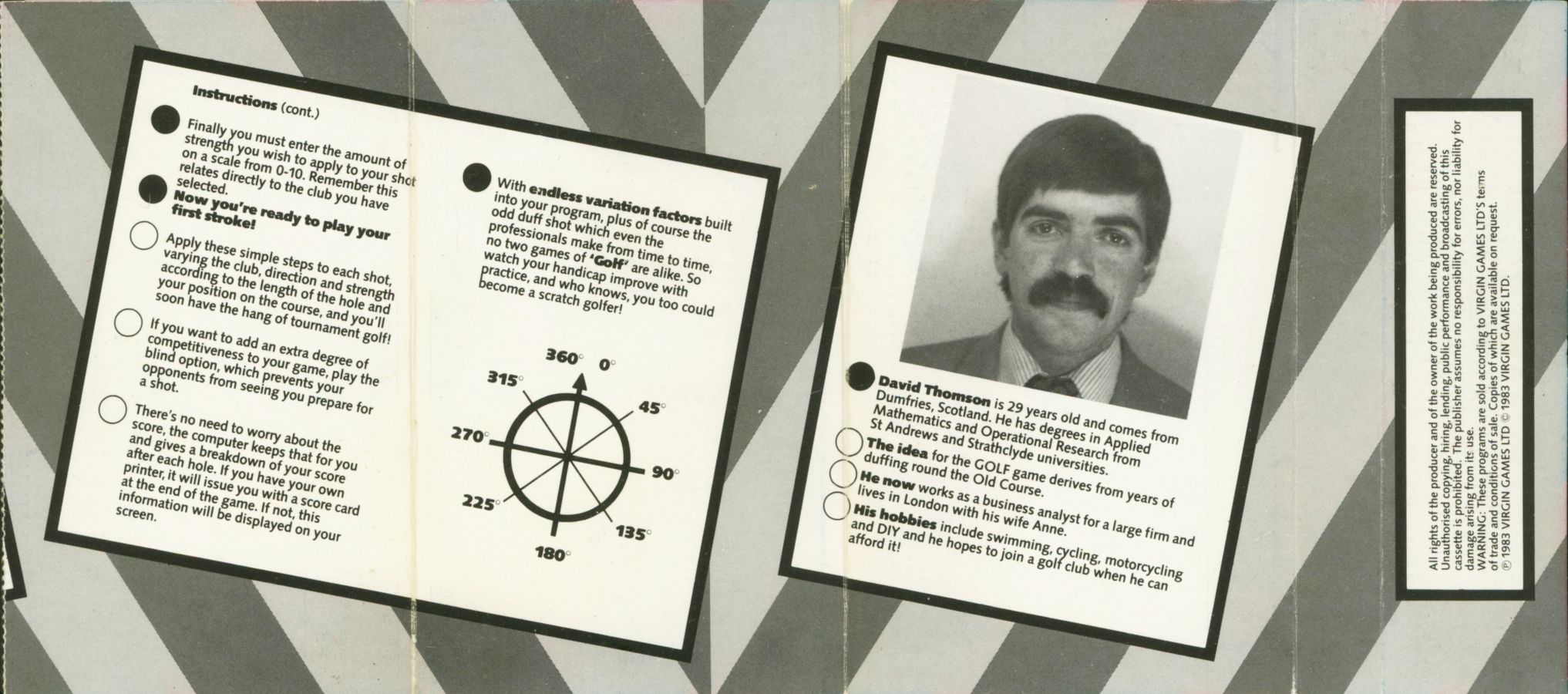
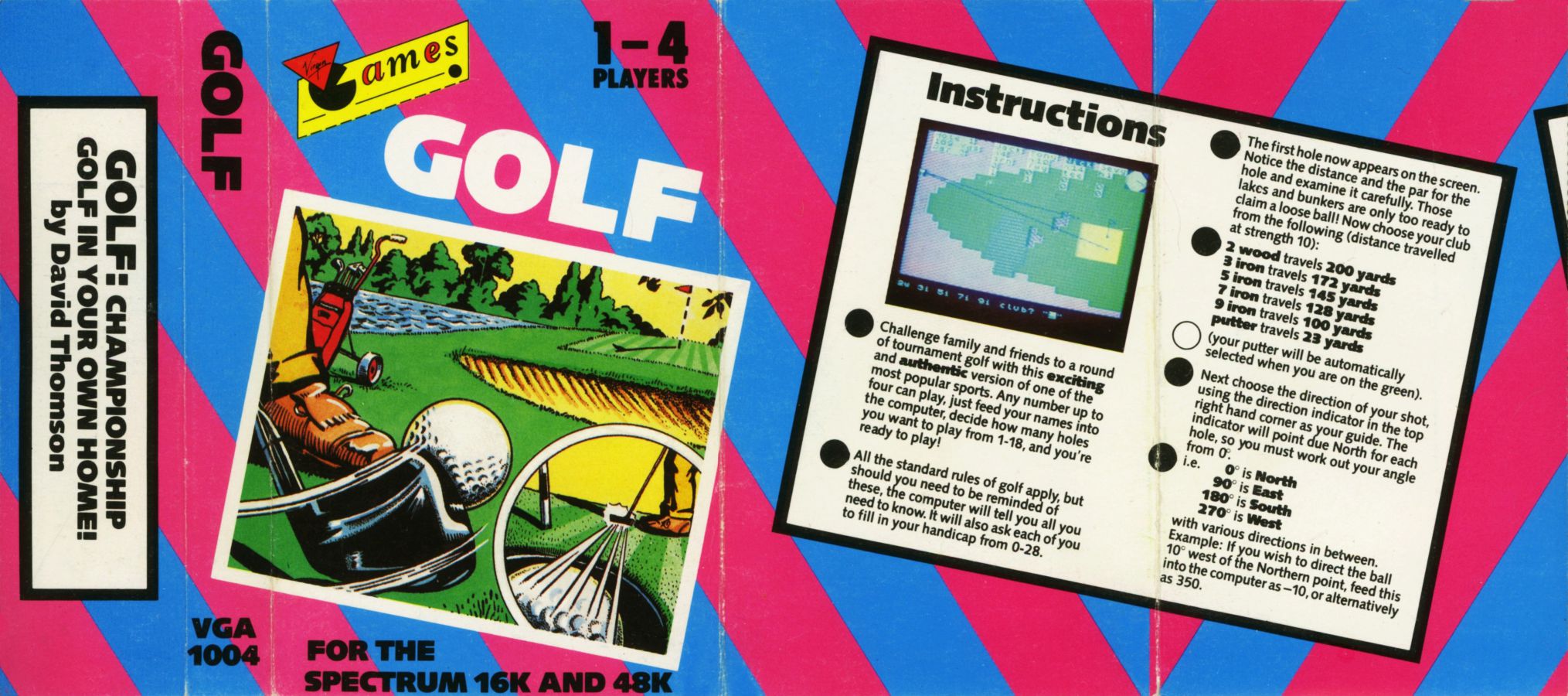
Producer: Virgin Games, 48K £5.95 Author: David Thomson In this version of the noble game, one to four players may take part and play between one and eighteen holes, choosing handicaps up to 28. The higher (worse) your handicap the more erratically random your shots become. There's an option on five clubs with a choice of strength between 0 and 10. When your selection has been made and you have estimated the compass point direction in which to swing, an animated golfer appears and hits the ball. Once on the green a putter is automatically selected. While fun to play there are several drawbacks. The graphics are very slow, each hole being built up character line by character line. The random quality of the handicap system undermines its value - everyone should choose a zero handicap! And the compass points are needlessly difficult as North keeps shifting direction with every hole. Worst of all Virgin have been selling the game with a glaring bug - when asked if you would like another game, there's an incorrect command in the BASIC which stops the program dead. It's easily corrected but annoying.
Crash #2Mar 1984 · p.61
Producer: Virgin Games, 48K £5.95 Author: David Thomson In this version of the noble game, one to four players may take part and play between one and eighteen holes, choosing handicaps up to 28. The higher (worse) your handicap the more erratically random your shots become. There's an option on five clubs with a choice of strength between 0 and 10. When your selection has been made and you have estimated the compass point direction in which to swing, an animated golfer appears and hits the ball. Once on the green a putter is automatically selected. While fun to play there are several drawbacks. The graphics are very slow, each hole being built up character line by character line. The random quality of the handicap system undermines its value - everyone should choose a zero handicap! And the compass points are needlessly difficult as North keeps shifting direction with every hole. Worst of all Virgin have been selling the game with a glaring bug - when asked if you would like another game, there's an incorrect command in the BASIC which stops the program dead. It's easily corrected but annoying.
Crash #1Feb 1984 · p.60
Producer: Virgin Games, 48K £5.95 Author: David Thomson In this version of the noble game, one to four players may take part and play between one and eighteen holes, choosing handicaps up to 28. The higher (worse) your handicap the more erratically random your shots become. There's an option on five clubs with a choice of strength between 0 and 10. When your selection has been made and you have estimated the compass point direction in which to swing, an animated golfer appears and hits the ball. Once on the green a putter is automatically selected. While fun to play there are several drawbacks. The graphics are very slow, each hole being built up character line by character line. The random quality of the handicap system undermines its value - everyone should choose a zero handicap! And the compass points are needlessly difficult as North keeps shifting direction with every hole. Worst of all Virgin have been selling the game with a glaring bug - when asked if you would like another game, there's an incorrect command in the BASIC which stops the program dead. It's easily corrected but annoying.
Personal Computer News #26Sep 1983 · p.49
Mike Gerrard
Steve McClure
SPORTING SPECTRUM Mike Gerrard and Steven McClure set up a two-man defence against the latest Sinclair hordes. Spectrum games keep coming thick and fast - some of them more thick than fast, it must be said. But this latest consignment includes at least a couple that match arcade standards and even one in which it's your shout - you literally call the shots! Start yomping .. PHEENIX (£5.50) - Megadodo Software, [redacted] Why should anyone write a fast-moving machine code version of an arcade classic, then make you wait 20 seconds between each and every game while the screen fills with stars? It's a pity because this is otherwise an enjoyable version of Phoenix... go on, admit it, you'd never have guessed. You can use the keyboard or either Kempston or AGF joysticks, and select from five skill levels. There are several screens of birds and eggs to be scrambled before you get to assault the Flagship. The hardest level is suicidal, but a few instructions wouldn't have gone amiss. It is colourful, but due to the frustrating wait between each screen change I recommend you look for a better alternative. AQUARUIS (£5.95) - Bug-Byte, [redacted] Bug-Byte bites again with a game that would grace any arcade. Using Kempston joystick or keyboard, you must negotiate your diver through a scrolling sea filled with sharks. Jellyfish, mines, strangleweed and other fishy nasties. Most of these can be despatched with a direct shot from your gun, but your oxygen is also expiring, so pick up the supplies from the seabed when you can. If you're lucky, or extremely skillful, you'll eventually come to dark caverns, at the end of which is your mission - to defuse the death machines by shooting the three-colour coded panels in the sequence given at the start of the game. Amusing graphics, if a little jerky here and there, but definitely the pick of this batch. ANT ATTACK Macronics Systems, [redacted] After a hard day's gardening you fall asleep, but your dream turns nasty as the ants decide to get their own back on you. At least that's the story behind what's claimed to be the first Spectrum game controlled partly by your voice. Yell 'fire' at your tape recorder and that's what's meant to happen. I couldn't make it work, but that's not to say it won't on other tape recorders. More of a gimmick than of practical use, unless you can shout at a very fast rate indeed. Settling for keyboard control, I enjoyed a fast and furious Centipede-type game, shooting at ants and other pests as they descend the screen in that well-known fashion. The cassette insert is cheaply done, but there's nothing wrong with the game itself. ALIEN INSECTS Macronics Systems, [redacted] Armed with a laser bolt, you must shoot down the fat little insects that are buzzing all over the screen. You can move in four directions, with a sensible layout for keyboard control. This is a game worth getting just to see what sounds can be squeezed out of the Spectrum. If you kill enough nasties then space eggs start to appear at the top of the screen, waiting to descend on you. By this time the insects are about as easy and pleasant to deal with as a swarm of wasps. 3D STRATEGY (£6.95) - Quicksilva, [redacted] As a change from killing ants, aliens, birds or jellyfish, here's a game where you could cheerfully kill the programmer. It is so hard to beat the machine in this 4x4x4 version of Noughts and Crosses or Connect Four, and I was only playing on the easiest of the four skill levels. The only drawback to this piece of software is the instructions. They drivel on for pages about how totally wonderful the game is... auto-play option, timer that can be set per move, per game or switched off, on-screen ticking clocks, two styles of play, an average response time of 1.7 seconds, machine code, over 200,000 decisions per move, and so on. The board is displayed as four separate grids at the bottom of the screen, which is a little confusing, though We no doubt a proper three-dimensional cube would have been even more so. However, it does offer a very tough opponent, and it may be as good as it claims. YOMP (£7.98) - Virgin Games, [redacted] A paratrooper opera which is fairly easy to figure out. You use four keys to manoeuvre your way through four columns of trucks and tanks and all you have to do is learn how to place yourself in the optimum position to sneak through to the other side of the moving convoys. As a video game memento of the Falklands conflict it's a pretty weak effort. SHEEPWALK (£7.98) - Virgin Games, [redacted] Sheepwalk is almost as dull as Yomp once it's in play. You're a sheepdog moving around the screen trying to catch up with miscreant sheep. While doing this you risk trampling the vegetables or bumping into walls. GOLF (£7.98) - Virgin Games, [redacted] In its Virgin form, Golf is an interesting enough game to play. It requires players to plot out each shot's direction and strength, while using the right club. There's enough of a random element to make the game more than a little irritating. When your ball lands in the rough it can take three or four strokes to get it out. This is where having a low handicap (you can choose between 1 and 28) is a real advantage. The game's designers have assumed real duffers are going to have problems in getting out of the woods.
Advert9
- Your Computer #11Nov 1983 · p.202
- C&VG (Computer & Video Games) #22Aug 1983 · p.22
- Computing TodayAug 1983 · p.26
- ZX Computing #8Aug 1983 · p.39
- Sinclair User #16Jul 1983 · p.19
- Popular Computing Weekly #27Jul 1983 · p.8
- Your Computer #7Jul 1983 · p.10
- Personal Computer News #15Jun 1983 · p.52
- Home Computing Weekly #16Jun 1983 · p.8
Feature4
- Crash #16May 1985 · p.44
- Sinclair User #29Aug 1984 · p.56
- Personal Computer Games #6May 1984 · p.41
- Your Spectrum #3May 1984 · p.24
Letters1
- Sinclair User #31Oct 1984 · p.15
News/Note1
- C&VG (Computer & Video Games) #22Aug 1983 · p.19
Review1
- Home Computing Weekly #17Jun 1983 · p.29
Related
- Tags
- Golf, Turn based
- Elsewhere
- UVL
- Same entry at
- Spectrum ComputingZXInfo
Reviews from people here
Sign in to write about this, or make an account. It takes a minute and lets you correct the catalogue too.
No description recorded.
Sign in to correct or add to this.
Hold the rights to this and want it taken down?