
The Great Space Race
Strategy Game: Management · ZX-Spectrum 48K · 1 players · English
Legend [UK] · 1984 · Pound sterling 15.00
Discussion
Nobody has started a thread about this yet.
Remarks
The game runs on the game engine Movisoft 2, an improved version of Movisoft as used in {Valhalla|Legend [1]|0007152}.
Play
- GreatSpaceRaceThe.tzx.zipTape image English25 KB
- GreatSpaceRaceThe.tap.zipTape image English26 KB
Documents
- GreatSpaceRaceThe.zipInstructions English598 KB
- GreatSpaceRaceThe(EN).pdfInstructions English4,589 KB
Other files
- Great Space Race, The (1984)(Legend).pokPOK pokes file 0 KB
Files and rights
No permission is on record either way. Screens and pictures are copied here on a take-down basis: if you hold the rights and want something removed, say so and it goes.
Scores
In the magazines
- Sinclair User #361985 · Gilbert Factor3/10
- Sinclair Programs #291985 · Rating45%
- Crash #131985 · Overall44%
- Big K #121985 · Overall1/3
Elsewhere on the web
- WorldOfSpectrum 39 votes3.30
Awards and competitions
Crash Readers Awards 1985
- 1Tackiest Game Of The Year
In the magazines 50
Your Spectrum #13Apr 1985 · p.470/5 MISS1/5 MISS0/5 MISS
Dave Nicholls 0/5 MISS
Roger Willis 1/5 MISS
Ross Holman 0/5 MISS
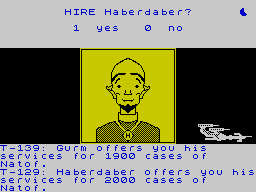
JOYSTICK JURY From their bench on high, our regular panel of jurors - Ross Holman, Roger Willis and Dave Nicholls - pass judgement on the latest and greatest games software! Here they are again - that motley bunch of joystick jockeys, ready and waiting to sift through the plethora of software to help you make that important decision! WARNING! Just in case you find our scoring system too confusing, here's what it's all about. The score out of five at the end of each person's review is based on their own experience of the game. But that's pretty subjective... so they also use the HIT and MISS system to indicate its potential as a commercial success. THE GREAT SPACE RACE Legend £15 Ross: When a program's been hyped as much as The Great Space Race, it'd have to be something really special to live up to the expectations. Based loosely on the 'space trader' idea, the object of the exercise is to deliver consignments of a wicked alcoholic beverage called Natof to space stations spread around the galaxy. You start by choosing up to four racers to carry the Natof, and you decide which weapons you'll use to arm their ships. All potential candidates then present themselves and state their price; you see large pictures of them on-screen, and their faces smile, wink or grimace according to your choice. The screen splits up into three parts during the race; the top part displays a menu of options and allows you to communicate with your racers, while the lower shows textual reports. The middle section is used for graphical output - for example, the racer you're talking to, or the space station that's approaching. The problem with TGSR is that it doesn't involve the player. There may be some subtle character interaction going on, but it doesn't appear to make much difference to the player and it certainly doesn't justify the ludicrous price tag.
Sinclair Programs #29Mar 1985 · p.1945%45%
Rating 45%
Colette McDermott 45%
PRICE: £14.95 GAME TYPE: Simulation Legend promised great things of The Great Space Race. Characters with animated faces; a program that goes one step beyond their last program, Valhalla; a development of the computer movie concept: all these were promised, and have been delivered. Unfortunately, it all goes wrong. The game centres around delivery of the potent intoxicant, Natof, to ninety six different planets. Staff must be chosen, equipped and guided in order to deliver Natof to all planets as quickly as possible. Choice of staff is important, and choices can be made based on the accompanying booklet, and on experience gained from past games. Some characters spend all their time asking whether they can fight pirates, and get very little work done. Others drink Natof too frequently, and have to be dried out at great expense. Others never ask you for guidance, and spend their time visiting the same planets. The main problem is that, true to the computer movie formula, the game virtually plays itself, and all decisions will be made for you if you do not enter an answer quickly enough. As this is a long game, and bound to take over an hour to complete, it is easy to lose concentration for vital seconds, and thus miss your opportunity to make important decisions. There is little to hold the attention in a game which plays itself. The Great Space Race is produced for the 48K Spectrum by Legend, [redacted].
C&VG (Computer & Video Games) #41Mar 1985 · p.1089/107/106/107/10
Graphics 9/10
Sound 7/10
Value 6/10
Playability 7/10
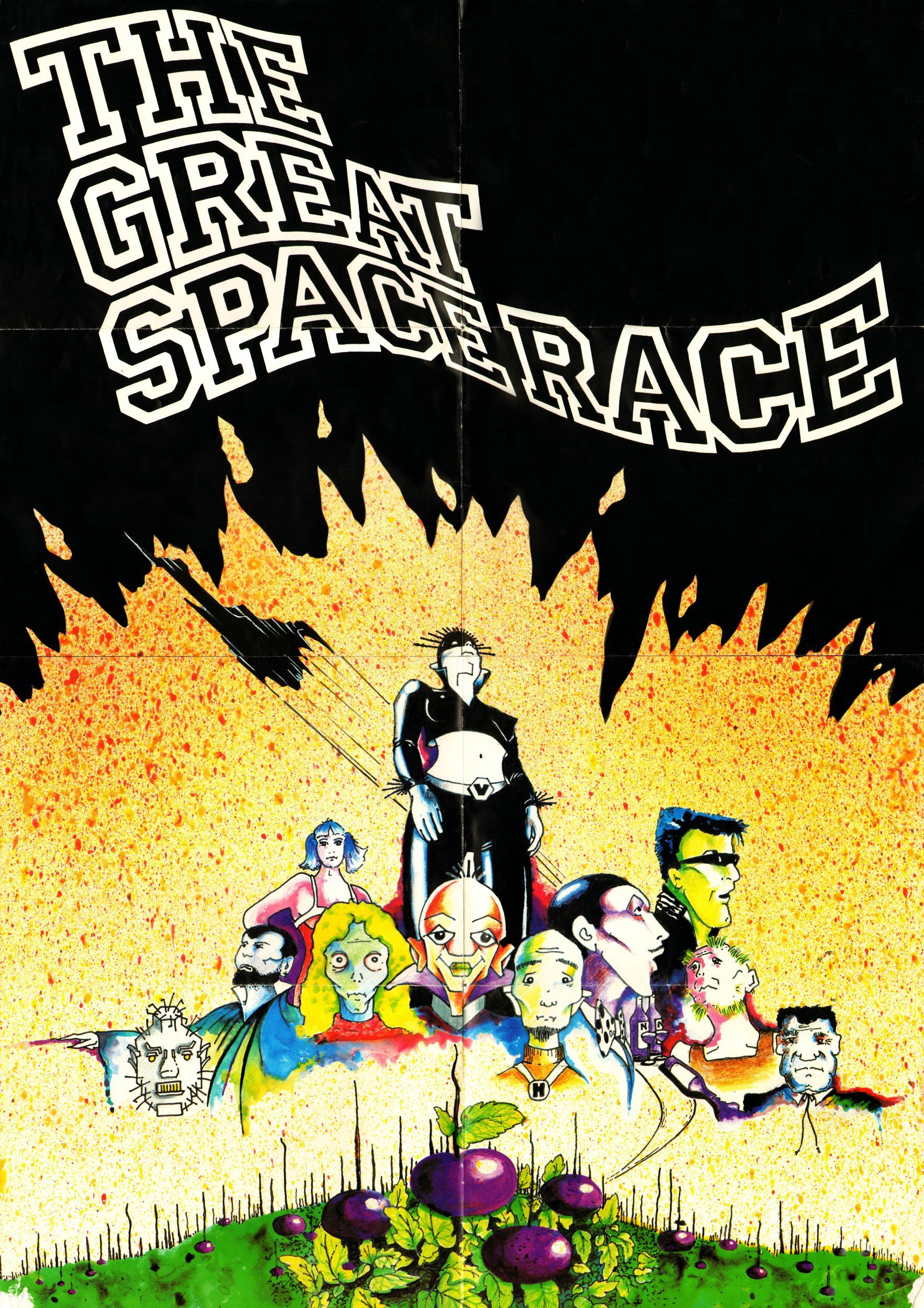
MACHINE: Spectrum SUPPLIER: Legend Software PRICE: £14.95 At last - alter all the hype and pre-release fanfares, Legend's The Great Space Race is finally out on the shelves of your local software shop. The packaging, as you'd expect, is impressive. The game cassette is lost inside a giant video-style box - and comes with a 56-page booklet which features game details and cartoons, plus a colour poster. The booklet explains the scenario of the game, which goes like this. Once upon a time there was a small unvisited planet at the centre of a small unvisited galaxy. When the first colonists landed they stepped on to a lush green landscape dotted with strange purple plants - plants that looked suspiciously like... vines. Those first pioneers gathered in the purple fruit - jumped up and down on it for hours before someone remembered the pulping machine in their supplies - and left it to ferment. The first tasting was an historic event, which regrettably nobody present can recall, but at the end of the day - or week - or whatever - the least incapable businessmen rushed samples of this fantastic liquid to every planet in the galaxy. Their message was simple: "Sample new product. Price to follow. Delivery to follow. Name to follow." The product was duly sampled and that was, pretty much, that. People wanted to know the price. They wanted to know about delivery. They wanted to get their hands on it and naming the brew was the least of their concerns. "Name to follow" didn't exactly roll off the tongue however. And so, in the absence of any better ideas, it was simply abbreviated - and Natof was born. And that's where The Great Space Race begins. The idea is for you to take part in an intergalactic Beaujolais race - to get all the Natof you can to the people who want it in the four spiral arms of the Natof galaxy. You also have to watch out for nasty pirates, like Ghengis, Krone and Zanik. And the equally nasty police force known as PKBs. And the other racers who you failed to hire at the start of the game. Talking of hiring racers - this is what you have to do at the start of the game. You must choose four of the oddly named racers to act for you - delivering the Natof around the galaxy. Racers like Dos, Vindaloo or Gurm. Once you have hired them, you have to arm their spacecraft with lasers, missiles and shields. They'll need all this as attacks are frequent - and you may wish to launch one yourself from time to time. Each arm of the galaxy has its own characteristics which you learn as you go along. And each of the characters you control have their own distinct ways of behaving - again you learn these as you play. As your racers move through the galaxy, they send messages back to you - and ask you what to do next! You have to make quick decisions as you only get a matter of seconds to decide what to do. The graphics are well done. Each character's face is flashed up on screen when he or she is talking to you. The video "window" also shows the various space stations being visited, space battles between the rival racers etc. At the top of the screen you see a control option window while at the bottom there is a message window - Valhalla style. Dotted around the galaxy are space hulks full of Natof. But now for the bad news - these hulks are booby trapped. The traps can be defused using special codes which your racers pick on their travels - but you must be sure to note down and use the right code in the right location if you are to survive an attempt to plunder the cargo. I found The Great Space Race nice to look at - but there just isn't enough to do. As the instructions say, you can actually sit back and watch the game unfold. But when you spend over £14 on a game I think you want a bit more action than that! You do have to make split second "yes" or "no" decisions and pick the right code to defuse the hulk booby-traps. You can't control the space battles, though, which I found irritating. Overall, The Great Space Race is a nice looking game but - despite the nice graphics and all that packaging - not really worth the £14 price tag.
Big K #12Mar 1985 · p.231/31/3
Overall 1/3
Richard Burton 1/3
HEADS DOWN MAKER: Legend FORMAT: cassette PRICE: £14.95 Among the many turkeys on sale this Christmas past could be found The Great Space Race that mega-hyped, long-promised follow-up to Valhalla. Resplendent in a plush, over-size plastic case, containing a glossy 56-page manual and colour poster, the game - pardon me, "computer movie" (Legend are into that socko boffo stuff) promised much... and delivered little. Far from the gods, myths and legends of Valhalla, the folks at Legend have got right down to basics with The Great Space Race (or TGSR from here on in). You are invited to become a galactic booze runner. Seems the civilized galaxy has become hooked on Natof ("Name to Follow"), a miracle drink that can get you paralytic without ever producing a hangover and, just for good measure contains all the nutrition needed for a good, healthy if alcoholic life (Mary W will love this one). The demand is there - you have to fill it. To do this you hire four racers to deliver crates of the stuff to 96 space stations in different parts of the galaxy. The first one to complete the course wins the race. They are only hindered in their work by roaming pirates, booby-trapped space wrecks, over-zealous police and a few other pitfalls which can knock out your racers one by one. The game/movie comprises of two main phases. In the first you have to hire the racers. Eight are offered (with exotic names like Noxin, Gurm, Urg, Vindaloo, Haberdaber) with fees on a sliding scale according to capability and performance. Decisions to hire or not have a time limit and hesitations can lumber you with unwanted racers, automatically assigned. Each racer must also be kitted out with weaponry, both defensive and offensive. Payment for everything comes out of your initial allocation of 50,000 cases of Natof. Kitting out complete, the "race" begins and consists of your racers, in strict rotation, visiting various stations, off-loading crates of Natof, then moving onto the next. The screen display consists of a central graphics area sandwiched between two large text windows; the lower giving events and reports and the upper offering options - usually a yes/no decision with a time limit given before the computer takes over and makes the decision for you. The player's toughest task is to decide which of the two keys has to be pressed. During the race the player is aroused from his stupor every so often to deal with a situation; sobering up a racer, bribing police and pirates not to attack his racers or arrange for repairs - but only if he feels up to it. Occasionally there will be a bit of action as two ships engage in battle. This is terrifically exciting and well worth opening one eye for. That's basically it. Keep your racers in the game for as long as possible and hope that one makes the rounds safely int he shortest possible time. To be fair some strategic elements are built in with "personality factors" ensuring that some characters will react to other characters in "unpredictable ways". Priorities can also be chosen as to whether wining means delivering to more stations than before or the same number in a shorter time. No doubt, given time, a player could exploit these strategic factors - but there's absolutely no incentive for him to do so. The minimal control takes away any involvement and reduces the player to a mere spectator. Fine for movies, but we're talking games here. Graphics are great - by 1982 standards. in 1985 they look amateurish and unprofessional. The much-vaunted "facial expression" routine for the TGSR characters comes down to merely a "happy" or "sad" face depending on decisions. Animation is of a similar primitive quality and general screen presentation is poor. Even the concept itself is not new. Bug-Byte's Star Trader and Pixel's early but enjoyable Trader multi-parter have been there before. The best comes last: the game is partly in BASIC, which can be accessed by a simple BREAK command. Unforgivable in this day and age. In the final analysis, TGSR is a major disappointment. It is a retrograde step from a company the promised innovation and quality with its first release - and charging £15 a go should be considered the next worst thing to vandalism.
Sinclair User #36Mar 1985 · p.403/103/10
Gilbert Factor 3/10
John Gilbert 3/10
THE GREAT SPACE RACE Legend Memory: 48k Price: £14.95 In space nobody can hear you scream which is just as well if you intend buying The Great Space Race. It is one of the most vacuous products we have seen and its time that this sci-fi 'epic' was exposed as yet another dose of Legend super-hype. The loose plot involves a race between space ships, some piloted by user-controlled characters and others by the computer, to deliver consignments of an alcoholic beverage called Natof to as many planets as possible. During the delivery runs characters may indulge in ship-to-ship laser gun butchery or lift the lid on the cargo and arrive at the next port of call in a drunken haze. At seemingly random times during the game one of the characters may discover the code number of a booby trap bomb which has been hidden on a planet or ship. If you have time to scribble the number and location down before the information is scrolled off the screen you can defuse the bomb in the unlikely event of arriving at the location. If the game Loads without crashing back into Basic you will immediately see the most attractive aspect of the package. The graphics in which the characters are displayed are in brilliant high resolution which is produced on the screen with the utmost professionalism. It is, however, a pity that the programmers at Legend do not seem to be able to produce a good animated representation of a space battle. The two ships on the screen look like two mis-shaped fried eggs sliding around in a pan. Legend has taken minimal graphics to new heights. As for playability, if you want to make a cup of tea or 'phone a distant relative in Australia you can leave the game to play with itself. As with soaps such as Coronation Street or The Archers you can go away and come back without having missed much. It is incredible that the company which produced Valhalla with interactive characters and real-time action, difficult to program by any standards, could produce such a whimper after the bang. The Great Space Race includes real-time action but if intelligent character interaction does exist within the game it must be hiding somewhere. As for the Natof, the game plays as if it was written under the influence of the stuff.
Crash #13Feb 1985 · p.11858%69%25%80%10%20%44%
Use of Computer 58%
Graphics 69%
Playability 25%
Getting Started 80%
Addictive Qualities 10%
Value For Money 20%
Overall 44%
Unknown
Unknown
Unknown
Producer: Legend Memory Required: 48K Retail Price: £14.95 Language: BASIC Legend has created its own legend through the release of only two games, Valhalla which incorporated the graphic technique of 'Movisoft', and this new release, The Great Space Race with the advanced technique of 'Movisoft2'. Movisoft is a grand term for animated graphics, which were seen to good effect in Valhalla, but by implication the graphics are intended to resemble a real film in motion. The Great Space Race comes in a sizeable hard box containing the tape, a poster and a hefty 56 page booklet. Opening the book you find instructions on playing the game and a series of black and white comic strips which tell a short story on all 12 characters you will primarily encounter. The purpose behind the comic strips is to give the player some insight into the strengths and character of the racers you will have to hire or fight. These are all introduced to you at the commencement of a game, and it is with the characters' faces that 'Movisoft2' comes in. The basic story is that in the galaxy and at a time past, a marvellous alcoholic beverage had been developed called Natof (it seems the first ever consignment of the yet un-named drink was filled in on the form with 'Name To Follow', and as it never did and Name To Follow was a bit of a mouthful, it became abbreviated to Natof). This beverage is in enormous demand since it never leaves a hangover and contains all the right constituents for a healthy and happily inebriated life. The galaxy is divided into four arms of its spiral, Alpha, Beta, Gamma and Delta. In each arm there are 24 space stations in desperate need of Natof. Your task is to supply them all. To do this you must hire four racers, one for each sector and arm their ships ready to cope with the race using stocks of your starting supply of Natof. The first section of the game consists of the hiring and arming. Each of the main characters appears in the viewscreen and his or her details appear below in the information panel plus the hiring price. In the top information panel you are told to press for yes or no, and a graphic representation of a clock ticks the seconds away for you to make your choice. On selecting a crew member, you must then select the weapons from a choice of lasers, missiles and smart bombs and a shield per craft. There is a time limit on making all these choices before the race commences, and racers' fees tend to drop as the starting time approaches. Understanding the character and abilities of the racers is important in choosing them and apart from the comic strips, much intelligence is gained through playing the game. Choice of weapons is also dictated by the arm of the galaxy in which the racer will be operating - some are more violent and lawless than others. The better policed ones will also bring problems with the often corrupt police chasing you for taxes. Once the race starts in earnest, the bottom information panel becomes more important, for it is here that your racers and enemies will report to you. The viewscreen shows the animated faces of the communicant, while their message appears below. This may take the form of your racer saying another racer's ship is in sight, should they attack? (any racers you have not hired are automatically working for the computer). It may be the other way round, with your racer being attacked by another. It may be one of the four computer controlled characters, the incredible Ghengis, the pirates Zanik and Krone or the police threatening to attack one of your racers unless you pay so much Natof over. The outcome of any combat, which is graphically represented, will depend on the shield strength, weaponry and character of the racer and ship in question, as well as that of the attacker. Reports come in constantly about the Natof deliveries being made by your hired racers, and decisions may be required at this point to send the racer in a different direction. More money may have to be paid out for ship repairs, otherwise the racer will simply drop out, or for sobering up time (they drink Natof constantly). The game ends when either all 96 space stations have been supplied, or when your four racers have been knocked out of the race. The game operates in real time, so time spent making up your mind is time wasted. Scoring is done by the number of space stations supplied, the total time taken and the average time that each delivery took. In this sense there is no real winner, only an improving of times and numbers of deliveries. COMMENTS Control keys: 'yes' or 'no' key presses to screen prompt Joystick: doesn't need one Keyboard play: very simple, but slowish response time Use of colour: above average, reasonably varied Graphics: very large, in most cases quite detailed but some insignificant Sound: hardly any Skill levels: 1 Lives: not entirely applicable, but four racers Screens: several Special features: lavish packaging and large instruction booklet
First off, all the characters introduce themselves to you.
Haberdasher's ship attacks Zanik's ship in a fight to the death over a bottle of NATOF.
One of the galaxy arm space stations eagerly awaiting a delivery of NATOF.
Zanik demands a ransom. In the information panel one of the peculiarities of the text presentation can be seen where NATOF is spelt with a capital N one time and a small n next time.
Two-page ad19
- Personal Computer Games #15Feb 1985 · p.22
- Big K #11Feb 1985 · p.28
- Crash #13Feb 1985 · p.30
- Big K #10Jan 1985 · p.60
- Crash #12Jan 1985 · p.54
- Personal Computer Games #13Dec 1984 · p.148
- Your Spectrum #10Dec 1984 · p.72
- Personal Computer Games #12Nov 1984 · p.58
- Big K #8Nov 1984 · p.110
- Your Spectrum #9Nov 1984 · p.40
- Big K #7Oct 1984 · p.36
- Your Spectrum #8Oct 1984 · p.48
- Crash #9Oct 1984 · p.84
- Personal Computer Games #11Oct 1984 · p.74
- Personal Computer Games #10Sep 1984 · p.10
- Sinclair Answers #1Sep 1984 · p.4
- Your Spectrum #7Sep 1984 · p.48
- Crash #8Sep 1984 · p.44
- Popular Computing Weekly #31Aug 1984 · p.8
News/Note15
- Computer Gamer #5Aug 1985 · p.5
- Sinclair User #41Aug 1985 · p.6
- Your Spectrum #17Aug 1985 · p.11
- Big K #12Mar 1985 · p.4
- C&VG (Computer & Video Games) #40Feb 1985 · p.21
- Big K #10Jan 1985 · p.4
- Big K #7Oct 1984 · p.3
- TV GamerOct 1984 · p.6
- Sinclair User #31Oct 1984 · p.7
- Your Spectrum #8Oct 1984 · p.3
- Crash #8Sep 1984 · p.32
- Personal Computer Games #10Sep 1984 · p.12
- Home Computing Weekly #77Aug 1984 · p.1
- Popular Computing Weekly #31Aug 1984 · p.1
- Popular Computing Weekly #31Aug 1984 · p.5
Feature5
- ACE (Advanced Computer Entertainment) #42Mar 1991 · p.71
- ACE (Advanced Computer Entertainment) #3Dec 1987 · p.20
- Crash #27Apr 1986 · p.67
- Sinclair User #41Aug 1985 · p.96
- Sinclair User #37Apr 1985 · p.94
Letters2
- Crash #14Mar 1985 · p.74
- Popular Computing Weekly #2Jan 1985 · p.6
CompoEntry2
- Personal Computer Games #15Feb 1985 · p.67
- Crash #10Nov 1984 · p.156
Preview1
- Personal Computer Games #11Oct 1984 · p.33
Related
- Same entry at
- Spectrum ComputingZXInfo
Reviews from people here
Sign in to write about this, or make an account. It takes a minute and lets you correct the catalogue too.
No credit recorded.
Sign in to correct or add to this.
Hold the rights to this and want it taken down?