
Gulpman
Arcade Game: Maze · ZX-Spectrum 16K · 1 players · English
Campbell Systems · 1982 · Pound sterling 5.95
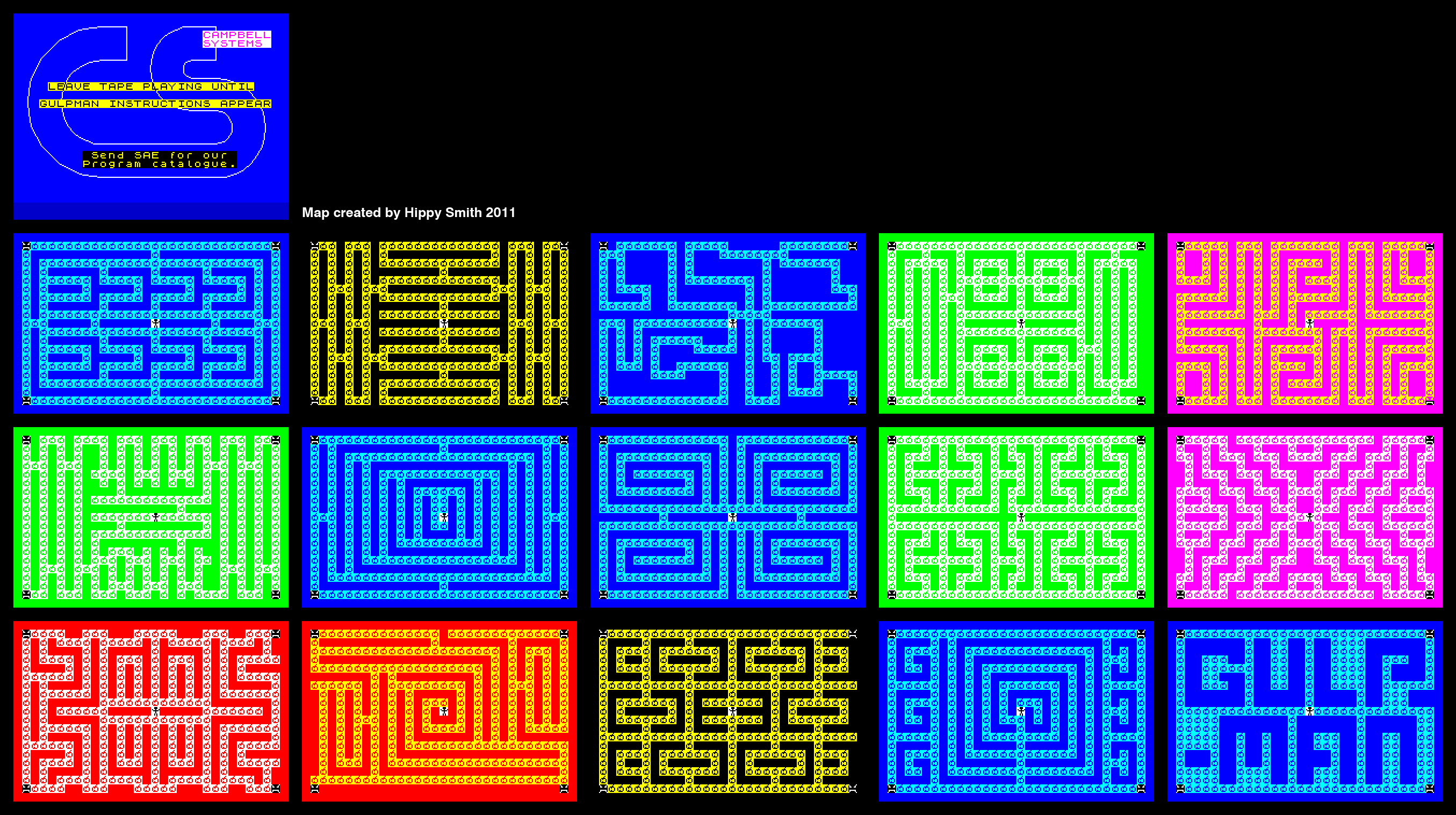
_Back.jpg)
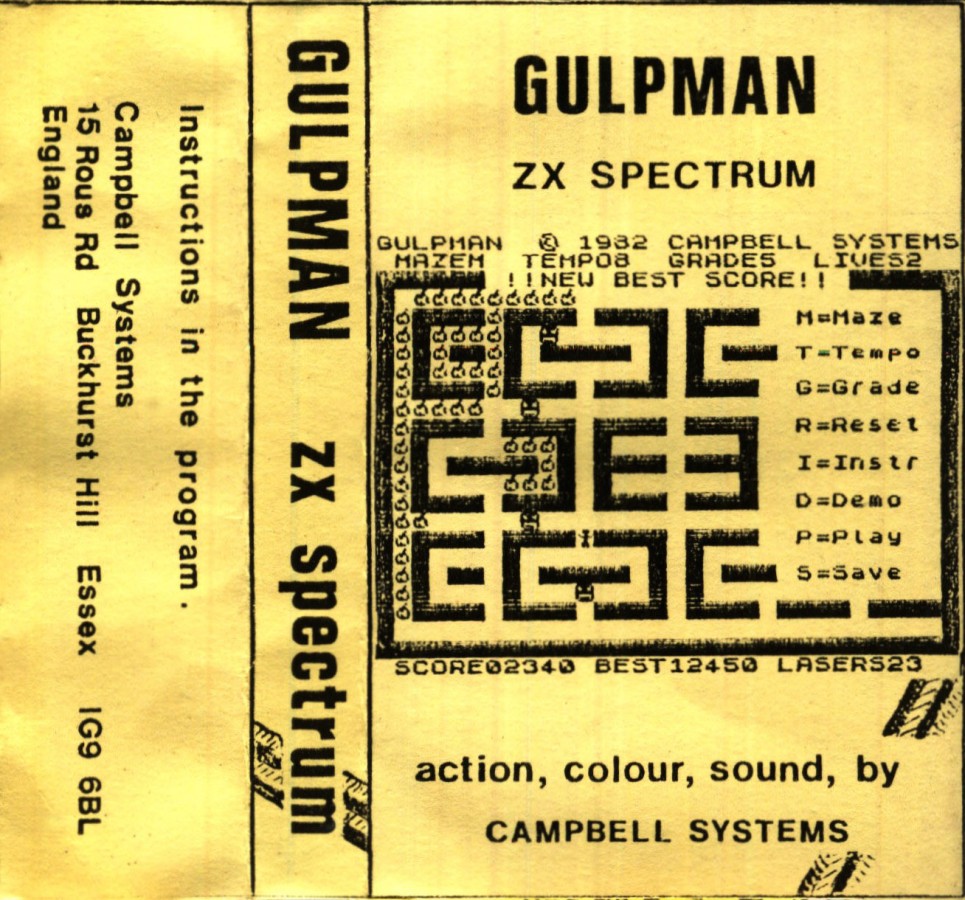
_Front.jpg)
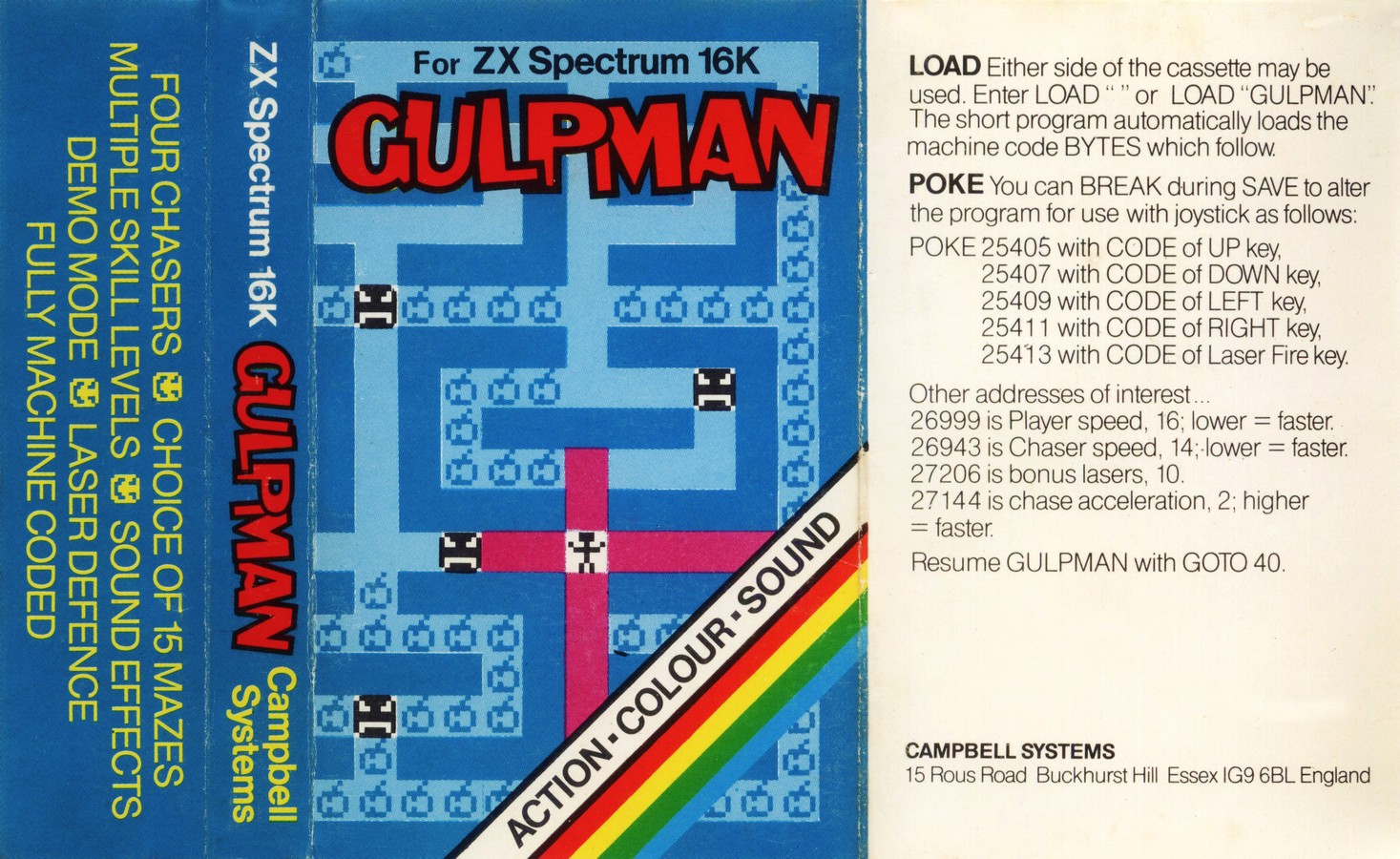
_Front.jpg)
_Front.jpg)
_Front.jpg)
.jpg)
.jpg)
.jpg)
.png)
_SideB.jpg)
_SideB.jpg)
_SideA.jpg)
_SideA.jpg)
_SideA.jpg)
_SideA.jpg)
_SideB.jpg)
_SideA.jpg)
_SideB.jpg)
(ES)_Scan.jpg)
Discussion
Nobody has started a thread about this yet.
- Control Option
- Cursor
Releases
- 1982Campbell SystemsPound sterling 5.95
- 1982Aackosoft
- 1982Profisoft [1]
- 1983Micromega
- Oct 1983Riko Data
- 1983VentamaticSpanish peseta 1190.00
- 1984Intelligent Program
- 1982ZX DataDanish krone 115.00
Play
- Gulpman(ZXData).tzx.zipTape image English4 KB
- Gulpman(IntelligentProgram).tzx.zipTape image English4 KB
- Gulpman(Ventamatic).tzx.zipTape image English5 KB
- Gulpman(SV).tzx.zipTape image Swedish5 KB
- Gulpman(Profisoft1).tzx.zipTape image English4 KB
- Gulpman(Micromega).tzx.zipTape image English6 KB
- Gulpman(Aackosoft).tzx.zipTape image English4 KB
- Gulpman.tap.zipTape image English5 KB
- Gulpman.tzx.zipTape image English5 KB
Documents
- Gulpman.txtInstructions English2 KB
- Gulpman(EN).pdfInstructions English40 KB
Other files
- Gulpman (1982)(Campbell Systems).pokPOK pokes file 0 KB
Files and rights
Distribution permission is on record, granted to another archive rather than to this one. Screens and pictures are copied here; everything else links to the archive that holds it.
- AllowedCampbell Systems → WorldOfSpectrum
- AllowedVentamatic → WorldOfSpectrum
Credits
- John A. Campbellcredited
- Birger LarssonLocalization/Translation
Sign in to credit somebody, or say what these people did.
Scores
Elsewhere on the web
- WorldOfSpectrum 19 votes6.21
In the magazines 77
Crash #6Jul 1984 · p.9440%37%50%52%55%49%40%42%50%43%
Use of Computer (CP) 40%
Use of Computer (MU) 37%
Graphics (CP) 50%
Graphics (MU) 52%
Playability (CP) 55%
Playability (MU) 49%
Addictive Qualities (CP) 40%
Addictive Qualities (MU) 42%
Value for Money (CP) 50%
Value for Money (MU) 43%
Chris Passey
Matthew Uffindell
ELECTRO GOBBLE - PACMAN TYPE GAMES In our sixth comparison, reviewers CHRIS PASSEY and MATTHEW UFFINDELL snatch a glass of water and a handful of power pills and prepare to do battle with a legion of ghosts... Pacmania came over from the States quite a while back. Initially the game was regarded as odd in that it was relatively non-violent for a computer game, but it rapidly established itself as the number one arcade favourite. Although the craze is over now, there are still a lot of pacfans around. As a classic maze game, Pacman was among the first arcade originals to be copied in numerous forms on to the Spectrum. Copyright owners, Atari International, have been promoting their expensive 'official' version since before Christmas, but it competes against some very strong 'unofficial versions. Some are good, some not so good, and there are some interesting variants. In brief, the classic version should have a medium complex maze connected horizontally by a wrap around tunnel. In the four corners are a similar number of power pills. Each pathway of the maze is regularly dotted. In the centre is a 'home' for ghosts of differing colours and point values, which are released into the maze at intervals. The object is to take your Pacman, an orange ball with a gobbling mouth, around the maze and eat all the dots to promote to a more difficult screen with more intelligent ghosts. Eating a power pill will cause all the ghosts to turn blue and edible. In this condition they should run away from your approach at a slower speed than yourself, Strawberries appear at intervals and can be eaten for bonus points. GULPMAN Producer: Micromega Memory Required: 16K Retail Price: £4.95 This was originally the Campbell Gulpman, which is now marketed by Micromega. It is a variation on the Pacman theme, which involves you in shooting the nasties. There are a large selection of mazes, speeds and skill levels. The graphics are small but smooth, but I think colour could be better used. On the subject of control, the keyboard is poor - cursor, but it does offer Kempston joystick. Generally this is a nice variation, playable but for me not over-addictive. CP This must be one of the oldest pieces of software available on the market. Gulpman gives you a choice of 15 mazes which look very blocky, four chasers also of primitive character design, and incredibly, 81 skill levels ranging from unchallenging ghosts to super non-human ghosts. No power pills, but lasers defend you. Fruit and warp tunnels are non-existent. An ageing game, but with plenty of choice. MU
Crash #3Apr 1984 · p.70
Producer: Campbell Systems, 16K £4.95 This is slightly different in that there's only one ghost to chase you but the more dots you eat, the faster he gets. Five screens, nine speeds, no pills or tunnels, but pretty addictive.
Crash #2Mar 1984 · p.53
Producer: Campbell Systems, 16K £4.95 This is slightly different in that there's only one ghost to chase you but the more dots you eat, the faster he gets. Five screens, nine speeds, no pills or tunnels, but pretty addictive.
Crash #1Feb 1984 · p.51
Producer: Campbell Systems, 16K £4.95 This is slightly different in that there's only one ghost to chase you but the more dots you eat, the faster he gets. Five screens, nine speeds, no pills or tunnels, but pretty addictive.
Sinclair User1984 · p.24
John Gilbert
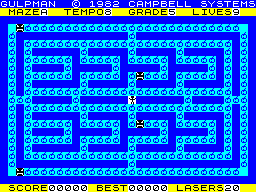
LEADING THE PAC New and varied life-forms now inhabit the Pacman maze. John Gilbert investigates. Pacman is part of what the video historians like to call the arcade maze craze. The game is set in a maze where a hungry little round creature eats dots and power pills scattered through the corridors. The monsters are ghosts which hunt the little man and will eat him if he is not agile enough to escape. If, however, the Pacman eats a power pill it can chase and eat the ghosts. The original game was introduced to the home computer market by Atari, primarily on its VCS video system and then on the 400 and 800 computers. The first versions for other computers, variously called Puckman, Gobbleman and Scoffer, arrived shortly afterwards and since then new versions have been released almost every month. Not surprisingly, the ZX-81 did not escape the craze. The authors of Zuckman, from DJL Software, claim that it is the first version of Pacman for the ZX-81. The game runs in 16K and is written in machine code, which gives the scrolling routines and Pacman a smooth movement. That is something unusual on the ZX-81, as most games flicker slightly. The game adheres as closely as possible to the original and the limited graphics of the ZX-81 do not matter much. One snag with playing the game on the ZX-81 is the membrane keyboard. Moving a Pacman around the screen using it can be difficult but not impossible. At the beginning of Zuckman the ghosts speed on their victim and if you panic trying to find the keys and do not press them properly you are liable to lose a Pacman or crash the machine. Once you have a fair idea of the game, however, it is surprising how quickly you can move the Pacman around. Zuckman is available for £5.95 on the 16K ZX-81 and Spectrum. Super Glooper is a version of Pacman, also for the 16K ZX-81, which is retailed by Sinclair Research. Glooper's task is slightly different from normal. Instead of gorging himself with power pills he has to paint the maze. Obviously the ghosts will not tolerate Glooper's antics - perhaps they do not like the smell of paint. The ghosts will try to kill Glooper as usual but if he can get round the maze and paint all the walls you have won. The game is very amusing and is well worth £4.95. The program will load in less than two minutes, so you will not have to wait six minutes to play the game. The launch of the Spectrum provided software houses with an excuse to try to produce the perfect Pacman which simulated the Atari version as closely as possible but Atari guards its rights over products jealously and investigated the products of several firms in the ZX industry. The Abbex Spookyman game is the most famous of the Spectrum versions. It also looks most like the original. Most games, until now, have included only dots and power pills in the mazes. Abbex has included dots, power blobs, diamonds, hearts, clubs, mean-looking ghosts and a cute little Pacman which looks like a diamond turned on its side. The keyboard is divided into three sections with left control on the left, right on the right, and up and down in the centre. The controls are very difficult to master but, once you have done so, usually with the aid of both hands, you will be surprised at the agility you can attain. At times the game is almost impossibly fast but Abbex estimates that the highest score possible after every screen has been cleared is 22,400. If you manage to reach 10,000 points you will receive a bonus life. We managed to go that far only once. Spookyman can be played by one or two players. If two play they take turns to control the Pacman. Their individual scores and the highest score are included at the top of the screen. There are two unusual features in Spookyman. The first is that you can reset the high score at any time between games; the second is that you can use a joystick. The game is compatible with the KempSton joystick and once you have seen it in action it is almost a necessity. Spookyman is available from Abbex and costs £4.95. Gulpman is another variation on the Pacman theme. The round Pacman is replaced by a little man running round the maze and the ghosts become frowning faces which smile only when they have caught Gulpman. The game is very complex and you can switch to any of 15 mazes in which to play. It is also possible to change the tempo. At tempo one the speed is bearable but at tempo 10 life is not worth living. The little man can fight back slightly more easily than in other games as he approaches with a fully-loaded laser gun. If the ghosts get too close you can blast them away but only until your energy runs out. It seems as if the space age is over-running everything. Gulpman is available from Campbell Systems and costs £5.95. Hungry Horace, from Sinclair Research, has developed a reputation as a fun game; in fact Horace is almost a legend. The game is a great improvement on the original and has remained at the top of the software top ten for some time. Horace is a large purple blob which has sprouted arms and legs. He wanders around the maze which looks like a park, eating everything in his path and trying to avoid the guards who act like ghosts and try to capture him. He can scare away the guards by using the alarm bell situated somewhere in the maze. If Horace reaches the exit of one of the mazes he can enter the next maze and continue to the next exit. The mazes become more difficult as Horace proceeds further in his adventure and we managed to reach only the third maze. With a large amount of skill, however, it should be possible to go further. Hungry Horace, for the 16K Spectrum, is available from Sinclair Research and costs £5.95. Although the arcade industry in the States, and now in Britain, is declining it is good to see that games concepts like Pacman are being transferred to micros. Some of the Sinclair versions of Pacman seem as good as, if not better than, the original Atari version. Games such as Hungry Horace are setting-up an interesting mutation in the Pacman concept. They also seem more interesting than the original version because they have added to the idea of Pacman. So far as the consumer is concerned it is to be hoped that concepts such as Pacman will not be destroyed within the industry. DJL Software, [redacted]. Sinclair Research, [redacted]. Abbex Electronics Ltd, [redacted]. Campbell Systems. (Dept. SU), [redacted].
ZX Computing #7Jun 1983 · p.43
Kevin Bell
Now that Spectrum programs are making their long awaited appearance, there are two programs for all you 'Pacman' addicts. Hungry Horace from Psion and Gulpman from Campbell Systems. Firstly I'll look at Hungry Horace. This is quite a departure from the usual 'Pacman' genre, in that the 'Pacman' is replaced by Horace, and the ghosts have been mysteriously transformed into park keepers. You have to guide Horace around the park, eating as many flowers as possible whilst evading the park keepers. Clever graphics play a large part in the game. Horace is a novel cartoon character with over-sized feet, his eyes constantly searching for food. The park keepers rove around the park ready to evict Horace from the park if he is caught, Should this happen too many times then the game ends. Occasionally, a park keeper may drop his lunch, consisting of cherries or strawberries which are even tastier than flowers and so are worth extra points. There are four mazes in all which repeat in sequence if you get past the fourth one. Somewhere in each maze there is an exit which leads on to the next maze. Instead of power pills there is a bell which, if eaten, causes the park keepers to panic. They turn white, their hair stands on end and they become edible for a short while. There is a bug in this routine, however, enabling Horace to get the points for eating the bell without actually eating it (if you see what I mean!). This is only a minor error in a brilliant program. There is glorious colour throughout the program and good use is made of the Spectrum's somewhat limited BEEP command. The graphics are second to none which makes this one of the best programs for Uncle C's cantancerous box of tricks. Hungry Horace is destined for the dizzy heights of programming and attain the much sought after status of 'a classic'. Although Gulpman is also a Spectrum 'Pacman', it takes an entirely different approach to the game. It goes for speed and versatility rather than mindblowing graphics. Gulpman is a more traditional 'Pacman' in which a blob-guzzling dwarf is chased by four wicked ghosts, their minds full of evil thoughts. Power pills it seems have gone out of fashion, because in this game they are replaced by defence lasers. Instead of eating the ghosts you can now blow them into very small pieces, how nice! Versatility cropped up earlier, and that is the watchword with this program. There is a choice of fifteen different mazes ranging from simple to downright impossible. There are two skill levels to adjust, the speed and the acceleration of the ghosts. Especially for lazy people like me who can't even be bothered to actually play the game, there is demo mode in which the hard working computer does all the playing on its own. Again there is full colour, pretty good graphics and excellent use of sound. Full instructions are included in the program and the game is easily menu driven. An entertaining addition to any Spectrum library. Hungry Horace and Gulpman are both priced at £5.95.
Sinclair User #13Apr 1983 · p.30
John Gilbert
LEADING THE PAC New and varied life-forms now inhabit the Pacman maze. John Gilbert investigates. Pacman is part of what the video historians like to call the arcade maze craze. The game is set in a maze where a hungry little round creature eats dots and power pills scattered through the corridors. The monsters are ghosts which hunt the little man and will eat him if he is not agile enough to escape. If, however, the Pacman eats a power pill it can chase and eat the ghosts. The original game was introduced to the home computer market by Atari, primarily on its VCS video system and then on the 400 and 800 computers. The first versions for other computers, variously called Puckman, Gobbleman and Scoffer, arrived shortly afterwards and since then new versions have been released almost every month. Not surprisingly, the ZX-81 did not escape the craze. The authors of Zuckman, from DJL Software, claim that it is the first version of Pacman for the ZX-81. The game runs in 16K and is written in machine code, which gives the scrolling routines and Pacman a smooth movement. That is something unusual on the ZX-81, as most games flicker slightly. The game adheres as closely as possible to the original and the limited graphics of the ZX-81 do not matter much. One snag with playing the game on the ZX-81 is the membrane keyboard. Moving a Pacman around the screen using it can be difficult but not impossible. At the beginning of Zuckman the ghosts speed on their victim and if you panic trying to find the keys and do not press them properly you are liable to lose a Pacman or crash the machine. Once you have a fair idea of the game, however, it is surprising how quickly you can move the Pacman around. Zuckman is available for £5.95 on the 16K ZX-81 and Spectrum. Super Glooper is a version of Pacman, also for the 16K ZX-81, which is retailed by Sinclair Research. Glooper's task is slightly different from normal. Instead of gorging himself with power pills he has to paint the maze. Obviously the ghosts will not tolerate Glooper's antics - perhaps they do not like the smell of paint. The ghosts will try to kill Glooper as usual but if he can get round the maze and paint all the walls you have won. The game is very amusing and is well worth £4.95. The program will load in less than two minutes, so you will not have to wait six minutes to play the game. The launch of the Spectrum provided software houses with an excuse to try to produce the perfect Pacman which simulated the Atari version as closely as possible but Atari guards its rights over products jealously and investigated the products of several firms in the ZX industry. The Abbex Spookyman game is the most famous of the Spectrum versions. It also looks most like the original. Most games, until now, have included only dots and power pills in the mazes. Abbex has included dots, power blobs, diamonds, hearts, clubs, mean-looking ghosts and a cute little Pacman which looks like a diamond turned on its side. The keyboard is divided into three sections with left control on the left, right on the right, and up and down in the centre. The controls are very difficult to master but, once you have done so, usually with the aid of both hands, you will be surprised at the agility you can attain. At times the game is almost impossibly fast but Abbex estimates that the highest score possible after every screen has been cleared is 22,400. If you manage to reach 10,000 points you will receive a bonus life. We managed to go that far only once. Spookyman can be played by one or two players. If two play they take turns to control the Pacman. Their individual scores and the highest score are included at the top of the screen. There are two unusual features in Spookyman. The first is that you can reset the high score at any time between games; the second is that you can use a joystick. The game is compatible with the KempSton joystick and once you have seen it in action it is almost a necessity. Spookyman is available from Abbex and costs £4.95. Gulpman is another variation on the Pacman theme. The round Pacman is replaced by a little man running round the maze and the ghosts become frowning faces which smile only when they have caught Gulpman. The game is very complex and you can switch to any of 15 mazes in which to play. It is also possible to change the tempo. At tempo one the speed is bearable but at tempo 10 life is not worth living. The little man can fight back slightly more easily than in other games as he approaches with a fully-loaded laser gun. If the ghosts get too close you can blast them away but only until your energy runs out. It seems as if the space age is over-running everything. Gulpman is available from Campbell Systems and costs £5.95. Hungry Horace, from Sinclair Research, has developed a reputation as a fun game; in fact Horace is almost a legend. The game is a great improvement on the original and has remained at the top of the software top ten for some time. Horace is a large purple blob which has sprouted arms and legs. He wanders around the maze which looks like a park, eating everything in his path and trying to avoid the guards who act like ghosts and try to capture him. He can scare away the guards by using the alarm bell situated somewhere in the maze. If Horace reaches the exit of one of the mazes he can enter the next maze and continue to the next exit. The mazes become more difficult as Horace proceeds further in his adventure and we managed to reach only the third maze. With a large amount of skill, however, it should be possible to go further. Hungry Horace, for the 16K Spectrum, is available from Sinclair Research and costs £5.95. Although the arcade industry in the States, and now in Britain, is declining it is good to see that games concepts like Pacman are being transferred to micros. Some of the Sinclair versions of Pacman seem as good as, if not better than, the original Atari version. Games such as Hungry Horace are setting-up an interesting mutation in the Pacman concept. They also seem more interesting than the original version because they have added to the idea of Pacman. So far as the consumer is concerned it is to be hoped that concepts such as Pacman will not be destroyed within the industry. DJL Software, [redacted]. Sinclair Research, [redacted]. Abbex Electronics Ltd, [redacted]. Campbell Systems. (Dept. SU), [redacted].
C&VG (Computer & Video Games) #17Mar 1983 · p.69/106/107/10
Getting Started 9/10
Value 6/10
Playability 7/10
Eugene Lacey
Based on Pacman but adding a few twists of its own comes this latest game from the business software firm Campbell Systems. Gulpman offers good instructions with a comprehensive list of game options. There were fifteen different mazes to choose from with an option to vary the speed of the Gulpman and his chasers. Another interesting feature is a laser gun with a limited amount of energy with which you can shoot the chasers. On the minus side Gulpman has pretty basic graphics. The Pacman, for example, moves around the maze without moving his legs. It would have been more convincing had the program simulated some sort of running motion. At £4.95 I found this the most playable of the batch of Spectrum maze games tested. The variety of mazes adds interest.
DOTS ON THE MENU Pacman may well be the last of the great craze arcade games after much mega-hits as Space Invaders, Asteroids, and Galaxians. Greater competition and an ever increasing number of games releases has created a much greater variety in the arcades and few, if any, definable trends. But there is an added dimension to the Pacman story. While the game was reaching fever pitch popularity in the US the home computer boom was also beginning to happen. The game was soon converted for the home computer and is now an essential part of the games players collection. The game takes its name from the Japanese verb Paku - meaning to eat - which aptly describes the simple task of steering a yellow chappie around a maze - gobbling up dots, bonus fruits, and power pills as you go. There are two types of computer maze game. Straight rip-offs of the Atari original and developments of the basic theme which add a number of original features. Things to look for when buying a straight copy of the Pacman game are bonus fruits, an authentic and steadily accelerating movement of ghosts, multiplying bonus score for ghost gobbling, and an accurately shaped maze. If your computer has joysticks then make sure your maze game works with them. And beware, playing Pacman without a joystick is rather like fishing without a rod. If you opt for an original maze game avoid gimmicky graphics but look for extra features which genuinely improve the playability of the game. A choice of different mazes is a useful bonus as it is good fun developing strategies and working out the best routes. Eugene Lacey
GAMES GLOSSARY If you can tell a Pacman from a Defender and a Galaxian from a Space Invader you probably know your way around computer games. But if some of the game terms we have used in this supplement, or in the issue itself, are new to you, then this page should supply the answers. In it we take some of the best known types of computer game and describe how they are played and what features these games normally incorporate. So, if we claim that Penetrator is a "Scramble-type game" and that leaves you just as much in the dark about what to expect, then below there is a full description of Scramble to put you in the picture. ASTEROIDS The Asteroids came into the arcades courtesy of Atari. It features a small dart-shaped craft controlled by the player which can rotate left or right and thrust or fire in the direction it is facing. There is one further control, the panic button (hyperspace) which lets you travel to another part of the screen chosen by the computer. The enemy is mainly made up of large asteroids which sweep across the screen in large deadly groups of rock. When blown up these break into smaller fragments worth extra points. There is extra danger supplied by two UFOs. The first larger creature you'll meet fairly early on. It tends to spray shots in all directions and often crashes into an asteroid. The smaller variety is far more deadly in its own shooting and also more difficult to hit. Each cleared screen means you start again with extra asteroids. DEFENDER You can't expect to keep a finger on every control button in Defender or you'd end up in knots. The action, which takes place above an alien landscape, involves some seven control buttons and takes patience to gain proper mastery of your lone craft. That patience can be rewarded though, as Defender is challenging from the word "Go". The Defender craft can go: up, down, thrust forward, reverse direction, fire, smart bomb and hyperspace. Ten humanoids wander on the landscape and these may fall prey to raiding alien creatures known as Landers. Landers pick up the humanoids and take them to the top of the screen. If they succeed in getting there the Landers turn into fearsome mutants hellbent on your destruction. In all there are six alien opponents. On top of Landers and Mutants, these are: Pods are quite harmless but contain the small and persistent Swarmers; Bombers seed space with white bombs and Baiters only appear if you take too long clearing a screen of the rest of the aliens. If all 10 humanoids are captured, the planet explodes and all remaining alien life attacks your craft at once. Defender games usually feature a small radar screen which shows what is going on at all parts of the planet surface. FROGGER Frogger has spawned a whole host of computer games with a similar theme. This game features a frog hero who must jump across a road and make his way across a river torrent to five frog-holes in the bank. The busy road usually features live streams of traffic travelling in both directions at varying speeds, between which the player must hop his frog without wrapping it around any fenders. Once across the road, the river can be crossed by leaping onto floating logs and onto the back of swimming turtles, until our frog can enter a vacant spot in the far bank. Turtles have a habit of diving though so don't let a frog dally too long on one. Being carried off the edge of the screen (by log or turtle) also results in a note in the funeral column of Amphibians' Weekly. When all five frog-holes have been filled, the game becomes more difficult with extra traffic being added to the road, snakes traversing the bank between road and river and alligators appearing instead of logs in the river. A timer running down on each frog also adds to the difficulties. The arcade original also featured a small lady frog who could be "picked up" on the logs and offered a lift home for a bonus. Other bonuses can be scored by entering a frog-hole in which a tasty fly meal has come to rest. DONKEY KONG Donkey Kong is the strange name for a climbing and jumping game which features a starlet-grabbing monster gorilla. Often referred to as Crazy Kong or Crazy Climber in the computer circles, it has only just found its way onto the home screen. The game features a gorilla holding a girl captive at the top of the screen and an intrepid hero (Mario the carpenter), who starts at the bottom of the screen. Between the two is a connecting network of platforms and ladders up which Mario must run to achieve his rescue. Kong hurls barrels down the screen and Mario makes use of his "jump" button to leap over them. He can also grab a hammer and smash the barrels as they approach him. Once at the top of the screen a new complex is built with Mario, again starting from the bottom with a view to rescue. This time the screen features a series of conveyor belts and deadly fires which travel around on the ladders and belts. GALAXIANS The Galaxians were the sons of Space Invaders. Instead of proceeding down the screen at a leisurely pace, they wavered at the top of the screen before swooping down in batches of two or three (or more often on a solo mission) firing bombs. The player has the usual left, right and fire controls on his laser base and must take care not to get trapped in a corner. He scores double points for a galaxian hit in mid-swoop and there are bonus points for taking out the red fleet commanders, who usually descend flanked by their generals, dispersing bombs at such a rate that the first instinct is to flee for cover. That is the essence of Galaxians but with each destroyed platoon, new waves appear at screen top and their attacks become more frequent, more accurate and, all too often, more deadly! PACMAN The ghostly world of Pacman is made up of a dot-filled maze, a hungry dot-eater and four pursuing spectres. Pacman variations can be found under a whole range of titles from Vic-men to Gobbleman, Snapper to Super Glooper and many others. Most dot-eating games are related to it. The main character is the dot-eater, which travels around the maze, eating every dot he touches. His objective is to clear the screen of dots. He is hampered in this by the four chasing ghosts whose touch is lethal. The Pacman's main defence against the ghosts, who usually number four, are energiser dots. These pulse in the four corners of the maze and, upon being eaten, reverse the roles for a short while. This means that Pacman can turn the tables on the ghosts and eat them for bonus points. He is allowed only a few seconds of dominance before the usual hunter and hunted rules come back into operation. It is also usual for fruits to appear on the screen occasionally and these too can be consumed by Pacman for bonus points. When Pacman has cleared the screen, it refills with dots and the game restarts except that this time the ghosts are a little livelier and a new fruit, worth extra points, appears at this level. SCRAMBLE Scramble should have a big one-way sign on its cabinet. The screen rolls from right to left, taking the player's craft along it into ever-increasing danger. Scramble variations often contain the word "Mission" or "Attack" but there are some weird and wonderful titles about. The player controls a craft heading right across the screen over hilly terrain His craft can never turn around and opt out of its mission but he does have some control over his destiny. His controls are up and down, fast and slow and he can both bomb and fire at his enemies. The Scrambler is not usually equipped with enough fuel to complete his task, but it is normal to obtain more fuel by bombing fuel tanks on the ground and so (mysteriously) replenish his own stocks. The enemies come in all shapes and sizes. Most common are missiles which fire up from the ground as your craft passes overhead and alien invader creatures which frequently inhabit caves and fly at the player's craft. The original Scramble game sent the player through a series of different terrains with new challenges in each section. And most computer Scrambles attempt to duplicate this with a number of different stages. Scramble requires a cool head which can find the right control in a crisis, but it makes an ideal computer game as success naturally leads to new and more difficult stages. INVADERS Space Invaders started the whole computer game craze back in 1977 and most gamers know the format backwards. Still, just a brief resume... The invaders come in waves above the ground and move in rows across the screen one step at a time, firing missiles earthwards. When one row of the aliens reach an edge of the screen, the whole platoon jump down a line and return back the way they came. When they achieve their slow progression to the bottom of the screen, the game ends. The player controls a laser base which moves left to right and fires directly up from its position. His aim is to blow up the entire fleet before it reaches the bottom of the screen. Flying saucers move across the top of the screen in both directions and can be hit for a mystery bonus score. In the arcade original, top saucer scores of 300 were achieved by firing 22 shots before shooting at the first saucer, then firing 14 shots in between each subsequent saucer. Some computer versions have copied this technique.
C&VG (Computer & Video Games) #16Feb 1983 · p.999/106/107/10
Getting Started 9/10
Value 6/10
Playability 7/10
DINING OUT WITH THE GHOSTS A stack of Pacman-type games have been cluttering up the C&VG reviews office over the last few weeks. A new maze gobbling game is added to the list of software available for the Spectrum at the rate of about one a week. We tested a batch of the more obvious straight copies of the arcade original. First on the screen was Spookyman from Abbex Software of London. This game got off to a bad start as it did not tell me which keys to move my little man around the maze. A prime consideration in this game! Although the maze looked fairly good the Pacman somehow failed to convince. It just didn't feel like controlling a little chap with a personality of his own. Having just borrowed an Atari 400 with a Pacman cartridge I was used to much better player involvement in the game. If you got caught by one of the ghosts the game paused for an annoyingly long period. There is also an absence of shrinking and gobbling sands and the characteristic gulp, gulp, gulp as you clock 200 then 400 and 800 in the arcade original. Next up was Mazeman from Abersoft of Dyfed. This was the fastest and most playable of the pile but this too left a little too much to be desired. The game produced no sound effects, bonus fruits or flashing ghosts. All of the games would have been greatly improved by the use of a joystick. Playing Pacman without a joystick is rather like Blackpool without the illuminations. Based on Pacman but with a few twists of its own was Gulpman from Campbell Systems of Essex. This game offered thorough instructions with a comprehensive list of game options. You could choose one of fifteen mazes and vary the speed of your little man and the chasers. Another interesting variation on the basic Pacman theme was a laser-gun with a limited amount of energy with which you could shoot the chasers. On the minus side Gulpman has pretty basic graphics. The Gulpman for example moves around the maze without moving his legs. It would have been more convincing had the program simulated some sort of running motion. Artic Computing of Hull also produce a Pacman-type game called Gobbleman, which I believe is a fairly close copy of the arcade game. I cannot give you my comments on this game however as it steadfastly refused to load on my Spectrum. I was not over impressed with any of these versions. I don't know if it's the software or the machine but frankly Spectrum Pacman is not a patch on its Atari and BBC model B counterparts. But if you really want a Pacman for your Spectrum, Gulpman just pips Mazeman. You might be better advised going for some of the original maze chase games.
Your Computer #1Jan 1983 · p.50
Simon Beesley
SPECTRUM SOFTWARE Simon Beesley brave attacks by trolls, bombardment by meteoroids, alien invasions and even English literature to bring you up to date with Spectrum software. The quality of Spectrum software has improved since our last survey but originality remains in short supply. Most of the programs looked at are games programs and the bulk of these are modelled on the arcade classics, Space Invaders, Pac-Man, Defender and Asteroids. Perhaps this is because the games-buying public is only interested in games that fall into a recognisable category. Some of the programs are written entirely in Basic. This need not count against them unless the program displays moving graphics. The Spectrum's keyboard is not very suitable for fast-moving games although Quicksilva and Softek offer a joystick option on some games. Sinclair has released a large range of programs written for them by ICL and Psion. By and large the ICL programs compare badly with those from Psion and have a rather amateurish look to them. Each of the tapes in the ICL games series, Games 1 to 4, contains four short Basic programs with titles such as Galactic Invasion, Skittles and Train Race. These are the sort of programs a reader might like to key in from a listing in a magazine. They are fairly simple and afford a limited entertainment for a short period. In view of their variety each package represents reasonable value although they are perhaps more suitable for young people. ICL has also produced five titles in a Fun to Learn series covering Music, History, English Literature, Geography and Inventions. They present a variety of quizzes on their respective subjects. Players can compete against each other in a race in which correct answers send them further along the track. It is difficult to know who these programs are aimed at. One soon runs through the stock of questions and the same names appear in different types of question. Some of the information presented is too obscure or eccentric to make the programs suitable for schools. In the English Literature quiz, for example, Ian Fleming rubs shoulders with Shakespeare and little-known seventeenth century playwrights. Psion's collection of programs is far more satisfactory. Hungry Horace is loosely related to Pac-Man but has a number of original features. Horace has to eat the flowers in a park while avoiding the park guards. Sinclair gives a fair description of Horace as a subtle and amusing cartoon-style game. Psion's 48K chess program was written in conjunction with Microgen. It plays a remarkably strong game even at the lower levels. As an averagely competent player I found it quite hard to beat at level two, although its play seemed to come adrift under pressure. The program's response time is quick and the pieces are quite easily distinguished. Space Raiders and Planetoids are Psion's versions of the arcade games Invaders and Asteroids. Anyone who still has an appetite for these games will find the Psion products more than adequate. With Vu-Calc, Psion has scaled down a Visi Calc-type program to the dimensions of the home micro. These programs, which are commonly used on business micros, are usually described as providing a financial spreadsheet. They enable the user to lay out financial data in rows and columns and enter formulae to run calculations on parts or all of the table. Vu-Calc supplies a range of commands for entering data, text or formulae and performing calculations. Basic programs which have been compiled by Softek's compiler, Super C, run - typically - 10 times faster. The compiler sits at the top of memory above RAMtop and is unaffected by a New command. It leaves room for a Basic program of up to 8K and a further 10K for data. The present version cannot cope with decimals, arrays or string variables. These limitations need not be too constricting. Strings, at least, can be stored in the data areas as ASCII codes and accessed through Peeks. At £14.95 this is good value; particularly since it enables people to write commercially respectable programs without having to master machine code. However Softek insists that anyone planning to sell programs created with the compiler should negotiate for the rights. Softek claims that trace elements have been included to detect code written with Super C. The arcade game Asteroids crops up on almost every micro. Softek's version Meteoroids is one of the fastest for the Spectrum with good colour and sound. Softime supplies the Spectrum with a digital clock and alarm at the top of the screen which remains there while other programs are loaded and running. The last program in Softek's list is Zolan Adventure, a standard text adventure game which has the merit of fitting into 16K. Quicksilva gave Time Gate considerable advance publicity claiming it would make as great an impact on the computer games' world as had Atari's Star Raiders. As it turns out the game closely resembles Star Raiders. Given that the Atari is a rather more sophisticated computer it is not surprising that the Spectrum version of the game does not match the original. Time Gate presents a view from the cockpit of a spaceship. An instrument panel below contains a long-range scanner and a variety of other indicators giving information on the ship's position and damage incurred. Your mission is to clear 18 galactic sectors of enemy craft. The business of locating and firing on enemy ships is not as interesting as attending to all the other procedures. The controls are not as responsive as on the Atari. Nonetheless this is an elaborate game with excellent graphics - certainly one of the best so far for the Spectrum. In an impressive piece of synthesised speech Quicksilva's chess program announces itself at the beginning with 'this is the Chess Player'. Rather startlingly the packaging relates how the Chess Player, an Evil Being, has called for a challenger from Earth. The planet's survival hangs on your game - and you thought you were just going to have a quiet game of chess. In the event the program plays quite a strong game with the option of six levels of play. The board is clearly displayed and the pieces are well designed. Psion's chess program, however, is probably the better player. Meteor Storm, another version of Asteroids, also announces itself but rather indistinctly. There is not much to choose between this and Planetoids or Meteoroids. The major problem for software companies writing an Asteroids-type game must be in finding an alternative title. Spectres from Bug-Bvte gives a novel twist to the Pac-Man concept. Eddie the electrician has to rewire a haunted house. Instead of eating or picking up objects in his path he lays down light bulbs. Reaching one of the four power generators enables him to illuminate the house and drive off ghosts. The game has a highly individual flavour. The characters which glide around at a fairly leisurely pace, are engagingly different from the standard Pac-Man figures. This is one of the more original games yet to appear for the Spectrum. Gulpman from Campbell Systems is also based on Pac-Man but refreshingly breaks away from the standard format. It offers a choice of 15 different mazes and allows the speed of play to be set. At the highest levels your little man dashes around the maze at quite a pace. By contrast Jega's Specman, written in Basic, is dismally slow. Sometimes the ghosts seem to be stricken with paralysis and unwilling to take up the chase. Escape from New Generation Software is a variation on the maze theme which involves escaping from dinosaurs. The dinosaurs - brontosauri, pterodactyls and such like - pursue the player's character with considerable animation through the maze which is shown in bird's-eye view. Silversoft's games Orbiter and Ground Attack are probably the best Spectrum versions of the arcade games Defender and Scramble. Ground Attack requires the player to fly a plane through a series of caverns and avoid or destroy missile attacks from the ground. Scramble from Work Force is similar but marginally slower. Likewise Avenger - Abacus' version of Defender - is competent but not quite as accomplished as Silversoft's. MYSTERY MEETING A gold sundial worth £6,000 is the prize for the first person to solve all the clues in the adventure game Pimania. As in Kit Williams' book Masquerade, deciphering all the clues will lead the winner to a meeting at a specific time and place with representatives from the authors of the game, Automata Ltd. The other side of the program tape contains a disco single. Automata say that the clues are scattered in the music, the program and the graphics. Although we did not proceed very far with the quest the music and opening graphics seemed to bear out Automata's claim that the world of the Pi Man is totally bizarre. Melbourne House has based The Hobbit, on the novel by Tolkien. It helps to have read the book in finding your way about. The Hobbit is claimed to be an advance on other adventure games because it introduces other characters from the book who react to the player in the role of Bilbo with an independent life of their own. It also allows you - in a limited fashion to enter sentences rather than single words as commands. In practice these extra features do not amount to much and give the program greater scope for the sort of inconsistencies adventure programs are prone to. Thorin, for example, repeatedly enters the scene and tells you to hurry up. This is irritating because you were unaware that he had left and he seems to be totally devoid of constructive ideas. It is not a good idea, however, to kill him off since he sometimes proves too strong for your attack. Furthermore the manual suggests that you should stay on good terms with the other members of your party if you are to succeed in your quest. Many of the locations in the adventure are illustrated by some excellent graphics. We only managed to complete 7.5 percent of the game during which the text was accompanied by six different pictures. The graphics coupled with a more varied plot than usual make The Hobbit superior to any other adventure games available for the Spectrum. Both the assemblers tested, from ACS and PI software, require Z-80 mnemonics to be entered in Rem statements and both allow addresses to be replaced by labels. The ACS assembler, Ultraviolet, costs twice as much at £7.50 but offers several extra features. It allows multiple statement lines and provides five pseudo-instructions such as DEFS, which inserts a string of ASCII characters at the current assembly position. ACS also supplies a disassembler, infrared. Like the assembler this has two different versions for 16K or 48K machines. The program is easy to use and docs all you might expect from it. Company: SN Program Name: Games 1-4 Memory Required: 16K Price: £4.95 Company: SN Program Name: Hungry Horace Memory Required: 16K Price: £5.95 Company: SN Program Name: Fun to Learn Memory Required: 16K Price: £6.95 Company: SN Program Name: Chess Memory Required: 48K Price: £7.95 Company: SN Program Name: Vu-Calc Memory Required: 48K Price: £8.95 Company: SN Program Name: Space Raiders Memory Required: 16K Price: £4.95 Company: SN Program Name: Planetoids Memory Required: 16K Price: £4.95 Company: QS Program Name: The Chess Player Memory Required: 48K Price: £6.95 Company: QS Program Name: Time Gate Memory Required: 48K Price: £6.95 Company: QS Program Name: Meteor Storm Memory Required: 16K Price: £4.95 Company: SF Program Name: Super C Memory Required: 48K Price: £14.95 Company: SF Program Name: Meteoroids Memory Required: 16K Price: £4.95 Company: SF Program Name: Softime Memory Required: 16K Price: £3.95 Company: SF Program Name: Zolan Adventure Memory Required: 16K Price: £4.95 Company: SS Program Name: Orbiter Memory Required: 16K Price: £5.95 Company: SS Program Name: Ground Attack Memory Required: 16K Price: £5.95 Company: MH Program Name: The Hobbit Memory Required: 48K Price: £14.95 Company: AU Program Name: Pimania Memory Required: 48K Price: £10 Company: WF Program Name: Scramble Memory Required: 16K Price: £4.95 Company: AB Program Name: Avenger Memory Required: 16K Price: £4.95 Company: CS Program Name: Gulpman Memory Required: 16K Price: £5.95 Company: JS Program Name: Specman Memory Required: 16K Price: £5.95 Company: AC Program Name: Ultraviolet Memory Required: 16K Price: £7.50 Company: AC Program Name: Infrared Memory Required: 16K Price: £6.75 Company: PI Program Name: Assembler Memory Required: 16K Price: £3.75 Company: NG Program Name: Escape Memory Required: 16K Price: £4.95 Company: BB Program Name: Spectres Memory Required: 16K Price: £8
Advert57
- Sinclair User #20Nov 1983 · p.98
- Your Computer #11Nov 1983 · p.122
- Your Computer #10Oct 1983 · p.45
- Sinclair User #19Oct 1983 · p.86
- ZX Computing #9Oct 1983 · p.46
- Your Computer #9Sep 1983 · p.142
- Sinclair User #18Sep 1983 · p.32
- Home Computing Weekly #27Sep 1983 · p.12
- ZX Computing #8Aug 1983 · p.6
- Your Computer #8Aug 1983 · p.183
- Your Computer #8Aug 1983 · p.50
- Sinclair User #17Aug 1983 · p.97
- Your Computer #7Jul 1983 · p.26
- Your Computer #7Jul 1983 · p.83
- Sinclair User #16Jul 1983 · p.65
- ZX Computing #7Jun 1983 · p.51
- Your Computer #6Jun 1983 · p.142
- Your Computer #6Jun 1983 · p.209
- Sinclair User #15Jun 1983 · p.71
- Your Computer #5May 1983 · p.113
- Sinclair User #14May 1983 · p.16
- Your Computer #4Apr 1983 · p.166
- ZX Computing #6Apr 1983 · p.121
- Home Computing Weekly #5Apr 1983 · p.34
- Sinclair User #13Apr 1983 · p.29
Feature4
- Crash #6Jul 1984 · p.92
- Sinclair User1984 · p.24
- Sinclair User #13Apr 1983 · p.30
- Your Computer #1Jan 1983 · p.50
Review3
- Popular Computing Weekly #22Jun 1983 · p.49
- Home Computing Weekly #15Jun 1983 · p.23
- Popular Computing Weekly #23Sep 1982 · p.13
Information1
- SSD-IISep 1999
Offer1
- Crash #5Jun 1984 · p.120
News/Note1
- Home Computing Weekly #11May 1983 · p.10
Licensed from
- Pac-ManArcade coin-opunofficialAtari Games Ltd, Namco Ltd
Related
- Compilations
- Load 'n' Run issue 05
- Same entry at
- Spectrum ComputingZXInfo
Reviews from people here
Sign in to write about this, or make an account. It takes a minute and lets you correct the catalogue too.
No description recorded.
Sign in to correct or add to this.
Hold the rights to this and want it taken down?