
Gyroscope
Arcade Game: Maze · ZX-Spectrum 48K · 1 players · English
Melbourne House · 1985 · Pound sterling 7.95
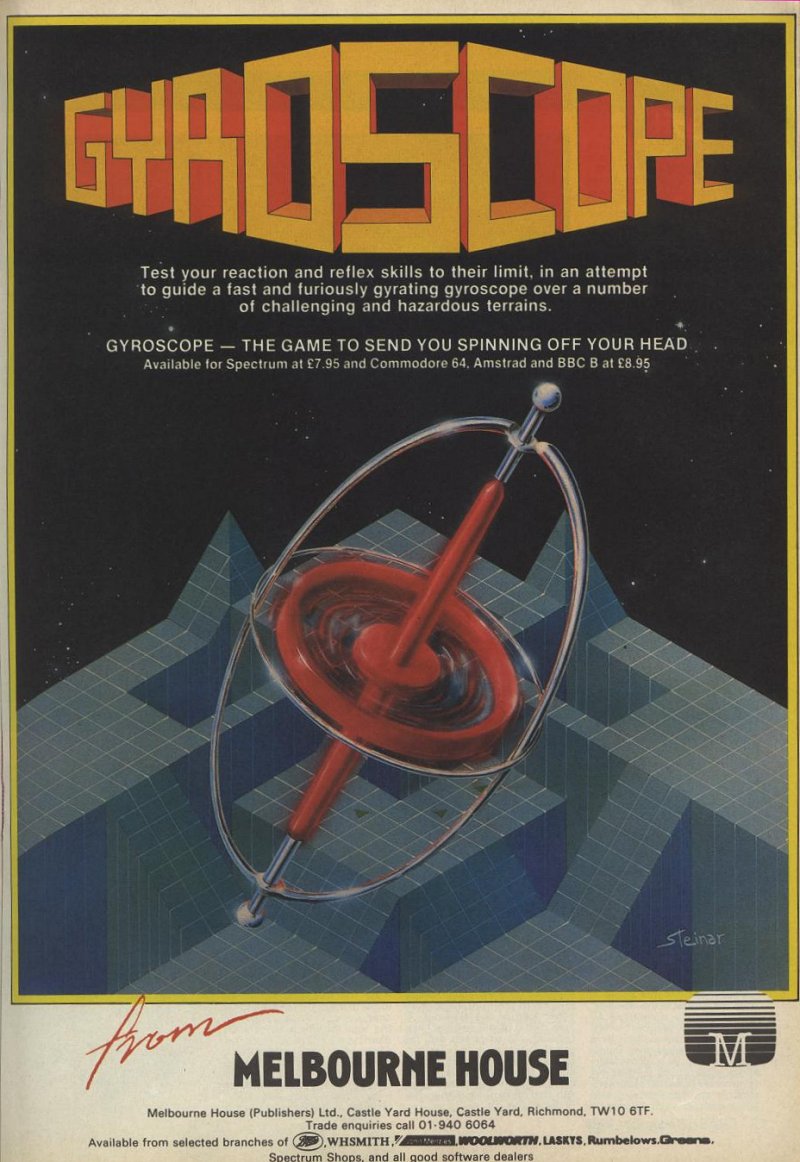
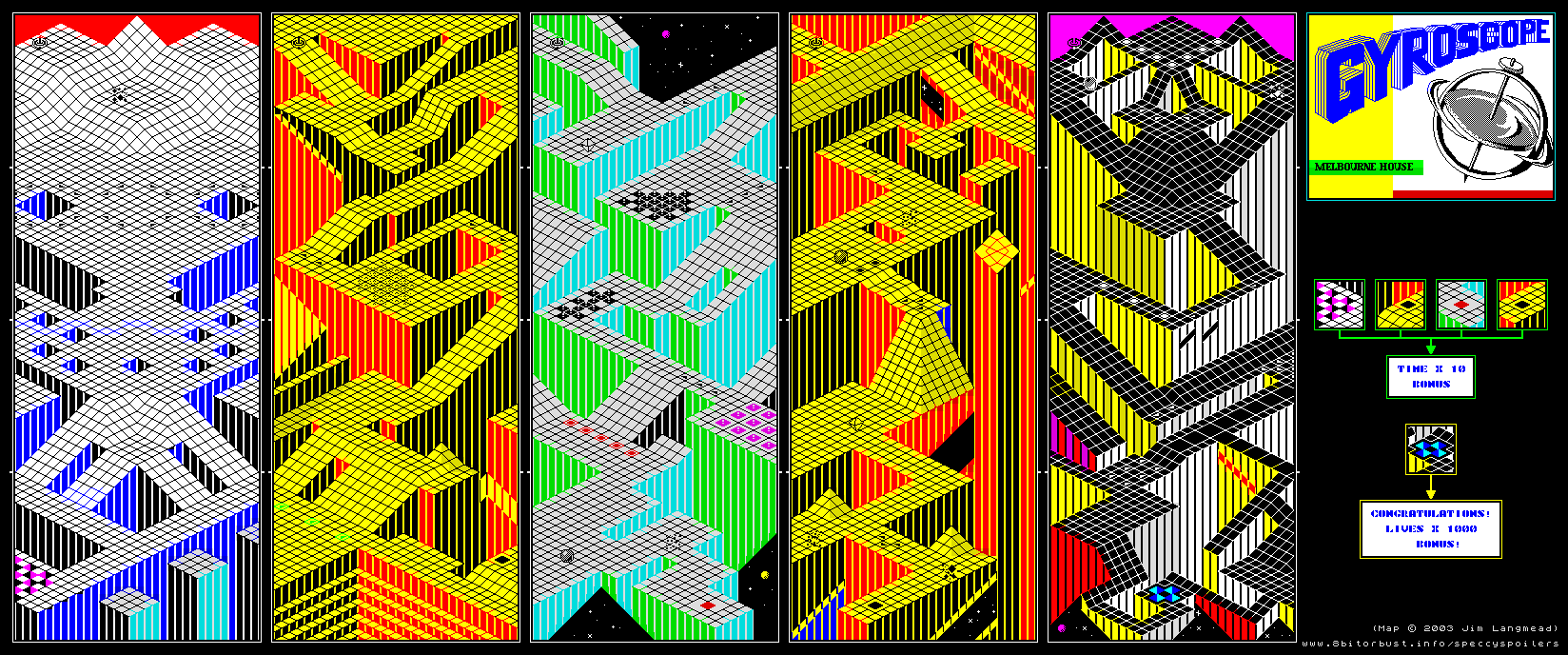
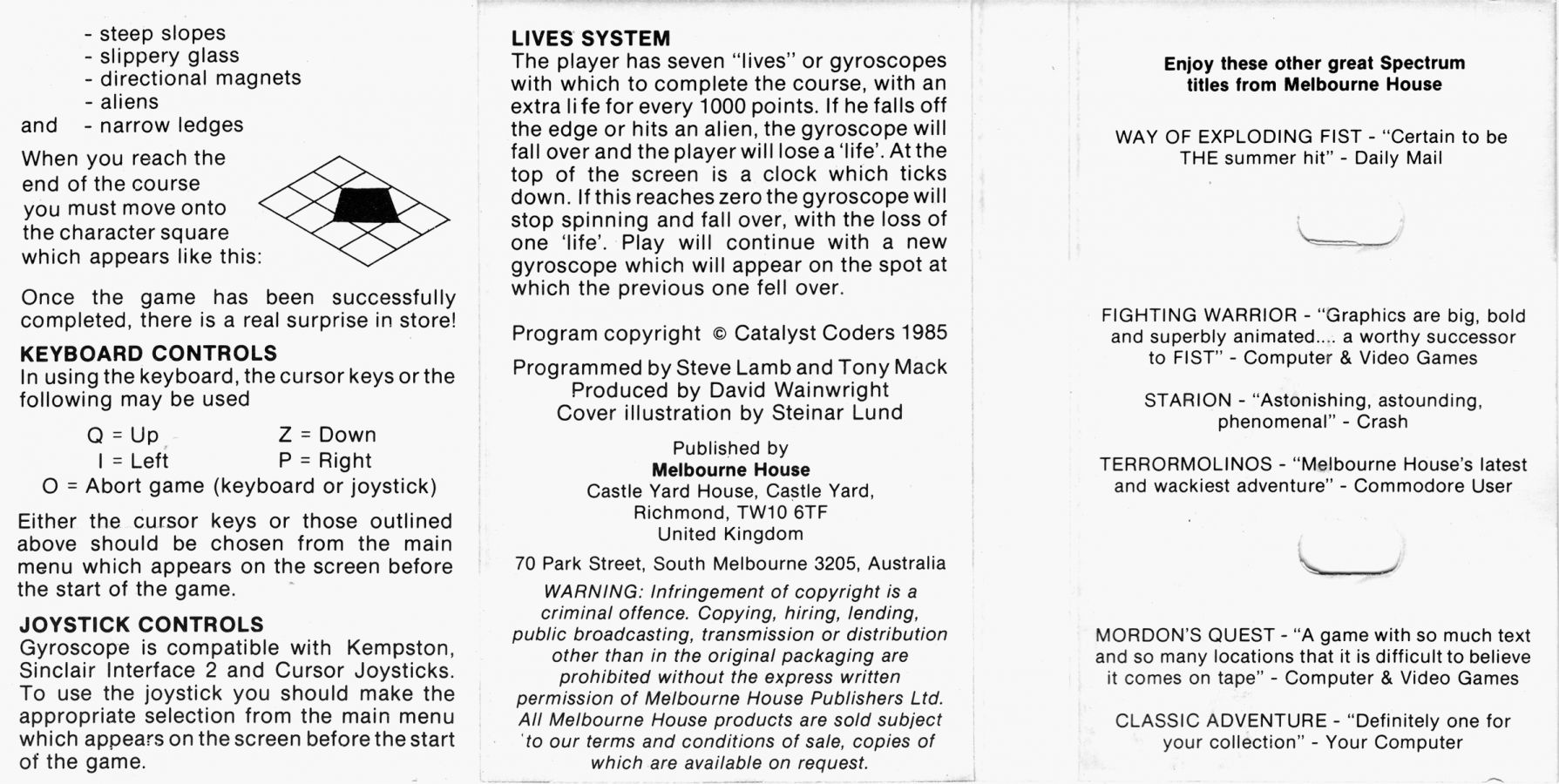
.jpg)
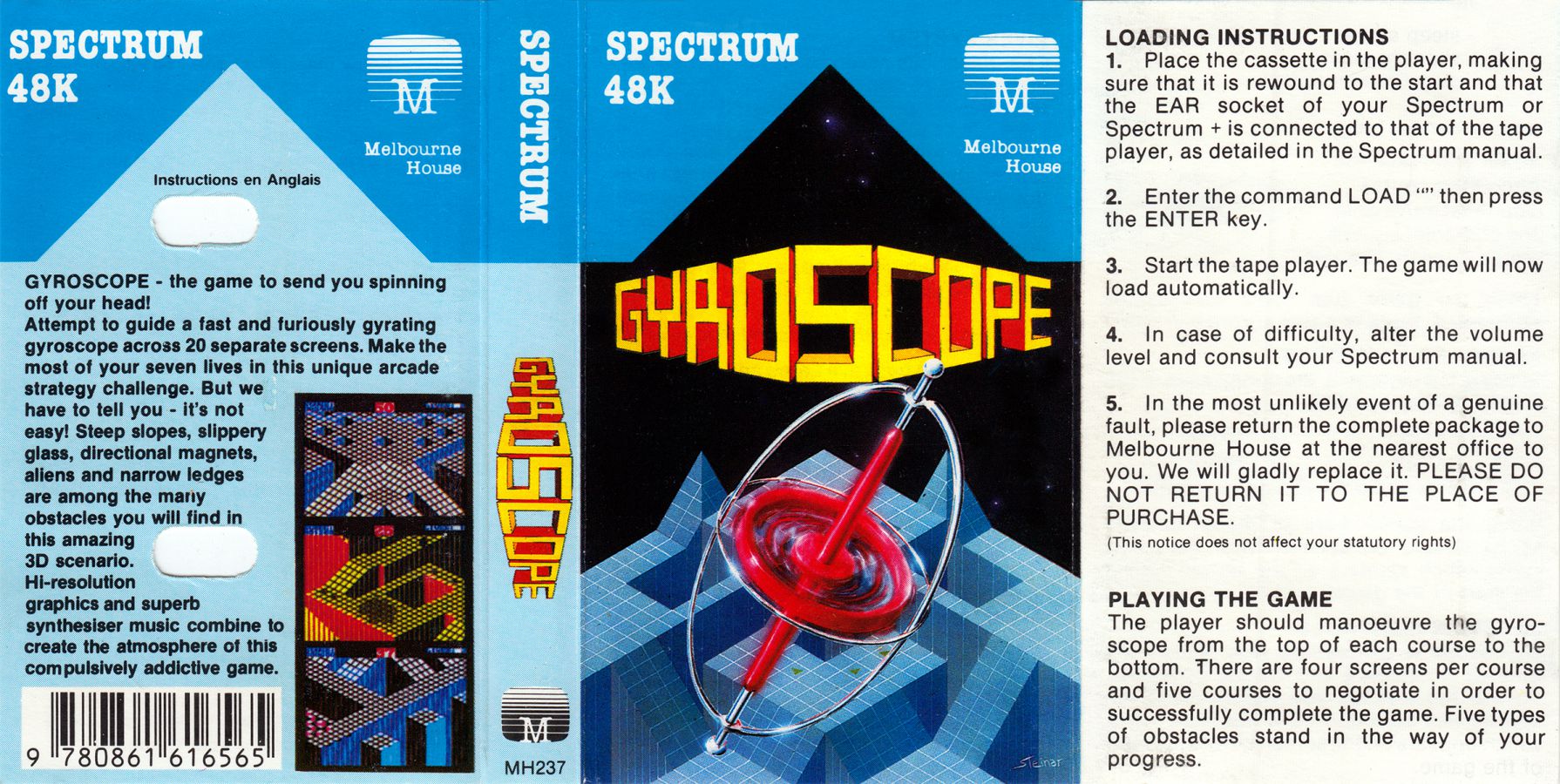
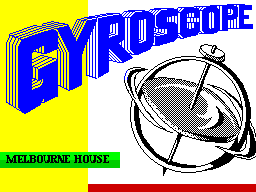
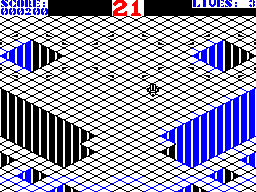
Discussion
Nobody has started a thread about this yet.
- Control Option
- Cursor, Interface 2 (right), Kempston Joystick
Releases
- 1985Melbourne HousePound sterling 7.95
- 1985Erbe Software S.A.
Play
- gyroscope.rzxRZX playback file
- Gyroscope.tzx.zipTape image English15 KB
- Gyroscope.tap.zipTape image English19 KB
- Gyroscope(ErbeSoftwareS.A.).tzx.zipTape image English16 KB
Documents
- Gyroscope.txtInstructions English2 KB
- Gyroscope(ErbeSoftwareS.A.).pdfInstructions Spanish21 KB
Music
- Gyroscope.ay.zipRipped in-game/theme music in AY format 2 KB
Other files
- Gyroscope (1985)(Melbourne House).pokPOK pokes file 1 KB
Files and rights
No permission is on record either way. Screens and pictures are copied here on a take-down basis: if you hold the rights and want something removed, say so and it goes.
Credits
- Steve Lambcredited
- Tony Mackcredited
- Dave Dewcredited
- Mark AlexanderMusic
- Steinar LundInlay/Poster Art
Sign in to credit somebody, or say what these people did.
Awards
Scores
In the magazines
- Sinclair User #451985 · Overall5/5
- Crash #231985 · Overall92%
- Your Sinclair #11986 · Overall8/10
- ZX Computing #231986 · Overall6/6
Elsewhere on the web
- WorldOfSpectrum 60 votes8.00
Awards and competitions
Computer Gamer's Game of the Year Awards 1985
- 2Best Arcade Game
Crash Readers Awards 1985
- 2Best Music
In the magazines 32
ZX Computing #23Feb 1986 · p.415/55/56/6
Graphics 5/5
Addictiveness 5/5
Overall 6/6
Melbourne House £7.95 I remember owning one of these devices, you spun the wheel inside the frame and as long as it whirled fast enough or didn't hit anything, it would balance upright on virtually anything, a piece of string, a pencil point, or follow a ramp of books. Why I mention this is because Melbourne House has created a program in which the movement of their gyroscope is incredibly accurate when compared to the real thing! With some similarities to Marble Madness, now a hit in the arcades, you have to steer this awkward object down five maze-like ramps, each extending over four screens. These are beautifully created in solid 3D perspective and have walls and pits to crash into. As if that is not hard enough, there are steep slopes, slippery glass patches, directional magnets, aliens and narrow ledges to contend with. Oh, and you are racing against the clock, but at least you get seven lives with extra ones for every 1000 points. I played this game for far longer than I could really spare for the review and found gentle nudging of the joystick (or keys) game me the most control. Another tip - don't let the gyroscope build up too much speed. I completed the first screen after a few plays but only completed the second screen once, and after many attempts a tearing of the hair program. A mention here of the sound. I am sure they must have used their WHAM program because it is program because it is without doubt one of the most impressive bits of music I have heard so music I have heard so far. Brilliant. One of the state of the art programs awarded our rare six star award.
Your Sinclair #1Jan 1986 · p.389/106/107/109/108/108/10
Graphics 9/10
Playability 6/10
Value For Money 7/10
Addictiveness 9/10
Overall 8/10
Alison Hjul 8/10
Melbourne House £8.95 Reviewer: Alison Hjul If you get your kicks from those fairground rides that have you reaching for the nearest brown paper bag, then Melbourne House has got a treat for you. Cos, with Gyroscope, those nauseous thrills have been transported to your Speccy. It all sounds very easy - guide a giddy gyrating gyroscope across 20 screens - just five courses of four screens. But don't be fooled! The gyro's got a will of its own and you'll need to be quick witted if you're to stop it falling off an edge or hitting an alien, while manoeuvring steep slopes, slippery glass or directional magnets. Gulp! Pass that paper bag... In fact, I really thought I had it cracked after belting through the first course, but it's all downhill - literally! - after that. Shame you can't pick a course at random to get a bit of practice on those stickier screens. Melbourne House says a surprise awaits at the end of the game - getting to the end of the game would be surprise enough for me! Gyroscope, with its stunning 3D graphics will have you hooked - especially if you're a devotee of Marbles Madness, its arcade twin. But remember to keep a bottle of aspirin by your side...
Sinclair User #45Dec 1985 · p.205/55/5
Overall 5/5
Chris Bourne 5/5
Publisher: Melbourne House Price: £7.95 Memory: 48K Joystick: Kempston, Cursor Those irrepressible Aussies at Melbourne House seem full of arcade games this Christmas, and are just about to release another, in Gyroscope. Somewhat less violent that the last two gladiatorial offerings, it casts you as a gyroscope, that small spinning toy which appears to defy the laws of gravity. You must guide the gyroscope down five four-screen courses of increasing difficulty, avoiding the cliff edges, walls, and various hazards which are set in your path. Amusement arcade fanatics may recognise it as a version of the successful Atari game, Marble Madness, but Melbourne House says there's no connection between the two, and Gyroscope is not based on it. Weird - but never mind, it's a remarkably addictive game of great difficulty. The graphics are really impressive - a 3D landscape of gridded ramps and cliffs along which the gyroscope teeters, speeding up as it goes down hill, running out of steam when climbing. The secret is to build up just the right speed and angle of movement across each part of the course, so as to move smoothly into the next screen without wasting time. But if you go too fast, you'll fall over the edges - and some of the corners must be negotiated with single-pixel precision to stay spinning. As you progress, the paths become more treacherous. Directional magnets draw you unwillingly towards disasters, while certain sections of track are coated with glass to disrupt your movement. Then there are patches of what Melbourne House claims to be aliens - they chatter at you and bounce you around until, inevitably, it's over the edge again. There's a time limit of 60 seconds on each spin, so even if you stay out of trouble you have to shift to make it in time. We managed the first run reasonably easily after a bit of practice, but the second is much nastier and the third - well, hair-raising isn't the word. Luckily, if you lose a life, you remain on that screen, instead of going back to the beginning of the run, so it is possible to achieve some success even if you use up all your lives to do it. Melbourne House should have another winner on its hands. It seems a pity that only 20 screens could be fitted into the game - but they're a pretty dazzling 20. Whether or not the game is as original as Melbourne House seems to think, we've never seen anything quite like it on the Spectrum. Buy it and go bananas.
Crash #23Dec 1985 · p.40Crash Smash93%94%92%89%92%93%92%
Use of Computer 93%
Graphics 94%
Playability 92%
Getting Started 89%
Addictive Qualities 92%
Value For Money 93%
Overall 92%
Unknown
Unknown
Unknown
Producer: Melbourne House Retail Price: £7.95 Language: Machine code Author: Steve Lamb and Tony Mack Gyroscope puts you in a similar surrealistic situation to the arcade classic Marble Madness. The basic gameplay is very simple - you take control of a gyroscope with the task of getting from the starting post at the top of the course to the finishing post at the bottom within the allotted time. Each time the gyroscope topples, a life is lost. The course is very strange, presented with a surrealistic 3D effect featuring tall geometric buildings, ramps and steep slopes along and around which you have to guide your gyroscope. The course also provides a home for some rather strange (and vaguely familiar) aliens whose touch topples your spinner. There are five courses in the run, each containing four screens. When you complete one screen the display turns purple and the next part of the course scrolls into view, replacing the section you've just traversed. The whole game is played against a clock, which ticks off the time relentlessly as you try to complete each quartet of screens. Completing each screen earns you bonus points, and completing a course of four screens earns you a bonus related to the amount of time remaining on the clock. You begin the game with seven lives in store, and pick up a bonus life for each 1,000 points scored. If you fail to complete a screen course within the time limit, the gyroscope topples when the count hits zero, a life is lost and you resume play from the spot you'd reached at timeout with the clock reset to start a new run. If things are going badly, you can press fire at any time and restart the game from scratch. There are some very thin catwalks between the buildings and here the main danger lies. If you stray too near the edge of a construction or catwalk your gyro will become unbalanced and totter over - another life gone. When this happens your gyro is put back to the top of the screen on which you died, and thus time is lost as well as a life. Taking control of a gyroscope takes some getting used to - once you start moving in one direction it takes a while to slow down. The beast will accelerate down slopes, and constant checks have to be made when you trundle down a slope to make sure you're not going too fast - if there's a sharp turn at the bottom you could find yourself in deep trouble, and run out of road. Inanimate hazards on the course complicate matters further, and include glass slopes (which send you spinning in all directions), knobbly floors (which makes control of your gyro next to impossible), red discs (which send you completely out of control) and directional floors (which act like slopes only they're flat). The landscapes are very deviously created; starting from relatively easy the y get more tricky very rapidly. Some of the difficult courses contain thin catwalks, horrendous slopes with tight corners, holes in the floor and combinations of all these with the aforementioned hazards - being a gyroscope isn't all just spinning around. COMMENTS Control keys: Q up, Z down, I left, P Right, O to abort Joystick: Kempston, Cursor, Interface 2 Keyboard play: responsive Use of colour: neatly done, minimising attribute problems Graphics: simple design which is remarkably effective Sound: excellent, two channel simulation Skill levels: progressively more difficult Screens: twenty
GYROSCOPE from Melbourne House - pilot your spinner across a three dimensional landscape trying to avoid spills.
C&VG (Computer & Video Games) #50Dec 1985 · p.23C+VG Blitz Game8/109/107/107/10
C&VG (Computer & Video Games)C+VG Blitz Game
Graphics 8/10
Sound 9/10
Value 7/10
Playability 7/10
MACHINE: Spectrum SUPPLIER: Melbourne House PRICE: £7.95 Well, here's something different. Gyroscope is like nothing you've ever seen before. Except maybe Marble Madness, the mega-arcade game. So what's the idea? Well, basically you have to guide a gyroscope - a spinning top type thing - down five different courses, avoiding aliens, magnets and negotiating narrow ledges and staying away from deadly pits. The courses are set in a futuristic 3D grid style landscapes with weird folds and steep slopes. You must manoeuvre your gyro around the hazards, down slopes and up hills to the end of each course using the keyboard or joystick. It's a difficult little machine to control. You have five gyros to play with - and you'll need every last one of them. Gyroscope is definitely different - but difficult to get into. But DO give it a chance. It's worth getting hold of to stave off Marble Madness withdrawal symptoms while we wait for that game to be converted for home computers. Be prepared to spend some learning the game and the control system though... Oh yes, there's some really nice synthesised music to go with the game. Give it a go.
Hack/Poke11
- Crash #59Dec 1988 · p.45
- YS Smash TipsAug 1988 · p.22
- C&VG (Computer & Video Games) #57Jul 1986 · p.92
- Your Sinclair #4Apr 1986 · p.32
- Crash #26Mar 1986 · p.112
- Your Sinclair #3Mar 1986 · p.54
- Your Sinclair #2Feb 1986 · p.77
- Sinclair User #47Feb 1986 · p.26
- Popular Computing Weekly #5Jan 1986 · p.26
- Crash #24Jan 1986 · p.104
- Popular Computing Weekly #2Jan 1986 · p.27
Tips4
- Your Sinclair #3Mar 1986 · p.66
- C&VG (Computer & Video Games) #53Mar 1986 · p.36
- MicroHobby #66Feb 1986 · p.30
- C&VG (Computer & Video Games) #52Feb 1986 · p.45
Review4
- Computer Gamer #11Feb 1986 · p.18
- MicroHobby #55Dec 1985 · p.12
- Computer Gamer #9Dec 1985 · p.63
- Popular Computing Weekly #46Nov 1985 · p.48
Full-page ad3
- C&VG (Computer & Video Games) #51Jan 1986 · p.112
- C&VG (Computer & Video Games) #50Dec 1985 · p.123
- Crash #23Dec 1985 · p.85
Feature2
- Your Sinclair #9Sep 1986 · p.19
- Popular Computing Weekly #51Dec 1985 · p.11
Information1
- SSD-IISep 1999
CompoResult1
- C&VG (Computer & Video Games) #55May 1986 · p.46
CompoEntry1
- C&VG (Computer & Video Games) #52Feb 1986 · p.37
Licensed from
- Marble MadnessArcade coin-opunofficialAtari Games Ltd
Related
- Compilations
- Load 'n' Run issue 58
- Ports
- (Amstrad CPC), (BBC Micro), (Commodore 64), (Acorn)
- Elsewhere
- Speccy Screenshot MapsWikipediaFRGCBSpectrum +2A/+3 IncompatibilityCentre for Computing HistoryMobyGamesRZX ArchiveThe TipshopUVLThe Spectrum Show - YoutubeFRGCB TVModern ZX-Retro GamingRZX Archive - YouTubeSpectrum Computing RZX - YouTube
- Same entry at
- Spectrum ComputingZXInfo
Reviews from people here
Sign in to write about this, or make an account. It takes a minute and lets you correct the catalogue too.
No description recorded.
Sign in to correct or add to this.
Hold the rights to this and want it taken down?