
Apocalypse
Strategy Game: War · ZX-Spectrum 48K · 4 players · English
Red Shift Ltd · 1983 · Pound sterling 9.95
Also known as Apocalypse: The Game of Nuclear Devastation (English)
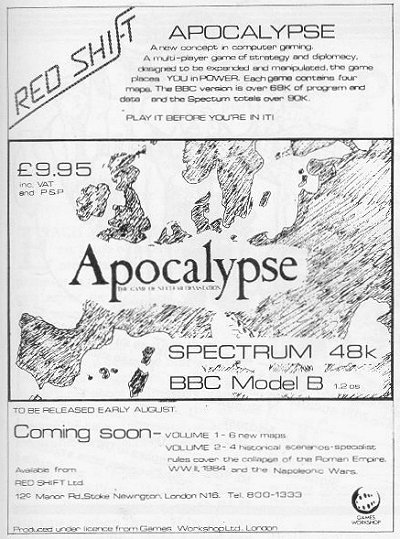
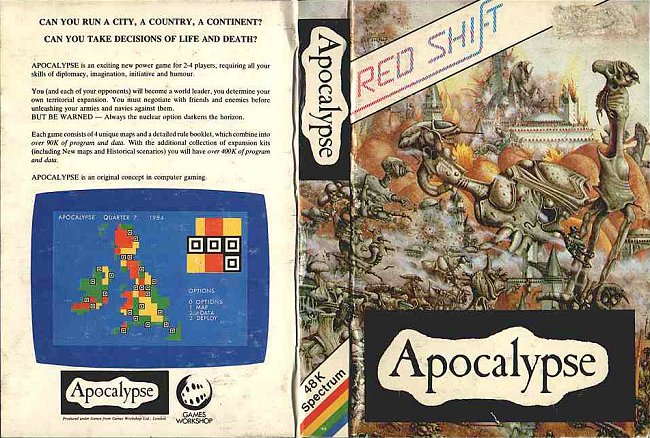
_Front.jpg)
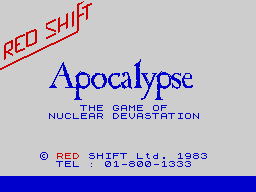
_SideA.jpg)
_SideB.jpg)
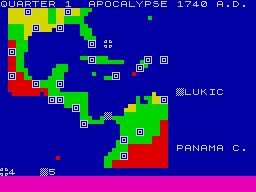
Discussion
Nobody has started a thread about this yet.
Releases
- 1983Red Shift Ltd Sold as Apocalypse: The Game of Nuclear DevastationPound sterling 9.95
- 1987Command Software
Play
- Apocalypse.tzx.zipTape image English24 KB
- Apocalypse.tap.zipTape image English22 KB
- Apocalypse(CommandSoftware).tzx.zipTape image English18 KB
- Apocalypse(alternate-Side1).tzx.zipTape image 17 KB
- Apocalypse(alternate-Side2).tzx.zipTape image 7 KB
Documents
- Apocalypse.zipInstructions English20 KB
- Apocalypse(EN).pdfInstructions English472 KB
- Apocalypse(CommandSoftware)(EN).pdfInstructions English898 KB
Files and rights
No permission is on record either way. Screens and pictures are copied here on a take-down basis: if you hold the rights and want something removed, say so and it goes.
Credits
- Mike HayesGame Design/Concept
- Dino [UK]Code
- Joeycredited
Sign in to credit somebody, or say what these people did.
Scores
In the magazines
- Sinclair User #631987 · Overall4/5
- Your Sinclair #231987 · Overall6/10
Elsewhere on the web
- WorldOfSpectrum 6 votes6.50
In the magazines 55
Your Sinclair #23Nov 1987 · p.945/106/106/105/106/106/106/106/10
Graphics 5/10
Playability 6/10
Value For Money 6/10
Addictiveness 5/10
Strategy 6/10
Overall 6/10
Audrey Bishop 6/10
Owen Bishop 6/10
Command £9.95 Reviewer: Owen Bishop, Audrey Bishop Essentially a classical strategy game for two to four players (no computer-opponent). The map displays 24 strategic centres, divided between the players at the beginning. Your aim is to exapnd your empire by occupying the centres held by your opponent(s), while holding your centres against all-comers. Your revenue is derived from the centres and other areas you occupy and used to deploy army, navy or nuclear weapons. Spend you revenue wisely and deploy your forces where they will be the most effective. The more you expand your empire, the more revenue you obtain. Victory conditions are not built into the program. Suggestions are given in the manual and the players agree beforehand on how the winner is to be decided. There are four scenarios, based on maps of Europe, Britain, London and the Caribbean, respectively. These present minor variations (naval strategy dominates the Caribbean scenario, for example) but, whether your are trying to capture Berlin, Battersea or Belize, the strategy is much the same. The London scenario seems intended for light-hearted play - nuking Paddington Station from a silo in Trafalgar Square is a little unrealistic, to put it mildly! in fact, in spite of the game's title, the nuclear aspect does not add anything to it. The effects of nuking are not as devastating as they would be in real life. It just provides a gambling slant in an otherwise sober game. Fortunately, players can agree to ignore nuclear weaponry altogether and concentrate on the basic strategic elements. The manual is detailed and clear, but it makes the game sound much faster and more exciting that it really is. This is a game for the pensive player who is happy to sit for a half-hour or more making a move. The manual helpfully suggest that you set yourself up with a supply of tasty provisions before beginning to play. Meanwhile, the other players will be scoffing all the dainties! The movement system is slow and cumbersome which further reduces the pace. Control is menu-driven and easy to understand; if in doubt press '0' and you are returned to the main menu. Unfortunately, the frequently used '0' key is next to BREAK, so a keying inaccuracy puts you back into BASIC. The maps are simple but adequate. Noises off are irritating - especially if you really are trying to think. Combat resolution appears to be based almost entirely on chance with a bit of bluff (poker players will like it, tacticians will hate it). Summing up, serious strategy with frills of the wrong sort.
Crash #43Aug 1987 · p.51
Philippa Irving
FRONTLINE With Philippa Irving MURDER? SHE ASKED A perennial question of wargaming is whether its morally justifiable to make a game out of the mass destruction of human life. We first have to ask whether there can be an absolute objection - 'war games are wrong, judged by an external standard' - or whether it's a matter of individual feelings. Curiously, it's easier to ignore the moral question altogether if we accept that wargames could be absolutely wrong. All wargames, from Ancient Rome to nuclear war, would be equally wrong because they make a game out of people killing each other. One could then choose to say that if all wargames are equally bad, modern settings are no more offensive than games which depict ancient wars. But people are generally reluctant to admit the logic of this, in their hearts anyway. The conspicuous thing about most historical wargames is that they don't take sides, or at least not within the game itself. Many offer a chance to play either side of the fence, and those which don't usually don't because of memory restrictions. Wargames which do take take a position are normally the ones which raise objections, and this is fair enough, particularly when the war in question still effects us. It wouldn't matter much if a game condoned the Romans in their war with the Carthaginians, but when American software houses produce propaganda about Vietnam it's time to feel uneasy. Politically slanted wargames represent one side as morally justified; unbiased wargames allow the player to make his own judgment. APOCALYPSE Producer: Infogrames Retail Price: £9.95 Apocalypse seems to have a worthy pedigree - according to the instruction manual, it first appeared in 1983 on the Red Shift label. It's quite difficult for me to give a fair judgement of this one, because it's a two-player game only. The full title is Apocalypse - The Game Of Nuclear Devestation, but the concept is more abstract than the specific settings suggest. The main program is a framework for four maps on different scales: Europe, the Caribbean, Britain and London. There are four scenarios of this kind, and the rulebook promises an expansion set with 'star systems' and 'Nether Earth'. But there's little variety in the gameplay. One the European map you can move across entire countries and capture capital cities, the British map scales things down and lets you fight for the privilege of owning Liverpool, and the London map gives you the chance to take over Wimbledon and Games Workshop! Essentially, the players form from two to four empires, which can be given their own names; each empire then attempts to bring the whole map under its control, whether that's all of Europe or just London. The empire centres - cities and important districts - are distributed equally among the empires at the start of the game. The player can choose his own, or let the computer allocate the randomly. Each location has a revenue value, and the total revenue value of each empire's territory represents how much the player can spend on divisions, warships and nukes each turn. The turn system is quite complex. The game gets under way with a deployment phase, where the players buy forces and position them around their empires. The phase which follows allows four subtly different methods of movement; irritatingly, forces can go one square at a time, and nuclear missiles, once deployed, can't be moved at all. Units are not represented in the traditional pictorial fashion. Instead, the empire which controls each location square leaves its own symbol in the square, and the forces deployed there are indicated in a businesslike way by numbers. This does nothing for atmosphere, but it stops the map getting cluttered. There are really two maps - an overview to move the cursor about, and a scrolling close-up in a small window where you can examine each location. This works well, though it looks dated. Combat occurs when one empire tries to occupy another's territory in the movement phase. This is only allowed if the attacker mobilises enough divisions, so kamikaze attacks aren't possible! There are different types of attack, and it seems the success of an attack depends largely on how much defence the opponent offers. The genocidal player can choose not to bother with this sort of thing and launch a nuke instead. Predictably, this causes widespread devastation, indiscriminately destroys forces in the locations surrounding the target, and permanently reduces the revenue value of the affected area. The instructions warn against nuking, but the advice isn't so sharply brought to life in Apocalypse as in, for instance, Theatre Europe. There's no instant over-retaliation from the computer, merely the possibility of annoying your human opponent. Apocalypse is an odd blend a realism and fantasy. For a start, you're required to choose your millennium. You pluck a date out of thin air - and of course it bears no resemblance to real history and makes no difference to the game. If you let the computer select empire centres for you, the result is an impossible intermingling of power bases which, despite the realistic maps, makes the game look abstract from the start. Apocalypse lacks atmosphere because of this conspicuous 'gamishness'. But Apocalypse has some meat. Though the scenarios are really only different maps, they add the imaginative scope which many games lack. And the very fact that Apocalypse has been designed for expansion is impressive, though the necessity of having at least two players limits its appeal. It looks slightly old-fashioned, but it's well enough programmed (don't press BREAK, though!). There's no point giving ratings to a computer game which doesn't function like other computer games, but I'd recommend Apocalypse as a good buy to those who are certain they'll have someone else to play it with.
Aggressive empire-building in Infograme's Apocalypse.
Sinclair User #63Jun 1987 · p.994/54/5
Overall 4/5
Gary Rook 4/5
Label: Command Author: Red Shift Price: £9.99 Memory: 48K/128K Reviewer: Gary Rook Apocalyse was originally (still is, in fact) a boardgame, published by Games Workshop. A couple of years back, a software house called Red Shift produced a computerised version and now Command Software (part of Infogrames) is reissuing it. In effect, Apocalypse is four games in one, or more accurately the same game with four different maps to play on. The different maps are Europe, the Caribbean, Great Britain and London. In each case, the objective is the same - to use the force of arms, represented by your land and naval forces and your nuclear strike force, to dominate the playing area. The game mechanics are the same in each scenario. The best way to describe the game, is to give a brief idea of how just one of the scenarios works - the European map is probably the simplest. Most of the screen is taken up with a large strategic map divided into squares, representing deserts, mountains, rural areas, the sea and cities. To the right of the strategic map is a smaller, tactical map showing the area immediately around the cursor. It lists the value of each region shown, and the troop strengths in each square At the beginning of the game, the players, however many there are taking part, divide up the cities on the board between them and build forces, either divisions, navies or nukes. Movement of units is simple - cursor over an area where you have troops, choose how many divisions or ships you want to move, then cursor to destination and hit Fire and combat occurs when you try to move into an enemy occupied square. The number of units you can move into a space depends on what sort of terrain it contains. You need more armies to attack cities, for example. There are two ways of deciding who wins a combat. In one, the attacker picks a number and the defender then tries to guess what that number is. The second combat method is the same, except the computer randomly chooses numbers for you. Apocalypse is now a couple of years old and looks it. Unlike many other wargames being produced now. It's ugly as hell. Squares are very, well, square looking. And the movement system can be very tiresome as it takes a very long time for orders to be input. Add to that the fact that you've got to have two to four players - no one player option - and it should be a dodo. But actually it isn't, mainly because you get so much for your dosh. But in addition to the cash value, the games are really more than playable, if you don't mind the length of time they take.
Personal Computer Games #9Aug 1984 · p.100
Stuart N Cooke
MICRO WARS Fancy yourself as a latter-day Napoleon, staging intergalactic time-travelling battles or controlling the Roman Empire? Stuart Cooke surveys the latest in war games. If you have bit blasted too many aliens for one day, or have got lost in that dratted maze in the new adventure you've bought and are about to see just how well your computer will fly through the window, why not give these 'normal' computer games a rest. Load in a strategy game and find Out just how well you would have run the Roman Empire. Take control of a group of soldiers or travel through lime and fight out battles in outer space or on planets you have never heard off. War games with scenarios similar to the above as well as many others can be found for nearly every micro. Some games will allow you to play against the computer. In others you have to play against a partner: why not have a go at killing your beloved brother, wife etc? In fact buying war games could lead to the end of family arguments as we know them. Whole families could be crowded around the television waiting to see who will win the War of the Roses and settle the latest family feud. Until very recently most of the computer-moderated war games were shipped over from the US. All of these, although of very good quality, tended to be of a very high price. A number of British manufacturers have now produced many excellent packages, all marketed at a price far lower than their American counterparts. This feature will concentrate on products from these companies. One British company who have really made an impact on the war gaming market are Lothlorien. Titles from this company are available fur nearly every machine: Commodores, BBCs, Dragons etc. Most of them seem to make a first appearance on the Spectrum and are converted onto the other machines at a later date. CONVENTIONAL WARRFARE Confrontation is possibly one of the most popular games from this Stockport-based company. This is a two player game of conventional 20th century warfare. One player controls the Blue forces and the other player the Red. One nice feature of this game is the option to play on a black and white TV set. If you wish to play in black and white, the pieces of the player on the left hand side of the screen are shown in inverse to make them distinguishable from those of his opponent. Each player takes control of a number of forces. The forces consist of mobile units made up of tanks, mechanised infantry and engineers. Each type of unit has its own particular use, for example it would be of very little use trying to destroy a plane with a paratrooper, but the flak guns can easily inflict damage on enemy aircraft. The playing area is very clear with rivers, mountains, cities, bridges and other useful landmarks displayed. Pieces on the board belonging to each player are only displayed when they are actually being moved, which means that if the players agree not to look at the TV while the enemy is moving you will not know which piece is what type of unit before it is adjacent. All pieces are represented by a little picture when they are being controlled. The number of squares they can be moved and their type are displayed at the bottom of the screen. One of the nicest and fairly original features this game offers is the option to design your own scenario. Once the program has loaded there is no map held in memory and you can load the one supplied by Lothlorien or design one of your own. Map design is very easy: the cursor keys are used to move a cursor around the playing area and the designer can place cities, rivers, mountains etc by pressing the appropriate key. Because the map can be designed by the user there are no set victory conditions. You can play until all forces have been destroyed for a set number of moves, until a particular point is captured; in fact the list of possibilities is almost endless. Since the finishing conditions are left to the players a game could last five minutes, five hours, or until you wish to end. Confrontation is an excellent game, available on a number of popular micros. Because the scenario is left up to the player it is an ideal program for both beginner and expert war gamer. ZAP THE YANKEES Johnny Reb is another popular game produced by Lothlorien. This game can be played against another player or the computer. On the Commodore 64 version you can even get the computer to take both sides. The game is set in the American Civil War and is a fairly small skirmish at a river crossing between the Union and Confederate forces. To win at this game you must capture the enemy's flag. though it is possible to set a limit upon the number of possible moves, the winner being the person (computer) who has scored the most hits against the enemy. Unfortunately, this game lacks some of the polish you find in Confrontation. Numbers surround the playing area making it easy to judge distances when moving but making the display very messy. The only symbols found on the map other than the various pieces controlled by each player are the river, marshland, forest and a bridge. None of these graphics is used very well and the video display seems to lack a great amount of interest. Each player is supplied with a number of playing pieces. These have differing movement and fighting capabilities, depending on what they represent. Artillery pieces are the only ones that can fire at the enemy from a distance. Unfortunately you can only shoot in eight directions and therefore have to be fairly close to, or in line with, the enemy or the shot disappears off the screen before you can hit him. It would have been nice to be able to select your target by moving a cursor around to point at the destination square. First impressions led me to believe that this was a very simple and boring game. After a few sessions at the keyboard, however, I found there was a lot more to it than you would expect. To start with, a lot of forward planning is required so you can line yourself up with the enemy to shoot at him face to face. Secondly, you must make sure that whenever you do move one of your pieces you are not placing your man in the firing line of the enemy's guns. Even though the graphics of this game are simple. and it is simple to understand, a lot of skill is required. It will take quite a while before you can totally master the game, if ever. This program is also a little slow - you get the impression that when the computer is playing one of the sides and you are waiting for it to use some of its artillery fire against your men you could have overrun the whole of its army and returned home to your farmstead. LEGIONS ON THE MARCH ASP Software is another firm which has begun to put a lot of strategy games on the market. Their latest release is The Fall of Rome, another game available for most popular micros. The outside cover for this game states that you are supplied with a Free Colour Map, so you open up the box expecting to find some painstakingly drawn map of the Roman Empire only to find that the printed instructions are larger than the map. Don't go fixing the free map to your bedroom wall, you'll only lose it and it comes in very handy when playing the game. The Fall of Rome bears a slight resemblance to the well worn Dictator type of game. Each game turn you have to enter the number of legions you wish to buy and maintain in each area of the Empire. Income varies from region to region and the presence of unfriendly tribes will reduce it. This games goes a step further than the normal buy or sell that you normally have to do in a Dictator game in that you are allowed to move your men around. During the movement phase you can move your forces into any neighbouring province. Once you have moved the computer will move the enemy tribes. By moving to an area controlled by the enemy you can fight against him. Even though the graphics are good and the responses to input faster than on some other games The Fall of Rome does not give you the feeling that you are actually in control. If you had a little more control of how each legion fought then you would have a better game. Instead you get the impression that you are having an exercise in entering numbers. HEAVY METAL Kriegspiel from Beyond Software runs on the Dragon 32 and is one of the few games around that exploits graphic facilities to the full. The scenario puts you in control of a heavy tank division. You have the option of your opponent either being another player or the computer. Whoever plays, the object of the game is to capture the other player's city HQ. All the action takes place on a high resolution map that scrolls around the screen, which means that the battlefield is actually much bigger than the small area you can see. Three different maps are supplied with the game, and it is very simple to choose the one you wish to use. Each player is put in control of 15 pieces. These consist of four heavy tanks, five light tanks and six infantry. It is possible to increase the number of playing pieces up to 25, after every round the player in control of the most friendly towns will gain extra men. It is possible to enter all of your moves by either the keyboard or by using a joystick. Use of a joystick makes all entries to the computer very quick and speeds up play considerably. Probably one of the most original aspects of this game is the way in which the weather affects play. It's realistic - and very annoying. You just think that you are about to make a surprise attack on an enemy when it begins to rain and you find all your powers of movement halved. If it snows, for example, your movement is halved and you have no transport. The instructions supplied with the game are very clear, therefore a beginner to war games should soon be playing. So that you can tell which area is which on the map a key is given on the instructions; remember it's a lot harder to move through a forest than through a desert. This is a very well-presented game and its clear, colourful graphics should appeal to everyone. If you are a Dragon owner then you should buy this game just so that you can see what your machine is really capable of. For those of us who don't own a Dragon, would Beyond please bring out versions for other machines. Probably one of the most popular war games that you can buy is Apocalypse from Games Workshop. Red Shift are producing the computer game version of Apocalypse under licence. WORLD WAR III If you are one of those unfortunate people who have never played Apocalypse then the subtitle given to the game should give you the whole story: The Game Of Nuclear Devastation. You are told, however, that use of nuclear weapons could cause a catastrophic chain reaction. Apocalypse allows between one and four players to take part, however, if only one player is involved he will have to take two sides, the computer will not play against you. Each player is given a certain amount of power points, the number he gets depending on how many centres he occupies and the type of land that his centre is on. There are three different maps provided with the game for your warfare to take place upon. These maps cover areas such as Britain, Europe and London. Red Shift have realised the potential of this game and are producing expansion cassettes containing more maps. Expansion maps cover areas such as US, Galactic, Napoleon's Campaigns and War in the Pacific. The BBC version does not yet have all the expansion packs available. The maps used in Apocalypse cover most of the screen and are very clear. The map shows all the occupied areas and under which player's control they are. When making moves it is possible to move a cursor around the screen and an exploded view of the cursor position is given, showing which forces are situated there. This is very easy to use but tends to be a little slow and it is easy to forget which forces you have where, it's a law playing area to try to find out every time. The only 'major' flaw in this game was found in the BBC version. The symbol of each of the players is positioned on any area he owns. Quite regularly the background colour was the same as the character's piece making it difficult to see exactly who was in control of the square. Apocalypse is a very involved game and it will take quite a time for a beginner to master play. The instructions are good and clear and give examples wherever possible. The fact that you can purchase extra maps should add to the length of time before this game is put on the shelf and forgotten about. 25TH CENTURY RAIDERS Rebelstar Raiders comes from the same stable as Apocalypse. This game takes place in the 25th century. You are given three different scenarios: Moonbase, Starligdale and the Final Assault. Two players are needed to play, each having control of between 20 to 30 characters. Every character in this game has his/its own name and weapon and characteristics. All inputs to the computer are very easy. To get information on a particular character all you need to do is place the cursor over the player in question and press the I key. If you wish to find out about the character's weapon you press the P key. Because each of the maps is different, the victory conditions differ although a specific object has to be destroyed or protected in each of them. This is a game that you need at least an hour to play, but it is worth it when you guide one of your men around a corner and blast three of your opponent's men into little pieces. Rebelstar Raiders is a challenging and very enjoyable game.
Crash #4May 1984 · p.68
Producer: Red Shift, 48K £5.95 'Apocalypse' is a game of nuclear devastation. It's a long two-sided load and a game for 1-4 players. It can take between four hours and four years to play and if you outgrow the scenario, Red Shift have others to add on. A large selection of maps allows the action to take place anywhere and at almost any period. You set up the empires, their centres, their armies and weaponry. This is a very flexible game of real war strategy which should keep the addict going for a long, long time. Very good value.
Micro Adventurer #7May 1984 · p.39
Tony Bridge
A GAME WITH AN UNLIMITED LIFE A wargame that promises entertainment for months is how Tony Bridge describes Apocalypse in the review below. The trouble with most strategic-tactical wargames, compared with arcade games, is that once the solution is found, the game is usually consigned to a deep drawer. It has lost any surprise. Red Shift have come up with a novel solution to this. Apocalypse is a game for 1-4 players - an interesting departure in itself, but solo players should be warned that solo play is, as they say, difficult. The game is produced in conjunction with Games Workshop. Available for the Spectrum 48K and BBC B what makes it particularly rewarding is that expansion kits are available which effectively give the game an unlimited life? The master program comes in a stout box, roughly the size of two cassettes, which in my opinion is the best method of packaging nowadays: neat, endurable, good-looking and manageable. It costs £9.95. In computer wargaming, as in board wargaming, bigger is often thought to be best, and Red Shift draw your attention to the fact that, with expansion modules, the whole outfit will give you over 400K of program and data. That should be enough for anybody. The main, skeleton program is loaded first (during which you may choose to see the ads), after which one of the four scenarios contained in the master pack is loaded. You may elect to start wars in Europe, Britain, London or the Caribbean (I would have thought the Middle East would be more appropriate here). The idea is that, although the maps may differ, the game mechanics remain the same from map to map. To start the game, players choose the millennium in which they wish to destroy the world: from 0AD (were nuclear weapons a problem then?) to 7999 AD. Then they decide on names for their empire, after which one of 10 symbols is given to each domain. Twenty-four empire centres are flashed on to the screen in quick succession, with each player attempting to grab one. If your reflexes are slow, you may find that you have got Tunis instead of Vienna. This carries on until all centres are occupied. I would have liked to have seen this come about as a result of strategy and territory-winning, rather than quickness of the hand. As it is, there seems to be little chance of coherent strategy at this stage. Then the game proper begins. Each player deploys his armies, expanding during the course of the game from his chosen centres. In one corner of the screen is a box which shows a magnified, nine-square view of the area with information on each unit at the present location, underneath a cursor which the player can move around a screen. Now old board wargamers (or old bored wargamers, or old BALD wargamers) are on familiar ground. The units look just like those little cardboard counters, with the strength of the unit displayed next to a little graphic symbol. The unit may be either navy, army or nuke. During the deployment phase, new units may be built, depending on the revenue at the location (urban areas generating more than desert areas, and so on; the presence of nuclear weapons drastically reduces that area's earning capability. After all, who wants to live and work at ground zero). After building and deployment comes moving and combat. All this is familiar ground - terrain affects movement, and the outcome of combat is decided by the players choosing one of several options. This is where the usual stumbling-block of multi-player computer games is met. At some point, everyone has to turn away while the current player makes his secret entry. Combat in Apocalypse is a sort of scissors-and-paper game, comprising a secret input by attacker and defender of one from a list of numbers, followed by the matching of the options selected. If the defender has chosen the same option as the attacker, then the defender wins. If he underestimates the attack, the attacker wins, but may suffer some casualties. However, if the defender overestimates then the attacker wins outright. The solo player may ask the computer to launch its own attack and defence systems, in which case, all you have to do is sit back and watch everything happen. This is all pretty much like any other board game, but Apocalypse, as you will have realised, has a nuke capability. At any time during his move, a player may decide to launch a pre-emptive nuclear strike (the manual, reassuringly, warns against the consequences) but doing so may well precipitate the final conflagration. COMPLEX RULES The manual is generally quite good though a little confusing in certain areas. It states that there are three basic sets of victory conditions then goes on to list just two. The first is the fast game, which consists of players fighting swift actions to occupy a certain number of (named) centres. No provision is made here for solo play. The second is the long game, which consists of an economic battle in which the players aim for a target revenue. The rules are fairly complex, and so should appeal to refugees from the game board. Play ability, too, is good, and benefits from the colourful graphics: the manipulation of the various modules is a little awkward, and you may find yourself loading and reloading the programs a tedious chore from cassette. However, Apocalypse and its attendant modules are extremely good value. The initial program will cost you, as mentioned, £9.95. There are, at the moment, three expansion modules available, each containing several new maps. These are £4.95 each, which is good value for the first volume since it contains USA, SE Asia, S Africa, the Arctic Circle, Star Systems, the Nether Earth, a great selection. But subsequent volumes seem a little mean, offering, as they do, just two maps each, these cover the Fall of Rome, Napoleon's campaigns, the War in the Pacific, as well as 1984. With others to follow, no-one can complain about Apocalypse wearing out. The maps are accessed by, first of all, loading the main program, and then the desired expansion kit. A sheet of instructions with the expansion kits gives victory conditions (which are different in each case) for each map and hints on how to play for the victory. The play mechanics, however, are the saute for all the maps. So, for instance, in the Galactic module, the player moves around a map of deep space, in which the empire centres are not earthly cities, like most of the others (with the exception of the Nether Earth scenario) but stars and planets. Learn the mechanics of the original tape, and the rest follows on. This is rather like the good old board games from Avalon Hill and SSI. Although the loading can be a little tricky, once play is started, everything is pretty straightforward. To take a detailed look at just one of the scenarios, Decline and Fall, we can see that this is all about the dread Goths and Sassanids, against the Romans. The map displays Europe in 286 AD, and the game is played through quarterly periods, and the play follows the same shape as that in the Master Module. There are certain details, however, in Decline and Fall, one being the emergence of disease. At the start of each quarter there is a random chance of plague occurring, and if this does indeed happen the effects will last for five periods. Up to three plague areas may be effected at any one time, and troops within these areas will also be adversely affected. Combat, too, is slightly different, in that Roman Legions, if stronger than 10 divisions, may regroup after a wrong defence by their commander, and re-attack. The other scenarios have their own victory conditions, and their own anomalies. INSTRUCTIONS Though the original, Master Module is lavishly packaged, with a good manual, the expansion kits come in ordinary cassette boxes, with a sheet of photocopied instructions - not very inspiring. All in all, however, what this adds up to is a game system which should keep anyone happy for many months. If you are fed up with saving the world from marauding alien hordes and want instead to start the final holocaust.
ZX Computing #12Apr 1984 · p.49
Greg Turnbull
READERS REVIEWS Tell us what you think about the software that's on the market. This feature provides space for you to air your views on any software, be it for the ZX80, ZX81 or ZX Spectrum. If you've had a good or bad experience of any of the commercial software packages available for your micro, why not write and tell us. Your reviews should contain your critical thoughts about the software and the relevant details concerning the availability of the package, the price etc. If you can provide any screen dumps to illustrate the review, so much the better. Any reviews published in this section of the magazine will be rewarded with the price of the tape you review. So, if you buy a cassette and send in a review that gets published, you'll get your software for free! APOCALYPSE Red Shift Greg Turnbull Apocalypse is the new strategic wargame program for 2-4 players from Red Shift. The program comes in a sturdy box with a full 16 page user manual. Tape side A loads the main program and the prompt to load one of the four available maps on side B (Europe, Great Britain, the Caribbean and London). Once the map is loaded you must select the play date from 0 to 7999 AD, the number of players' names (and symbols for the map display), then select the empire centres (of the 24 names offered). Each centre (and all squares) is worth between 0 and 9 revenue points, depending on the location (desert: low, centre: high). These points are the currency of the game. The screen shows the year and quarter currently being played, player number and decision information, main map plus symbols for each players' areas, the player's power points (sum total of all revenue points) and an exploded window of the current cursor position plus surrounding squares. At the start of each quarter the power points give each player a revenue which he can spend on troops, warships or nuclear missiles. There are four phases to each quarter: 1. Nukes phase where nukes can be be seen on the map and launched if required. (If this is done, the target square is destroyed and all 8 surrounding squares as well.) 2. Deployment phase where the player can build up armies or fleets on the squares he owns. 3. Movement phase where the player can move any army or fleet to occupy new territory (and so build up his total revenue points), or may attack another player's area. (Movement of each force is limited to a certain amount for each turn). If an attack is made, the Combat phase occurs where both players can choose a number (from 1 to 9) without letting each other see the value chosen. This then determines who wins the conflict (alternatively the computer can be left to make the decision). 4. End Turn phase where a player may challenge the next to concede. During the main deployment/movement phases of the game, the exploded window is used to observe the strengths of each square (this is scrolled at a rate of 1 or 3 squares, in any direction, by the use of cursor keys). Victory can be decided by the number of names of the centres captured, or the total number of revenue points built-up, or the destruction of the opponent's forces. The program is a complex wargame that can last from a few hours to a few days depending on how involved you get with it, as it is highly addictive. Luckily, a save game facility is included. It is also easy to break in and list the program with LIST 2, this is endorsed by Red Shift as they welcome any ideas on improvements to the program and will even supply a listing if you send an sae. If you get tired of playing on one map there are three others to choose from, although every game will of course be different - unlike arcade games. Each map demands different tactics: the Caribbean needs warships and control of the ports. Great Britain relies more on the troop movements. Also, the Nukes option does not have to be used in a game. If after many weeks of play you need other maps or you are getting too used to them, there are expansion tapes available. Volume 1 contains maps for USA, SE Asia, Africa, Arctic Circle, Star systems and Nether Earth. Volume 2 has historical scenarios such as the fall of Rome, Napoleon's campaigns, the Pacific War and 1984. Red Shift say that they will be altering the rules of play in these further expansions to add to the interest for seasoned players. Plus if you need any help there is a telephone number to ring for advice from Dr Strangelove! Overall, at £9.95, this is an excellent program which will give you many hours of enjoyment especially as the game is constantly expanding and looking for ways in which to be improved. As such, it is highly recommended but it must be noted that some of the recent tapes will not load due to poor tape duplication processes. If you get one of these tapes (as I did) then just telephone Red Shift and they will very quickly replace the tape. For further information on the cassettes reviewed in this article you can write to the following addresses: Silversoft Ltd, [redacted]. New Generation Software, [redacted]. Red Shift, [redacted]. Artic Computing, [redacted]. Automata UK Ltd, [redacted]. Abacus Programs, [redacted]. Bug Byte, [redacted]. Softek Software, [redacted]. PSS, [redacted].
Crash #2Mar 1984 · p.63
Producer: Red Shift, 48K, £5.95 'Apocalypse' is a game of nuclear devastation. It's a long two-sided load and a game for 1-4 players. It can take between four hours and four years to play and if you outgrow the scenario, Red Shift have others to add on. A large selection of maps allows the action to take place anywhere and at almost any period. You set up the empires, their centres, their armies and weaponry. This is a very flexible game of real war strategy which should keep the addict going for a long, long time. Very good value.
Your Spectrum #2Mar 1984 · p.58
Peter Shaw
Stephen Cathrall
Stewart McPherson
SPECTRUM SOFT Starting this issue Your Spectrum will be touring computer clubs up and down the country in an effort to find dedicated games enthusiasts who will give us their impressions, thoughts and feelings on the current selection of new releases. Little do they know it, but these unsuspecting souls will be contributing a large slice of our regular review section in the future. This month we visited the Stanwell Computer Club (which meets weekly at the Stanwell School, Short Lane, every Friday evening from 7-10pm). Five of the resident 'freaks' were enlisted to tell us (and you) what was good or bad about the programs we gave them to play around with. In some cases comment was justifiably harsh, and in others they could hardly contain their glee at coming across a really well thought-out game. The guinea-pig five whose comments appear below, are all members of the club, and they are (in alphabetical order): Corrie Brown, Stephen Cathrall, Ryan Davis, Stewart McPherson and Peter Shaw. Peter, by the way, is also Secretary of the Stanwell Club. Them we do thank. APOCALYPSE Red Shift £9.95 A strategic wargame, based upon an original board game under licence. The plot centres around four opponents attempting world domination.
Crash #1Feb 1984 · p.61
Producer: Red Shift, 48K, £5.95 'Apocalypse' is a game of nuclear devastation. It's a long two-sided load and a game for 1-4 players. It can take between four hours and four years to play and if you outgrow the scenario, Red Shift have others to add on. A large selection of maps allows the action to take place anywhere and at almost any period. You set up the empires, their centres, their armies and weaponry. This is a very flexible game of real war strategy which should keep the addict going for a long, long time. Very good value.
Advert26
- Games ComputingDec 1984 · p.27
- Micro Adventurer #10Aug 1984 · p.40
- Micro Adventurer #7May 1984 · p.26
- ZX Computing #12Apr 1984 · p.22
- Micro Adventurer #6Apr 1984 · p.26
- Personal Computer Games #5Apr 1984 · p.96
- Big K #1Apr 1984 · p.8
- Popular Computing Weekly #13Mar 1984 · p.44
- White Dwarf #51Mar 1984 · p.46
- Personal Computer News #53Mar 1984 · p.70
- Popular Computing Weekly #5Feb 1984 · p.24
- Sinclair User #21Dec 1983 · p.144
- Popular Computing Weekly #48Dec 1983 · p.52
- Popular Computing Weekly #42Oct 1983 · p.38
- Popular Computing Weekly #40Oct 1983 · p.31
- Popular Computing Weekly #41Oct 1983 · p.44
- Your Computer #9Sep 1983 · p.134
- Sinclair User #18Sep 1983 · p.121
- Popular Computing Weekly #39Sep 1983 · p.34
- Popular Computing Weekly #38Sep 1983 · p.21
- Popular Computing Weekly #37Sep 1983 · p.46
- Popular Computing Weekly #36Sep 1983 · p.34
- C&VG (Computer & Video Games) #23Sep 1983 · p.144
- Popular Computing Weekly #34Aug 1983 · p.44
- Popular Computing Weekly #33Aug 1983 · p.26
Full-page ad8
- Your Spectrum #3May 1984 · p.37
- C&VG (Computer & Video Games) #30Apr 1984 · p.6
- Games ComputingApr 1984 · p.21
- Personal Computer Games #4Mar 1984 · p.100
- Your Spectrum #2Mar 1984 · p.4
- Micro Adventurer #5Mar 1984 · p.6
- C&VG (Computer & Video Games) #29Mar 1984 · p.13
- Personal Computer Games #3Feb 1984 · p.104
News/Note4
- Your Sinclair #18Jun 1987 · p.104
- ZX Computing #38Jun 1987 · p.6
- C&VG (Computer & Video Games) #68Jun 1987 · p.12
- Popular Computing Weekly #48Nov 1986 · p.5
Feature4
- Crash #9Oct 1984 · p.76
- Micro Adventurer #9Jul 1984 · p.24
- Micro Adventurer #7May 1984 · p.39
- Computer Answers #15Apr 1984 · p.23
Review2
- White Dwarf #54Jun 1984 · p.18
- Popular Computing Weekly #37Sep 1983 · p.58
Letters1
- Crash #31Aug 1986 · p.51
Licensed from
- ApocalypseBoard/TabletopGames Workshop
Related
- Ports
- (BBC Micro)
- Tags
- Border Effects, Turn based
- Same entry at
- Spectrum ComputingZXInfo
Reviews from people here
Sign in to write about this, or make an account. It takes a minute and lets you correct the catalogue too.
No description recorded.
Sign in to correct or add to this.
Hold the rights to this and want it taken down?