
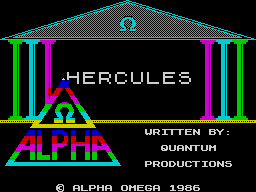
Hercules
Arcade Game: Platform · ZX-Spectrum 48K · 2 players · English
Alpha-Omega Software · 1986 · Pound sterling 1.99
_Back.jpg)
_Front.jpg)
_SideA.jpg)
_SideB.jpg)
Discussion
Nobody has started a thread about this yet.
Credits
Comes with a free audio track by H.E.X. Tim White is the author of The Power House edition inlay art.
- Control Option
- Cursor, Interface 2 (right), Kempston Joystick
Releases
- 1986Alpha-Omega SoftwarePound sterling 1.99
- UnknownThe Power House
Play
- hercules1.rzxRZX playback file
- Hercules.tzx.zipTape image English22 KB
- Hercules.tap.zipTape image English22 KB
Documents
- Hercules.txtInstructions English0 KB
Other files
- Hercules (1986)(Alpha-Omega Software).pokPOK pokes file 0 KB
Files and rights
Distribution permission is on record, granted to another archive rather than to this one. Screens and pictures are copied here; everything else links to the archive that holds it.
- AllowedAlpha-Omega Software → WorldOfSpectrum
- AllowedThe Power House → WorldOfSpectrum
Credits
- John A. Whitecredited
- Ayyaz Mahmoodcredited
- Phil GascoineInlay/Poster Art
- Tim WhiteInlay/Poster Art
Sign in to credit somebody, or say what these people did.
Awards
Scores
In the magazines
- Sinclair User #581987 · Overall2/5
- Your Sinclair #131987 · Overall3/10
- ZX Computing #331987 · OverallGood
Elsewhere on the web
- WorldOfSpectrum 18 votes4.44
In the magazines 5
Sinclair User #58Jan 1987 · p.512/52/5
Overall 2/5
Graham Taylor 2/5
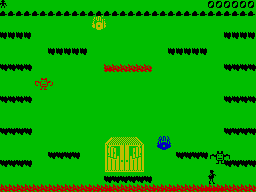
Label: Alpha Omega Author: In House Price: £1.99 Joystick: various Memory: 48K/128K Reviewer: Graham Taylor Hercules looks absolutely awful. It isn't. Quite. I wouldn't go as far as some other magazines and say that Hercules is a great game that just looks like a terrible one but certainly it has some unusual features. It looks like a platforms and ladders game, the plot is based on the twelve labours of Hercules as divided over fifty screens. For those who don't know about the twelve labours worry not, somehow they are all reduced to running and jumping around and dodging funny objects. But that's not all. What makes Hercules at little are than a runny jumpy game with terrible graphics is the overall structure of each screen. It isn't merely a matter of jumping this, dodging that, taking this route or whatever, you find that over time things happen - previously safe platforms turn into fire - other platforms look safe but turn to fire the moment you step on them, sometimes you don't even know where the platforms are... This adds a different dimension to the game and gets it a few brownie points (a star's worth I guess). I would still say that a) the graphics on Hercules are unspeakably bad b) some of the 'will it burst into flames? element' is simply unfair at least first time around - no amount of skill, dexterity or judgement will help you solve it and it's just luck. I wouldn't go so far as to recommend this one even at a budget price but if you are an addict of the platforms and ladders genre and fancy something a bit unusual this could be of interest.
Your Sinclair #13Jan 1987 · p.552/103/103/102/103/103/10
Graphics 2/10
Playability 3/10
Value For Money 3/10
Addictiveness 2/10
Overall 3/10
Peter Shaw 3/10
Alpha-Omega £1.99 Reviewer: Peter Shaw Just when you thought it was safe to return to the software stores Alpha Omega releases another gift from the gods - Hercules. Yes, if you ever wanted to dispel the fear that Hercules was a menacing and fearsome warrior then this little stick insect will do it faster than Icarus's wax melted. Taking on the title role, you have to perform the twelve 'mighty' labours of Hercules - not that many people can remember offhand what they all are. but still... This is all controlled by what's called RAP - Random Access Principle. Alpha Omega reckons this is the first game in the world to bring you this, and then goes on for the rest of the instructions chewing the cud about it. Well, okay, I don't want to get into any arguments over whether this is the first game to use the idea, but I know that it's definitely not worth mentioning, let alone making it the game's biggest feature! One thing that the YS team discovered was that if you stay on any platform for more than two seconds you die. As the instructions were so busy prattling on about RAP they forgot to mention anything about it, so we can only assume that the place must be on fire, or something, 'cos you're only safe if you're swinging on the ropes. Tarzan style. The labours you have to perform don't seem particularly clear either and since I couldn't do any of them, I gave up in frustration. I couldn't even content myself with ogling at the beautiful graphics - 'cos they aren't. Poor colours and flickery sprites - they were feeble to say the least. Hercules didn't hold any magic for me, or any of the YS team who saw it. Quite frankly he'd be better off back mending broken cart wheels, or fair maidens or something.
ZX Computing #33Jan 1987 · p.39ZX Computing GlobertGood
ZX ComputingZX Computing Globert
Overall Good
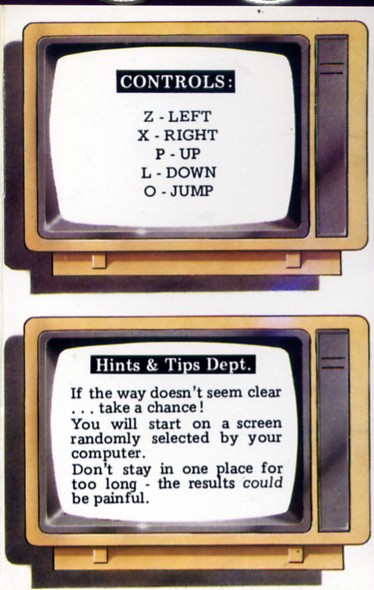
Alpha Omega £1.99 Occasionally, a game comes along that proves the point that you don't have to have great graphics for it to be addictive. I originally saw Hercules on the C64 and I thought that no-one could come up with a game that had worse graphics. Well the people who converted it to the Spectrum have managed! So what is it about Hercules that makes it addictive? Well, it is a platform game but with the added interest of problems to be solved as well as monsters to be leapt etc. You play the part of Hercules as you try to complete his twelve labours. Each labour is spread over several screens and the first eleven appear in a random order. Only if you succeed in completing all of them will you have the chance to have a crack at the twelfth. Your first problem on each screen is usually one of time. The platform you start on has the annoying habit of bursting into flames and frying you to a crisp if you stand around waiting for more than a couple of seconds. This forces you into action which is usually equally lethal. Ropes and platforms collapse under you plummeting you to a fiery grave. Frequently, the route to your objective - a large door - isn't obvious at all and you have to take a wild plunge into the unknown hoping that a platform will miraculously appear under you. You soon get used to ignoring the platforms originally on the screen as they tend to be red herrings. This leads a lot of people to claim that the game is too random but it only needs for you to complete a couple of the fifty plus screens to get the hang of what's going on and you are hooked. Presentation wise, the game is dreadful. The chosen keys are unplayable with no redefine option although you can use a joystick. When it says 'Press P to start', it actually means Caps shift and P and as already mentioned, the graphics are dreadful - the crudity of the C64 version with added garishness. But, for all that, I do keep going back and playing it again and again.
Power Plays carries this game and has 5 references of its own.
Hack/Poke1
- Your Sinclair #40Apr 1989 · p.35
Preview1
- MicroHobby #173Jul 1988 · p.15
Related
- Compilations
- Power Plays
- Ports
- (BBC Micro), (Commodore 64), (Commodore Plus/4), (Acorn)
- Elsewhere
- WikipediaCentre for Computing HistoryMobyGamesRZX ArchiveThe TipshopModern ZX-Retro GamingRZX Archive - YouTubeSpectrum Computing RZX - YouTube
- Same entry at
- Spectrum ComputingZXInfo
Reviews from people here
Sign in to write about this, or make an account. It takes a minute and lets you correct the catalogue too.
Everything ZXDB can hold about this is here.
Sign in to correct or add to this.
Hold the rights to this and want it taken down?