
High Frontier
Strategy Game: War · ZX-Spectrum 48K · 1 players · English
Activision Inc · 1987 · Pound sterling 9.99
Discussion
Nobody has started a thread about this yet.
Releases
- 1987Activision IncPound sterling 9.99
- 1987Proein Soft Line
Play
- HighFrontier.tzx.zipwithheld by rights holder
Documents
- HighFrontier.txtInstructions English49 KB
- HighFrontier(EN).pdfInstructions English4,523 KB
Other files
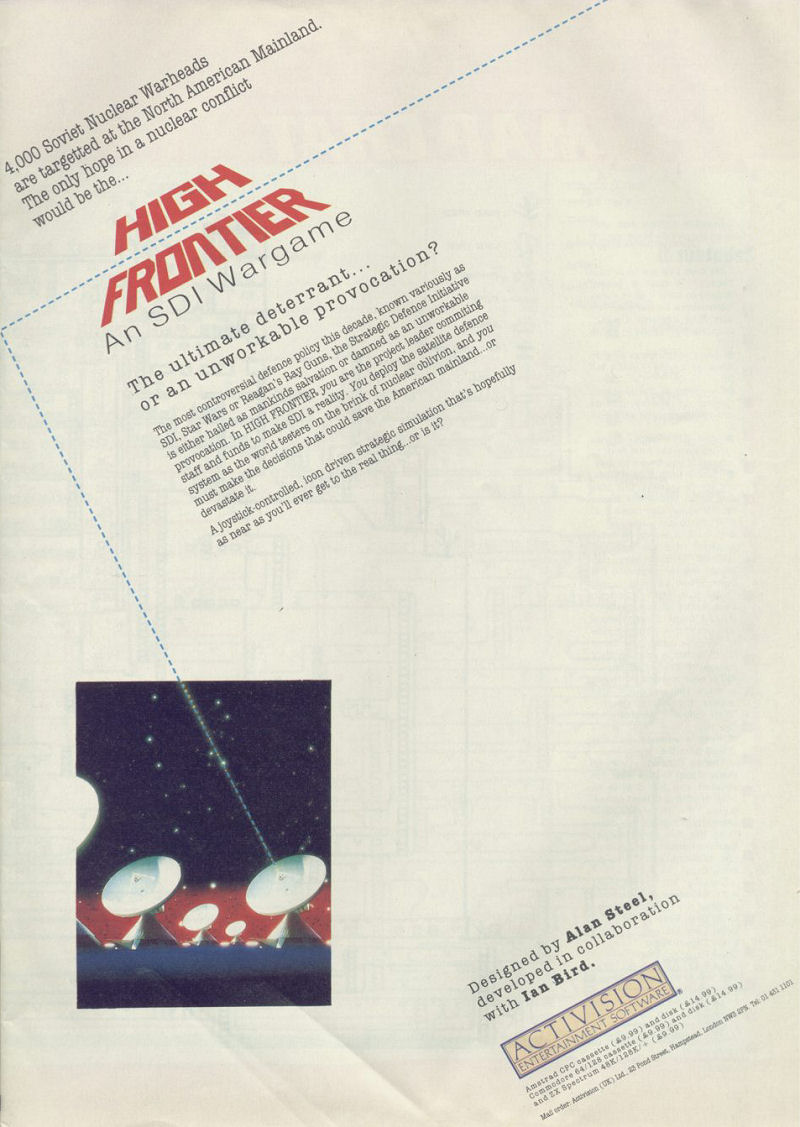
- HighFrontier.jpgAdvertisement 128 KB
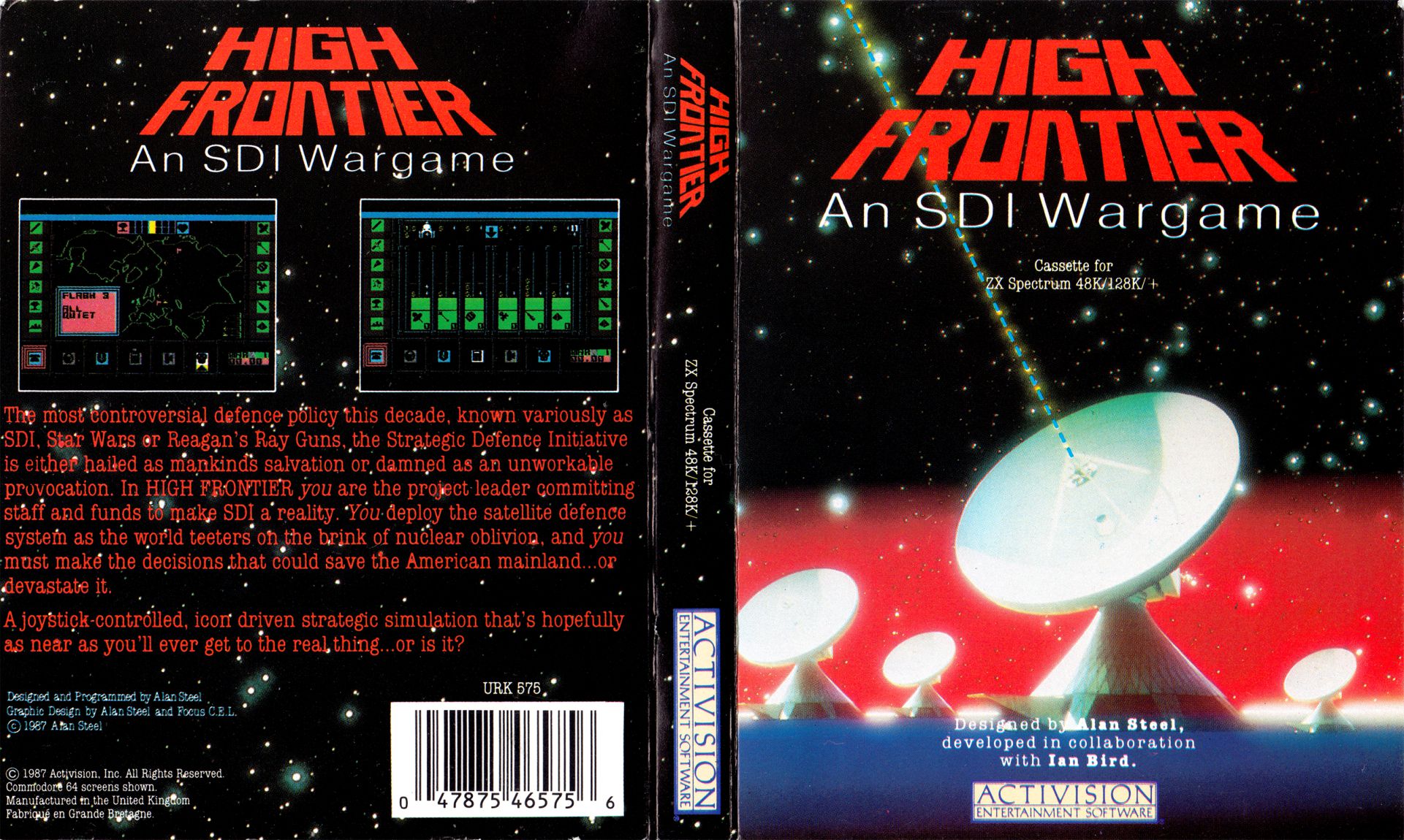
- HighFrontier(ProeinSoftLine).jpgInlay - Front 37 KB
- HighFrontier.jpgInlay - Front 462 KB
- HighFrontier.scrLoading screen 7 KB
- HighFrontier_SideA.jpgMedia scan 142 KB
- HighFrontier_SideB.jpgMedia scan 143 KB
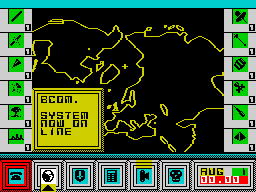
- HighFrontier.gifRunning screen 4 KB
.jpg)
Files and rights
The rights holder has refused distribution. Files are listed because their existence is a catalogue fact, and none are served from here.
- DeniedActivision Inc → WorldOfSpectrum
Credits
- Alan Steelcredited
- Ed Hickmancredited
- Ian Birdcredited
- Focus Creative Enterprises Ltdcredited
Sign in to credit somebody, or say what these people did.
Scores
In the magazines
- Sinclair User #681987 · Overall8/10
- Your Sinclair #261988 · Overall7/10
- Crash #481988 · Overall71%
Elsewhere on the web
- WorldOfSpectrum 2 votes7.50
In the magazines 12
Your Sinclair #26Feb 1988 · p.628/107/107/105/107/107/107/107/10
Graphics 8/10
Playability 7/10
Value For Money 7/10
Addictiveness 5/10
Strategy 7/10
Overall 7/10
Audrey Bishop 7/10
Owen Bishop 7/10
Activision £9.99 Reviewer: Owen Bishop, Audrey Bishop SDI (Ronnie's Star Wars) is a controversial topic, and Activision is out to make a few dollars from the debate. High Frontier is a strategic wargame in which you build your own (or rather Uncle Sam's) SDI system from scratch. Before you start on the hi-tech, you have to get your own low-tech sorted out - like which keys to press if you don't happen to be using a joystick. To save you 10 minutes of frustration, fire is 'V', the up-down cursor keys move the cursor right and left (the left-moving key is on the right and the right-moving key is on the left) and the left-right cursor keys move the cursor up and down. Still with us? Fine! Because that's all that is wrong with this otherwise well-produced, competent game. Study the manual before you start - its full of clear and helpful information, photos and advice. You play the busy director of a mighty organisation. You begin with the World Screen which displays the calendar and is the main icon-driven menu, from where you reach the screens showing the activities of the many departments of your organisation. When a department has news for you, its icon is highlighted on the World Screen. Or maybe your hot-line from the President is ringing. You're advised to answer this pretty smartly and key in a response to his messages, repetitive though they may be. The other screens for the main game are: Research and Development, in which you allocate funds and staff to develop SDI systems of various kinds (your choice); and Espionage and Reconnaissance, where you finance agents and spy satellites to obtain vital information about enemy weapon stocks. The Threat Screen shows the disposition of enemy forces, and estimates the probability of an attack; the SDI Command Screen, launches and arms your SDI weapons after they've been brought to readiness and the Attack Display on which the final conflagration occurs. There's plenty to look at, nice neat graphics and a control system that is easy to learn and operate. The Orbit Screen is intended for the trigger-happy ones among us. It's not part of the main game, but you can enter it from the main game, or play it by itself. The graphics are clever but it's really only a very simple shooting-gallery. Summing-up, High Frontier is a realistic simulation, and if you like a game based on the idea of building something that you hope never to use, then it comes highly recommended!
Crash #48Jan 1988 · p.13590%87%79%75%81%71%71%
Presentation 90%
Graphics 87%
Rules 79%
Authenticity 75%
Playability 81%
Overall 71%
Philippa Irving 71%
FRONTLINE With Philippa Irving WARGAMES NEED REVITALISING To my great relief things have picked up again this month; which is just as well, for I was beginning to fear for the future of wargaming on the Spectrum. And for my job! The wargame world concentrates heavily on World War II scenarios. I don't have statistics to hand, but it seems that in the last year most of the games which have relied on traditional troop-moving have concerned the years 1939-1945. Many of the public prefer games based on familiar battles (especially those in the last war) because they are still very recent history; film critic Barry Norman has commented that Nazis make perfect cinematic villains. The imagination is excited by the kind of baddie whose image is still part of everyday life, but who is no longer a threat. Practical considerations are also an important factor: designers can take advantage of the many diaries and memoirs of the last war which have been published, and photographs are abundant. However, there many people, myself included, who would like to see wars from the much more distant past, and imaginary wars, treated in the same way. If reliable historical information is lacking, then surely a resourceful designer could make it up. Games based on events many centuries ago could be just as realistic as those of World War II. What about a game, with a series of scenarios and a campaign, about some of the wars fought by the Israelites in the Old Testament? Or Hannibal's invasion of Italy? Another possibility is Boadicea's uprising. I'm not a programmer and I'm not a military historian, but I can think of half a dozen ideas off the top of my head. The Spectrum's memory does have limitations, which do affect the way strategies are devised. However, a bit of imagination and innovation would revitalise things. HIGH FRONTIER High Frontier is most unusual; it's not entirely hypothetical, as the Americans' Strategic Defence Initiative (the so-called Star Wars system, with space-based laser weapons set up to destroy nuclear missiles which attack the States) is going to become a reality. Nearly all wargames are either based on the past or are purely hypothetical; this one is on the frontier of the present and the future. Another unusual aspect is that you are not only defending a superpower - you're conducting a major research project at the same time. The objective is to construct one or more satellite systems and get them into orbit before a Russian bombardment takes place; success is measured by how few missiles get through to American soil. So even if your teachers couldn't see you becoming an aerospace engineer, you now have the chance to prove them wrong. High Frontier is presented in a series of highly symbolic icon-driven screens, and it is essential to use the 26-page manual to interpret the screens. The first stage in playing the game is to decide how many missiles the USSR starts off with, and whether the presidents of the USA and the USSR are warlike 'hawks' , peace-mongering 'doves' or middle-of-the-road realists. Having made your choices, you have to develop and assemble your defence systems, keeping a watchful eye on the clock (because an attack is coming) and on expenditure (because the money for the project has to come from somewhere). There are six defence systems available, though it's unlikely you'll have the time or funds to get all six operational before being attacked. So the player must allocate funds and manpower to the projects of his choice, and each stage of each project requires a particular level of funding and manning. Your requirements vary from stage to stage, and are never predictable, which adds to the strange addictiveness. Some of the research turns out to be fruitless, but once you manage to produce satellites, you can launch them. True to life, some of the launches are flops. And even when the satellites are in space, they can be a millstone round your neck, as payments must be kept up. Failure to pay off all the development costs will result in bits falling off them. The author has made sure that the Presidential telephone icon cannot be ignored. Throughout the game, the President contacts the player, usually to ask for progress reports. Since the President controls the purse strings, anything you tell him should be calculated to get him to release more money for research. Thus this section becomes a cynical exercise in telling him only what he ought to be told! Sooner or later, the real excitement begins. It's all over very quickly, and the program will assess the performance of each defence system. It may be a postmortem. High Frontier is beautifully produced to what might be called arcade standards, and makes a neat and self-contained game with a fairly short time limit. My only complaint is that there's little to it, though it's enjoyable to play while it lasts. But it's certainly well put together, and the manual is interesting in itself.
Activision's High Frontier: developing space-age for an inevitable war.
Sinclair User #68Nov 1987 · p.1078/108/10
Overall 8/10
Gary Rook 8/10
Label: Activision Author: Alan Steel Price: £9.99 Memory: 48K/128K Joystick: various Reviewer: Gary Rook High Frontier is a complex and fascinating simulation of Ronald Reagan's Strategic Defence Initiative, otherwise known and loved as Star Wars. The idea of SDI is that once perfected, a series of laser satellites and inertial weapons satellites will be able to pick off incoming missiles and so preserve truth, justice and the American way. The likelihood that the rest of the world is going to be a pile of radioactive slag doesn't seem to worry the Pentagon much. Enough of politics, Activision, which publishes High Frontier, has called it a wargame. It isn't, it's a joystick-controlled strategy game. An even more accurate description might be business management game for participants in the arms race! You are in charge of the development and eventual use of the American SDI system. Your task is to juggle the various resources in men, money and materials that you have at your disposal, to create the best and most effective system you can. How well you have succeeded will become obvious after the most acid test of all - World War III. There are a number of different screens which can be accessed, and all except one have a common border of control icons. The R&D screen is the one you tend to use most in the early stages of the game. You can commit manpower and monetary resources to developing up to six different SDI systems - laser satellites, X-ray laser satellites, 'rail' guns, which use electro-magnetic pulses to fire chunks of metal. Satellite Launched Attack Missiles (SLAMS) which are like mini-rockets with lasers on board, space planes, a cross between the space shuttle and a jet fighter, and a battle management system which basically acts as an anti-ballistic missile screen. Each of the different systems have different capabilities. Some are better against missiles than against warheads, some work best in deep space, others within the atmosphere and so on. You'll not be able to develop all six systems at the same time so you have to start making the difficult decisions right from the start. The SDI screen is for controlling systems which you have built using the R&D screen. You can use espionage and reconnaissance to find our what the Soviets are up to. The threat screen gives you some idea of the state of 'international tension' and if the worst happens, and war starts then you'll be treated to a nice little graphics sequence showing little dots bleeping across the world. These are nuclear missiles, and you better start hoping that your systems are going to hold them off. The president will ask you whether you think you can stop bombs from falling on America; if you give the answer no, then he will launch the US counterstrike. Unlike some games, where everybody loses once nuclear war has started. High Frontier is based on the idea that a nuclear war could be survivable. Your success at creating an efficient SDI system will decide how much of America has survived, and so your final score. A very dubious assumption, I'd have thought. The idea of anyone thinking conflict is acceptable is pretty frightening. If you get tired of playing around with icons, then you can have a go at the arcade sequence which is built into the game. This lets you control one of the various types of weapons systems you have in orbit. You get a view from your satellite, just as the Russian missiles are launched. This is your chance to save a little bit more of America for posterity and it's an absolutely straight arcade zap in which you try to knock out as many missiles as possible. It may all seem complicated but High Frontier is actually quite simple to play once you've had a couple of tries, although not easy to win, not at first, anyway. I'm not sure that I can say that I enjoyed High Frontier, the whole thing is a touch tasteless but it certainly had a sort of compulsive fascination. I have to admit that I was hooked.
Big Box carries this game and has 1 reference of its own.
News/Note4
- Your Sinclair #20Aug 1987 · p.73
- Sinclair User #64Jul 1987 · p.20
- Crash #42Jul 1987 · p.10
- Popular Computing Weekly #25Jun 1987 · p.7
Preview2
- Sinclair User #66Sep 1987 · p.74
- C&VG (Computer & Video Games) #69Jul 1987 · p.100
Full-page ad2
- Sinclair User #65Aug 1987 · p.11
- C&VG (Computer & Video Games) #70Aug 1987 · p.23
Review1
- Popular Computing Weekly #31Aug 1987 · p.42
Related
- Compilations
- Big Box
- Ports
- (Amstrad CPC), (Commodore 64)
- Same entry at
- Spectrum ComputingZXInfo
Reviews from people here
Sign in to write about this, or make an account. It takes a minute and lets you correct the catalogue too.
No description, tag recorded.
Sign in to correct or add to this.
Hold the rights to this and want it taken down?