
Hocus Focus
Arcade Game: Maze · ZX-Spectrum 48K · 1 players · English
Quicksilva Ltd · 1986 · Pound sterling 8.95
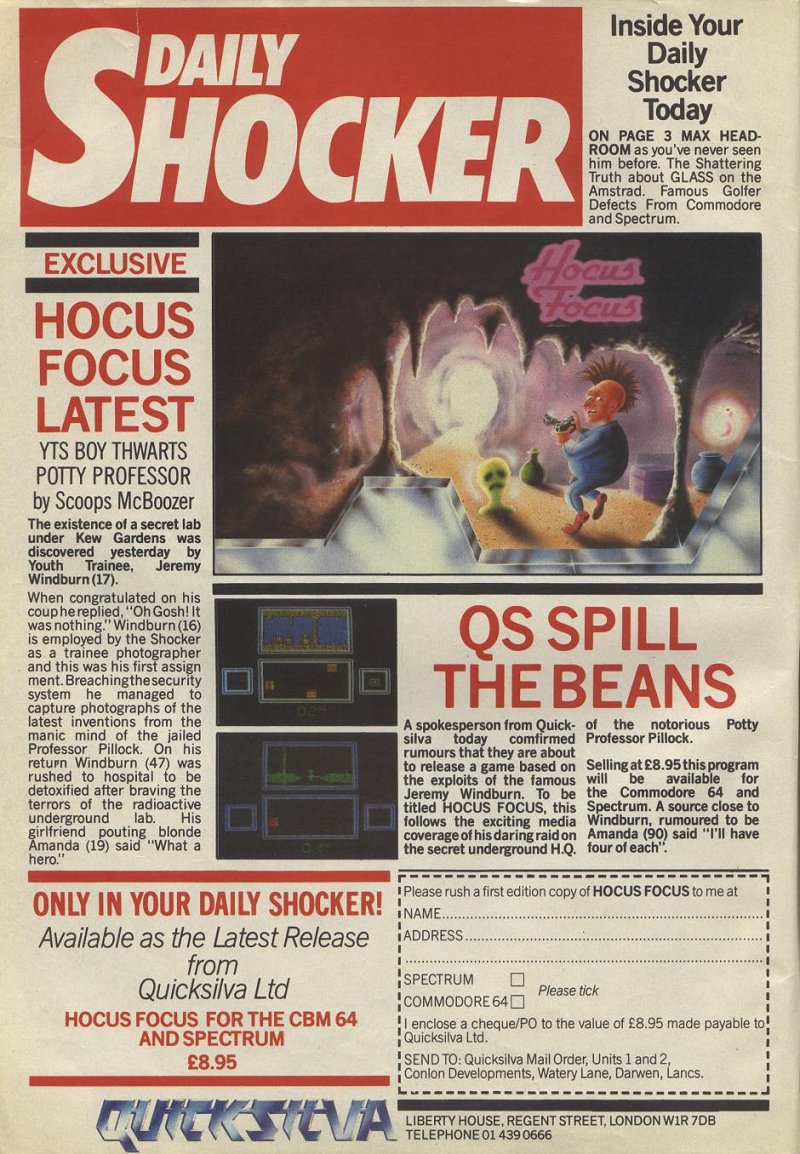
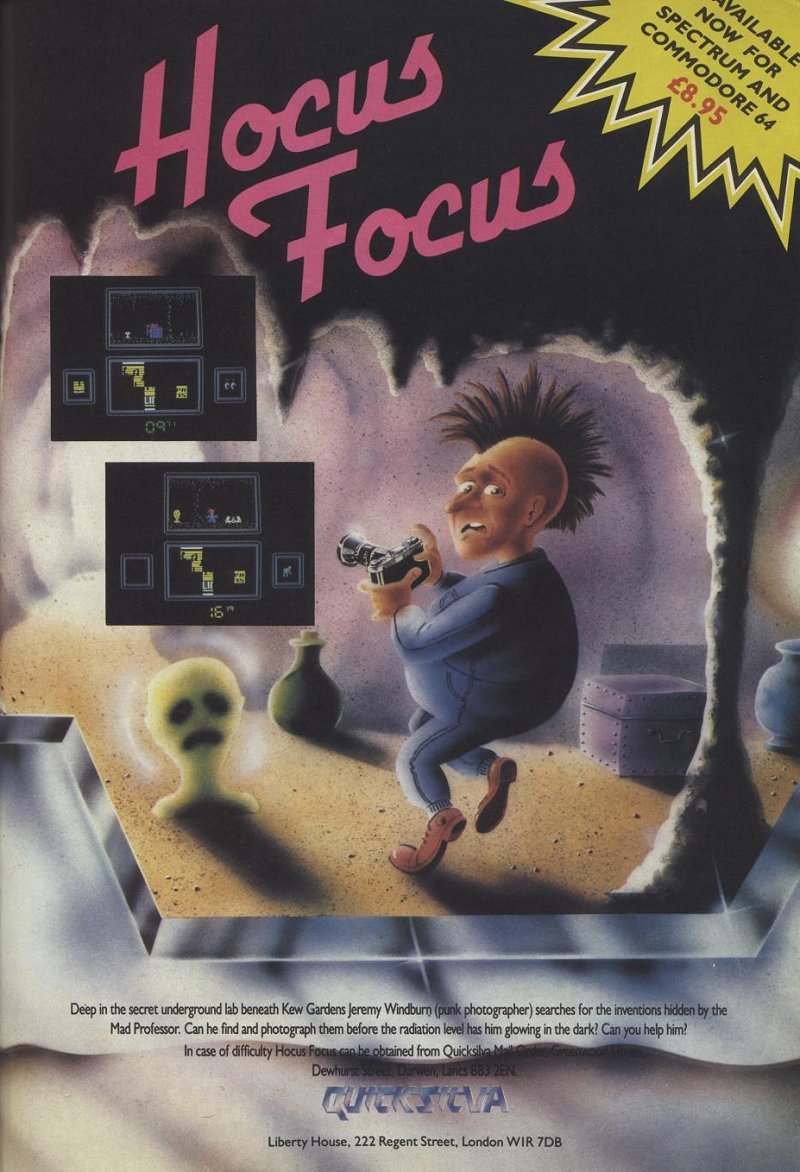
_Back.jpg)
.jpg)
.jpg)
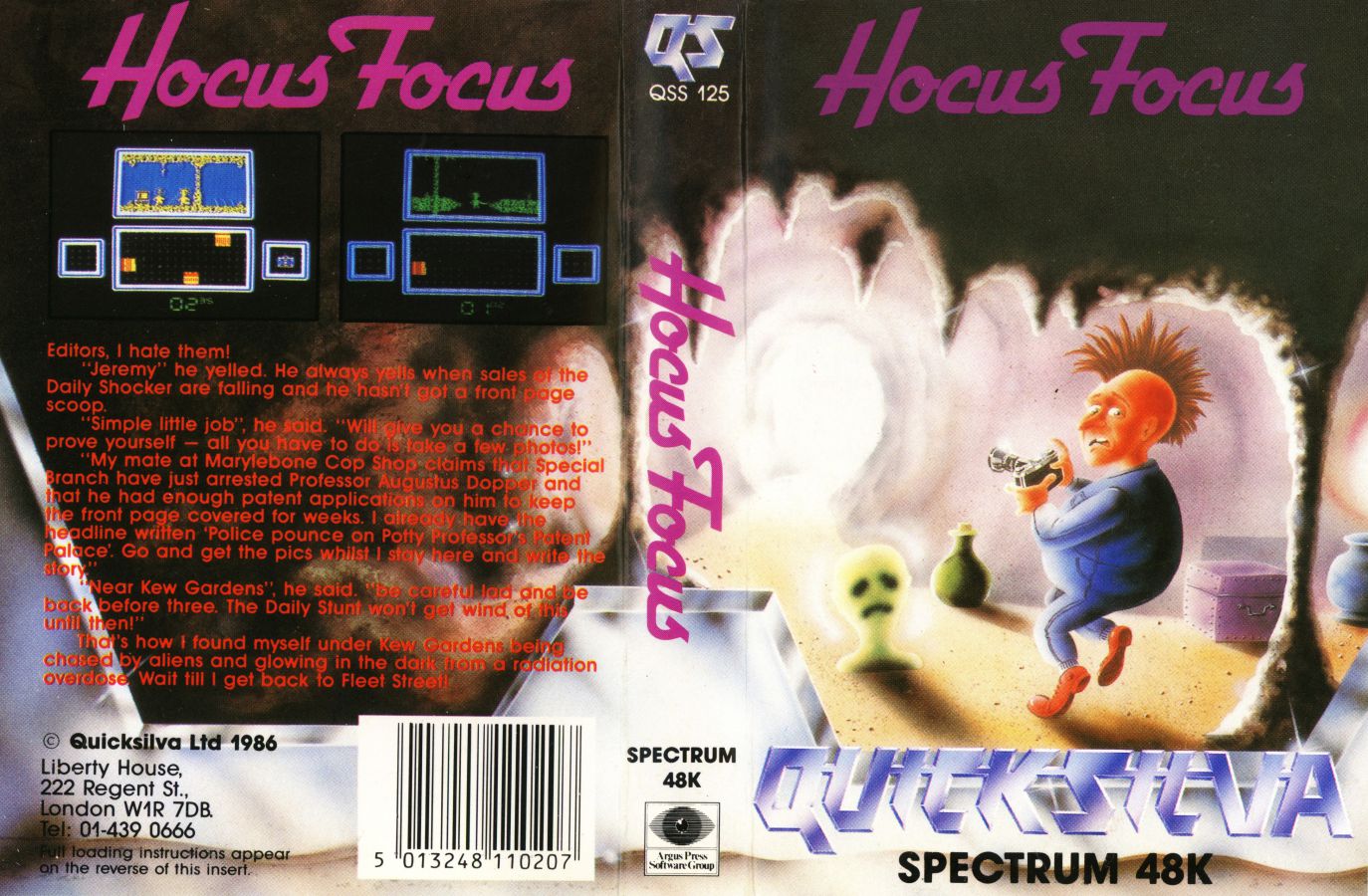
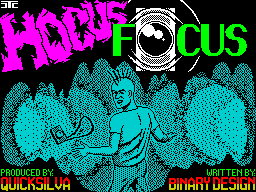
_Media.jpg)
Discussion
Nobody has started a thread about this yet.
Credits
Popular ZX Spectrum composer Dave Whittaker was the author of the original Commodore 64 game. He was not involved on the ZX Spectrum version, ported by Binary Design without any music.
- Control Option
- Cursor, Interface 2 (right), Kempston Joystick
Releases
- 1986Quicksilva LtdPound sterling 8.95
- 1986Bug-Byte Software LtdPound sterling 1.99
- 1986Mind Games Espana S.A.
Play
- hocusfocus.zipRZX playback file
- HocusFocus.z80.zipSnapshot image English26 KB
- HocusFocus.tzx.zipTape image English26 KB
- HocusFocus(Bug-ByteSoftwareLtd).tzx.zipTape image English27 KB
Documents
- HocusFocus.txtInstructions English3 KB
- HocusFocus(EN).pdfInstructions English84 KB
Files and rights
No permission is on record either way. Screens and pictures are copied here on a take-down basis: if you hold the rights and want something removed, say so and it goes.
Credits
- David WhittakerGame Design/Concept
- Steve Hughescredited
- Ste Pickfordcredited
Sign in to credit somebody, or say what these people did.
Awards
Scores
In the magazines
- Your Sinclair #71986 · Overall6/10
- ZX Computing #271986 · OverallGreat
- Crash #281986 · Overall70%
- Sinclair User #661987 · Overall4/10
Elsewhere on the web
- WorldOfSpectrum 12 votes5.58
In the magazines 12
Sinclair User #66Sep 1987 · p.374/104/10
Overall 4/10
Andy Moss 4/10
Label: Bug Byte Price: £1.99 Memory: 48K/128K Joystick: various Reviewer: Andy Moss Not much fun being a YOP trainee these days. All you get is a posting to a newspaper as a novice photographer and given an assignment to film every one of the mad professor's inventions hidden in various objects around his underground cave system. This is your typical arcade multi-level adventure that has some novel differences, which I suppose brings it a few pegs higher on the entertainment scale. Not only do you need to find the inventions and snap them with the camera, but you only have 16 pictures on the reel and touching the many mutants loses film, so you need to get back to the start and get another - but how? Going down is easy, but going up? One other thing, the caves are radioactive and guess what, only a limited amount of time folks! The icon control is fun, and the layout is pretty but the gameplay is no way startling.
Your Sinclair #7Jul 1986 · p.627/108/107/105/106/106/10
Graphics 7/10
Playability 8/10
Value For Money 7/10
Addictiveness 5/10
Overall 6/10
Gwyn Hughes 6/10
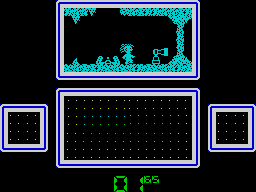
Quicksilva £8.95 Reviewer: Gwyn Hughes Here's a snappy little game on the popular photography theme - and what an oddity! At heart it's a platform game but the presentation cleverly disguises the fact - something in its favour 'cos if I see another Jet Set Willy clone somebody will be taking photos of me as they cart me off to the funny farm. The plot concerns Jeremy, the YOP's punk trainee, who's with Doris from accounts in the darkroom (perhaps it's as well that we're never allowed into the lab to see the exposures involved!) when the Editor shouts 'Hold the Front Page!' Jeremy immediately drops Doris and grabs his Box Brownie to take on the assignment. His task consists of investigating the subterranean chambers of the Potty Professor (chambers - potty? Suit yourself). There he has to photograph the Mad Doc's inventions that're hidden below Hyde Park (Hyde Park - hidden? Well, it you don't appreciate wit, I won't waste my time), in jars, chests and what look like 1950s TV sets! Camera ready, Jeremy wanders off only to find the vaults are a shocking place (vaults - shocking! Surely you got that one!). Once he locates a hiding place you move to icon control and select Look. You'll then see if there's some hot photo in the pot. If so, you can go to the camera option and it's over in a flash. The caverns are carefully guarded though, The hidey hole may contain a mutant kleptomaniac that'll steal Jem's film or, if he's not careful, he may bang into a detector device to unleash another vicious freak. This may be fought off with a sword but if he fails in this task, which is highly likely because he first has to select the correct icon, then it's goodbye to the camera again. One advantage of working in Fleet Street is the endless supply of equipment but to replace his nicked Nikon Jeremy has to return to terra firma, as he does when it's time to develop a film. Once a film has been processed, and there's no need to finish it before returning, the separate frames must be accurately placed on a plain grid. There's no real test to this though as you get unlimited goes at guessing the positions. The game's graphic presentation is novel though. At the top is a scrolling speckly landscape and Jeremy's solid figure. It's a rather small window on his world though, dwarfed by the photo screen which you gradually fill, a la Rocky Horror, below it. Either side are frames for individual parts of the picture and icons. It's a novel approach but doesn't have enough content behind it - unless you're into games where the main challenge is beating the monotony.
ZX Computing #27Jul 1986 · p.10ZX Computing GlobellaGreat
ZX ComputingZX Computing Globella
Overall Great
Quicksilva £7.95 Take several elements from various games, add a dollop o! originality and you end up with Hocus Focus. You are Jeremy, a punk YOP trainee given the task of photographing the inventions of a mod professor which are kept, in pieces, hidden around the prof's laboratory in caves under Hyde Park. Of course it's not that simple. The caves are protected by mutants who appear when you trigger a detector device. These destroy your film and take away your sword (every punk YOP photographer carries a sword!), and you have to go back to the start for another one. The screen is divided into four areas. Top centre is the action screen where small but finely drawn and animated. Jeremy walks in front of and behind objects. Bottom centre is the panel showing the number of photos developed for an invention, 20 pics for each and only 16 pics per film, this means at least one trip to the start even if you do not lose your film to a mutant, and there are 16 inventions to photograph. Actions are controlled by selection of icons in a small window to the right of the main photo panel and a small window left of it shows the pictures ready to be positioned in the main photo panel. All in all there is enough action, challenge and problems for the most demanding arcade-adventure fan. Playing the game took a little practice, perseverance was rewarded though as the game is worth sticking with. A joystick option is provided and keys are well chosen, though on my keyboard the M key became the comma one for firing. My biggest gripe is that the game takes a long while to play and there is no save/load option that I could find. Perhaps not a classic, but a worthwhile addition to any games player's collection.
C&VG (Computer & Video Games) #56Jun 1986 · p.406/105/104/105/10
Graphics 6/10
Sound 5/10
Value 4/10
Playability 5/10
MACHINE: Spectrum/C64 SUPPLIER: Quicksilva PRICE: £8.95 After producing the highly , Max Headroom, Electronic Pencil split up and a new company emerged, Binary Design. This is Binary Design's first that I have seen and it's all about Jeremy the 'Glowing' punk reporter. The basic idea is that the paper you work for, called the "Shocker," hasn't had a great story for weeks, so when the Ed hears about a nutty Professor's inventions, he sends Jeremy out. Simple? Oh no, because the Professor has created some mutants which try their best to hinder your quest by pinching your film. This means you have to go back to the darkroom, reload your camera and start again. But, you don't seem to be told when your films have gone, so it makes it a bit harder. The graphics in this game made by eyes pop out. Good? No, terrible. The punk looks more like a mutant than the mutants do. Overall this game is not what I expected - it looks like something that was written in 1982 rather than 1986.
Crash #28May 1986 · p.3278%77%71%81%71%68%70%
Use of Computer 78%
Graphics 77%
Playability 71%
Getting Started 81%
Addictive Qualities 71%
Value For Money 68%
Overall 70%
Unknown
Unknown
Unknown
Producer: Quicksilva Retail Price: £8.95 Author: David Whittaker and Steve Hughes After committing some horribly sordid and particularly nasty crime arch professor eccentric, Dr Augustus Dopper, has been taken into the police custody and is in severe danger of having to eat large amounts of porridge. Left within his Hyde Park residence are a number of yet to be submitted patent applications. Though the dear old Prof was far more than the odd marble short, stupid he wasn't and the various potential patents are of a very interesting nature indeed. The Daily Shocker is one of the organisations that the new inventions have managed to interest. Why? Because their readers have a right to know? Because some rather mind-stimulating and in-depth articles could be written about them? No, the Daily Shocker isn't that sort of paper. It's because the headline 'SICKO BOFFINS STARTLING INVENTIONS' would sell plenty of copies to the type of reader that the rag attracts. Hacker Harry, editor in chief, soon assigns the best man on the staff to the job of getting into the Prof's labs to photograph the pat. pending papers left around the place. His name is Jeremy, he is a punk and is a YOP trainee photographer. Old Augustus Dopper had a very strange mind indeed and for some peculiarly unexplained reason the professor's workplace is decorated with a number of palm trees and a hole in the ground. Since the palm trees are a bit dull Jeremy decides to jump through the hole and into the multi-layered caverns that make up Augustus's secret lair. Within this subterranean psycho bin there are some very strange objects to be found and not all of them are as benign as they may well seem. The major concern of Jeremy's travels is to seek out the number of pots that proliferate in the caves, for within these lie one of three items: a vacuum, a nasty or a patent. The first causes no trouble, just disappointment. The second is surprising and steals any objects in Jeremy's inventory. The third should be photographed instantly and recorded for posterity. Once the film is full it has to be developed, an activity which is carried out at the place where Jeremy came into the scene. It's also worth resurfacing for the fresh air as it blows away any form of radiation that may have infected Jeremy. Because of the strange nature of Dr Dopper's experiments there's more background radiation about than there is on Cumberland's beaches and popping back to the outside world drains off the millirads at a reassuring rate. Another thing to be wary of are the baddies ready to spring into Jeremy's path if he trundles over a Jeremy sensitive pad, plodding after him, they trounce the punk person and steal all of his loot. Hocus Focus is a game that takes place within 'windows'. There are four in all and the main window should keep your eye for most of the time. It contains a centrally placed Jeremy sprite with his background around him. As Jeremy moves with his left, right and jump keys the pretty scenery scrolls smoothly by. To interact with his environment far more than the normal directional controls are supplied, two of the other windows relate to the implementation of the icon system. Hocus Focus is also an adventure type game and a quick pound on the icon key freezes all action and activates two little windows. Up and down cycles through the various actions available while fire selects that command. This section is needed quite a bit for peering in vases, taking photos and developing film type activities. As in all good adventures, objects can be picked up and manipulated, in fact they have to be to finish the game. All is over once the complete set of patents have been celluloidally captured by the punk cub reporter. COMMENTS Control keys: O/P left/right, M to jump/activate icon, A for icon mode, Q & A to scroll icons Joystick: Kempston, Cursor type, Interface 2 Keyboard play: responsive Use of colour: monochromatic main screen with colourfully pretty windows. Graphics: nice animation though the backgrounds are a bit bland Sound: not amazing and barely audible Skill levels: 1 Screens: multi-level playing area
Games Compendium carries this game and has 13 references of its own.
Review2
- MicroHobby #91Aug 1986 · p.14
- Computer Gamer #15Jun 1986 · p.66
News/Note2
- ZX Computing #25May 1986 · p.6
- Popular Computing Weekly #18May 1986 · p.45
Preview1
- Sinclair User #49Apr 1986 · p.12
Related
- Compilations
- Games Compendium
- Ports
- (Commodore 64)
- Same entry at
- Spectrum ComputingZXInfo
Reviews from people here
Sign in to write about this, or make an account. It takes a minute and lets you correct the catalogue too.
Everything ZXDB can hold about this is here.
Sign in to correct or add to this.
Hold the rights to this and want it taken down?