
Hungry Horace
Arcade Game: Maze · ZX-Spectrum 16K · 1 players
Sinclair Research Ltd · 1982 · Pound sterling 5.95 · Pound sterling 14.95 disk
Also known as Horacio Gloton (English), Horácio Glutão (Portuguese)
Horace, 1 of 4

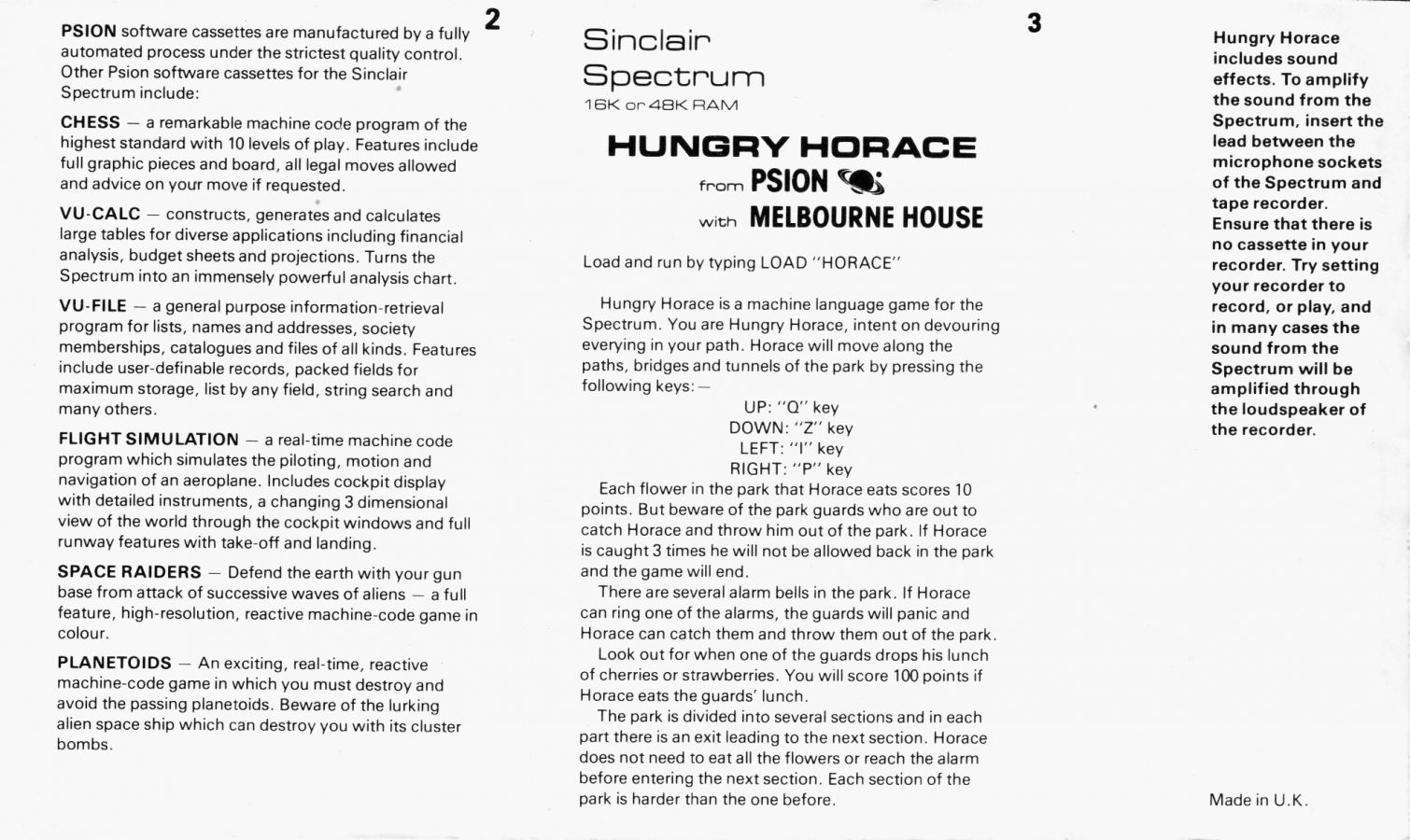
(InvestronicaS.A.).jpg)
.jpg)
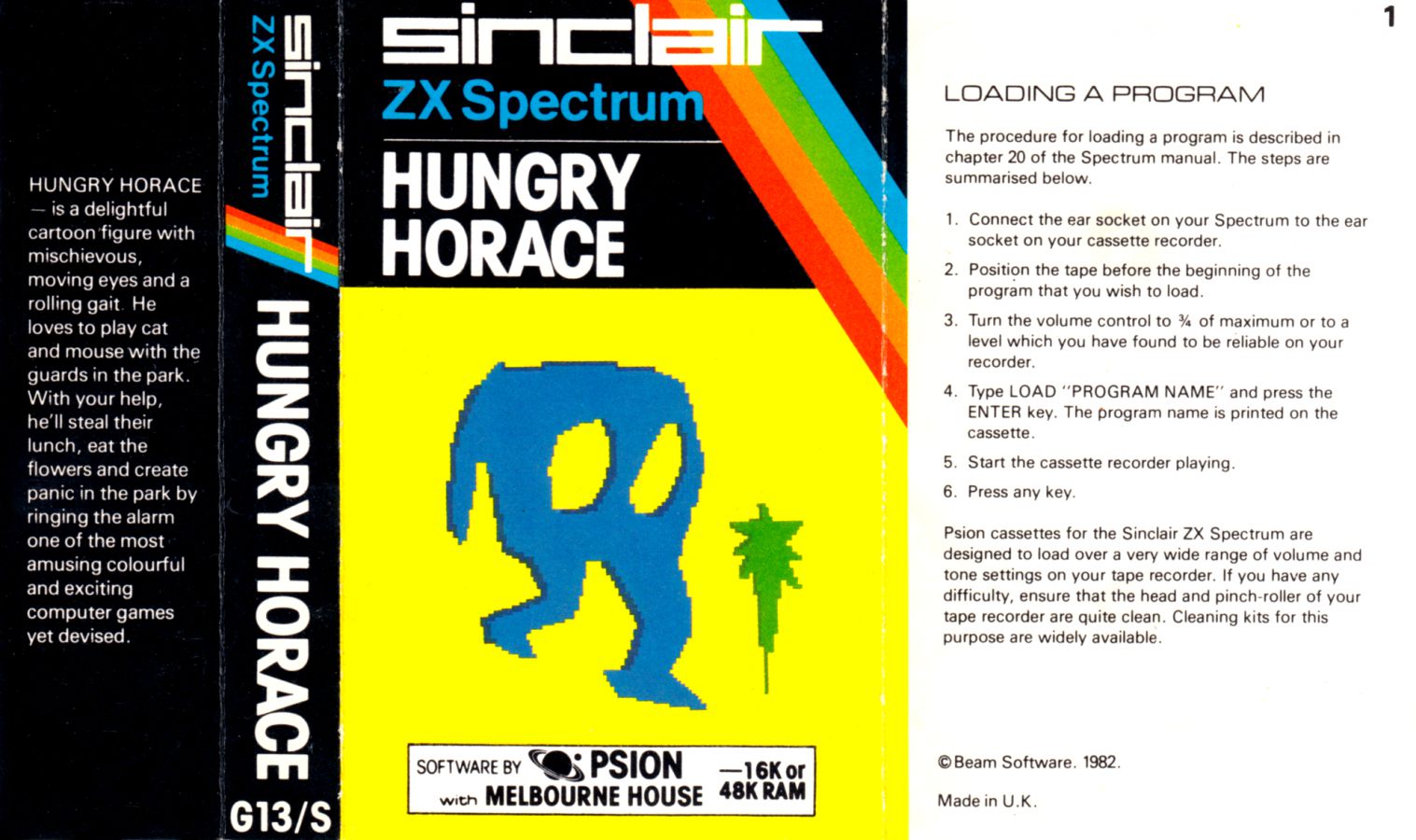
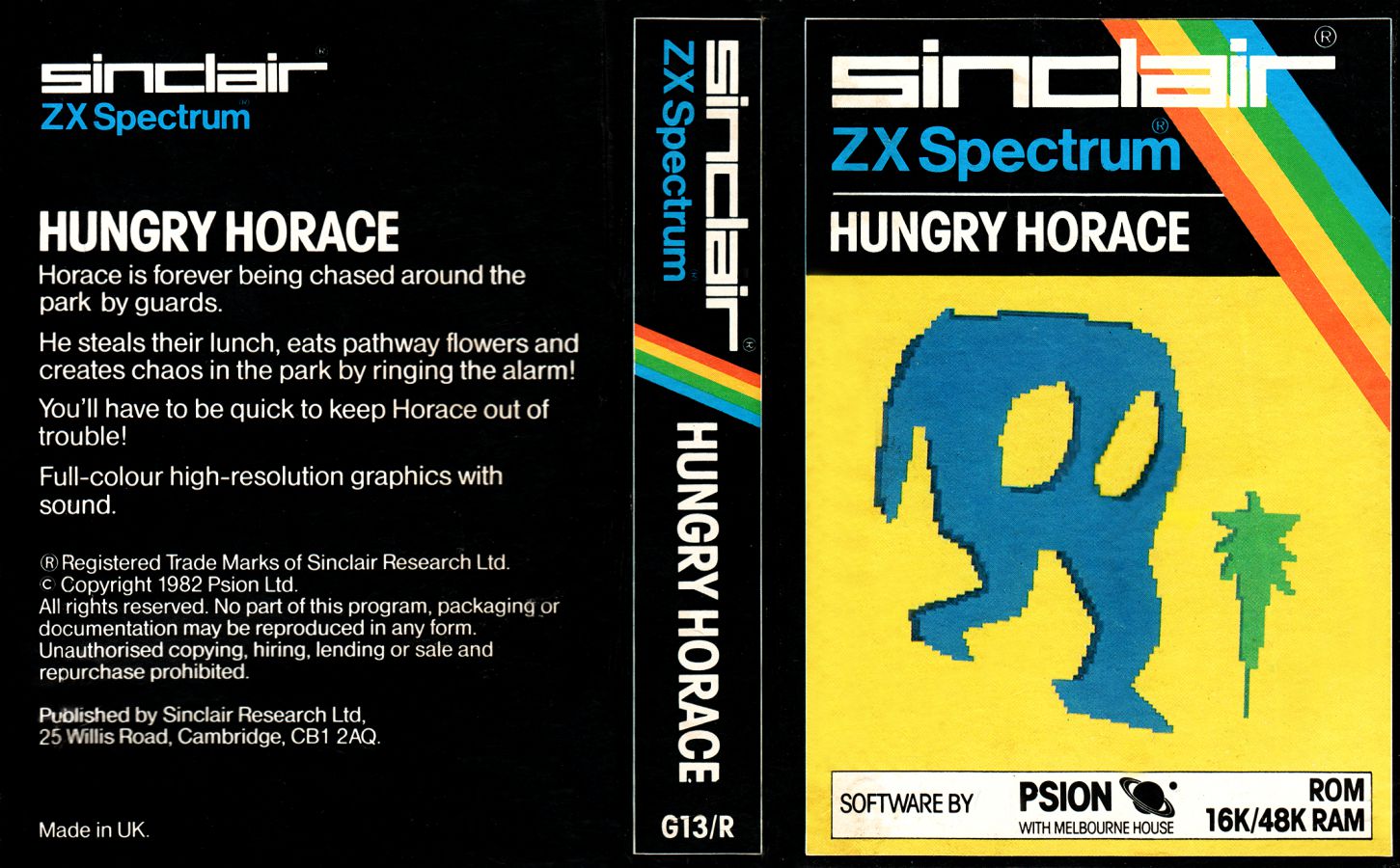
.jpg)
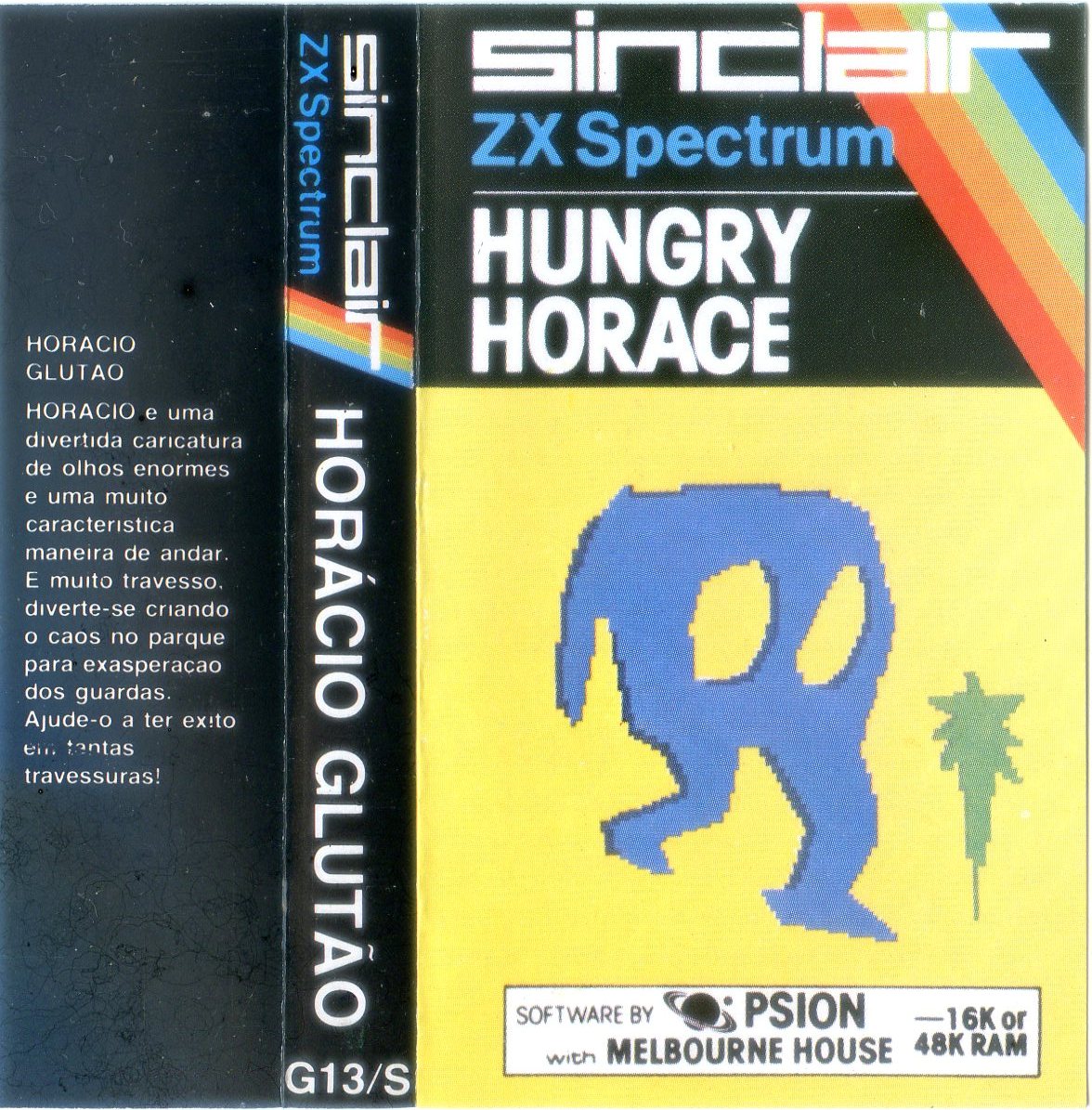
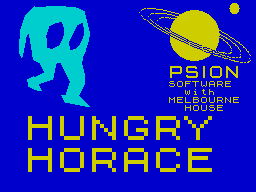
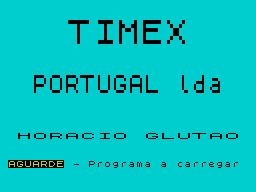
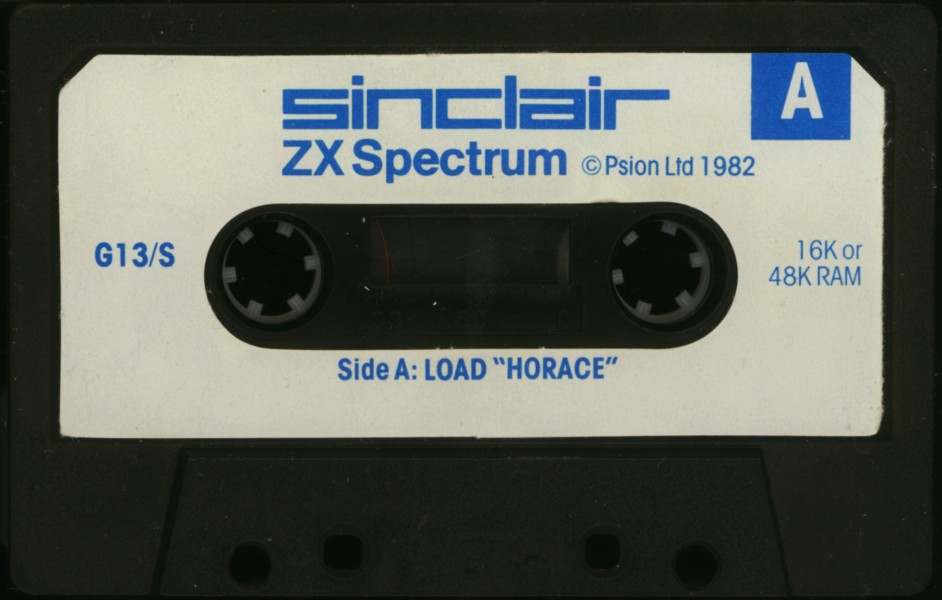
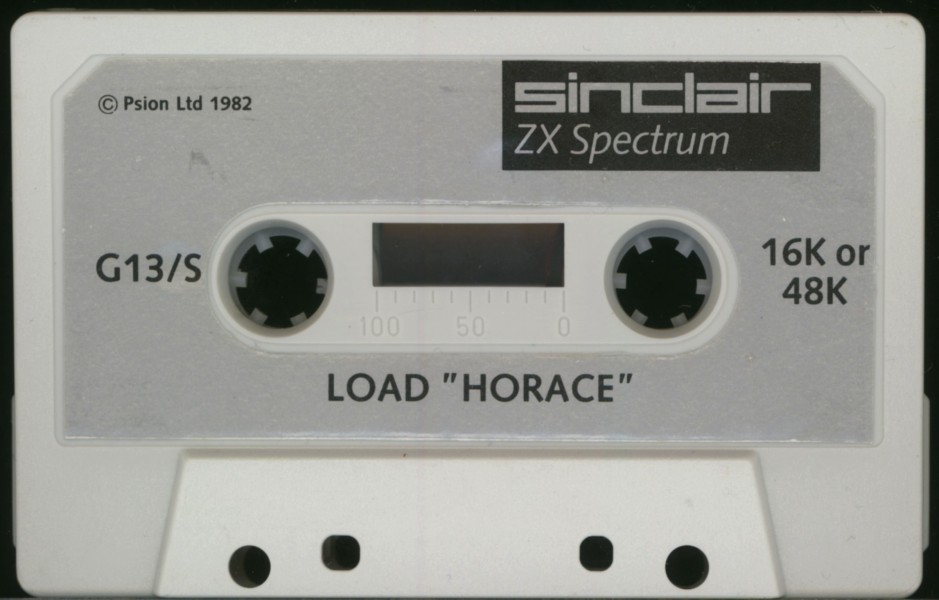
_Tape.jpg)
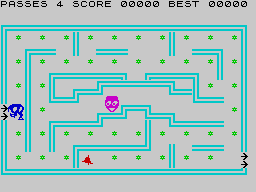
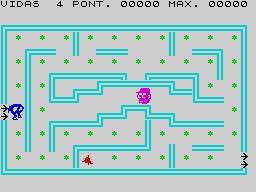
_Scan.jpg)
_Scan_2.jpg)
Discussion
Nobody has started a thread about this yet.
Remarks
Also available on ROM cartridge (separate cassette/cartridge prices)
Awards
Rank #26 - 1984 Sinclair User Top 50 Spectrum Software Classics
Releases
- 1982Sinclair Research LtdPound sterling 5.95 · Pound sterling 14.95 disk
- 1982Investronica S.A. Sold as Horacio GlotonSpanish peseta 2150.00
- 1983Sinclair Research Ltd [PT] + TMX Portugal Ltda Sold as Horácio Glutão
- 2020Bumfun SoftwarePound sterling 12.00
Play
- HungryHorace.rom.zipComputer/ZX Interface 2 cartridge ROM image dump English5 KB
- HungryHorace.rom.zipComputer/ZX Interface 2 cartridge ROM image dump English5 KB
- hungry_horace.rzxRZX playback file
- HungryHorace.tzx.zipTape image English5 KB
- HungryHorace_2.tap.zipTape image English7 KB
- HungryHorace(HoracioGloton)(InvestronicaS.A.).tzx.zipTape image Spanish5 KB
- HoracioGlutao.tap.zipTape image 5 KB
- HoracioGlutao.tzx.zipTape image 5 KB
- HungryHorace(alternate).tzx.zipTape image 5 KB
- HoracioGlutao_3.tzx.zipTape image Portuguese
- HoracioGlutao_2.tzx.zipTape image Portuguese
Documents
- HungryHorace.txtInstructions English4 KB
- HungryHorace(HoracioGloton)(InvestronicaS.A.).txtInstructions Spanish4 KB
- HungryHorace(EN).pdfInstructions English149 KB
Other files
- Hungry Horace (1982)(Sinclair Research).pokPOK pokes file 0 KB
Files and rights
Distribution permission is on record, granted to another archive rather than to this one. Screens and pictures are copied here; everything else links to the archive that holds it.
- AllowedSinclair Research Ltd → WorldOfSpectrum
- AllowedSinclair Research Ltd [PT] → WorldOfSpectrum
- AllowedTMX Portugal Ltda → WorldOfSpectrum
Credits
- William Tangcredited
Sign in to credit somebody, or say what these people did.
Scores
In the magazines
- Sinclair User #91982 · Gilbert Factor8/10
- Sinclair User #241984 · Gilbert Factor8/10
- Sinclair User #321984 · Gilbert Factor8/10
- Sinclair User1984 · Gilbert Factor8/10
Elsewhere on the web
- WorldOfSpectrum 49 votes6.44
In the magazines 52
Sinclair User #32Nov 1984 · p.288/10
Gilbert Factor 8/10
A game whose claim to fame is the cartoon-style character Horace who has to eat the plants in a park maze and escape before the attendants catch him. It was the first game in which the character was more important than the plot. The graphics were, and still are, outstanding with the predominant use of sprites for character images, a technique which had not been used before. The game is a logical progression from the arcade Pacman; the latter had no software equivalent on the Spectrum because Atari was not interested in the small machine. Position 26/50
Crash #6Jul 1984 · p.9570%67%75%71%80%69%75%62%78%60%
Use of Computer (CP) 70%
Use of Computer (MU) 67%
Graphics (CP) 75%
Graphics (MU) 71%
Playability (CP) 80%
Playability (MU) 69%
Addictive Qualities (CP) 75%
Addictive Qualities (MU) 62%
Value for Money (CP) 78%
Value for Money (MU) 60%
Chris Passey
Matthew Uffindell
ELECTRO GOBBLE - PACMAN TYPE GAMES In our sixth comparison, reviewers CHRIS PASSEY and MATTHEW UFFINDELL snatch a glass of water and a handful of power pills and prepare to do battle with a legion of ghosts... Pacmania came over from the States quite a while back. Initially the game was regarded as odd in that it was relatively non-violent for a computer game, but it rapidly established itself as the number one arcade favourite. Although the craze is over now, there are still a lot of pacfans around. As a classic maze game, Pacman was among the first arcade originals to be copied in numerous forms on to the Spectrum. Copyright owners, Atari International, have been promoting their expensive 'official' version since before Christmas, but it competes against some very strong 'unofficial versions. Some are good, some not so good, and there are some interesting variants. In brief, the classic version should have a medium complex maze connected horizontally by a wrap around tunnel. In the four corners are a similar number of power pills. Each pathway of the maze is regularly dotted. In the centre is a 'home' for ghosts of differing colours and point values, which are released into the maze at intervals. The object is to take your Pacman, an orange ball with a gobbling mouth, around the maze and eat all the dots to promote to a more difficult screen with more intelligent ghosts. Eating a power pill will cause all the ghosts to turn blue and edible. In this condition they should run away from your approach at a slower speed than yourself, Strawberries appear at intervals and can be eaten for bonus points. HUNGRY HORACE Producer: Psion Memory Required: 16K Retail Price: £5.95 No need for intros here as every self-respecting Spectrum owner has heard of Horace (if not, why not?). This is an excellent variation which has stood the test of time well. I remember buying this one over a year ago and it still has appeal. Some details like the 'finishing' of the maze are a little bit primitive by today's standards, but this still outdoes many newer games. If anyone has not got Hungry Horace get it! CP Horace cannot be called a traditional Pacman game - there are no ghosts for a start off, just park guards which multiply after a set time. The three mazes are very simple indeed, though quite well drawn. Power pills don't exist either, instead there is an energency alarm bell. Ringing the bell will cause the guards to freak, allowing you to throw them out of the park. The characters are well drawn and move smoothly. Colour and sound are well used. Totally different from the arcade version. MU
Crash #3Apr 1984 · p.70
Producer: Psion, 16K £5.95 Many critics regard this as the definitive pacman game for the Spectrum, and of course Horace has begat a number of sequels in other categories. Highly attractive graphics and smoothly animated make it a joy to play. There are several mazes of increasing complexity to get through. No power pills - just wits. Highly recommended.
Sinclair User #24Mar 1984 · p.548/108/10
Gilbert Factor 8/10
John Gilbert 8/10
INTERFACE GAMES ARE FAST BUT NOT FURIOUS John Gilbert reviews the ROM cartridge software currently available. The Sinclair Research Interface Two has had few kind words said about it and that it is not surprising. The add-on is supposed to give the Spectrum the ROM potential of the Atari games consoles and computers into which you can plug ROM cartridges which will load games into the machine directly on power-up. It should have been the ideal add-on for users who want a quick-load device and no messing with tape recorders or even Microdrives. The main difficulties with the idea are that the software available consists of reproductions of arcade games which are already on the market and that many software companies have been deterred from producing software for the interface because of the conditions attached to ordering. At the moment companies have to order batches of 1,000 cartridges in a sector of the market which is not fully-established. It is a risky business even for a company as established as Melbourne House or Psion. The situation could develop so that Sinclair is the only company producing the ROM cartridges. It certainly has the monopoly now. The first ROM packages, together with their colourfully-styled display boxes, to arrive on the market were titles which already existed on the cassette format in the Sinclair software library. They included Planetoids, Backgammon and Space Raiders which are all from Psion. The packages, one of which appeared originally on the ZX-81, are not particularly innovative or awe-inspiring and they are certainly not the kind of titles which would be expected to be produced when bunching a new peripheral for a prime-selling microcomputer. It is as if Sinclair could not wait to get Interface Two out of the way and so complete its obligations for peripherals for the Spectrum. One reason may well have been that the new QL machine was occupying its thoughts. Backgammon featured as the only mind game in the first release, the others being held back because the Psion games were the quickest to produce. It is a pity that Backgammon was first instead of the chess package, which was left until later - chess has a far greater appeal to the majority of home computer users. Fortunately there was a gap of only two months before Chess was released and it has proved to be one of the better software packages in the launch. Space Raiders is a painfully slow version of Space Invaders and could just as well be bought on cassette more cheaply. There are three spaceships with which you can fire at the aliens which amble across the screen. Once you have finished one screen of the game, and that is not difficult, you will progress to the next level which is just as difficult or easy as the first. That makes the game a push-over and there is little challenge to tax even the newcomer to the arcade game scene. Like most of the games in the range the price of the program on cassette is only £5 but the ROM version costs almost £10. Considering that the software does not show off either the graphics, colour or sound of the Spectrum to best effect it does not seem advantageous to buy the ROM version. Planetoids is another arcade game with a familiar theme. Your spaceship first appears stationed at the centre of the screen and asteroids start to close in on it. You must try to destroy them and avoid the ones you miss. Alien spaceships make your task even more impossible. The standard of the game is reasonable for the market, even though it was first produced in late 1982. The graphics are better than the original Atari version of Asteroids. The ship and the planetoids have been given a solid, almost three dimensional quality. The program has a wrapround screen which allows your spaceship to go off one side and return on the other. That causes a strange effect when your ship fires across the screen, as the missiles will disappear off one edge and reappear somewhere else. The rogue missiles could even cause you to have some nasty accidents shooting at yourself. Those packages comprised the ROMs available at the launch of Interface Two and there was a considerable wait until the other ROMs were launched in December. The new packages include some old favourites from Melbourne House, already in the Sinclair software library, and some releases introduced by Ultimate Play the Game. The Melbourne house offerings feature the clown of the software scene. The newest Horace adventure is not on ROM but it is pleasant to see Hungry Horace having a re-birth and Horace and the Spiders on ROM. For those who know nothing of the Horace myth he is a little round, Pacman-type creature who has the habit of annoying everyone he meets. Each of the games has a cute plot and Hungry Horace sees the round man taking the part of a Pac-man. He is, however, no ordinary powerpill eater. He has to eat the flowers in the park and avoid the keepers who will throw him out if he is discovered. If you go through one maze into another there will be more surprises and if you are adept enough you may start to think that there is no limit to the number of mazes in the game. Horace and the Spiders is slightly different Horace has to dodge the spiders to gain points before he can reach the main part of the game which takes place in a cobwebbed house. You must destroy the spiders and their webs if you are to win the game. The Horace adventures are a pleasure to play and it is good to see them in a format where they can be loaded immediately you feel like a quick game. The range of Ultimate games is also worth having on cartridge, although they could be bought more cheaply on cassette from that company. In chronological order, Jet Pac was the first game Ultimate produced for the Spectrum. In it you play a spaceman whose task is to deliver and assemble spaceship kits and to collect valuable treasures on the way. You will be faced with all kinds of odd creatures which you must avoid and destroy to complete your task. The other games from Ultimate are Pssst, which involves a robot keeping away the bugs from a sunflower, and Cookie, which involves a chef bouncing ingredients for a cake, avoiding the nasties in the larder and keeping clear of the bins. Both games are arcade standard in quality and benefit from the ROM treatment. The only mind game in the second release of ROM software is Chess. It is the original cassette version which has existed since the title was launched, with no changes. That is surprising since Mikro Gen, the original manufacturer of the game, has produced an upgraded version. The game is standard so far as computer chess goes with options for playing or setting-up the board to play in particular situations. There are 10 levels and the highest, nine, takes several minutes to make a move. Each move for both you and your opponent is monitored in seconds, minutes and hours on a chess clock above the board on the screen. The future of the ROM interface is still uncertain and many software houses are unsure what they will do in the way of supporting it. It seems unlikely that any large-scale production of programs on Sinclair standard ROMs is planned in the software industry and Sinclair could be in the unenviable position of having a monopoly of ROM software. Sinclair Research hopes to produce some language and utility packages for Interface Two but the company still has no idea which language or utilities will be available, or when. It is likely that a ROM version of Micro-Prolog will be available soon but no firm date is being given even for that step forward. The indications are that it will be the last interface for the Spectrum. The buffer at the back of the board will support only a ZX printer and Sinclair has given no intention of producing more peripherals for its home market machine. It would therefore seem logical to support the interfaces it already has as far as it can and to promote the use of those devices as much as possible. As far as Interface Two is concerned it has crept on to the market with more of a whisper than the bang which was expected.
'The company has no idea which utilities will be available.'
'The packages are not innovative or awe-inspiring.'
Crash #2Mar 1984 · p.53
Producer: Psion, 16K £5.95 Many critics regard this as the definitive pacman game for the Spectrum, and of course Horace has begat a number of sequels in other categories. Highly attractive graphics and smoothly animated make it a joy to play. There are several mazes of increasing complexity to get through. No power pills - just wits. Highly recommended.
Crash #1Feb 1984 · p.51
Producer: Psion, 16K £5.95 Many critics regard this as the definitive pacman game for the Spectrum, and of course Horace has begat a number of sequels in other categories. Highly attractive graphics and smoothly animated make it a joy to play. There are several mazes of increasing complexity to get through. No power pills - just wits. Highly recommended.
Sinclair User1984 · p.248/108/10
Gilbert Factor 8/10
John Gilbert 8/10
LEADING THE PAC New and varied life-forms now inhabit the Pacman maze. John Gilbert investigates. Pacman is part of what the video historians like to call the arcade maze craze. The game is set in a maze where a hungry little round creature eats dots and power pills scattered through the corridors. The monsters are ghosts which hunt the little man and will eat him if he is not agile enough to escape. If, however, the Pacman eats a power pill it can chase and eat the ghosts. The original game was introduced to the home computer market by Atari, primarily on its VCS video system and then on the 400 and 800 computers. The first versions for other computers, variously called Puckman, Gobbleman and Scoffer, arrived shortly afterwards and since then new versions have been released almost every month. Not surprisingly, the ZX-81 did not escape the craze. The authors of Zuckman, from DJL Software, claim that it is the first version of Pacman for the ZX-81. The game runs in 16K and is written in machine code, which gives the scrolling routines and Pacman a smooth movement. That is something unusual on the ZX-81, as most games flicker slightly. The game adheres as closely as possible to the original and the limited graphics of the ZX-81 do not matter much. One snag with playing the game on the ZX-81 is the membrane keyboard. Moving a Pacman around the screen using it can be difficult but not impossible. At the beginning of Zuckman the ghosts speed on their victim and if you panic trying to find the keys and do not press them properly you are liable to lose a Pacman or crash the machine. Once you have a fair idea of the game, however, it is surprising how quickly you can move the Pacman around. Zuckman is available for £5.95 on the 16K ZX-81 and Spectrum. Super Glooper is a version of Pacman, also for the 16K ZX-81, which is retailed by Sinclair Research. Glooper's task is slightly different from normal. Instead of gorging himself with power pills he has to paint the maze. Obviously the ghosts will not tolerate Glooper's antics - perhaps they do not like the smell of paint. The ghosts will try to kill Glooper as usual but if he can get round the maze and paint all the walls you have won. The game is very amusing and is well worth £4.95. The program will load in less than two minutes, so you will not have to wait six minutes to play the game. The launch of the Spectrum provided software houses with an excuse to try to produce the perfect Pacman which simulated the Atari version as closely as possible but Atari guards its rights over products jealously and investigated the products of several firms in the ZX industry. The Abbex Spookyman game is the most famous of the Spectrum versions. It also looks most like the original. Most games, until now, have included only dots and power pills in the mazes. Abbex has included dots, power blobs, diamonds, hearts, clubs, mean-looking ghosts and a cute little Pacman which looks like a diamond turned on its side. The keyboard is divided into three sections with left control on the left, right on the right, and up and down in the centre. The controls are very difficult to master but, once you have done so, usually with the aid of both hands, you will be surprised at the agility you can attain. At times the game is almost impossibly fast but Abbex estimates that the highest score possible after every screen has been cleared is 22,400. If you manage to reach 10,000 points you will receive a bonus life. We managed to go that far only once. Spookyman can be played by one or two players. If two play they take turns to control the Pacman. Their individual scores and the highest score are included at the top of the screen. There are two unusual features in Spookyman. The first is that you can reset the high score at any time between games; the second is that you can use a joystick. The game is compatible with the KempSton joystick and once you have seen it in action it is almost a necessity. Spookyman is available from Abbex and costs £4.95. Gulpman is another variation on the Pacman theme. The round Pacman is replaced by a little man running round the maze and the ghosts become frowning faces which smile only when they have caught Gulpman. The game is very complex and you can switch to any of 15 mazes in which to play. It is also possible to change the tempo. At tempo one the speed is bearable but at tempo 10 life is not worth living. The little man can fight back slightly more easily than in other games as he approaches with a fully-loaded laser gun. If the ghosts get too close you can blast them away but only until your energy runs out. It seems as if the space age is over-running everything. Gulpman is available from Campbell Systems and costs £5.95. Hungry Horace, from Sinclair Research, has developed a reputation as a fun game; in fact Horace is almost a legend. The game is a great improvement on the original and has remained at the top of the software top ten for some time. Horace is a large purple blob which has sprouted arms and legs. He wanders around the maze which looks like a park, eating everything in his path and trying to avoid the guards who act like ghosts and try to capture him. He can scare away the guards by using the alarm bell situated somewhere in the maze. If Horace reaches the exit of one of the mazes he can enter the next maze and continue to the next exit. The mazes become more difficult as Horace proceeds further in his adventure and we managed to reach only the third maze. With a large amount of skill, however, it should be possible to go further. Hungry Horace, for the 16K Spectrum, is available from Sinclair Research and costs £5.95. Although the arcade industry in the States, and now in Britain, is declining it is good to see that games concepts like Pacman are being transferred to micros. Some of the Sinclair versions of Pacman seem as good as, if not better than, the original Atari version. Games such as Hungry Horace are setting-up an interesting mutation in the Pacman concept. They also seem more interesting than the original version because they have added to the idea of Pacman. So far as the consumer is concerned it is to be hoped that concepts such as Pacman will not be destroyed within the industry. DJL Software, [redacted]. Sinclair Research, [redacted]. Abbex Electronics Ltd, [redacted]. Campbell Systems. (Dept. SU), [redacted].
Personal Computer Games #1Sep 1983 · p.60
PRICE: £5.95 MEDIA: cassette DISTRIBUTORS: WH Smith and Sinclair dealers REQUIREMENTS: 16K Spectrum LANGUAGE: assembler CHALLENGE In Hungry Horace, the first of our blue friend's adventures, Horace wants nothing more than a little food to see him through his stroll in what seems to be a rather large park. Unfortunately, there are few concession stands and food outlets in the park - most people seem content to bring their own lunches. Horace has absent-mindedly forgotten to make one of his own. So he decides to steal other people's lunches. It's your job to help him. Horace's efforts to cadge cuisine are opposed by the park's guards who pursue him from the moment the game starts. His only defence is to ring the park alarm bells that send the guards scurrying in every direction looking for the cause of the trouble. In Horace Goes Skiing, our intrepid hero wants merely to make his way across the road to rent skis and then move on to the slopes. He wants to show off his schussing to all the young Horacettes sunning themselves in the cool video slopes of Mount Spectrum. In Horace and the Spiders, Horace laughs in the face of adversity as he survives - we hope the dangers of bridge and mountain to battle a pack of deadly spiders. For Horace novices, we will personally tackle our friend's first adventure: his food-snatching farce in Hungry Horace. HOW TO WIN Very carefully... There are a few dead ends in Hungry Horace mazes. You will find Horace trapped and ready for easy capture by the park's guards if you lead him into one of those dead ends. You must make sure Horace is never farther away from an alarm bell or exit than the guard chasing him. Make sure also that you don't get mixed up as to which button is moving Horace to which place. In moments of panic you may be likely to send poor old Horace into the waiting arms of a park guard. The best advice is simple observation. You will soon find that some patterns work better than others in moving you through various mazes. VIDEO VERDICT A Spectrum classic, it's a pretty safe bet that the spiders will regret the day they met Horace and we will soon see the lovable blue blob's next episode.
Horace is unaware of trouble ahead in 'Horace Goes Skiing'
Narrow corridors and flying lunches make for a hard time.
Relax before some serious playing - this is the easiest level.
Will Horace tiptoe quietly enough to sneak past the guards?
ZX Computing #7Jun 1983 · p.43
Kevin Bell
Now that Spectrum programs are making their long awaited appearance, there are two programs for all you 'Pacman' addicts. Hungry Horace from Psion and Gulpman from Campbell Systems. Firstly I'll look at Hungry Horace. This is quite a departure from the usual 'Pacman' genre, in that the 'Pacman' is replaced by Horace, and the ghosts have been mysteriously transformed into park keepers. You have to guide Horace around the park, eating as many flowers as possible whilst evading the park keepers. Clever graphics play a large part in the game. Horace is a novel cartoon character with over-sized feet, his eyes constantly searching for food. The park keepers rove around the park ready to evict Horace from the park if he is caught, Should this happen too many times then the game ends. Occasionally, a park keeper may drop his lunch, consisting of cherries or strawberries which are even tastier than flowers and so are worth extra points. There are four mazes in all which repeat in sequence if you get past the fourth one. Somewhere in each maze there is an exit which leads on to the next maze. Instead of power pills there is a bell which, if eaten, causes the park keepers to panic. They turn white, their hair stands on end and they become edible for a short while. There is a bug in this routine, however, enabling Horace to get the points for eating the bell without actually eating it (if you see what I mean!). This is only a minor error in a brilliant program. There is glorious colour throughout the program and good use is made of the Spectrum's somewhat limited BEEP command. The graphics are second to none which makes this one of the best programs for Uncle C's cantancerous box of tricks. Hungry Horace is destined for the dizzy heights of programming and attain the much sought after status of 'a classic'. Although Gulpman is also a Spectrum 'Pacman', it takes an entirely different approach to the game. It goes for speed and versatility rather than mindblowing graphics. Gulpman is a more traditional 'Pacman' in which a blob-guzzling dwarf is chased by four wicked ghosts, their minds full of evil thoughts. Power pills it seems have gone out of fashion, because in this game they are replaced by defence lasers. Instead of eating the ghosts you can now blow them into very small pieces, how nice! Versatility cropped up earlier, and that is the watchword with this program. There is a choice of fifteen different mazes ranging from simple to downright impossible. There are two skill levels to adjust, the speed and the acceleration of the ghosts. Especially for lazy people like me who can't even be bothered to actually play the game, there is demo mode in which the hard working computer does all the playing on its own. Again there is full colour, pretty good graphics and excellent use of sound. Full instructions are included in the program and the game is easily menu driven. An entertaining addition to any Spectrum library. Hungry Horace and Gulpman are both priced at £5.95.
Sinclair User #13Apr 1983 · p.30
John Gilbert
LEADING THE PAC New and varied life-forms now inhabit the Pacman maze. John Gilbert investigates. Pacman is part of what the video historians like to call the arcade maze craze. The game is set in a maze where a hungry little round creature eats dots and power pills scattered through the corridors. The monsters are ghosts which hunt the little man and will eat him if he is not agile enough to escape. If, however, the Pacman eats a power pill it can chase and eat the ghosts. The original game was introduced to the home computer market by Atari, primarily on its VCS video system and then on the 400 and 800 computers. The first versions for other computers, variously called Puckman, Gobbleman and Scoffer, arrived shortly afterwards and since then new versions have been released almost every month. Not surprisingly, the ZX-81 did not escape the craze. The authors of Zuckman, from DJL Software, claim that it is the first version of Pacman for the ZX-81. The game runs in 16K and is written in machine code, which gives the scrolling routines and Pacman a smooth movement. That is something unusual on the ZX-81, as most games flicker slightly. The game adheres as closely as possible to the original and the limited graphics of the ZX-81 do not matter much. One snag with playing the game on the ZX-81 is the membrane keyboard. Moving a Pacman around the screen using it can be difficult but not impossible. At the beginning of Zuckman the ghosts speed on their victim and if you panic trying to find the keys and do not press them properly you are liable to lose a Pacman or crash the machine. Once you have a fair idea of the game, however, it is surprising how quickly you can move the Pacman around. Zuckman is available for £5.95 on the 16K ZX-81 and Spectrum. Super Glooper is a version of Pacman, also for the 16K ZX-81, which is retailed by Sinclair Research. Glooper's task is slightly different from normal. Instead of gorging himself with power pills he has to paint the maze. Obviously the ghosts will not tolerate Glooper's antics - perhaps they do not like the smell of paint. The ghosts will try to kill Glooper as usual but if he can get round the maze and paint all the walls you have won. The game is very amusing and is well worth £4.95. The program will load in less than two minutes, so you will not have to wait six minutes to play the game. The launch of the Spectrum provided software houses with an excuse to try to produce the perfect Pacman which simulated the Atari version as closely as possible but Atari guards its rights over products jealously and investigated the products of several firms in the ZX industry. The Abbex Spookyman game is the most famous of the Spectrum versions. It also looks most like the original. Most games, until now, have included only dots and power pills in the mazes. Abbex has included dots, power blobs, diamonds, hearts, clubs, mean-looking ghosts and a cute little Pacman which looks like a diamond turned on its side. The keyboard is divided into three sections with left control on the left, right on the right, and up and down in the centre. The controls are very difficult to master but, once you have done so, usually with the aid of both hands, you will be surprised at the agility you can attain. At times the game is almost impossibly fast but Abbex estimates that the highest score possible after every screen has been cleared is 22,400. If you manage to reach 10,000 points you will receive a bonus life. We managed to go that far only once. Spookyman can be played by one or two players. If two play they take turns to control the Pacman. Their individual scores and the highest score are included at the top of the screen. There are two unusual features in Spookyman. The first is that you can reset the high score at any time between games; the second is that you can use a joystick. The game is compatible with the KempSton joystick and once you have seen it in action it is almost a necessity. Spookyman is available from Abbex and costs £4.95. Gulpman is another variation on the Pacman theme. The round Pacman is replaced by a little man running round the maze and the ghosts become frowning faces which smile only when they have caught Gulpman. The game is very complex and you can switch to any of 15 mazes in which to play. It is also possible to change the tempo. At tempo one the speed is bearable but at tempo 10 life is not worth living. The little man can fight back slightly more easily than in other games as he approaches with a fully-loaded laser gun. If the ghosts get too close you can blast them away but only until your energy runs out. It seems as if the space age is over-running everything. Gulpman is available from Campbell Systems and costs £5.95. Hungry Horace, from Sinclair Research, has developed a reputation as a fun game; in fact Horace is almost a legend. The game is a great improvement on the original and has remained at the top of the software top ten for some time. Horace is a large purple blob which has sprouted arms and legs. He wanders around the maze which looks like a park, eating everything in his path and trying to avoid the guards who act like ghosts and try to capture him. He can scare away the guards by using the alarm bell situated somewhere in the maze. If Horace reaches the exit of one of the mazes he can enter the next maze and continue to the next exit. The mazes become more difficult as Horace proceeds further in his adventure and we managed to reach only the third maze. With a large amount of skill, however, it should be possible to go further. Hungry Horace, for the 16K Spectrum, is available from Sinclair Research and costs £5.95. Although the arcade industry in the States, and now in Britain, is declining it is good to see that games concepts like Pacman are being transferred to micros. Some of the Sinclair versions of Pacman seem as good as, if not better than, the original Atari version. Games such as Hungry Horace are setting-up an interesting mutation in the Pacman concept. They also seem more interesting than the original version because they have added to the idea of Pacman. So far as the consumer is concerned it is to be hoped that concepts such as Pacman will not be destroyed within the industry. DJL Software, [redacted]. Sinclair Research, [redacted]. Abbex Electronics Ltd, [redacted]. Campbell Systems. (Dept. SU), [redacted].
Personal Computer News #2Mar 1983 · p.613/55/54/53/5
Lasting Appeal 3/5
Playability 5/5
Use Of Machine 4/5
Value 3/5
David Tebbutt
NAME: Hungry Horace, Horace Goes Skiing APPLICATION: Animated games SYSTEM: ZX Spectrum, 16K PRICE: £5.95 each PUBLISHER: Psion FORMAT: Cassette LANGUAGE: Assembler OTHER VERSIONS: Vic 20, £7.95 OUTLETS: WH Smith, all Sinclair dealers HORACE STORIES Just when you thought microcomputer games had nothing more to offer, Psion and Melbourne have come up with the electronic equivalent of the Mr Men books. The idea is that one cartoon character - in this case Hungry Horace - is central to a whole series of games. Hungry Horace has been around since September, and now the first successor, Horace Goes Skiing, has been launched. The Horace games seem suitable for seven-year-olds and upwards, and run on the 16K or 48K Spectrum. OBJECTIVES The objectives in both games is to amass points while attempting to prolong Horace's life. Hungry Horace gives you four lives, and you run round a succession of maze-like parks eating flowers while park-keepers try to catch you. Horace Goes Skiing gives you $40 to spend on skis and ambulance fees. The idea is to cross a busy road to the ski hire shop. If you run out of money, you can earn more by pushing your points over pre-set thresholds, or by deliberately crossing and recrossing the roads without mishap. FIRST IMPRESSIONS Both Horaces come in attractive packaging. The instructions are clear, although the spelling leaves a little to be desired . Both games are easy to learn, but hard to master as they become progressively faster and/or more difficult. IN PLAY The controls used are 'I' and 'A' for vertical movement and 'I' and 'P' for horizontal. Since you must use a keyboard, these are sensible letters to use. The idea is to negotiate Horace round a park eating the flowers and being pursued by up to four park-keepers, who are portrayed as ferocious-looking disembodied heads. If a park-keeper drops his lunch of cherries or strawberries, Horace earns extra points by eating it. Somewhere on each screen a bell is tolling. If Horace gets to the bell, the parkies turn white with fear and their hair stands on end. 'Skiing' uses similar controls, although vertical movement is controlled by the 'Q' and 'Z' keys. First, Horace has to cross a very busy road in order to get to the ski shop where he buys skis for $10. Then he has to cross back to get on to the ski slope. If hit by a vehicle, Horace has to stump up a $10 ambulance fee and then attempt to cross the road again. Once on the ski slope, Horace has to negotiate the usual nags, hillocks and trees. If he hits a tree, he can break his skis. But sometimes he gets away with it. A hillock can send him in any direction and passing between flags increases the points. VERDICT Neither game is completely original, but both are a lot of fun. Horace, like ET, is a lovable little chap and I think £5.95 is a reasonable price to pay for each of his adventures.
C&VG (Computer & Video Games) #17Mar 1983 · p.69/108/107/10
Getting Started 9/10
Value 8/10
Playability 7/10
Eugene Lacey
Cute comic character Hungry Horace adds the sparkle to the Psion software maze game for the Sinclair Spectrum. In this episode he plays cat and mouse with the park attendants. stealing their sandwiches and eating their prizewinning daisies. There is also an alarm bell which Horace just can't resist ringing, much to the annoyance of the park attendants. The maze was a little bit on the simple side and a common problem with Spectrum games is the absence of a joystick - particularly acute with maze games - slightly detracted from my enjoyment. With this one reservation my overall impression was of an amusing game with entertaining graphics and worth the £5 price tag. It comes from Melbourne House originally but is sold by Psion.
DOTS ON THE MENU Pacman may well be the last of the great craze arcade games after much mega-hits as Space Invaders, Asteroids, and Galaxians. Greater competition and an ever increasing number of games releases has created a much greater variety in the arcades and few, if any, definable trends. But there is an added dimension to the Pacman story. While the game was reaching fever pitch popularity in the US the home computer boom was also beginning to happen. The game was soon converted for the home computer and is now an essential part of the games players collection. The game takes its name from the Japanese verb Paku - meaning to eat - which aptly describes the simple task of steering a yellow chappie around a maze - gobbling up dots, bonus fruits, and power pills as you go. There are two types of computer maze game. Straight rip-offs of the Atari original and developments of the basic theme which add a number of original features. Things to look for when buying a straight copy of the Pacman game are bonus fruits, an authentic and steadily accelerating movement of ghosts, multiplying bonus score for ghost gobbling, and an accurately shaped maze. If your computer has joysticks then make sure your maze game works with them. And beware, playing Pacman without a joystick is rather like fishing without a rod. If you opt for an original maze game avoid gimmicky graphics but look for extra features which genuinely improve the playability of the game. A choice of different mazes is a useful bonus as it is good fun developing strategies and working out the best routes. Eugene Lacey
GAMES GLOSSARY If you can tell a Pacman from a Defender and a Galaxian from a Space Invader you probably know your way around computer games. But if some of the game terms we have used in this supplement, or in the issue itself, are new to you, then this page should supply the answers. In it we take some of the best known types of computer game and describe how they are played and what features these games normally incorporate. So, if we claim that Penetrator is a "Scramble-type game" and that leaves you just as much in the dark about what to expect, then below there is a full description of Scramble to put you in the picture. ASTEROIDS The Asteroids came into the arcades courtesy of Atari. It features a small dart-shaped craft controlled by the player which can rotate left or right and thrust or fire in the direction it is facing. There is one further control, the panic button (hyperspace) which lets you travel to another part of the screen chosen by the computer. The enemy is mainly made up of large asteroids which sweep across the screen in large deadly groups of rock. When blown up these break into smaller fragments worth extra points. There is extra danger supplied by two UFOs. The first larger creature you'll meet fairly early on. It tends to spray shots in all directions and often crashes into an asteroid. The smaller variety is far more deadly in its own shooting and also more difficult to hit. Each cleared screen means you start again with extra asteroids. DEFENDER You can't expect to keep a finger on every control button in Defender or you'd end up in knots. The action, which takes place above an alien landscape, involves some seven control buttons and takes patience to gain proper mastery of your lone craft. That patience can be rewarded though, as Defender is challenging from the word "Go". The Defender craft can go: up, down, thrust forward, reverse direction, fire, smart bomb and hyperspace. Ten humanoids wander on the landscape and these may fall prey to raiding alien creatures known as Landers. Landers pick up the humanoids and take them to the top of the screen. If they succeed in getting there the Landers turn into fearsome mutants hellbent on your destruction. In all there are six alien opponents. On top of Landers and Mutants, these are: Pods are quite harmless but contain the small and persistent Swarmers; Bombers seed space with white bombs and Baiters only appear if you take too long clearing a screen of the rest of the aliens. If all 10 humanoids are captured, the planet explodes and all remaining alien life attacks your craft at once. Defender games usually feature a small radar screen which shows what is going on at all parts of the planet surface. FROGGER Frogger has spawned a whole host of computer games with a similar theme. This game features a frog hero who must jump across a road and make his way across a river torrent to five frog-holes in the bank. The busy road usually features live streams of traffic travelling in both directions at varying speeds, between which the player must hop his frog without wrapping it around any fenders. Once across the road, the river can be crossed by leaping onto floating logs and onto the back of swimming turtles, until our frog can enter a vacant spot in the far bank. Turtles have a habit of diving though so don't let a frog dally too long on one. Being carried off the edge of the screen (by log or turtle) also results in a note in the funeral column of Amphibians' Weekly. When all five frog-holes have been filled, the game becomes more difficult with extra traffic being added to the road, snakes traversing the bank between road and river and alligators appearing instead of logs in the river. A timer running down on each frog also adds to the difficulties. The arcade original also featured a small lady frog who could be "picked up" on the logs and offered a lift home for a bonus. Other bonuses can be scored by entering a frog-hole in which a tasty fly meal has come to rest. DONKEY KONG Donkey Kong is the strange name for a climbing and jumping game which features a starlet-grabbing monster gorilla. Often referred to as Crazy Kong or Crazy Climber in the computer circles, it has only just found its way onto the home screen. The game features a gorilla holding a girl captive at the top of the screen and an intrepid hero (Mario the carpenter), who starts at the bottom of the screen. Between the two is a connecting network of platforms and ladders up which Mario must run to achieve his rescue. Kong hurls barrels down the screen and Mario makes use of his "jump" button to leap over them. He can also grab a hammer and smash the barrels as they approach him. Once at the top of the screen a new complex is built with Mario, again starting from the bottom with a view to rescue. This time the screen features a series of conveyor belts and deadly fires which travel around on the ladders and belts. GALAXIANS The Galaxians were the sons of Space Invaders. Instead of proceeding down the screen at a leisurely pace, they wavered at the top of the screen before swooping down in batches of two or three (or more often on a solo mission) firing bombs. The player has the usual left, right and fire controls on his laser base and must take care not to get trapped in a corner. He scores double points for a galaxian hit in mid-swoop and there are bonus points for taking out the red fleet commanders, who usually descend flanked by their generals, dispersing bombs at such a rate that the first instinct is to flee for cover. That is the essence of Galaxians but with each destroyed platoon, new waves appear at screen top and their attacks become more frequent, more accurate and, all too often, more deadly! PACMAN The ghostly world of Pacman is made up of a dot-filled maze, a hungry dot-eater and four pursuing spectres. Pacman variations can be found under a whole range of titles from Vic-men to Gobbleman, Snapper to Super Glooper and many others. Most dot-eating games are related to it. The main character is the dot-eater, which travels around the maze, eating every dot he touches. His objective is to clear the screen of dots. He is hampered in this by the four chasing ghosts whose touch is lethal. The Pacman's main defence against the ghosts, who usually number four, are energiser dots. These pulse in the four corners of the maze and, upon being eaten, reverse the roles for a short while. This means that Pacman can turn the tables on the ghosts and eat them for bonus points. He is allowed only a few seconds of dominance before the usual hunter and hunted rules come back into operation. It is also usual for fruits to appear on the screen occasionally and these too can be consumed by Pacman for bonus points. When Pacman has cleared the screen, it refills with dots and the game restarts except that this time the ghosts are a little livelier and a new fruit, worth extra points, appears at this level. SCRAMBLE Scramble should have a big one-way sign on its cabinet. The screen rolls from right to left, taking the player's craft along it into ever-increasing danger. Scramble variations often contain the word "Mission" or "Attack" but there are some weird and wonderful titles about. The player controls a craft heading right across the screen over hilly terrain His craft can never turn around and opt out of its mission but he does have some control over his destiny. His controls are up and down, fast and slow and he can both bomb and fire at his enemies. The Scrambler is not usually equipped with enough fuel to complete his task, but it is normal to obtain more fuel by bombing fuel tanks on the ground and so (mysteriously) replenish his own stocks. The enemies come in all shapes and sizes. Most common are missiles which fire up from the ground as your craft passes overhead and alien invader creatures which frequently inhabit caves and fly at the player's craft. The original Scramble game sent the player through a series of different terrains with new challenges in each section. And most computer Scrambles attempt to duplicate this with a number of different stages. Scramble requires a cool head which can find the right control in a crisis, but it makes an ideal computer game as success naturally leads to new and more difficult stages. INVADERS Space Invaders started the whole computer game craze back in 1977 and most gamers know the format backwards. Still, just a brief resume... The invaders come in waves above the ground and move in rows across the screen one step at a time, firing missiles earthwards. When one row of the aliens reach an edge of the screen, the whole platoon jump down a line and return back the way they came. When they achieve their slow progression to the bottom of the screen, the game ends. The player controls a laser base which moves left to right and fires directly up from its position. His aim is to blow up the entire fleet before it reaches the bottom of the screen. Flying saucers move across the top of the screen in both directions and can be hit for a mystery bonus score. In the arcade original, top saucer scores of 300 were achieved by firing 22 shots before shooting at the first saucer, then firing 14 shots in between each subsequent saucer. Some computer versions have copied this technique.
Your Computer #1Jan 1983 · p.50
Simon Beesley
SPECTRUM SOFTWARE Simon Beesley brave attacks by trolls, bombardment by meteoroids, alien invasions and even English literature to bring you up to date with Spectrum software. The quality of Spectrum software has improved since our last survey but originality remains in short supply. Most of the programs looked at are games programs and the bulk of these are modelled on the arcade classics, Space Invaders, Pac-Man, Defender and Asteroids. Perhaps this is because the games-buying public is only interested in games that fall into a recognisable category. Some of the programs are written entirely in Basic. This need not count against them unless the program displays moving graphics. The Spectrum's keyboard is not very suitable for fast-moving games although Quicksilva and Softek offer a joystick option on some games. Sinclair has released a large range of programs written for them by ICL and Psion. By and large the ICL programs compare badly with those from Psion and have a rather amateurish look to them. Each of the tapes in the ICL games series, Games 1 to 4, contains four short Basic programs with titles such as Galactic Invasion, Skittles and Train Race. These are the sort of programs a reader might like to key in from a listing in a magazine. They are fairly simple and afford a limited entertainment for a short period. In view of their variety each package represents reasonable value although they are perhaps more suitable for young people. ICL has also produced five titles in a Fun to Learn series covering Music, History, English Literature, Geography and Inventions. They present a variety of quizzes on their respective subjects. Players can compete against each other in a race in which correct answers send them further along the track. It is difficult to know who these programs are aimed at. One soon runs through the stock of questions and the same names appear in different types of question. Some of the information presented is too obscure or eccentric to make the programs suitable for schools. In the English Literature quiz, for example, Ian Fleming rubs shoulders with Shakespeare and little-known seventeenth century playwrights. Psion's collection of programs is far more satisfactory. Hungry Horace is loosely related to Pac-Man but has a number of original features. Horace has to eat the flowers in a park while avoiding the park guards. Sinclair gives a fair description of Horace as a subtle and amusing cartoon-style game. Psion's 48K chess program was written in conjunction with Microgen. It plays a remarkably strong game even at the lower levels. As an averagely competent player I found it quite hard to beat at level two, although its play seemed to come adrift under pressure. The program's response time is quick and the pieces are quite easily distinguished. Space Raiders and Planetoids are Psion's versions of the arcade games Invaders and Asteroids. Anyone who still has an appetite for these games will find the Psion products more than adequate. With Vu-Calc, Psion has scaled down a Visi Calc-type program to the dimensions of the home micro. These programs, which are commonly used on business micros, are usually described as providing a financial spreadsheet. They enable the user to lay out financial data in rows and columns and enter formulae to run calculations on parts or all of the table. Vu-Calc supplies a range of commands for entering data, text or formulae and performing calculations. Basic programs which have been compiled by Softek's compiler, Super C, run - typically - 10 times faster. The compiler sits at the top of memory above RAMtop and is unaffected by a New command. It leaves room for a Basic program of up to 8K and a further 10K for data. The present version cannot cope with decimals, arrays or string variables. These limitations need not be too constricting. Strings, at least, can be stored in the data areas as ASCII codes and accessed through Peeks. At £14.95 this is good value; particularly since it enables people to write commercially respectable programs without having to master machine code. However Softek insists that anyone planning to sell programs created with the compiler should negotiate for the rights. Softek claims that trace elements have been included to detect code written with Super C. The arcade game Asteroids crops up on almost every micro. Softek's version Meteoroids is one of the fastest for the Spectrum with good colour and sound. Softime supplies the Spectrum with a digital clock and alarm at the top of the screen which remains there while other programs are loaded and running. The last program in Softek's list is Zolan Adventure, a standard text adventure game which has the merit of fitting into 16K. Quicksilva gave Time Gate considerable advance publicity claiming it would make as great an impact on the computer games' world as had Atari's Star Raiders. As it turns out the game closely resembles Star Raiders. Given that the Atari is a rather more sophisticated computer it is not surprising that the Spectrum version of the game does not match the original. Time Gate presents a view from the cockpit of a spaceship. An instrument panel below contains a long-range scanner and a variety of other indicators giving information on the ship's position and damage incurred. Your mission is to clear 18 galactic sectors of enemy craft. The business of locating and firing on enemy ships is not as interesting as attending to all the other procedures. The controls are not as responsive as on the Atari. Nonetheless this is an elaborate game with excellent graphics - certainly one of the best so far for the Spectrum. In an impressive piece of synthesised speech Quicksilva's chess program announces itself at the beginning with 'this is the Chess Player'. Rather startlingly the packaging relates how the Chess Player, an Evil Being, has called for a challenger from Earth. The planet's survival hangs on your game - and you thought you were just going to have a quiet game of chess. In the event the program plays quite a strong game with the option of six levels of play. The board is clearly displayed and the pieces are well designed. Psion's chess program, however, is probably the better player. Meteor Storm, another version of Asteroids, also announces itself but rather indistinctly. There is not much to choose between this and Planetoids or Meteoroids. The major problem for software companies writing an Asteroids-type game must be in finding an alternative title. Spectres from Bug-Bvte gives a novel twist to the Pac-Man concept. Eddie the electrician has to rewire a haunted house. Instead of eating or picking up objects in his path he lays down light bulbs. Reaching one of the four power generators enables him to illuminate the house and drive off ghosts. The game has a highly individual flavour. The characters which glide around at a fairly leisurely pace, are engagingly different from the standard Pac-Man figures. This is one of the more original games yet to appear for the Spectrum. Gulpman from Campbell Systems is also based on Pac-Man but refreshingly breaks away from the standard format. It offers a choice of 15 different mazes and allows the speed of play to be set. At the highest levels your little man dashes around the maze at quite a pace. By contrast Jega's Specman, written in Basic, is dismally slow. Sometimes the ghosts seem to be stricken with paralysis and unwilling to take up the chase. Escape from New Generation Software is a variation on the maze theme which involves escaping from dinosaurs. The dinosaurs - brontosauri, pterodactyls and such like - pursue the player's character with considerable animation through the maze which is shown in bird's-eye view. Silversoft's games Orbiter and Ground Attack are probably the best Spectrum versions of the arcade games Defender and Scramble. Ground Attack requires the player to fly a plane through a series of caverns and avoid or destroy missile attacks from the ground. Scramble from Work Force is similar but marginally slower. Likewise Avenger - Abacus' version of Defender - is competent but not quite as accomplished as Silversoft's. MYSTERY MEETING A gold sundial worth £6,000 is the prize for the first person to solve all the clues in the adventure game Pimania. As in Kit Williams' book Masquerade, deciphering all the clues will lead the winner to a meeting at a specific time and place with representatives from the authors of the game, Automata Ltd. The other side of the program tape contains a disco single. Automata say that the clues are scattered in the music, the program and the graphics. Although we did not proceed very far with the quest the music and opening graphics seemed to bear out Automata's claim that the world of the Pi Man is totally bizarre. Melbourne House has based The Hobbit, on the novel by Tolkien. It helps to have read the book in finding your way about. The Hobbit is claimed to be an advance on other adventure games because it introduces other characters from the book who react to the player in the role of Bilbo with an independent life of their own. It also allows you - in a limited fashion to enter sentences rather than single words as commands. In practice these extra features do not amount to much and give the program greater scope for the sort of inconsistencies adventure programs are prone to. Thorin, for example, repeatedly enters the scene and tells you to hurry up. This is irritating because you were unaware that he had left and he seems to be totally devoid of constructive ideas. It is not a good idea, however, to kill him off since he sometimes proves too strong for your attack. Furthermore the manual suggests that you should stay on good terms with the other members of your party if you are to succeed in your quest. Many of the locations in the adventure are illustrated by some excellent graphics. We only managed to complete 7.5 percent of the game during which the text was accompanied by six different pictures. The graphics coupled with a more varied plot than usual make The Hobbit superior to any other adventure games available for the Spectrum. Both the assemblers tested, from ACS and PI software, require Z-80 mnemonics to be entered in Rem statements and both allow addresses to be replaced by labels. The ACS assembler, Ultraviolet, costs twice as much at £7.50 but offers several extra features. It allows multiple statement lines and provides five pseudo-instructions such as DEFS, which inserts a string of ASCII characters at the current assembly position. ACS also supplies a disassembler, infrared. Like the assembler this has two different versions for 16K or 48K machines. The program is easy to use and docs all you might expect from it. Company: SN Program Name: Games 1-4 Memory Required: 16K Price: £4.95 Company: SN Program Name: Hungry Horace Memory Required: 16K Price: £5.95 Company: SN Program Name: Fun to Learn Memory Required: 16K Price: £6.95 Company: SN Program Name: Chess Memory Required: 48K Price: £7.95 Company: SN Program Name: Vu-Calc Memory Required: 48K Price: £8.95 Company: SN Program Name: Space Raiders Memory Required: 16K Price: £4.95 Company: SN Program Name: Planetoids Memory Required: 16K Price: £4.95 Company: QS Program Name: The Chess Player Memory Required: 48K Price: £6.95 Company: QS Program Name: Time Gate Memory Required: 48K Price: £6.95 Company: QS Program Name: Meteor Storm Memory Required: 16K Price: £4.95 Company: SF Program Name: Super C Memory Required: 48K Price: £14.95 Company: SF Program Name: Meteoroids Memory Required: 16K Price: £4.95 Company: SF Program Name: Softime Memory Required: 16K Price: £3.95 Company: SF Program Name: Zolan Adventure Memory Required: 16K Price: £4.95 Company: SS Program Name: Orbiter Memory Required: 16K Price: £5.95 Company: SS Program Name: Ground Attack Memory Required: 16K Price: £5.95 Company: MH Program Name: The Hobbit Memory Required: 48K Price: £14.95 Company: AU Program Name: Pimania Memory Required: 48K Price: £10 Company: WF Program Name: Scramble Memory Required: 16K Price: £4.95 Company: AB Program Name: Avenger Memory Required: 16K Price: £4.95 Company: CS Program Name: Gulpman Memory Required: 16K Price: £5.95 Company: JS Program Name: Specman Memory Required: 16K Price: £5.95 Company: AC Program Name: Ultraviolet Memory Required: 16K Price: £7.50 Company: AC Program Name: Infrared Memory Required: 16K Price: £6.75 Company: PI Program Name: Assembler Memory Required: 16K Price: £3.75 Company: NG Program Name: Escape Memory Required: 16K Price: £4.95 Company: BB Program Name: Spectres Memory Required: 16K Price: £8
Sinclair User #9Dec 1982 · p.488/10
Gilbert Factor 8/10
John Gilbert
SINCLAIR RESEARCH OPENS ITS SPECTRUM SOFTWARE LIBRARY John Gilbert assesses the new major range of cassettes and finds they do not compare to the machine's qualities. When the Spectrum was launched, Sinclair stressed that a software library containing business, household and games cassettes would be released soon. The first batch of tapes was launched at the Personal Computer World Show in September. The launch was billed as one of the great attractions of the show. Spectrum owners were looking forward to putting their machines to good use. Unfortunately, unlike the Spectrum computer, the new tapes are disappointing. The Spectrum library, with a few exceptions, seems to be a repeat of the ZX-81 range of tapes launched in early 1982. The new software library comprises several sections which include the Fun to Learn series, Pastimes and Games. There are also several cassettes, such as Bio-rhythms and Vu-calc, which stand alone. There is a set of five games cassettes. Each contains four 16K games which have been written for Sinclair by ICL. The games are very simple and it is easy to lose interest in them in a very short time. Several of them, such as Martian Knockout, Invasion from Jupiter, and Galactic invasion, are all based on the same principle - guessing the velocity at which you have to fire a laser cannon at a group of marauding aliens. The game consists of entering the guessed velocity and pressing NEW LINE. That becomes incredibly tedious after the first 10 minutes' play. The rest of the games are either of the Invader, Mastermind or maze types. Daylight Robbery is not only the phrase which might be used to describe some of the new software but is also on the Games Three Cassette, although it has slightly more depth to it than some of the others. The player moves around a maze full of safes. For every safe which can be cracked the player will have the amount of money in it added to the total score. The only danger encountered with entering the safes is that the player must dodge the guards in the maze. The game is enjoyable for a short time but it plays rather like Pacman and is much less addictive. Of the five games tapes in the series so far, Games One seems to be the best value. It contains one of the few games which will last longer than five minutes. Labyrinth is an adventure maze game in which the player must fight monsters to find hidden gold in the maze. Each of the games cassettes costs £4.95, which is somewhat expensive for what they contain. It would have been better to have sacrificed quantity for quality on this occasion. The illustrations on the insert cards are of good quality but people expect better games for the price. Two of the cassettes in the library mysteriously are labelled Pastimes but would have been better-placed in the Games series. They include a Mastermind game called Secret Code; a memory game Kim; and a puzzle, Magic Square. Magic Square is interesting for a time but soon it becomes just another trivial observation game. The computer displays a square filled with rows of letters of the alphabet in a jumbled sequence. One space in the square is empty. Letters can be shifted around using the blank to place the alphabet in the correct sequence. Kim also displays a square but with numbers in it. The numbers disappear one at a time in a random sequence and the player must guess which letter has disappeared each time. Again, the game is interesting but becomes dull and repetitive after a time. The games on the two cassettes do not warrant the title of Pastimes as they are too repetitive and because of the lack of depth the player may soon begin to feel disappointed. Pastimes cost £4.95 each. The Fun to Learn cassettes provide the user with a series of question-and-answer races on various subjects. With only one exception the graphics capabilities and sound facilities of the Spectrum are not used to full advantage. Neither is there a real reward at the end of the tests to induce the user to try again. The cassette which redeems the whole Fun to Learn series is Geography. The computer displays maps labelled with numbers and the user has to guess which numbers correspond to towns and countries displayed below the map. The idea behind the cassette is good and the map display is reasonably detailed. The cassettes in the Fun to Learn series are £6.95 each. The Bio-rhythms cassette from ICL is also very good value. The program will plot bio-rhythms and also calculate the critical days for the intellectual, physical and emotional cycles. The graphics are fairly good but the display is confusing when all the cycles are plotted on one graph. The best cassettes in the range have been produced by Psion. They include Vu-calc, Space Raiders, Planetoids and Hungry Horace, a new Pacman-type game. Space Raiders is an addictive space invaders game. The only thing wrong with it is that it is too easy to achieve a high score. Scores of 10,000 have been reached in less than 10 minutes. Planetoids is an above-average asteroids game which is very difficult to beat for any length of time. The asteroids are displayed in 3D and the players'ship is easy to move around the screen. The game is more difficult to beat, faster, and much more fun than Space Raiders. Hungry Horace is an ideal game for young children. It uses the Pacman mould but is a great improvement on the popular arcade game. Horace is a large purple blob with arms and legs. He wanders up and down the maze-like park eating everything in his path and avoiding the guards who try to capture him. He can scare away the guards by ringing-the alarm in the maze. If he can reach the exit he enters another sector of the maze and continues to the next exit. The game is difficult but after a time a degree of skill can be developed in evading the guards. The mazes become more difficult as the game proceeds and we managed to reach only the third section of the maze. Hungry Horace costs £5.95 and is well worth the money. The cassettes in the new Sinclair range can be split into programs which can be played and enjoyed again and again and those with which the user will easily become bored. There are no really outstanding cassettes in the range so far, although Planetoids, Bio-rhythms, Space Raiders and Hungry Horace can be recommended. These games have the depth in them to be played for months, while the others may leave the Spectrum owner disappointed. All the cassettes mentioned use 16K memory. Further details about the range can be obtained from Sinclair Research, Camberley, Surrey GI15 3BR.
'Of the five games tapes Games One seems the best value'
'There are no really outstanding tapes in the series so far'
Advert20
- Your Computer #1Jan 1984 · p.137
- Personal Computer News #39Dec 1983 · p.19
- Sinclair User #21Dec 1983 · p.183
- Your Computer #12Dec 1983 · p.25
- C&VG (Computer & Video Games) #26Dec 1983 · p.147
- ZX Computing #10Dec 1983 · p.37
- Sinclair Programs #14Dec 1983 · p.17
- Computer ChoiceDec 1983 · p.43
- Sinclair User #20Nov 1983 · p.137
- Home Computing Weekly #37Nov 1983 · p.30
- Home Computing Weekly #35Nov 1983 · p.2
- Your Computer #11Nov 1983 · p.157
- Your Computer #11Nov 1983 · p.256
- C&VG (Computer & Video Games) #25Nov 1983 · p.175
- Practical Computing #11Nov 1983 · p.11
- Personal Computer News #32Oct 1983 · p.61
- Your Computer #10Oct 1983 · p.14
- Home Computing Weekly #33Oct 1983 · p.49
- Popular Computing Weekly #37Sep 1983 · p.29
- Your Computer #9Sep 1983 · p.103
Letters6
- Personal Computer Games #3Feb 1984 · p.11
- Sinclair User #19Oct 1983 · p.20
- Sinclair User #17Aug 1983 · p.17
- Sinclair User #15Jun 1983 · p.18
- Popular Computing Weekly #8Feb 1983 · p.7
- Popular Computing Weekly #4Jan 1983 · p.7
Feature5
- Crash #6Jul 1984 · p.92
- Sinclair User #24Mar 1984 · p.54
- Sinclair User1984 · p.24
- Sinclair User #13Apr 1983 · p.30
- Your Computer #1Jan 1983 · p.50
Review3
- Practical Computing #3Mar 1983 · p.131
- Popular Computing Weekly #1Jan 1983 · p.12
- Personal Computer World (PCW)Jan 1983 · p.112
Tips2
- Crash #21Oct 1985 · p.78
- Home Computing Weekly #128Sep 1985 · p.46
Information1
- SSD-IISep 1999
News/Note1
- Popular Computing Weekly #29Jul 1984 · p.36
Licensed from
- Pac-ManArcade coin-opunofficialAtari Games Ltd, Namco Ltd
Remakes
- Hungry Horace PC2001PC/DOS
Rebelstar
Related
- Compilations
- 6 Great Games, ZX-Spectrum Vega, The Spectrum
- Ports
- (Commodore 64)
- Tags
- Horace family
- Elsewhere
- Speccy Screenshot MapsWikipediaFRGCBCentre for Computing HistoryMobyGamesRZX ArchiveThe TipshopUVLFRGCB TVRZX Archive - YouTubeModern ZX-Retro GamingModern ZX-Retro GamingSpectrum Computing RZX - YouTube
- Same entry at
- Spectrum ComputingZXInfo
Reviews from people here
Sign in to write about this, or make an account. It takes a minute and lets you correct the catalogue too.
No language recorded.
Sign in to correct or add to this.
Hold the rights to this and want it taken down?