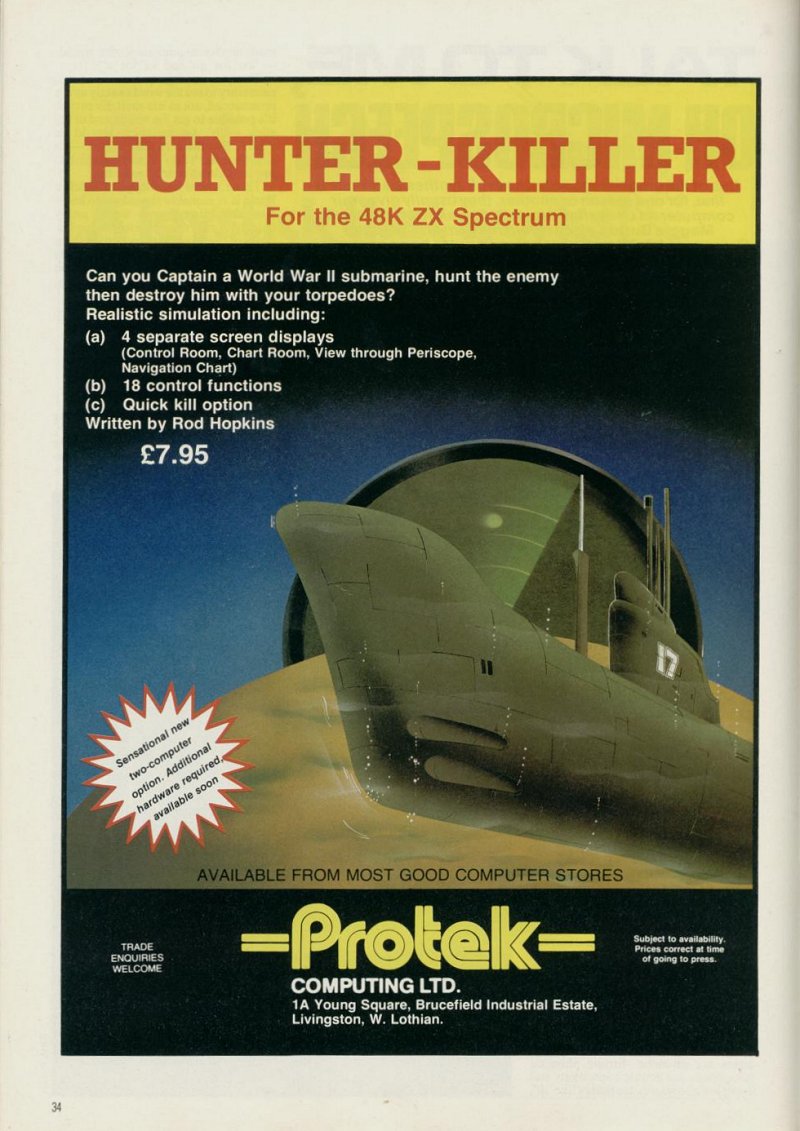
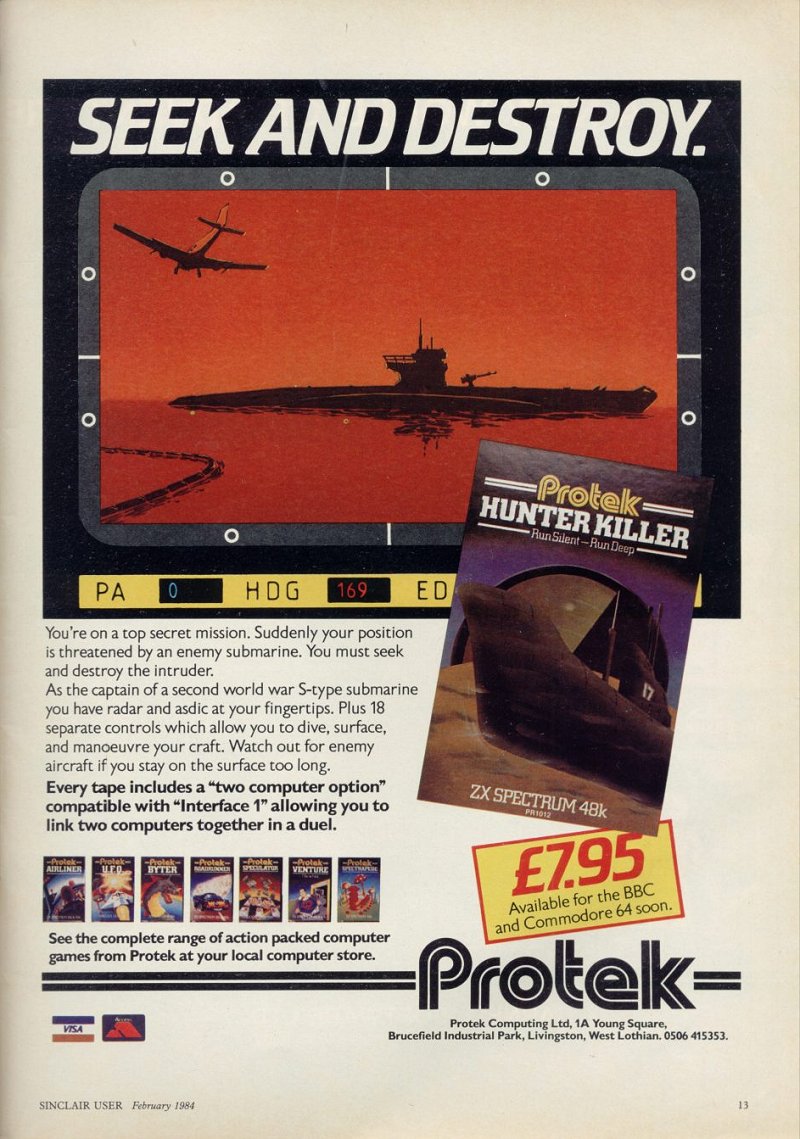
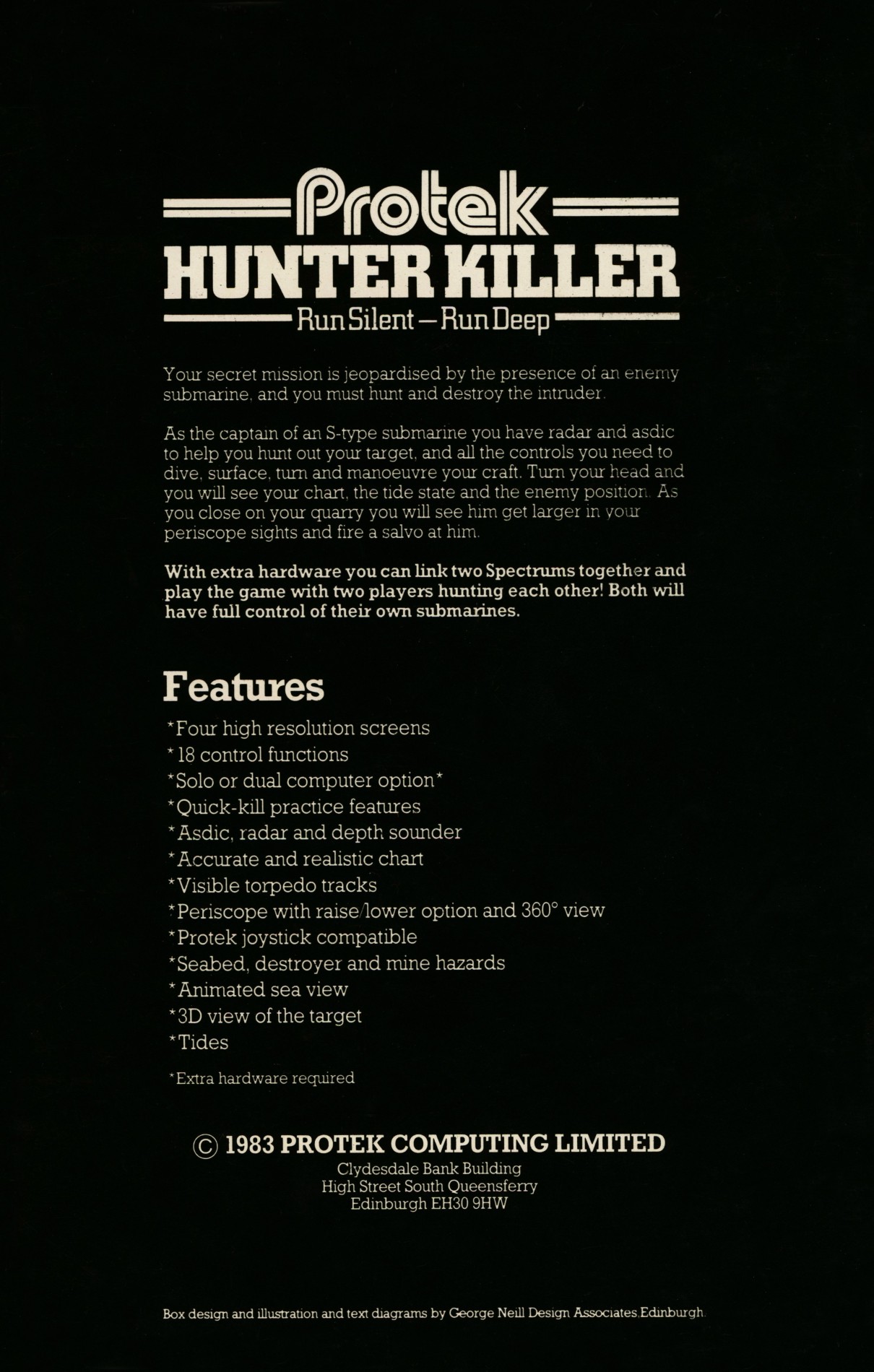
Hunter-Killer
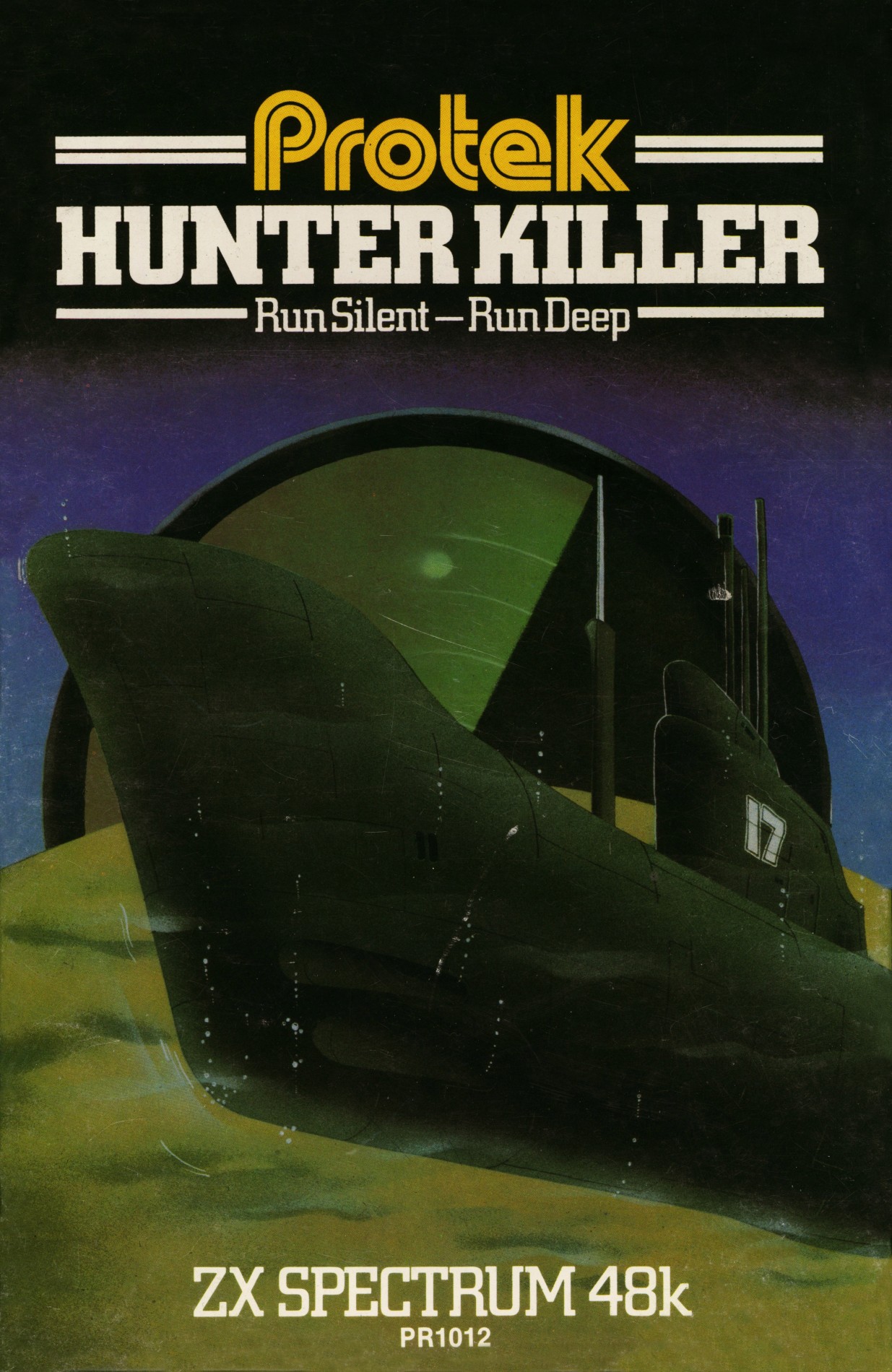
Game: Simulation · ZX-Spectrum 48K · 2 players · English
Protek Computing Ltd · 1983 · Pound sterling 7.95
Discussion
Nobody has started a thread about this yet.
Releases
- 1983Protek Computing LtdPound sterling 7.95
- 1985ABC SoftSpanish peseta 2250.00
- UnknownMicrobyte [ES]
Play
- Hunter-Killer.tzx.zipTape image English25 KB
- Hunter-Killer.tap.zipTape image English14 KB
Documents
- Hunter-Killer.pdfInstructions English49 KB
- Hunter-Killer.txtInstructions English13 KB
Files and rights
No permission is on record either way. Screens and pictures are copied here on a take-down basis: if you hold the rights and want something removed, say so and it goes.
Credits
- Rod K. Hopkinscredited
- George NeillInlay/Poster Art
Sign in to credit somebody, or say what these people did.
Scores
In the magazines
- Crash #11984 · Overall61%
- Crash #21984 · Overall61%
- Crash #41984 · Overall61%
- Personal Computer News #431984 · Overall Value4/5
Elsewhere on the web
- WorldOfSpectrum 3 votes5.67
In the magazines 33
ZX Computing #13Jun 1984 · p.58
L. Tout
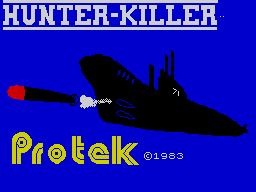
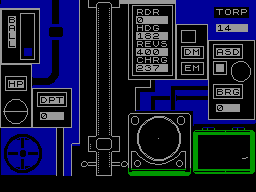
READERS' REVIEWS Once again we throw caution to the wind and air your opinions on the software currently available for the ZX machines. HUNTER KILLER Protek L. Tout Imagine you're the commander of a British "S" type submarine on an important mission off the coast of Germany and that you have to hunt and destroy enemy submarines. Well this is exactly what you do, if like me, you have bought Protek's submarine simulation program, Hunter-Killer. On loading an impressive picture showing a submarine launching a torpedo is drawn. You are then asked if you would like a quick practice shot at a submarine. Because the program is a simulation, there is a lot of cunning strategy involved. In all there are 18 keys to master, which I found did not take long although finding the enemy took a little longer owing to some confusion over bearings. but they soon disappeared. Your craft has two engines; one diesel and one electric. On the surface you should use the diesel engine but because this needs air to run, the electric engine is used under water. However, if the submarine stays down too long you won't be left with enough power to surface and recharge, so an eye must be kept on the battery charge indicator. The speeds for the diesel and electric engines are 16 and 9 knots respectively, so it's better to use the diesel engines to reach the enemy more quickly. To make the submarine dive, the ballast tanks must be flooded using key N, and the hydroplane angle altered, using key 6. To stop diving and remain at a constant depth, the hydroplanes must be horizontal and the ballast tanks emptied. Surfacing can be accomplished by blowing the tanks (key B) and raising the hydroplanes (key 7). Every submarine has to have a periscope and this one is no exception. Key P raises and lowers it and key V lets you look through it. The water level is shown (which corresponds to your depth) and the enemy, if in visual range. Along the bottom of the screen are shown the periscope angle, your heading (so many degrees from North), the distance to the enemy and the torpedo count. Key O turns the periscope clockwise and key i, anticlockwise. To help with navigation there are three types of radar; long range (22 miles), short range (4 miles) and an echo sounder which gives the familiar, hollow echo sound, when the submarine is below 15 feet in depth. There are three high resolution screens shown. All the gauges and dials are shown in the control room which is scrolled sideways on pressing key C, to take you into the Chart Room. The other screen is your view from the periscope. In the Chart Room a map shows the area which you are in and part of the German Coast. Also shown are a tide indicator which tells you its strength and direction, the enemy's last reported position, your position and places where there are mines lurking. Once the enemy is in range (three miles) and is dead ahead, pressing T will prime the torpedos and fire the first one. Second and subsequent torpedos are then fired using key F. Their speed is 45 knots and when you peer through the periscope, a bubble track can be seen heading towards the enemy submarine (or not as the case may be). If your aim is true, the submarine can be seen exploding. Since you are in enemy waters you also encounter aerial attacks. Through the periscope a plane can be seen and heard and then a klaxon sounds. If this happens you have roughly two minutes to dive below 30 feet before you see the screen shake due to the shock waves from the depth charge dropped by the plane. If you fail however, there is the sound of rushing water and which ever room you are in slowly fills up with water. The sound effects are brilliant. Hunter-Killer has five levels of difficulty and a manual is supplied with the program. A unique feature of this game is to let you play against a friend, each hunting the other but alas, this can only be done if you have a Microdrive to link both Spectrums. One other drawback is that it takes a long time to reach the enemy but this is because it's a simulation program and Protek have based your submarine on a British "S" type craft with true speeds of 9 and 16 knots, nevertheless, this is a very small snag in an excellent program. I have only given you the bare facts of how to play the game, but there are many more factors which contribute to the need of intricate strategy. This in itself gives the game millions of variations. Hunter-Killer is for the 48K Spectrum and is priced at £7.95.
Crash #4May 1984 · p.6861%
Overall 61%
Producer: Protek, 48K £7.95 (1) Author: Rod Hopkins This is a submarine simulation game set off the coast of German Helegoland (North Sea) during the Second World War. You are commander of an 'S' type submarine and your mission is to find an enemy sub in the same area and hunt it down. Sailing too close to the coast may result in your hitting a mine or running aground. 3 screens show you the control room, the chart room and the periscope view of the surface. The instrumentation is quite complex, including ballast indicator, hydroplanes, battery charge, engine speed, rudder angle, heading, asdic, echo sounder and much more. In the periscope you may see enemy shipping and enemy aircraft which will hunt you if you stay on the surface too long. Under water you use electric engines and recharge the batteries on the surface, when you use a diesel engine. The accompanying booklet is very detailed and essential reading. Good graphics and realistic sound, real time operation. Overall CRASH rating 61% BASIC and M/C.
Crash #2Mar 1984 · p.6261%
Overall 61%
Producer: Protek, 48K £7.95 (1) Author: Rod Hopkins This is a submarine simulation game set off the coast of German Helegoland (North Sea) during the Second World War. You are commander of an 'S' type submarine and your mission is to find an enemy sub in the same area and hunt it down. Sailing too close to the coast may result in your hitting a mine or running aground. 3 screens show you the control room, the chart room and the periscope view of the surface. The instrumentation is quite complex, including ballast indicator, hydroplanes, battery charge, engine speed, rudder angle, heading, asdic, echo sounder and much more. In the periscope you may see enemy shipping and enemy aircraft which will hunt you if you stay on the surface too long. Under water you use electric engines and recharge the batteries on the surface, when you use a diesel engine. The accompanying booklet is very detailed and essential reading. Good graphics and realistic sound, real time operation. Overall CRASH rating 61% BASIC and M/C.
Crash #1Feb 1984 · p.9665%69%50%74%50%58%61%
Use of Computer 65%
Graphics 69%
Playability 50%
Getting Started 74%
Addictive Qualities 50%
Value For Money 58%
Overall 61%
Unknown
Unknown
Unknown
Producer: Protek Memory Required: 48K Recommended Retail Price: £7.95 Language: machine code and BASIC Author: Rod Hopkins Hunter-Killer is a submarine simulation game set off the German Helegoland coast of the North Sea during the Second World War. You are commander of an 'S' type submarine and your mission is to find an enemy submarine in the same area and hunt it down. The coast is heavily mined, so sailing in too close may result in hitting a mine or running aground. The simulation is quite detailed. Three screens show you the control room, periscope view and chart room. In the control room you can see the ballast tank level indicator, the hydroplane angle, battery charge, engine speed, rudder angle, heading, torpedoes left, engine warning light, engine indicator, asdic display, echo sounder display, radar display, periscope, and the depth meter. The periscope view shows you the horizon and enemy shipping or aeroplanes if any are about. Below are indicators for periscope angle (which can be turned in either direction), heading, distance to enemy and torpedoes left. The chart room is accessed by pressing the C key - the control room slides across and is replaced by the charts. Apart from the map, details shown are tide indicator, compass rose, indication of position, minefields, enemy position, speed of submarine and tide strength. The asdic comes on automatically at a depth of 10 feet or more and you can hear it pinging. On the surface the radar is automatically switched on. It has a range of 22 miles and you can see the sweep of the antenna. Enemy aircraft are hunting for you. If you spend too much time on the surface they will spot you and then a klaxon sounds, giving you only two minutes to dive below 10 feet to safety. All diving and surfacing commands must be carried out properly as in a real submarine. So too must the firing of torpedoes. Another realistic feature is the use of twin engines, diesel for on the surface and electric for under water. Using the diesel underwater results in damage. If you stay under water too long the electric engine's batteries will run down and require recharging on the surface. This game can be played with two Spectrums each fitted with Sinclair Interface 1 and their own tv screens. Then each player has his own submarine and can pit his wits against the other. The game includes instructions for solo and dual play. Timing and synchronisation are obviously very important in this unique mode to avoid error reports popping up. COMMENTS Keyboard positions: complicated, 18 keys in use Joystick options: Protek (naturally) or AGF for direction Keyboard play: slow to react, but hardly essential in a real time game. Use of colour: good Graphics: good and detailed, but poorer in periscope Sound: not much, klaxon, asdic and a nice gurgling if you're hit Skill levels: 5 Screens: 3
The control room (part seen) is to the left of the map room.
Personal Computer News #43Jan 1984 · p.614/54/55/54/54/5
Lasting Appeal 4/5
Playability 4/5
Use Of Machine 5/5
Overall Value 4/5
Mike Gerrard 4/5
NAME: Hunter Killer SYSTEM: 48K Spectrum PRICE: £7.95 PUBLISHER: Protek, [redacted] FORMAT: Cassette LANGUAGE: Basic OTHER VERSIONS: None OUTLETS: Mail order, Menzies, other dealers UNDERSEA SEARCH As the software skies are now so full of flight simulators that Protek has decided to come down from out of the clouds with a splash and offer something different, a submarine simulator. OBJECTIVES They have made you Commander of an "S" type submarine lurking off the coast of Holland and Germany during World War Two, your mission to locate and sink an enemy submarine in the same patch of water. Another nice, friendly game designed to increase international understanding. FIRST IMPRESSIONS The cassette is certainly well presented, coming in a large box complete with 12-page manual and two additional instruction manuals because one of the interesting features of Hunter Killer is that it can be played in a dual game linking two machines with the networking lead provided with Interface 1, both machines needing an Interface with their own TV screens. IN PLAY The solo game offers five difficulty levels, and after choosing your level you're given the option of seeing a practice torpedo fired. You're only likely to choose this option once as the torpedo makes painfully slow progress through the water towards the enemy sub seen through your periscope. To be fair, this is the only part of the game which was slow, the rest responding pretty briskly to the keyboard or a Protek joystick. There are three screens giving you the information you need: the Control Room and Chart Room down below, both with excellent graphics. The first tasks to master are how to dive and surface successfully, which involves adjusting your ballast tanks and hydroplanes. You cannot stay underwater too long as the electric motors can only be recharged from the diesel engines on the surface. But stay on the surface too long and you risk the enemy submarine getting you first, or being spotted by a passing aircraft (this doesn't apply in the dual game.) You scroll from the Control Room to the Chart Room using the 'C' and 'X' keys, and these keyboard controls are sensibly laid out, using adjacent keys where possible, with a summary of the controls printed on the back of the instruction booklet. VERDICT An excellent simulation, and definitely not sub-standard.
Full-page ad21
- Sinclair User #25Apr 1984 · p.8
- Personal Computer Games #4Mar 1984 · p.143
- Your Computer #3Mar 1984 · p.172
- Personal Computer Games #3Feb 1984 · p.160
- Sinclair User #23Feb 1984 · p.13
- C&VG (Computer & Video Games) #27Jan 1984 · p.119
- Your Spectrum #1Jan 1984 · p.34
- Your Computer #1Jan 1984 · p.259
- Sinclair User #22Jan 1984 · p.47
- C&VG (Computer & Video Games) #26Dec 1983 · p.127
- ZX Computing #10Dec 1983 · p.89
- Your Computer #12Dec 1983 · p.179
- Personal Computer Games #2Dec 1983 · p.145
- Sinclair User #21Dec 1983 · p.15
- Personal Computing Today #4Nov 1983 · p.79
- C&VG (Computer & Video Games) #25Nov 1983 · p.71
- Your Computer #11Nov 1983 · p.255
- Sinclair User #20Nov 1983 · p.43
- Sinclair User #19Oct 1983 · p.10
- ZX Computing #9Oct 1983 · p.155
- Your Computer #10Oct 1983 · p.93
News/Note3
- ZX Computing #11Feb 1984 · p.85
- Games ComputingFeb 1984 · p.12
- Popular Computing Weekly #41Oct 1983 · p.5
Letters2
- Sinclair User #28Jul 1984 · p.20
- Crash #2Mar 1984 · p.10
Review1
- MicroHobby #12Jan 1985 · p.16
Feature1
- Computer ChoiceMay 1984 · p.31
Related
- Versions
- U-Boat Hunt (Derived from)
- Same entry at
- Spectrum ComputingZXInfo
Reviews from people here
Sign in to write about this, or make an account. It takes a minute and lets you correct the catalogue too.
No description recorded.
Sign in to correct or add to this.
Hold the rights to this and want it taken down?