
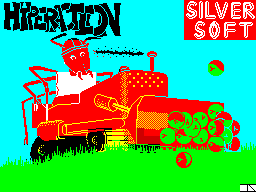
Hyperaction
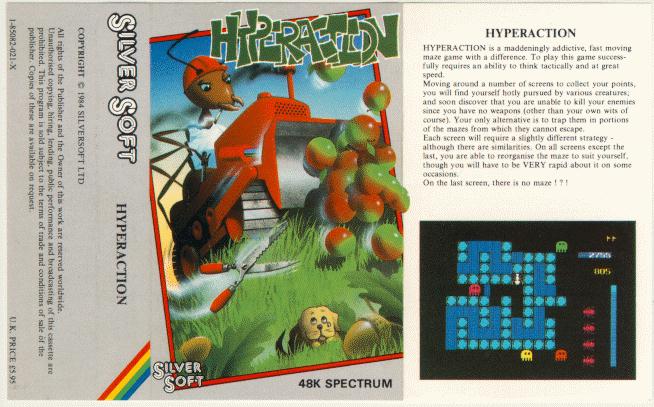
Arcade Game: Action · ZX-Spectrum 48K · 1 players · English
Silversoft Ltd · 1984 · Pound sterling 5.95
Discussion
Nobody has started a thread about this yet.
- Control Option
- Cursor, Interface 2 (right), Kempston Joystick
Play
- hyperaction.zipRZX playback file
- Hyperaction.tzx.zipTape image English24 KB
- Hyperaction.tap.zipTape image English14 KB
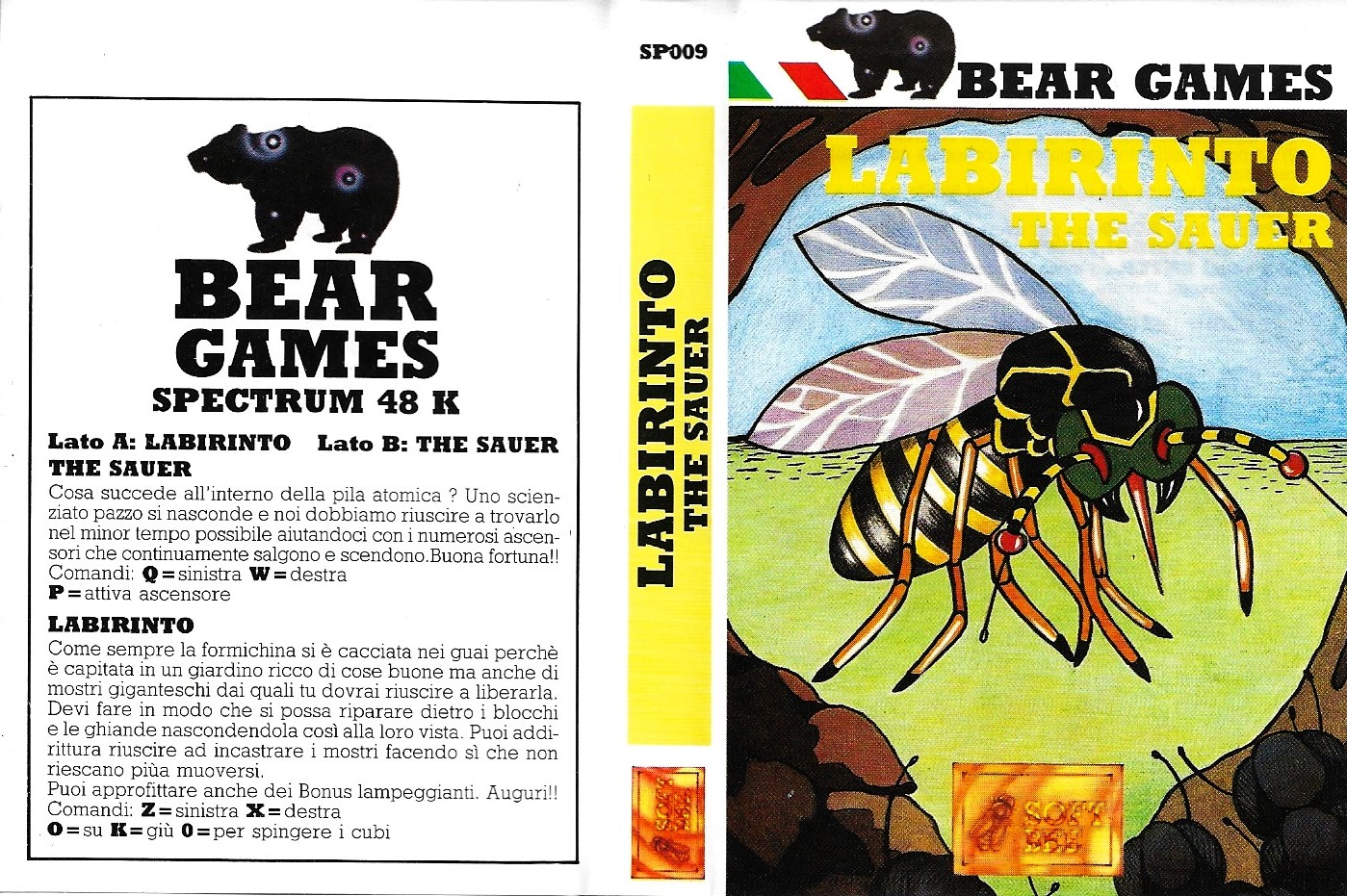
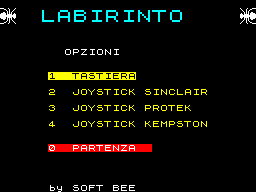
- Labirinto.tzx.zipTape image Italian9 KB
Documents
- Hyperaction.txtInstructions English2 KB
Other files
- Hyperaction (1984)(Silversoft).pokPOK pokes file 0 KB
Files and rights
Distribution permission is on record, granted to another archive rather than to this one. Screens and pictures are copied here; everything else links to the archive that holds it.
- AllowedSilversoft Ltd → WorldOfSpectrum
Credits
- Iain Christopher Haywardcredited
- Jay Derrettcredited
Sign in to credit somebody, or say what these people did.
Scores
In the magazines
- Crash #91984 · Overall84%
- Personal Computer Games #121984 · Overall7/10
Elsewhere on the web
- WorldOfSpectrum 23 votes7.95
In the magazines 16
Crash #21Oct 1985 · p.51
Lloyd Mangram
Robin Candy
Use of Computer: 77% Graphics: 82% Playability: 89% Getting Started: 80% Addictive Qualities: 91% Value for Money: 85% Overall: 84% Hyperaction followed hot on the heels of Silversoft's previous release Worse Things Happen At Sea, but instead of a totally original game they turned back to using a more traditional arcade type of game. Hyperaction is best described as a 'Pengo' meets 'Pacman' type game. You move around a randomly generated screen collecting objects (usually four) but you have some nasties chasing along after you. What makes Hyperaction is that you can't actually kill the baddies only trap them by pushing the blocks that form the maze in their path. Each screen is a game in its own right and subsequently has its own problems - sometimes collecting the objects will be enough to finish that screen or it might require you to eat all the blue out of the Artic Jelly fish. Pushing the blocks is easy enough, just press fire and push the block in the direction you wish it to go; should the block meet the edge of the screen or another block then a further push will burn the block away. The blocks are an important of the game but on the last screen there are none and you have to survive on skill and speed alone. Hyperaction is certainly the name of the game for this horrendously fast 'Pengo' variant. The graphics are very colourful and move smoothly, which makes this game a treat to watch. Sound is used well and the whole game has a very polished look to it. Hyperaction is highly playable and quite addictive though it is probably a bit too hard. Overall it is still a good game by today's stanndards and will doubtlessly appeal more to the younger players. RC Silversoft took a bit of risk with this one, using older ideas and simple looking graphics, but they certainly aimed to make a tough, fast and highly addictive game and they succeeded. Because of those rather 'timeless' qualities, it has hardly aged at all and still represents excellent fun for anyone with fingers sufficiently nimble and eyes adequately bright LM (Rob) I would keep the playability the same and lower all the other ratings by 10%. (Lloyd) On the whole I think I would leave well alone, except on the graphics, which in all fairness are not worth the rating they got, but that was probably due to the system then in use in CRASH.
ZX Computing #17Feb 1985 · p.6265%75%85%80%8/108/10
Instructions 65%
Presentation 75%
Addictability 85%
Value For Money 80%
ZXC Factor 8/10
David Harwood 8/10
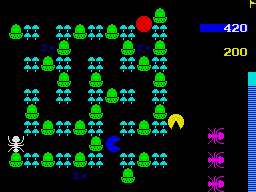
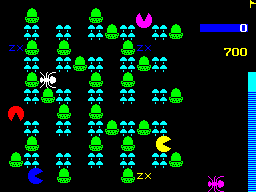
Now we come onto Hyperaction, a game of intrigue and wits for the 48K Spectrum. Produced by Silversoft, we should expect an arcade quality game, but do we have it? First of all, a minus. In these days of first impressions etc, etc, etc, an introductory screen is very important. It not only makes the waiting for the program to load acceptable, but it also impresses the player with a taste of the game to follow. This game has got various screens, although I only managed to progress to the second, but perhaps those with nimble fingers or joysticks should get onto to more. You are a spider with only 6 legs, I suppose the Spectrum's graphics handling made the decision on the last two and are faced initially with a grid, which turns into a random maze after the computer has knocked out various holes. In the first screen there are acorns and mushrooms along the path of the maze with the letters ZX hanging around the screen. Your task is to gather all the ZX's in order to get to the next level. Pacmen have been sent in order to prevent you from doing this and they have been well trained in their mission. You can change the paths of the maze by forcing the acorns to form different paths, but you need to be careful not to force an acorn onto a ZX or a Pacman as you will lose a life. The first screen is very hard to master at first, but once you get the idea it is very hard to stop playing. You need to design your own way of approach, but I decided to block out the opposing pacmen in the first screen, by moving the wall and then gathering the ZX's. The same idea is on screen 2, but there are Arctic Jellyfish instead of Pacmen and this time you have to cover all the blue ground on the screen (ice), but as you are still in the maze, you can move walls etc. If the first two screens are anything to go by, the rest should be very good, I am still trying to get onto screen 3. There is quite a bad point in between each new attempt, there is a delay while you are introduced to Pacmen, Jellyfish etc, and the name of the next screen, but this should not hinder your excitement. Hyperaction is an excellent and original arcade game, with Sinclair, Cursor and Kempston joystick compatibility.
Your Spectrum #10Dec 1984 · p.613/5 HIT3/5 HIT4/5 HIT
Dave Nicholls 3/5 HIT
Roger Willis 3/5 HIT
Ross Holman 4/5 HIT
JOYSTICK JURY What's on your software shopping list for Christmas? Let Ross Holman, Dave Nicholls and Roger Willis help you make your mind up! This month, our motley crew of Joystick Jurors include Dave Nicholls, a self-confessed adventure fanatic and seasoned hacker; Ross Holman, ace games player and winner of the Jet Set Willy prize; and, last but by no means least, Roger Willis, a relative newcomer to the Spectrum scene. Dave and Ross you'll already know from our monthly major games reviews. Roger Willis, on the other hand, is probably more at home in the saddle of a massive motorbike... but that was before he discovered the thrills and spills of the Spectrum. Check out what they thought of the latest in games software... HYPERACTION Silversoft £5.95 Ross: Silversoft's more recent output has tended to be colourful, well writen and fun to play - and Hyperaction is no exception. At first glance it seems a sort of cross between Pacman and Pengo, but it's actually different again. To begin with, each screen cleared means another almost totally different game, strategy-wise. In screen one you're a spider in a maze consisting of blocks of greenery separated by patches of mushrooms. Also tucked up inside the maze are four 'ZX' symbols and the object is to collect all of them and return pronto to the centre of the maze. The only problem is that Pacmen also live in said maze and if they touch you - whoops, there goes another life. You can push around the blocks of greenery to alter the maze and block in the Pacmen - but watch out! The next game has you trying to destroy all the blue maze pathways by walking over them. The following screens are variations that get increasingly more difficult. I couldn't get past screen five, where marauding 6502 chips soon polished me off. Good graphics and a fun game. Careful thought is needed if you're going to be good at it.
Sinclair Programs #25Nov 1984 · p.32
June Mortimer
AS THE CHRISTMAS SOFTWARE GOES ON SALE SPECTRUM OWNERS ARE SPOILED FOR CHOICE. There was a time when the Spectrum software market was full of games involving ice blocks and penguins, the idea of which was to protect the player by sliding ice cubes around the screen. Hyperaction from Silversoft takes this theme one step further. Each level of the game involves a maze in which blocks must be shuffled around for protection. The aim of the game is sometimes to cover four points, sometimes to reach five, and sometimes to eliminate one colour from the board. The common denominator is the maze. On each level you begin with several lives and, if you fail at a maze, it will be redrawn in a different pattern. The chances are that you will see a very large amount of versions of the first few mazes, without seeing the later ones more than once or twice. If your ambition has always been to be reincarnated as a penguin, then this game is for you. If mazes and monsters drive you screaming up the wall, as is more probably the case these days, then avoid it like the plague. Hyperaction was written and produced for the 48K Spectrum by Silversoft, [redacted] and costs £5.95.
Personal Computer Games #12Nov 1984 · p.847/106/104/107/107/107/10
Graphics 7/10
Sound 6/10
Originality 4/10
Lasting Interest 7/10
Overall 7/10
Bob Wade
Martyn Smith
Peter Walker 7/10
Samantha Hemens
MACHINE: Spectrum 48K CONTROL: Keys, Sinc, Curs, Kemp FROM: Silversoft, £5.95 At first glance, Silversoft's latest Spectrum release appears to be nothing more than a hybrid of Pacman and Pen go. However, play it a few times and you realise it offers a totally new and quite entertaining challenge. The idea is fairly simple. You play the part of a nicely-drawn spider who must travel around a randomly generated maze either collecting objects or filling in the corridor in a certain colour. Naturally you are not alone, the maze being populated by the four obligatory nasties (thankfully not ghosts) who chase you in the usual anti-social manner. However you can push the walls of the maze across passages, changing its shape and trapping nasties. You must be careful not to crush either them or the objects you must collect, for this loses you a life. Thus a significant strategy element is introduced, half the tactics being to trap the creatures in a small part of the maze, allowing you a clear run. Silversoft have also apparently caught the Minter disease, for the stages have such names as 'Return of the Jelli' and 'Attack of the Mutant Chips'. Graphically, the game is done well, with detailed backgrounds and smoothly animated characters. The sound isn't a let down either, with some quite, satisfying noises being coaxed out of the Spectrum's pitiful speaker. The spider is very easy to control and even if you don't own one of the supported joystick interfaces, the keys are sensible enough. Overall, Hyperaction is a really rather playable game, the arcade feel being tempered by an interesting strategic element. There are a number of screens, each with randomly generated mazes, so the program's appeal should last. Nice one Silversoft.
Crash #9Oct 1984 · p.10277%82%89%80%91%85%84%
Use of Computer 77%
Graphics 82%
Playability 89%
Getting Started 80%
Addictive Qualities 91%
Value For Money 85%
Overall 84%
Unknown
Unknown
Unknown
Producer: Silversoft Memory Required: 48K Retail Price: £5.95 Language: Machine code Author: Iain Hayward Silversoft produced a highly successful oddity of a game in Worse Things Happen At Sea - a recent CRASH SMASH. Now they return to more traditional arcade pastures with Hyperaction - the name of the game is in the name of the game, a fast and furious compilation of ideas which have been put together in such a way that they transcend the individual ingredients. If you want an identifying slot for Hyperaction, then it would be Pengo meets Pacman, a randomly generated series of mazes in which certain of the square blocks can be pushed or burned away so that 'you' can score points while avoiding the chasers. What is attractive about Hyperaction is that each maze is in effect a different game with changed game rules. Sometimes, having collected the objects on screen (usually four), you may have to make your way to the centre of the screen and a flashing block to get to the next level, sometimes just completing the task like eating all the blue in Artic Jellyfish, is enough. Each screen has its own title like Snapper Trapper, Artic Jellyfish, The Hampton Nightmare, Return of the Jelli, and so on. One rule which is standard is that you must not push a block over a useful or collectible item, nor over a chaser, or you lose a life. This means you have no weapons and must survive on skill, speed and a good eye. Another point is the time limit for each screen, which affects your score and that all important hi-score overall. If it runs out completely then you lose another life. Pushing the blocks around is simple enough using direction and fire. The blocks, unlike in a Pengo game, only move one square per push, so they can be used easily enough for tactical blocking. Should a block meet another block or the screen edge, then a further push will burn it away. COMMENTS Control keys: Z/X left/right, O/K up/down, 0 to push Joystick: Cursor, Kempston, Sinclair Keyboard play: very responsive and good positions Use of colour: excellent Graphics: varied, large, smooth - very good Sound: very good Skill levels: 1 Lives: 5 Screens: many
The first screen, 'Snapper Trapper'.
Review5
- Games ComputingFeb 1985 · p.52
- Personal Computing Today #6Jan 1985 · p.67
- TV GamerJan 1985 · p.47
- Home Computing Weekly #84Oct 1984 · p.28
- Popular Computing Weekly #40Oct 1984 · p.24
News/Note3
- ZX Computing #16Dec 1984 · p.60
- Personal Computer Games #11Oct 1984 · p.14
- Your Spectrum #6Aug 1984 · p.34
Related
Reviews from people here
Sign in to write about this, or make an account. It takes a minute and lets you correct the catalogue too.
No description recorded.
Sign in to correct or add to this.
Hold the rights to this and want it taken down?