
Arcadia
Arcade Game: Shoot-em-up · ZX-Spectrum 16K · 1 players · English
Imagine Software Ltd · 1983 · Pound sterling 5.50
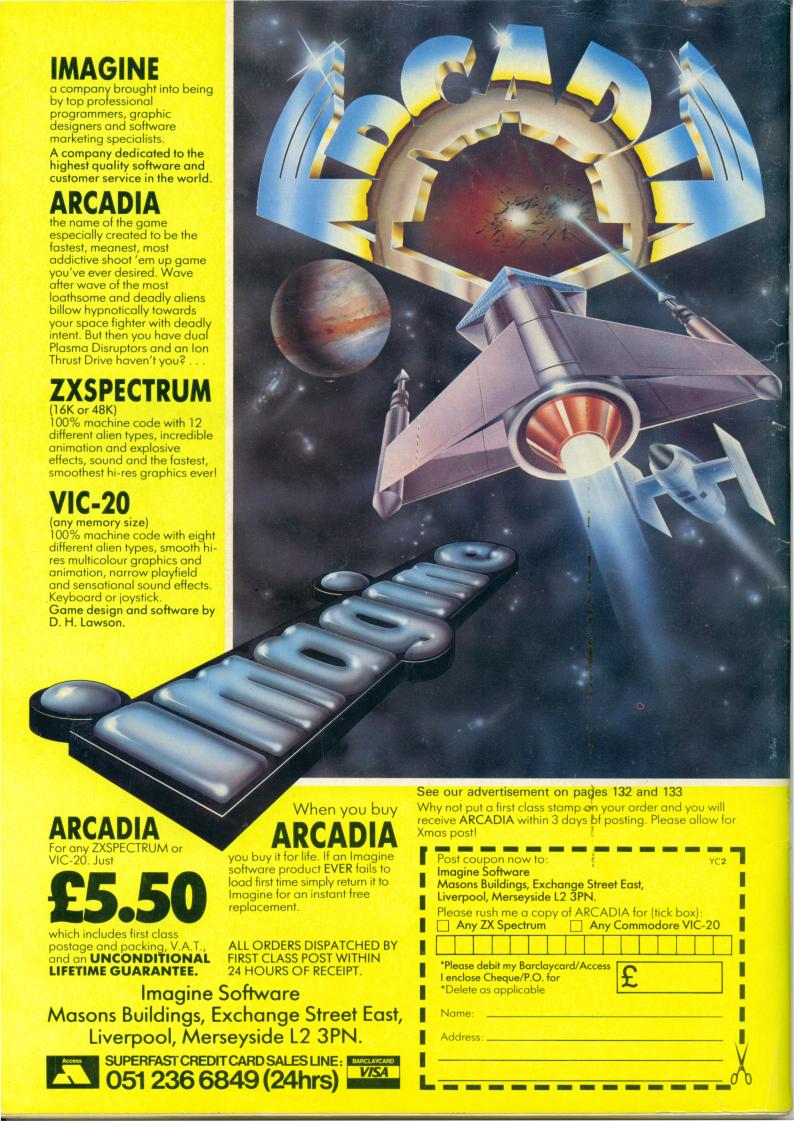

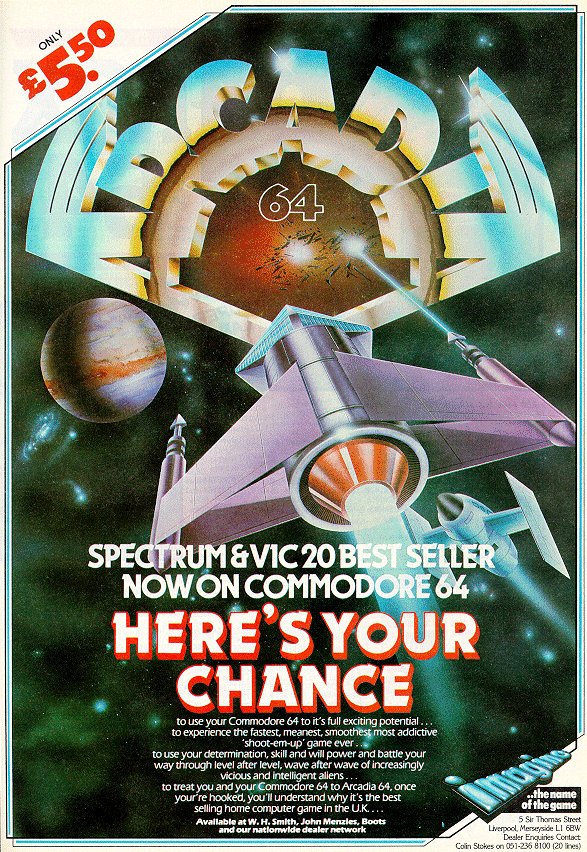
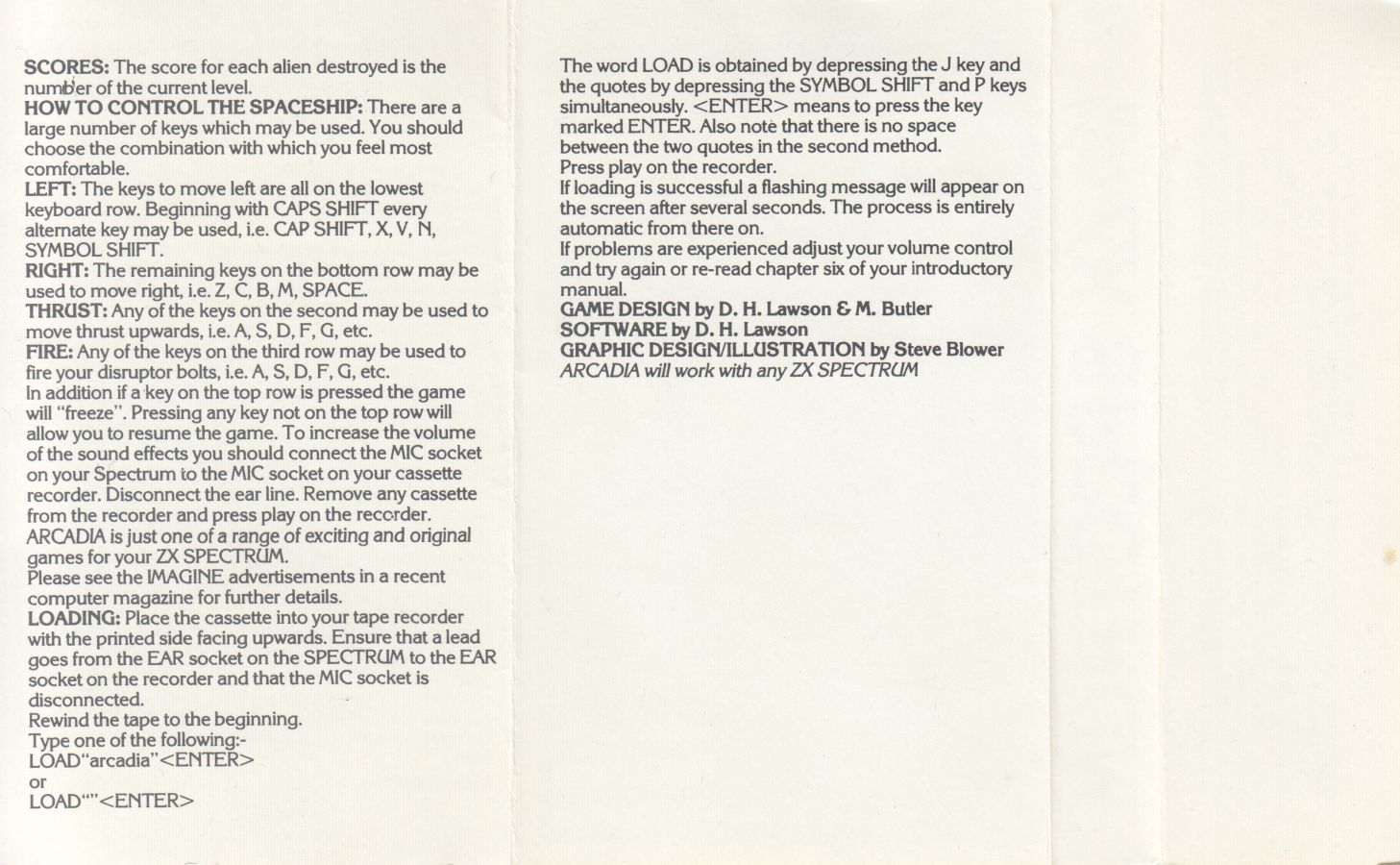
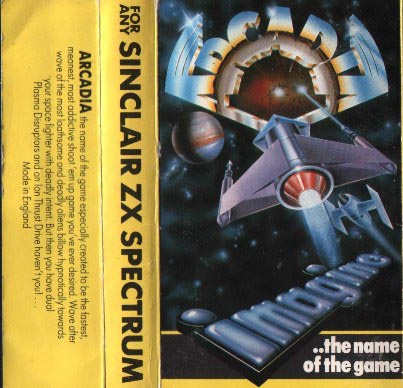
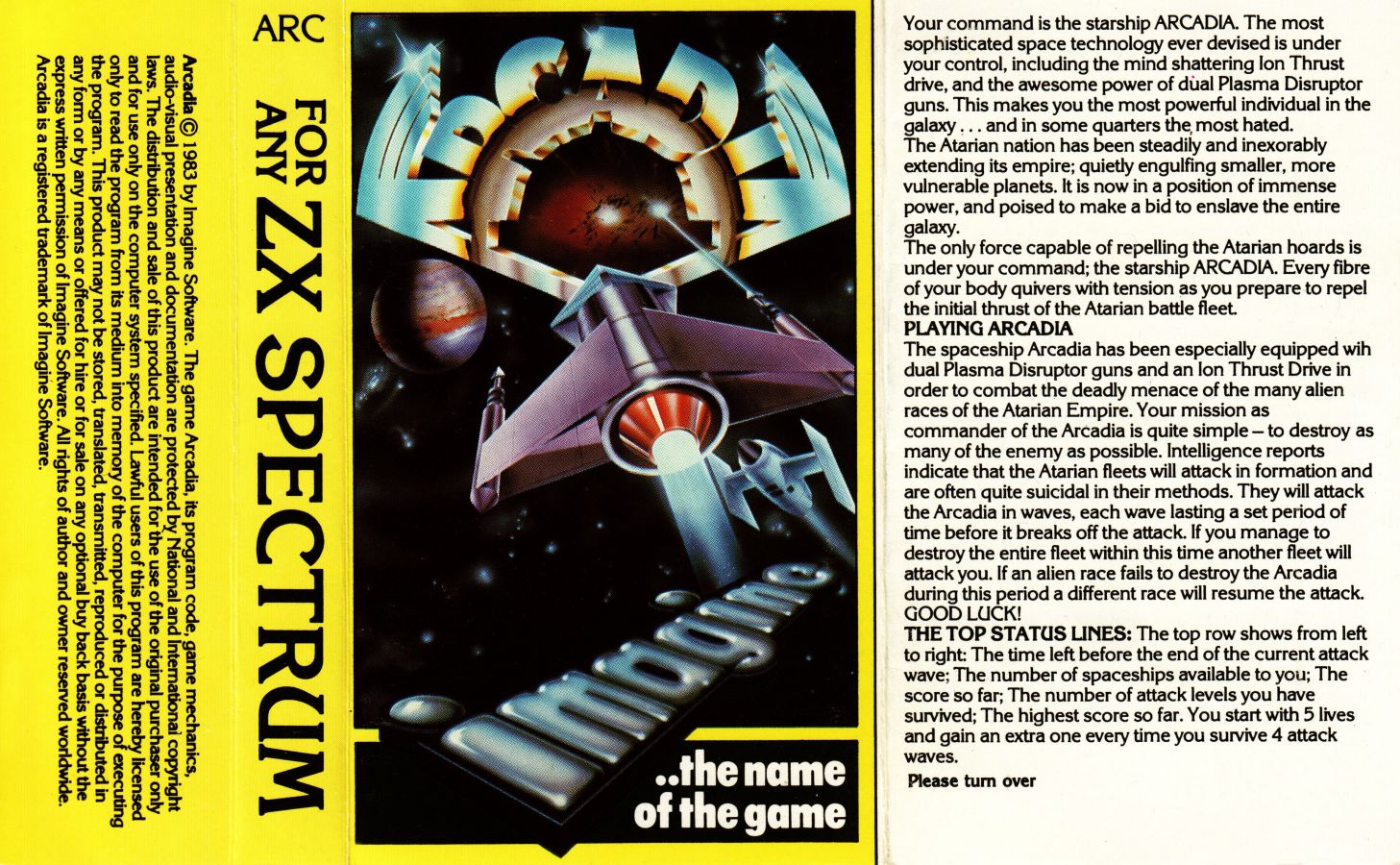
.jpg)
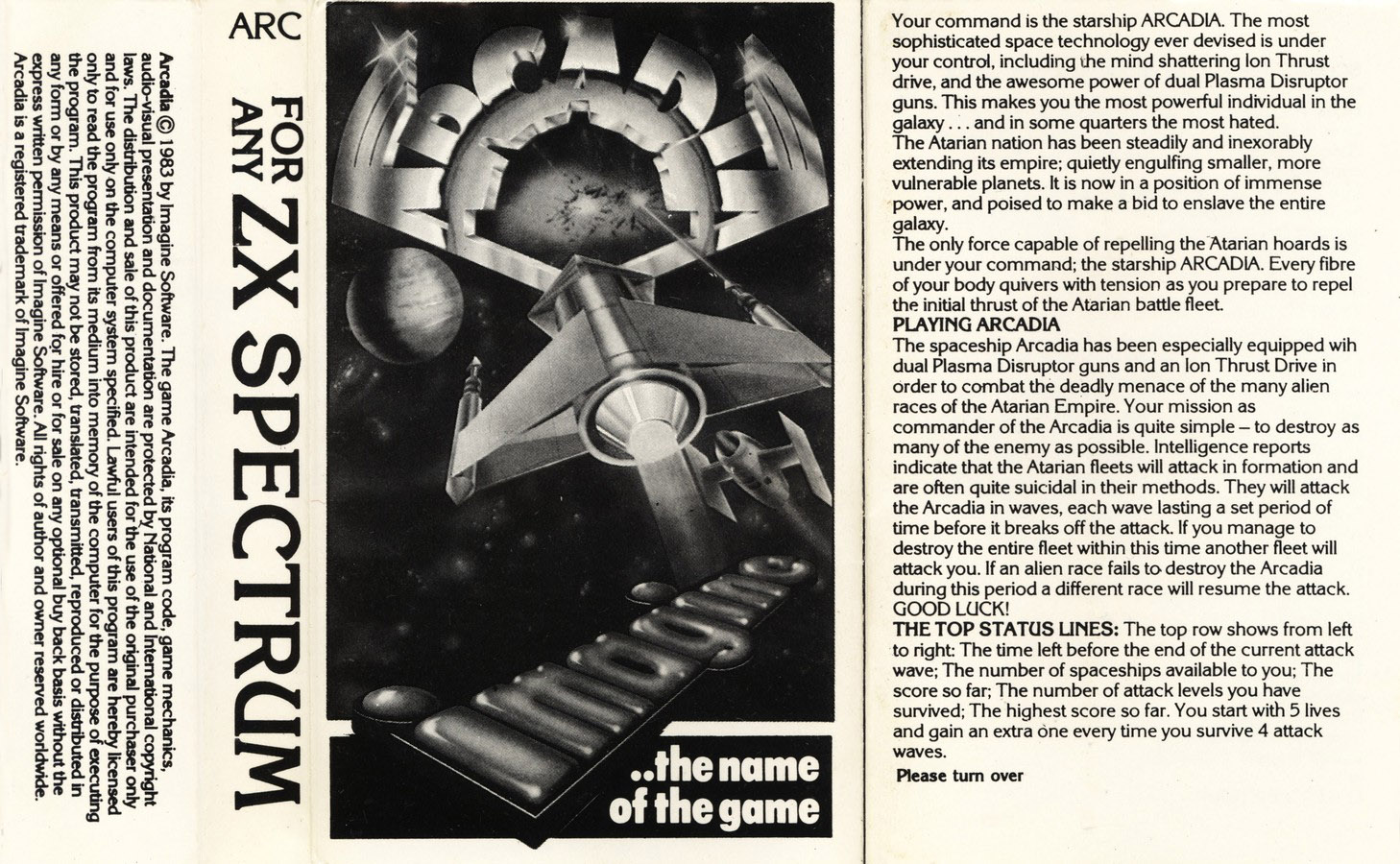
_Tape.jpg)
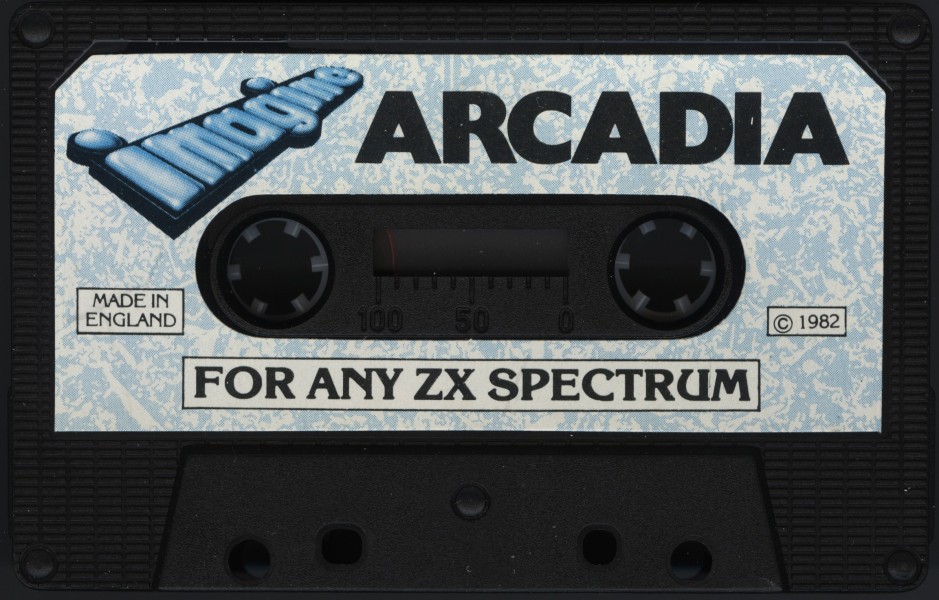
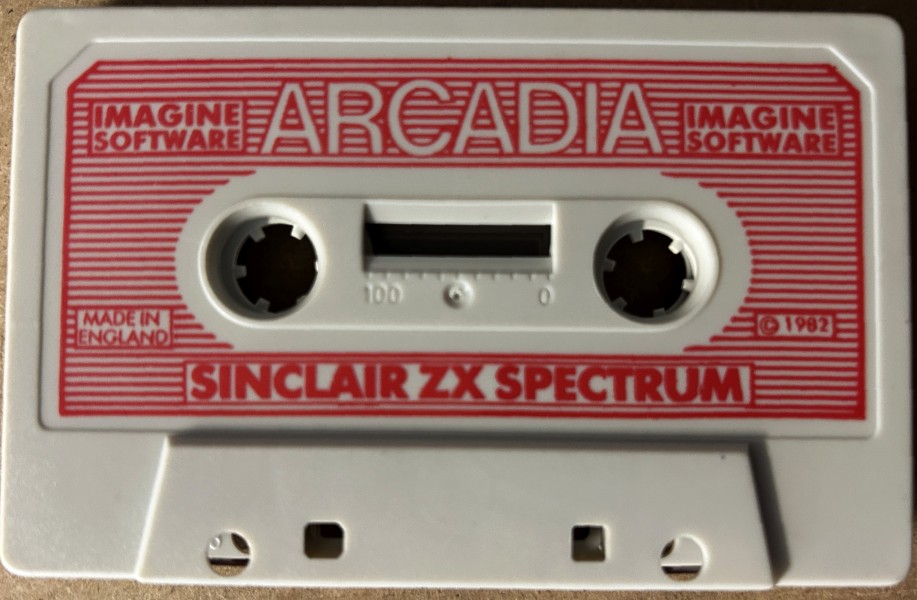
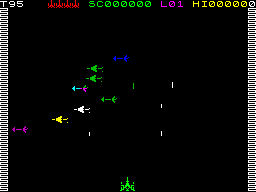
Discussion
Nobody has started a thread about this yet.
Awards
Rank #47 - 1984 Sinclair User Top 50 Spectrum Software Classics
Releases
- 1983Imagine Software LtdPound sterling 5.50
- 1983ABC SoftSpanish peseta 1495.00
- 2020Bumfun SoftwarePound sterling 12.00
Play
- Arcadia.tap.zipBUGFIX tape image English6 KB
- arcadia.rzxRZX playback file
- Arcadia.tzx.zipTape image English6 KB
- Arcadia.tap.zipTape image English8 KB
- Arcadia(alternate).tzx.zipTape image 6 KB
Documents
- Arcadia.txtInstructions English1 KB
Other files
- Arcadia (1982)(Imagine Software).pokPOK pokes file 0 KB
Files and rights
No permission is on record either way. Screens and pictures are copied here on a take-down basis: if you hold the rights and want something removed, say so and it goes.
Credits
- Mark ButlerGame Design/Concept
- D.H.L.Code
- D.H.L.Game Design/Concept
- Steve BlowerInlay/Poster Art
Sign in to credit somebody, or say what these people did.
Scores
In the magazines
- Sinclair User #161983 · Gilbert Factor5/10
- Sinclair User #321984 · Gilbert Factor5/10
Elsewhere on the web
- WorldOfSpectrum 41 votes7.45
Awards and competitions
C&VG Spectrum Top Ten 1983
Golden Joystick Awards 1983
- 3Best Arcade-Style Game of the Year
- 4Game of the Year
In the magazines 92
Sinclair User #32Nov 1984 · p.495/10
Gilbert Factor 5/10
When Arcadia burst on an unsuspecting world it was hailed as the most addictive shoot-em-up game ever written. The graphics were said to have achieved new heights in Spectrum arcade games. Comparing the game to current standards it is hard to see what all the fuss was about. The graphics now seem crude and the game itself a simple Space Invaders variant with twelve screens of aliens. Despite shortcomings, it is nevertheless incredibly addictive and very fast moving. It was a huge success and launches Imagine on a course which led to the top of the software industry and eventually to disaster. Position 47/50
Crash #3Apr 1984 · p.62
Producer: Imagine, 16K £5.50 Generally considered to be the best shoot 'em up game around. Aliens come in droves from the right, each wave more suicidal than the last. Continuous fire and thrust (to half the screen height only) with good keyboard positions. Excellent hi-res smooth graphics. Joystick: Kempston (and Softlink II) or Fuller. Addictive and difficult to master.
Crash #2Mar 1984 · p.46
Producer: Imagine, 16K £5.50 Generally considered to be the best shoot 'em up game around. Aliens come in droves from the right, each wave more suicidal than the last. Continuous fire and thrust (to half the screen height only) with good keyboard positions. Excellent hi-res smooth graphics. Joystick: Kempston (and Softlink II) or Fuller. Addictive and difficult to master.
Crash #1Feb 1984 · p.46
Producer: Imagine, 16K £5.50 Generally considered to be the best shoot 'em up game around. Aliens come in droves from the right, each wave more suicidal than the last. Continuous fire and thrust (to half the screen height only) with good keyboard positions. Excellent hi-res smooth graphics. Joystick: Kempston (and Softlink II) or Fuller. Addictive and difficult to master.
Crash #1Feb 1984 · p.4090%90%90%
Use of Spectrum 90%
Addictive Qualities 90%
Value For Money 90%
Chris Passey
Lloyd Mangram
Memory Required: 16K RRP: £5.50 Dual Plasma Disruptors and Ion Thrust Drive' is how Imagine describe the good ship Arcadia. They aren't far wrong. This highly manoeuvrable ship has enough fire power to send the average aliens packing. Alas these are not average aliens (Atarian Battle Fleet with Imagine's usual touch of humour). Twelve attack waves, each wave for a set period of time, each more suicidal than the last, It's highly addictive, with superb graphics (fantastic coloured explosions) and the sound is good too. Definitely up to arcade standards. CHRIS PASSEY Although graphically this is more simple looking than The Detective, it has to be considered as one of the shoot 'em up classics. They've given you a certain area of up/down movement as well as left/right. Each wave of aliens gets lower and lower, zooming in from the right each time. Keyboard positions are sensible, but you can use a Kempston joystick with the utility Softlink II, and Fuller joystick. If you enjoy the sort of games we're discussing here, then I think this is going to be considered as one of the most addictive. LLOYD MANGRAM
Personal Computer Games #1Sep 1983 · p.97
Steve Mann
MACHINE: Spectrum SUPPLIER: Imagine PRICE: £5.50 Now this really is something special. The bright young things at Imagine have confidently pledged themselves to the production of totally original arcade-style software for a variety of home machines - no Pacman rip-offs here. First impressions of Arcadia are of a high degree of professionalism. The colourful cassette insert credits the game and graphics designers; take a bow, D Lawson and M Butler. Arcadia also offers a lifetime guarantee. If one of their games fails to load it will be replaced at once, free of charge. This is certainly a step to be encouraged. Instructions for setting up are clear and concise, and there's a touch of sly humour in that the alien beasties you are battling against belong to the Atari-an Empire. Of course, it could just be coincidence... The object of the game is fairly standard zap-the-alien stuff. The alien fleets attack in waves, and there is a timer at the top of the screen. If you manage to destroy a whole fleet before the timer reaches zero, another replaces it. Conversely, if the fleet fails to destroy your ship (the Arcadia) in this time limit, it will break off the attack and home a new wave. There is a wide choice of control keys, so it is easy to configure the keyboard to suit your particular finger-span. There is also a 'freeze' facility: any key on the top row halts execution, enabling you to take a break. Arcadia is very deceptive in the early stages. Playing the game for the first time, it is highly unlikely you'll get past the initial stage of fairly ordinary-looking alien ships. But as you improve you can appreciate the truly stunning graphics. There are 12 different waves of attackers: mutant butterflies, birds, spinning circles, octopus-type shapes, even a mini-Centipede game. If you manage to get through four levels intact, you get an extra ship (you start with five). I am told that there is someone out there who has reached the 53rd level, a claim I find hard to believe as the Atarian Empire is no soft touch. This cassette really does show that, given sufficient imagination, Spectrum graphics can match up to almost any other machine around.
Your Computer #7Jul 1983 · p.62
Meirion Jones
FROM DEEP-SPACE ADVENTURES TO WORLDLY BOARD-GAMES IN MEIRION JONES' SURVEY Less than a year ago the appearance of Scrabble on disc for the Apple caused consternation among micro owners. The program defeated three-quarters of the humans who challenged it to a dual of words. At least Scrabblers could comfort themselves with the knowledge that they had been beaten by a £750 disc-based system. Now Psion has taken even that consolation away by launching an improved version of the game with a bigger dictionary and better graphics which will run on a £150 system - the 48K Spectrum and a cassette recorder. This illustrates the rate at which Spectrum software is improving. The latest releases include clever implementations of board- games like monopoly and arcade favourites such as Scramble, long and complicated Adventures with names like Knight's Quest and combinations of arcade and Adventure like Pixel's Trader. While serious and educational material software is still thin on the ground, programs like Hewson's Countries of the World show how much useful information can be packed into the Spectrum. MORE ORIGINALITY Unfortunately the standard is not uniformly high. Sometimes imagination is lacking. Bridge software still insists on marketing what it calls "an exciting game for two to six players". Yes, you guessed, it is boring old Hangman. At other times graphics are weak. Micromega sells a version of Roulette which features a roulette wheel which looks more like a flying saucer on an off day. There is still too high a percentage of unloadable tapes and of tapes which you wished had been unloadable. Davic Games Tape 1, for instance, features a game which has Tooth Monsters instead of ghosts, which is probably the dullest-ever version of Pac-Man. The Tooth Monsters themselves are about as threatening as a pair of jelly babies. If you want real tooth monsters try Imagine's excellent Molar Maul. This is a real nerve-tingler from the moment that an enormous set of gleaming teeth appears on the screen like something out of jaws. Armed only with a toothbrush and toothpaste you have to defend these dentures from swarms of evil bacteria. These germs go by the name of Dentorium Kamikazium which allows Imagine to talk about "the DK Menace" - a triple pun partly at the expense of Imagine's Ipswich-based rivals DK'tronics. Imagine's punsters are at work again on the cover of Arcadia where we are told we are fighting against the "deadly menace of the Atarian empire". Perhaps this explains why Sinclair owners have shown such enthusiasm for Arcadia because the game itself is just a lacklustre version of Galaxians. Much better is Imagine's Schizoids. If, like me, you have always wanted to be a bulldozer, Schizoids is the game for you. You are a bulldozer in outer space and your job is to push tumbling cubes and pyramids into a nearby black hole without falling in yourself. Perhaps this nearby anomaly in the space-time continuum affects the wavelength of light. At any rate the game itself is only in black and white. Pixel is another company which cannot resist veiled messages. Trader is part space Adventure and part arcade game. The Adventure, trading commodities between different worlds, is more convincing than the crude skill tests such as finding the right orbit when approaching a planet. Trader may well be bought as much for its attractive packaging - which includes a survival guide for the would-be Trader - as for the game itself. After buying supplies for your first trip you set out for the planet Psi where the inhabitants - yes, Psions - who look like a cross between Clive Sinclair's beard and a muppet ask you tiresome questions such as "What is the formula for carbon monoxide?" or "What is your first name?". Entering "Clive" as an answer elicits the response "What a strange name". So, for that matter, does any other reply. If disaster should strike, a caption will appear saying "Is this the end...?" The answer is "No" because Trader is a trilogy so there are another two complete parts to load from the tape. There are many more traditional text Adventures of the "Go south, open door, take gold" variety but the narrowness of the replies they will accept is often irritating. DOWN THE MINES Mikrogen's Mines of Saturn starts with a cheery "Have fun" and then proceeds to ask questions like "Tunnels lead N, S, E and W - what will you do?" Attempts to answer "N" or "go N" or even "go n" will not wash. It must be "go North" or nothing. At least Phipps' Knight's Quest has a 120-word vocabulary to help you on your damsel-ridden way to a castle in the air. Everest by Richard Shepherd Software is more of a strategy game than a straight Adventure. You have to take enough food and rope to climb the mountain and cope with every hazard. I enjoyed the climb but I never reached the summit - partly because the Sherpas are not what they used to be. When Sir Edmund Hillary climbed Everest for the first time he managed to find a Sherpa called Tensing. The time when you visit a Nepalese hill village to recruit porters you are asked to choose between Sherpas with names like Keith, Brian, Ron, Tim and Paul. Presumably they are ex-hippies, lost on the road to Katmandu. Things obviously still are what they used to be down at Mikrogen. If Andy Capp sends you into fits of laughter Mad Martha might just raise a smile. It is the same old story, boy meets girl, well, hen-pecked husband meets axe-happy wife - all very predictable. Mikrogen also sells arcade games like Cosmic Raiders - a competent impersonation of Defender with a long-range screen and grabbers. Melbourne House's variation on the same theme is called Penetrator. The display looks more like the arcade version of Scramble. A training facility to help you build up specific game skills is a good idea. C-Tech's Rocket Raider is yet another competent variant on similar lines. Artic offers a suicidally fast asteroids game called Cosmic Debris. Still in the arcades, both Elfin Software and Quicksilva produce robot battles which are of the Pac-Man-meets-Tanks variety. Elfin's Tobor has the more exciting opening titles but loses on points to Quicksilva's QS Frenzy whose exotic science-fiction plot seems to offer a better justification for the game. Speaking of Tanks, DK'tronics 3D Tanx was one of my favourite programs in the whole batch. You can track you gun barrel from side to side and adjust the elevation as you lob your shells at four lines of moving tanks which can fire back at you. Although the opposing tanks at first appear to be crawling across a structure that looks more like Brighton's West Pier than a battleground, this is one of my four games you might catch me paying to play in an arcade. JOIN THE PROFESSIONALS Artic's Combat Zone is another ambitious attempt at a Tank game. Your target and the landscape - a few pyramids on an invisible plane - look like refugees from Psion's Vu-3D program. They are very simple three-dimensional shapes but they change position smoothly and realistically as if you were walking past them in some world inside your Spectrum. You and your opponents fire fragments of cubist paintings at each other but the abstraction is not so important as the fact that you are playing the first real Spectrum game in three dimensions - Vu-3D itself is a Psion program which allows you to build up three dimensional objects on the screen and then rotate them, or float them towards you and back again. In effect it is a crude version of the mainframe programs which create the effects for films like Tron. ET makes an appearance too in an Abbex Adventure with voices called ETX. Unfortunately after loading pages of instructions about how I should phone home ending with the advice that I should treat any MI5 man who appeared as an enemy, the tape self-destructed. This left me with an unnerving impression of "the strength of Britain's security services. The secret police are certainly important in DK'tronics strategy game called Dictator. The setting is a banana republic. The instructions ominously point out that "your rule is measured in months". You have to balance political factions, army, secret police, peasants, landowners, guerillas and superpowers if you are to survive. Breaking into embassies would doubtless be all in a day's work for a dictator. So for all prospective saviours of the nation, Sinclair's Embassy Assault will come in useful. It is very much like those maze games which present your view. standing in the maze. Instead of trying to avoid a minotaur, this time you are looking for secret codes and the like. All this is enough to send you back into the arcades but Jet Pac's creators have moved from the arcades into home computing. Ultimate Play the Game's Jet Pac puts you into the position of an astronaut who has to build a rocket from the pieces he can find sitting on clouds around the screen. The scenario is not entirely convincing but it makes for a good game. The same cannot be said of the simulations by CCS. CCS's representations of the oil business, Dallas, running a printers, Print Room, and of international aviation, Airline, may be realistic but they are not very exciting. Although these were originally designed as training for middle management, livelier presentation would not necessarily have made them less useful. Hewson's simulations of air-traffic control, Heathrow, and the Nightflite flight simulator are more convincing. Board-games seem to transfer particularly well to the Spectrum. Psion's Scrabble has already been recommended. With its four levels of play and 11,000-word dictionary it can offer almost as tough opposition as you could want. There are also two different approaches to that old favourite Monopoly. Automonopoli offers a continuous display of the part of the board around your current position. This display moves smoothly when the dice are thrown. Do Not Pass Go from Workforce has a less interesting display but at least shows the whole board all the time. Automonopoli allows you to personalise the program with the names of players and both programs give the option of being either a board for humans to play on or of letting the computer join in as a player. In each case the computer becomes a soft opponent once you have reached the stage of building houses and hotels. If you have ever wandered into a rundown dockland hotel or pub and been confronted by the sort of balding drunk who says he used to sail the seven seas and boasts that he can name the capital of any country you care to choose, I can reveal his secret. At home he has a Spectrum with Hewson's Countries of the World up and running on it. At the touch of a button it will remind you that N'djamena is the capital of Chad or that Yaounde is the capital of Cameroon. In the corner of the pub someone with probably be playing a video game not unlike Firebirds. Softek's Firebirds is a Galaxians-type game distinguished by good croaking noises from the birds. Still on the subject of sound effects Workforce's Jaws Revenge is very noisy and fun. The graphics are great. You are a shark and you are after the divers and- boats which are after you. Mined Out from Quicksilva is a very strange version of Mines. It is subtitled "Rescue Bill the worm from certain old age" and if you find a way through the first minefield you then have to rescue damsels in distress. Someone at Quicksilva has been playing too many Adventure games and it is beginning to show. The last words on the cassette packet read "the image fades to soft focus which is replaced by waves falling on a rocky shore, except in Bill's dream there are no waves or soft focus..." It is certainly time that software cassettes carried a government health warning. Company: Abbex Game: ETX Memory: 16/48K Price: £5.95 Company: Artic Game: 3D Combat Zone Memory: 48K Price: £5.95 Company: Artic Game: Cosmic Debris Memory: 48K Price: £4.95 Company: Automata Game: Automonopoli Memory: 16/48K Price: £6 Company: Bridge Game: Lynchmob Memory: 16K Price: £6.50 Company: CCS Software Game: Dallas Memory: 48K Price: £6 Company: C-Tech Game: Rocket Raider Memory: 16K Price: £6.50 Company: DK'Tronics Game: 3D Tanx Memory: 16/48K Price: £4.95 Company: DK'Tronics Game: Dictator Memory: 48K Price: £4.95 Company: Elfin Game: Tobor Memory: 48K Price: £7.95 Company: Hewson Game: Heathrow Memory: 16/48K Price: £7.95 Company: Hewson Game: Countries of the World Memory: 16/48K Price: £5.95 Company: Imagine Game: Molar Maul Memory: 16/48K Price: £5.50 Company: Imagine Game: Arcadia Memory: 16/48K Price: £5.50 Company: Imagine Game: Schizoids Memory: 16/48K Price: £5.50 Company: Melbourne House Game: Penetrator Memory: 48K Price: £6.95 Company: Micromega Game: Roulette Memory: 16/48K Price: £4.95 Company: Mikrogen Game: Cosmic Raiders Memory: 16/48K Price: £5.95 Company: Mikrogen Game: Mines of Saturn Memory: 48K Price: £5.95 Company: Mikrogen Game: Mad Martha Memory: 48K Price: £6.95 Company: Phipps Game: Knight's Quest Memory: 48K Price: £5.95 Company: Psion Game: Scrabble Memory: 48K Price: £15.95 Company: Psion Game: Vu-3D Memory: 48K Price: £9.95 Company: Quicksilva Game: Frenzy Memory: 16/48K Price: £4.95 Company: Quicksilva Game: Trader Memory: 16/48K Price: £9.95 Company: Quicksilva Game: Mined Out Memory: 48K Price: £4.95 Company: Richard Shepherd Game: Everest Ascent Memory: 48K Price: £6.50 Company: Sinclair Research Game: Embassy Assault Memory: 16/48K Price: £4.95 Company: Softek Game: Firebirds Memory: 16K Price: £5.95 Company: Ultimate Play The Game Game: Jet Pac Memory: 16/48K Price: £5.50 Company: Workforce Game: Do Not Pass Go Memory: 48K Price: £6.95 Company: Workforce Game: Jaws Revenge Memory: 16/48K Price: £5.95
Sinclair User #16Jul 1983 · p.295/10
Gilbert Factor 5/10
LACKING IMAGINATION Despite the glossy advertisements, Spectrum games from Imagine seem to be only average. The first program to be released is Arcadia. The player controls a spaceship at the bottom of the screen and waves of enemy fighter swoop in, dropping bombs. There is a series of levels to the game and on each level the spaceship Arcadia faces a different foe. The colour and explosion effects in the game are unusual and the range of space invaders was interesting but the game lost its appeal after a few hours and became just another version of beat the evil nasties. The second game also gave a good first impression but that wore off after play. The game centres on a black hole which sucks in all the garbage of the universe. The player controls an inter-galactic refuse collector. The rubbish is displayed as three-dimensional cubes and pyramids and the collector must push it into the black hole. If the collector gets too near the black hole it will be sucked in. Both games are for the 16K and 48K Spectrum and cost £5.50 each. They can be obtained from Imagine, [redacted].
ZX Computing #6Apr 1983 · p.115
James Walsh
IT'S ALL A GAME... James Walsh looks at some of the latest and greatest software for you Spectrum. Games form the major portion of the software available for the Spectrum, so there is likely to be a pretty good choice available. But as with any market, there is the good and the bad. Though it is not difficult to differentiate when you're playing them on a computer, when they are staring at you from the pages of a glossy computer magazine, or sitting on the shelves of W.H. Smiths, then the choice is far more difficult. There are now the established producers of top quality software, such as Quicksilva and Artic, who can be relied upon to bring out good software. However, various new companies are now coming into the market with new and often exciting programs, some of them having the financial backing to compete with the Quicksilvas of this world and the market is definitely opening up at an alarming rate. For these reasons I am delighted to have new packages from one of my favourites, Artic, a new company, Imagine, and Computer Rental Limited. ARCADIA Imagine Software If you had told me back in late November that a company called Imagine had come up with an amazing new game, then my reaction would probably have been 'Who?'. By the time that this review is published, Imagine should be competing more than favourably with giants such as Quicksilva for the title of creators of the 'ultimate game'. The three wise men of Imagine, DH Lawson, Eugene Evans and Mark Butler, obviously don't believe in coming quietly onto the market - but with the advertising campaign that they have recently launched, they can only be described as having exploded onto the market! Sometimes when you see a really amazing advert, you wonder whether the software can possibly be as good as it claims, but in this case, they may well be justified. Imagine can be quoted as saying that they have only one real aim - to be the BEST!!! At the moment they seem to be going about it in exactly the right way. To describe accurately a game which relies on some of the best two-dimensional graphics around is far from easy, but the wording used in the advert is quite apt: 'The fastest, meanest, most addictive shoot 'em up game you've ever desired!' Arcadia, which is written totally in machine code, and will fit in both the 16K and 48K versions of the Spectrum, is, if you break it down, really a third generation invaders. The basic idea is the same in that you gain points by killing off the aliens, but you can also blast yourself off from the bottom of the screen and then let yourself glide back down again when you release the pressure. You also have two Plasma Disruptors instead of the one meager gun that is found in more basic versions. The functions of the keyboard have been laid out very nicely - on the bottom row each key is either move left or right; all the keys on the second row are thrust and all the keys on the third row are fire, whilst pressing a key on the top row causes the game to HOLD. The first thing that happens is that a high-resolution picture of the Imagine logo drifts down the screen before the name Arcadia is drawn. It will then ask you to press any key to start and you are then thrust straight into the game itself. The idea of the game is to survive the particular race of aliens long enough for the counter in the top left of the screen to reach zero. This usually entails killing off just enough to keep yourself safe when the counter gets near zero and the aliens become suicidal. If you kill them all off, a new wave of the same race appears, whilst if you survive long enough a new race of aliens attacks you. The different sets of alien are quite bizarre and amazing. They range from defender-like characters, to seagulls, to little space men, to pulsating blobs and asteroids... the list goes on. The graphics are amazingly smooth and precise, with an extensive use of colour and sound. The game has a highest score display though you can't type your own name in, which is a shame. But remember that most of the really amazing games, such as Time-Gate, only fit into the 48K machine, whilst Arcadia will run in the 16K or 48K... a feat in itself. ARCADE ADDICT Arcadia is highly addictive and very well presented, though the instructions could have been mildly improved upon. But at only £5.50, it is fantastic value for money. Imagine also offer an unconditional lifetime guarantee - if an Imagine software product ever fails to load first time, simply return to Imagine for on immediate free replacement. Can't say fairer than that, can you? Imagine also publicise the fact they they will normally despatch all orders by first class post within 24 hours of receipt. Though this may not be the ultimate game (they may be still working on it), it makes nearly all other invaders type 'shoot 'em up' games look like mere childs-play. Arcadia must rank in the top three arcade games on the market for the Spectrum. All I say to the arcade games fans is that Arcadia is well worth the £5.50 (I'd buy it just to watch the graphics), and beware their next game... Schizoids. Though at the time of writing I have not seen a copy, I have been assured that we will be more than a little surprised by its contents. 'Arcadia' is available from Imagine Software, [redacted].
C&VG (Computer & Video Games) #17Mar 1983 · p.88/108/108/10
Getting Started 8/10
Value 8/10
Playability 8/10
Pat Norris
Arcadia is advertised as the "meanest shoot 'em up game ever" and it certainly does give you a weird and wonderful assortment of aliens. They attack in eleven waves of progressive difficulty and come in different shapes and sizes. You can move from left to right across the bottom of the screen and also thrust forward. The game makes good use of the Spectrum's colour capabilities but most importantly it lives up to the advertisement blurb and gives you a good addictive game of space attack. Arcadia is produced by the new Liverpool software house Imagine and is also available for the unexpanded Vic 20. Both versions are available at £5.50.
GAMES GLOSSARY If you can tell a Pacman from a Defender and a Galaxian from a Space Invader you probably know your way around computer games. But if some of the game terms we have used in this supplement, or in the issue itself, are new to you, then this page should supply the answers. In it we take some of the best known types of computer game and describe how they are played and what features these games normally incorporate. So, if we claim that Penetrator is a "Scramble-type game" and that leaves you just as much in the dark about what to expect, then below there is a full description of Scramble to put you in the picture. ASTEROIDS The Asteroids came into the arcades courtesy of Atari. It features a small dart-shaped craft controlled by the player which can rotate left or right and thrust or fire in the direction it is facing. There is one further control, the panic button (hyperspace) which lets you travel to another part of the screen chosen by the computer. The enemy is mainly made up of large asteroids which sweep across the screen in large deadly groups of rock. When blown up these break into smaller fragments worth extra points. There is extra danger supplied by two UFOs. The first larger creature you'll meet fairly early on. It tends to spray shots in all directions and often crashes into an asteroid. The smaller variety is far more deadly in its own shooting and also more difficult to hit. Each cleared screen means you start again with extra asteroids. DEFENDER You can't expect to keep a finger on every control button in Defender or you'd end up in knots. The action, which takes place above an alien landscape, involves some seven control buttons and takes patience to gain proper mastery of your lone craft. That patience can be rewarded though, as Defender is challenging from the word "Go". The Defender craft can go: up, down, thrust forward, reverse direction, fire, smart bomb and hyperspace. Ten humanoids wander on the landscape and these may fall prey to raiding alien creatures known as Landers. Landers pick up the humanoids and take them to the top of the screen. If they succeed in getting there the Landers turn into fearsome mutants hellbent on your destruction. In all there are six alien opponents. On top of Landers and Mutants, these are: Pods are quite harmless but contain the small and persistent Swarmers; Bombers seed space with white bombs and Baiters only appear if you take too long clearing a screen of the rest of the aliens. If all 10 humanoids are captured, the planet explodes and all remaining alien life attacks your craft at once. Defender games usually feature a small radar screen which shows what is going on at all parts of the planet surface. FROGGER Frogger has spawned a whole host of computer games with a similar theme. This game features a frog hero who must jump across a road and make his way across a river torrent to five frog-holes in the bank. The busy road usually features live streams of traffic travelling in both directions at varying speeds, between which the player must hop his frog without wrapping it around any fenders. Once across the road, the river can be crossed by leaping onto floating logs and onto the back of swimming turtles, until our frog can enter a vacant spot in the far bank. Turtles have a habit of diving though so don't let a frog dally too long on one. Being carried off the edge of the screen (by log or turtle) also results in a note in the funeral column of Amphibians' Weekly. When all five frog-holes have been filled, the game becomes more difficult with extra traffic being added to the road, snakes traversing the bank between road and river and alligators appearing instead of logs in the river. A timer running down on each frog also adds to the difficulties. The arcade original also featured a small lady frog who could be "picked up" on the logs and offered a lift home for a bonus. Other bonuses can be scored by entering a frog-hole in which a tasty fly meal has come to rest. DONKEY KONG Donkey Kong is the strange name for a climbing and jumping game which features a starlet-grabbing monster gorilla. Often referred to as Crazy Kong or Crazy Climber in the computer circles, it has only just found its way onto the home screen. The game features a gorilla holding a girl captive at the top of the screen and an intrepid hero (Mario the carpenter), who starts at the bottom of the screen. Between the two is a connecting network of platforms and ladders up which Mario must run to achieve his rescue. Kong hurls barrels down the screen and Mario makes use of his "jump" button to leap over them. He can also grab a hammer and smash the barrels as they approach him. Once at the top of the screen a new complex is built with Mario, again starting from the bottom with a view to rescue. This time the screen features a series of conveyor belts and deadly fires which travel around on the ladders and belts. GALAXIANS The Galaxians were the sons of Space Invaders. Instead of proceeding down the screen at a leisurely pace, they wavered at the top of the screen before swooping down in batches of two or three (or more often on a solo mission) firing bombs. The player has the usual left, right and fire controls on his laser base and must take care not to get trapped in a corner. He scores double points for a galaxian hit in mid-swoop and there are bonus points for taking out the red fleet commanders, who usually descend flanked by their generals, dispersing bombs at such a rate that the first instinct is to flee for cover. That is the essence of Galaxians but with each destroyed platoon, new waves appear at screen top and their attacks become more frequent, more accurate and, all too often, more deadly! PACMAN The ghostly world of Pacman is made up of a dot-filled maze, a hungry dot-eater and four pursuing spectres. Pacman variations can be found under a whole range of titles from Vic-men to Gobbleman, Snapper to Super Glooper and many others. Most dot-eating games are related to it. The main character is the dot-eater, which travels around the maze, eating every dot he touches. His objective is to clear the screen of dots. He is hampered in this by the four chasing ghosts whose touch is lethal. The Pacman's main defence against the ghosts, who usually number four, are energiser dots. These pulse in the four corners of the maze and, upon being eaten, reverse the roles for a short while. This means that Pacman can turn the tables on the ghosts and eat them for bonus points. He is allowed only a few seconds of dominance before the usual hunter and hunted rules come back into operation. It is also usual for fruits to appear on the screen occasionally and these too can be consumed by Pacman for bonus points. When Pacman has cleared the screen, it refills with dots and the game restarts except that this time the ghosts are a little livelier and a new fruit, worth extra points, appears at this level. SCRAMBLE Scramble should have a big one-way sign on its cabinet. The screen rolls from right to left, taking the player's craft along it into ever-increasing danger. Scramble variations often contain the word "Mission" or "Attack" but there are some weird and wonderful titles about. The player controls a craft heading right across the screen over hilly terrain His craft can never turn around and opt out of its mission but he does have some control over his destiny. His controls are up and down, fast and slow and he can both bomb and fire at his enemies. The Scrambler is not usually equipped with enough fuel to complete his task, but it is normal to obtain more fuel by bombing fuel tanks on the ground and so (mysteriously) replenish his own stocks. The enemies come in all shapes and sizes. Most common are missiles which fire up from the ground as your craft passes overhead and alien invader creatures which frequently inhabit caves and fly at the player's craft. The original Scramble game sent the player through a series of different terrains with new challenges in each section. And most computer Scrambles attempt to duplicate this with a number of different stages. Scramble requires a cool head which can find the right control in a crisis, but it makes an ideal computer game as success naturally leads to new and more difficult stages. INVADERS Space Invaders started the whole computer game craze back in 1977 and most gamers know the format backwards. Still, just a brief resume... The invaders come in waves above the ground and move in rows across the screen one step at a time, firing missiles earthwards. When one row of the aliens reach an edge of the screen, the whole platoon jump down a line and return back the way they came. When they achieve their slow progression to the bottom of the screen, the game ends. The player controls a laser base which moves left to right and fires directly up from its position. His aim is to blow up the entire fleet before it reaches the bottom of the screen. Flying saucers move across the top of the screen in both directions and can be hit for a mystery bonus score. In the arcade original, top saucer scores of 300 were achieved by firing 22 shots before shooting at the first saucer, then firing 14 shots in between each subsequent saucer. Some computer versions have copied this technique.
THE METEOR STORM Science fiction buffs have explored the galaxies from the comfort of their armchairs for decades thanks to authors like Michael Moorcock, Arthur C. Clarke and Frank Herbert. Now there is an even easier way to stretch your imagination out into the stars - through the medium of home computer space games. You are now the space hero battling against evil forces intent on the destruction of the earth or even the universe. Pit your wits against alien beings with powers beyond imagination. In fact imagination is only limited to the type of program that you can obtain for your micro. In this article we tell you some of the things to look out for when buying a computer space game. Whatever type of micro you own, you may be sure that there will be a number of space programs to choose from. Buying software by post means that you have to rely an advertisements when making your choice, but you can also choose from the ranks of cassettes on display in local computer shops. And don't forget that magazines, like Computer and Video Games publish games. It is not possible to recommend a set type of space game program as many of the features are matters of individual choice. Straight forward attack games in the Space Invader vein still have a lot of appeal and some of the latest versions based on this theme are excellent. Programs are available to take you into the realms of space adventure where deduction, strategy, memory and planning are as much a requirement as quick finger on the fire button. Micro versions of arcade games like Defender and Galaxians, to name but two from a vast selection, are fast, colourful, highly playable, and in some recent cases extremely authentic versions of their arcade counterparts. With the advent of the new generation of low priced computers, high standards are expected with this type of program. So look for good presentation with clear instructions. Where applicable the program should have high score facilities as well as good use of colour and sound. But the main points to look for are excitement and enjoyment without which the games will not hold your attention for long. Pat Norris
Value Pack 16K carries this game and has 4 references of its own.
Advert51
- Personal Computer Games #9Aug 1984 · p.48
- Personal Computer Games #8Jul 1984 · p.16
- Personal Computer News #65Jun 1984 · p.30
- Your Computer #4Apr 1984 · p.97
- Crash #3Apr 1984 · p.19
- Sinclair User #25Apr 1984 · p.36
- C&VG (Computer & Video Games) #30Apr 1984 · p.74
- Sinclair User #24Mar 1984 · p.85
- C&VG (Computer & Video Games) #29Mar 1984 · p.64
- Your Computer #3Mar 1984 · p.150
- Personal Computer Games #2Dec 1983 · p.109
- C&VG (Computer & Video Games) #26Dec 1983 · p.217
- C&VG (Computer & Video Games) #24Oct 1983 · p.105
- Your Computer #10Oct 1983 · p.243
- C&VG (Computer & Video Games) #23Sep 1983 · p.111
- Personal Computer News #27Sep 1983 · p.47
- Your Computer #9Sep 1983 · p.15
- Personal Computer News #21Aug 1983 · p.37
- C&VG (Computer & Video Games) #22Aug 1983 · p.87
- Your Computer #8Aug 1983 · p.97
- C&VG (Computer & Video Games) #21Jul 1983 · p.96
- Your Computer #7Jul 1983 · p.220
- Your Computer #7Jul 1983 · p.200
- C&VG (Computer & Video Games) #21Jul 1983 · p.156
- C&VG (Computer & Video Games) #20Jun 1983 · p.132
Hack/Poke12
- Sinclair User #124Jun 1992 · p.13
- Crash #59Dec 1988 · p.44
- YS Smash TipsAug 1988 · p.3
- Crash #41Jun 1987 · p.51
- Crash #40May 1987 · p.65
- Sinclair User #52Jul 1986 · p.18
- Your Computer #1Jan 1986 · p.91
- C&VG (Computer & Video Games) #50Dec 1985 · p.46
- Your Spectrum #15Jun 1985 · p.6
- Sinclair Programs #29Mar 1985 · p.30
- Popular Computing Weekly #8Feb 1985 · p.39
- Crash #12Jan 1985 · p.147
Full-page ad6
- Your Computer #1Jan 1984 · p.39
- C&VG (Computer & Video Games) #27Jan 1984 · p.107
- Sinclair User #11Feb 1983 · p.46
- Your Computer #2Feb 1983 · p.156
- Your Computer #1Jan 1983 · p.148
- C&VG (Computer & Video Games) #15Jan 1983 · p.115
News/Note3
- Crash #20Sep 1985 · p.19
- Popular Computing Weekly #29Jul 1984 · p.36
- C&VG (Computer & Video Games) #25Nov 1983 · p.121
Review3
- Popular Computing Weekly #9Mar 1983 · p.13
- Which Micro? & Software ReviewMar 1983 · p.49
- Home Computing Weekly #2Mar 1983 · p.32
Letters2
- C&VG (Computer & Video Games) #35Sep 1984 · p.8
- ZX Computing #8Aug 1983 · p.9
Feature2
- Crash #1Feb 1984 · p.38
- Your Computer #7Jul 1983 · p.62
Information1
- SSD-IISep 1999
Tips1
- MicroHobby #59Dec 1985 · p.35
CompoEntry1
- Home Computing Weekly #48Feb 1984 · p.7
Remakes
- Arcadia2002PC/Windows
Dan's Remakes
- Arcadia2002PC/Windows
Cabi-Soft (Paul Jenkinson)
- Arcadia - The Particle Experiment2004PC/Windows
PeeJays Remakes
Related
- Compilations
- Value Pack 16K, Load 'n' Run issue 14, Load 'n' Run issue 55
- Ports
- Arcadia 64 (Commodore 64), Arcadia (VIC-20)
- Elsewhere
- WikipediaCentre for Computing HistoryMobyGamesRZX ArchiveThe TipshopUVLThe Spectrum Show - YoutubeSpectrum Computing RZX - YouTubeModern ZX-Retro Gaming
- Same entry at
- Spectrum ComputingZXInfo
Reviews from people here
Sign in to write about this, or make an account. It takes a minute and lets you correct the catalogue too.
Everything ZXDB can hold about this is here.
Sign in to correct or add to this.
Hold the rights to this and want it taken down?