
Incredible Shrinking Sphere
Arcade Game: Action · ZX-Spectrum 48K · 1 players · English
Electric Dreams Software · Jan 1989 · Pound sterling 9.99
Also known as ISS (English)
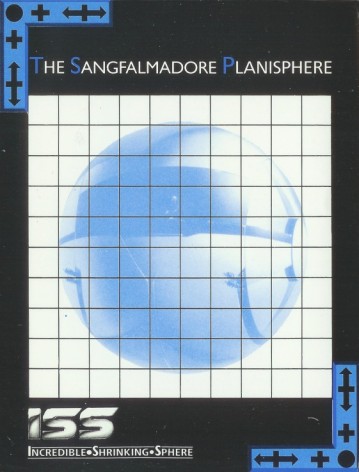
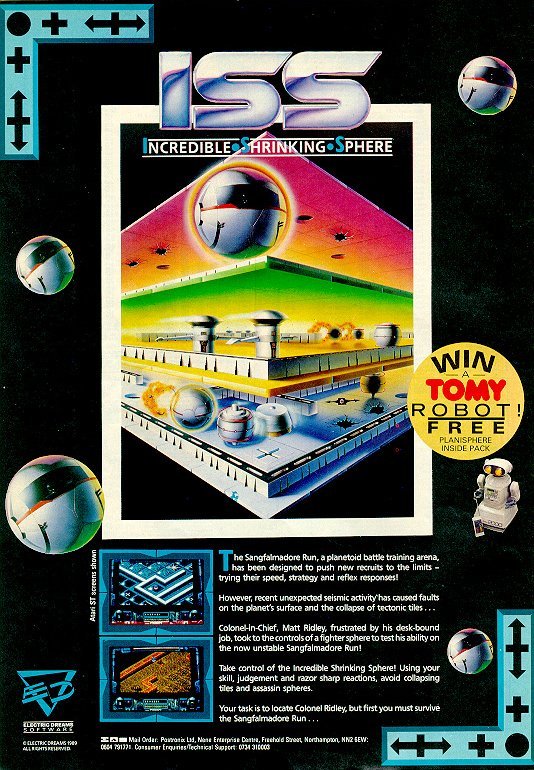

_Back.jpg)
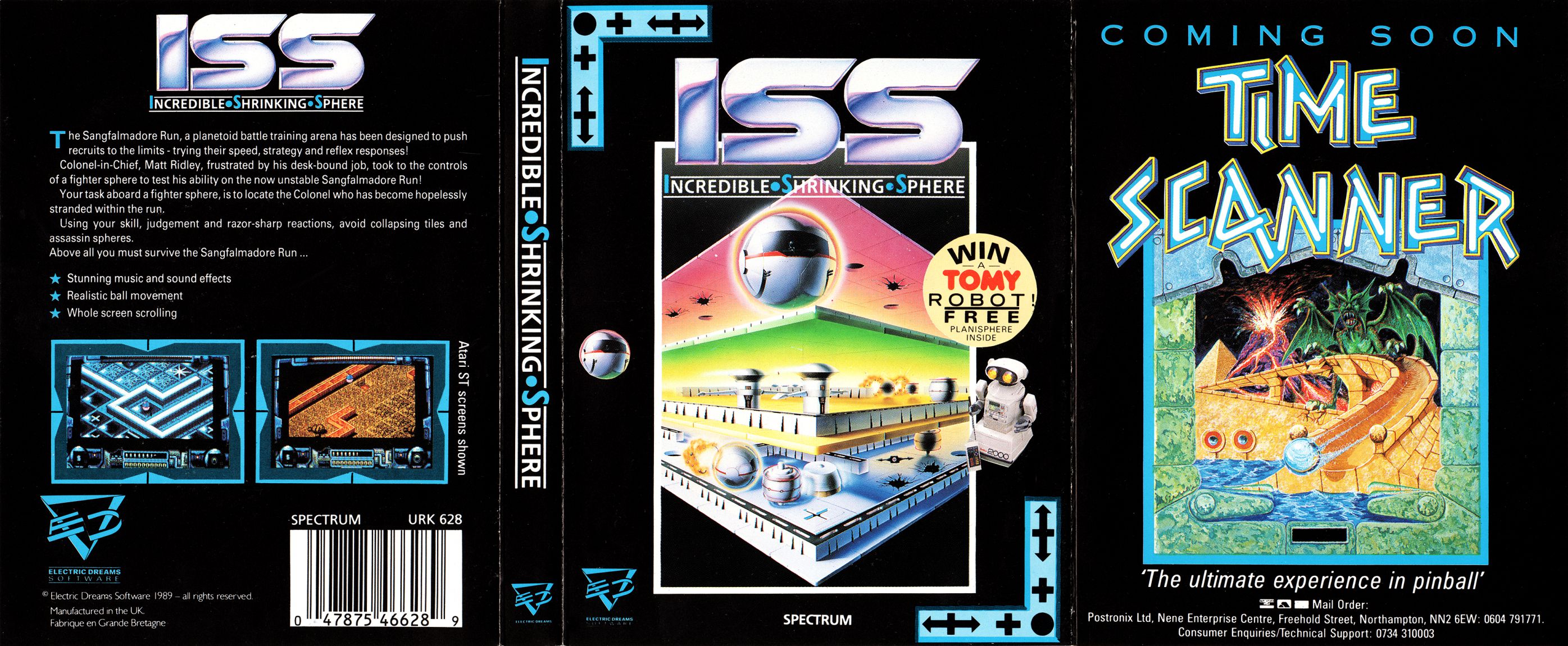
_Front.jpg)
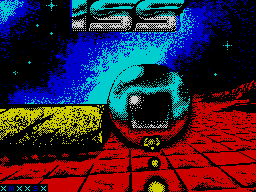
_SideA.jpg)
_SideB.jpg)
Discussion
Nobody has started a thread about this yet.
- Control Option
- Interface 2 (left), Kempston Joystick
Releases
- 25 Jan 1989Electric Dreams Software Sold as ISSPound sterling 9.99
- 1989MCM Software S.A.
Play
- IncredibleShrinkingSphere.tzx.zipTape image English23 KB
- IncredibleShrinkingSphere(ElectricDreamsSoftware).tzx.zipTape image English23 KB
- IncredibleShrinkingSphere(MCMSoftwareSA).tzx.zipTape image English22 KB
Documents
- IncredibleShrinkingSphere.txtInstructions English19 KB
- IncredibleShrinkingSphere(MULTI-LANG).pdfInstructions Multi-language: English, French, German1,120 KB
Other files
- Incredible Shrinking Sphere (1989)(Electric Dreams Software).pokPOK pokes file 0 KB
Files and rights
Electric Dreams Software has refused distribution of its catalogue.
- DeniedElectric Dreams Software → WorldOfSpectrum
Credits
- The Oliver Twinscredited
Sign in to credit somebody, or say what these people did.
Awards
- Your Sinclair MegagameYour Sinclair41 · 1989
- Crash SmashCrash62 · 1989
Scores
In the magazines
- Your Sinclair #411989 · Overall91%
- Crash #621989 · Overall90%
- ACE (Advanced Computer Entertainment) #201989 · Ace Rating863/1000
- The Games Machine #171989 · Overall80%
- Sinclair User #841989 · Overall58%
Elsewhere on the web
- WorldOfSpectrum 6 votes6.50
In the magazines 18
ACE (Advanced Computer Entertainment) #20May 1989 · p.80863/1000
ACE (Advanced Computer Entertainment)
Ace Rating 863/1000
Electric Dreams £9.99cs, £14.99dk C64 version reviewed Issue 17 - ACE rating 923 Does not suffer from the speed problems of the Amstrad version and is consequently much more playable. The detailed, mono-colour graphics work better here. Not quite the same feel as the C64 and 16-bit versions, but still plenty to get to grips with.
Your Sinclair #41May 1989 · p.45Your Sinclair Megagame86%83%70%90%91%91%
Your SinclairYour Sinclair Megagame
Life Expectancy 86%
Instant Appeal 83%
Graphics 70%
Addictiveness 90%
Overall 91%
Ben Stone 91%
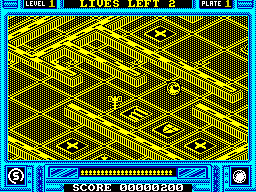
Electric Dreams £9.99 Reviewer: Ben Stone Pac-Man better watch out 'cos there's some cool competition around - and he's got a wicked pair of shades to prove it! The competition comes in the form of a Sangfalmadorian Sphere Corps Incredibly Shrinking Fighter Sphere from the Twenty-Fifty Century (a YS house point goes to those of you who can repeat that twice without pause to unwind your tongue!) but why it's got a pair of designer specs only the keyboard prodders at Electric Dreams will know. Anyway, your Fighter Sphere has at long last been called into action, but not to engage an unknown enemy force - everyone knows they've all been well and truly clobbered by now. In fact there hasn't been any action in so long that even the old Corps training areas have started getting rusty and malfunctions are commonplace. It's one of these malfunctions that you've been sent to clear up. It seems that the old boy himself, that's Colonel-In-Chief Matt Ridley for those not acquainted with him, get a little bored with his pen pushing job back at Corps Elite HQ. Just to see whether he'd still 'got what it takes' he made an unauthorised trip into the Corp's most unforgiving battle trainer - The Death Run - unfortunately for him he 'hadn't'! Normally the automatic retrieval system would shut down the area and send in a drone to recover the Colonel-in-Chief and what was left of his Fighter, but something has gone very wrong. Soft's up to you to successfully navigate The Death Run, locate the Colonel and get him back. ISS is set out in a similar way to Revolution an old fossil from Vortex. The playing area is a multi-directional scrolling isometric maze with your Sphere more or less in the centre. The controls are simple enough, just the standard directions and a fire button. Moving around is quite a different kettle of fish though, your craft momentum is incredibly strong and fairly difficult to get to grips with. The Death Run is split up into four levels and each level is, again, split up into four tiers of plates, one above the other - the exit from each level is located on the lowest plate and your quarry is obviously on the bottom plate of the last level. Each plate is constructed from Techtonic Tiles, of which there are about twenty different types. Each of these has a different effect on your Sphere - more often than not an unwanted one. Most of the tiles have a life span, but once your Sphere's moved over one, it'll slowly turn into a deadly Vapiouriser - thing's get pretty hectic when there's a lot of these around so don't hang around! At the start of each level you're given the option of distributing four ammo dumps. These come in fairly handy as your Sphere can only carry about 25 rounds and assassin spheres are generated at quite a rate by the training area's generators. A large bonus is awarded at the end of a level if you don't lace many ammo dumps, extra lives are only awarded every 50,000 points so there's a good argument for reserving firepower on the earlier levels to gain a much needed extra life. Some of the later levels are impossible to complete without the help of your Sphere's special mass and volume changing powers. Go over a tile marked 'H' and your fighter'll become heavier, go over a tile with arrows pointing outwards and the Sphere will grow larger, in this state you'll be able to smash through special walls, making large short-cuts. The price you'll pay for these short cuts is far less manoeuvrability and a larger chance of tiles breaking up underneath you. Electric Dreams has got the strategy and action pitched just right to make ISS one of the most addictive games I've played in years. In the second, third and fourth levels you really have to work hard to get anywhere. The presentation is very good and the display works well although a little guesswork comes into play if you want to know how many lives you've got left and how heavy or large you are. The inertia of your Sphere adds a lot to the playability, - without it, trickling through cracked tiles and speeding to the nearest ammo dump would lose all its challenge. The only thing that spoils ISS are the sound effects during the game which were about as simplistic as you can get, and even then they kind of 'flip-out' every now and then for no reason I can tell. The scrolling playing area leaves a little to be desired, it jerks badly once in a while to catch up with what's going on onscreen. Still an enjoyable game that'll keep most people happy for a long while (there's another training area to overcome once you've rescued the Colonel from the Death Run), and for ten quid I wouldn't really expect anything less.
PRISON - Tile with four small holes. If caught freezes Sphere to the spot for about fifteen seconds - bad news when there are assassins around. DAMAGED TILE - Covered in crack marks. If the Sphere is too heavy you'll fall through it. RAMP - Looks a little ramplike. Useful for jumping over walls, will collapse if you're too heavy. MOVING WALLS - Sections of wall distinguished by their movability. Smash through these when the Sphere is at maximum velocity. AMMO DUMP - Pyramid shape. Provides and endless supply of Ammo to deal with assassins.
The Games Machine #17Apr 1989 · p.5580%
Overall 80%
Spectrum 48/128 Cassette: £9.99 Amstrad CPC Cassette: £9.99, Diskette: £14.99 Commodore 64/128 Cassette: £9.99, Diskette: £14.99 Atari ST: £19.99 Amiga: £24.99 MARBLE MADNESS GETS MODERN Marble Madness proved to be a durable arcade idea which has spawned several clones in its time, and it's a tribute to the original concept that most lookalikes have been invigoratingly playable and addictive. The Incredible Shrinking Sphere from Four's Field rings the changes to produce an imaginative ball-on-a-maze game for the Spectrum as you race in your sphere fighter on a training mission called the Sangfalmadore Run. The Run is made up of eight levels, subdivided into four interconnected isometric mazes. A good enough sense of direction isn't enough, however, to find exits and lifts. The sphere is incredible not only because it can shrink, but also because it can expand and change its weight by touching special tiles. Small means you can use narrow passageways, light means you don't fall through cracked tiles, but at other times you need to be big and heavy to push objects around. In the mazes hostile tiles can trap you, domes send you zooming off at high speed, and watch out for assassin generators - hostile drones which take a life on contact - unless you have a shield (gained by touching the relevant tile) or shoot them first. Ammunition is limited, but you can get a refill by bumping into an ammo dump. The Runs toughest problem however, is the rapid decay of all the blank tiles. Contact with a decayed tile is deadly, so there's a time limit. But dashing blindly about often causes the normally erratic ball to become quite uncontrollable. Incredible Shrinking Sphere is a fairly complex game and one of immense playability. Skill and strategy are needed to get through the levels and this combination gives it great lasting appeal.
Bouncy music and professional programming come together on the C64.
It's been a while since a decent Marble Madness clone hit the streets, but Four's Field have gone several leaps ahead with this highly addictive game - Amiga screen at the top, Spectrum on the right.
"A complex game of immense playability"
AMIGA Overall: 80% Four's Field have come up with a frustratingly addictive variation on the simple maze game. The ball glides smoothly around the playing area although novices may find the inertia makes handling tricky. The sampled tune - a little rough - isn't as well suited to the game as it is on the ST.
AMSTRAD CPC Overall: 63% Eye-straining background colour schemes aren't helped by monochrome sprites and juddery scrolling. Some graphics are lost in the mazes and the occasional sound effects are harsh, but some playability manages to show through the faults.
ATARI ST Overall: 80% A slick version with very glossy presentation though some opponents look a little dull on the ST's limited colour screen, and ball movement doesn't quite match the Amiga's quality. It's nice to hear music that's original for once and not lust a sample from the Amiga game. Multi-load is swift and doesn't distract from the game.
COMMODORE 64/128 Overall: 84% Anthony Lees's musical interludes, bouncy in-game FX and Four's Field's professional programming touch all come together in what is by far the best 8-bit version, the all-round presentation beats the 16-bit versions hands down too.
Crash #62Mar 1989 · p.23Crash Smash86%85%52%89%91%90%90%91%90%
Presentation 86%
Graphics 85%
Sound 52%
Playability 89%
Addictive Qualities 91%
Overall 90%
Mark Caswell 90%
Mike Dunn 91%
Phil King 90%
Ball goes on crash diet Producer: Electric Dreams Software Small Change: £9.99 Author: Fours Field You live on the planet Sangfalmadore and, being an ambitious sort of chap, have entered the Sphere Training Corps. The most fearsome part of the STC is the Sangfalmadore Run, made even more deadly by a recent earthquake trapping Colonel Matt Ridley. You've volunteered to rescue him, but only complete mastery of your fighter sphere will see you through. The Run is made up of eight levels, each subdivided into four interconnected isometric mazes. There's much more to the game though, than simply having a good enough sense of direction to find the exits and lifts. The sphere is incredible not only because it can shrink, but also because it can expand and change its weight by touching special tiles. Being small allows you to go through narrow passageways, being light means you don't fall through cracked tiles, but at other times you need to be big and heavy to push objects around. There are also hostile tiles which can trap you, domes which can send you zooming off at high speed, and assassin generators. Assassins are hostile drones which take a life on contact - unless you have a shield (gained by touching the relevant tile) or shoot them first. You only have a limited amount of ammunition, but you can get a refill by bumping into an ammo dump - four of these are placed by the player before the start of the game. The Run's toughest problem however, is the rapid decay of all the blank tiles. Contact with a decayed tile is deadly, so there's a time limit. Clearly ISS is a fairly complex game, made even more so by the ball's inertia leading to control problems. Persistence has its own reward though, and a game of immense playability is soon revealed. Both skill and strategy are needed to get through the levels and this combination gives the game long-lasting appeal - it really grows on you the more you play it. PHIL 90% THE ESSENTIALS Joysticks: Kempston, Sinclair Graphics: attractive scrolling, isometric mazes Sound: only a few spot effects, even on the 128K Options: place ammunition dumps
About to be assassinated - the incredible shrunken sphere.
ROLL OVER? Try to stay as small and light as possible (did I mention Nick?!). Collect a new shield whenever you see one. If your shield runs out, be very careful not to bump into assassins. When you place your ammunition dumps, make a sketch of the maze so you'll know where you're going. Roll over the plus signs for extra points - you get an extra life after 50000 points. Whatever you do, don't be a square!
Sinclair User #84Mar 1989 · p.3069%61%43%35%58%58%
Graphics 69%
Sound 61%
Playability 43%
Lastability 35%
Overall 58%
Tony Dillon 58%
Label: Activision Author: In-house Price: £8.95 Memory: 48K/128K Joystick: various Reviewer: Tony Dillon Marble Madness, but a bit more pinbally... that sounds like a good idea for a game. Mix in a bit of platforms and ladders here and there, by using over four interconnecting levels, linked by holes and air-lifts. (Getting better all the time.) Add some progressive elements, like being able to change size and mass to through difficult sections. PERFECT!!! It's not. It's far from it, (say this very quietly) it doesn't quite live up to the hype/ All the elements are there, but, here comes that magi word - playability - the game just doesn't hang together and what you are left with is a rather boring isometric maze game. It's not even particularly well executed. In short, you are Private (please insert name of your choice, like parts or bits) and you have to locate and rescue Colonel in Chief Matt Ridley, who quite cleverly, decided to take a crack at the awesome Death Run, and is now imprisoned within its walls. You have to climb aboard your battle sphere and head into the Death Run. Land of unplayability and jerky scrolling. The Death Run is a little 3D maze set over four planes. At the start of the game you can display maps of all four mazes in the 'deploy your ammunition dumps'. You have four dumps - supplies of ammo to help you survive in the game - so obviously the most sensible thing to do is place one on each level. In the game itself, the maze is displayed as a scrolling isometric map, with lots of walls and special tiles and things, and in the middle of it all is you, the battlesphere. The walls are there to stop you moving in a certain direction, and the special tiles are there to do special things. A plus sign on a tile increases your battlesphere's size, and a tile with four arrows pointing inward reverses the effect. A question mark randomly changes mass and size every time you cross it. Mass and size play important parts in getting through some key trouble spots in the maze. The denser you are (and no missus, I don't mean stupid) the more powerful you become. Unfortunately, when you are lumping around something of that mass, it gets a bit uncontrollable. Well, even more uncontrollable than it already is. Size can also be important. The smaller you are, the more likely you are to be splatted should you rush into a nasty, but being small also means that you can get through some narrow gaps a lot easier. Graphics are OK to a point, but the scrolling is dire. It just shouldn't be allowed. Now come on, this is 1989! I can take a bit of jerkyness at slow speeds - it's always a problem. But this game stays jerky, no matter how fast you go. It plays like, well, something that doesn't play very well. The rebounding effect off walls and things is a little erratic and normally sends you flying at high speed regardless of your original speed. At high speed, the game collapses almost completely. It seems the only way you're going to keep control is by moving very, very slowly. Now I'm no hopeless cripple at computer games, but even I couldn't keep control of this baby. Scratch another few points. ISS could have been very good, but as it ended up, it isn't. What a huge disappointment from the people that brought you R-Type and Afterburner.
Preview5
- MicroHobby #187Apr 1989 · p.15
- Crash #62Mar 1989 · p.97
- Your Sinclair #39Mar 1989 · p.96
- New Computer ExpressDec 1988 · p.12
- The Games Machine #13Dec 1988 · p.16
Review3
- MicroHobby #188May 1989 · p.28
- New Computer Express #20Mar 1989 · p.56
- ACE (Advanced Computer Entertainment) #17Feb 1989 · p.52
Full-page ad2
- Your Sinclair #38Feb 1989 · p.70
- C&VG (Computer & Video Games) #88Feb 1989 · p.63
News/Note2
- ACE (Advanced Computer Entertainment) #16Jan 1989 · p.33
- ACE (Advanced Computer Entertainment) #12Sep 1988 · p.8
Map1
- ACE (Advanced Computer Entertainment) #19Apr 1989 · p.70
Related
- Compilations
- 2x1: ISS + SDI, Poke City
- Ports
- (Amstrad CPC), ISS: Incredible Shrinking Sphere (Commodore 64), ISS: Incredible Shrinking Sphere (Amiga), ISS: Incredible Shrinking Sphere (Atari ST)
- Same entry at
- Spectrum ComputingZXInfo
Reviews from people here
Sign in to write about this, or make an account. It takes a minute and lets you correct the catalogue too.
No description recorded.
Sign in to correct or add to this.
Hold the rights to this and want it taken down?