
Insurgency
Strategy Game: War · ZX-Spectrum 48K · 1 players · English
CCS · 1984 · Pound sterling 5.95
Discussion
Nobody has started a thread about this yet.
Play
- Insurgency.z80.zipSnapshot image English7 KB
- Insurgency.tzx.zipTape image English18 KB
Documents
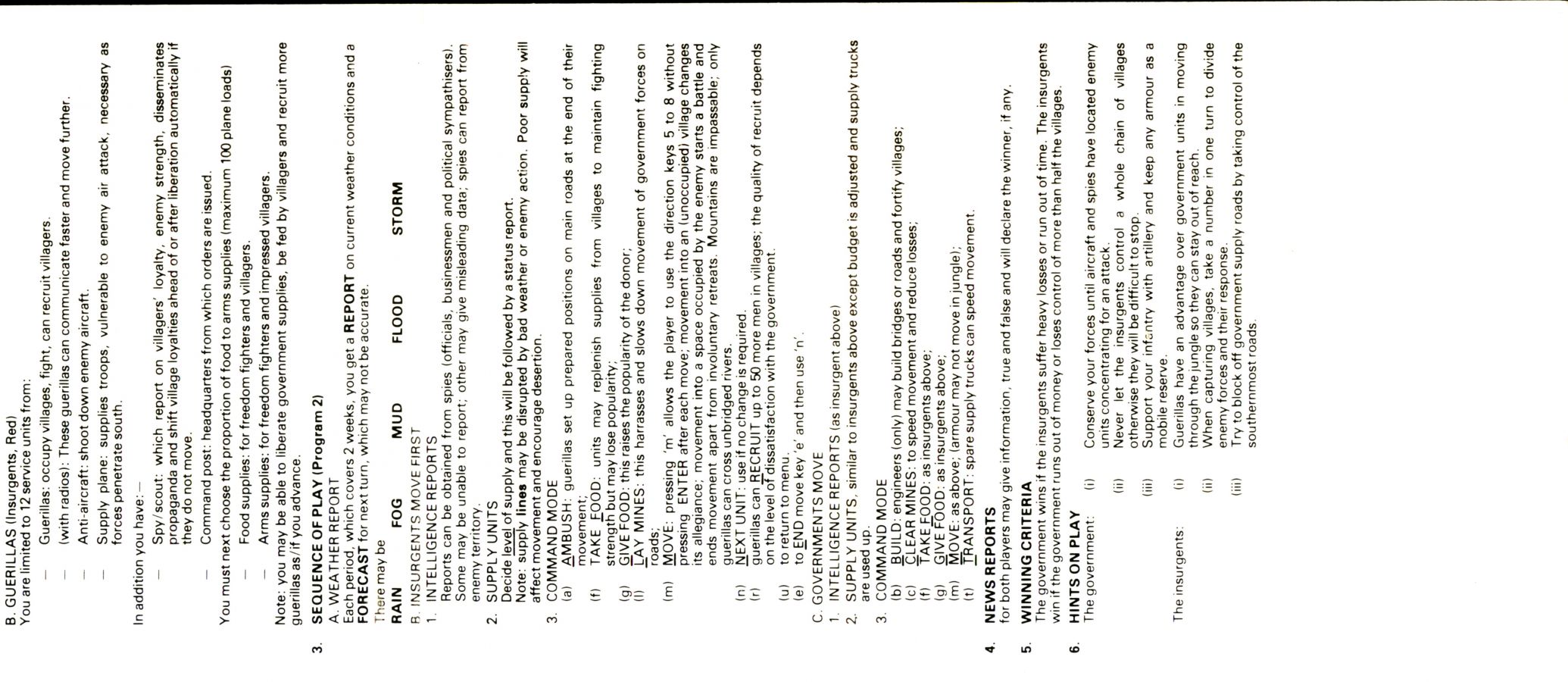
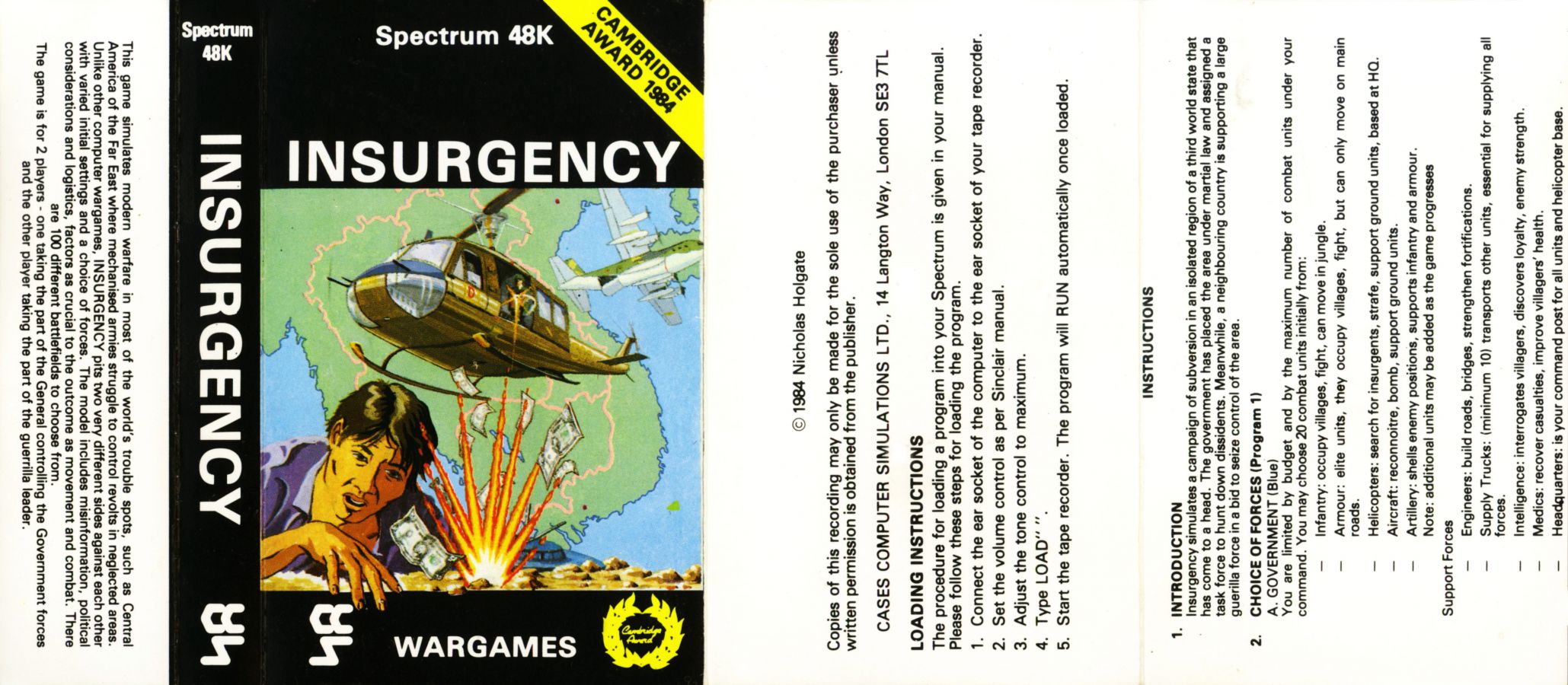
- Insurgency.txtInstructions English7 KB
Files and rights
Distribution permission is on record, granted to another archive rather than to this one. Screens and pictures are copied here; everything else links to the archive that holds it.
- AllowedCCS → WorldOfSpectrum
Credits
- Nicholas Holgatecredited
Sign in to credit somebody, or say what these people did.
Scores
In the magazines
- Big K #101985 · Overall1/3
- Personal Computer Games #141985 · Overall6/10
Elsewhere on the web
- WorldOfSpectrum 3 votes6.33
Awards and competitions
Cambridge Awards 1984
- 2placed
In the magazines 10
Crash #12Jan 1985 · p.159
Angus Ryall
FRONTLINES From our correspondent at the front Angus Ryall. Direct response! I've finally done it! Two issues ago I bemoaned the fact that the software industry was so complacent - it seemed that no matter what I wrote or said, I couldn't get through the thick skins of the people who need to buck their ideas up. But - over the last month it seems to have worked. First of all John Merry (of Reichswald fame -now of Scorpio Gamesworld) rang up to say that not only was Reichsweld a brilliant game (a point which I obviously missed when reviewing it) but that my remarks about his girth were totally unfounded and libellous. Quoth he: 'This kind of petty slander makes my blood BOIL!' Me: 'Sorry John, I was only trying to liven up a really tedious subject.' I was hoping that John would send in a couple of 'before and after' pics as irrefutable proof, but instead he burbled on about withdrawing all Scorpio's advertising from Crash (ho-hum, here we go again) which is probably why Roger is refusing to pay me. My apologies also go out to Argus Specialist Press, whose representatives threatened me with legal action and/or severe bodily dismemberment - I didn't really mean to say anything horrible about your wonderful magazines chaps, I was of course talking about EMAP (at this point the editor grasps me firmly round the windpipe. As I feel the life-force draining from my limbs I manage to scrawl ONLY JOKING PEOPLE, I LOVE YOU ALL)! THE CRASH SANDINISTAS STRIKE A BLOW IN THE CITADEL OF CAPTILISM Or, to put it another way, this month's report comes to you direct from the Ritz Hotel in Picadilly, London. Unfortunately this does not mean that Crash has seen the light and started treating its reviewers with the respect they deserve - we'd be lucky to get a room in the Red Cow in Ludlow. It means that I went along to the 'most prestigious award for amateur programmers' ceremony, the Cambridge Award. Funnily enough, I've only recently reviewed last year's winner and runner-up, Battle 1917 and War 70, so I thought I had an idea of what to expect: but in the event I was pleasantly surprised. There were four 'finalist' games, which I've reviewed below. They can all be loosely described as 'strategy games. But first I must tell you a little about the actual event itself, since I feel morally obliged under the freeloaders' code of honour. As I entered the Ritz in my rainbow-striped jumper and my hardware jeans, I sensed that something was not quite right - why wasn't I being thrown out on my ear for not wearing a tie? Well, apparently if you are going to a private function then you don't have to. Great, I thought; let's just head straight for the bar in my usual manner. Having located the 'Marie Antoinette' suite, I made the mistake of asking the barman for a drink. I say mistake because the man was fairly well blasted by the time I arrived and he could only understand the kind of 'tourist' French that the waiters oil heff to spik, (Was he on a percentage from Beefeater?) Anyway, I got a gin big enough to farm salmon in, topped up with about two millimetres of tonic water. Now I'm not actually that keen on neat gin, so I asked one of the floating French penguins to fetch mea bitter lemon so that I could mix it with the half-pint of gin. A minute later he returned with a slice of lemon on a stick: 'Your beet urv limon monsieur,' he said! Things went from bad to worse. RUSSELL AND Carol from White Dwarf arrived, already half cut, and pounced on a QL chap, hoping to have a meaningful discussion about artificial intelligence. The man was so scared he ran away. The waiters wrested our half-empty glasses from our hands and topped them up with yet more neat gin. By now I had started to acquire a taste for neat gin, and when I was accosted by the Argus heavies I was able to fend them off with a bottle of (yes, you guessed it) gin. Julian Fuller from Micronet got very earnest with a man from Telecom about Multi-User Dungeon. I think that if ever a nuclear war is imminent I shall book myself into the Ritz, because it's the only place I know where you can get drunk in under eight minutes without even trying! Then the buffet lunch arrived, consisting of a load of raw, minced meat on what looked like pieces of Ryvita (I have since learned that this is in fact a great delicacy known as 'Steak Diane') and some kind of Scampi - or was it Pork Balls? (The kind you get at a Chinese take-away, I mean!) Then the speeches began, greeted with thunderous applause. The sponsors of the awards were C.C.S., Sinclair User magazine and Sinclair Research Ltd. I think that most of us who'd managed to stay sober were hoping to have a word with Sir Clive about his plans for world domination and whether we'd be able to buy shares in Sinclair in 1985 (ha-ha). But alas, it was not to be because he didn't show up. Instead we had to make do with Nigel Searle who is (only) the Managing Director. He spoke about how Sinclair had been responsible for getting computing off the ground in the U.K., and how pleased they all were to be British and all that sort of thing. My associates Russell and Carol kept making distinctly negative comments at particularly high volume, which made one feel slightly conspicuous. The Chairman of C. C. S, made a rather rambling speech and seemed a little overwhelmed by the whole situation; but then, if he had drunk as much as I had then I wouldn't be at all surprised. John Gilbert of Sinclair User made a punchy but totally vaccuous speech about what a brilliant magazine he works for. John Sherry from Keele received the award from Nigel Searle for his program The Prince, and looked understandably pleased with himself since he'd just won £2,000. INSURGENCY Author: Nicholas Holgate Producer: C.C.S. Retail Price: £5.95 I must confess that I really do not know how C.C.S. do it. One minute they put out a truly enthralling games such as The Prince, the next they try to foist the most awful garbage on us, like Blue Riband. Then they bounce back again with an excellent offering like Insurgency. I must confess to being totally baffled. Insurgency is a two-player game of guerrilla warfare in which one player is the Sandinistas, or the VC's, while the other is the usual fascist oppressor. There is a selection of 100 maps to play on an each contains a number of villages connected by roads, several areas of jungle (accessible to guerrillas and army helicopters) and mountains (accessible to all) in each map the guerrillas are being supplied from the North and the army from the South. Supplies arrive by air through the game, but you have to be able to collect them. The army has a wider choice of units, with armour, aircraft, artillery, trucks and medics, but the guerrillas have an advantage of being able to move faster through the jungle, thus remaining out of reach. As the game progresses each side builds up a picture of the other's position by means of intelligence reports, and then they attempt to take over villages, block roads with mines and so on. The guerrillas can recruit villagers and provide them with food and arms. But the army medics can improve their health, which helps to bring them back into the government fold. The number of options available at any one time is amazingly high and I got really involved in running my Mujaheddin campaign. As with The Prince though, the drawback is that only one player is supposed to be at the screen at any time, which strikes me as something of a contradiction when you consider that multi-player games are supposed to bring increased sociability. The graphics also leave something to be desired (although they are well up to the usual strategy game standard - which isn't very high). All in all, however, a very impressive game, and the author one to watch for the future.
Micro Adventurer #15Jan 1985 · p.37
Kevin Bergin
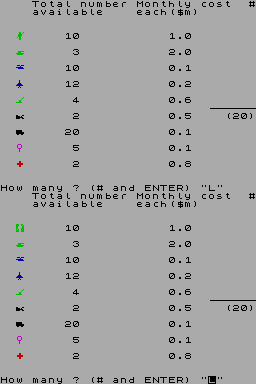
VIVA LA REVOLUTION MICRO: Spectrum 48K PRICE: £5.95 FORMAT: Cassette SUPPLIER: Cases Computer Simulations, [redacted] Insurgency claims to "simulate modern warfare in most of the worlds trouble spots". One player is the government forces and the other the guerillas. Theoretically this could be a very interesting game, but in practice it is an extremely boring and frustrating waste of an hour or two. MAPS The programme offers 100 different maps chosen by selecting a number between 1-100. All of them are extremely basic, simply being a series of villages, linked by roads, with the odd mountain range or two. The map colour is predominantly green, depicting jungle. Choices of troops and budget allocation are offered to the players in turn, necessitating the other player turning away from the screen. The government forces are: infantry used for occupying villages and trotting about in the jungle, armour which is restricted to riding up and down the road net but better at fighting than the infantry, artillery for shelling (but which is extremely vulnerable to attack), helicopters, to support ground troops and searching for the pesky rebels, and finally aircraft, to carry out recon and bomb the guerilla forces. The cover instructions tell you that you also receive other units, but I never got any! The government may choose within certain limitations 20 combat units. In addition there are: engineers, supply trucks, which oddly can go through the jungle while the armour units cannot, intelligence for victimising locals and spying, medics, and lastly your headquarters command post. The guerillas have a much more limited choice of troop type. Guerillas for fighting and recruiting, the same with radios, moving faster and more communicative, antiaircraft units, and supply planes for resupply. They are also given options for spies, and a command post. The supply planes are able to drop arms or food you must choose a mixture of these up to 100 plane loads. The guerillas have 12 active service units only. The command key words are simple enough, each unit having a series of options per turn. On the surface of it the commands should cover the things that you would like to do, but this is not so. Either I totally misunderstood the spartan instructions or the game has definitely missed the crucial point of the whole idea. Conflict is the name of the game, and conflict is exactly what's missing. When we moved two opposing units into the same village nothing happened, when we wanted to attack a guerilla unit with helicopters or aircraft, the programme merely flashed up the word CONTACT. Without the option to fight, what does one do? Unless someone tells you, forget Insurgency. CCS can do better - and they have.
Big K #10Jan 1985 · p.161/32/31/31/31/3
Graphics 1/3
Playability 2/3
Addictiveness 1/3
Overall 1/3
John Conquest 1/3
REBELLIOUS STUFF FROM: CCS FORMAT: cassette PRICE: £5.95 A very clever two-hander, government vs. guerrillas in a third world country. The uniformed mob, working to a budget, get 20 combat units (infantry, armour, choppers, jets and artillery) plus support (engineers, trucks , intelligence, medics and command), while the black pyjama brigade make do with 12 service units (guerrillas with or without radios, flak ad supply planes) plus spies, command, food and arms supplies. Having picked their mix, both sides are placed on one of 100 maps showing villages, rivers, bridges, roads, mountains and jungles. Weather reports are given for the next (two week) turn and a more or less accurate forecast for the one after. The guerrillas get some reports from spies, supply units, lay ambushes, give or take food from the locals, lay mines, recruit villagers or move. The government gets equally unreliable intelligence reports, does an aerial reconnaissance sweep, supplies, build roads and bridges, fortifies villages, gives or takes food, uses transport or moves. News reports give out more unreliable information and, eventually, declares the winner. A very useful print facility will provide copies of the map and unit breakdowns, useful stuff for serious players as it's very easy to lose track. As in real life, there are no quick short-cuts to victory and, with the guerrillas looking at a 30 turns deadline, both sides must try and accumulate a mass of small pay-offs that will add up to success. Getting all that detail onto a Spectrum window means that everything is pretty small, so you really have to pay attention to details. Serious stuff.
Personal Computer Games #14Jan 1985 · p.927/103/105/105/106/106/10
Graphics 7/10
Sound 3/10
Originality 5/10
Lasting Interest 5/10
Overall 6/10
Martyn Smith
Peter Walker 6/10
Steve Spittle
MACHINE: Spectrum 48K CONTROL: Keys FROM: CDS, £5.95 Ever fancied yourself as a bit of a Che Guevera, fighting for the freedom of the people? Or, for that matter, a government, battling for democracy and stability in a tiny state? If so, then C.C.S.'s latest release, Insurgency, will appeal to you. The cassette describes the game as simulating 'a campaign of subversion in an isolated region of a third world state that has come to a head'. It's a story that will be all too familiar to anyone who reads the newspaper: martial law, task forces hunting down dissidents, neighbouring countries supporting guerilla forces. It's a two-player game, with one player taking the part of the rebels, the other controlling state forces. Whichever role you choose to play - you will have an equal number of complicated options and eventualities to juggle with. The tape contains two programs. The first holds the routine which sets up the game - the two players choosing the various forces with which they will wage the campaign, and the map upon which it will be fought. The next program uses this data for the game itself, a complex affair in which the players can move forces, occupy villages, bring in new supplies, receive intelligence reports... and so on. As you can tell the game is fairly complicated, so arcade aces who cannot think beyond the trajectory of their next missile should give this one a miss. Graphically it is quite well done, the map being clear and easy to understand. The text is laid out neatly and with some thought and is therefore simple to follow. Sound is necessarily limited to informative beepings, and the controls are limited to the keyboard. It is difficult to follow at first and takes a lot of thinking - every tactical nuance will not be immediately obvious. If you do enjoy tactical games, then this is about as good as they come.
Advert3
- Sinclair User #36Mar 1985 · p.56
- Crash #14Mar 1985 · p.123
- Micro Adventurer #16Feb 1985 · p.41
News/Note2
- ZX Computing #17Feb 1985 · p.83
- Micro Adventurer #14Dec 1984 · p.6
Feature1
- Sinclair User #32Nov 1984 · p.93
Reviews from people here
Sign in to write about this, or make an account. It takes a minute and lets you correct the catalogue too.
No description recorded.
Sign in to correct or add to this.
Hold the rights to this and want it taken down?