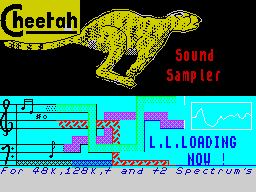
Cheetah Sound Sampler
Utility: Sound/Speech · ZX-Spectrum 48K · 1 players · English
CheetahSoft Ltd · 1986
Discussion
Nobody has started a thread about this yet.
Play
- CheetahSoundSampler.tzx.zipTape image English50 KB
Files and rights
No permission is on record either way. Screens and pictures are copied here on a take-down basis: if you hold the rights and want something removed, say so and it goes.
Credits
- Robert Powellcredited
Sign in to credit somebody, or say what these people did.
In the magazines 3
ACE (Advanced Computer Entertainment) #23Aug 1989 · p.90
ACE (Advanced Computer Entertainment)
Jon Bates
£44.95 Cheetah 0222 555525 No MIDI, rather grainy sound, well thought out editing screens if a trifle on the slow side but somewhat dated. Like many programs, it doesn't use any of the additional memory offered by the 128k version. Manual is informative, optimistic and miniscule.
Your Computer #3Mar 1987 · p.44
Tony Sacks
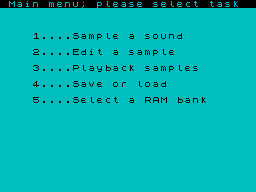
SAMPLE PLEASURES Until about a year ago there was almost no commercial software or hardware for the Spectrum owner wanting to experiment with music-making and sound manipulation. Not any more. Reporting on this change is Tony Sacks. Until about a year ago there was almost no commercial software or hardware for the Spectrum owner wanting to experiment with music-making and sound manipulation. The demand for such packages was demonstrated when Cheetah Marketing unleashed its SpecDrum percussion simulator. To date more than 30,000 SpecDrums have been sold. Cheetah is hoping to repeat this success with a new crop of musical products for the Spectrum. They include a Midi package which will allow the Spectrum to communicate with electronic musical instruments, and a five-octave musical keyboard which can be used to control either the sound chip included in recent Spectrums or Midi-equipped instruments. Cheetah has also launched a Sound Sampler. It turns the Spectrum into a sound recorder by using the micro memory to store a digitised version of a fragment of sound. The sound can later be extracted from the memory and reconstituted into its original form. SIX-FOOT CABLE The sampler hardware takes the form of an unassuming black box which plugs into the Spectrum user port. Two anonymous control knobs project over the Spectrum chassis - the function of one of them remains a mystery until neat the end of the finely-printed instruction manual. To hear the sampler output you will need an amplifier within the six-foot reach of the audio cable which protrudes from it. One attraction of sampler programs is that they load relatively quickly because as much memory as possible has to be reserved for storing the sampled sounds. Another result of this requirement is that the programs tend to be graphically rather stark. The Cheetah sampler is no exception, loading in less then three minutes - or even quicker if you take up the option of transferring the program to Microdrive to present you with a bland five-option main menu. You will probably head straight for the sampling option which takes you to a sub-menu offering a choice of six alternatives. One of these produces a slightly-delayed oscilloscope effect so that, as you talk or sing into the microphone supplied with the sampler, the sound waves are displayed on the screen. This display allows you to adjust the first of the mystery knobs to set the sampler sensitivity. If you are overloading the input, the sound will distort, with obvious effect on the oscilloscope trace. On the review model, the sensitivity knob had very little effect for most of its rotation but small adjustments near the end of its travel could make a large difference to the sensitivity. DEVOTED UNITS Cheetah divides its sampler memory into 116 units, each about 1/144 second long. If my arithmetic is correct, this means that the longest sample possible at the normal sampling speed lasts just less than a second. Several shorter samples can be stored at the same time and, before recording a sample, you are asked how many units you want to devote to the sound. This can be difficult to estimate, unless you are used to thinking in terms of l/!44th of a second. If you allow too few units your sample could be cut off in its prime, while too many units would waste precious memory. If you are privileged enough to own a 128K Spectrum, you can use the extra memory to store up to 256 extra units of sound in four banks. The maximum length of any one sample, however, is not increased. Before you record a sample you have to give it a name and decide whether you want to record it at full or half-speed. In the latter case, your sample will last twice as long but the quality of the replayed sample is noticeably reduced. You are now ready to record your sample, either when the program tells you to or, if your prefer, when you hit the space bar. DUBIOUS TUNING The quickest way to listen to the results is to use an option which lists all the samples in memory, replaying each of them as its name appears on the screen. A few more keystrokes will take you to a section where you can play back the sample at different pitches in a two-octave range using two rows of the Spectrum QWERTY keyboard transformed into a makeshift piano keyboard. The tuning of some of the notes is dubious. To take the rough edges off your sample or to alter its character you head for the edit menu. There you can reverse the sample, produce a copy of it or combine it with a second sample to produce a more complex sound. More important, you can also configure the sample by chopping unwanted bits at either end and by defining a central section to be repeated or looped several times to extend the sound. LOOPING Looping is done by placing markers on displays of the soundwaves stored in each of the units of sample memory. You place the markers where you feel the replayed sample should start and finish and where you would like it to be looped, if at all. Unfortunately there is no single display of the complete sample to give you an overall idea of how it varies with time. Instead you have to step through each of the units in the sample with the screen being re-drawn each time. This can be a laborious process if you have a single sample taking up all 116 units of memory. Stepping sequentially from one end of such a sample to the other can take almost a minute. There is an option of going directly to a particular unit by selecting its chronological position but as this number is not displayed on the screen, finding a specific unit is a hit-and-miss affair. Once you have configured your sample, you can return to the musical keyboard section and the looped section of the sample will play repeatedly until a key is released. If you are lucky this can give an impression of a note lasting much longer than the original sample but the chances of the repeat points merging smoothly with each other are small. SAMPLE FILES On the second side of the program cassette. Cheetah has stored six sample files to give you an idea of what can be achieved with the sampler. Also lurking on the cassette but not made clear in the manual is a second program which turns the sampler into a real-time effects processor. This offers half-a-dozen ways of transforming any sound fed into the sampler. They include an echo chamber, a reverb, a pitch shifter to give Donald Duck effects, a fuzz box which produces a distorted version of the input sound, a sound chopper for Dalek-type effects, and an intriguing bubbleiser which performs indescribable mutations on your original sound. The role of the second control knob is now revealed as controlling feedback levels for the echo and reverb effects. FUN TO PLAY WITH The effects program is more than a mere gimmicky afterthought to the sampling program. It produces some attractive and musically useful variations on the input and is also fun to play with. Indeed, many musicians would probably find the effects section more useful than the sampler. Despite the Cheetah Claim that the sampler is suitable for professional use. It is unlikely to make an appearance on Top of the Pops. The sound quality is not high enough and, equally important, the Spectrum QWERTY keyboard does not make a very convincing musical keyboard, especially as you have to use a Shift key to change octaves. One way of avoiding this limitation would have been to include a Midi interface in the sampler as Ram Electronics does in its Music Machine package - see Your Computer, January 1987. Cheetah has not provided this or any other means of controlling the sampler from a conventional musical keyboard. This omission is surprising because, as mentioned previously. Cheetah is already marketing both a Midi software package and a full-size, five-octave keyboard. STIFF COMPETITION Six months ago the Cheetah Sampler would have had the market to itself. Now it has to face formidable competition from the Music Machine which, for about £5 more, offers a Midi interface, a drum machine and a simple music composing section. The Ram package also allows samples to be played back at two pitches simultaneously for greater harmonic interest. MORE SOPHISTICATED In its defence, the Cheetah Sampler produces higher quality sounds than the Music Machine but the difference is not so great as the 17.5MkHz bandwidth - compared to 9.5kHz for the Music Machine - would imply. Its sample manipulation facilities are more sophisticated and its real-time effects more versatile and convincing than those of the Music Machine package. At £44.95, the Cheetah Sampler offers undoubted value but you may feel that the £49.95 Music Machine provides even better value.
Cheetah sound sampler for the 128K Spectrum.
Your Sinclair #12Dec 1986 · p.36
Kay Ann Helen
Michael Jones
Phil South
WE'VE GOT A SPECTRUM* YS MAKES IT BIG SPECIAL Three months ago, Black Mist, a band from Manchester, sent YS a demo tape containing songs they'd made using a SpecDrum. Impressed? Not half. But could the Spectrum catapult a band to fame and fortune? And could you, with the use of your favourite computer, use the Ram Electronics Music Machine, Cheetah SpecDrum and Sound Sampler, and the Data-Skip Video Digitiser to put together a package that would impress a record company? Only one way to find out. So, one day last month a Black Mist descended on YS. Resident muso, Phil South, reports. Photos by Tony Sleep. 8.30am - I arrive at Castle Rathbone and slap myself awake. Spot two shady looking figures dressed in black, silhouetted against the wall. They're carrying guitars and are accompanied by an evil looking smurf... must be the band. I take a hard swallow and approach them. Black Mist introduce themselves as Mike and Kay. The smurf says nothing, and I leave him to it. They seem friendly enough, though. We work our way down into the dungeon and put the coffee on. 9.02am - A couple of cuppas later I'm feeling more human, and Black Mist are looking more chipper too. The smurf doesn't have any, so he's looking as miserable as ever. 9.25am - A phone call to our local friendly Turnkey Shop, in Percy Street, secures the loan of a 4-track recorder for the day. Phew! I leave Mike setting up the gear (and Kay searching for some paracetamol 'cos she's got a headache) and nip round to Turnkey. The 4-track's a brand spanking (ow) new Yamaha MT1X tape recorder. Sounds technical? Not really. If you can use a Spectrum, you can use a 4-track tape deck. I sign in blood and leg it back. 9.28am - After more coffee we connect the 4-track into the setup and turn the power on. Good start. Nothing blows up. Okay, let's boot up the Speccy. We resolve to try the Ram Electronics Music Machine first, plugging it into the user port and loading the driving software. It doesn't take long, and soon we're listening to the demo tune. Mike listens closely to the drum sounds. He's a veteran SpecDrum owner, and looks suitably impressed. "That's not bad. I like that. Can we program it?" I select the Drum Editor screen and tap a few pads experimentally. Mike taps in one of his own rhythms and we listen to the bar over and over again. It sounds good so we resolve that it'd make a good start for our tape. By now it's after ten so we have a sound check and prepare to lay down the first track. 10.12am - We begin to record the first sounds, the drums from the Ram Music Machine, onto track 1 of the 4-track. Mike programs a rhythm that has a lot of cowbell in it. "Hmm. Why do sampled cowbells always sound like saucepans being hit with a wooden spoon?" he says, wincing. So, we decide to sample a sound and incorporate it with the sequence. After much experimentation, we settle on the sound we get from tapping the TV screen with the tip of a pair of scissors. It takes a few seconds to set up the Music Machine to sample the sound. Then, with a bit of judicious editing a new cowbell is born, and not a vet in sight. 11.00am - Mike wants a special drum effect (called a 'fill-in' in the trade, 'cos it fills a gap). He's going to do this fill using the SpecDrum, so he sets up the pattern he wants, using a specially edited kit from the Kit Editor, and triggers it at the appropriate beat. The speed of the two drum patterns is easily synchronised by matching the beats per minute figure, in this case 140. Then when the end of the bar comes around again, press the button and brrrum buh bum bum ba bup bup bup b-b-b-b-b', instant 'thumbs aloft worra nice geezer' Phil Collins! 11.52am - In the absence of a bass guitar, we decide to do the bass line on the Casio CZ-101. Nice little synthesiser the CZ-101; digital, cheap at £300, and lovely sound, what more do you need? We thumb the preset buttons and select a bass sound. Hmm, not quite right. I change the sound a little to make it more percussive and thumpy, like a guitar. In the mix it sounds just like the real thing. I play the riff through the entire track just to try it out, and record it so we can hear it back. It sounds so neat (breathe on fingernails and polish on shirt) Mike decides to leave it in. 12.30pm - Kay's been working on a lyric all this time, with the title of 'Too Late Mary'. She writes her lyrics as poems, with no thought of scanning the words to fit specific lines, preferring to mate the words to the music as she sings it. 1.45pm - We break for lunch. It's been a long morning, and Kay and Mike's pasties have been crushed to debris (by a fat lady on the bus). 2.30pm - Much refreshed, we troop back into the studio and link Mike's guitar into the system. A few experimental wangy twangs later, we have it sounding right in the headphones, and Mike's left strumming his guitar while I steal Kay away to the video room. We're going to lace together images from the digitiser to make a video to accompany the music; some stuff from old horror movies, Frankenstein and King Kong, plus some magazine pictures. 3.15pm - Mike has recorded the guitar track and we sit and listen to the finished 'backing track' (a track without the vocals and twiddly bits on) with looks of awe. It's amazing how different a piece of music sounds when you've put all the different parts in it. Having nodded approvingly at the quality, we commence the 'mixdown'. This is where you mix a track down in stereo onto another tape, and then play it back in stereo onto two tracks of the 4-track. You then have two tracks of the 4-track playing all the music you just had on four, leaving two tracks free for extra 'overdubs'. 4.10pm - Vocals time! Kay clears her throat and carefully positions the headphone strap into her hair. (Fashion hint: v. trendy pop stars use headphones upside down, so as not to ruffle their quiffs!) The searing vocal is fed, via the Ram Echo function to provide some 'slapback' echo, into the first of the spare tracks. Was Mary too late? Was it all her fault? Is she to blame? I dunno, but it sounds brilliant. 5.00pm - Mixdown! The final act in a recording session is to mix down your tape in stereo onto a 'master' tape. Mike looks worried. "I dunno. It sounds a bit rough to me." Maybe it's the 4-track, we're not used to it? "Possibly. I might have to redo it on my own 4-track." Well you could take the 4-track tape and the stuff and remix it, Paul Hardcastle style? Mike grins. He reckons it'd be a good idea. 5.55pm - A few piccies later, I'm helping Black Mist get their gear together. (Sniff) I even wave my hanky as they run up the street to get the bus! If you want to hear how the Black Mist megamix turned out, you can hear it on this issue's Digi'T'ape. Their own demos, containing six of their hits including Dead Mouse, Shade Shade and Hurry Along Timmy can be obtained by sending a measly £1.25 (inc p&p) to Black Mist, [redacted]. Cheap at half the price! *and we're gonna use it! LOVE MACHINE FAX BOX Device: Ram Music Machine Price: £49.95 Publisher: Ram Electronics Contact: Ram Electronics (Fleet) Ltd, [redacted] The Ram Electronics Music Machine is less of a sound sampler, more a way of life. At least, that's what it feels like after you've used it for a while. It's more of a MIDI equipped Sound Sampling Sequencer, actually. You can sample sounds and sequence them, at normal pitch like drums, or sequence them in a piece of music, on a musical stave. All the facilities are very easy to use, and have a lot of potential for musicians, as well as complete novice users. All the functions are accessed by single key presses, indicated by the Main Menu. There's a superb editing facility whereby you can cut the sounds to fit your memory and reverse or fine edit them via the zoom function. The Tune Editor allows you to write music on a stave, and play it back using on the sounds in memory. The Drum Editor enables you to make drum patterns on a sixteen beat bar, just like professional drumboxes. Sampling is easy, with a visual display of the sound as you're sampling it, removing the possibility of overloading and distorting the sample. Mike: I liked the on-board drum sounds, but what I might do when I remix the track is sample some of my friend's drum kit instead. That sort of thing's very easy to do, too. Being able to play the keys on the Speccy like drum pads is fun, although they're a bit close together for really fast playing. Oh, and I don't like the fact that you have to type a long line of 1's if you want patter 1 to repeat over and over again! Kay: Being able to play the sounds from a MIDI keyboard would be great fun, but we couldn't get it to go. I haven't got a synth anyway, but I might like one in the future, so it's very nice to have it there. It's a good all round machine. For fifty quid you can't go wrong. Brilliant. RANDOM SAMPLING FAX BOX Device: Sound Sampler and SpecDrum Price: £44.95 and £29.95 Contact: Cheetah Marketing Ltd, [redacted] The Cheetah range grows by the minute, first the SpecDrum, now the Sound Sampler and MIDI interface. The SpecDrum was the first cheap digital drumbox on the entire Earth, and has cleaned up in both the financial and critical acclaim stakes. You can sequence real drum sounds, playing them up to three at a time, in any pattern you like. As well as the sounds you get with the SpecDrum, Cheetah regularly releases new 'kits' of different drum sounds; currently there are two, the Latin/African set and the new Electro (Simmons style) kit. At the PCW show it released the Sound Sampler. Although you can't sequence your sounds, or play them through MIDI (because you can't have MIDI and quality sampling in a Z80) the quality of the sounds you get is quite good. Although not as versatile as the Ram Music Machine, when Cheetah has worked out the bugs in the system it should be a fine little sampler. The bandwidth is a startling 17.5Khz, which considering that a Compact Disc player has a bandwidth of 22Khz, is pretty good quality. Also included are a number of useful sound processing programs like Echo, Harmoniser, Fuzz, Reverb, Chopper and Bubbleiser. Mike: Hmm. Yeah... very nice... it's very good quality, but what can you do with it? Not very well thought out as a musicians tool, I'd say. You can sample a sound. Fine. It sounds pretty good. Great. You can play it up and down the rubber keyboard of the Speccy. Yeah. But what do you do then? There's no retrig so it's unusable as a 'keyboard' instrument. You can't MIDI it so you can't sequence it either, not even in conjunction with the SpecDrum, which is a real shame, 'cos it's such a brilliant drumbox. Kay: I expected better from Cheetah, but no, I don't like it. Just a sampling engine, really, and definitely for fun use only. The Utilities program is really funny. Most of the sounds are like a helicopter taking off in your amplifier. Good for fun I s'pose. I liked the Electro Kit for the SpecDrum though. Just like a Simmons Kit for the SpecDrum, although I'm probably not allowed to say that. (No you're not. Ed). DOUBLE DUTCH FAX BOX Device: Data-Skip Video Digitiser Price: £69 Contact: Data-Skip, [redacted]. Double Dutch was a popular skipping dance craze, and Data-Skip is a Dutch firm who makes video digitisers. The version we received was a prototype model, but the only difference between that and the finished one will be the casing. The software is will error-trapped and the thing practically runs itself. A digitiser scans a TV picture, or image gathered from a TV camera, and puts the resultant data into a computer screen. The product of the process is a saveable SCREEN$ which you can use in the same way as any other screem, as a title/loading screen, as a part of any movable graphic in a game (like T'zer's picture in Strike Force Cobra or Sam Fox Strip Poker), or as an image source for another medium, in this case video. The digitised pictures can then be treated and coloured with a painting program like Rainbird's Art Studio. Mike: I think this is brilliant. Very clever. And it makes the picture from the telly look so good. They all come out in black and white, and you can adjust the tones of grey produced by turning the knob on the top. Really good fun. Kay: Very simple to use and a lot of fun. I chose the images for our video from the old black and white movies, 'cos that's more in keeping with our music than a story video or pictures of us playing. I want one!
The Yamaha MT1X 4-Track in petulant mood.
The mighty Casio CZ-101 digital synthesiser.
They're mean, they're moody, they're dressed in black! Kay and Mike look pretty serious too.
Wow, its the configure sound screen (edit) function on the Sound Sampler. You must configure every sound with trigger, sustain, begin and end points before you can do anything else which can be a little tiresome. The sampling isn't very interactive - you can't see the sound you're sampling which makes it a slightly hit and miss affair.
GLOSSOLIA 4-Track: Tape recorder which can record on four tracks. Demo: Demonstration, especially of a band's rough tapes. Sound-Check: Quick test to see everything's working. Lay Down: To record an instrument on a track. Track: Either a channel on the tape recorder or a song. Sample: To digitally record a sound into the computer. Fill-in: A beat on the drums that fills a boring space. Drop-in: Add a short section to an already recorded track. Mix: To blend the tracks together. Remix: Re-blend already mixed track with new sounds. Mixdown: Mixing the four tracks into finished stereo tape. Riff: Any musical phrase. Digitiser: Scans TV picture and reproduces it as SCREEN$. Overdub: Record something whilst hearing previous track. Slapback: Strong echo with audible heavy repeats. Retrig: Retrigger; sound restarts when key pressed again.
HOW TO MAKE A VIDEO In order to make a video using graphics from your Spectrum you must connect the output from the Speccy to the BNC (Video in) bayonet style plug at the back of the video recorder, taking the video signal from the user port, not the RF output which usually goes to the TV. (See diagram). The images were moved by two methods: 1 Using Andrew Pennell's Movin 'n' A'groovin' program from Your Spectrum (Issue 19), and 2, a specially written program by Max Phillips which flips four screens. The resultant sequences were videoed on a Ferguson Hi-Fi video recorder, and the track dubbed onto the soundtrack in Dolby stereo.
MULTITRACK? If you're not familiar with multitrack recording, let me explain. On a stereo tape recorder you have two tracks running side by side, one for each speaker. But some bright spark reasoned that if you made a recording head with four pickups instead of two, you could make an elementary multitrack tape recorder, like a scaled down version of the 24 track machines in pro recording studios. The upshot of all this is that you can record a voice for instance on one track, on the next track a guitar, on the next a bass, and on the last track a drum kit. Then you can play them back simultaneously, making it sound like they're all playing together! Brilliant, eh? Especially if you don't actually have a band at your disposal. Recording all the parts yourself, you can then hear them carefully blended together.
Name: Michael Jones Age: 20 Place of Birth: Cardiff When did you get your Speccy: January 86 in an effort to give up smoking. (No luck) Musical Influences: The Cure, Birthday Party, Big Flame, Three Johns. Why you use computers: Because there aren't many drummers in Cardiff, and it's quieter to use a drumbox. Name: Kay Ann Helen Jones Age: 21 Place of Birth: Cardiff Musical Influences: The Cure, Siouxie and the Banshees, Echo and the Bunnymen, Cocteau Twins. When did you get married: One year last August. What do you think about sampling: We must play the machine, not the other way around.
ON THE RECORD Having written the next Number 1, what then? How do you approach a record company with your product? What do they want to see? We asked an A'n'R Man (talent spotter to you). "It's a common mistake for bands to send three songs which are all different, to sort of show off how versatile they are. This isn't what your average Artists and Repetoire Man wants to hear. He wants three songs which show the band can produce a recognisable style time after time. He will also, before he lets any band near a contract, want to hear them play live, even if it's just a rehearsal. A video is an asset, because it demonstrates that the band have an image they want to project, and can do so. Build up a relationship with one record company and, if you can blag your way through the receptionist, ask to see the A'n'R man personally. Most will agree to see you." What receptionists say to you off speaking to A'n'R men: "He's in a meeting..." (He's not. Try again.) "He's on the other line at the moment..." (They haven't got one.) "Can he call you back?" (He won't! You call him.) "He's gone to lunch..." (He has. Phone back.) "What was it concerning?" (Don't tell her. Say you'll call again.) "Could you send your tape to us?" (You might as well bin it.) "We like your stuff, please keep in touch..." (You're amateur.) "Can I take a message?" (No, you'll call back.)
Related
- Versions
- Cheetah Sound Sampler (Included with)
- Tags
- Cheetah
- Same entry at
- Spectrum ComputingZXInfo
Reviews from people here
Sign in to write about this, or make an account. It takes a minute and lets you correct the catalogue too.
No description recorded.
Sign in to correct or add to this.
Hold the rights to this and want it taken down?