Archon
Game: Board · ZX-Spectrum 48K · 2 players
Ariolasoft UK Ltd · 1985 · Pound sterling 10.95
Also known as Archon: The Light and the Dark (English)
.jpg)
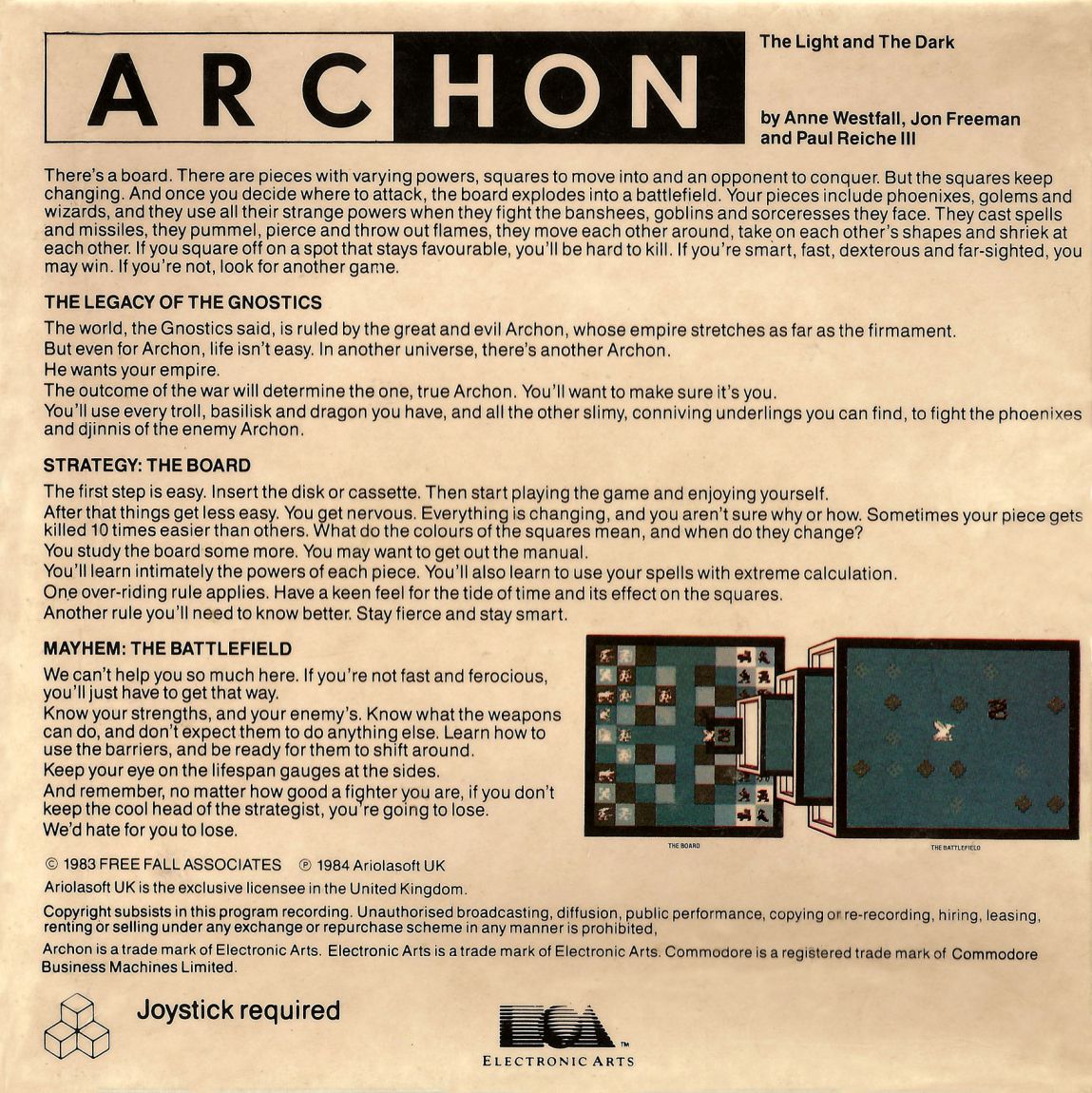
_Back.jpg)
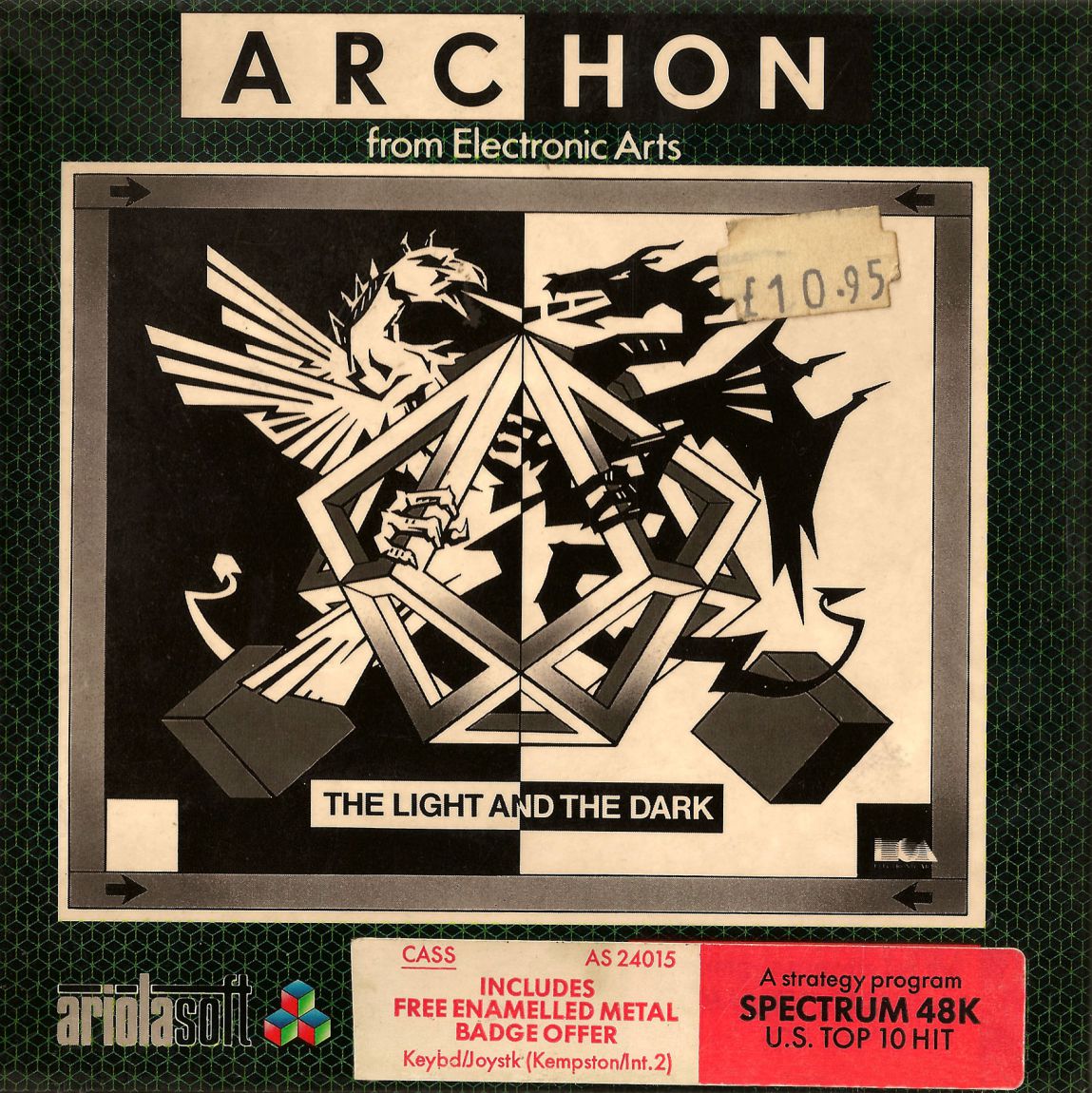
_Front.jpg)
_Spine.jpg)
Discussion
Nobody has started a thread about this yet.
Remarks
Comes with free enamelled metal badge offer.
- Control Option
- Interface 2 (left), Interface 2 (right), Kempston Joystick
Releases
- 1985Ariolasoft UK Ltd Sold as Archon: The Light and the DarkPound sterling 10.95
- 1985Dro SoftSpanish peseta 2500.00
Play
- Archon.tzx.zipTape image English20 KB
- Archon.tap.zipTape image English20 KB
- Archon(DroSoft).tzx.zipTape image Spanish19 KB
Documents
- Archon(EN).pdfInstructions English709 KB
- Archon(DroSoft).pdfInstructions Spanish21 KB
- Archon.txtInstructions English9 KB
Other files
- Archon (1985)(Ariolasoft UK).pokPOK pokes file 0 KB
Files and rights
No permission is on record either way. Screens and pictures are copied here on a take-down basis: if you hold the rights and want something removed, say so and it goes.
Credits
- Tony Barbercredited
- Simon Dunstancredited
- Dave McMackenInlay/Poster Art
Sign in to credit somebody, or say what these people did.
Scores
In the magazines
- Sinclair User #391985 · Overall2/5
- ZX Computing #201985 · Overall5/5
- Crash #181985 · Overall83%
Elsewhere on the web
- WorldOfSpectrum 13 votes7.54
Awards and competitions
Computer Gamer's Game of the Year Awards 1985
- 1Best Strategy Game
In the magazines 19
ZX Computing #20Aug 1985 · p.774/55/55/5
Graphics 4/5
Addictiveness 5/5
Overall 5/5
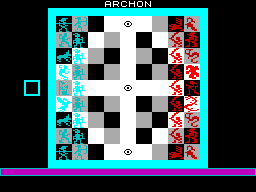
Ariolasoft £10.95 This is the game I've been waiting for ever since I saw the 3D laser game played by Chewbacca and R2D2 in Star Wars! Of course it isn't 3D laser, and who knows what the name or rules of the film game was, but this is what I imagined it to be like. Essentially you have two forces, either human or computer controlled, black and white, lined up against each other on a chess style board of 9x9 squares. Some of these squares change colour as the game progresses and the closer it is to your colour the more power you get from it. Five squares have flashing power points. Each member of each force has their own strengths, weaknesses and movement allowance and you attack an opponent by moving onto their square. Once you move onto an enemy square the game changes to a simple dodge and fire arcade sequence. Although the outcome is likely to be in favour of the most powerful piece there is always an outside chance of pulling off an upset. Strategy is an important factor in this game and the aim is to capture or control all the power squares. The graphics are a little indistinct and the manual is not as simple as it could have been, but it is worth persevering with the manual, and you soon get used to the graphics. Archon is a game that takes a while to grasp but which will be played long after most others will have been forgotten.
Your Spectrum #16Jul 1985 · p.412.5/5 HIT2/5 MISS3/5 HIT
Dave Nicholls 2.5/5 HIT
Roger Willis 2/5 MISS
Ross Holman 3/5 HIT
JOYSTICK JURY They came, they saw and they conked out - or rather the joysticks did. Dave Nicholls, Roger Willis and Ross Holman hung on just long enough to give the verdict on all the new games. ARCHON Ariolasoft £8.95 Ross: This is a strategy game that pits the forces of good against those of evil. You're greeted by the opposing forces lined up on either side of a board that chess players will no doubt recognise. At the start you're given the option of controlling the good guys or the bad guys, and whether to battle it out with the computer. You've got 18 pieces at your disposal and they can all move different distances though there are no restrictions on the direction. But that's where the similarity with chess ends. In Archon, each character earns the right to take over an occupied square by beating the opposition in a bout of single-handed combat. There are many different forms of defence some characters throw fireballs, some wield swords, while others generate a deadly force field. This mystic fisticuffs takes place on a separate screen with the characters' respective strengths shown by a bar at each side. Each time you're hit this strength reduces until one of the pieces is completely clobbered. Each side also has one magical being that can cast spells on the opposition. The ones to watch out for are the revive and heal spells that'll bring a defeated piece back to life or restore its strength. To move the pieces, you must position a square on the chosen character's symbol and then press the key to pick it up. From there you can move it and drop it in the desired location. Although the board is chequered black and white, there are also some grey squares - the colour of the square a piece occupies will affect its fighting fortunes. The forces of darkness for example, do best on black squares. An added complication are the five power points positioned like a cross on the board. These squares have the power to restore strength and to protect from magic - occupy all five and you're automatically the winner. At first, Archon appears quite simple, but there's an underlying complexity to it that offers a formidable challenge. The combat screen is marred by jerky graphics and be warned, the computer's an annoyingly good shot. But then I always was a bad loser.
A tip if you're playing the computer - move in close and then nip in and out of your opponent's firing line. That way you'll fool him into firing and you'll have as much time as it takes his missile to reach the other side of the screen to pump him full of lead. Go on, make my day punk! These objects just get in the way but if you use them to good effect you can use them as defence shields. On the combat screen get your chosen battle warrior body-poppin' - the more jerky his movements are, the less chance you have of being hit.
Use the revive spell to bring back to life any of your lost characters - but make sure it's one of the strongest. There's no point in reviving a knight when you've got a wizard waiting in the wings. Use this box to indicate the character you want to move - and where you want to move him. Then tap the fire button and pow! Try this for openers - before the opposition has time to rally, take out their main man. If you get the strongest character early on, it'll give you the edge.
Crash #18Jul 1985 · p.2181%72%85%83%92%69%83%
Use of Computer 81%
Graphics 72%
Playability 85%
Getting Started 83%
Addictive Qualities 92%
Value For Money 69%
Overall 83%
Unknown
Unknown
Producer: Ariolasoft Memory Required: 48K Retail Price: £10.95 Language: Machine code Author: Paul Reiche III and Anne Westfall Archon is a strategy game requiring quite a high degree of arcade skill. The main playing area looks remarkably like a chess board until you notice that while some of the squares are either black or white others are in tones of grey, and changing. As with chess you have two opposing forces facing each other but unlike chess the forces are not matched. Each of the two armies have different pieces, each having individual strengths and weaknesses. Before the game begins you must decide between playing for the good guys or for the powers of evil naturally a sportsman would select the former. The game can be played either against the computer or against another player but in any event to be successful you must learn to appreciate the individual powers of each of your pieces. Each side has different characters, or icons, but overall they are matched. As with chess some icons are able to move ahead only two or three squares while others may be able pass over other icons or even, with the aid of a spell, teleport to any location on the board. To move you simply manipulate a cursor square over a piece, press fire, then move the square to the position you desire. If the move is over a distance greater than is allowed, or is illegal for some reason, perhaps because it is blocked by other pieces or has been imprisoned by your enemy, then the computer will tell you. When playing the computer it moves its pieces in exactly the same way, so it's easy to follow its moves. The object of the game is to take and hold the five 'power' points but to do that you must destroy the enemy forces and this takes a great deal of shrewd planning. Apart from having to know the strengths and weaknesses of each of the pieces and remembering how best to use them, it's good to take advantage of situations unique to this game. For example perhaps you have just lost a major piece and in doing so have severely wounded the opposing icon, are you in a position to send in a minor icon and finish the job before the enemy has a chance to heal its wounds? When you are ready to attack all that is required is to move your icon over to the occupied square then the computer will ask if you want to challenge the occupant. A positive response causes the main display to change for the battle screen. The battle screen has a life strength indicator for each of the icons in combat, a first time player may be horrified to notice the life bar of his opponent's icon is three times greater than his own. At the start of battle the two icons are positioned on opposite sides. At various and constantly changing locations around the screen blocks are located, these act as barriers for either side to cower behind. The two icons must fight it out to the death and the winner will, of course, win the square for which they are fighting. Depending on the nature of the icons involved, the mode of attack will vary, for some are able to fire bolts and can cause damage at a distance while others must make contact to strike a blow. The meat of the game, however, is making sure that your icon is able to defeat the enemy and this is where strategy comes in. Try not to take on an opponent that has greater strength. While some icons are able to move at great speed they may only be able to fire at close range, others move very slowly but a direct hit from one of these could kill you. Other icons may possess speed and strength but require long intervals before they can fire again. The minor icons enter the battlefield with very little strength, but with luck and nifty play perhaps you may inflict a lethal blow. To make the strategic element of the game even more complicated the program introduces concepts such as 'luminosity cycles' and 'power points'. If you decide to attack an icon on a power point then that icon will be much stronger than normal as well as being protected from the effects of magic. The luminosity cycle dictates that while icons on squares of their own colour are stronger (dark on black etc) some of the squares will change in colour. The effects of the magic applied by the magicians make for greater complexity, the spells can only be used once and their use weakens the icon. The revive spell allows you to bring back from the dead a useful icon while the summon spell allows you call an icon that did not previously exist. While these icons will only last for one battle, they are very powerful and will almost always win. Other spells include teleport, heal, exchange and imprison. Since the use of a spell at the appropriate time can make significant changes to your progress, you must make very sure that your magician is protected while at all times trying to find ways of destroying the enemies. COMMENTS Control keys: Q/A up/down, Z/X left/right, C to fire Joystick: Kempston, Sinclair Keyboard play: responsive Use of colour: limited Graphics: average Sound: very little Skill levels: 1 Lives: N/A Screens: 2
The powers of light and dark prepare for war. The Phoneix prepares for battle.
Sinclair User #39Jun 1985 · p.302/52/5
Overall 2/5
Chris Bourne 2/5
Publisher: Ariolasoft Price: £10.95 Memory: 48K Joystick: Kempston, Sinclair There is a world of difference between the intellectual precision of chess and the imaginative power of good fantasy games. All the more peculiar, then, that veteran fantasy game designers Paul Reiche and Jon Freeman should have combined the two to produce Archon. The game is played out on a chequered board with 81 squares. The opposing armies remind one instantly of chess, with pawn-like knights and goblins, and stronger, more mobile pieces on the back row. When two pieces clash for a square the game shifts to arcade action, and the monsters fight it out, blasting with fireballs or trying to close with fang or blade. White squares favour the forces of light, black squares darkness, and there are five power points with healing qualities and variable colour. Although well packaged and presented, the graphics are predictable and seem old fashioned. The problem is really that the abstract nature of the game serves to dissipate most of the creativity involved in producing interesting monsters. You rapidly lose any sense of involvement in the fantasy myths surrounding the struggle, and play the game mechanically. The inclusion of magic spells for two of the pieces is a good idea, but again they are used merely as extra options in play, and have no real emotional force of their own. Viewed as a board game, Archon is a competent invention, and clearly has strategic possibilities. But it is not ideally suited to the home computer, and we would have preferred to see Reiche turning the talent he used to good effect, with the creators of Dungeons and Dragons to more adventurous material. Archon is a game for the collector of such things, not for those who want good entertainment at a fair price. The price is certainly not fair, and our rating would have been higher if Ariolasoft had charged less.
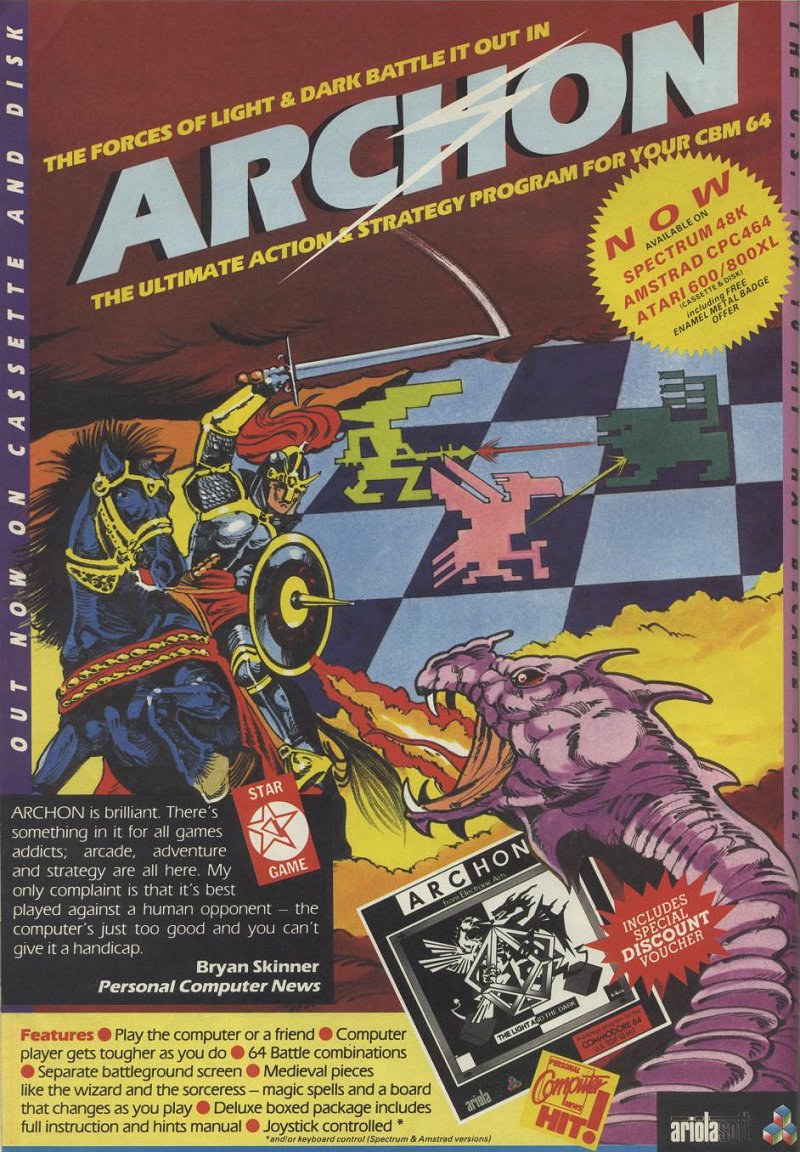
Full-page ad5
- Your Spectrum #15Jun 1985 · p.57
- Computer Gamer #3Jun 1985 · p.11
- C&VG (Computer & Video Games) #44Jun 1985 · p.119
- Crash #17Jun 1985 · p.28
- Home Computing Weekly #104Mar 1985 · p.47
Tips3
- New Computer Express #11Jan 1989 · p.39
- Crash #23Dec 1985 · p.82
- Computer Gamer #4Jul 1985 · p.30
News/Note3
- Popular Computing Weekly #35Aug 1985 · p.26
- Computer Gamer #3Jun 1985 · p.6
- Personal Computer News #109May 1985 · p.33
Information1
- SSD-IISep 1999
Solution1
- BiT #17Feb 1993 · p.13
Review1
- MicroHobby #71Mar 1986 · p.15
Feature1
- Computer Gamer #4Jul 1985 · p.30
Licensed from
- ArchonSoftwareFree Fall Associates
- ChessBoard/Tabletopunofficial
Related
- Ports
- (Amstrad CPC), (Atari 8-bit), Archon: The Light and the Dark (Commodore 64), (NES), Archon: The Light and the Dark (Amiga), (Macintosh)
- Tags
- Turn based
- Elsewhere
- WikipediaMobyGamesThe TipshopUVL
- Same entry at
- Spectrum ComputingZXInfo
Reviews from people here
Sign in to write about this, or make an account. It takes a minute and lets you correct the catalogue too.
No language recorded.
Sign in to correct or add to this.
Hold the rights to this and want it taken down?