
Jasper!
Arcade Game: Platform · ZX-Spectrum 48K · 1 players · English
Micromega · 1984 · Pound sterling 6.95
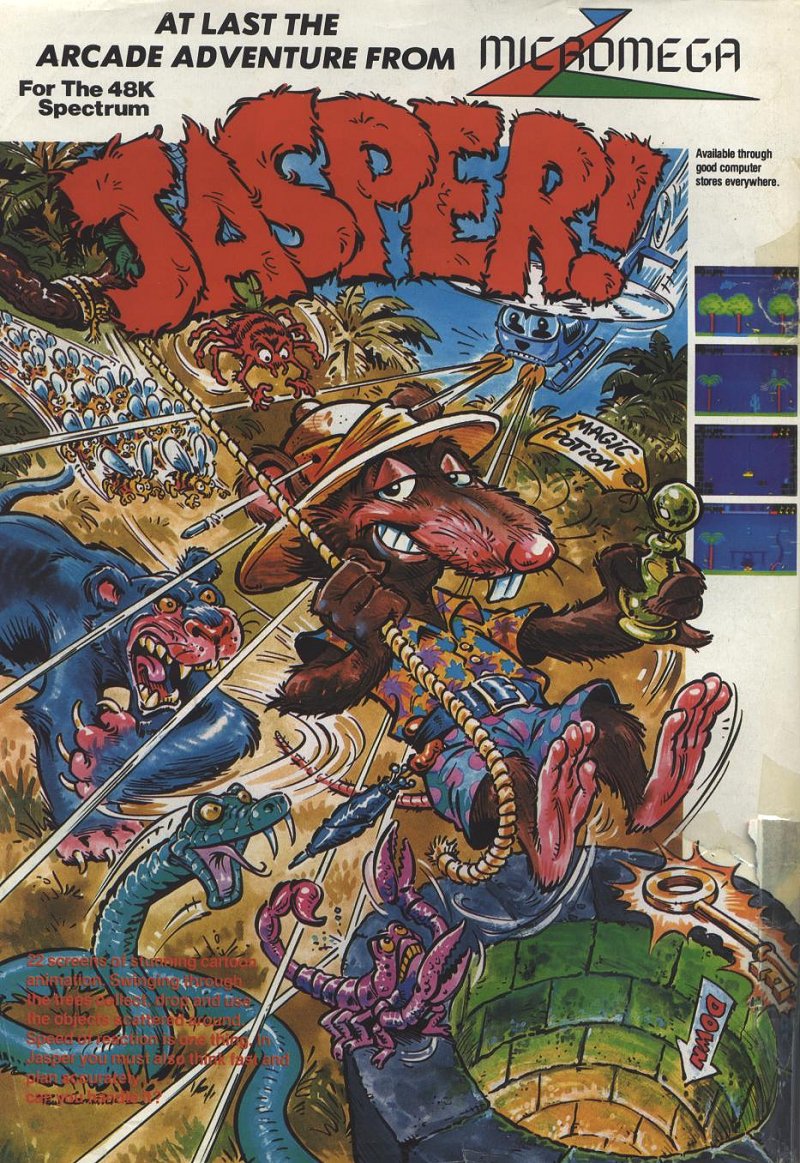

_Back.jpg)
_Back.jpg)
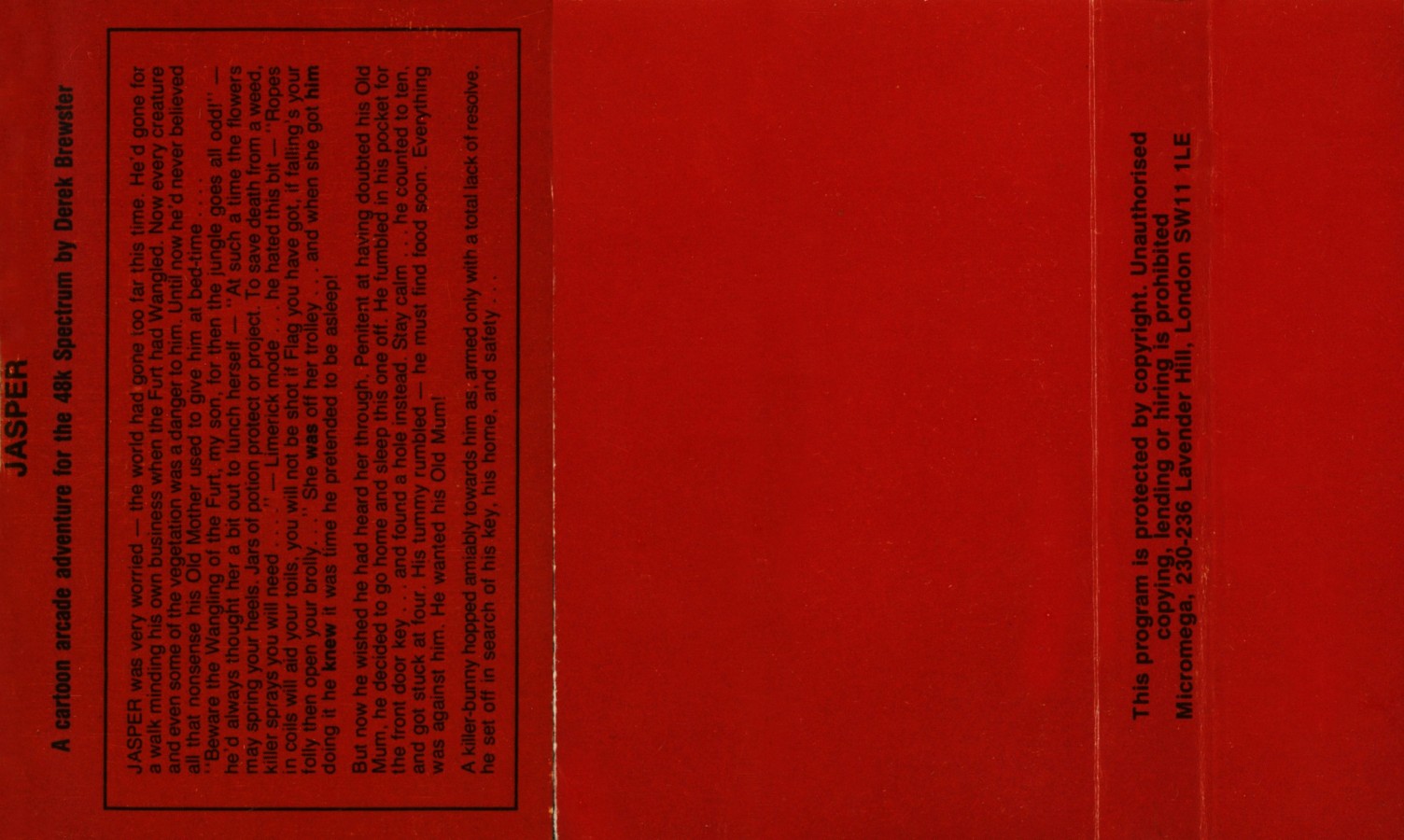
.jpg)
.jpg)
.jpg)
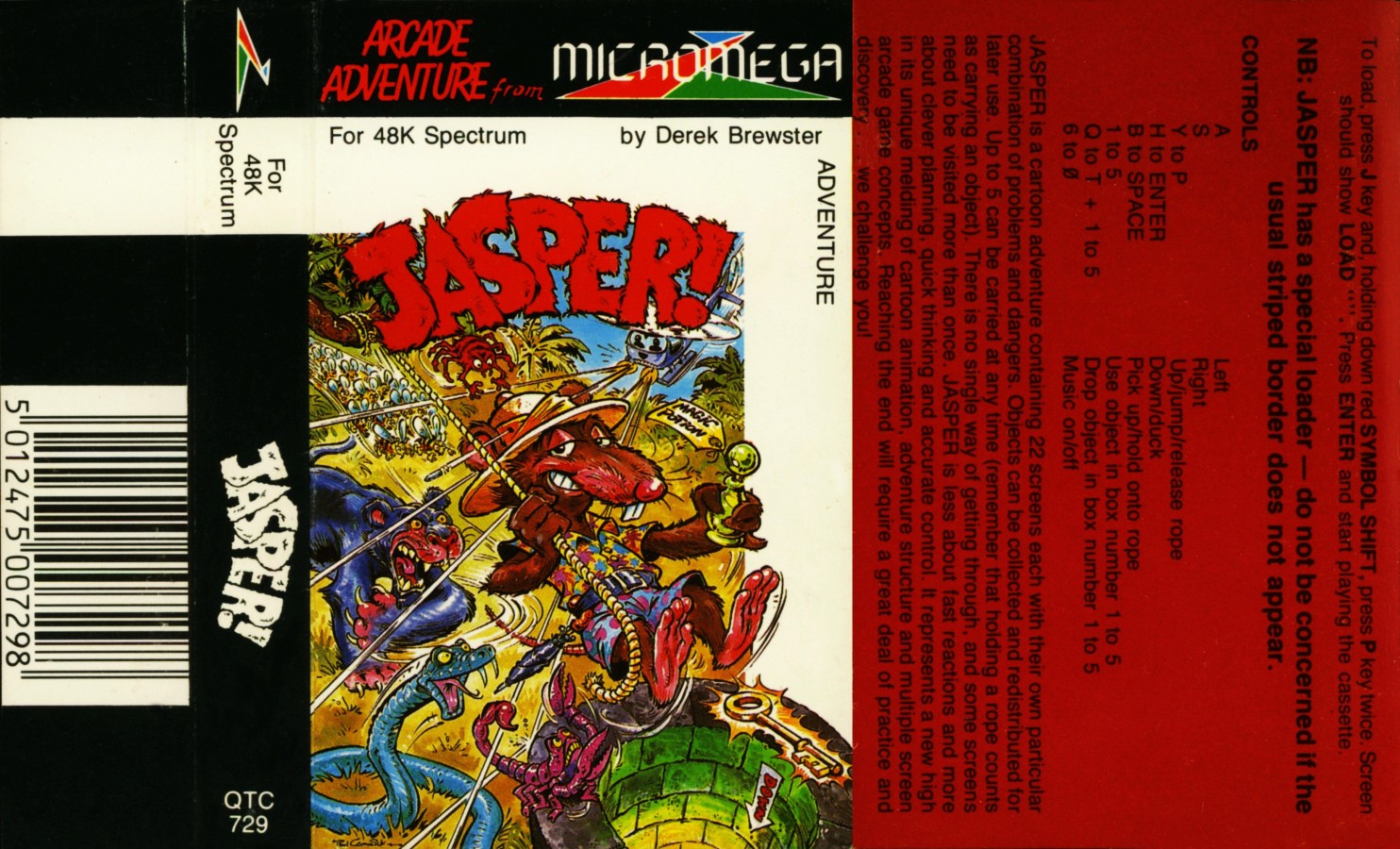
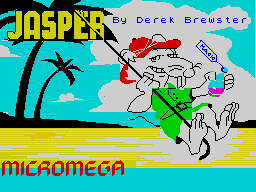
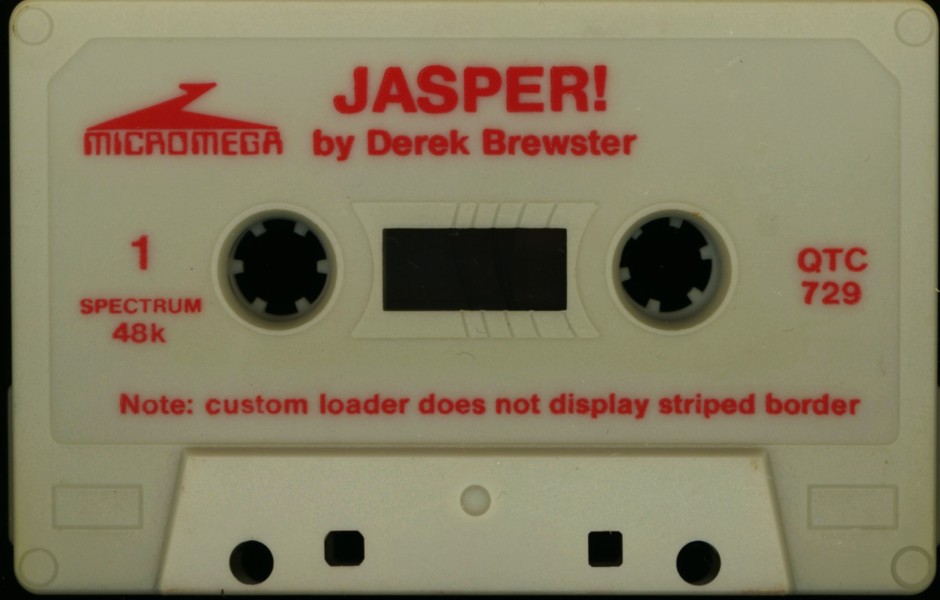
_Media.jpg)
_Media.jpg)
Discussion
Nobody has started a thread about this yet.
Releases
- 1984MicromegaPound sterling 6.95
- 1984Zeppelin Games LtdPound sterling 2.99
- 1985ABC SoftSpanish peseta 1695.00
- 29 Sep 19862.99 Classics
Play
- jasper.rzxRZX playback file
- Jasper.tzx.zipTape image English23 KB
- Jasper.tap.zipTape image English23 KB
- Jasper(2.99Classics).tzx.zipTape image English23 KB
- Jasper(ZeppelinGamesLtd).tzx.zipTape image English22 KB
- Jasper(MasterTape)(ZeppelinGamesLtd).tzx.zipTape image English22 KB
Documents
- Jasper.txtInstructions English3 KB
- Jasper(ABCSoft).pdfInstructions Spanish14 KB
Other files
- Jasper! (1984)(Micromega).pokPOK pokes file 0 KB
Files and rights
No permission is on record either way. Screens and pictures are copied here on a take-down basis: if you hold the rights and want something removed, say so and it goes.
Credits
- Derek Brewstercredited
- Paul CemmickInlay/Poster Art
Sign in to credit somebody, or say what these people did.
Awards
- PCG HitPersonal Computer Games14 · 1985
- Crash SmashCrash10 · 1984
Scores
In the magazines
- Crash #101984 · Overall91%
- Personal Computer News #861984 · Overall8/10
- Sinclair User #351985 · Gilbert Factor6/10
- Personal Computer Games #141985 · Overall9/10
- Your Sinclair #101986 · Overall7/10
- Sinclair User1986 · Overall3/5
Elsewhere on the web
- WorldOfSpectrum 22 votes7.15
In the magazines 47
Your Sinclair #10Oct 1986 · p.847/107/107/108/107/107/10
Graphics 7/10
Playability 7/10
Value For Money 7/10
Addictiveness 8/10
Overall 7/10
Luke C 7/10
2.99 Classics £2.99 Reviewer: Luke C Ah, this takes me back. Even though the state-of-the-art animation this game boasted two years ago now pales alongside most of the software around at the moment, it still has some of that good or magic. It all revolves round this 'dirty rat', Jasper, who's lost his way home as well as his front door key. With 22 screens to discover, you'll have to get the hang of it PDQ or you'll end up wandering round only three like I did. That was until I realised the potion on the top level of the tree was an antidote to the instant death I was suffering at the hands - or should I say leaves - of the huge plant blocking my exit from the third screen. That's what made Jasper exciting at the time - it was one of the first games to introduce the interesting elements of adventure games into an arcade. You can pick up and collect up to five objects at a time and use them to get past otherwise impossible opposing forces. Jasper can do all the usual rat type movements like left, right and crouch as well as some rather death defying leaps at dangling ropes so he can get across vast expanses of water. He's obviously not that athletic 'cos he spent most of his time crouching in terror from his various adversaries which include polar bears, panthers, scorpions, spiders and a not-so-cuddly rabbit. Don't ask me, I didn't stock the jungle! The graphics aren't brill but they set the scene admirably - just look at the way the panther walks. In the words of the dirty rat himself, it's top of the world Ma!
Sinclair User1986 · p.473/53/5
Overall 3/5
Clare Edgeley 3/5
ARCADE Clare Edgeley blasts her way through a wealth of challenging software. Get fit quick just about sums up the last 12 months. 1985 has seen enough sports games to put you off doing anything more strenuous than lifting a pint glass, at least for the next year. Since the 1984 Olympics, we have competed in every imaginable sport: played footie with Bobby Charlton, run rings round Daley Thompson and been KO'd by big Frank... There is hardly an action sport left which has not been turned into a money spinner, with a Sportsman's name attached. What is wrong with Tessa Sanderson's Javelin anyway? Daley Thompson's Decathlon was first to the tape back in November '84 and notched up a gold for Ocean when it jumped to number one in the charts for a few weeks. You have to compete in all ten events of the decathlon, taking part in the high jump, long jump and pole vault as well as track events. The 400m is the most gruelling and to keep up speed you must pump the joystick back and forth, which may result in a touch of cramp. The graphics are colourful and the game does give a taste of the real thing. Melbourne House also attempted a compilation of events with Sports Hero, although it was nowhere near as successful as Daley Thompson. Sports Hero has you competing in four events - 100m sprint, long jump, 110m hurdles and the pole vault, over three difficulty levels. To gain speed you must pummel the run button and press the jump button before takeoff. Aching fingers seem to be the norm in that type of game and in many cases you will end up with a sick keyboard as well. There is no sound and the graphics are not fantastic, although the scrolling background is interesting. A few more events should have been possible. More recently, Brian Jacks' Superstar Challenge from Martech reached the top ten, although it came a poor second to Imagine's Hypersports. Both contain a weird hotch-potch of events - some interesting, others boring. Brian Jacks gives you a pretty raw deal. For £7.95 you can immerse yourself in such exciting events as squat thrusts and arm dips. Those may be thrilling to watch on TV but on computer they are about as much fun as a wet blanket. Hypersports is a different ball game altogether. Licensed from the arcade game of the same name, the computer version is very like the original, although some events lack imagination. When swimming - or floundering, if you forget to breathe - instead of tearing down to the end of the pool, the end moves towards you. Clay pigeon shooting is certainly one of the better events, in which you must shoot the skeets through automatically moving sights. The vault is tricky and rather than vaulting as far as possible from the horse, you are likely to end up on your head beside it. The graphics are generally thought to be more professional than Daley Thompson's Decathlon, though whether the game is better is a moot point. Jonah Barrington's Squash from New Generation is an interesting concept which seems to have fallen flat. Knock a miniscule black ball round the 3D court and try to beat Jonah at his own game. Jonah is one of Britain's leading squash players. Much was made of the fact that a taped recording of Jonah's voice calls out the scores. Unfortunately, all you get is an unintelligible gabble and it is easier to read them on the score board anyway. We awarded imagine's World Series Baseball three stars in the June issue, which just goes to show that our forecasts are not always spot on. In June, July and August it remained at number three in the charts, only dropping to eleventh place in September. The game opens with a traditional rendering of the tAmerican National Anthem. Then play starts, with one team pitching and the other batting. You can play with a friend or against the computer, adjusting the speed and direction of the ball when pitching and the strength and lift of your swing when batting. Loving attention has been paid to detail with a large scoreboard displaying genuine adverts between innings. Last, but not least, boxing - the sport for ugly mugs. Cauliflower ears and battered brains are only half the fun - just think what you can do to your opponent. A few months ago three games were released simultaneously on the back of Punch Out!!, a highly successful arcade game. Elite's Frank Bruno's Boxing knocks Rocco and Knockout for six, and is easily the most playable and realistic, offering more possible moves and a greater number of competitors than either of the other games. It is also the only boxing game featuring a sporting personality - Bruno helped in an advisory capacity during production which explains the close attention to detail. Gremlin Graphic's Rocco squares up well in the ring, though you will find it is not as easy to dodge your opponent as it is in Frank Bruno, and there are only three competitors. The scoring system is simple and the graphics are the clearest of the three games. It is worth playing and annihilates Alligata's Knockout in the ring. Knockout is appalling and lacks any addictive qualities. It is the only game which uses colour - the others being mono - although that could have been sacrificed for extra playability. Other than left and right punches to the body and head, there is no facility for ducking and dodging, but at least you can amble away if the going gets too rough. You tend to spend a great deal of time seeing stars after being KO'd. At least it lives up to its name. The legendary success of Manic Miner and Jet Set Willy lives on. Platform and ladders games are still the rage and dozens of versions have landed in the Sinclair User offices over the last 12 months. Two years ago Manic Miner was a sure recipe for success, and because it was ahead of its time a lot of money was made. Programming techniques are now more sophisticated and with games like Alien 8 and Spy vs Spy around, who needs a Manic Miner spin-off? However, they are here to stay and some at least are worth the money you pay for them. One of the more successful games is Strangeloop, released late in '84, which has gone a long way to repairing the damage done to Virgin by Sheepwalk - one of its earliest and most awful games. A half-crazy computer is the source of all your troubles in Strangeloop and, playing the part of a metagalactic repairman, you must shut it down. There are over 240 rooms filled with lethal swarf which attacks and damages your space suit. A jetbike waits somewhere and will make your task easier but you have to locate and refuel it first. Objects picked up will help with various tasks and friendly robots will patch your torn suit. The graphics are colourful and simple. and there is even a facility for saving your position on tape, to be resumed later when you have recharged your batteries. Jet Set Willy II is the biggest rip-off of them all as Software Projects has done little other than add about 70 extra screens to the original. Essentially it is the same as Jet Set Willy which was launched back in 1984. The plot is similar; clear up the house before going to bed and avoid the hundreds of lethal thingummies found in each room. Despite being little more than a re-release, Jet Set Willy II is currently doing very well in the charts. Despite the lack of original thought, if you are still hooked on the challenge of platform and ladders, try The Edge's Brian Bloodaxe. A loopy game if ever there was one. Brian, a viking soldier has been trapped in a block of ice for centuries, and as it thaws, he leaps out shivering, but ready to conquer the British. Flapping 100 seats, deadly ducks and mad Scotsmen are a few of the dangers that lurk on each level. Objects to collect and chasms to be leapt add to his daunting task. Brian Bloodaxe is at least as good as Jet Set Willy, with much visual humour and bright, clear graphics. Hewson, which has made a name for itself in recent months with arcade adventures such as Dragontorc and simulations like Heathrow ATC, must have had a brain storm late last year with Technician Ted, which is totally unlike the semi-serious games released since. Guide Ted around a silicon chip factory while looking for a plate of the real things. Pick up knives, forks and other necessary implements and avoid several nasty traps. Easy to play and reasonably addictive, Technician Ted is not one of Hewson's best games but has done quite well in the platform and ladders stakes. Artic's Mutant Monty is more sophisticated than Technician Ted and includes some extremely tricky screens requiring split second timing - if you are slightly out, a lemon or some other incongruous object will squash you flat, and then where will the beautiful maiden be? it is a constant source of amusement that so much work goes into preparing intricate story lines bearing absolutely no resemblance to the game you are playing. On the whole rip-offs are uniformly mediocre in standard and not the sort of game you would buy for lasting playability. Real fanatics will find Activision's Toy Bizarre and Micromega's Jasper a doddle, and probably have more fun playing blindfold with their hands tied behind their backs. Both games are average and employ run-of-the-mill graphics. In Toy Bizarre, the player leaps round the levels of a toy factory popping balloons while being chased by a gang of irate toys. Meanwhile, in Jasper much the same thing is going on, only this time you are a furry rat collecting money bags and treasure chests while avoiding furry cats, rabbits and other hairy animals. Platform games are usually fast moving and it is generally easier to keep up with the pace using a joystick. Unless you have very strong fingers, Jasper is doomed as your only option is to use the Spectrum's sticky keyboard. Arcade adventures have come into their own in recent months, some remaining for weeks at a time in the top ten. With the advent of games like Gyron, fewer people are willing to put up with games like Jet Pac - classics two years ago but now gathering dust in cupboards across the country. Superior graphics is the name of the game and the Spectrum is being stretched to its limits in a constant effort to improve software. Some games combine excellent graphics with originality, though equally large numbers have been launched on the back of the successful few. Ultimate's Knight Lore, Underwurlde and Alien 8 are three successful examples and Nightshade is expected to do as well. Underwurlde is rather like a vertical Atic Atac featuring the Sabre-man who must escape a series of chambers while avoiding hosts of nasties. The pace is fast, the screens colourful - a devious game. Knight Lore and Alien 8 could, at first glance, be mistaken for the same game. Featuring superb 3D grahpics, Knight Lore's hero must search a maze of rooms and find the ingredients of a spell to lift a curse placed upon him. Each room presents a challenge and one wrong move spells instant death. The scenario in Alien 8 is different from its predecessor and the quality of graphics is even higher. Wizard's Lair from Bubble Bus is an Atic Atac lookalike with shades of Sabre Wulf and is an excellent game, even if you have seen the same sort of thing before. Bubble Bus has made some attempt to change the scenario which covers three levels, accessed via a magic wardrobe lift. The programmers of Firebird's Cylu were influenced by Alien 8. Cylu is in the Silver range and at £2.50 represents very good value - it is almost as frustrating as the original but the graphics are a little patchy. Ultimate should be proud that so many companies want to copy their games, though it's a crying shame that those same software houses cannot put their combined programming expertise to good use, and produce something original of their own. Games featuring film scenarios and famous names are often the subject of massive advertising campaigns, and Domark's A View to a Kill was no exception. Played in three parts you must guide the intrepid 007 through the streets of Paris, San Francisco and into Silicon Valley to stop the evil Max Zorin from tipping chip valley into the drink. The game received mixed reviews but, at the time of writing, it had just made it into the top ten - probably due to the James Bond name. It is an exciting game but lacks much visual detail. The Rocky Horror Show from CRL is already sliding down the charts and does not live up to its namesakes, the film and play. Rescue Janet or Brad from the Medusa machine by finding 15 component parts of the de-Medusa machine. It sounds riveting. Your task seems enormous as you can carry only one part of the machine at a time and if you expect to meet normal sane characters in the castle, forget it. More could have been made of the graphics and the action is slow in places, but it is worth playing if only to meet Magenta who will strip you of your clothes. Wow! Beyond's Spy vs Spy is unique and features simultaneous play between two players on a split screen. Take part in the zany humour of MAD magazine's two famous characters, the black spy and the white spy, each trying to stop the other finding secret documents in a foreign embassy. Set whacky traps as you ransack each room before escaping to the airport. It is fun, highly addictive and very amusing. Buying the licence to films, books and names is an expensive business, and at last one company has made the most of it with an excellent game. It is interesting to note that when one unusual game is launched others of a similar nature swiftly follow. Perhaps all programmers follow the same thought waves. Last summer we had an unusual trio of games, reviewed in May, June and August issues. Two are based on the human body - not the most obvious subject for a game. Quicksilva's Fantastic Voyage is a thrilling game based on the sixties film of the same name, in which Raquel Welch is injected into the body of a brain damaged scientist. Unfortunately, your mini-sub breaks up and you have only one hour to locate all the missing parts. Searching is a novel experience as you rush from atrium to stomach to lung and heart in a never ending circle. Finding your way to the brain is difficult as it is not signposted and the turning is easy to miss. Dine on red blood cells to keep up your energy and clear any infections which frequently break out - normally in the most inaccessible parts of the scientist's anatomy. A great way to learn about your bits, and where they are situated. Icon's Frankenstien 2000 bears little resemblance to Fantastic Voyage, though it is played in a monster's body. Whoever heard of monsters smoking fags? This one obviously did and that is probably why it's dead. On reaching the lungs, battle with cigarette packets, avoid hopping frogs in the trachea, and fire at any oxygen molecules it is your misfortune to encounter. The graphics are uninspired and the game is simple. Genesis' Bodyworks was reviewed in June and it is difficult to know what to make of it. It is hardly an arcade game - more of an illustrated, educational tour of the workings of a human body, describing the nervous, circulatory and respiratory systems. Space Invaders was one of the first great games on the Spectrum and software houses have never tired of the theme. Space games crop up in all categories; simulations, adventures and arcade adventures. Activision has even brought out Ballblazer, a sports game played in space. Way out! Moon Cresta from Incentive is a traditional game in which you shoot everything in sight, and then dock with another space ship before taking off to do exactly the same on the next level. With complex games like Starion around one would think that games of this calibre would flop. But no, there must be some people around whose brains are in their trigger fingers. Surprisingly, Moon Cresta is creeping up the charts. Long live the aliens. Melbourne House's Starion takes space travel seriously and combines a number of features, including the traditional shoot 'em up, word puzzles and anagrams. Kill off enemy space ships and collect the letters they drop, then unscramble those to form a word. Fly down to earth and answer a puzzle to change the course of Earth's history. There are 243 events to rewrite - and that amounts to a lot of flying time. Starion is well up in the top ten. System 3 has come up with the goods against all opposition with the dreadful Death Star Interceptor, which has proved surprisingly popular. If you are really into boring games, this is right up your alley. Played in three sections, first take off into outer space, next avoid assorted aliens and then, as in Star Wars, plant a bomb in the exhaust port of an enemy death star. It is all thrilling stuff. Quicksilva's Glass is amazing to look at. Psychedelic colours make you want to blink in this repetitive but addictive game. There are hundreds of screens to blast through, and whole sections are spent dodging columns as you hurtle through a 3D spacescape. The rest of the time is spent shooting radar antennae off unsuspecting space ships. The graphics make up for any limitations in the game and demonstrates that a traditional shoot 'em up need not be boring. This final section consists of a number of games which cannot be categorised. A strange mixture falls into this area - many are shoot 'em ups in some form or another, others require an element of cunning and strategy. Gyron from Firebird, a Sinclair User classic, is a unique game in which you must travel through a complex maze, dodging massive rolling balls and keeping a watchful eye on the guardian towers to be round at each junction. Those shoot at you, but approaching from another angle may change the direction of their fire. As there are two mazes to get through, it should take months. Gyron is likely to deter arcade nuts, but for those with staying power, it is an attractive proposition. It did make a brief appearance in the top ten at the time of writing, but has since fallen away. US Gold's Spy Hunter, based on the arcade game of the same name, is a faithful replica of the original. It all takes place on the road as you drive your souped-up sports car through a variety of traps laid down by the baddies. Equip your motor with a variety of weapons, obtainable from a weapons van which you drive into Italian Job style. Rockets, smoke screens and oil slicks are all strongly reminiscent of 007. Elite's Airwolf is a game that we found so hard as to be almost impossible, and which everyone else seemed to find a cinch - and told us so in no uncertain terms! Try if you can, to fly your chopper down a long, narrow tunnel to rescue five scientists stuck at the end. Blast your way through walls, which rematerialise as fast as you can destroy them - a well nigh impossible task for those whose trigger fingers and joysticks have suffered from the likes of Daley Thomson's Decathlon. Airwolf has done better than we predicted. You can't win them all. Ghostbusters, the mega box office hit last Christmas was a prime candidate for a computer game and Activision was first to the ghost. Featuring all the best parts of the film, it was an instant success and Activision did well to launch it simultaneously with the movie. Drive around the city coaxing ghouls into your ghost trap but listen out for a Marshmallow Alert. That giant sticky marshmallow man is quite capable of flattening whole streets unless halted. Greenbacks play an important part in the game as you have to buy your equipment to get started, and earn enough prize money for the number of ghosts caught, in order to take part in a final showdown with Zuul. Finally Tapper from US Gold - another Sinclair User classic. Tapper is a simple but refreshing game centered round an all-American soda bar. You play a harassed barman, who must serve his customers with drinks. Easy at first as you slide them down the bar but wait until they have gulped down the fizzy stuff. Running backwards and forwards between four bars, make sure the customers have got a drink, and catch the empties as they come skidding back. There are three difficulty levels, each one faster and more hectic than the last. Tapper is moving up the charts and we are sure that it will go far towards refreshing the parts other games cannot reach. The fierce competition over the last 12 months has chased many companies into liquidation. There have, however, been successes, particularly with a number of small software houses bringing new blood into the market. That can only be seen as a healthy sign. The lack of QL games software is the only disappointment. Where is it? Other than a few basic programs such as Reversi, which cut its eye teeth on the ZX-81 years ago, there has been a dearth of games for this flagging micro. If games of the quality of Knight Lore can be produced for the Spectrum, why not for the QL?
Your Spectrum #11Feb 1985 · p.591/5 MISS5/5 HIT2.5/5 MISS
Dave Nicholls 1/5 MISS
Roger Willis 5/5 HIT
Ross Holman 2.5/5 MISS
JOYSTICK JURY All the latest software from around the houses! Passing judgement this month are Dave Nicholls, Ross Holman and Roger Willis. Our regular crew of software screw balls are in fine form this month. Draining the dregs of Christmas spirit are Dave Nicholls, the hairy hacker; JSW champion Ross Holman; and our own two-wheeled terror, Roger Willis. Just in case you find our scoring system too confusing, here's what it's all about. The score out of five at the end of each person's review is based on their own experience of the game. But that's pretty subjective... so, they also use the HIT and MISS system to indicate its potential as a commercial success. JASPER Micromega £6.95 Roger: Forget the nonsensical story line - "mummy rat warning young Jasper about how dangerous the jungle becomes after the 'Furt is Wangled'" - because this superb offering is obviously intended as a covert training aid to Central American guerrillas. Twenty-two screens of lethal shrubbery, wildlife and obstacles have to be negotiated successfully, to recover the key and get safely back indoors... to continue one's studies of Che Guevara's Collected Works in Basic, no doubt! Everything kills with gory certainty, but a smart rat can collect all sorts of useful tackle along the way. Pacifists will relish Jasper's inability to slaughter vindictive rabbits, spiders, wasps, dogs, bears, scorpions, frogs and monkeys (not to mention the odd 'Contra' chucking spears and the sinister helicopter buzzing through some frames, blasting away at our Jasp). Avoidance and survival skills are the name of this game. Assault course simulation is a strong feature, with ropes in situ to swing on and others lying about in handy coils for later use. Picking flowers helps jumping ability, food can be picked up for score and sustenance, umbrellas stored for cliff descent and the occasional aerosol spray used for dodgy weed disposal. Acquisition of Magic Potion restores lives, too. If you can handle attractive cartoon graphics, excellent arcade tactics and essential adventure strategy, then an awful lot of practice with Jasper could get you a decent job as a full-time guerrilla.
Sinclair User #35Feb 1985 · p.246/106/10
Gilbert Factor 6/10
John Gilbert 6/10
JASPER! Micromega Memory: 48K Price: £6.95 Hey rat fans, Roland has a competitor in Jasper, a 22 screen arcade game which is about as much fun as bubonic plague. In this overland, and overhyped, version of Manic Miner Jasper has to jump and crawl through assorted obstacles, such as yellow bears and spiders, collecting treasure chests and money bags which grow on trees. The bags give the furry rodent energy and extra lives, all of which you will need to get through even the first three screens. On novelty which is not available in Manic Miner is that you can move off both edges of the screen into other scenarios without scrambling through exits. The game is not mapable as we found when we went off the first screen with its bionic bunny to a prowling wild cat. Moving back to what should have been a rabbit screen disclosed a new format with yellow panthers. Confused? The game is not compatible with joysticks, or at least does not proclaim their use on the cassette insert. Once loaded the computer launches into a demo mode and no joysticks show up there either. Jasper may only require a few control keys to play but it is an obvious candidate for joysticks and it is amazing that they are not included.
Personal Computer Games #14Jan 1985 · p.80PCG Hit9/108/107/109/109/109/10
Personal Computer GamesPCG Hit
Graphics 9/10
Sound 8/10
Originality 7/10
Lasting Interest 9/10
Overall 9/10
Bob Wade 9/10
Peter Connor
Peter Walker
Robert Patrick
MACHINE: Spectrum 48K CONTROL: Keys FROM: Micromega, £6.95 Jasper! is an arcade adventure with 22 screens in which you have to get past animal and vegetable obstacles using a variety of objects. Your character is gracefully animated with a pot-belly and curling tale which wobbles as he walks along. There are a number of things which you can pick up and use: ropes, weedkiller sprays, potions, brollies, a key and a flag. These can be picked up so that they appear in a box at the top of the screen. You can carry no more than five at once and use them only one at a time, by pressing the number of the box in which it is shown. The obstacles that bar your way home consist of realistically animated rabbits, wasps, big cats, bears, snakes and scorpions. There are also deadly weeds, and a fall from a tree or a vine is fatal. Jasper can jump over obstacles or duck under them and even swing on ropes to cross some hazards. While doing this the rope counts as an item picked up, so don't try and grab any ropes while you're carrying five things. Your journey will take a long time and you will need sustenance in the form of purple apples and yellow bananas to keep you going. To begin with, running out of energy is the least of your worries: you're too busy dodging the killer bunny. However, as you get the hang of the screens you can settle down to try and work out the problems that face you. There is no one way of doing things and tasks can be completed in different orders as long as you have planned out your route carefully. I haven't told you how to use the objects but most of them are fairly obvious while clues to the others are on the cassette inlay. Completing 22 screens is a real job although once you have grasped the basic principles it is less a matter of discovery than of honing your skills to finish the challenge.
Jasper's programmer, 24-year-old Derek Brewster. His previous hits for Micromega include Kentilla and Code Name Mat.
Polar bears and spiders.
C&VG (Computer & Video Games) #39Jan 1985 · p.209/108/109/108/10
Graphics 9/10
Sound 8/10
Value 9/10
Playability 8/10
MACHINE: Spectrum 48k SUPPLIER: Micromega PRICE: £6.95 The craze for this year certainly seems to be graphical adventure games. This latest from Micromega is better than most, and also a lot harder. You are controlling a cute character called Jasper who can move left to right and jump. The easiest way to remember the rules is that anything which moves will kill you. As Jasper moves off the side of a screen, he will reappear on another. You don't have to collect all the objects on a screen at once, but you can come back to them later if you want. Before you even start to play the game, the first thing you'll notice is that there aren't any blue and yellow flashing border stripes while the game loads. This is a feature of Micromega's turbo loader and it works well. It also gives you a chance to enjoy the title screen without being hypnotised at the same time. The graphics are gorgeous. Beehives hang from trees and rather large bees flap their wings as they fly. A rabbit hops around on some of the screens and his back legs move in and out just like the real thing. There are also leopards after which move very realistically. The instructions which come with the game are deliberately brief. The idea is that you find things out for yourself, just like in a real Adventure. Some of the objects which are lying around should be collected and will help you on later screens, Others won't. A tune plays the the background during game, though you can turn this off. All in all, a good, non-violent game. Unless, of course, a coconut falls off the tree and squashes the bunny.
Crash #10Nov 1984 · p.98Crash Smash86%96%91%90%94%89%91%
Use of Computer 86%
Graphics 96%
Playability 91%
Getting Started 90%
Addictive Qualities 94%
Value For Money 89%
Overall 91%
Unknown
Unknown
Unknown
Producer: Micromega Memory Required: 48K Retail Price: £6.95 Language: Machine code Author: Derek Brewster Micromega have two games in this issue, and both are by the same author. Kentilla is a text/graphics adventure in the classic vein, but with Jasper Derek Brewster has changed tack completely (although it could well be called an arcade/adventure game) and taken himself and Micromega far away from the universe of 3D. Jasper is an all swinging, all singing, all dancing jump, hop and collect game in the tradition of Jet Set Willy. However collecting here isn't a question of collecting for points but because the various objects have a strictly defined purpose and use, which is what adds the adventure element. Jasper is a mouse and the basic object of the game is to guide him from the start screen to the finishing screen without getting finished off en route. There are 22 screens to negotiate, all linked in the sense that you can move from one to the next and back again for in one case down and up again). This is rather important because Jasper can only carry five objects at a time which means often having to drop something and then return for it. Consequently the 22 screens become more in terms of completing the game. The items collected (by standing on them and pressing the collect key) appear in small boxes at the top of the playing area and they may be used by pressing the appropriate numerical key. Each object does have a specific use - ropes are pretty obvious, but umbrellas? Well think carefully - this is a cartoon comic strip - press the button when forced to leap off a high place and bingo - the brolly opens to lower Jasper to the ground safely. Once used an object vanishes. Up against Jasper are a series of problems which include traditional platform strategical thinking, various animated animals like big cats, bunnies, wasps, spiders, snakes and scorpions, flowers which may be helpful or lethal and natives that throw coconuts and spears. Each screen has its own identity and share of the horrors. Fortunately Jasper has a mighty leap and can walk on two feet or duck down to all fours. Indeed, Jasper is a Mighty Mouse. COMMENTS Control keys: A/S left/right, Y to P up (rope), jump and release rope (when swinging), H to ENTER down (rope), and duck, B to SPACE = get an object, 1 to 5 = use carried object by box number, Q to T plus 1 to 5 = drop carried object. Joystick: none - too many keys Keyboard play: highly responsive, with two directional keys next to each other, leaves other hand free for key selection, but a programmable joystick might be an advantage here Use of colour: excellent, very varied and bright Graphics: excellent, marvellous animation and detail, fast and smooth and without any flicker Sound: continuous tune and spot effects Skill levels: 1 Lives: 3 Screens: 22
Jasper's a real swinger when it comes to big cats.
if you go down to the woods today you're sure of a big surprise.
Personal Computer News #86Nov 1984 · p.578/108/10
Overall 8/10
Sandra Grandison 8/10
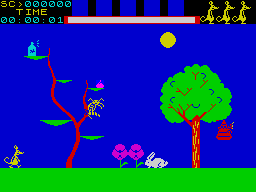
PRICE: £6.95 PUBLISHER: Micromega [redacted] If you've mastered the jungle and platform-type game, you'll feel at home with this one. Jasper is a jungle rat who goes on a wild adventure through the swamps avoiding all the beasts of the land, in a bid to find his way back home. In this cartoon adventure you have 22 screens to plough through - each with its own dangers and problems. The scenery of the first screen is quite good. Bees flutter, spiders bob up and down and a killer rabbit bounces towards Jasper ready to pounce on him. At the top of the screen is the number of lives you have (you start with three) and there's also a timer. Controlling Jasper needs clever planning, quick thinking and good keyboard control. There's no single way of getting through the dangers as some screens need to be visited more than once. To save Jasper from the manic rabbit I pressed S to go right, and then Y to jump over the rabbit. But then I ran into trouble: my friendly rat collided with a deadly spider and a wasp, and lost his three precious lives. I tried another strategy - this time Jasper went left on to the next screen-jumped over a leopard and skilfully grabbed an apple and traversed towards the riverbank. With the leopard pacing up and down I didn't have a lot of time to get Jasper across. So I adopted some long-jump tactics. Going quickly up to the riverbank, I pressed Y for jump then grabbed a rope dangling above the river and pressed B for hold. Then H to climb down the rope, A and S,to swing it and when the time was right, I pressed Y to let go and land. Along Jasper's journey he picks up objects which he can use later. But he can carry only five objects at once. I never got further than the third screen - but there's certainly plenty to keep you going.
10 Computer Hits 1 carries this game and has 2 references of its own.
The Derek Brewster Collection carries this game and has 1 reference of its own.
Full-page ad15
- Crash #14Mar 1985 · p.2
- Popular Computing Weekly #6Feb 1985 · p.10
- Crash #13Feb 1985 · p.2
- Personal Computer Games #14Jan 1985 · p.104
- Games ComputingJan 1985 · p.17
- Sinclair Answers #2Jan 1985 · p.67
- Crash #12Jan 1985 · p.2
- Popular Computing Weekly #2Jan 1985 · p.8
- Popular Computing Weekly #49Dec 1984 · p.79
- C&VG (Computer & Video Games) #38Dec 1984 · p.33
- Crash #11Dec 1984 · p.2
- Personal Computer Games #12Nov 1984 · p.154
- Popular Computing Weekly #45Nov 1984 · p.41
- Crash #10Nov 1984 · p.2
- Your Spectrum #9Nov 1984 · p.43
Advert10
- Your Sinclair #10Oct 1986 · p.7
- C&VG (Computer & Video Games) #60Oct 1986 · p.11
- Crash #33Oct 1986 · p.2
- Big K #10Jan 1985 · p.2
- Crash #12Jan 1985 · p.153
- Your Spectrum #10Dec 1984 · p.45
- Crash #11Dec 1984 · p.121
- Popular Computing Weekly #47Nov 1984 · p.19
- Crash #10Nov 1984 · p.85
- Popular Computing Weekly #41Oct 1984 · p.17
News/Note5
- Popular Computing Weekly #23Jun 1988 · p.25
- ZX Computing #17Feb 1985 · p.81
- Sinclair Programs #26Dec 1984 · p.11
- Your Spectrum #10Dec 1984 · p.4
- Home Computing Weekly #86Oct 1984 · p.5
Review3
- Games ComputingMar 1985 · p.33
- MicroHobby #15Feb 1985 · p.14
- Home Computing Weekly #88Nov 1984 · p.40
Tips1
- Sinclair User #50May 1986 · p.21
CompoResult1
- Home Computing Weekly #99Feb 1985 · p.5
CoverGame1
- Personal Computer Games #13Dec 1984 · p.34
CompoEntry1
- Home Computing Weekly #93Dec 1984 · p.15
Related
- Compilations
- 10 Computer Hits 1, Personal Computer Games issue 13, The Derek Brewster Collection, Load 'n' Run issue 21, Spectrum Load'n'Run v2 issue 03
- Elsewhere
- Speccy Screenshot MapsThe Cutting Room FloorCentre for Computing HistoryMobyGamesRZX ArchiveThe TipshopUVLRZX Archive - YouTubeSpectrum Computing RZX - YouTubeModern ZX-Retro Gaming
- Same entry at
- Spectrum ComputingZXInfo
Reviews from people here
Sign in to write about this, or make an account. It takes a minute and lets you correct the catalogue too.
No description, tag recorded.
Sign in to correct or add to this.
Hold the rights to this and want it taken down?