
Jet Set Willy
Arcade Game: Platform · ZX-Spectrum 48K · 1 players
Software Projects Ltd · Mar 1984 · Pound sterling 5.95
Also known as JetSet Willy (English)
Miner Willy, 2 of 3


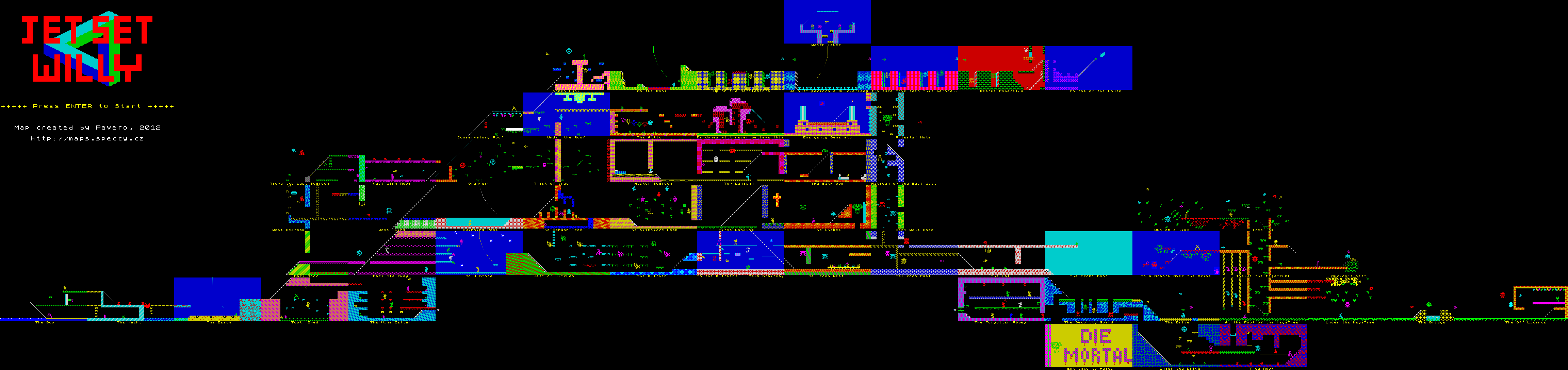
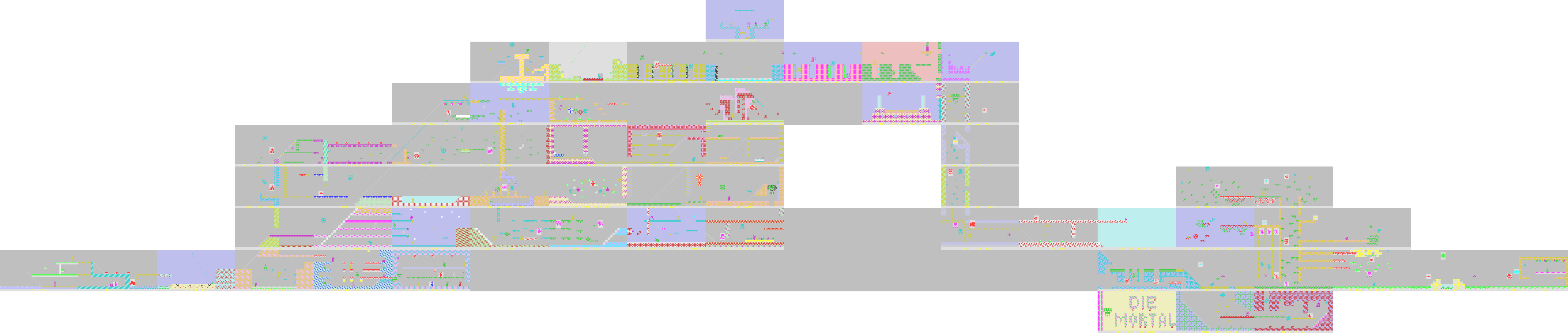
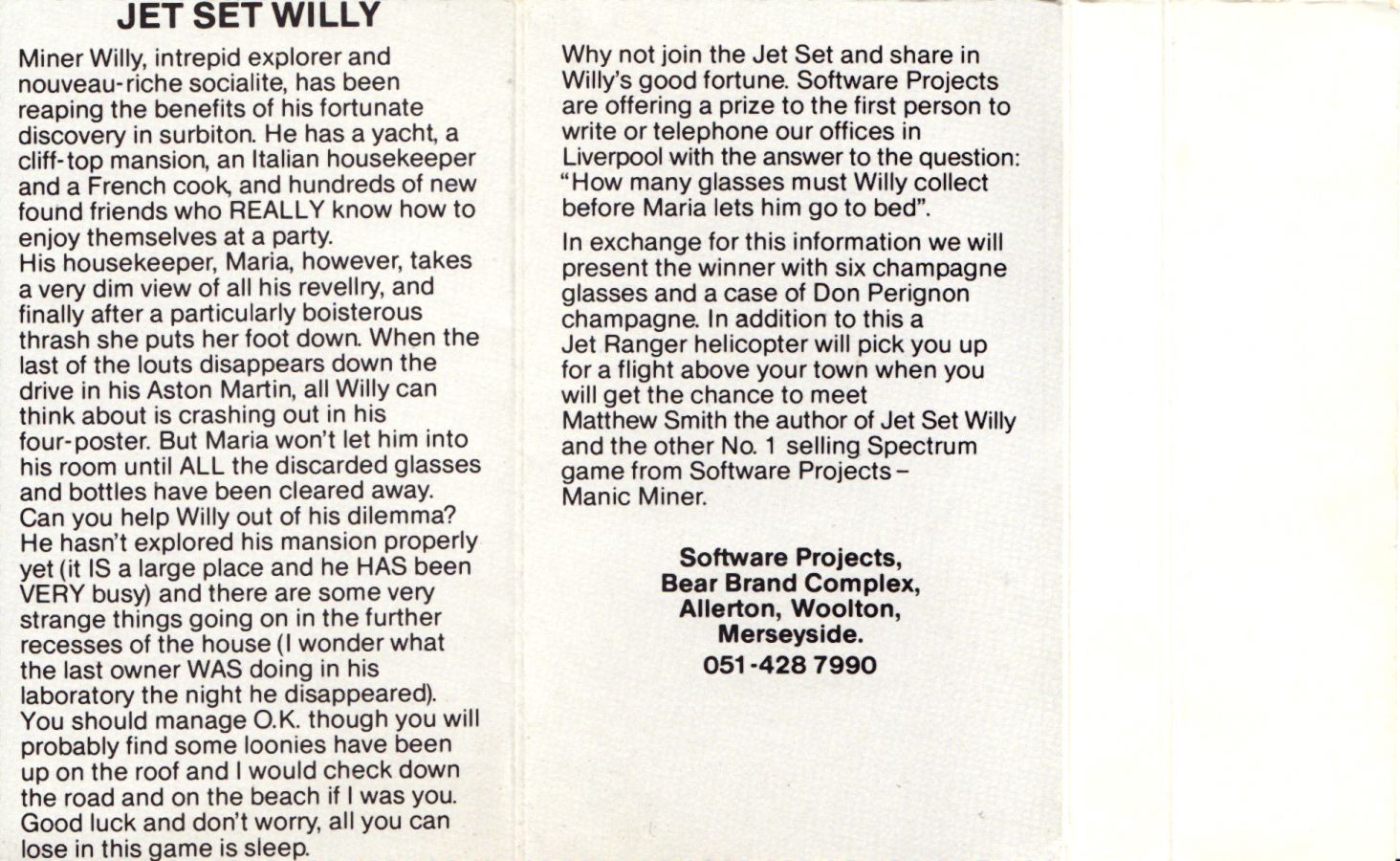
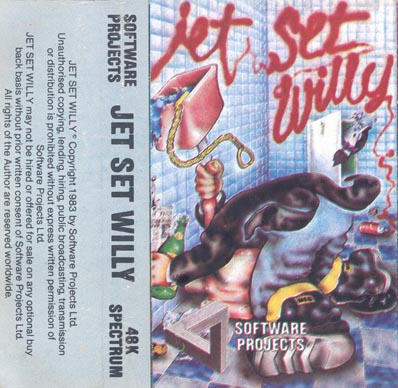
.jpg)

Discussion
Nobody has started a thread about this yet.
Awards
Rank #05 - 1984 Sinclair User Top 50 Spectrum Software Classics
Known Errors
(Taken from <A HREF="http://en.wikipedia.org/wiki/Jet_Set_Willy">Wikipedia</A>): As originally released, the game could not be completed due to several bugs. Although actually four completely unrelated issues, they became known collectively as "The Attic Bug". Initially Software Projects attempted to pass off the most severe - The Attic bug itself - as an intentional feature to make the game more difficult, claiming that the rooms in question were filled with poison gas. However, they later rescinded this claim and issued a set of POKEs to correct the flaws. The most notorious bug was the The Attic Bug. After the player entered the room The Attic, various rooms would undergo corruption on all subsequent game plays, including all monsters disappearing from The Chapel, and other screens triggering instant death. This was caused by an error in the path of an arrow in The Attic, resulting in the sprite travelling past the end of the Spectrum's video memory and overwriting crucial game data instead. This bears similarities to a buffer overflow, and as such is an early example of such an error - and the problems it can cause. An item under The Conservatory Roof was placed too close to both the screen entrance and a killer object making it impossible to collect. The Software Projects fix removed the killer object. There was an invisible and impossible to reach item in First Landing. The Software Projects fix relocated the item to The Hall - although some fixes relocated the object to The Bathroom where it became visible as another tap item. (By poking value 33, instead of 11.) The Banyan Tree was impassable in an upward direction - the Software Projects fix changed the status of an essential block from solid to passable.
Music References
Includes the following music: L. v. Beethoven, Sonata No. 14 in C# Minor "Moonlight Sonata" op. 27 no.2, I. Adagio sostenuto [title screen]; Sheldon Harnick and Jerry Bock, "If I Were a Rich Man" [in game]
Releases
- 9 Mar 1984Software Projects Ltd Sold as JetSet WillyPound sterling 5.95
- 1984Microbyte [ES]
- 1984Ventamatic
- 1984CPL Computer Plus Soft GmbH
Play
- jswvariations.zipRZX playback file
- jswvariants.zipRZX playback file
- jsw.zipRZX playback file
- JetSetWilly(StormWarningMix).z80.zipSnapshot image English19 KB
- JetSetWilly(hacked).z80.zipSnapshot image English26 KB
- JetSetWilly_2.tzx.zipTape image English16 KB
- JetSetWilly(PCGBugfix).tzx.zipTape image English17 KB
- JetSetWilly(pre-production).tzx.zipTape image English17 KB
- JetSetWilly(original).tap.zipTape image English24 KB
- JetSetWilly(Ventamatic).tzx.zipTape image Spanish23 KB
- JetSetWilly(CPLComputerPlusSoftGmbH).tzx.zipTape image English16 KB
Documents
- JetSetWilly(EN).pdfInstructions English229 KB
- JetSetWilly(CPLComputerPlusSoftGmbH)(DE).txtInstructions German9 KB
- JetSetWilly_historical.txtInstructions English18 KB
- JetSetWilly.txtInstructions English3 KB
- JetSetWilly(StormWarningMix).txtInstructions English2 KB
Music
- JetSetWilly.ay.zipRipped in-game/theme music in AY format 1 KB
Other files
- Jet Set Willy (1984)(Software Projects).pokPOK pokes file 7 KB
- authors_jodi.htmlRemote link
Files and rights
Distribution permission is on record, granted to another archive rather than to this one. Screens and pictures are copied here; everything else links to the archive that holds it.
- AllowedVentamatic → WorldOfSpectrum
Credits
- Matthew Smithcredited
- Roger TissymanInlay/Poster Art
Sign in to credit somebody, or say what these people did.
Awards
Scores
In the magazines
- Crash #41984 · Overall95%
- Big K #41984 · Overall3/3
- Personal Computer Games #61984 · Overall10/10
- Sinclair User #271984 · Gilbert Factor9/10
- ZX Computing #161984 · Overall5/5
- Sinclair User1985 · Gilbert Factor9/10
Elsewhere on the web
- WorldOfSpectrum 498 votes8.26
Awards and competitions
Big K - Readers Poll 1984
- 1Game of the Year
- 1Worst Packaging of the Year
- 3Best Ad of the Year
C&VG Top Ten 1984
Crash Readers Awards 1984
- 2Best (Overall) Arcade Game
- 2Best Looking Advert To Appear In A Magazine
- 2Best Platform Game
- 3State Of The Art Award
Your Spectrum Strangled Turkey Awards 1984
- 1Strangled Turkey of the Year
In the magazines 174
Crash2018 · p.59
Chris Wilkins
Ryan Coleman
As the Crash annuals are still for sale ZXSR has taken the decision to remove all review text, apart from reviewer names and scores from the database. A backup has been taken of the review text which is stored offsite. The review text will not be included without the express permission of the Annuals editorial team/owners.
Sinclair User1985 · p.469/109/10
Gilbert Factor 9/10
John Gilbert 9/10
SOFTWARE SCENE While some software houses are taking the Spectrum to its limits and beyond others doggedly continue to churn out ever more diabolical pieces of programmed junk. John Gilbert present a personal pick of the bunch, and Chris Bourne take an irreverent look at the dwindling ZX-81 software scene. Their talents are combinedd in listing the Top Ten Turkeys of 1984. Let the reader be warned. SPECTRUM SOFTWARE A cynic may argue that development within the software market in 1984 was non-existent. The same type of game appeared as those which took the lead in 1983, the most popular being of the arcade variety. The programs were written in the same style and to please the same type of customers. That is only a superficial view, however, and if you look at the games market as a whole, dividing it up into sectors such as strategy, arcade and adventure, you will see that substantial and sophisticated changes have taken place. Despite what some pundits have said you will find that the world of computer games is still buzzing with life. JET SET WILLY £5.95 Software Projects A number of cult games sprang up during the year. The biggest was the Manic Miner sequel, Jet Set Willy. Manic Miner was one of last year's classic Spectrum games and programmer Matthew Smith brought Willy back again in an equally zany sequel. Willy is living the decadent life after striking it rich down the mine but his housekeeper revolts after one party too many and will not let Willy go to bed until he has cleared all the mess. You have to guide the debauched playboy round his enormous mansion full of lethal traps and a strange blend of domestic and diabolic mayhem. It is worth the initial trouble. The graphics are clear, fast-moving, and varied, depicting ghosts, mad monks and animated toilet seats with equal smoothness and precision. Tactics need to be varied as well; only quick reactions will save you from the predatory security guards, whereas forethought is required to negotiate your way through the hazards of the giant Metatree or the unspeakable menace in the kitchens.
ZX Computing #16Dec 1984 · p.15392%100%5/55/5
Presentation 92%
Zapability 100%
Overall 5/5
Jim Watson 5/5
Software Projects Ltd [redacted] £5.95 Manic Miner - The Sequel! Whereas most cinema sequels are rip offs, this game is as good, and in my opinion, better than the original. For anyone who has been living in the Sahara desert for the last year as a hermit, Manic Miner was written by Matthew Smith and was the first of a whole new style of game in which the player progressed through several screens of weird and wonderful creations by making carefully timed jumps from level to level in order to collect various objects. JSW is the same in outline and again produced from the nightmare mind of Matthew. This time however, the scene is a mansion and JSW has to collect all the glasses left around before he is allowed to go to bed. Software Projects ran a competition for the first person to tell them how many glasses had to be collected but this has now been won - so no more calls please. For those of you who don't want to know, close your eyes when reading the next bit - there are 83 glasses. The game has many more rooms to visit, 60 in all, and the manic sense of humour runs through them all, accompanied by a frantic version of "If I were a rich man" guaranteed to drive you bonkers! The 'ups' are much harder in JSW and timing is very critical indeed. Personally I found it easier to play from the keyboard rather than joystick - all the usual options for these are included. I loved the sneaky digs at other programs, the set of "Hunchback" type screens for instance. Definitely a classic that every Spectrum owner who enjoys playing games should have! I hope that Matthew's fertile mind gives this theme a rest now as I'm sure he can create another whole new generation of games, given the chance.
Sinclair User #32Nov 1984 · p.7
An instant, and not unexpected, success which closely followed on the heels of the classic Manic Miner. Willy the miner has retired and taken to a life of drunken debauchery. His housekeeper, Maria, will not let him get to bed until he has cleared up the bottles and glasses lying around the house. The arcade-style graphics, the number of rooms and the strange creatures which inhabit them ensure Jet Set Willy a place in the history of arcade gaming. The game is also notable for the colour code system employed to combat piracy - with, unfortunately, limited success. Position 5/50
Sinclair Programs #21Jul 1984 · p.32
June Mortimer
This month we focus on the exploits of hero Willy after his mining experience and on some of the best and worst new Spectrum games. SURBITON MILLIONAIRE JET SETS ON TO SCREEN In the beginning was Manic Miner, the game with the potential to break up more friendships and families than any others. Obsessed players, with eyes for nothing but Miner Willy and the mines beneath Surbiton, played all day and all night long. Now there is Jet Set Willy, which is more fun, more enjoyable and more addictive than almost any game on the market. It is so addictive that not only did our review department play it for hours but members of our circulation and advertising departments remained after hours to play. Willy, having made his fortune in the mines beneath Surbiton, must clean up his mansion after a wild party before his housekeeper will allow him to go to bed. Each room contains an obstacle course and various enemies to be avoided. Superbly animated characters fill each room, each posing a threat to the miner. The game is also a form of maze, for some rooms may be reached only by a long and tortuous route. Other rooms, such as the wine cellar and the yacht, need very exact timing to make escape possible. At first sight the pace of the game is sedate. Willy strolls along, bounces gently upwards, and reaches for the litter strewn round the house. Meanwhile the security guards, demons and revolving peardrops move relentlessly onwards and the hapless player hammers at the keys. There can be months of enjoyment from this original and brilliant game. Any Spectrum owner willing to sacrifice sleep and peace of mind should rush out and buy it immediately. Jet Set Willy is produced for the 48K Spectrum by Software Projects, [redacted]. It costs £5.95.
Big K #4Jul 1984 · p.263/33/3
Overall 3/3
Richard Burton 3/3
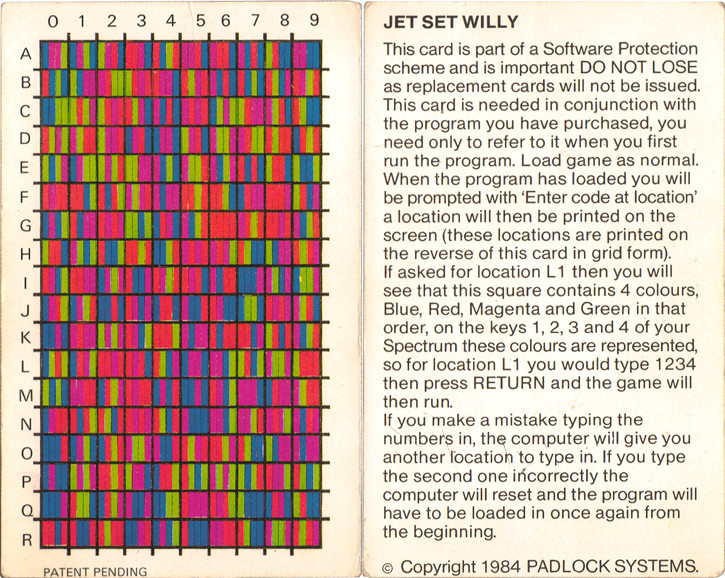
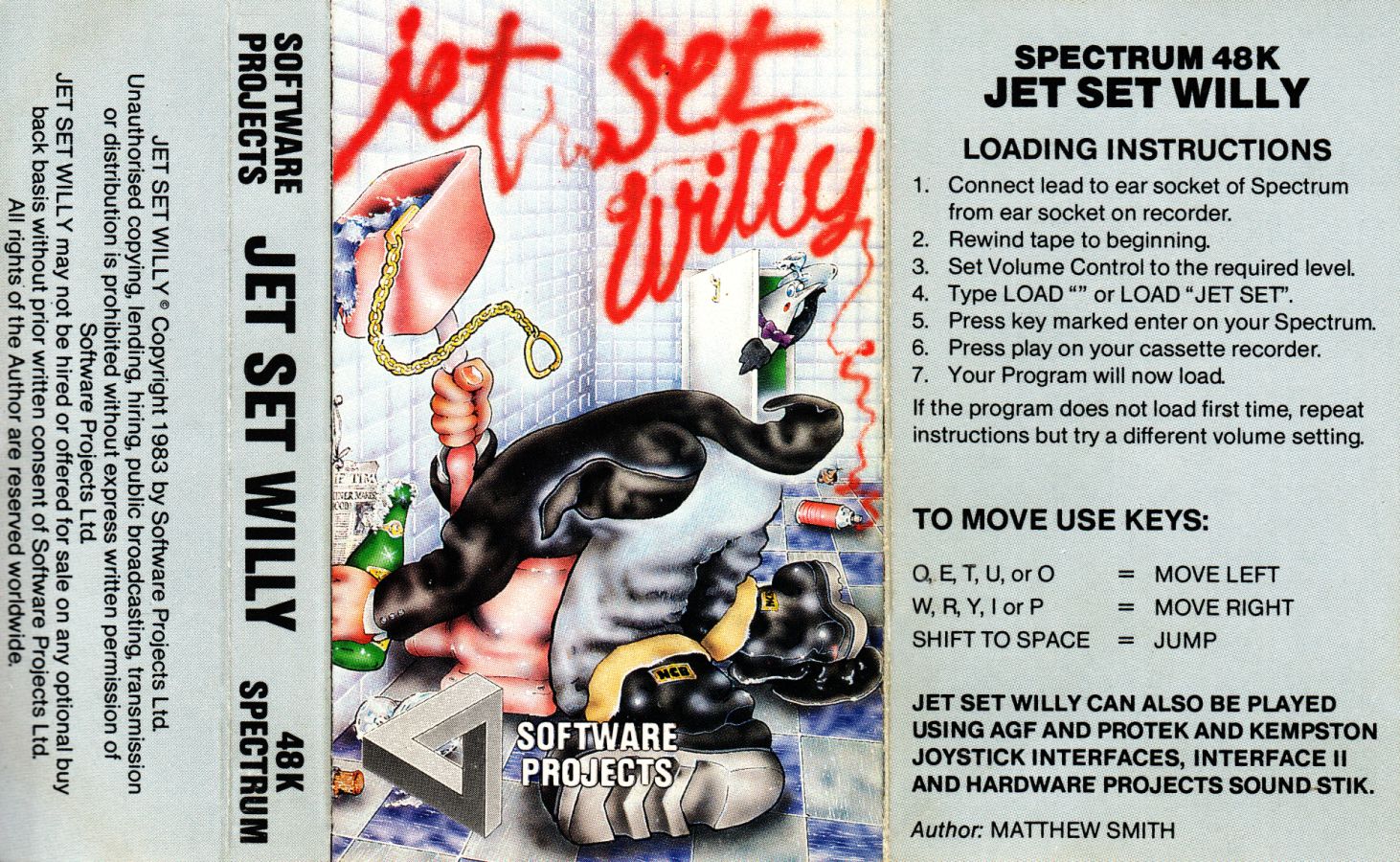
GREAT GAME, BUT... MAKER: Software Projects MACHINE: Spectrum 48K FORMAT: cassette PRICE: £5.95 Jet Set Willy arrived at the Big K office late (thanks a bunch, SP), the prerogative you might say of the micro scene's cosmic megastar. However, this put me in the unenviable task of trying to review a game that, as I write, is already Number One (with a bullet!) in most of the game charts. I guess that neatly disposes of the questions, will you like it and will it be a success! So, for the few who've recently returned from swan-upping in darkest Belgium, here we have the second appearance of Miner Willy, fresh from his starring role in the Bug-Byte/Software Projects mega-hit Manic Miner. Willy mates his elegant reappearance on the cover of Jet Set Wily, head down the lav in a graffiti-covered bathroom (tasteful, SP), his non-NCB approved wellies akimbo. The premise, it seems, is that Willy has become so stinking rich from the fortune he discovered in Manic Miner that he has bought himself a huge mansion and thrown the mother of all parties. The party's over and Willy wants to crawl into bed (and die?) but his housekeeper inststs he collects every glass and bottle eh in the mansion before he can do so. The stage is set for Willy to take off on another sojourn through the strange mind of Matthew Smith as each room he enters (and there are around 60) is some incredible carnival of moving things, hazards and rewards. In this respect it is identical to Manic Miner. All you have to do is keep Willy moving and try to jump over any traps or dangers. Use up all his lives and it's The Foot (unclad this time) for you, my lad. The major disappointment for me was the lack of demo mode. SP claim Jet Set Willy is a "Total Graphics Adventure" (say what?) and are offering a Big Prize to the first person who cracks it. All well and good, but at least no-hopers like myself who can only manage about half a dozen screens had the chance of seeing the full range of Matthew Smith's lunacy on MM. Any kind soul out there want to tell me what I'm missing? That said, Jet Set Will is a worthy successor to Manic Miner. The graphics, animation and sound are as good as, if not better than the original. Maria, the housekeeper, in particular, is superbly characterised. The way she taps her foot as Willy approaches his bed and then points an accusing finger towards the mess he has to clear up is brilliant. Okay, compliments out of the way - let's talk about the security system on Jet Set Willy. Software companies are of course going to fight the serious piracy problem in any way they can and I support them in the fight, but the hare-brained system in use on JSW isn't going to help anyone! A small, inlay-sized card containing 180 different 4-colour combinations comes with each copy of JSW. Once loaded the program asks for the particular combination at column X, row y on the card. The user then has to search out that combination and key it in. You only get two attempts before the program wipes itself! There's no way you can erase a mistake. The system fails on two levels. First, the card is too small and the print quality so bad that it is difficult to distinguish between a red and a magenta even if you have good eyesight. Secondly the system takes no account of people who are colour blind or who may be playing on black and white sets. The system is a hindrance and I'm sure will discourage people playing JSW as often as they'd really like. A shame that a program of this quality and popularity should inhibit the majority of honest, fur-loving hackers on account of the actions of the minority of rip-off merchants.
Sinclair User #27Jun 1984 · p.89/10
Gilbert Factor 9/10
Memory: 48K Price: £5.95 Joystick: AGF, Protek, Kempston, ZX, Soundstik Manic Miner was one of last year's classic Spectrum games and now programmer Matthew Smith has brought Willy back again in an equally zany sequel, Jet Set Willy. Willy is living the decadent life after striking it rich down the mine but his housekeeper revolts after one party too many and will not let Willy go to bed until he has cleared all the mess. So you have to guide the debauched playboy round his enormous mansion full of lethal traps and the strange blend of domestic and diabolic mayhem we might expect from Smith on previous form. It is worth the initial trouble. The graphics are clear, fast-moving, and varied, depicting ghosts, mad monks and animated toilet seats with equal smoothness and precision. Tactics need to be varied as well; only quick reactions will save you from the predatory security guards, whereas forethought is required to negotiate your way through the hazards of the giant Megatree or the unspeakable menace in the kitchens. Software Projects offers a case of champagne to the first person to solve the game.
Your Spectrum #4Jun 1984 · p.60
Sue Denham
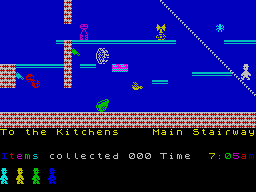
JOIN THE JETSET Keeping one jump ahead of the software market seems to come naturally to author of Jet Set Willy, Matthew Smith. Sue Denham checks out his follow-up to Manic Miner, where Miner Willy hits the big time. Every now and then, there comes a program that somehow prevents reviews from being written in a hurry - simply because tapping typewriter keys is cold comfort after you've negotiated the perilous journey up The Megatrunk, or collected the goodies from The Forgotten Abbey, or entered The Chapel and lived, or... Star of the Speccy screen. Matthew Smith, has finally delivered his followup to Manic Miner, and it's every bit as good and refreshing as the original. The story line is as weak as ever - some nonsense about Willy having thrown a party and the guests having left lots of champagne glasses strewn about his mansion (altered slightly in the production version). The aim is for him to collect all of these, because his housekeeper won't let him into the bedroom until he has. Weak it may be, still 'it's the game itself wot matters'. The game is colourful, fast and ingenious. The controls are simple; you can move left or right and you can jump effortlessly into the air. And that's all there is to it - except, of course, that this is where all your problems begin! CLOCK THIS Press Enter and you're whisked from the title page to your first glimpse of Willy's 60-room mansion. That's you standing in the bath, staring at a flashing tap and a toilet (complete with moving seat (a la Manic Miner). The moral of the game is that virtually everything that isn't flashing will kill you should you be foolish enough to walk into it. You've guessed it... the flashing objects are the ones you have to collect; there are 83 of them in all and the majority are very difficult to find indeed. At the bottom of the screen, there's an indication of time. You begin your quest at seven in the morning (it must have been one heck of a party!) and the idea is to get into your bedroom by the hour of midnight. No, that doesn't mean you'll be sitting at the keyboard for 17 hours (although that wouldn't surprise me) for Matthew has thoughtfully shortened each minute to around 40 seconds. But anyway, this is unlikely to bother users for quite a time... in the many weeks this game has taken to review, the clock has still never made it to eight in the morning! When you begin playing you start with eight lives, which at first seems a bit excessive (ho ho) - until you venture past The Bathroom. It's worthwhile just having a wander around to get a feel for the way Miner Willy handles; for example, you can get Willy to hang precariously to a surface by what looks like a single pixel before making that important leap - and in some cases that's exactly what you'll have to do. BATHTIME'S OVER One step out of The Bathroom and you're thrust into the thick of Matthew Smith's fertile imagination - and what a place that must be! You can forget all about malevolent space invaders and greedy Pac-persons, here the baddies are Swiss Army knives, razor blades, mini-chefs, grotesque faces, wobbling jellies, rolling eggs, ballet-dancing gerbils, a Monty Python foot, and... need I go on? That's not all you have to watch out for. The program has a nasty habit of thrusting you on-screen in a room you've just lost a life in - leaving you powerless to prevent all the remaining lives being eaten up in the same way. Try making some of the leaps across The Orangery, for instance. Should you miss your footing you're likely to end up falling down into The Swimming Pool and dying. The rest of your lives will then automatically be swallowed up in the same way, leaving you impotent with rage and uselessly hitting every key in sight, in a vain attempt to prevent the inevitable. Another strange quirk is the way in which the rooms have been laid out. The top floor seems to have more rooms than the floor below, and the basement has even fewer. For instance, if you go from The Wine Cellar into the next room, you'll end up in The Forgotten Abbey - which according to my calculations is right over the other side of the mansion! You can also reach some strange places by getting to the highest point of some rooms and jumping up. The first experience of this came after a timely leap from Rescue Esmerelda, which sent poor Willy headlong into the floor of Ballroom East. Also, if you try jumping off most of the other rooms on the top floor, Willy ends up in The Off Licence. Whether this just shows Matthew Smith's alcoholic sense of humour, I'll probably never know, but after a few hours of Jet Set Willy, it turns out not to be a bad suggestion at all. Unlike Andrew Pennell (the little cheat!), the approach in the YS office was simply one of striking out with eight meagre lives, in an attempt to find all the rooms. Having located around 45 of them, we seemed to come across a bug: each time we walked into certain rooms, Willy lost all his lives. It was time for a frantic phone call to Software Projects' Alan Morton. "Ahah', said Alan, "you didn't by any chance visit The Attic did you?" Sure 'nuff, we had - and very proud we were at the time. "Well, that's just a little something we put in to make it a bit more difficult", came the heavily understated reply. (The feeling our end is that it's a bug being turned into an asset - but who knows, we could be wrong!) Indeed, it does make the game "a bit more difficult" - in fact, nigh on impossible to be precise. Once you visit The Attic, the tour guardians from The Chapel race off to guard the entrances to The Kitchen, West of Kitchen, Cuckoo's Nest and East Wall Base. So, for goodness sake remember to check these places out first (and all rooms beyond) before you set foot in The Attic - otherwise you'll only have to re-load the program from tape again and start over. Another clever little trick you discover, even before getting to indulge in the delights of the game, is the way Matthew Smith has chosen to 'anti-pirate' his program. Using a colour chart (don't lose it or you'll be in a mess), you have to type in a code of four colours which you access from the chart via co-ordinates flashed on-screen. Obviously it's not fool-proof, but it should slow 'em down a bit. Like Manic Miner Jet Set Willy has a charm which sets it aside from virtually every other game on the market. On a personal level, I find Jet Set Willy to be infinitely superior to its predecessor - if only because a practised Jet Setter can travel throughout the entire gamut of rooms without dying; my failure to complete the 12th level of Manic Miner prevented me from ever having to face the traumas of the following levels. Most of the objects cached in Jet Set Willy are attainable, but there are some which, even when working from carefully scaled maps of each room, seem impossible to retrieve without sacrificing a life. For instance, there's a tricky one to get on the third level of the Cold Store, a couple in the Wine Cellar, and the one in the Nightmare Room; this is made even more difficult by the sudden transformation of the Miner Willy character into an awkward flying pig shape. But if you really want to set yourself a task, try going after the goodies on the Conservatory Roof and see how well you make out. If you enjoyed Manic Miner, then Willy is going to seem like the proverbial manna from heaven. Matthew Smith seems to have incorporated the best of his original creation, let none of his apparent fame spoil his wonderful sense of humour, and firmly set the blueprint for what I'm sure will be a very successful range of games - in much the same sort of way that Psion originally planned for Horace (remember him?). In the meantime, it's good to see a program that'll rattle the software houses a bit and get them thinking along less traditional lines for their future releases. Full marks then to A&F Software for its Chuckie Egg which appeared in the wake of Manic Miner. Matthew Smith, meanwhile, is now happily ensconced in the Software Projects team (soon to be a director, we hear) - let's hope the association is both long and happy. Okay, review over. Now, I think I'll just go and check out the Cuckoo's Nest - I almost managed to get the sparkler last time I tried…
...And only one way out (one false move and you'll be in Hades).
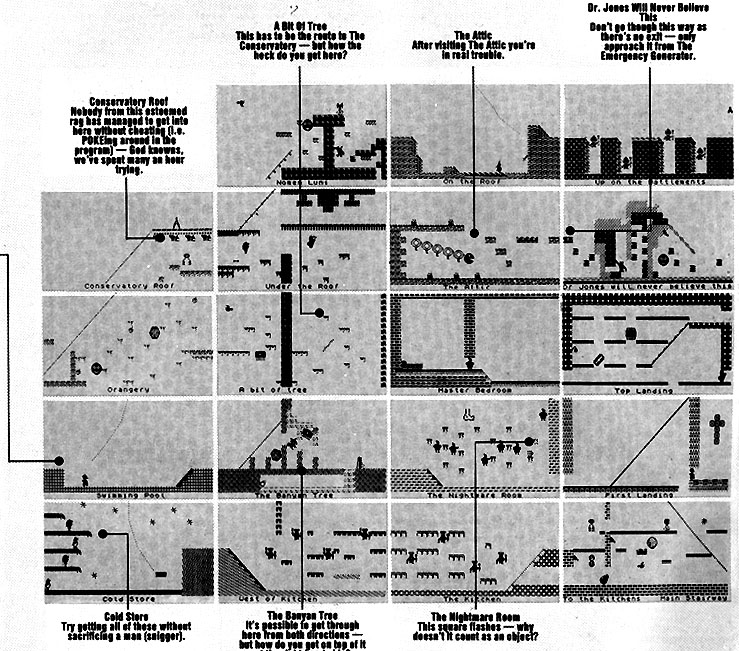
A Bit Of Tree: This has to be the route to The Conservatory - but how the heck do you get here?
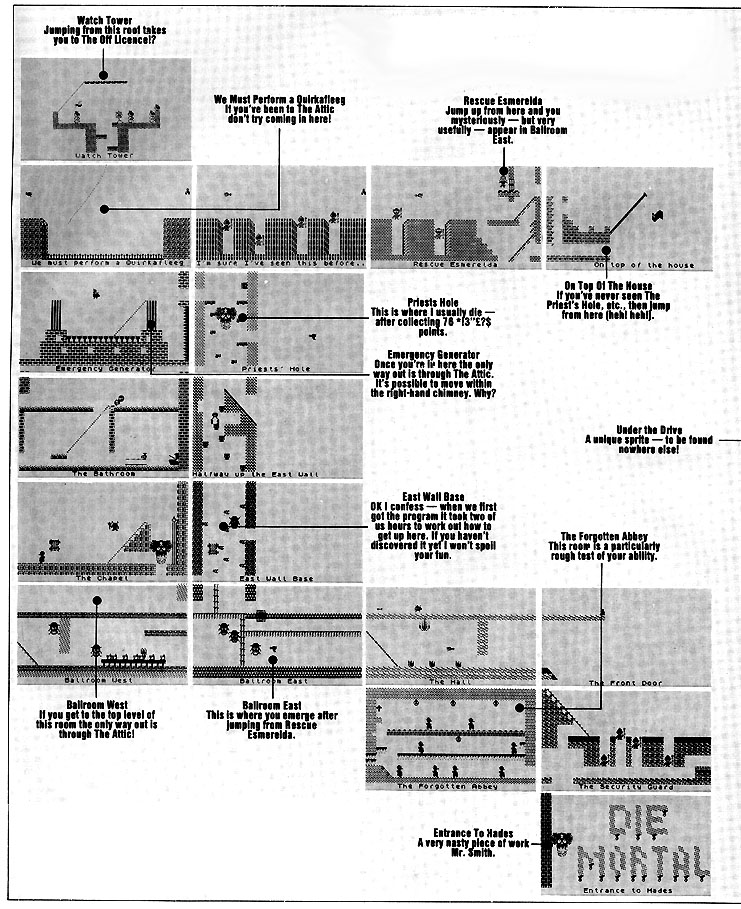
Ballroom East: This is where you emerge after jumping from Rescue Esmerelda.
Ballroom West: If you get to the top level of this room the only way out is through The Attic!
Cold Store: Try getting all these without sacrificing a man (snigger).
Conservatory Roof: Nobody from this esteemed rag has managed to get into here without cheating (i.e. POKEing around in the program) - God knowns, we've spent many an hour trying.
Dr. Jones Will Never Believe This: Don't go through this way as there's no exit - only approach it from The Emergency Generator.
East Wall Base: OK I confess - when we first got the program it took two of us hours to work out how to get up here. If you haven't discovered it yet I won't spoil your fun.
Emergency Generator: Once you're in here the only way out is through The Attic. It's possible to move within the right-hand chimney. Why?
Entrance To Hades: A very nasty piece of work Mr. Smith.
Fall out of the bottom of this and you'll witness the incredible frustration of Willy's agonisingly repeated death.
On Top Of The House: If you've never seen The Priest's Hole, etc., then jump from here (heh! heh!).
Our Hero.
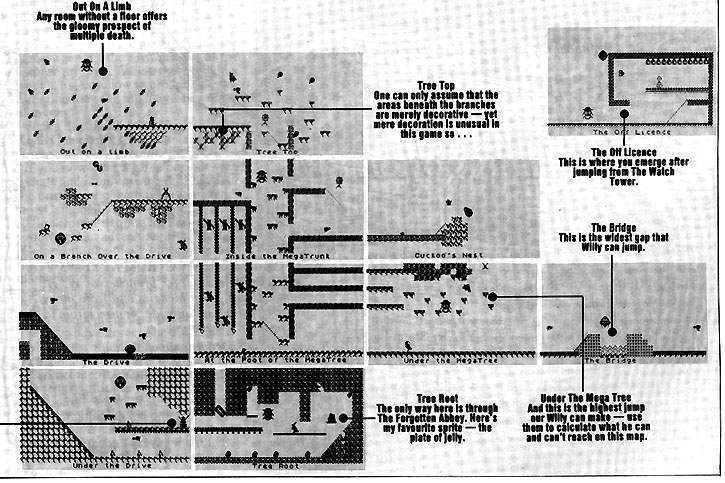
Out On A Limb: Any room without a floor offers the gloomy prospect of multiple death.
Priests Hole: This is where I usually die - after collecting 76 !3"£?$ points.
Rescue Esmerelda: Jump up from here and you mysteriously - but very usefully - appear in Ballroom East.
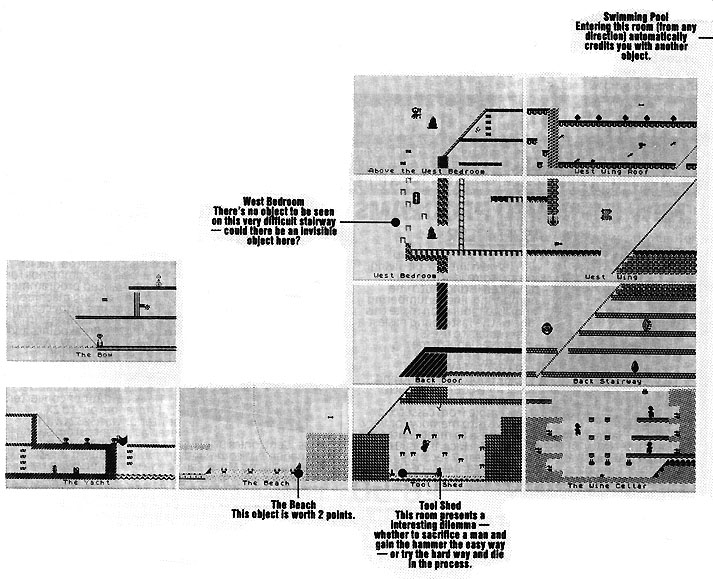
Swimming Pool: Entering this room (from any direction) automatically credits you with another object.
The Attic: After visiting The Attic you're in real trouble.
The Banyan Tree: It's possible to get through here from both directions - but how do you get on top of it at the right-hand side?
The Bridge: This is the widest gap that Willy can jump.
The Forgotten Abbey: This room is a particularly rough test of your ability.
The Nightmare Room: This square flashes - why doesn't it count as an object?
The Off Licence: This is where you emerge after jumping from The Watch Tower.
The Reach: This object is worth 2 points.
The only way to get here is by jumping on and off the leaves, risking death each time.
There is only one way into this screen.
These are some of the constantly moving baddies trying to stop you.
These are the goodies you're after.
These little things don't move - they are just there for you to smash your head into and to make things more complicated (as if we needed it!).
This path is a one-way travelator - once on it you can only go forward.
Tool Shed: This room presents a interesting dilemma - whether to sacrifice a man and gain the hammer the easy way - or try the hard way and die in the process.
Tree Root: The only way here is through The Forgotten Abbey. Here's my favourite sprite - the plate of jelly.
Tree Top: One can assume that the areas beneath the branches are merely decorative - yet mere decoration is unusual in this game so…
Under The Mega Tree: And this is the highest jump our Willy can make - use them to calculate what he can and can't reach on this map.
Under the Drive: A unique sprite - to be found nowhere else!
Via this shelf is the only possible route to the object.
Watch Tower: Jumping from this roof takes you to the Off Licence!?
We Must Perform A Quirkafleeg: If you've been to The Attic don't try coming in here!
West Bedroom: There's no object to be seen on this very difficult stairway - could there be an invisible object here?
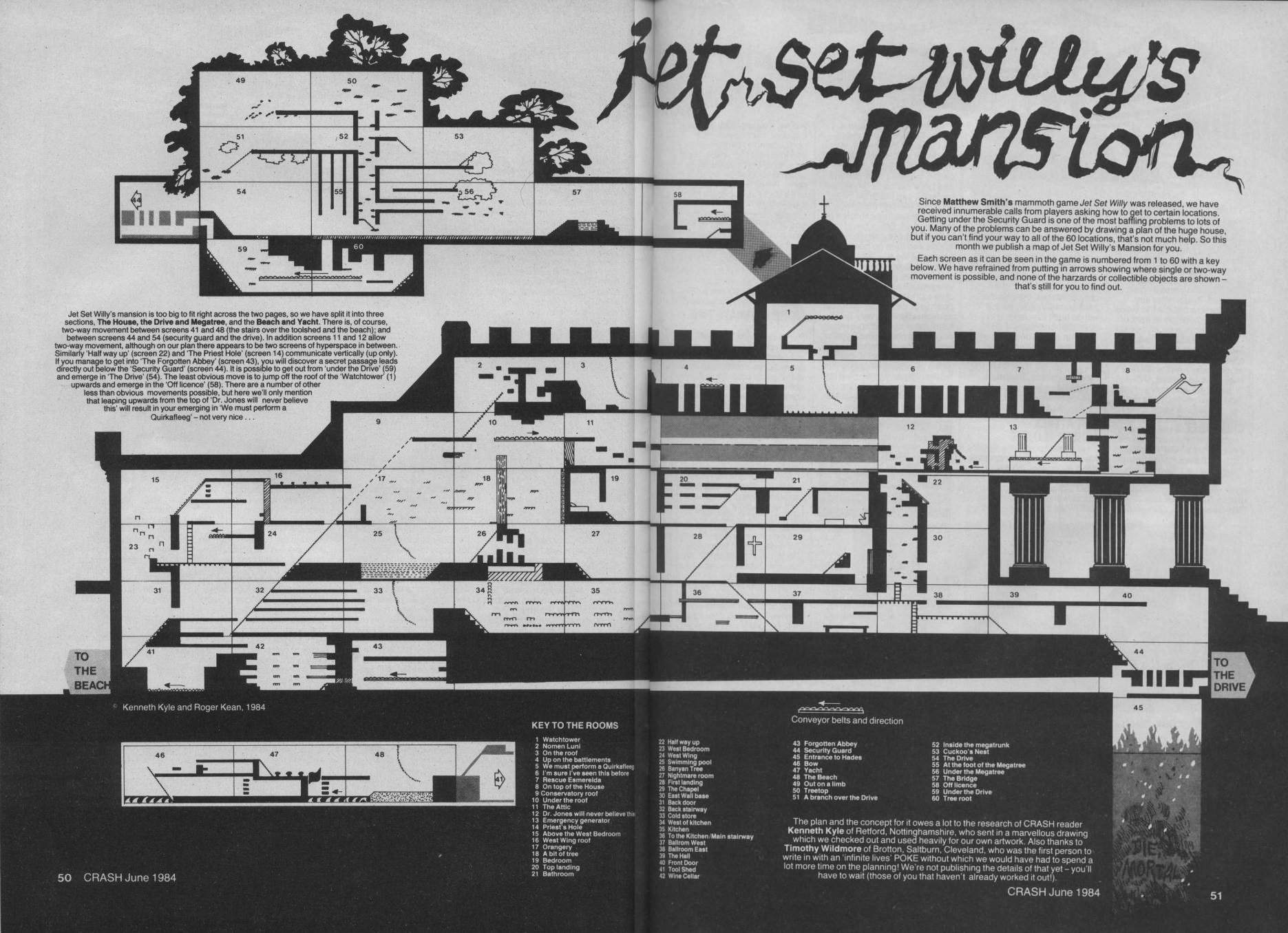
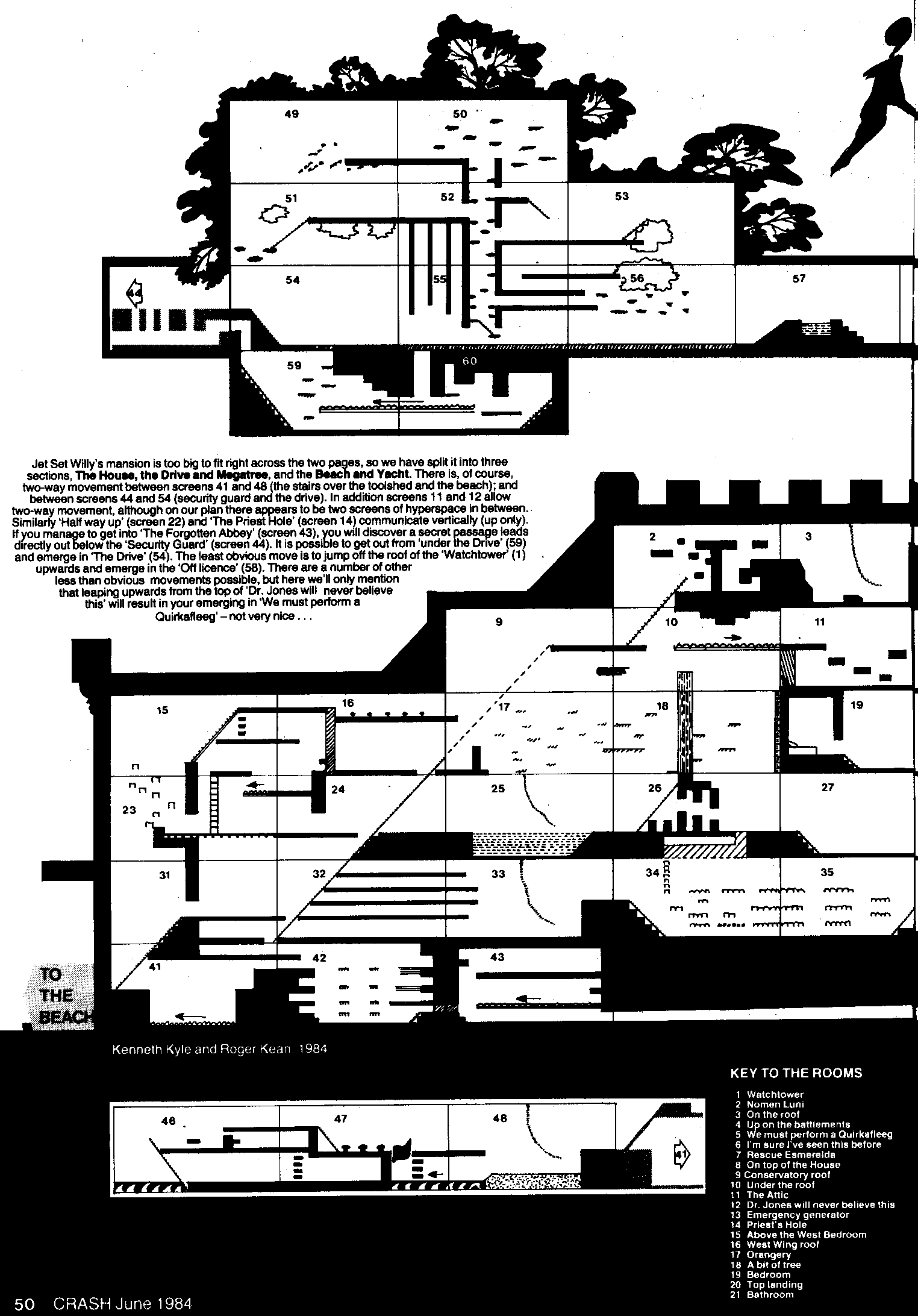
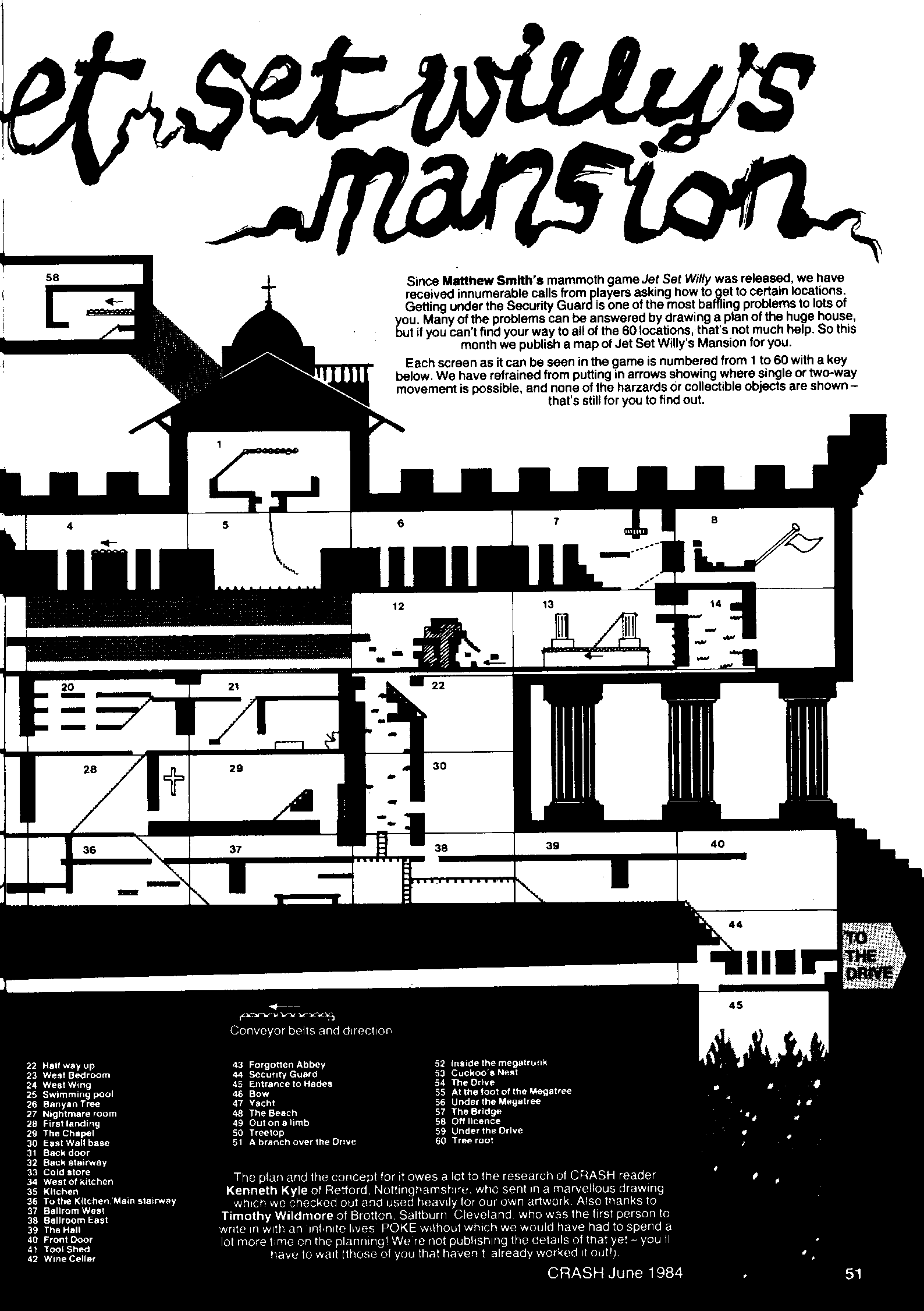
JSW - A HACKER'S GUIDE If you always type MERGE "" whenever you load a game for the first time, then you can count yourself amongst that select programming group known as 'hackers'. Join Andrew Pennell on a journey through the machine code magic that comprises Jet Set Willy. Although playing any game of the quality of Jet Set Willy is in itself great fun, the more mischievous among us get a double helping of kicks by peering into sections of the program - both to examine its structure and to alter certain attributes (in other words, to cheat). The program itself can hardly be described as fully protected. Although the colour chart supplied will defeat most home pirates, the keener and more able ones will resort to any lengths to get bootlegs of the game. I know of one player who typed the whole chart into his word processor, and another who dutifully duplicated it all with felt tips. This latter soul gave me the biggest laugh - the fact is just a single POKE disables the entire coding mechanism! The first thing I had to find was simply an 'infinite lives' POKE; eight lives are nowhere near sufficient. A delve into the code quickly unearthed the important DEC (HL), which was duly NOP'd out. This, however, is not the perfect solution. You'll probably have discovered that once the Attic has been visited, the program irrevocably alters itself - from there on in it's instant death if you enter four particular rooms. With infinite lives you're much more likely to find the Attic and, once you do, most of the rooms become blocked permanently. The (rather crude) solution I employ is simply to power down and re-load Willy from Microdrive cartridge, although cassette users could have a problem here. Incidentally, my current version of JSW (on Microdrive, of course) has a menu on it complete with options to choose the number of lives, which screen to start on and the numbers of objects within the game. The code itself has also been modified so that by pressing a certain key, the screen contents can be saved on cassette as a SCREEN$ file and, using the routines described in my article Print Routines in this issue, dumped onto my Epson printer. Anyway, - getting back to the Attic - I spent quite some time trying to find the piece of code that 'switched-in' this clever, if frustrating, effect; alas, to no avail. But the time wasn't wasted because during my investigations I turned up a number of other useful things including a way to find out the final solution. (By the way, if anyone out there has sorted out the POKE to disable the catastrophic 'Attic Attack' feature, please tell us here at YS.) The first thing that amazed me about JSW was the fact that there's only about 4K of machine code in the whole program! There's some 22K of data for the rooms, sprites and sound, while the remaining 12K or so is all used as 'workspace' by the other routines. In fact, much of the code is concerned with scanning the keyboard and all the possible types of joystick (except the Interface 2 type), not just to move Willy! As you may have discovered on the original Manic Miner, you could get to any screen after typing in a nine-digit number (or on the Software Project's version, a 10-digit word) while playing the game. On Jet Set Willy it's a little bit harder. Here you have to be in a particular room at a particular height when you type out the 10 letters. But the problem is, having done this, you enter a room not at a 'safe' place, but at your current position - so extreme care must be taken when changing rooms using this method. You'll find you can only access 39 rooms like this anyway (answers on a postcard please for how to access the other 21). The first person to finish JSW received a prize of Champagne and gasses from Software Projects, but to prove your bona fides you had to tell the company how many hidden objects there were and what happened when you then tried to go to bed. My first attempt at winning the splendid prize involved a couple of POKEs to remove the wall above Maria in the Master Bedroom (trying to get rid of Maria herself proved futile!). The POKEs worked and I could jump over her and into the bedroom proper. Touching the bed had no effect, while touching the pillow proved fatal - this was obviously not the way to cheat. A bit more time misspent listing out the code revealed both answers - and a single POKE allows anyone to see the final graphic effect, having picked up just one object! I'm sure you'll be happy to know that I came nowhere near the first to come up with the final answer though - no champers for me... Anyway, I next built up a complete map of the house by sticking together screen dumps of each room - in a similar fashion to the illustration included with this article. However, I was still unable to see all of the objects. Finally, after much searching I stumbled upon a table that held the locations of each object - and found a few surprises. Some of them count as two, and others are 'invisible'; indeed, there's one somewhere on the First Landing which still eludes me. Along with the program and all its data are some very weird bytes indeed. For instance, the data for a further screen which contains very little - and, in fact, it's possible to reach it without cheating - is called ']' and just appears to have been forgotten about. For reference, it lies above the Conservatory Roof. There are also some strange-looking instructions towards the end of the program that appear to address a very complicated piece of hardware; exactly what, I don't know. Incredibly, the data for each screen is stored in only 256 bytes - 128 for the room's appearance, 32 for its title and the remaining bytes for sprite information. There are also quite a few oddities in the program, such as when Willy turns into what appears to be a flying pig. In fact, using a few more POKEs, being the pig character all the time can be a distinct advantage on some of the screens (sorry, not in the Emergency Generator - eat your heart out Pink Floyd!). There are also some strange sections in some of the rooms that are either impossible to get to, or are seemingly useless. In particular, I would question the need for the gap at the bottom right of Nomen Lumi and the useless exit on the right of the Emergency Generator. As well as all this, what is the subtle pun behind 'Dr Jones Will Never Believe This'? What is 'Nomen Lumi'? And what the devil is a 'Quirkafleeg'? - and is the act of performing one illegal below a certain age? The regular staff at YS and myself would also be glad of any reader's help solving the mystery of the Banyan Tree - it's obvious you've got to get on top of the right-hand side of it to approach the goodies in the Conservatory Roof, but none of us can get there without fiddling it - and apparently Matthew Smith has only done it once himself, so what chance have we mere mortals? Jet Set Willy is a great game to play, and from a programmer's point of view the ideas are structured magnificently. Even with my custom version I've only managed to get hold of around 40 objects! My excuse is that I've spent most of my time fiddling around inside the listing, what's yours? Hack on, my friends!
Succeeding with Jet Set Willy demands a number of basic skills as well as perverse dedication. The first problem is to discover how to get to each room, and once there, how to get each object - we've solved most of that for you here. Certain screens, such as 'Out on a limb' pictured here, demand extreme accuracy with the keyboard and although the game is also configured for joysticks they are not accurate enough as often you need to jump from what appears to be the last possible pixel to gain the goodies. Others such as 'The Forgotten Abbey' demand nano-second timing and synchronisation of jumps. This room might look intimidating here - but wait till you see it with the Napoleonic ducks in action, particularly when you realise that you have to leap over every one of them! Most rooms (see over) demand both skills simultaneously.
There's no need to other counting - there are 82 visible objects. Including the four in the conservatory. I also know of a hidden one and one that is worth four points. The highest score this scribbler can achieve is 78 without cheating (er... well... apart from using the POKE for multiple lives that is).
Crash #4May 1984 · p.8Crash Smash90%96%94%90%98%99%95%
Use of Computer 90%
Graphics 96%
Playability 94%
Getting Started 90%
Addictive Qualities 98%
Value For Money 99%
Overall 95%
Unknown
Unknown
Unknown
Producer: Software Projects Memory Required: 48K Retail Price: £5.95 Language: Machine code Author: Matthew Smith There were rumours that Matthew Smith was a figment of the Liverpool computing mass psyche, or merely a clever code name for a Tandy computer. There were rumours that Matthew Smith didn't really exist, and that if he did, then Jet Set Willy didn't and wouldn't. So, after all the waiting, was it worth it? in fact, it's probably worthless even reviewing Jet Set Willy, since by the time you read this you will probably have already worked out the boots to cheat the game! The rags-to-riches story is already well known. Rich from his sub-Surbiton mining exploits, Willy has bought a huge mansion with over 60 rooms, most of which he has never seen. There's been a mammoth party and the guests have left the place in a dreadful mess. Willy just wants to go to bed, but his housekeeper, the nightmarish Martha, won't let him until every bit and piece has been picked up and tidied away. It is always difficult to do a sequel to a best-seller. Not only should it have the same style, it should be bigger and better. Jet Set Willy seems to score on all counts. Very sensibly, it is actually a very different game to Manic Miner, much more of an adventure in which the player can move freely between the linking rooms and work out the structure of Willy's strange house. In keeping with a good adventure, there are some random elements that have been thrown in. In some rooms the hazards may change places, or disappear altogether. Some rooms may not be entered from a particular direction - you lose all your lives, and sometimes that does not happen. In all respects, the creation of all the rooms is exceptional, each with its own peculiarities. Some of them are very hard to solve. Software Projects have included a complex colour code with the inlay, which must be looked after at all costs, since the game will not run without a correct code entry after loading is completed. COMMENTS Control keys: alternate keys row Q to P left/right. SHIFT to SPACE for jump Joystick: pointless having one, keyboard is much better Keyboard play: highly responsive, but watch the tight spots, which have been purposely made as finicky as possible Use of colour: excellent Graphics: perfect Sound: excellent Skill levels: how nimble are your fingers? Lives: 8
Lives vanish in puffs of smoke at the Banyan tree.
It is unusual to have one software house releasing really excellent games at the same time, but that is what Software Projects have just done. Manic Miner's followup, Jet Set Willy, is obviously destined for the top of the charts, and its almost guaranteed success may well overshadow the second game, which would be a pity. So, congratulations to Software Projects.
C&VG (Computer & Video Games) #31May 1984 · p.288/109/108/109/10
Getting Started 8/10
Graphics 9/10
Playability 8/10
Value 9/10
IS THIS THE NEXT NO. ONE? Manic Miner strikes again! That genius of the bizarre, Matthew Smith, the programmer behind the C&VG Golden Joystick winner, Manic Miner, has come up with another original game. Everyone has been waiting for the sequel to Matthew's top selling Spectrum game with bated breath. Could it match up to the quality and playability of Manic Miner? Well, the answer is most definitely a resounding yes! Miner Willy is the star of this game - but he's no longer lost in a mysterious mine. With all the money he made down the mine, Willy has purchased a vast mansion in Surbiton. Why Surbiton? Don't ask me, ask Matthew! Willy isn't mean with his newfound wealth either - he has huge parties in his new home with hundred of friends who 'really' know how to enjoy themselves. They often leave the place in quite a mess, however, and Maria, Willy's fiery Italian housekeeper, gets really upset about this. This new Willy epic begins after one of these big parties. Maria has finally put her foot down and won't let poor Willy get to bed until he's cleared up the house! Maria stands at the doorway of the master bedroom and won't let Willy past the threshold until he has picked up every glass and bottle in the place. Now, Willy's mansion is massive and there are places and rooms which even he - an intrepid explorer - hasn't seen yet. So there you have it - you control the top-hatted Willy on his quest through the weird rooms of his mansion searching for the glasses and bottles left lying around by his untidy mates. Jet Set Willy has well over 60 screens - all different - featuring Matthew's wonderful graphic oddities. Watch out for the ballet-dancing rabbit and the penguins in the cold room. Graphic masterpieces in their own right. There are also some refugees from Manic Miner among the odd creatures to be found - but spotting them yourself is half the fun. The game is just too big for this reviewer to take in in the limited time available to look at the game - but I'm certain this game is going to be a winner, I found it much easier to get into than Manic Miner. The controls are extremely simple - just three keys for left right and jump. You can also move from screen to screen without having to complete a task first - a bonus when you want to find out what's coming next! Software Projects have come up with an original anti-piracy device to protect their latest blockbuster. It's a card with a coloured grid pattern. When you load the game, the computer comes up with a random location which corresponds to a square on the grid. You have to key in the colour code before you can play the game. This routine has to be carried out each time you play the game. Will it stop the pirates? We don't know - but it will certainly make life more difficult for them. All this and a great competition too! The first person to discover just how many glasses Willy has to collect before he is allowed to get to bed will win a case of champagne and a helicopter ride over his or her home town. Jet Set Willy is bound to be up among the top ten in the C&VG Daily Mirror software charts before very long - and I confidently predict that Matthew Smith and Software Projects have got another number one on their hands. Jet Set Willy is available now from Software Projects of Liverpool and is a bargain at £5.50.
Jet Set Willy.
Personal Computer Games #6May 1984 · p.72PCG Game of the Month9/107/1010/1010/1010/1010/10
Personal Computer GamesPCG Game of the Month
Graphics 9/10
Sound 7/10
Originality 10/10
Lasting Interest 10/10
Overall 10/10
Chris Anderson 10/10
MACHINE: Spectrum 48K JOYSTICK: No SUPPLIER: Software Projects PRICE: £5.95 Ever since the Spectrum classic Manic Miner took the nation by storm, excitement has been mounting over the promised follow-up. It took ages to come. But it's here at last. And it's sensational. Jet Set Willy doesn't simply offer more of Miner Willy's whacky exploits, it brings an entirely new game idea to Britain's micros. Just suppose that after gaining fabulous wealth from his mine, Miner Willy decides to build himself a fabulous seaside mansion featuring no less than 60 rooms and other locations. Suppose that each of these locations was a kind of obstacle course filling the entire screen and featuring platforms, swinging ropes, conveyor belts and a large number of bizarre creatures to be avoided at all costs. And just suppose that Willy has to move round this mansion collecting objects from each room. Yes. you guessed. That's the scenario of Jet Set Willy. The game starts with Willy in the bath after a mad party. You're told that all he wants to do is go to bed. But there, barring the way to the bed stands Willy's Housekeeper Maria. What a vast and marvellous creature he is. She stands there tapping her foot, and if Willy moves toward her she raises one arm in a gesture whose meaning is unmistakable: 'You may not pass.' Why not? Because the mansion is in a mess after the party. So before Willy can get to bed he must go round the entire place collecting all the the dirty glasses and other objects littering the rooms. Off he sets on a task which turns out to be rather a lot to expect from a chap suffering a hangover. The major criticism of Manic Miner was that, despite its 20 different fun packed screens of action, you could get frustrated by having to work through the screens in the same order each time. You would reach a new screen, rapidly lose your lives, and then have to spend 20 minutes getting back there again. Jet Set Willy's brilliance is that you can take the action any which way you like. Most of the locations have several different entrances and you can wander into and out of a room without necessarily risking your life to collect the objects it contains. Of course all the objects have to be collected in the end, but you can decide in what order you collect them. There is one exception to this, caused by a program bug. Entering the attic will make it fatal for you to try to enter certain other locations. You can still complete the game by reserving the attic until last - but it remains a significant blemish which Software Projects must correct as soon as possible. I was able to find 50 of the 60 rooms without too much difficulty, and they're linked to each other in a logical way which makes it possible (indeed essential) to draw a map of the mansion. Another feature which makes the game superior to Manic Miner, is that the action in each location is not necessarily self-contained. For example there is an object in a location called the Banyan Tree which seems impossible to reach, until you realise that to get it, you must use a different entrance. By looking at the map of the house which you've been drawing, you can see that the entrance must be reached through the ceiling of the West Kitchen. Sure enough the West Kitchen does have a platform from which you could leap through the ceiling - but it's impossible to reach. To do so you have to go first to the Main Kitchen. And so it goes on. In fact, what programmer Matthew Smith has done is to produce the first game which combines the zany action of the platform games with the complexity and intrigue of an adventure. When you take a walk through the mansion he's created you'll see why it's been months in the making. Not all of the 60 locations have the same complexity as the screens of Manic Miner, but the place is astonishing nonetheless. Moving downstairs and east you will come across a ballroom, hall, front door, security guard, drive, a mega-tree, bridge and eventually an off-licence. To the west lie kitchens, a cold store, a tool shed, and eventually a beach and yacht. Elsewhere in the mansion you will find a swimming pool, wine cellar, attic, chapel and a series of roofs and battlements. The action on the battlements is a take-off of the game Hunchback, complete with guards armed with spears, flying arrows and swinging ropes. Buy Jet Set Willy, and you get Hunchback thrown in for nothing! Special mention must be made of these ropes, which also appear in several other locations. They swing in the most realistic way you've ever seen and as well as jumping on and off them, you can also climb up and down. Incidentally, all of Willy's stupendous daredevil feats are achieved with the use of just three control keys - left, right and jump. No knotted fingers here. In order to fit the program into 48K, the same creatures appear in several different locations. But they are still a remarkable collection, including chefs with waggling knives, rolling eggs, birds, grimacing faces, scorpions, rotating razor blades and a vacuum cleaner. With this crew protecting the various objects. It's not surprising that Software Projects are offering a large amount of champagne and a helicopter encounter with Matthew to the first person who can collect them all and retire Willy to bed. And in view of the huge piracy problem, it's also not surprising that they've included a clever protection scheme in which you have to enter a colour code off a card before you can start the game. The idea is that it's harder to copy the card than to copy the program, but easy to imagine people buying the game losing the card, and getting very, very annoyed. That's a risk you'll have to take because this game is one you simply can't afford to miss. Enter Willy's mansion. And begin the whackiest, craziest adventure of your life.
GAMES EXPERT? NOT ME! You may not believe this, but Jet Set Willy's 18-year-old programmer Matthew Smith has never come anywhere near collecting all the game's objects. Mind you, he's never been through all 20 screens in Manic Miner either. 'The furthest I ever got was screen 12, he told PCG. 'I program games, I don't play them.' Jet Set Willy was a marathon effort. While Manic Miner was completed in two months, its follow-up took more than six months to program. 'I was working about 12 hours a day, starting at 3pm. Sometimes I'd still be programming at 6am. Towards the end it was getting a bit of chore, there was just so much to get in.' Matthew believes that the merging of arcade action into adventure-type plots is bound to continue, and already he's planned a third chapter in the Miner Willy saga called Miner Willy Meets The Tax Man. He intends it to have a mind-boggling 250 different screens. But meanwhile, with massive sales of Jet Set Willy guaranteed, Matthew is no doubt preparing for his own encounter with the Inland Revenue.
They Sold a Million carries this game and has 24 references of its own.
Hack/Poke43
- YS Smash TipsAug 1988 · p.27
- Crash #40May 1987 · p.89
- Sinclair User #53Aug 1986 · p.20
- C&VG (Computer & Video Games) #46Aug 1985 · p.82
- Your Spectrum #16Jul 1985 · p.15
- Sinclair User #39Jun 1985 · p.18
- C&VG (Computer & Video Games) #44Jun 1985 · p.69
- Sinclair User #38May 1985 · p.18
- Your Computer #3Mar 1985 · p.25
- Your Spectrum #12Mar 1985 · p.5
- Sinclair Programs #29Mar 1985 · p.30
- C&VG (Computer & Video Games) #41Mar 1985 · p.6
- Sinclair Programs #27Jan 1985 · p.26
- Crash #12Jan 1985 · p.146
- Crash #11Dec 1984 · p.138
- Your Spectrum #9Nov 1984 · p.10
- Crash #10Nov 1984 · p.77
- Personal Computer Games #12Nov 1984 · p.105
- Your Spectrum #8Oct 1984 · p.17
- Sinclair Programs #24Oct 1984 · p.27
- Big K #7Oct 1984 · p.108
- C&VG (Computer & Video Games) #36Oct 1984 · p.141
- TV GamerOct 1984 · p.66
- Home Computing Weekly #82Oct 1984 · p.35
- Your Computer #9Sep 1984 · p.32
Tips29
- Sinclair User #116Oct 1991 · p.20
- Sinclair User #86May 1989 · p.53
- YS Smash TipsAug 1988 · p.27
- Sinclair User #55Oct 1986 · p.20
- Your Spectrum #21Dec 1985 · p.6
- MicroHobby #56Dec 1985 · p.39
- Sinclair Programs #34Aug 1985 · p.30
- Sinclair Programs #27Jan 1985 · p.26
- TV GamerOct 1984 · p.66
- Crash #8Sep 1984 · p.83
- C&VG (Computer & Video Games) #35Sep 1984 · p.127
- Personal Computer Games #10Sep 1984 · p.108
- Home Computing Weekly #79Sep 1984 · p.26
- Sinclair User #29Aug 1984 · p.24
- Your Spectrum #6Aug 1984 · p.6
- Crash #7Aug 1984 · p.81
- Personal Computer Games #9Aug 1984 · p.20
- TV GamerAug 1984 · p.33
- Home Computing Weekly #75Aug 1984 · p.27
- Popular Computing Weekly #33Aug 1984 · p.36
- Personal Computer Games #8Jul 1984 · p.99
- Home Computing Weekly #69Jul 1984 · p.34
- Home Computing Weekly #71Jul 1984 · p.23
- Crash #5Jun 1984 · p.49
- Crash #5Jun 1984 · p.53
Letters19
- Sinclair Programs #35Sep 1985 · p.8
- Sinclair Programs #33Jul 1985 · p.8
- C&VG (Computer & Video Games) #44Jun 1985 · p.8
- Sinclair Programs #31May 1985 · p.7
- Home Computing Weekly #98Feb 1985 · p.43
- Crash #12Jan 1985 · p.29
- Big K #9Dec 1984 · p.125
- Your Spectrum #9Nov 1984 · p.17
- Crash #9Oct 1984 · p.35
- Sinclair Programs #23Sep 1984 · p.27
- C&VG (Computer & Video Games) #35Sep 1984 · p.8
- C&VG (Computer & Video Games) #34Aug 1984 · p.8
- C&VG (Computer & Video Games) #34Aug 1984 · p.11
- Personal Computer Games #9Aug 1984 · p.21
- Sinclair User #28Jul 1984 · p.19
- Sinclair User #27Jun 1984 · p.24
- Home Computing Weekly #66Jun 1984 · p.33
- Popular Computing Weekly #23Jun 1984 · p.7
- Popular Computing Weekly #19May 1984 · p.7
News/Note18
- ACE (Advanced Computer Entertainment) #16Jan 1989 · p.117
- New Computer Express #10Jan 1989 · p.39
- Your Sinclair #12Dec 1986 · p.11
- Your Spectrum #15Jun 1985 · p.6
- Popular Computing Weekly #42Oct 1984 · p.52
- Popular Computing Weekly #39Sep 1984 · p.50
- Sinclair User #29Aug 1984 · p.15
- Your Spectrum #6Aug 1984 · p.34
- C&VG (Computer & Video Games) #34Aug 1984 · p.132
- C&VG (Computer & Video Games) #33Jul 1984 · p.132
- Personal Computer Games #7Jun 1984 · p.22
- Crash #4May 1984 · p.42
- Popular Computing Weekly #18May 1984 · p.43
- Crash #2Mar 1984 · p.22
- Home Computing Weekly #54Mar 1984 · p.6
- Popular Computing Weekly #11Mar 1984 · p.5
- Crash #1Feb 1984 · p.25
- Popular Computing Weekly #49Dec 1983 · p.1
Full-page ad16
- C&VG (Computer & Video Games) #40Feb 1985 · p.87
- Personal Computer Games #15Feb 1985 · p.105
- C&VG (Computer & Video Games) #39Jan 1985 · p.117
- Personal Computer Games #14Jan 1985 · p.141
- C&VG (Computer & Video Games) #37Nov 1984 · p.115
- Crash #5Jun 1984 · p.122
- Personal Computer Games #7Jun 1984 · p.142
- Crash #4May 1984 · p.10
- Personal Computer Games #6May 1984 · p.144
- Crash #3Apr 1984 · p.40
- Personal Computer Games #5Apr 1984 · p.135
- Your Spectrum #2Mar 1984 · p.9
- Personal Computer News #53Mar 1984 · p.20
- Your Computer #1Jan 1984 · p.43
- Your Spectrum #1Jan 1984 · p.89
- C&VG (Computer & Video Games) #27Jan 1984 · p.55
Feature13
- ACE (Advanced Computer Entertainment) #41Feb 1991 · p.63
- MicroHobby Especial #1Nov 1985 · p.25
- Your Spectrum #15Jun 1985 · p.33
- Your Spectrum #13Apr 1985 · p.41
- Sinclair User1985 · p.46
- C&VG (Computer & Video Games)1985 · p.88
- Sinclair User #33Dec 1984 · p.88
- ZX Computing #16Dec 1984 · p.153
- Games ComputingNov 1984 · p.47
- Your Spectrum #6Aug 1984 · p.21
- Your Spectrum #4Jun 1984 · p.60
- Your Computer #5May 1984 · p.74
- Fusion #8 · p.47
Advert9
- Crash #24Jan 1986 · p.187
- C&VG (Computer & Video Games) #45Jul 1985 · p.103
- C&VG (Computer & Video Games) #44Jun 1985 · p.35
- Big K #6Sep 1984 · p.56
- C&VG (Computer & Video Games) #35Sep 1984 · p.4
- Personal Computer Games #10Sep 1984 · p.2
- Your Computer #5May 1984 · p.192
- C&VG (Computer & Video Games) #31May 1984 · p.146
- Home Computing Weekly #58Apr 1984 · p.32
Map6
- Die Speccy CDJan 1996
- Crash #12Jan 1985 · p.29
- Your Spectrum #4Jun 1984 · p.62
- Crash #5Jun 1984 · p.50
- C&VG (Computer & Video Games) #32Jun 1984 · p.50
- Personal Computer Games #7Jun 1984 · p.102
Review6
- Sinclair Answers #2Jan 1985 · p.27
- MicroHobby #13Jan 1985 · p.14
- Sinclair Answers #1Sep 1984 · p.33
- Computer ChoiceJun 1984 · p.15
- TV GamerJun 1984 · p.24
- Popular Computing Weekly #13Mar 1984 · p.61
Information1
- SSD-IISep 1999
CompoResult1
- Your Spectrum #15Jun 1985 · p.6
CompoEntry1
- Your Spectrum #13Apr 1985 · p.41
Preview1
- Crash #3Apr 1984 · p.24
Remakes
- Top Hat WillyAmiga
Overflow (Scotty)
- Jet Set BillyAmiga
Niilo Paasivirta
Rob Moseley
Richard Williams, Steven Tate
- Jet Set WillyArchimedes
M. Edwards?
- Jet Set WillyGameboy
Paul Taylor
- Jet Set Willy 3PC/Windows
Smila
- Jet Set Willy'971997Amiga
Cellblock 4 (Sam Becket)
- JetSet Miner Willy-PC1998PC/DOS
Craig Rothwell
- Java JSW1998Java
Matthew Wilson
- Jet Set Willy PC2000PC/Windows
Retrospec (Andy Noble)
- Willys Miner Nightmare2001PC/DOS
Space-Time Productions Ltd (Steve Watson)
- Lost2001PC/Windows
Dan Richardson
- Very Willy Christmas, A2001PC/DOS
Scottigesoft
- Willy's Universe2002PC/Windows
David Brooks
- Very Willy Christmas 2, A2002PC/DOS
Scottigesoft
- Jet Set Willy2006PC/Windows
Carles P.V.
- Jet Set Willy: Online2007PC/Windows
ovine by design
- Willy Mountain Party2009Flash
Denny Menato
- Jet Set Willy2009Java
Matthew Gordon
Related
- Compilations
- They Sold a Million, They Sold a Million (alternative), Load 'n' Run issue 11, Spectrum Load'n'Run v1 issue 02
- Ports
- (Amstrad CPC), (Atari 8-bit), (BBC Micro), (Commodore 64), (Commodore Plus/4), (MSX), (Ondra SPO 186), (Tesla PMD 85), (Atari ST), (Acorn)
- Elsewhere
- Speccy Screenshot MapsWikipediaJSW CentralThe Cutting Room FloorCentre for Computing HistoryMobyGamesRZX ArchiveRZX ArchiveRZX ArchiveThe TipshopUVLModern ZX-Retro GamingRZX Archive - YouTubeModern ZX-Retro Gaming
- Same entry at
- Spectrum ComputingZXInfo
Reviews from people here
Sign in to write about this, or make an account. It takes a minute and lets you correct the catalogue too.
No language recorded.
Sign in to correct or add to this.
Hold the rights to this and want it taken down?