
Arkanoid
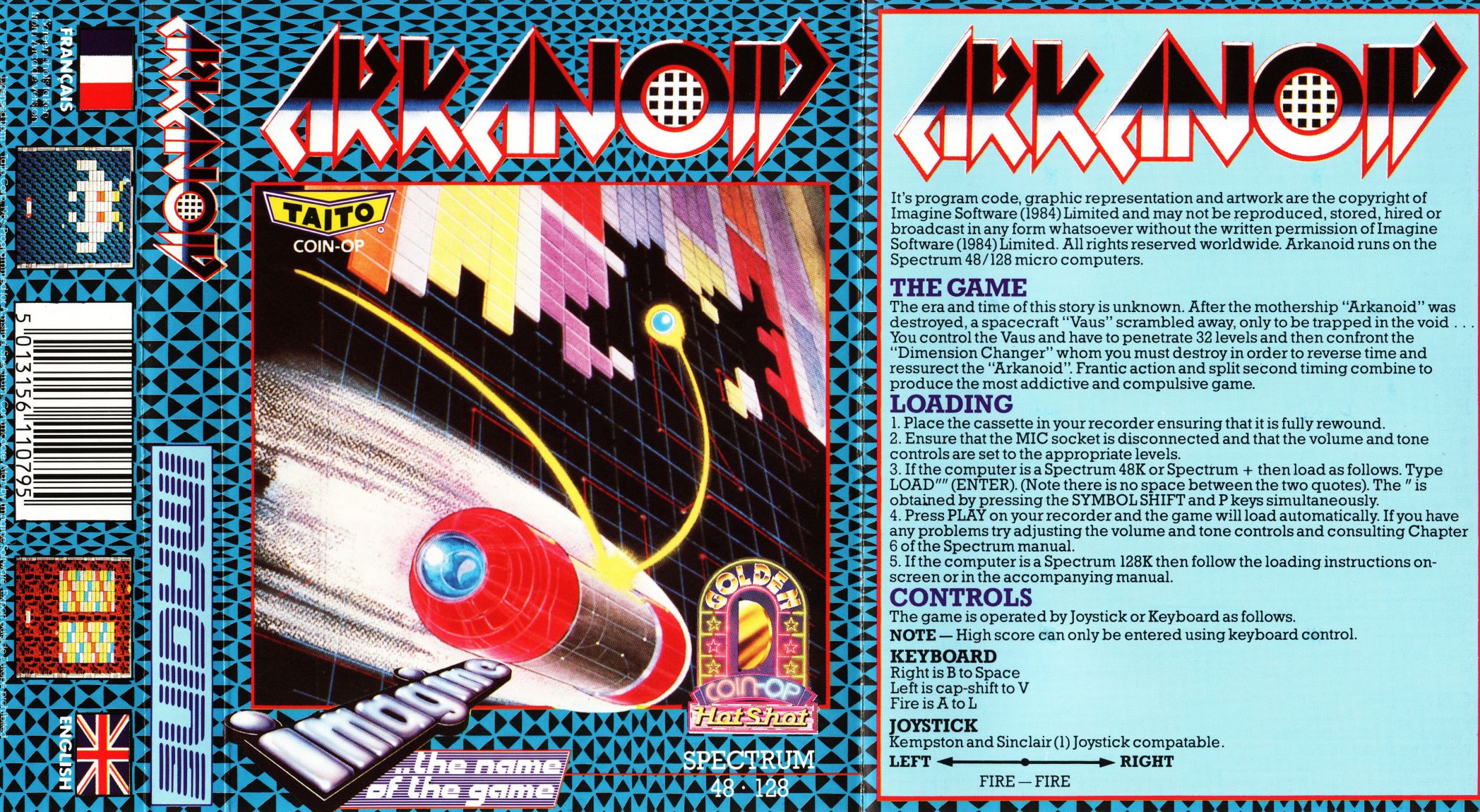
Arcade Game: Action · ZX-Spectrum 48K · 1 players · English
Imagine Software Ltd · 1987 · Pound sterling 7.95
Also known as ARCADE COLLECTION 07: Arkanoid (English)
Arkanoid, 1 of 2
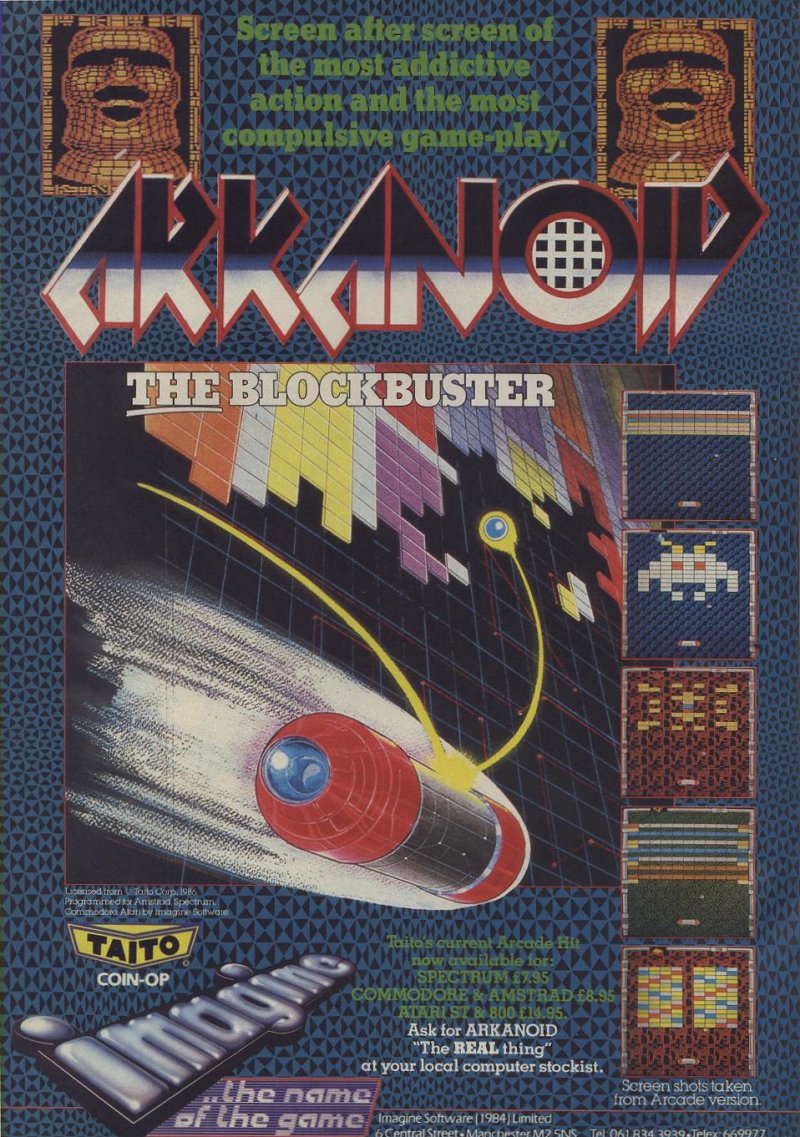
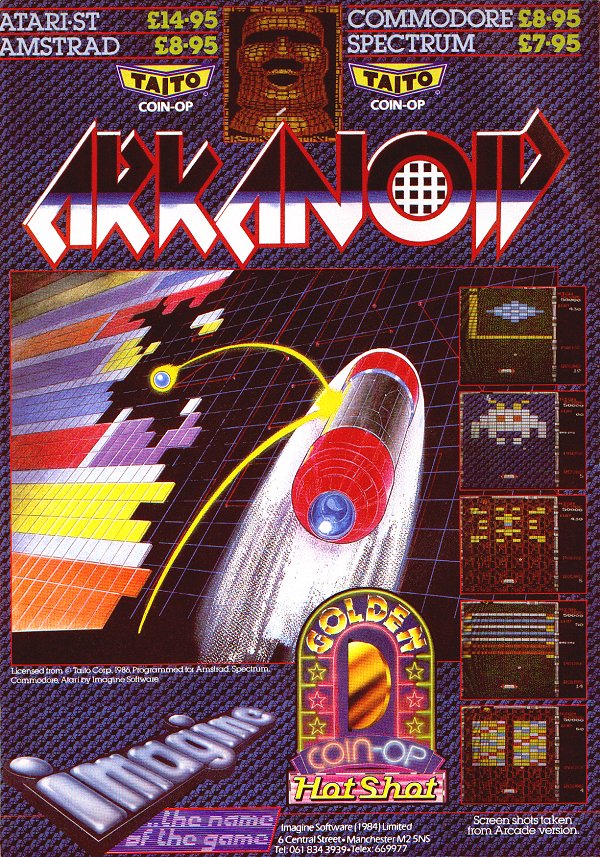
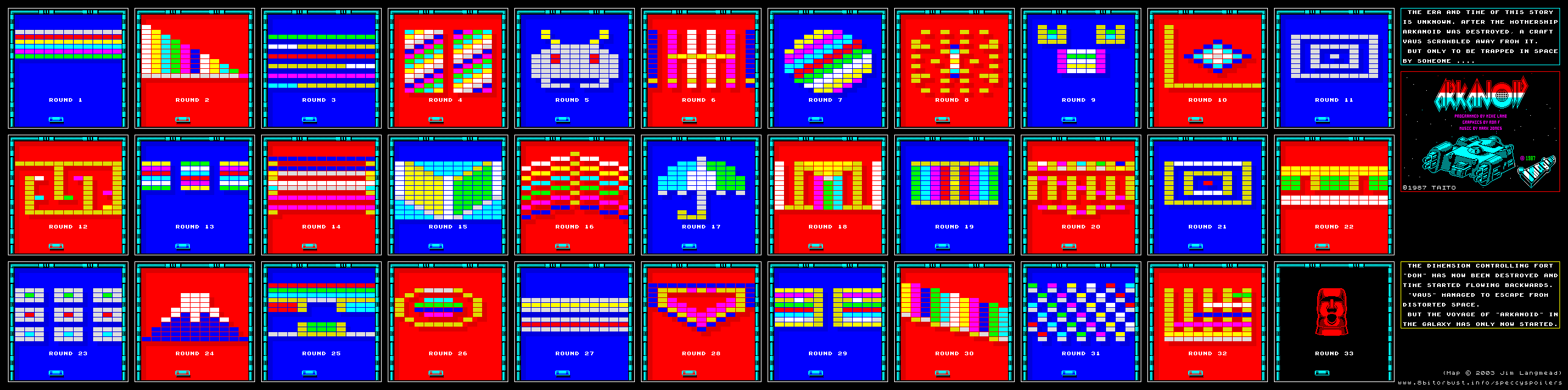
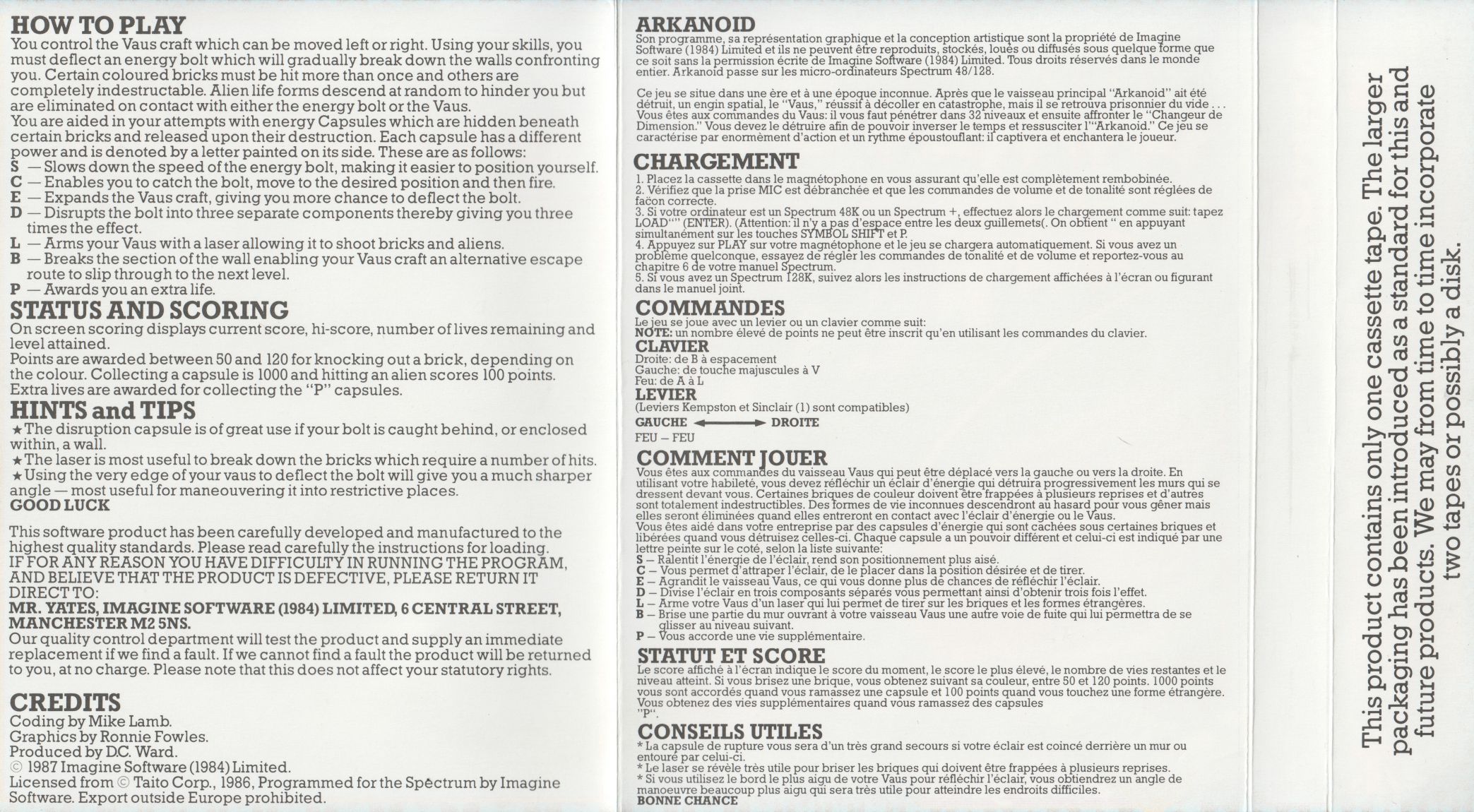
_Back.jpg)
.jpg)
.jpg)
.png)
_Media.jpg)
Discussion
Nobody has started a thread about this yet.
- Control Option
- Interface 2 (right), Kempston Joystick
Releases
- 1987Imagine Software LtdPound sterling 7.95
- 1987Erbe Software S.A.Spanish peseta 875.00 · Spanish peseta 500.00 budget
- 1990The Hit Squad Sold as ARCADE COLLECTION 07: ArkanoidPound sterling 2.99
Play
- arkanoid.rzxRZX playback file
- Arkanoid.tzx.zipTape image English23 KB
- Arkanoid.tap.zipTape image English22 KB
- Arkanoid(ErbeSoftwareS.A.).tzx.zipTape image English22 KB
- Arkanoid(different)(ErbeSoftwareS.A.).tzx.zipTape image English23 KB
- Arkanoid(TheHitSquad).tzx.zipTape image English28 KB
Documents
- Arkanoid.txtInstructions English5 KB
- Arkanoid(ErbeSoftwareS.A.).pdfInstructions Spanish18 KB
- Arkanoid(ErbeSoftwareS.A.).txtInstructions Spanish3 KB
- Arkanoid_HitSquad_Instructions.pdfInstructions 206 KB
Music
- Arkanoid.ay.zipRipped in-game/theme music in AY format 1 KB
- Arkanoid.mp3.zipSampled in-game/theme music in MP3 format 1,060 KB
Other files
- Arkanoid (1987)(Imagine Software).pokPOK pokes file 1 KB
Files and rights
No permission is on record either way. Screens and pictures are copied here on a take-down basis: if you hold the rights and want something removed, say so and it goes.
Credits
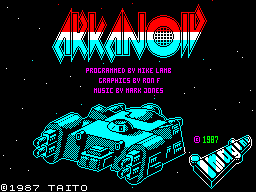
- Mike Lambcredited
- Ronnie Fowlescredited
- Mark R. Jonescredited
Sign in to credit somebody, or say what these people did.
Awards
Scores
In the magazines
- Sinclair User #611987 · Overall5/5
- Your Sinclair #171987 · Overall9/10
- ZX Computing #371987 · OverallGreat
- Crash #391987 · Overall59%
- The Games Machine #21987 · Overall71%
- C&VG (Computer & Video Games) #1021990 · Overall84%
Elsewhere on the web
- WorldOfSpectrum 117 votes8.30
Awards and competitions
Crash Readers Awards 1987
- 1Least Accurate Review
In the magazines 106
C&VG (Computer & Video Games) #102May 1990 · p.6384%
Overall 84%
Hit Squad Spectrum, C64, Amstrad £2.99 Another re-release, this time the conversion of the classic Breakout derivative coin-op. Thirty two levels are simply aching to be beaten before you can get to the big baddie at the very end. Sitting snugly inside your Arkanoid fighter craft (which bears a startling resemblance to a Breakout bat), blast the enemy missile against the defence wall, picking up the power-ups as they fall. Points are scored for each brick hit, and when the wall is completely destroyed you move to the next, more difficult stage. Arkanoid is a great Breakout game, and a smashing arcade conversion. The graphics aren't spectacular, but neither were those of the original; it's the gameplay that counts, and this game scores highly in that department. A must for everyone who enjoys bat 'n' ball games.
C64 SCORES Overall: 87% A brilliant Breakout game with lots of advanced features. Dig out three pound coins and spend them on Arkanoid.
The Games Machine #2Dec 1987 · p.3071%71%
Overall 71%
Richard Eddy 71%
NEW BALLS PLEASE THE BREAKOUT GAME Various Balls are a bit 'in' at the moment. Especially, it would appear, when they are smashing multicoloured bricks to pieces. Breakout clones are suddenly appearing in vast quantities and spreading faster than Wordstar or Knight Lore clones did. Richard Eddy gives a personal run-down... Taito, the company which produced the corky coin-op Arkanoid, are probably to blame for unleashing the craze, and then Ocean for producing a series of very competent conversions for the home micros. The ST version is undoubtedly the superior, retaining all of the arcade's original features - if it wasn't for the small screen you could almost think it was the arcade original. Imagine have just released it for the IBM PC. Following in Ocean's footsteps came Gremlin's Krackout, which was somewhat jollier but slower and really didn't have the addictiveness Arkanoid provided. Not to be outdone Elite shoved in their fourpenneth in the shape of Batty which now features on Hit Pak 2. Written by an ex-Ultimate programmer, Batty was polished and showed greater graphical sophistication than Arkanoid. And then everyone breathed a sigh of relief thinking that it was over... 'Not on your nelly!' shouted Audiogenic, Alligata, Pirate and CRL in unison, all proffering their latest versions which are: Impact, Addictaball, Smash Out! and Ball Breaker. Apart from the games, comparing inlay storylines proves most interesting. Pirate's budget Smash Out! goes for a desperately-try-to-be-convincing story where the bat is supposed to be a spaceship lost in space and bricks are blobs of plasma, while Ball Breaker claims the ball is some chappie called Ovoid on a mission of annihilation. Personally I prefer Impact's 'Trapped in a 1970s arcade machine...' or Alligata's straight for the throat approach with '...I have difficulty imagining a bat is a spaceship... so let's call things a bat, ball and bricks - it's much easier!' And so it is. I think you can quite happily disregard Smash Out; it is little more than a poor man's Arkanoid with measly graphics, nauseous sound and the addictiveness of drying paint. Okay, so it may have screen designer thrown in, but even this is fiddly to use and does nothing to push up Smash Out's credibility. NOVELTY There's a lesson to learn here - if you are going to produce a clone you have to do it very well, or devise a novel twist on the formula. Which is what CRL did with Ball Breaker, originally released for the Amstrad CPC range, it took Breakout into 3-D and worked well with some great sound effects and a colourful layout. Ball Breaker is just released for the Spectrum and retains its playability - although to avoid colour clash the monochromatic graphics can make it difficult to see exactly where to position your bat. Complete with all the typical features, it also includes a laser gun which stays with you throughout the game. Ball Breaker adds up to a worthwhile buy if you fancy a different twist on the rest - and soon to be available on the Atari ST and Amiga. Audiogenic, quiet for some time, return to our 16-bit screens with the elaborate Impact for the Atari ST and Amiga (and hopefully soon for the Spectrum and Commodore 64/128). Impact is quite the connoisseur's Arkanoid cleverly topped off by some great sounds (each brick, alien and the bat produces an individual sound, so occasionally it sounds like a decent tune gone wonky!). Graphically, it is what you would expect from 16-bit, utilising colour very well and sharp definition to add that extra bit of class to the aliens. THE LARGEST What gives it that little extra push is the novel way in which features, such as lasers, bat expand and catch are collected - a la Nemesis. Yellow tokens spin down from selected bricks when destroyed and, if collected, are stored in the power select pad at the bottom right-hand corner of the screen. Pressing the mouse button when one is collected makes the ball slow down, collecting two and then pressing the button gives you the catch effect and so on through divide (3 balls), expand, torch (to see hidden bricks), laser, smart bomb (to destroy aliens), missile and forcefield, which doesn't have the rebound effect off bricks, but simply continues to smash its way round the screen until hitting a wall where it bounces off. With 80 screens and 48 more you can design yourself using the easy-to-use screen designer, Impact definitely wins my approval as being the best just for sheer addictiveness. But coming a close second is Addictaball from Alligata, which doesn't quite make it to the very top for the simple reason that it falls down on presentation and graphics. The use of colour is very dull on the first levels - mainly greys, greens, and blues used for the bricks and surroundings - which doesn't do much to create an exciting atmosphere. However, Addictaball proves to be quite novel in the way the bricks slowly scroll down the screen in one long trail - its great saving grace. The trail can prove to be frustrating when, having died, you are returned to the beginning, or one of the internal stages within a level. Two weapons, laser gun and thruster (which allows you to move up and down the screen) can be collected at the very beginning, though they have to be replenished frequently by hitting the correct bricks. Along the bottom of the screen is a barrier preventing the ball from disappearing but this gradually gets destroyed by the shower of fireballs which come down the screen, unless the fireballs are destroyed with the bat before they reach the bottom. There are cars, bikes and the like to be battered along the way which, if nothing else, adds a bit of humour to the game. So, now what? Do we dare breathe a sigh of relief or is the next parcel we open going to be Revenge Of The Mutant Bouncing Balls From Jupiter...? STOP PRESS! No relief breathing yet! We have just received Reflex from Players priced at £1.99 for the MSX...! AVAILABILITY AND RATINGS IMPACT (Audiogenic) Atari ST (£14.95) 91% Amiga (£14.95) 90% Commodore 64/128 Spectrum ADDICTABALL (Alligata) Atari ST (£14.95) 80% Spectrum (£7.95) Commodore 64 (£7.95) MSX (£7.95) SMASH OUT! (Pirate) Spectrum (£1.99) 15% ARKANOID (Ocean) Spectrum (£7.95) 71% Commodore 64/128 (£9.95) 87% Amstrad CPC (£8.95) 86% Atari ST (£14.95) 89% KRACKOUT (Gremlin) Spectrum (£7.95) 42% Commodore (£9.95) 51% Amstrad (£8.95) 50% BATTY (On Hit Pak 2 by Elite) Spectrum (£9.95) 78% Amstrad (£9.95) 75% Commodore (£9.95)
Audiogenic's Impact - a colourful ST screen.
Right at the start, and it's high time to knock out the laser blocks at the left and right if you want the force to be with you - Atari ST screen.
"Impact definitely wins my approval as being the best just for sheer addictiveness."
AMSTRAD CPC Overall: 86%
ATARI ST Overall: 89%
COMMODORE 64 Overall: 87%
Your Sinclair #17May 1987 · p.36Your Sinclair Megagame9/109/109/109/109/109/10
Your SinclairYour Sinclair Megagame
Graphics 9/10
Playability 9/10
Value For Money 9/10
Addictiveness 9/10
Overall 9/10
Marcus Berkmann 9/10
Imagine £7.95 Reviewer: Marcus Berkmann Vaus ist los? A spacecraft lost in the perilous backwaters of space and time? Cast into outer darkness, though it seems reasonably well lit to me? Ah, but you know what Arkanoid's all about - it's that viciously addictive update of the mother and father of computer games, Breakout - all battering balls against bricks, but with knobs on. It wowed 'em in the arcades, and now all 33 screens of nut-crunching action have been converted to the Speccy. Imagine has done a fine job, and the result is one of the best games you'll see on the Spectrum this year. Yes, I know we've said it before, but it really is that good. Each screen has a different pattern of bricks to knock off, and they're all extremely tricky - at least I think so, since I haven't got beyond level 9 yet. Most bricks need just a single hit, but silver ones must be pinged twice (and on later screens, anything up to five times) and gold ones are indestructible. You also get little power capsules which drop down the screen occasionally when you hit certain bricks. If you can manoeuvre yourself to collide with one of these before you go back to meet the approaching ball, all sorts of weird and wonderful things can happen. Fortunately the capsules are lettered, so the eagle-eyed will get an idea of what's about to befall them. Best in the early stages is the 'E' capsule, which extends the length of your bat (or Vaus craft) so you can be sure to get it in the right place. The 'S' capsule slows down play, though not for as long as you might hope. Still, it's a useful ploy on later screens when things start getting a little hectic. 'P' gives you an extra life, while 'L' arms you with a laser that'll destroy both the bricks and the tiresome nasties that drop down from the top of the screen and obstruct all your careful planning. 'C' allows you to pick up the ball when you intercept it and then move position before firing it off again. 'D' is an odd one - it multiplies the ball by three, making it three times as effective, if three times as difficult to play. It comes into its own, though, when your ball is stuck behind or within a wall. Then watch the bricks go! But the best capsule of all is the 'B' one. Pick this one up and a short cut through to the level appears on your next right. All these capsules last only until you bump into another one, or until you die - a good incentive not to let your lives ebb away too swiftly! One dead easy way of losing a life is to assume that if you hit the ball on the very edge of your bat. It'll make contact. Wrong! You're only really safe in the centre, and if you're trying for a really whizzy angle to get at some awkward bricks, you've got to be a bit nifty about it. Anyway, enough of all that - I'm going back to play Arkanoid again. My excuse - further "research". My reason - well, how many ways are there of saying addictive, 'cos this is that and more.
Level 8 is no morceau de gateau, especially when you consider that all the yellow bricks are indestructible. In fact you start off with six bricks to dispose of, three above and three below the centre. The first couple are no problem, bit to get shot of the last few you must trust to luck and keep going.
Very nasty. On Level 9 you've got to get your energy bolt into those cups of indestructible bricks at the top. There are loads of other bricks to be bopped, but it's funny how the trickiest ones are the ones you're left with at the end, isn't it? Your only eral hope is a lucky bounce off one of the meanies.
ZX Computing #37May 1987 · p.37ZX Computing GlobellaGreat
ZX ComputingZX Computing Globella
Overall Great
WELCOME TO 2ND GENERATION BREAKOUT. Imagine £7.95 My first reaction when I saw this was to think that Imagine had a bit of a cheek to try and pass off a tarted up version of Breakout as some sort of space age mega-game. But then I've always been a sucker for a good game of Breakout and after a couple of tries I soon found myself hooked. When you read the instructions on the cassette inlay you get a lot of drivel about your Arkanoid mothership being destroyed and your escape vessel, the Vaus, being hurled into the void. It seems that the way to recreate the mothership is to move the Vaus left and right and bounce a ball against the barriers ahead of you. Once you've got through about thirty levels of this you get to meet the dimension changer' who can save you and the mothership from the void. What a load of rot. As I said, itTs just a version of Breakout (based on the coin-op game by Taito), but instead of the simple version of the game that's been floating around for years this version has a number of added features that put a bit of spark back into an old formula. The game starts with a simple bat and ball screen, in which the barrier is made up of layers of different coloured bricks running horizontally across the top of the screen. But as you start to hit the barrier capsules are released which, if caught, have differing effects on your ship/bat. Some of them slow the ball down, whilst others arm you with lasers, increase the size of the ship provide an escape onto the next screen and so on. These all add a bit of variety to the action, especially as you can often find yourself darting around the screen trying to decide whether to go for the ball or to risk going after the capsules. There are also different types of aliens' trapped behind the barriers. These aren't deadly, but once they're set free you can bounce the ball off them and rack up a few points. On later screens the shape of the barrier becomes more complex and just to make life even more difficult certain types of bricks are harder to destroy than others, while some are completely indestructible so you'll have a hard time controlling the movement of the ball well enough to find the barrier's weak spots. There are a couple of minor improvements that could be made: the ship responds quite well to keyboard control, though it sometimes gets a little bit jerky, and I wasn't too keen on using it with a joystick. And the collision detection is a bit suspect at times, as the ball can sometimes go right through the bat when it looked certain that you'd hit it solidly. It's almost embarrassing to admit, with all the mega-state-of-the-art-arcade-adventures going around, that you can get hooked on something as simple and old-fashioned as Breakout, but after all, it's one of those oldies but goodies that can get you completely hooked, and Arkanoids is currently the game that gets played most in our office. It's only the relatively high price that stops it getting an unreserved monster hit. Eight quid is a bit much for any version of Breakout these days, but Arkanoids is about the best version that you're likely to get.
C&VG (Computer & Video Games) #67May 1987 · p.14C+VG Game of the Month7/107/1010/1010/10
C&VG (Computer & Video Games)C+VG Game of the Month
Graphics 7/10
Sound 7/10
Value 10/10
Playability 10/10
Tim Metcalfe
MACHINES: Spectrum/C64/Amstrade/Atari ST SUPPLIER: Imagine PRICE: £7.95 (Spec), £8.95 (C64, AMS), £14.95 (Atari ST) VERSIONS TESTED: Spectrum/C64 Not since Ikari Warriors has the C+VG office seen such bloodshed! Yup, we've been fighting over the joystick again - this time just to get to grips with Imagine's instant smash arcade conversion Arkanoid. Our arcade ace Clare Edgeley raved about the Taito coin-op when it first appeared - and now we're going to rave about the computer conversions. OK, so in all reality Arkanoid is a revamped version of Breakout, that ancient game which us ancient gameplayers sometimes brush the cobwebs off to relive great moments of gaming history. Trouble is Arkanoid is just awesomely addictive and extremely playable. You're hooked from the moment you load up the game. So what's it all about? Well, you're in charge of a Vaus craft - sounds like some sort of German rodent - and you're supposed to be trapped in space. Armed only with an energy bolt you have to break down mysterious barriers preventing your escape. These barriers are built of "bricks", Breakout - see! Anyway you have to blast away at these bricks by using the Vaus craft as a bat - hitting the energy bolt back and forth off the walls. Energy capsules drop down from the wall as you destroy it. Collect these, they are useful items. Each has a codeletter on them which lets you know what they do. S: Slows down the speed of the energy bolt, making it easier to position yourself. C: Enables you to catch the bolt, move to the desired position and then fire. E: Expands the Vaus craft, giving you more chance to deflect the bolt. D: Disrupts the bolt into three separate components thereby giving you three times the effect. L: Arms your Vaus with a laser allowing it to shoot bricks and aliens. B: Breaks the section of the wall enabling your Vaus craft an alternative escape route to slip through to the next level. P: Awards you an extra life. On screen displays show your current score, hi-score, number of lives remaining and level attained. Points are awarded between 50 and 120 for knocking out a brick, depending on the colour. Collecting a capsule is 1000 and hitting an alien scores 100 points. There are six levels of differing complexity. You'll need to work out a good strategy for each screen to succeed - but always be ready to allow for the unexpected incident - that odd bounce etc. Opinion is divided herebut the 64 'ers among the team rate Krackout a nose in front of Arkanoid simply because of the joystick response.
C64 SCORES Graphics: 8/10 Sound: 9/10 Value: 10/10 Playability: 10/10
Sinclair User #61Apr 1987 · p.46Sinclair User Classic5/55/5
Sinclair UserSinclair User Classic
Overall 5/5
Jim Douglas 5/5
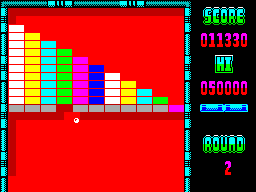
Label: Imagine Author: Mike Lamb Price: £7.95 Joystick: various Memory: 48K/128K Reviewer: Jim Douglas Arkanoid is Imagine's umpteenth licence tie-in. So far - as licences go - the arcade conversions have been infinitely superior to the TV/film links and this fits the trend. Arkanoid comes from the Taito arcade machine and is completely wonderful. Old timers, having seen the screenshots, will be scoffing loudly, claiming that it's exactly the same a Breakout. And this is, in fact, not all that far from the truth. Breakout was invented years ago and it featured a bat and a ball and a wall. The object was to keep bouncing the ball (a white blob) off the wall at the top of the screen and not let it slip past you on the re-bound. Now Ocean's game is at least a couple of generations down the line. It's still got the bat and the ball (still a white blob) and a wall of some sort but there are so many little twiddles and added bits, accusations of unoriginality are really a bit pointless. The plot tells of how your mothership, Arkanoid was destroyed, leaving only a shuttle craft, Vaus. In order for things to be well with the universe, you must destroy 32 levels of walls before reaching the Dimension Changer which will allow you to reverse time and bring back Arkanoid. OK, the plot stinks. Hit Fire and you're off. You're the blocky thing at the bottom of the screen. The ball sits on the top of your craft and after a couple of seconds, it'll fly up toward the top of the screen. It won't get particularly far before slapping into a large coloured square and being bounced back down again. All pretty familiar so far. A few bounces on and that's all changed. A kind of Hedex tablet with a letter on will drift down the screen. Now, each tablet does different things for you. For example, if you guide Vaus into one with the letter S on, the ball will slow down. One with a C on it gives your ship a kind of sticky property: the ball will stop when you touch it, and you can then move to whichever position you like before launching it again. Other letters make your ship wider (thus making it easier to hit the ball), give you extra lifes, move you to the next level or break the ball into three parts. This last offers you a very strange kind of bonus situation where you have to juggle three balls instead of one. The final tablet arms your ship with lasers which can blast away walls and aliens. Oh, I hadn't mentioned the aliens before, had I? They appear at the top of the screen and work their way down. The higher the level, the more numerous and infuriating they are. You can destroy them by crashing the ball into them, but this deflects its flightpath. That's the game, but it's all wrapped up in slick graphics and super-smooth movement. Despite it's relatively primitive roots. Arkanoid is a quite extraordinarily playable game.
It may look like Breakout but it plays like a whole new game. How many balls can you juggle?
Crash #39Apr 1987 · p.2262%51%61%60%45%59%
Presentation 62%
Graphics 51%
Playability 61%
Addictive Qualities 60%
Value For Money 45%
Overall 59%
Ben Stone
Mike Dunn
Paul Sumner
Producer: Imagine Retail Price: £7.95 Author: Mike Lamb A major interstellar catastrophe has occurred! The giant spaceship Arkanoid has exploded and a small shuttle craft, The Vaus, has scrambled away, only to be sucked into a void inhabited by 'The Dimension Changer'. This horrid creature has transported The Vaus into a strange dimension - a void consisting of 32 block-patterned screens. In order to escape, The Vaus has to move from one screen to another clearing each screen of blocks, finally confronting the Dimension Changer on Level 33 in a battle to the death. The Vaus sits at the bottom of the screen, and a ball is launched into the playing area. This ball bounces around the screen and ricochets off the sides, destroying the blocks on contact. The player moves The Vaus left and right, attempting to prevent the ball from leaving the screen. Not all of the blocks explode on first contact. Some take a more severe beating before they disappear, and others drop a spinning capsule which can be collected to gain a feature - such as an expanded bat, a slower ball, the ability to catch and relaunch the ball, a laser to shoot at the bricks, an escape route to the next screen, an extra life and the ability to split the ball into three separate spheres. Seemingly harmless aliens float about, but despite their appearance they pose an indirect threat to the Vaus - when one of these wandering obstacles is hit by the ball, it explodes and sends the ball flying off in the opposite direction. Failing to stop the ball from leaving the screen loses a life, although extra lives can be earned at regular point intervals - or by collecting a capsule marked with 'P'. COMMENTS Control keys: left CAPS SHIFT-V, right B-SPACE, fire A-L Joystick: Kempston, Interface 2 Use of colour: bright and attractive Graphics: smooth but unimaginative Sound: spot FX, not tune Skill levels: one Screens: 33
There you are, still on the first screen, and a 'catch' capsule falls towards the waiting Vaus.
The Magnificent Seven carries this game and has 31 references of its own.
Taito Coin-Op Hits carries this game and has 30 references of its own.
Advert26
- Sinclair User #100Jun 1990 · p.59
- Your Sinclair #54Jun 1990 · p.62
- Crash #77Jun 1990 · p.49
- Your Sinclair #53May 1990 · p.65
- Crash #76May 1990 · p.49
- Sinclair User #98Apr 1990 · p.25
- Your Sinclair #52Apr 1990 · p.14
- Crash #75Apr 1990 · p.49
- Your Sinclair #51Mar 1990 · p.91
- Crash #74Mar 1990 · p.4
- Sinclair User #94Jan 1990 · p.82
- Your Sinclair #49Jan 1990 · p.90
- Crash #72Jan 1990 · p.53
- ACE (Advanced Computer Entertainment) #1Oct 1987 · p.2
- Sinclair User #66Sep 1987 · p.-2
- Crash #44Sep 1987 · p.4
- C&VG (Computer & Video Games) #71Sep 1987 · p.134
- Sinclair User #65Aug 1987 · p.49
- Your Sinclair #20Aug 1987 · p.46
- Sinclair User #64Jul 1987 · p.77
- C&VG (Computer & Video Games) #69Jul 1987 · p.113
- Your Sinclair #18Jun 1987 · p.95
- Crash #41Jun 1987 · p.108
- C&VG (Computer & Video Games) #68Jun 1987 · p.120
- Sinclair User #62May 1987 · p.46
Tips21
- BiT #6Mar 1992 · p.25
- Sinclair User #117Nov 1991 · p.19
- Crash #91Aug 1991 · p.49
- Sinclair User #113Jul 1991 · p.16
- Sinclair User #111May 1991 · p.17
- Sinclair User #108Feb 1991 · p.17
- Crash #84Jan 1991 · p.57
- MicroHobby #204Nov 1990 · p.64
- Sinclair User #100Jun 1990 · p.16
- C&VG (Computer & Video Games) #85Nov 1988 · p.103
- YS Smash TipsAug 1988 · p.4
- MicroHobby #155Dec 1987 · p.39
- Sinclair User #68Nov 1987 · p.10
- ACE (Advanced Computer Entertainment) #1Oct 1987 · p.90
- Your Sinclair #20Aug 1987 · p.41
- C&VG (Computer & Video Games) #70Aug 1987 · p.51
- Your Sinclair #18Jun 1987 · p.33
- MicroHobby #131Jun 1987 · p.22
- Sinclair User #62May 1987 · p.15
- Crash #40May 1987 · p.83
- MicroHobby #122Mar 1987 · p.19
Hack/Poke15
- Sinclair User #117Nov 1991 · p.19
- Your Sinclair #71Nov 1991 · p.53
- Your Sinclair #45Sep 1989 · p.38
- C&VG (Computer & Video Games) #93Aug 1989 · p.27
- C&VG (Computer & Video Games) #93Jul 1989 · p.26
- Your Sinclair #36Dec 1988 · p.33
- Crash #59Dec 1988 · p.44
- YS Smash TipsAug 1988 · p.3
- Sinclair User #74May 1988 · p.15
- Your Sinclair #28Apr 1988 · p.29
- Crash #42Jul 1987 · p.52
- Sinclair User #63Jun 1987 · p.18
- Your Sinclair #18Jun 1987 · p.54
- Sinclair User #62May 1987 · p.19
- Crash #40May 1987 · p.83
Full-page ad13
- Sinclair User #63Jun 1987 · p.60
- C&VG (Computer & Video Games) #67May 1987 · p.113
- Sinclair User #61Apr 1987 · p.72
- Your Sinclair #16Apr 1987 · p.2
- Crash #39Apr 1987 · p.131
- C&VG (Computer & Video Games) #66Apr 1987 · p.97
- Computer Gamer #25Apr 1987 · p.2
- Sinclair User #60Mar 1987 · p.75
- Your Computer #3Mar 1987 · p.84
- Your Sinclair #15Mar 1987 · p.2
- ZX Computing #35Mar 1987 · p.92
- Crash #38Mar 1987 · p.124
- C&VG (Computer & Video Games) #65Mar 1987 · p.116
News/Note8
- ACE (Advanced Computer Entertainment) #8May 1988 · p.105
- ACE (Advanced Computer Entertainment) #7Apr 1988 · p.113
- ACE (Advanced Computer Entertainment) #6Mar 1988 · p.99
- ACE (Advanced Computer Entertainment) #4Jan 1988 · p.137
- Crash #42Jul 1987 · p.53
- Crash #38Mar 1987 · p.11
- C&VG (Computer & Video Games) #65Mar 1987 · p.8
- Popular Computing Weekly #49Dec 1986 · p.7
Feature5
- Your Sinclair #50Feb 1990 · p.72
- ACE (Advanced Computer Entertainment) #10Jul 1988 · p.31
- Crash #51Apr 1988 · p.58
- Sinclair User #69Dec 1987 · p.99
- MicroHobby #133Jun 1987 · p.28
Review4
- Computer Gamer #26May 1987 · p.17
- Popular Computing Weekly #17May 1987 · p.57
- Popular Computing Weekly #10Mar 1987 · p.52
- MicroHobby #122Mar 1987 · p.18
Letters2
- ACE (Advanced Computer Entertainment) #7Apr 1988 · p.98
- Crash #40May 1987 · p.46
Preview2
- Your Sinclair #16Apr 1987 · p.12
- Sinclair User #60Mar 1987 · p.104
Information1
- SSD-IISep 1999
CompoResult1
- Your Sinclair #19Jul 1987 · p.43
CompoEntry1
- Your Sinclair #15Mar 1987 · p.52
Licensed from
- ArkanoidArcade coin-opTaito Corporation
- BreakoutSoftwareunofficialAtari Games Ltd
Remakes
- Darkernoid2001PC/Windows
Outhouse Software
- Super Noid2002PC/Windows
Christiaan Kras
- Trikanoid2012PC/Windows, MacOS
Triumph Remakers
Related
- Compilations
- Los 40 Principales Vol. 3, The Magnificent Seven, Dixons Premier Collection for Your +2, Taito Coin-Op Hits, El Lingote, Dixons Premier Collection for Your +3, Poke City, Load 'n' Run issue 40, Tips Amazing
- Ports
- (Amstrad CPC), (Atari 8-bit), (BBC Micro), (Commodore 64), (MSX), (NES), (Amiga), (Atari ST), (PC/DOS), (Thomson MO/TO), (Commodore Plus/4), (Macintosh)
- Elsewhere
- Speccy Screenshot MapsLost in TranslationWikipediaStrategyWikiSpectrum +2A/+3 IncompatibilityMobyGamesRZX ArchiveThe TipshopUVLModern ZX-Retro GamingSpectrum Computing RZX - YouTubeRZX Archive - YouTube
- Same entry at
- Spectrum ComputingZXInfo
Reviews from people here
Sign in to write about this, or make an account. It takes a minute and lets you correct the catalogue too.
No description recorded.
Sign in to correct or add to this.
Hold the rights to this and want it taken down?