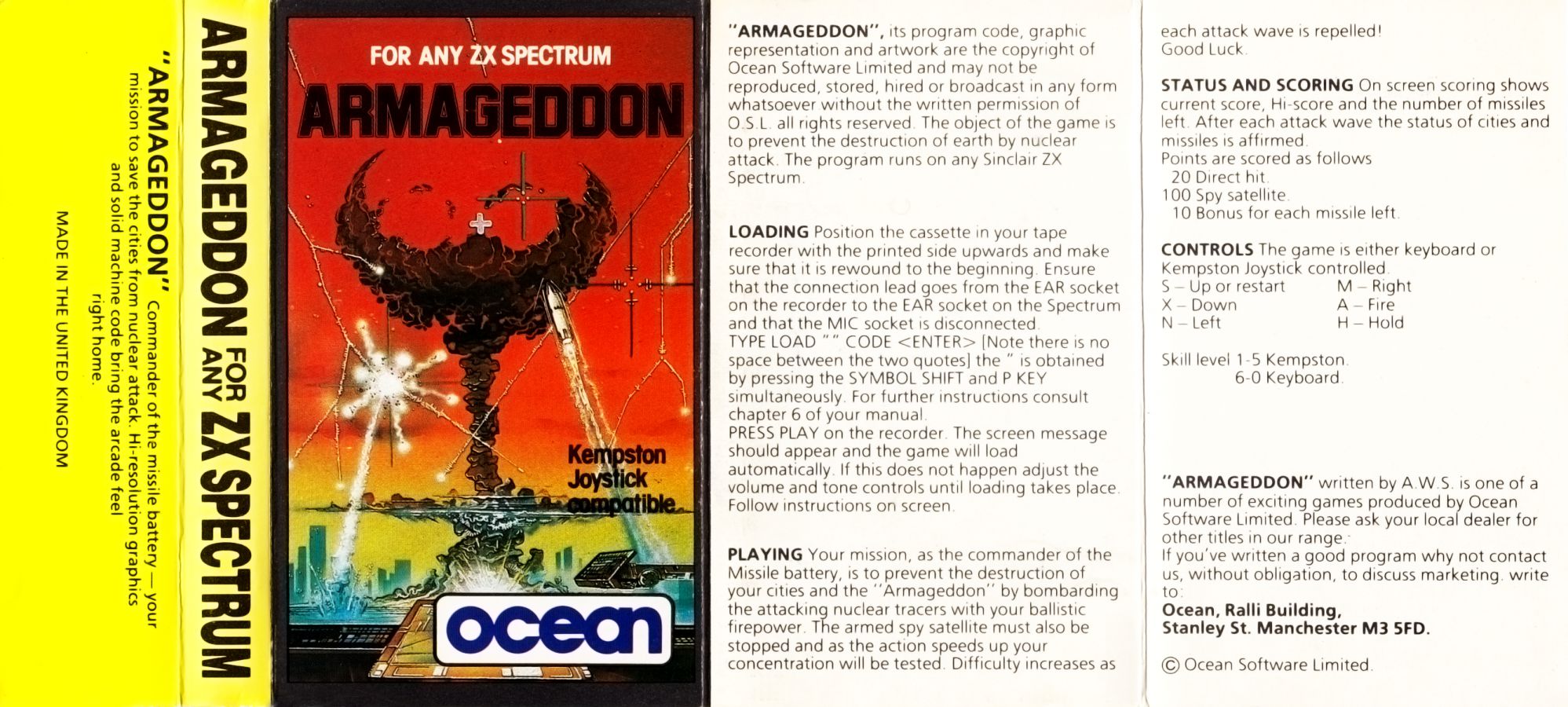
Armageddon
Arcade Game: Shoot-em-up · ZX-Spectrum 16K · 1 players · English
Ocean Software Ltd · 1983 · Pound sterling 5.90
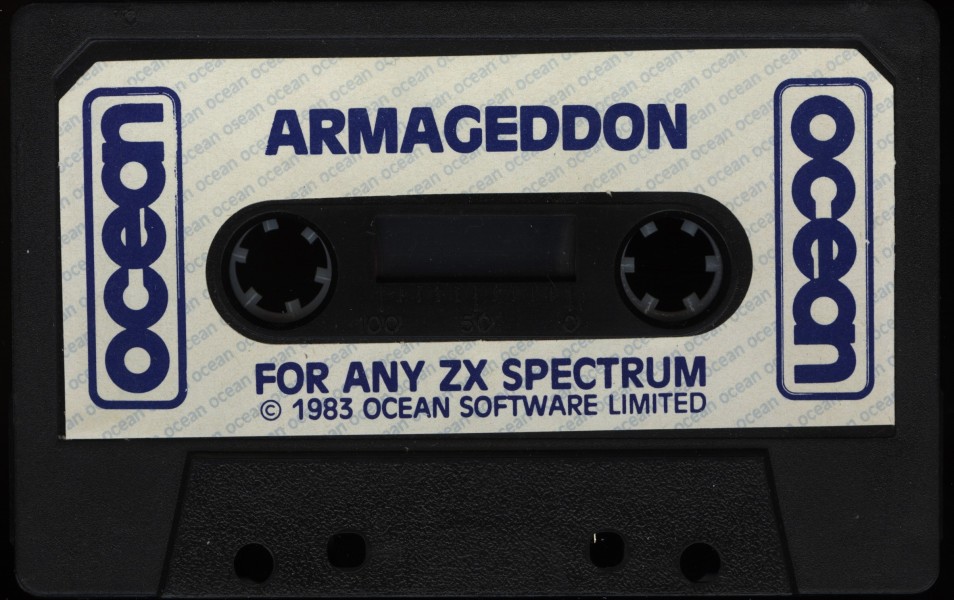
.gif)
Discussion
Nobody has started a thread about this yet.
- Control Option
- Kempston Joystick
Play
- armageddon.rzxRZX playback file
- Armageddon_2.tzx.zipTape image English4 KB
- Armageddon(different).tzx.zipTape image English9 KB
- Armageddon.tap.zipTape image English6 KB
- Armageddon(alternate2).tzx.zipTape image 4 KB
Documents
- Armageddon.txtInstructions English2 KB
Files and rights
No permission is on record either way. Screens and pictures are copied here on a take-down basis: if you hold the rights and want something removed, say so and it goes.
Credits
- Adrian Sherwincredited
Sign in to credit somebody, or say what these people did.
Scores
In the magazines
- Personal Computer News #401983 · Overall Value4/5
Elsewhere on the web
- WorldOfSpectrum 20 votes6.83
In the magazines 23
Crash #3Apr 1984 · p.9865%90%95%50%85%55%88%60%85%
Use of Computer (Keyboard) 65%
Use of Computer (Joystick) 90%
Graphics 95%
Playability (Keyboard) 50%
Playability (Joystick) 85%
Addictive Qualities (Keyboard) 55%
Addictive Qualities (Joystick) 88%
Value for Money (Keyboard) 60%
Value for Money (Joystick) 85%
Chris Passey
Matthew Uffindell
ARCADE APOCALYPSE - MISSILE COMMAND GAMES Our erstwhile arcade sleuths, CHRIS PASSEY & MATTHEW UFFINDELL duet of their track balls and compare some Spectrum 'Missile Command' type games. 'Missile Command' is the arcade classic in which the player defends six cities from enemy missiles. These missiles leave traces on the screen, splitting up at lower levels to make life more difficult. In addition planes and killer satellites move across the screen dropping more missiles. Heat sensitive missiles (or smart bombs) are able to avoid your defensive explosions and have to be hit accurately (direct hit) or deluged with explosions. Defence is by means of three missile bases, each having ten missiles. Any missile you launch will head for, and detonate at the point where your cross wire sight is set. The game continues until all your cities have been destroyed. The control of the sight is achieved by means of a track ball, which gives a very positive, accurate movement (analogue) and is very necessary for this type of game. The Spectrum games, of course, do not have a track ball provision. Armageddon by Ocean Retail Price: £5.90 Memory: 16K This is a variation on the theme, basically the same in essence but a few points have changed. There are still six cities but no missile or laser bases. Your defence missiles 'appear' from the centre of the screen, leaving no trace behind them, They take off at angles, altering their flight path to reach their destination (detonation!) point. They appear to be fired in groups of two with a slight pause between groups. Explosions caused by the missiles are nice, big, smooth balloon types, very similar to the original. Incoming missiles, which split at lower levels, do leave a trace. Due to the wrap around screen, any going off one side will reappear from the other. I liked this added touch. The graphics are smooth (pixel movement). There is also a spy satellite, but no aircraft or smart bombs. The colour at one point spoils the game by altering whole character squares when explosions occur (only on the light blue screen). Generally control is quite easy but the Kempston option is obviously far better. Although 5 skill levels are provided the game is not really challenging enough (perhaps because it is easer to control than most of the others). This is the best of the two Armageddons, and fairly good overall. CP Armageddon by Ocean is Kempston compatible although you don't really need a joystick because of the good keyboard layout and fairly easy game. The cross wire sight is moved in a very controllable amnner. You are allowed 32 plasma boltsa to defend yourself, which produce a fairly rounded explosion, not too bad at all. Every so often an odd looking space ship passes overhead and fires bombs at you. The sound is good but the colour is only average used. Not such a demanding game, so its value is lessened. MU Note on ratings: To be enjoyed to the full, 'Missile Command' games should be played with a joystick (shame there is not a track ball) because keyboard play, in general, cannot give the same degree of accuracy and control. Although the same may be said for many other types of game, we are sure 'Missile Command' fans will agree that this is the game which needs it the most badly. Therefore the ratings given below have been split in two, one for keyboard only play, and one for joystick play. The two reviewers figures have been averaged as, in general, they turned out to be in agreement. Ratings are given on a scale between zero and 100 points, and do not reflect what a game may receive in a regular review.
Crash #3Apr 1984 · p.64
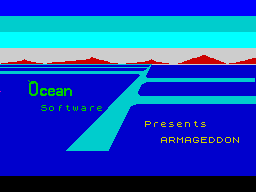
Producer: Ocean, 16K £5.90 This version is a classic missile defence game with excellent graphics, especially the sunburst explosions. The missile traces spilt into several traces, coming thicker and faster with each wave. The available number of missiles in your armoury for each wave is shown at the base of the screen and above that are your six cities which you are protecting. After each attack wave the program updates your score and cities left. Nice title graphics and 'end' card. Recommended.
Crash #2Mar 1984 · p.48
Producer: Ocean, 16K £5.90 This version is a classic missile defence game with excellent graphics, especially the sunburst explosions. The missile traces spilt into several traces, coming thicker and faster with each wave. The available number of missiles in your armoury for each wave is shown at the base of the screen and above that are your six cities which you are protecting. After each attack wave the program updates your score and cities left. Nice title graphics and 'end' card. Recommended.
Crash #1Feb 1984 · p.48
Producer: Ocean, 16K £5.90 This version is a classic missile defence game with excellent graphics, especially the sunburst explosions. The missile traces spilt into several traces, coming thicker and faster with each wave. The available number of missiles in your armoury for each wave is shown at the base of the screen and above that are your six cities which you are protecting. After each attack wave the program updates your score and cities left. Nice title graphics and 'end' card. Recommended.
Personal Computer News #40Dec 1983 · p.724/55/54/54/54/5
Lasting Appeal 4/5
Playability 5/5
Use Of Machine 4/5
Overall Value 4/5
Bob Chappell 4/5
NAME: Armageddon SYSTEM: Spectrum PRICE: £5.90 PUBLISHER: Ocean Software, [redacted] FORMAT: Cassette LANGUAGE: Machine code OTHER VERSIONS: None OUTLETS: Sinclair Dealers CROSS THEM OUT One day we may be regaling our grandchildren with nostalgic tales of those marvellous games we played long ago on that museum-piece, the microcomputer. No doubt among our reminiscences one game will be recalled with warmth and affection - Missile Command. If you've never tried it, you might like to invest in Armageddon, an excellent version for the Spectrum by Ocean Software. OBJECTIVES Six cities are under attack from nuclear tracers. Leaving a trail in their wake, these tracers roll down the screen, sometimes forking, towards the cities. By positioning a small cross-sight in the path of a tracer and firing, a missile will race unerringly toward the marker, detonating on impact. If the leading edge of a tracer is caught in the resulting explosion, the whole tracer is destroyed. You can have more than one missile in the air at once: there are 32 missiles available to you per wave of tracers. IN PLAY A title page is displayed as the main game loads, followed by 8 Charles Atlas dragging the game options into view (an Ocean trademark. I expect). Any of the first six skill levels can be selected. Control of your defences is by keys or Kempston joystick. Using the keyboard is difficult, since you have to cover five keys, but not impossible. The first tracers descend fairly calmly and are not too difficult to stop, though you have to watch out for the odd one that sneaks in at the side of the screen. Subsequent waves are more of a problem, especially when an individual tracer head decides to gallop off in all directions it splits up to form a Nile delta effect. Quite frequently, a spy satellite floats across, which you can pot for extra points. It's harmless but can distract you from the main business in hand since it always flies across the top half of the screen. You re-adjust your sight after blasting one, and find you're minus a city or three. Between rounds is a pleasant pause while your score is updated, the number of missiles and cities remaining are confirmed, and the unknown enemy are having a half-time orange. Points are gained by hitting tracers and satellites, and for every unfired missile. Sound effects are used sensibly and add to the atmosphere. VERDICT A very satisfying game that caters for a range of skill abilities. I rate this as one of the best versions of the breed around. Don't miss out on future nostalgia - get it now.
Advert15
- Sinclair User #25Apr 1984 · p.7
- C&VG (Computer & Video Games) #29Mar 1984 · p.11
- Sinclair User #23Feb 1984 · p.39
- Personal Computer News #39Dec 1983 · p.98
- Personal Computing Today #4Nov 1983 · p.2
- Home Computing Weekly #32Oct 1983 · p.48
- Personal Computer News #32Oct 1983 · p.90
- C&VG (Computer & Video Games) #24Oct 1983 · p.91
- Your Computer #10Oct 1983 · p.2
- Personal Computer News #26Sep 1983 · p.90
- Home Computing Weekly #28Sep 1983 · p.48
- Your Computer #9Sep 1983 · p.212
- Personal Computer News #25Aug 1983 · p.10
- Home Computing Weekly #23Aug 1983 · p.1
- Home Computing Weekly #26Aug 1983 · p.1
Information1
- SSD-IISep 1999
Review1
- Games ComputingSep 1984 · p.73
Feature1
- Crash #3Apr 1984 · p.96
Licensed from
- Missile CommandArcade coin-opunofficialAtari Games Ltd
Related
- Compilations
- Outlet issue 121
- Ports
- (Commodore 64)
- Tags
- Crosshair
- Elsewhere
- Centre for Computing HistoryMobyGamesRZX ArchiveThe TipshopUVLSpectrum Computing RZX - YouTube
- Same entry at
- Spectrum ComputingZXInfo
Reviews from people here
Sign in to write about this, or make an account. It takes a minute and lets you correct the catalogue too.
No description recorded.
Sign in to correct or add to this.
Hold the rights to this and want it taken down?