
The Krypton Factor
Arcade Game: Action · ZX-Spectrum 48K · 1 players · English
TV Games · 1987 · Pound sterling 7.95
Discussion
Nobody has started a thread about this yet.
Remarks
ZXSR: Featured on It's TV Showtime from Domark for £10.99. Other games included Bob's Full House, Every Second Counts, Bullseye and Blockbusters.
Play
- KryptonFactorThe.tzx.zipTape image English56 KB
- KryptonFactorThe.tap.zipTape image English55 KB
Documents
- KryptonFactorThe.txtInstructions English14 KB
Other files
- Krypton Factor, The (1987)(TV Games).pokPOK pokes file 0 KB
Files and rights
No permission is on record either way. Screens and pictures are copied here on a take-down basis: if you hold the rights and want something removed, say so and it goes.
Credits
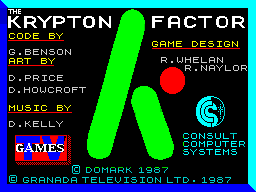
- Glenn Bensoncredited
- Dave Pricecredited
- Dave Howcroftcredited
- Dave Kellycredited
- Richard Whelancredited
- Richard Naylorcredited
Sign in to credit somebody, or say what these people did.
Scores
In the magazines
- Your Sinclair #291988 · Overall6/10
- Crash #501988 · Overall37%
- ACE (Advanced Computer Entertainment) #71988 · Ace Rating616/1000
- Your Sinclair #661991 · The Krypton Factor55%
- Crash #891991 · The Krypton Factor15/20
Elsewhere on the web
- WorldOfSpectrum 12 votes4.33
In the magazines 12
Your Sinclair #29May 1988 · p.736/105/106/104/106/106/10
Graphics 6/10
Playability 5/10
Value For Money 6/10
Addictiveness 4/10
Overall 6/10
Richard Blaine 6/10
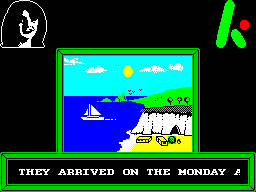
TV Games £7.95 Reviewer: Richard Blaine What will they think of next? Maybe there's a company out there negotiating for the rights to News At Ten or Gardener's Question Time... I'm sure you've seen the Krypton Factor on TV - the idea, if you haven't, is to pit four contestants against each other in a series of tests of their physical and mental abilities. The one who scores highest is supposedly the best all-rounder. On the box, players are tested on their memories, their abilities to perform different physical tasks, their recognition skills and their general knowledge. The computer game manages to reproduce the memory and general knowledge tests quite well, but the physical section is really a bit of a joke. The first subgame (of six), involves remembering sequences of numbers flashing on screen, and then being able to type then back in, but in the correct numerical order. This is not half as easy as you might think; at the same time though, while it's something of a challenge at first I don't honestly think it has much addictive quality. Game number two is weird. First you have to study a really naff picture while reading a story which scrolls across the bottom of the screen. Then you study a similar pic and read a similar story. In both pic and story, things have been changed - present becomes postcard, fete becomes fair, and so on - and you have to identify the changes. The third section has two separate games; in the first, you have to move the Ergobuggy to the end of a course. On the TV, this is quite a challenge, as you have to pedal in one direction with your feet and in the other with your hands - no mean feat, I can tell you. On the computer though, it's just an exercise in joystick waggling. Ho hum, and a missed opportunity. Once you've done that, you go to the vidwall, as in the real thing. And again as in the real thing, the longer you take over the buggy, the less time you have on the vidwall. This is a rectangle of TV screens, divided into four quarters. You have to work out which quarter has the most coloured screens of the same colour and then hit the right button. If you're confused, that puts you just ahead of me, as I was totally lost by this point. I tried hitting all the buttons at once, and the machine made all the right noises, but I didn't score anything. Section four is another Summer Games-type game, this time on the assault course. Your little figure runs along, viewed from above, and every time you come to an obstacle, you have to work out what combinations of strength, stamina, arm and leg power will best get you past it. Again I pounded away at all four keys, but this time it seemed to work, as I scored 10 points! At least I think I did. It could have been because I was the only person taking part and so automatically won! Part five involves solving a puzzle. At the bottom of the screen is a disassembled design, chopped into nine pieces. You have to put them in the right places in the empty square in the given time limit. Again, not as easy as you might think. Finally you get to the sixth section, the general knowledge quiz. This works much like Trivial Pursuit (not surprisingly, as TV Games is owned by Domark, which published that game). Rather than typing in the answers, you say them out loud, press a button to have the right answer flashed up, and then tell the computer whether you were right or wrong. Lots of scope for cheating if you're playing with yourself (Don't you mean 'by yourself'? Ed). And that's it, really. Up to four people can play, and right at the start everyone gets to choose from eight digitised pictures, which are accompanied by potted biographies. (Karen, a 22-year-old secretary from Blackpool). You can change the details if you want, but you can't change the picture - you're stuck with that grinning visage. What more can be said? The Krypton Factor is one of the century's less gripping licensing ideas, and while it has flashes of almost-interest, it really doesn't grab me. Yet again, this is an example of a licensing deal where no-one sat down and thought much about whether or not the projected product would work. Just because you can computerise something doesn't mean you should. Some things just don't work as computer games, and I tend to think that The Krypton Factor is one of those.
ACE (Advanced Computer Entertainment) #7Apr 1988 · p.514/101/107/105/10616/1000616/1000
ACE (Advanced Computer Entertainment)
Graphics 4/10
Audio 1/10
IQ Factor 7/10
Fun Factor 5/10
Ace Rating 616/1000
Steve Cooke 616/1000
Definitely not a game for one player only, this program is a brave but uninspiring attempt to convey the excitement (if any) of the popular TV series. Up to four players choose a game character from a list of eight, represented on-screen by a digitised portrait and a brief biography. You can enter your own occupation, age, and home town if you want, but these details don't reappear in the game. There then follow six challenges, each one a separate lead (best make sure you have a tape counter!) testing your powers of observation, short-term memory, physical control, and general knowledge. At the end of each round the scores and running total are shown and at the end of the game there's a brief victory display (just a static screen with a trophy) for the winner. The physical control sections involve tapping different keys at different rates simultaneously, either to propel an 'Ergobuggy' across the screen, or to tackle the 'assault course'. All the sections are dominated by strict time limits, except the 'Observation Round' in which you spot differences in pictures and short stories. The problem here is not too little time, but too much of it - those not playing at the time have nothing to do. This game offers a modicum of fun to a family of four who want to gather round the monitor. You could play with less participants but it wouldn't be as enjoyable For the soloist it's a waste of time. Reviewer: Steve Cooke RELEASE BOX Spec, £7.95cs, Out Now Ams, £7.95cs, £12.95dk, Out Now C64/128, £7.95cs, £109.95dk, Imminent Predicted Interest Curve 1 min: 60/100 1 hour: 50/100 1 day: 60/100 1 week: 50/100 1 month: 40/100 1 year: 30/100
Amstrad: Piloting the Ergobuggy involves tapping different keys at different rates - a test of co-ordination that sounds difficult in theory but disappointingly easy in practise.
AMSTRAD VERSION Not very exciting graphically and lacks sound during play. Some sections would benefit from a joystick option. The 464's inbuilt tape counter makes the multi-load a little more bearable, but the combination of loading delays and waiting for others to take their turn does nothing to enhance gameplay. Graphics: 5/10 Audio: 3/10 IQ Factor: 7/10 Fun Factor: 5/10 Ace Rating: 641/1000 Predicted Interest Curve 1 min: 65/100 1 hour: 55/100 1 day: 60/100 1 week: 55/100 1 month: 40/100 1 year: 30/100
SPECTRUM VERSION Digitised pictures display poorly on this machine and the graphics are generally slightly inferior. Plus 2 owners lacking a tape counter may fume over occasional loading errors, but otherwise there is little difference between this and the Amstrad version.
Crash #50Mar 1988 · p.2060%50%39%37%37%37%32%
Presentation 60%
Graphics 50%
Playability 39%
Addictive Qualities 37%
Overall 37%
Bym Welthy 37%
Mike Dunn 32%
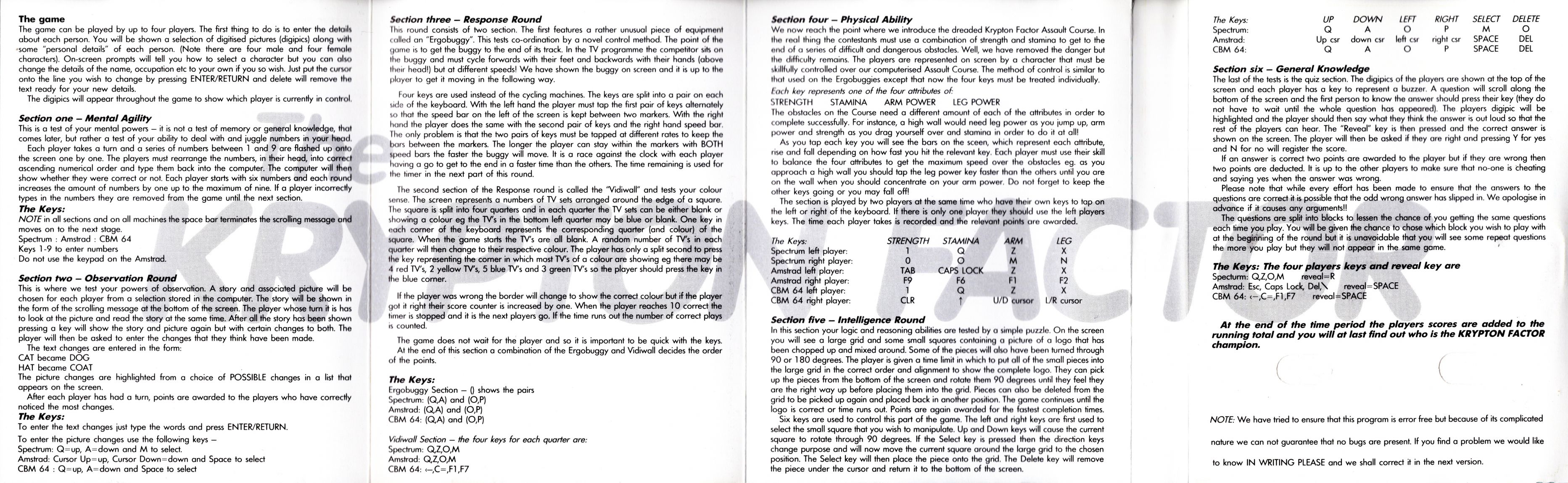
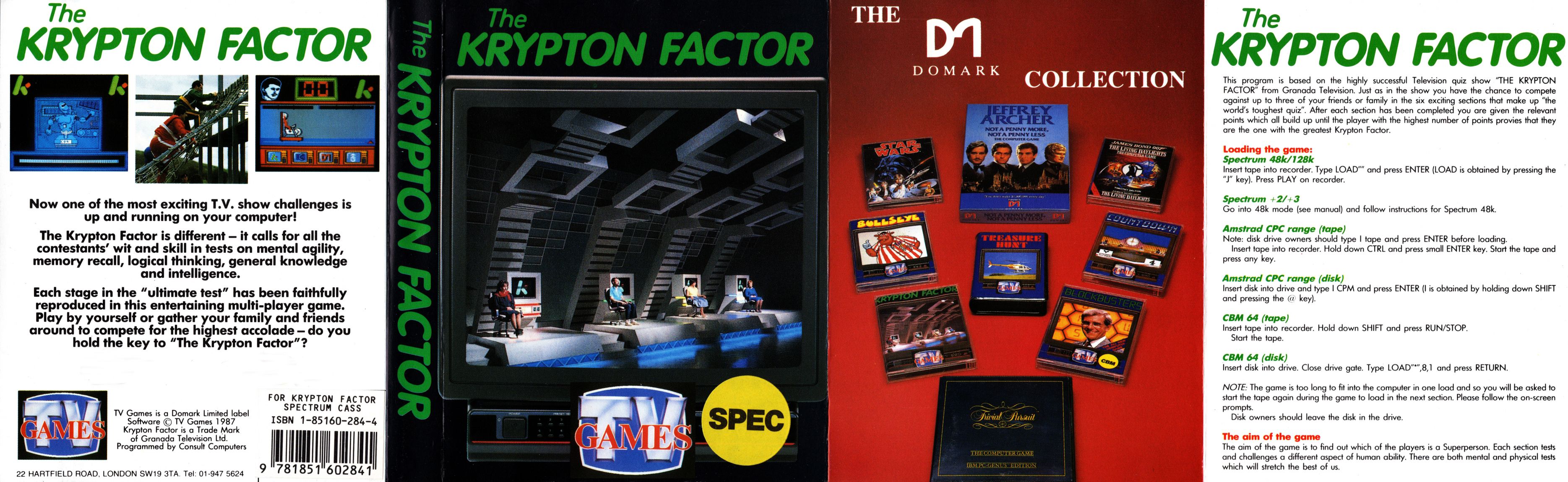
Producer: TV Games Retail Price: £7.95 Author: G Benson Intelligence, quick thinking and athletic ability are just some of the skills needed to prove yourself in The Krypton Factor. Based on the long-running Granada TV series, which has been putting suckers through their gruelling paces for a decade, this licence from Domark label TV Games throws up to four contestants into the ring. The Krypton Factor consists of six rounds testing mental agility, observation, response, physical ability, intelligence and general knowledge; players can choose their 'characters' from among four men and four women before the first round (participants in the TV show are ordinary members of the public). In the mental-agility round, a series of numbers appears briefly onscreen. The digits must be remembered and rearranged into ascending order. At first there are just six numbers to struggle with, but this can increase to a maximum of nine. Next there's an observation round. Here a picture appears with a scrolling story line beneath; picture and words then disappear to be replaced with a subtly different alternative version. The contestant must identify the changes within a time limit. In the two-part response round, contestants' reactions and responses are tested on the Ergobuggy and Vidiwall. The first is a strange combination of rotatable pedals, some moved by the legs (as on a bike) and others by hand. The two sets of pedals must be rotated at different speeds to propel the buggy forward - it's a tricky test of coordination. And the Vidiwall is a large square formed of many video screens, which randomly change colour. The player must decide in a split second which colour is shown on most screens, and then hit the key which represents that colour. The first contestant to do this correctly ten times wins the round. Sheer physical ability is now tested on an assault course, where players can adjust their contestants'stamina and strength in both legs and arms. Different obstacles, which include the net climb and a high wall, require different combinations of strength and stamina; in some you must rely on arms, in others on legs. Next it's the turn of brainpower, as each contestant is challenged to piece together the parts of the Krypton Factor logo. Some of these pieces can be turned and fit within a grid; others can be removed from the grid and repositioned. The last round tests the general knowledge of the contestants. Questions scroll across the screen, and in time-honoured quiz-show fashion the first player to press his key gets to answer. The correct answer is then revealed onscreen, and the game relies on players' honesty in admitting when they answered incorrectly. COMMENTS Joysticks: none Graphics: lacking detail, but not colour Sound: simple title tune, unimaginative effects Options: choice of eight charismatic contestants; up to four players
It's a gas: The Krypton Factor
It's TV Showtime carries this game and has 5 references of its own.
News/Note4
- C&VG (Computer & Video Games) #76Feb 1988 · p.8
- Popular Computing Weekly #6Feb 1988 · p.20
- ACE (Advanced Computer Entertainment) #2Nov 1987 · p.8
- Home Computing Weekly #127Aug 1985 · p.7
Review3
- Your Sinclair #66Jun 1991 · p.36
- Crash #89Jun 1991 · p.33
- C&VG (Computer & Video Games) #77Mar 1988 · p.64
Advert2
- Sinclair User #69Dec 1987 · p.63
- C&VG (Computer & Video Games) #73Nov 1987 · p.26
Licensed from
- The Krypton FactorTV showGranada Television Ltd, ITV
Related
- Compilations
- It's TV Showtime, TV Special
- Ports
- (Amstrad CPC), (Commodore 64)
- Elsewhere
- MobyGamesThe TipshopUVL
- Same entry at
- Spectrum ComputingZXInfo
Reviews from people here
Sign in to write about this, or make an account. It takes a minute and lets you correct the catalogue too.
Everything ZXDB can hold about this is here.
Sign in to correct or add to this.
Hold the rights to this and want it taken down?