
Lazer Tag
Arcade Game: Action · ZX-Spectrum 48K · 2 players · English
Go! · 1988 · Pound sterling 8.99 · Pound sterling 12.99 disk
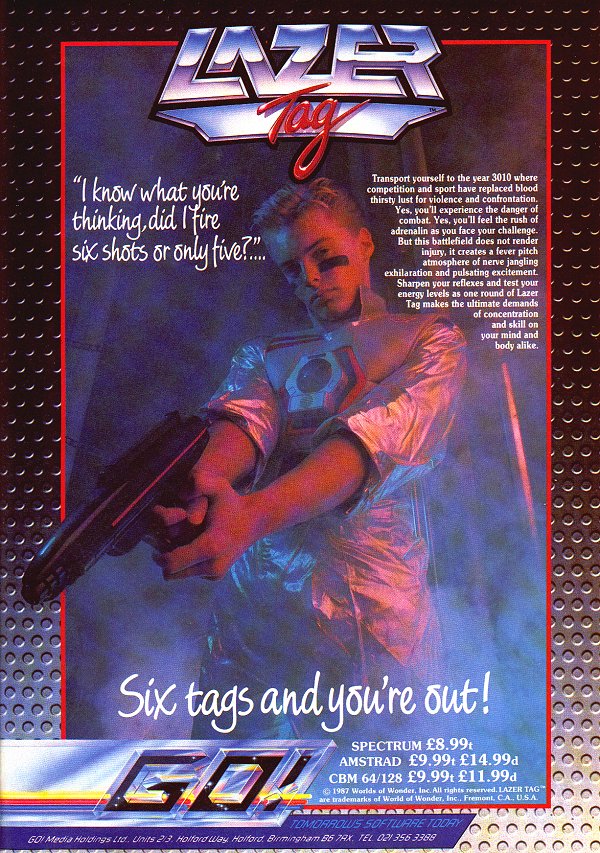
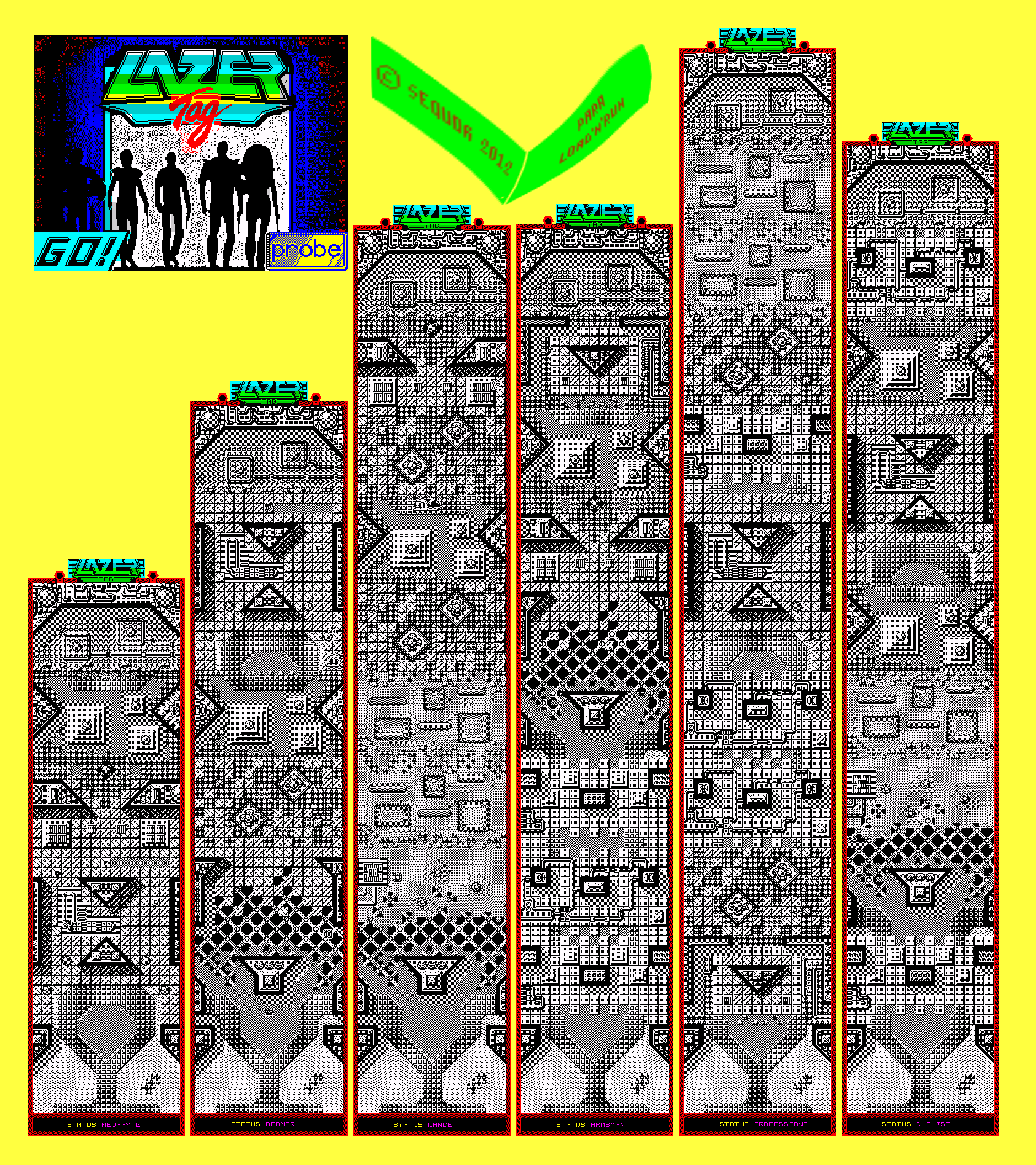
.jpg)
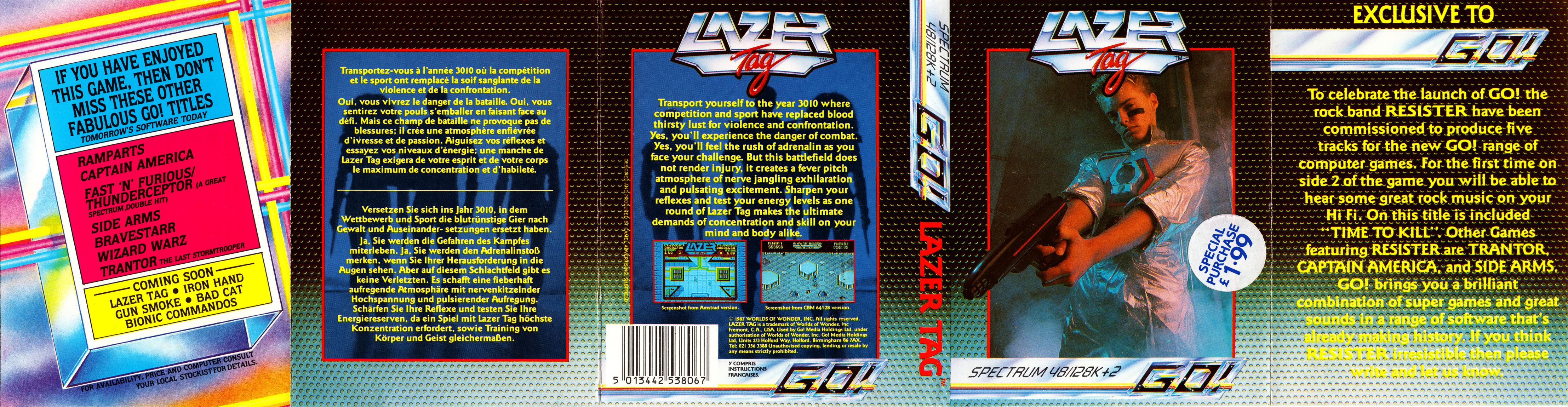
Discussion
Nobody has started a thread about this yet.
- Control Option
- Cursor, Interface 2 (right), Kempston Joystick
Releases
- 1988Go!Pound sterling 8.99 · Pound sterling 12.99 disk
- 1988Erbe Software S.A.Spanish peseta 875.00
Play
- LazerTag.dsk.zipDisk image English38 KB
- LazerTag.rzx.zipRZX playback file 125 KB
- LazerTag.tzx.zipTape image English53 KB
- LazerTag.tap.zipTape image English23 KB
- LazerTag(ErbeSoftwareS.A.).tzx.zipTape image English22 KB
Documents
- LazerTag(ErbeSoftwareS.A.).pdfInstructions Spanish18 KB
- LazerTag(EN).txtInstructions English3 KB
- LazerTag(MULTI-LANG).pdfInstructions Multi-language: English, French, German286 KB
Other files
- Lazer Tag (1987)(Go!).pokPOK pokes file 0 KB
Files and rights
No permission is on record either way. Screens and pictures are copied here on a take-down basis: if you hold the rights and want something removed, say so and it goes.
Credits
- Probe Software Ltdcredited
Sign in to credit somebody, or say what these people did.
Scores
In the magazines
- Sinclair User #751988 · Overall5/10
- Your Sinclair #321988 · Overall3/10
- Crash #531988 · Overall59%
- The Games Machine #81988 · Overall53%
Elsewhere on the web
- WorldOfSpectrum 16 votes5.25
In the magazines 19
Your Sinclair #32Aug 1988 · p.675/103/103/103/103/103/103/10
Graphics 5/10
Playability 3/10
Value For Money 3/10
Addictiveness 3/10
Overall 3/10
Ben Stone 3/10
Mike Dunn 3/10
Go! £8.99 Reviewer: Ben Stone, Mike Dunn Has anyone ever noticed how Gateway supermarkets seem to have been designed specifically as Lazer Tag arenas? Forget the Saturday morning trip down to the shopping centre for your Sunday joint, vegeburger or whatever - replace your shopping lists with the latest in infra-red technology Granny; we're talking targets not trolleys herre! The creepy mist, the atmospheric music and the slippery floors, it's all at Gateway. The only problem is the store manager brandishing a leg of frozen lamb! Yes Ben 'n' Skippy are well and truly veterans of the light fantastic (albeit infra-red!). But what has blasting with Lazer Tag go to do with Go!'s game of the same name? Good Question... The year is 3010 and you have roe been enrolled into the Laser Tag Training school - in the hope that, just maybe, one day you may be good enough to carry the title of Duelist and be entered in the Laser Tag games. As all other cadets before you, you have to prove yourself in the vertically scrolling arena and thus be promoted through the six levels, from Neophyte to Duelist. Each level has a sightly different playing area and is played in two phases: the first, called Rabitoid, is a straight shoot out with other cadets, who are all just as eager as you to climb the ranks and just as nifty with their Laser Tag weapons too. Here the player races against the clock to the end of the arena, to gain a whopping great bonus tagging out as many opponents as possible on the way, and icons can be picked up for extra points, time, lives or increased firepower. The second phase, called Target, is a lot less hassle. The players follows a fixed path through the arena and picks off targets, who don't shoot back, as they pop up around the place. This time the bonus is calculated from the shooters accuracy. On the whole Laser Tag plays like a mediocre Commando variant with insipid opponents (even on the higher levels), and a boring section in the middle that breaks up the gameplay drastically. The bouncy bullets/Laser blasts are a nice touch (and one of the few tie-ins with Laser Tag proper), but more often than not it's very difficult to see the surfaces that you can bounce your blasts off, or the things that you're supposed to shoot at, because the graphics are poorly coloured and detailed. When you consider that with a bit of shopping around, you can pick up an original Laser lag set for around twenty quid, the price tag of £8.99 on this seems to be well wide of the mark. I know which I'd rather spend my money on.
The Games Machine #8Jul 1988 · p.6253%
Overall 53%
Spectrum 48/128 Cassette: £8.99 Amstrad CPC Cassette: £9.99, Diskette: £14.99 Commodore 64/128 Cassette: £9.99, Diskette: £11.99 YOU'RE IT! Once upon a time in America George A Carter III founded a company - Photon Entertainment - which used hi-tech to simulate Star Wars-type battles in franchised arenas for kids with lots of pocket money. Of the various systems which proliferated, Lazer Tag has proved one of the most successful (see feature in TGM001) and GO! picked up the computer game licence on the bizarre condition that there be no violence. The programming is by Probe Software (Outrun conversions.) Apparently there is a Lazer Tag training school where cadets can learn how to be expert in the game and earn promotion. Training sessions are divided into two sections; tag and target. In the tag section you guide your character through the arena to the gate at its end. Other cadets may be shot for extra points, if they touch your character a life is lost. Along the way equipment can be picked up for time and lives bonuses. Various vehicles drive across screen and have to be avoided, but towers can be shot at which reflect your lazer in numerous direction. Failure to reach the gate before the time limits runs out loses a lite. If the gate is reached, a target section begins which has the character automatically running through the arena again, invincible, with the player able to shoot other cadets for points. In two-player mode players take turns rather than both being on screen at the same time. Ultimately, however, Lazer Tag looks and plays like an inferior and repetitive Commando clone, with some irritating quirks on machines such as the C64.
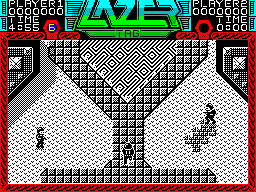
Not as colourful as the Amstrad version, but much faster - Spectrum screen.
The good guy tags his way up the screen so that he may tag his way up another - Amstrad screen.
"Lazer Tag looks and plays like an inferior, repetitive Command clone..."
AMSTRAD CPC Overall: 54% The Amstrad version has smaller but also more colourful graphics and a good continuous tune. Another plus point is that when cadets are shot they are instantly taken off screen much as in a conventional shoot-'em-up. Nevertheless lack of variety in gameplay and somewhat sluggish responses make this a below average Commando variant
COMMODORE 64/128 Overall: 32% The Commodore version has big graphics but rather bland colours and tune. More importantly cadets when shot can still kill you as they slowly walk off screen, which is irritating, as is the stunned stupor the character goes into after being shot making control difficult for a few seconds. Unlike the other two versions, enemy cadets don't actually fire at you but must touch the character to kill.
OTHER VERSIONS GO! are not planning conversions to any of the 16-bit machines.
Crash #53Jun 1988 · p.1257%58%60%50%59%60%44%70%
Presentation 57%
Graphics 58%
Playability 60%
Addictive Qualities 50%
Overall 59%
Kati Hamza 60%
Nick Roberts 44%
Paul Sumner 70%
Producer: Go! Retail Price: £8.99 cassette, £12.99 disk Author: Probe Fresh from its success as a light game, Lazer Tag makes its appearance in computerised form. One or two alternating players take the part of a cadet undergoing rigorous instruction at the Lazer Tag training school. Training is divided into two disciplines: Shoot Out and Target. Both take place against the background of a vertically scrolling, futuristic practice arena. In Shoot Out, 'tagger' opponents advance from all sides firing leers. The player attempts to make his way through the complex within a given time limit, shooting as many of his opponents as possible. The arena features spinning terminals which deflect the lazer and double or quadruple the beam when hit, and certain walls ricochet shots around the arena. Target is designed to test shooting accuracy. The player is automatically transported through the arena and attempts to shoot as many taggers as possible. He controls the direction in which he fires but not the route taken through each room. At the end of each practice session the player is given a rating: his skill determines the degree of promotion obtained. COMMENTS Joysticks: Cursor, Kempston, Sinclair Grpahics: poor on the first stage, but improve as you progress Sound: average title tune and spot effects Options: definable keys
Sinclair User #75Jun 1988 · p.405/105/10
Overall 5/10
Jim Douglas 5/10
Label: Go! Author: Probe Software Price: £8.99 Memory: 48K/128K Joystick: various Reviewer: Jim Douglas Now, we all know that the public image of the typical computer user is a small, spotty youth in an anorak and tatty trainers, hunched in a semi-darkened room trying to blast the last space pixie on level 99 of Alien Brain Gobblers at one o'clock in the morning. But you're not like that, are you? (Cries of "I am, I am!" - shut up, Dillon.) No, the real computer user is a tough, macho type who enjoys healthy physical exertion and getting duffed around a bit, 'cos it's all very character developing. So answer me this; what IS the point of taking an exciting, energetic game like Lazer Tag, which encourages you to get plenty of fresh air and exercise, and turning it into a spotty, pasty-faced computer game? Not that the game doesn't capture the spirit of the original, which, as you'll remember, involves jamming on big plastic helmets, light sensors and bandoliers, and racing around shooting light-pistols at each other or at robot targets. In the game, you take the role of a lowly cadet at the Lazer Tag Academy, whose aim is to progress through the ranks so that you don't have to spend your free time cleaning other people's boots. To do this you must demonstrate your proficiency at two disciplines; Rabbitoid, a free-for-all shooting contest, and Target, a test of accuracy and skill. In each game, you move through the lazer Tag arena, shown in a top-down perspective view with disappointingly little colour or detail. Your hero must blast the opposition as they emerge from cover. At this, they throw up their hands in horror and scuttle off the screen; no-one gets killed, remember, 'cos this is all very right on and socially conscious and not at all violent. In Target, you progress under computer control, and aim your gun manually to zap as many targets as you can along the way. Shooting spinning mirrors can increase your firepower by twice or four times, as ricochets zip around the arena. In both games, you're playing against a timer, and are awarded bonus points for speed and number of targets hit. You lose one of your six lives every time you are shot or run out of time. Technically competent, Lazer Tag misses out on any sort of exciting or involving gameplay. A perfect example of the sort of licensing deal which, I'm afraid, gives licensing deals a bad name.
Preview4
- MicroHobby #173Jul 1988 · p.15
- The Games Machine #6May 1988 · p.18
- Crash #49Feb 1988 · p.109
- Your Sinclair #23Nov 1987 · p.11
Full-page ad3
- C&VG (Computer & Video Games) #76Feb 1988 · p.79
- Your Sinclair #26Feb 1988 · p.69
- Sinclair User #71Feb 1988 · p.108
Review2
- MicroHobby #175Aug 1988 · p.38
- C&VG (Computer & Video Games) #80Jun 1988 · p.21
News/Note2
- The Games Machine #1Oct 1987 · p.14
- ACE (Advanced Computer Entertainment) #1Oct 1987 · p.8
CompoResult1
- The Games Machine #9Aug 1988 · p.73
CompoEntry1
- The Games Machine #7Jun 1988 · p.113
Advert1
- Crash #50Mar 1988 · p.116
Feature1
- C&VG (Computer & Video Games) #74Dec 1987 · p.60
Licensed from
- Lazer TagSoftwareMattel Inc, Worlds of Wonder Inc
Related
- Compilations
- Load 'n' Run issue 54
- Ports
- (Amstrad CPC), (Commodore 64)
- Same entry at
- Spectrum ComputingZXInfo
Reviews from people here
Sign in to write about this, or make an account. It takes a minute and lets you correct the catalogue too.
No description recorded.
Sign in to correct or add to this.
Hold the rights to this and want it taken down?