
Lode Runner
Arcade Game: Platform · ZX-Spectrum 48K · 1 players · English
Software Projects Ltd · 1984 · Pound sterling 9.95

.gif)
Discussion
Nobody has started a thread about this yet.
Remarks
This game was later converted to an arcade coin-op by Irem Corporation.
- Control Option
- Cursor, Interface 2 (right), Kempston Joystick, Redefineable keys
Play
- loderunner.zipRZX playback file
- LodeRunner(NewGameSet).z80.zipSnapshot image English18 KB
- LodeRunner.tzx.zipTape image English42 KB
- LodeRunner48.tap.zipTape image English21 KB
- LodeRunner(48K)(SideA).tzx.zipTape image English42 KB
- LodeRunner(48K)(SideB).tzx.zipTape image English42 KB
Documents
- LodeRunner_CodeSheet.txtCode sheet 20 KB
- LodeRunner_CodeSheet.zipCode sheet 12,909 KB
- LodeRunner.txtInstructions English2 KB
Other files
- Lode Runner (1984)(Software Projects).pokPOK pokes file 0 KB
Files and rights
No permission is on record either way. Screens and pictures are copied here on a take-down basis: if you hold the rights and want something removed, say so and it goes.
Credits
- David J. Andersoncredited
- Ian Morrisoncredited
- Roger TissymanInlay/Poster Art
Sign in to credit somebody, or say what these people did.
Awards
Scores
In the magazines
- Personal Computer News #911984 · Overall7/10
- Sinclair User #351985 · Gilbert Factor6/10
- Your Computer #11985 · Overall3/5
- Sinclair Programs #281985 · Rating60%
- Crash #121985 · Overall81%
- Personal Computer Games #151985 · Overall8/10
Elsewhere on the web
- WorldOfSpectrum 87 votes8.14
In the magazines 29
C&VG (Computer & Video Games) #41Mar 1985 · p.1057/106/108/108/10
Graphics 7/10
Sound 6/10
Value 8/10
Playability 8/10
MACHINE: Spectrum/joystick or keyboard SUPPLIER: Software Projects PRICE: £9.95 It seems only right that the company who brought you the all time classic English platform game in the shape of Manic Miner should now be bringing you the all time classic American platform game - Lode Runner. Ignore the graphics - they can't described as the best ever on the Spectrum - just play the game! The scenario goes like this. You are a highly trained galactic commando on a mission to recover a fortune in gold from a power hungry bunch of empire builders. The gold is hidden in an underground treasury packed with mysterious passageways designed to baffle would-be raiders. You are armed with a laser-drill which blasts through walls - but you'll need more than brute strength and speed to work out the many ways to the bullion. If you enjoy platform games then this is the game for you. The puzzling screens - there are 150 of them - will keep you guessing for quite a time. And once you've worked them out you can start designing your own and save them to tape using the games neat user-definable feature. Lode Runner rightly has a great reputation as a quality game - and this Spectrum version is no exception.
Personal Computer Games #15Feb 1985 · p.34PCG Hit5/103/10N/A9/108/108/10
Personal Computer GamesPCG Hit
Graphics 5/10
Sound 3/10
Originality N/A
Lasting Interest 9/10
Overall 8/10
Chris Anderson 8/10
Peter Walker
Robert Patrick
MACHINE: Spectrum 48K CONTROL: Keys, Kemp FROM: Software Projects, £9.95 This title was a big hit some time back in America and Software Projects have been trumpeting their release of it in Britain as a Major Event, guys. In essence it's very similar to Space Panic. You run round a network of ladders and platforms collecting gold nuggets and steering clear of a gang of chasing men. You can dig traps for them to fall into at a touch of a fire button, but unlike Space Panic you can't then have the satisfaction of stamping them out of existence. You simply secure yourself a few moments' reprieve. What Lode Runner does have are a few extra features such as invisible trap doors - and more importantly 150 different screens, although the Spectrum can only hold 75 at a time (the rest are on the other side of the tape). The program also allows you to design your own screens (although it doesn't tell you how!) and to switch the order of existing screens, a considerable boon when you're bored with the first half-dozen. The graphics are very ordinary, with tiny, single-character size men chasing each other round. But this has compensations in that individual screens can be made far more complex. My one gripe with the game is that there isn't enough variety. Once you've solved a few screens, the rest don't have much new to offer. On the other hand the vast size of the game can give you motivation enough to keep tackling screens. Knock off two an evening and the game will still take 11 weeks to complete! The play is by no means easy. It's easy to get trapped, and the large number of gold nuggets on some screens take a lot of collecting. I've never seen the Commodore 64 versions, so I can't compare them, but I suspect it's even better - Ariolasoft are releasing it in this country. Meanwhile this Spectrum version will do very nicely, thank you. The programmers at Software Projects tell me they haven't stopped playing in weeks.
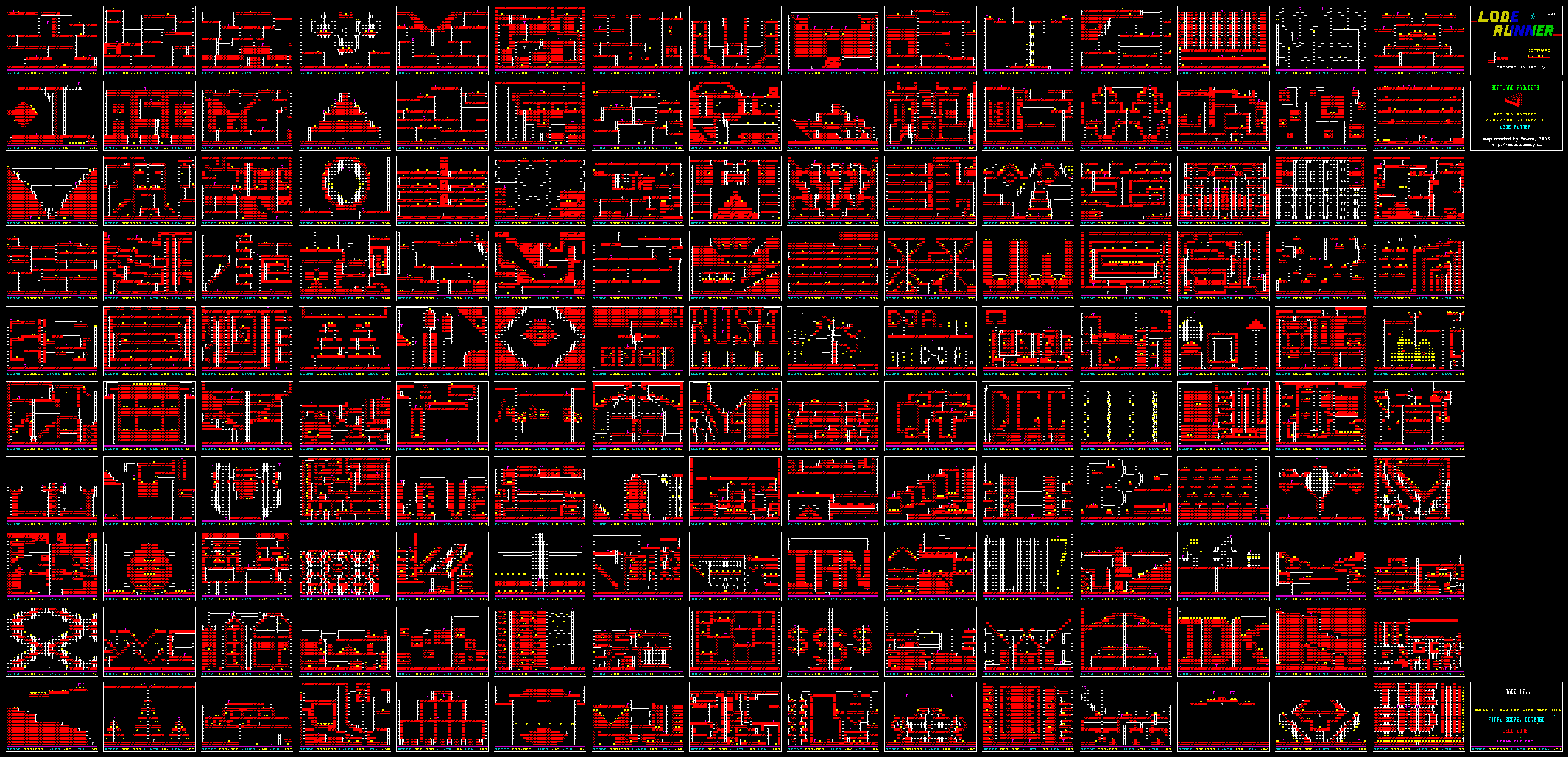
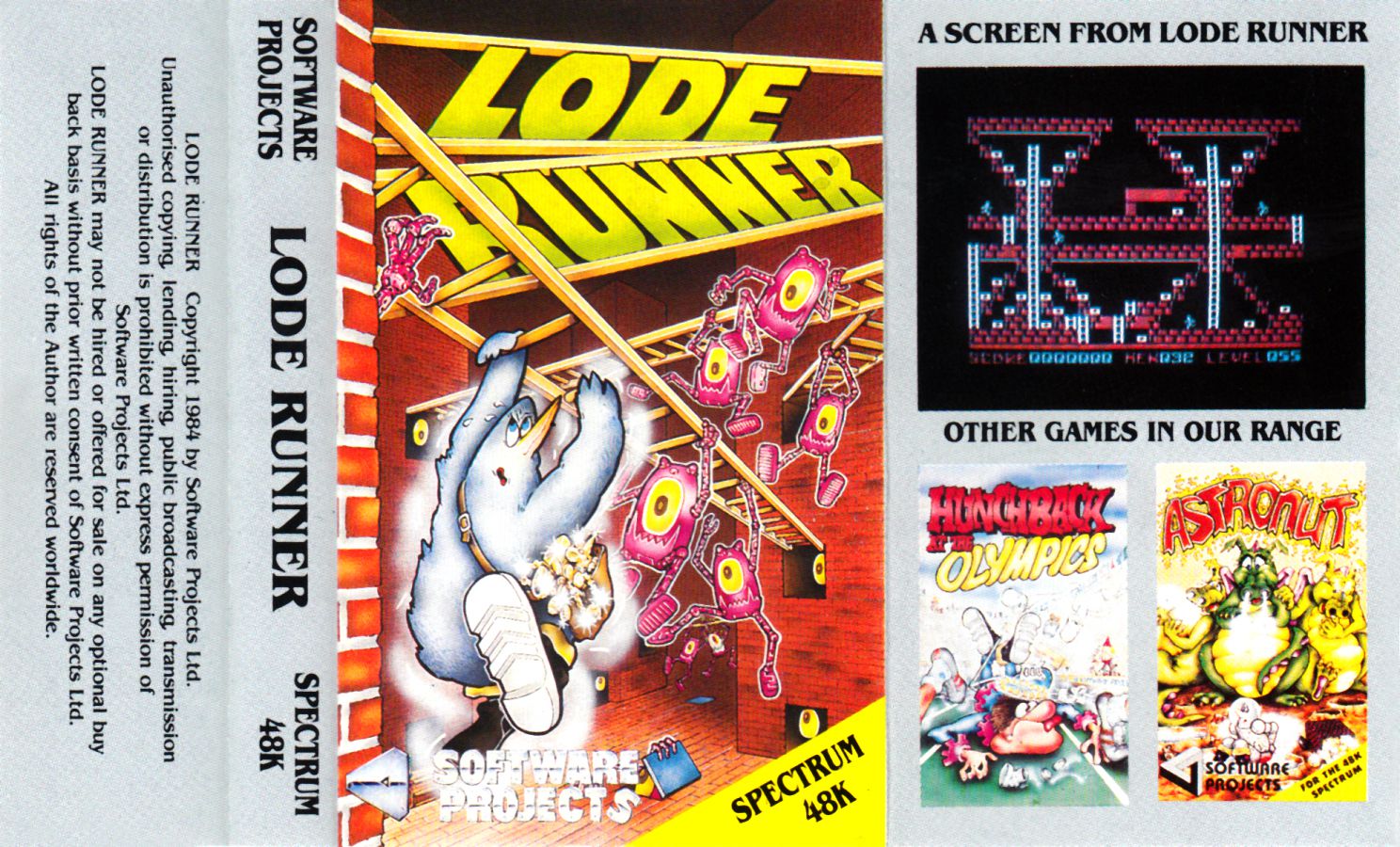
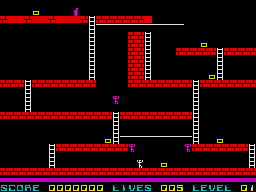
Just one of Lode Runner's 150 screens.
Sinclair Programs #28Feb 1985 · p.1560%60%
Rating 60%
June Mortimer 60%
PRICE: £9.95 GAME TYPE: Arcade If you thought the days of itsy-bitsy characters in games were long gone, you were wrong. If you thought tiny characters were a sign of a bad game you were even further from the truth. Lode Runner, from Software Projects, features several tiny characters running across the screen or, rather, running across 150 screens. Your aim is to collect all the gold on one screen and then escape to the next screen. Your enemies, who chase you commando-style across the screen, aim to stop you. Their touch means instant death and, what is more, they have a nasty habit of picking up the gold you want to collect. The basic idea behind the game is very familiar. Climb the ladders, collect the objects, avoid your enemies, and dig holes for them to fall into. Several points, though, differentiate it from a run-of-the-mill, seen-it-before game. Firstly, there is the sheer number and variety of the screens. 75 on one side of the cassette, and a further 75 on the next. Each contains an ingenious and challenging combination of ladders to climb, poles to slide along and different types of flooring. Secondly, there is the edit facility. This allows you to change any of the screens, adding ladders, poles, gold, enemies, or whatever you want, to change the whole atmosphere of the game. You can also move the screens around, place all the easy ones at the beginning, or the difficult ones where you can practise them. The screens are ingenious and the game is fun. However, with excellent graphics proving to be one of the chief selling points of this year's games, and with the Digger theme almost done to death, it does not have the strong attraction of similar games, such as Chuckie Egg, released a year ago.
Sinclair User #35Feb 1985 · p.296/106/10
Gilbert Factor 6/10
John Gilbert 6/10
LODE RUNNER Software Projects Ltd Memory: 48K Price: £6.90 Joystick: Kempston, Sinclair Another ladders and levels game you cry, as you aim Lode Runner at the dustbin ready for the drop. But, however, there is something extra which makes the game different from the rest. Once you have run up the ladders, swung from poles and picked up gold bricks while dropping the enemy into freshly dug holes, you can switch to Edit mode and change the positions of all moveable objects on any of the 150 screens. You can even switch levels around so that, for instance, level one could become level four at the touch of a key. Redesigning a screen is as simple as moving a cursor. You first select the object which you want to deposit on the screen. It can be a gold bar, or even yourself. Moving the drop cursor and pressing the fire button will put it on to the new set up. As for the rest of the game, you might just as well forget about it. The user definition is the most exciting aspect of it and anyone who can work their way through 150 screens of matchstick heroes deserves a prize for perseverance.
Crash #12Jan 1985 · p.3881%68%83%84%80%87%81%
Use of Computer 81%
Graphics 68%
Playability 83%
Getting Started 84%
Addictive Qualities 80%
Value For Money 87%
Overall 81%
Unknown
Unknown
Unknown
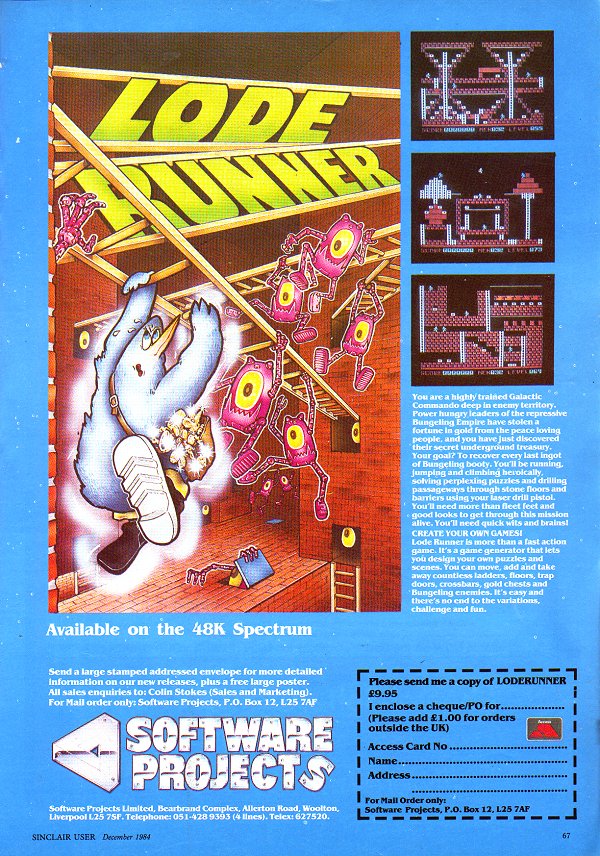
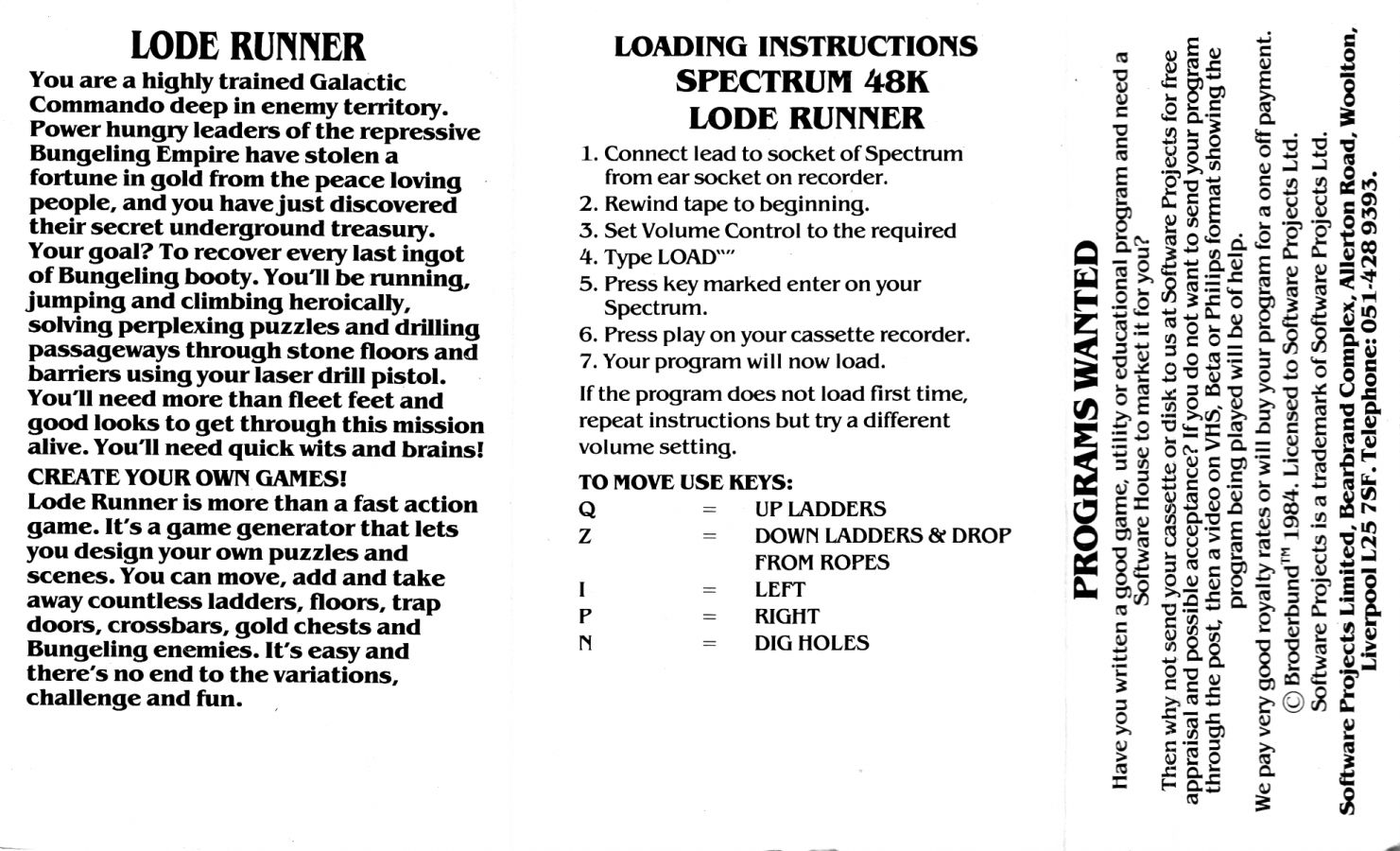
Producer: Software Projects Memory Required: 48K Retail Price: £5.95 Language: Machine code You are a highly trained Galactic Commando deep in enemy territory. Power hungry leaders of the repressive Bungeling Empire have stolen a fortune in gold from the peace loving people, and you have just discovered their underground treasury. Your aim in life is to recover every single ingot. So Software Projects describe this manic arcade game with over 150 different screens, and a customising facility for you to design your own screens and save them to tape. In fact, what we have here is a mammoth 'Panic' style game where the traditional digging function is actually an important part of the overall strategy. The screens are made up of numerous variations on the theme of brick blocks, ladders and bars, with the gold stacked here and there, often in seemingly inaccessible places. The Bugeling agents swarm all over the place after you, with one disadvantage - they can't leap up large blocks - but then, neither can you. What you can do is dig holes for them to fall into, out of which they spring after a few seconds. You can dig holes to get at the inaccessible gold too, and the longest possible fall does not kill you off. A nasty touch is that the holes heal themselves after a while, and as you can't jump out of them like the nasties, you get concretised in! This factor is important on screens where the gold is deeply buried under brick, as you can only dig a hole through a layer if there is more than one block missing on the layer above it. This means having to dig out several blocks length in order to have the room to dig downwards for three or four blocks. Meanwhile they are filling in above you and the nasties are leaping down on top of you. Because of the huge number of screens, there are 75 on one side of the tape and 75 on the second side. Access to any playing screen is available - they don't expect you to wade through all of them to complete the game! COMMENTS Control keys: user definable, preset are: Q/Z up/down, I/P left/right, N to dig holes Joystick: Kempston, Cursor, Sinclair 2 Keyboard play: highly responsive Use of colour: simple on the whole, but very good Graphics: small, mean as hell and well animated Sound: not much, but doesn't spoil the game Skill levels: 1, but it seems to get more difficult as you go along Lives: 4 to kick off with Screens: 150 Special features: you can design your own screens via the editor and save them to tape
Your Computer #1Jan 1985 · p.653/53/5
Overall 3/5
Paul Bond 3/5
Spectrum 48K Software Projects Platform Game £9.95 There is a justifiable awe of American software in this country with consistent scare stories being put about by the computer trade press that this particular software invasion will do for British companies what a cruise missile would do for Minsk. This is a Broderbund game under license and Broderbund brought us the memorable Choplifter on the Apple II and in various forms for other home computers. Sadly, this is unlikely to set the world on fire. All of that blurb about being a highly trained Galactic Commando deep in enemy territory is not going to disguise the fact that this is just another platform game, albeit complex and with neatly executed graphics. In the traditional way, you climb ladders, grab gold, swing on ropes - nice touch, this - and dig holes to get rid of your assailants. Later screens involve you in passage-way mazes and necessitate a certain amount of drilling with your laser pistol. The real strength of this game is that, like Beyond's Mr Robot, it is also a game generator. You can stick in loads of ladders, floors, trap doors, gold bars and enemies as you like. So, while not being part of the striking graphics trend, this game may well turn out to appeal to a new market for "kit" computer games.
Personal Computer News #91Dec 1984 · p.577/107/10
Overall 7/10
Bryan Skinner 7/10
PRICE: £9.95 PUBLISHER: Software Projects [redacted] Some of the best games around are American, and for the Commodore 64, so it's good to see British software houses producing conversions for the Spectrum. As a highly-trained galactic UDG, sorry Commando, you must recover gold from the Bungeling Empire. The ingots look like hot dogs and it's basically a levels and ladders game. The most unusual aspect is that you can edit any of the screens to suit your taste, and save them to tape. However, the screens are much of a muchness - plenty of red brickwork and white ladders on a black background. The Bungelers are tiny purple figures which tend to come after you a bit sharpish, so you might like to edit them out of the first screen altogether to let you suss out the controls and how best to get at the ingots. There are 75 screens. Not only can you add ladders, walls and pursuers (or take them away), but screens can be moved so you could make the last screen the first. Editing is dead easy with single key presses, and the way the screen dissolves instead of being wiped clear is a neat touch. Lode Runner isn't a games designer. All you can do is twiddle about with what's already there. You can't introduce new items or design them, but the ability to alter the game has to be an attraction. You can configure keys to taste and there's a wide range of joysticks on offer. Apart from up, down, left and right there's dig, which simply removes part of the brick floor immediately in front of you. This is needed to slow up the Bungelers. You might also get the spade (laser drill pistol) out so you can fall through the floor, connecting with an ingot on the way down. It doesn't matter how far you fall, the only way you end a life is when a Bungeler gets you. It's a pity that you can't give yourself more than five lives. Good fun for a few minutes, but I got tired of it rather quickly.
Full-page ad11
- Sinclair User #35Feb 1985 · p.73
- C&VG (Computer & Video Games) #40Feb 1985 · p.88
- Personal Computer Games #14Jan 1985 · p.32
- C&VG (Computer & Video Games) #39Jan 1985 · p.118
- Personal Computer Games #13Dec 1984 · p.164
- C&VG (Computer & Video Games) #38Dec 1984 · p.140
- Big K #9Dec 1984 · p.64
- Sinclair User #33Dec 1984 · p.67
- Personal Computer Games #12Nov 1984 · p.144
- C&VG (Computer & Video Games) #37Nov 1984 · p.110
- Personal Computer News #87Nov 1984 · p.52
Advert3
- Crash #24Jan 1986 · p.187
- C&VG (Computer & Video Games) #45Jul 1985 · p.103
- C&VG (Computer & Video Games) #44Jun 1985 · p.35
News/Note3
- Home Computing Weekly #107Apr 1985 · p.4
- Personal Computer Games #14Jan 1985 · p.20
- Big K #7Oct 1984 · p.4
Review2
- Home Computing Weekly #94Jan 1985 · p.9
- Popular Computing Weekly #47Nov 1984 · p.67
Information1
- SSD-IISep 1999
Letters1
- Crash #27Apr 1986 · p.48
Feature1
- Sinclair User #33Dec 1984 · p.88
Licensed from
- Lode RunnerSoftwareBroderbund Software
Remakes
- Lode Runner 21998PC/Windows
GT Interactive
- Lode Runner2006PC/Windows
ZX Games
- Lode Runner2006PC/Windows
ZX Games
- Lode Runner2006PC/Windows
ZX Games
- Apple Lode Runner - The Remake2009PC/Windows
Spoonbill Software
Related
- Ports
- (Amstrad CPC), (Atari 8-bit), (BBC Micro), (Commodore 64), (MSX), (NES), LodeRunner (Amiga), (Atari ST), Lode Runner (VIC-20)
- Elsewhere
- Speccy Screenshot MapsWikipediaStrategyWikiSpectrum +2A/+3 IncompatibilityMobyGamesRZX ArchiveThe TipshopUVLRZX Archive - YouTube
- Same entry at
- Spectrum ComputingZXInfo
Reviews from people here
Sign in to write about this, or make an account. It takes a minute and lets you correct the catalogue too.
Everything ZXDB can hold about this is here.
Sign in to correct or add to this.
Hold the rights to this and want it taken down?