
Astronut
Arcade Game: Platform · ZX-Spectrum 48K · 1 players · English
Software Projects Ltd · 1984 · Pound sterling 7.95

Discussion
Nobody has started a thread about this yet.
- Control Option
- Kempston Joystick
Play
- astronut.zipRZX playback file
- Astronut.tzx.zipTape image English19 KB
- Astronut.tap.zipTape image English23 KB
Documents
- Astronut_CodeSheet.txtCode sheet 2 KB
- Astronut.txtInstructions English1 KB
- Astronut(EN).pdfInstructions English264 KB
Other files
- Astronut (1984)(Software Projects).pokPOK pokes file 0 KB
Files and rights
No permission is on record either way. Screens and pictures are copied here on a take-down basis: if you hold the rights and want something removed, say so and it goes.
Credits
- Patrick J. Richmondcredited
- Roger TissymanInlay/Poster Art
Sign in to credit somebody, or say what these people did.
Scores
In the magazines
- Your Spectrum #91984 · Use of Graphics8/10
- Personal Computer News #911984 · Overall9/10
- Sinclair User #371985 · Gilbert Factor7/10
- Crash #121985 · Overall81%
- Big K #111985 · Overall3/3
- Personal Computer Games #151985 · Overall7/10
Elsewhere on the web
- WorldOfSpectrum 32 votes7.93
In the magazines 14
Sinclair User #37Apr 1985 · p.237/107/10
Gilbert Factor 7/10
John Gilbert 7/10
ASTRONUT Software Projects Memory: 48K Price: £7.95 Joystick: Kempston Software Projects, a company responsible for bringing out more repeat plots than Dynasty, has done it again with a new space hero called Astronut. He is a galatic Willy but without the bounce to get him out of trouble. His chums in the space freighter, headed for home planet CS, have thrown him out to collect resource blocks, blown from the ship in a meteor storm. Luckily, the ship bas crashed on an unknown planet, which has ladders and levels, so you do not have to swing around in space. You can also select which level you want to enter, unlike Manic Miner or Jet Set Willy. The monsters include jiving robots, jumping green fish and spinning rotary saws. To destroy them you drop bombs but be careful as explosions have a time delay of several seconds. When you reach a block push it down the levels to the ground and onto the flashing transporter pad where it will be beamed over to the ship. When you have placed one block on the transporter another will appear and you repeat the process. The game is difficult enough, and high scores are a luxury, but when first loaded there are no instructions for travelling to the various levels or for getting into the game. You are not even told how to drop bombs, though with a joystick it is easy. An attempt should have been made to include minimal instructions.
Big K #11Feb 1985 · p.173/33/32/33/33/3
Graphics 3/3
Playability 3/3
Addictiveness 2/3
Overall 3/3
Sean Cox 3/3
MAKER: Software Projects FORMAT: cassette PRICE: £5.95 The object of Astronut is to push three blocks onto matter transporters at the bottom of the screen but there are many things to stop you. Unlike Software Projects other game you don't have the option to jump, you rely completely on two little erupting volcanoes which will throw you up to the first bridge or ledge you reach. You can drop bombs which will kill the enemies but there is a time delay before they explode making it difficult to time the destruction. Astronut contains 15 screens, every one better than the next. If you can't clear a sheet you have the option to go directly to any other after the game. Graphically it is excellent bu unfortunately the instructions don't tell you which keys to use. This is one game I will add to my collection.
Personal Computer Games #15Feb 1985 · p.347/106/104/107/107/107/10
Graphics 7/10
Sound 6/10
Originality 4/10
Lasting Interest 7/10
Overall 7/10
Bob Wade 7/10
Peter Walker
Robert Patrick
MACHINE: Spectrum 48K CONTROL: Keys, Kemp FROM: Software Projects, £5.95 Software Projects are renowned for their platform games and this one should be a worthy addition to the line. There are 15 screens, on each of which you have to collect three 'resource' blocks by pushing them onto a matter transporter. The blocks appear one at a time and, as usual, there is a wide range of monsters and obstacles to stop you. You can start at any one of the 15 screens so it's a high score challenge. This does have one advantage: you don't suffer the frustration of mastering the first screen just to be killed off in the next. Also, it's not a matter of passing over objects since you have to move the blocks around the screen. You cannot jump, so your only way up is to stand on top of an erupting volcano which will boost you up to the first platform you come across. You can also travel up by using a red escalator which moves automatically, so watch out for dangers at the top before you decide to use it. Fortunately, you are allowed to fall any distance in pursuit of your blocks hut a missed step may have you trying to hoist yourself up to the top again. The monsters come in all shapes and sizes, from enormous dragons blowing fireballs to yo-yoing spiders and dipping ducks - Many of these can be disposed of with your handy time delay bombs. These will only destroy the beasts so it won't matter if you drop one accidentally. As with any platform game there are different floors and this one has an extending platform which flashes and then disappears. All this means that most screens require good timing to complete and with the time limit on each one you are continually under pressure to act quickly.
Crash #12Jan 1985 · p.3680%87%84%66%83%84%81%
Use of Computer 80%
Graphics 87%
Playability 84%
Getting Started 66%
Addictive Qualities 83%
Value For Money 84%
Overall 81%
Unknown
Unknown
Unknown
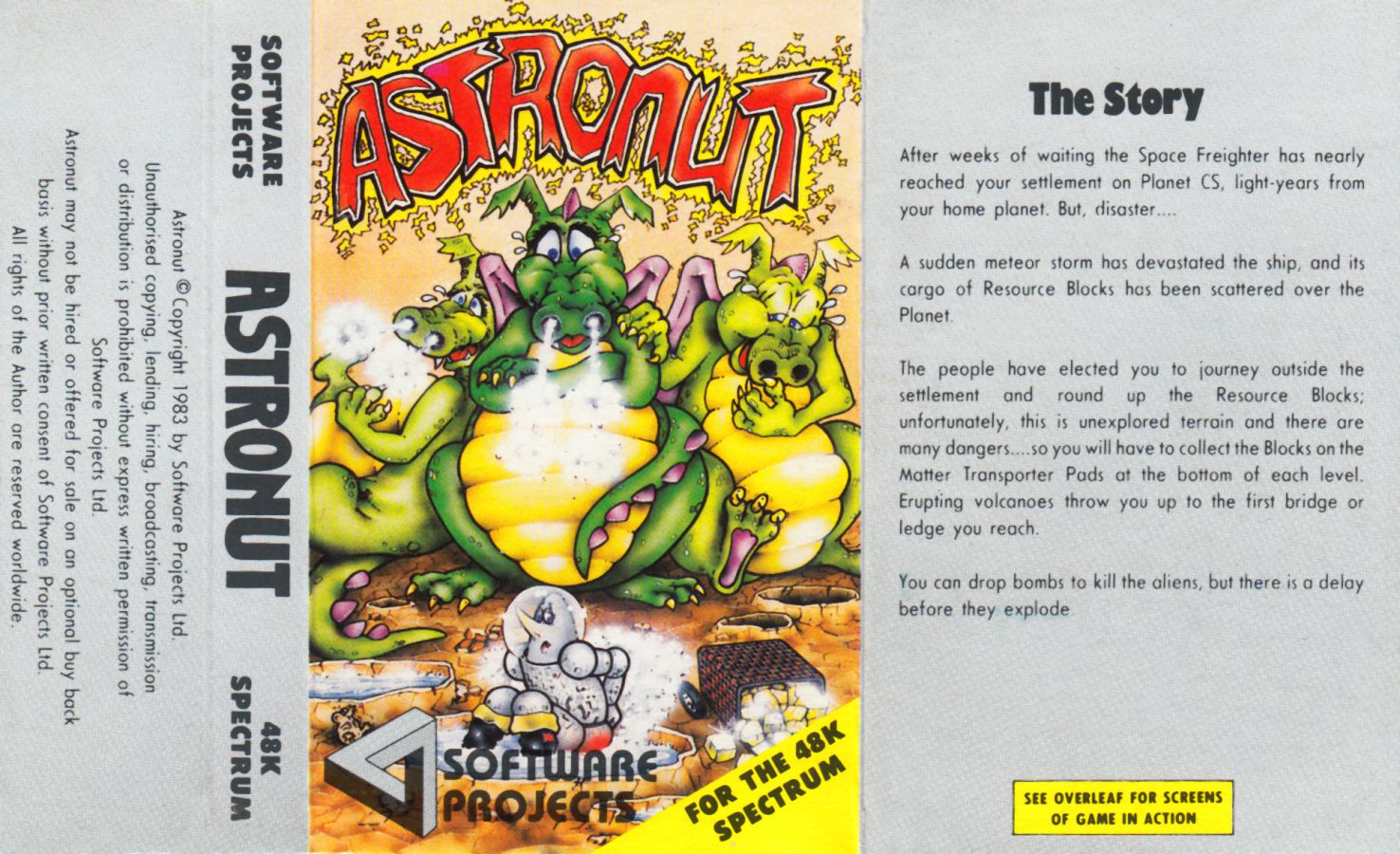
Producer: Software Projects Memory Required: 48K Retail Price: £5.95 Language: Machine code Author: Patrick Richmond Underneath one more of Software Projects lively inlay covers is a colour entry code card and THE STORY: After weeks of waiting the Space Freighter has nearly reached your settlement on Planet CS - but disaster… A sudden meteor shower has devastated the ship, and its cargo of Resource Blocks has been scattered over the planet. The people have elected you to journey outside the settlement and round up the Blocks. Unfortunately this is unexplored terrain and there are many dangers - naturally. In fact there are 15 varying screens in what is basically a novel platform game with very simple control keys. At the base there is the flashing transporter base onto which the Resource Blocks (three per screen) must be pushed. These blocks appear in awkward places on the screen and Astronut moves them by pushing against them until they fall from one level to the next one down and so on until they can be pushed onto the transporter block, at which poin the next one appears somewhere. Volcanoes or stairs automatically whisk Astronut upwards and he may jump down from any height. Various aliens waft about causing mayhem, but Astronut may leave behind bombs to destroy them, although the bombs have a time delay on them. Any of the 15 screens may be entered at the start of a game by the select menu, and each of these is quite different from any of the others, with its own distinct problems. COMMENTS Control keys: not stated anywhere, but they are Z/X left/right and ENTER to drop time bomb Joystick: Kempston Keyboard play: very simple, and responsive Use of colour: excellent Graphics: very good, varied and detailed Sound: continuous, but with on/off facility (Q) Skill levels: only 1 but each screen has a different problem Lives: 3 Screens: 15
You'll have to box clever on this one.
Personal Computer News #91Dec 1984 · p.559/109/10
Overall 9/10
Bob Chappell 9/10
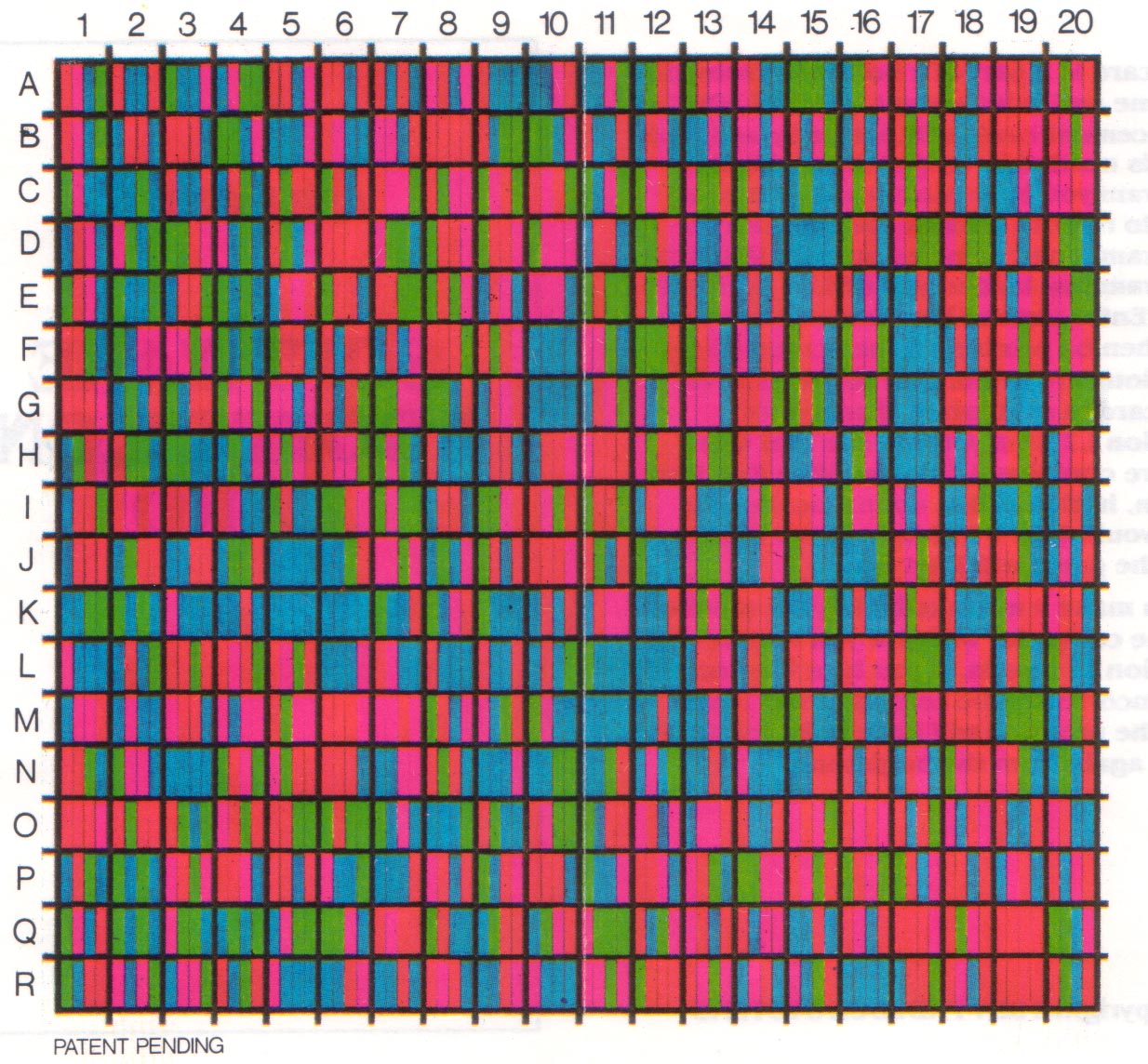
PRICE: £7.95 PUBLISHER: Software Projects [redacted] Astronut is yet another variation on the platform theme. Mind you, it took me a while to find out just what the game was about since it comes with one of those colour-grid protection cards. On loading, you are given a grid reference and must enter four colours from the card. Make two mistakes and the Spectrum resets. Is it worth this hassle? Emphatically yes - Astronut is a very good game with excellent animation. You have to move a bomb-planting astronaut around a series of platforms trying to push blocks from one ledge to another and down into a receptacle. To get to the higher ledges, you must position the astronaut over a belching volcano. At the next eruption, the astronaut is catapulted up to a higher ledge. The only thing that can hurt him are the wild assortment of weirdies. And what a collection they are: snapping clams, pulsating jellyfish, dancing flowers, nippy snails, bespectacled frogs, dangling spiders, and some of the largest, most impressive fireball spitting dragons ever to appear on your Spectrum. For me though, the best beasties were those bearing no resemblance to anything seen this side of sanity. An enormous bulbous head with boots on was one of the many loony creatures. Nutty stuff - imaginative, funny and addictive.
Your Spectrum #9Nov 1984 · p.428/10
Use of Graphics 8/10
Ross Holman
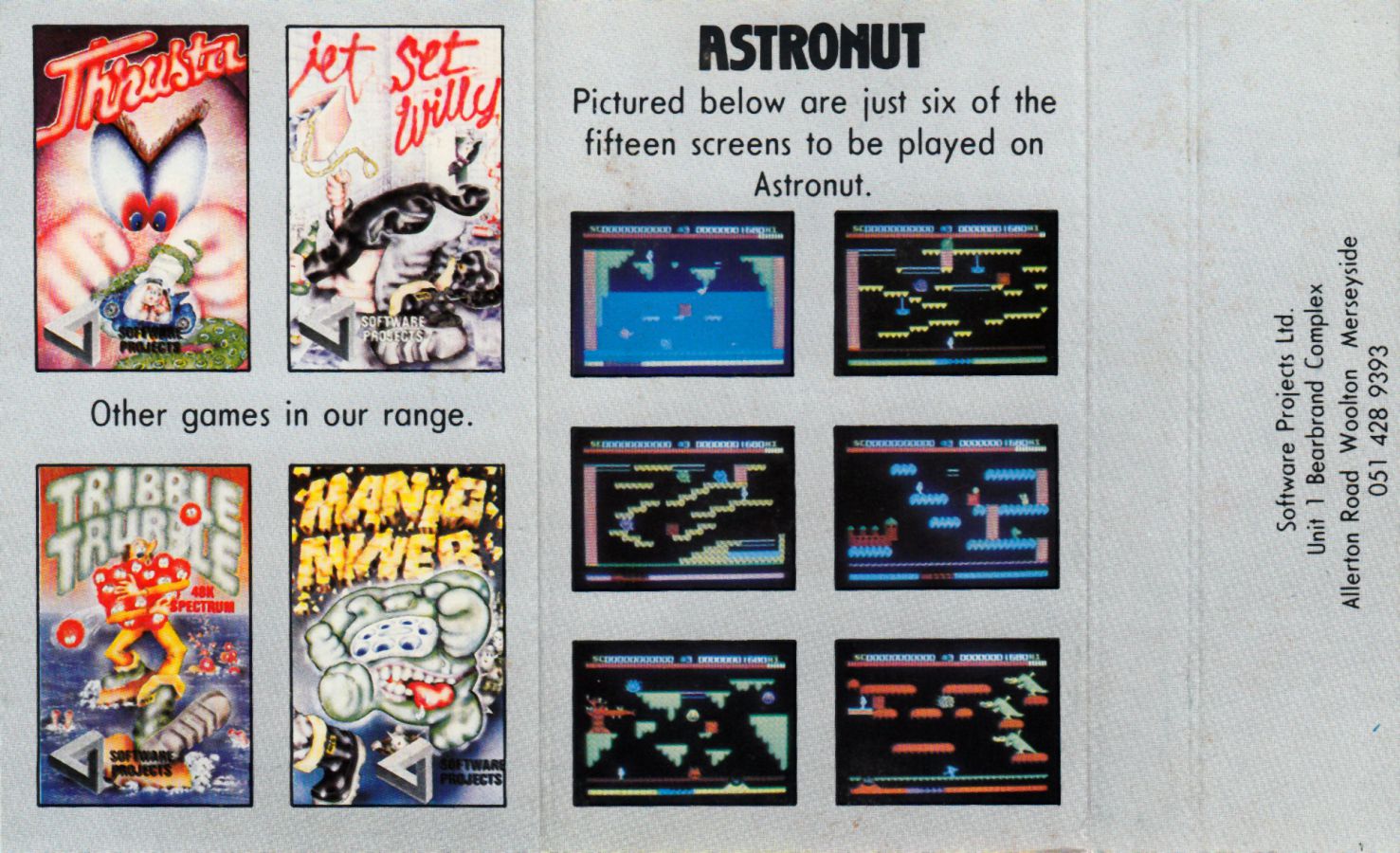
MANIC Could it be that there are too few original ideas coming out of UK software houses? Ross Holman examines three new releases - Astronut, Frank N Stein and Monty Mole - and draws the inevitable conclusion... In the current post-Manic Miner/Jet Set Willy depression, many software companies seem to be striving to emulate the success of these two games, resulting in a number of semi-clones appearing recently on the market. Of the three games reviewed here - Astronut, Frank N Stein and Monty Mole̶all - the cliched elements can be found, ie, little jumping figures, platforms, and collecting objects while avoiding the nasties. I'm sure that the companies themselves had no intention whatever of the games bearing any resemblance to other packages. But, having said that, it does seem that effort, conscious or otherwise, has been made to identify the addictive or attractive elements in already published software - such as the collection of objects, pixel graphics, colourful screens and figures leaping around a series of platforms. Throw these factors into a computerised melting pot and hope that something playable comes out. Maybe what the software houses fail to realise is that originality is a very important 'success' factor in any new package. A new version of Defender may still sell well, but too many variations on a theme and it's surely doomed to failure. Even Matthew Smith realised that Jet Set Willy had to be very different from its predecessor - just take a look at the increased size of the game, the 'move anywhere' ability and those wonderful ropes. The novelty value of a game and the comparative standard of the coding at the time of release are also important factors - most games players look back fondly to the days of the first copies of Space Invaders and the excitement generated by the first 48K arcade adventures like Time Gate, but they certainly wouldn't fork out hard cash for them today. You only have to take a time-trip back a few months to remember the furore created when Sabre Wulf was released, mainly due to its similarities to AticAtac̶ but try booting up AticAtac now and you may be surprised (I certainly was!) to discover it wasn't quite as good as you'd remembered. Producing an original game these days must be very difficult, especially as so many of the good ideas have been used. Also, it must be noted that, despite my criticism of the three games here being just a little reminiscent of others, it may well be that Matthew Smith himself had a good look at a game called Miner 2049'er before he buried himself in machine code to produce Manic Miner. The difference is, of course, that he turned a good idea into a brilliant one, with lots of original implementation based on his own ideas. It's the originality and complexity of UK software that makes it so good, and I hope we see more and more excellent material being produced for 1985. ASTRONUT Software Projects Astronut is produced by the same company responsible for Manic Miner and Jet Set Willy, although it's not billed in any way as a sequel to Matthew Smith's games. Written by Patrick Richmond, the game is attractive and colourful - but as a 'platform' game, I'm sure Software Projects are hoping that their reputation for this type of package will help this one on its way to the high street shelves. The lack of instructions both on the cassette sleeve and on-screen (at least with the copy I've got anyway), didn't actually inspire any confidence that it was a particularly polished piece of software. To start the game, you need to press the 'S' key - and the 'Q' key is used to turn off the terrible sound effect (you'll find this is probably the most useful key in the whole game!) Astronut's a game of some 15 screens; the object of the exercise on each screen is to push three resource blocks from various platforms down to ground level. You control the little two-cursor man and can move him left or right, or get him to drop bombs. To move the figure up the screen, you have to position him above a volcano and wait for it to erupt or, on the later screens, you can manoeuvre the figure up the ladders. Beware though, once you've started to climb there's no turning back. Stopping you gathering the power capsules and moving the resource blocks are, of course, many assorted meanies which have to be negotiated. There's also the problem of extending platforms, which have an annoying habit of collapsing just when you want to use them! The sprites move fairly smoothly by one or two pixels and come in the usual horizontally and vertically moving varieties; some are even more tricky and cascade back and forth along the platforms, defying gravity more often then not. The stationary graphics characters aren't your average run-of-the-mill platforms either - you may encounter dragons spitting fire and amazing castle towers - and they certainly go some way to brightening up the game. Despite the pixel movement of the sprites, our man moves by cursor block stages, although the figure is animated within each stage. Unfortunately, this, coupled with the 'attribute collision detection' routine used, sometimes causes your figure to be pronounced dead even when there's lots of clear air between you and your killer. Astronut is visually appealing, but it's too easy! Dropping bombs to protect yourself and timing the jumps to collapsing platforms do add an element of skill, but overall I didn't find it challenging enough. Each of the screens can be reached independently of the others by instructing the program to start on a specific screen - in my view, this spoils any suspense for the enthusiast. FRANK N STEIN PSS Despite the obvious enthusiasm for this game generated by the games players in the YS editorial office, Frank N Stein was the game I liked least of the three programs. The object of the game is to guide your two-cursor figure along platforms collecting the constituent parts of a Frankenstein-type monster - making it a little more complicated is the fact that all the limbs, etc, have to be collected in the correct order; head first, then torso, then hips and so on. To collect all the parts of the body, you have to walk over the dissected parts, while avoiding the various sprites that go through set patterns of movement around the screen. Again, you can move left or right, but vertical movement can only be achieved by standing over strategically placed springs and hitting the 'fire' button. Small jumps are possible, but these are sued mainly for letting one of the sprites pass underneath allowing your figure to safely carry on his macabre search. There are also an number of poles which can be used to descend from level to level. The graphics characters are mostly two-cursors, very colourful and animated fairly well, adding some welcome relief from the overall red appearance of the game. The move pixel by pixel, but they're a might bit slow - which means there are times when you're hanging around waiting for the baddies to get out of the way. This aspect is no doubt intended - especially as the game is played against the clock - but I feel that overall it detracted from the game. PSS claim Frank N Stein has 50 screens, but don't let that mislead you as there are only 26 different screens. After each 'collecting' screen, there's one that repeats; this special screen is slightly different from the rest in that the object this time is to get to the top platform while avoiding random graphics characters and rolling barrels (shade of Kong here). Planning out a route through each screen is reminiscent of Manic Miner, but it doesn't work out quite as well. If you miss the opportunity to jump for something, then very often you either die or have to hang around for the same pattern of events to repeat itself - there's not much room for you to experiment with new and original ways round each screen as more often than not, there's only one way round and that's your lot! MONTY MOLE Gremlin Graphics Monty Mole is probably the most similar to Manic Miner but there are many similarities to Quicksilva's Fred as well. This time, you get to play a mile whose graphic is on four cursors, thus avoiding any confusion that this game is based on Manic Minder. Your task is to guide the mole around a series of caverns - about 21 in all - until your eventual escape. This package received a lot of media attention a few weeks ago due to its supposed connections with the miner's strike and its inclusion of an Arthur Scargill character. How Gremlin Graphics conned the TV companies into believing this, I'll never know - I've been through the whole game and can find no real links at all with the current industrial situation. Anyway, back to the game. On the first screen you guide Monty over a river to collect a coal bucket in which to steal your coal - but the owner's not too happy about this and starts chasing you down the nearest available mine shaft. Once there, you can start collecting the twinkling pieces of coal. (For all you bug-hunters, try carrying on running towards the house and jumping just before you reach it - with any luck you'll find yourself in the coal-miner's house and he can't do a thing about it.) The caverns are, in essence, very similar to those found in Manic Miner, with platforms and graphics characters trollying along, and up and down. Ropes have also been added for Monty to climb up and down (a la Fred), and extending platforms are also used quite effectively. You'll also come to hate the Coal Crushers that appear in most screens - they are totally unpredictable, except for the fact that you can assure yourself that whenever you decide to walk under them you'll be crushed! Another nice feature is the Antics-like technique of being able to change events by dong certain things; carrying certain objects around with you makes various walls disappear when you enter the screen, allowing you to explore still more of the caverns. The program has a number of slightly off-putting characteristics which don't enhance its playability - for example: the graphics routine allows you to stand on any INKed pixel; you can get Monty actually standing in a graphic and still not have the fact that you've collected it registered; and if you die in a room having just caused a wall to disappear, that wall will appear with your new life and there's no way you can get past it! Despite all this though, I still thought Monty Mole the most challenging of the three - even though it's the most blatant clone of Matthew's Manic Miner.
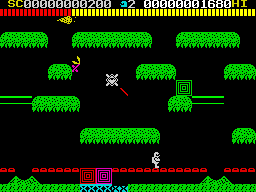
Astronut can set the odd bomb in the path of any nasties following - it'll stop 'em for a while but don't expect miracles! The next resource block is already in position once the first block has been placed in the flashing area designated for it. The idea is to get one side of the block and give it a gentle nudge in the direction you want it to fall.
Astronut nudges the first resource block into place. You have to move three of these blocks into place to get n to the next level - unless, of course, you've chosen to start on the last level first, that is! This is a pulse generator - which sends out deadly beams of energy to stop Astronut journeying round the screen.
The staircases provide a way of getting to the upper levels - trouble is that once you've started the climb there's no turning back... so make sure your path is clear before you begin. An alternative method of gaining access to the upper levels is to stop on one of the volcanoes and wait. When it blows, you get shot up to the first level above, whether it be a collapsible platform or a firm pathway.
Watch out for the moving platforms. One minute there nice and safe... the next, they've completely vanished and you've nowhere to go but down! The line at the very top of the screen is incremented and filled in as time porgresses. Needless to say, you've to complete your task on-screen before the time's up... otherwise it's back to the beginning of the screen.
You'll know where to nudge the resource blocks on each screen as an area of the bottom of the screen will flash on and off until it's filled. You can fall as far as you like in Astronut without coming to grief. Trouble is, falling can sometimes land you in more trouble than you bargained for... Some of the platforms comprise some very interesting graphics - take this tree for example. The graphics in Astronut are certainly a sight for sore eyes.
Advert3
- Big K #6Sep 1984 · p.56
- C&VG (Computer & Video Games) #35Sep 1984 · p.4
- Personal Computer Games #10Sep 1984 · p.2
Hack/Poke2
- Crash #27Apr 1986 · p.15
- Your Spectrum #9Nov 1984 · p.47
Review1
- Home Computing Weekly #91Dec 1984 · p.22
Full-page ad1
- Personal Computer Games #12Nov 1984 · p.88
Feature1
- Your Spectrum #9Nov 1984 · p.42
Related
Reviews from people here
Sign in to write about this, or make an account. It takes a minute and lets you correct the catalogue too.
No description recorded.
Sign in to correct or add to this.
Hold the rights to this and want it taken down?