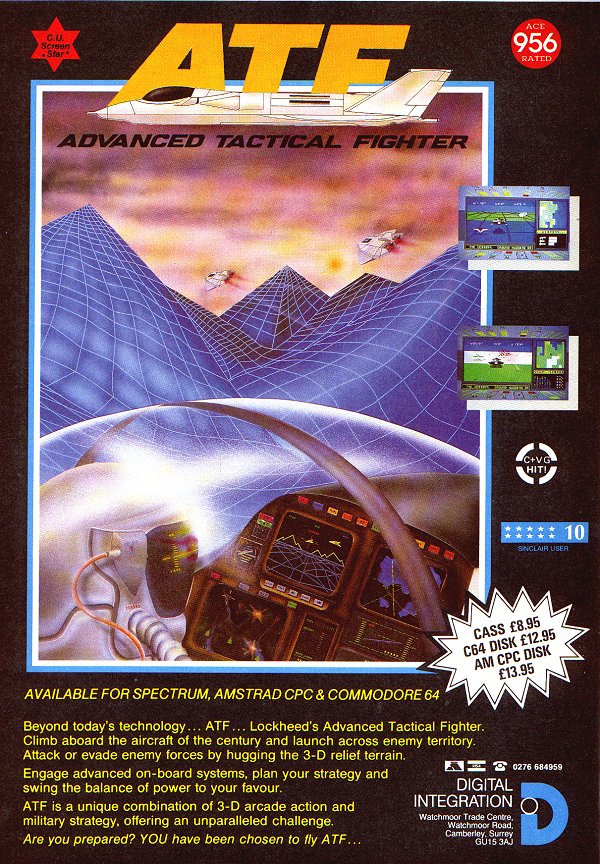
ATF
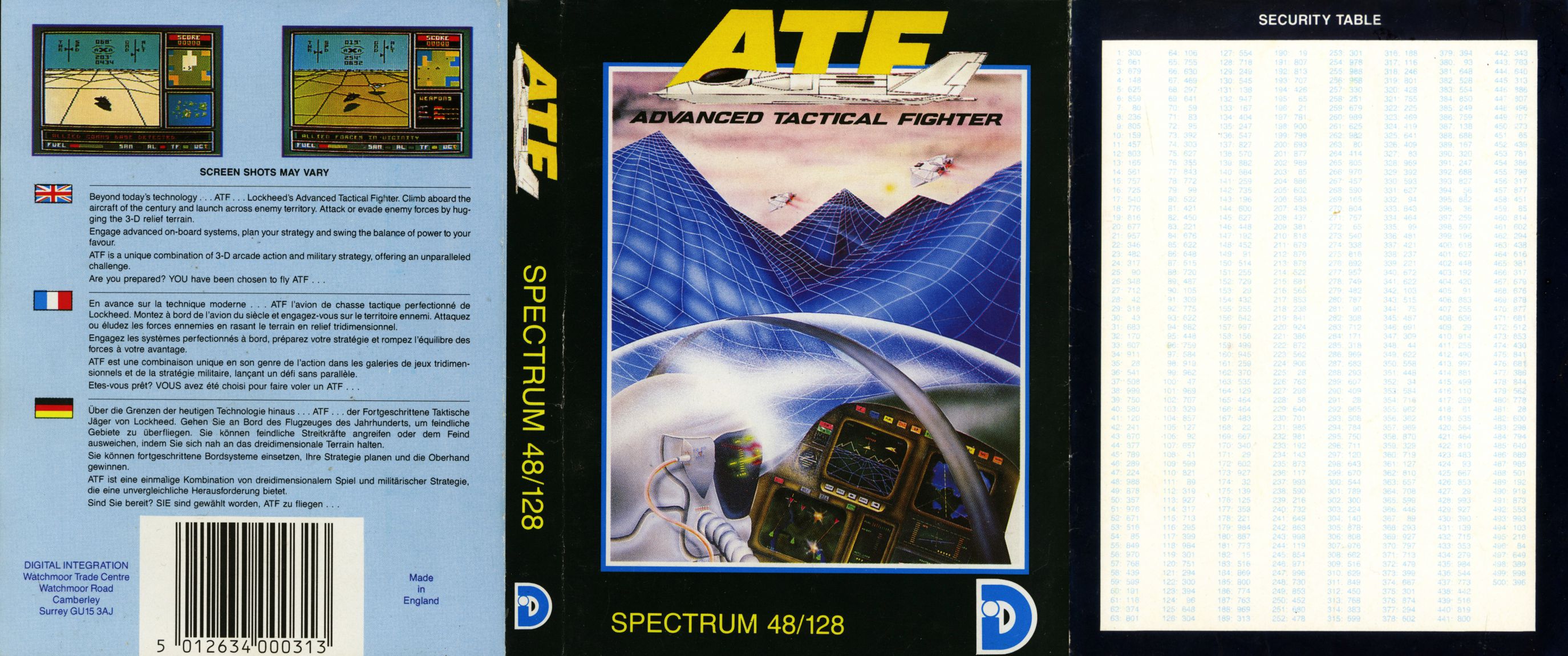
Game: Simulation · ZX-Spectrum 48K/128K · 1 players · English
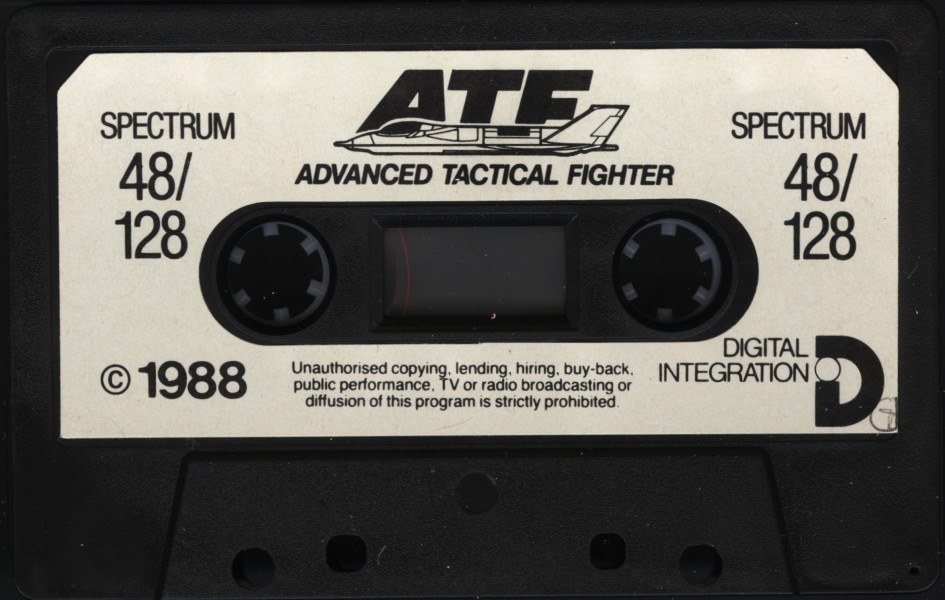
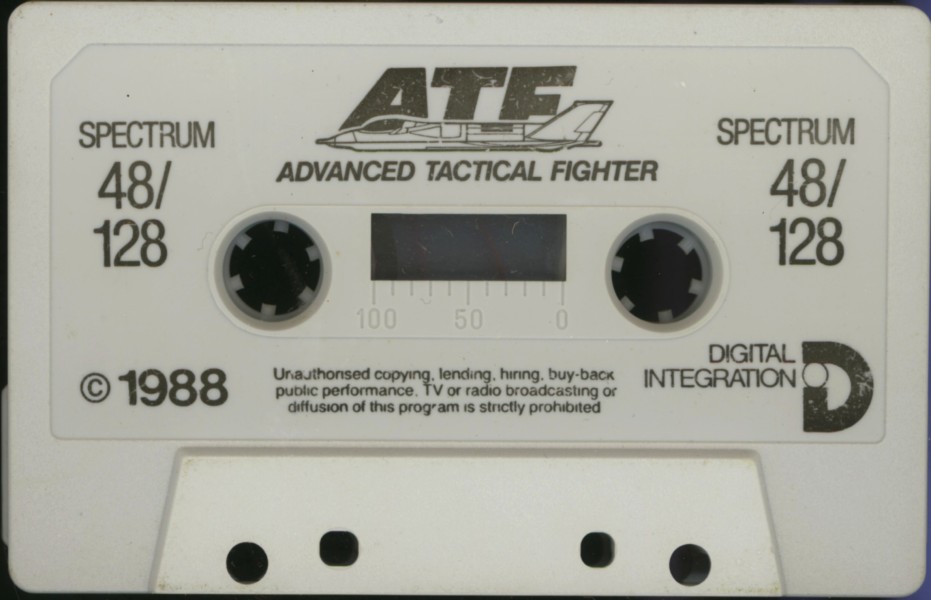
Digital Integration · Feb 1988 · Pound sterling 8.95
Also known as Advanced Tactical Fighter (English)
.jpg)
.jpg)
_2.jpg)
Discussion
Nobody has started a thread about this yet.
- Control Option
- Interface 2 (right), Kempston Joystick
Releases
- Feb 1988Digital Integration Sold as Advanced Tactical FighterPound sterling 8.95
- 1988Byte Back
- 1988Zafiro Software DivisionSpanish peseta 1200.00
Play
- ATF.dsk.zipDisk image English43 KB
- ATF(ZafiroSoftwareDivision).dsk.zipDisk image English43 KB
- ATF.z80.zipSnapshot image English35 KB
- ATF.tzx.zipTape image English35 KB
- ATF(ByteBack).tzx.zipTape image English32 KB
- ATF(ZafiroSoftwareDivision).tzx.zipTape image English35 KB
Documents
- ATF.txtInstructions English4 KB
- ATF(ZafiroSoftwareDivision).pdfInstructions Spanish34 KB
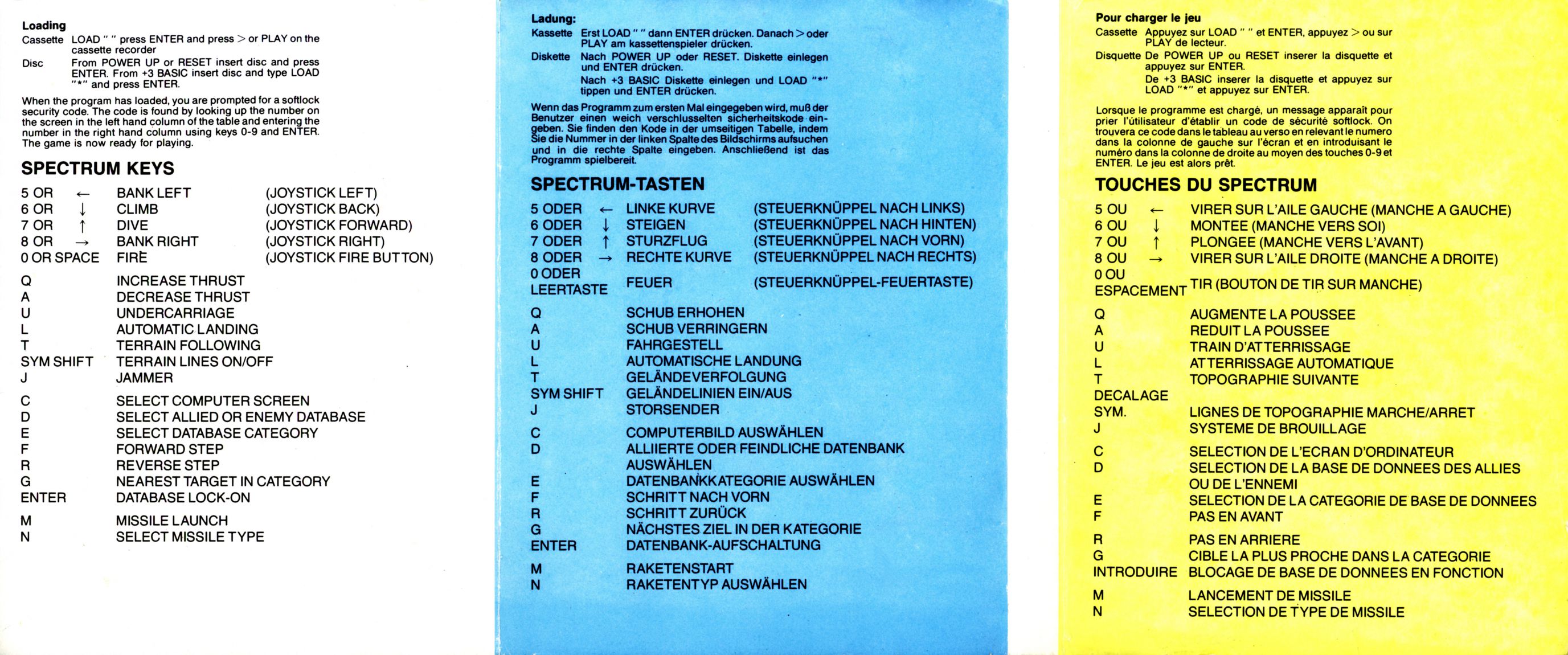
- ATF(MULTI-LANG).pdfInstructions Multi-language: English, French, German680 KB
Music
- ATF.mid.zipRecreated in-game/theme music in MIDI format 1 KB
- ATF.ay.zipRipped in-game/theme music in AY format 3 KB
- ATF.mp3.zipSampled in-game/theme music in MP3 format 1,404 KB
Other files
- ATF (1988)(Digital Integration).pokPOK pokes file 1 KB
Files and rights
Distribution permission is on record, granted to another archive rather than to this one. Screens and pictures are copied here; everything else links to the archive that holds it.
- AllowedDigital Integration → WorldOfSpectrum
Credits
- Ian Beynoncredited
- Kevin J. Bezantcredited
Sign in to credit somebody, or say what these people did.
Scores
In the magazines
- Sinclair User #721988 · Overall10/10
- Your Sinclair #281988 · Overall8/10
- Crash #501988 · Overall89%
- ACE (Advanced Computer Entertainment) #71988 · Ace Rating956/1000
- Your Sinclair #581990 · Overall70%
Elsewhere on the web
- WorldOfSpectrum 74 votes8.19
In the magazines 37
Your Sinclair #58Oct 1990 · p.2777%54%75%61%70%70%
The View 77%
Realism 54%
Dakka Factor 75%
Net Weight 61%
Overall 70%
Jonathan Davies 70%
THE COMPLETE YS GUIDE TO FLIGHT SIMS Oh cripes. Whose idea was this? Couldn't we do it on something else? Nah, we promised. How about putting if off for another month? Or we could make JONATHAN DAVIS do it? Heh heh. Right, where's he got to? Ah ha! Neeeeeow! Dakka dakka dakka! Kaboom! "Crikey, Ginger, pull up! Over." "I can't! I think my flaps have gone a bit funny. Over." Neeeow! Boom! "Bail out! Bail out! Over." Dakka dakka dakka. (Ricochet noises.) "Er, okay then. Over and out." Sorry about that, just trying to inject a bit of excitement into this thing because, let's face it, flight sims aren't exactly the most exciting bits of software around. Or are they? No, They're not. But there are loads of them about, and people keep buying them. Why is this? Perhaps we'd better investigate. For thousands of years man has dreamt of flight... (Cut the crap, Ed) Erm, well, perhaps it's because they demand a bit more thought than your average arcade game. Fast reactions are all very well, but what about using your noddle occasionally? Keeping a plane in flight isn't just a matter of wobbling your joystick about a bit, which is the impression that lesser games give. You've got angles of attack to worry about, altitude, navigation, weapons systems, undercarriage... the list is endless. As are the manuals usually. And that's another thing. If you've never played one before you'll need to spend hours wading through one of these breeze-block tomes before you can even get off the ground. Once you've got the thing up in the air though you're well away. With any luck there'll be lots of scenery to look at and plenty of enemy thingies to 'take out'. You might even like to indulge in a bit of aerobatics to pass the time. The one thing you should always keep an eye on though is the ground. Stay away from this at all costs. Unless you're landing, of course, which is another story altogether. SO WHAT'S A FLIGHT SIM THEN, EH? In compiling this guide I was faced with the usual problem - what exactly is a flight simulation? What are the criteria? Where do you draw the line? I decided to seek the advice of one of Europe's leading experts in the field of computer games. "Er, Matt? (Cough.) Matt?' I ventured. "Mmm?" "Would you have said that, say, Fighter Pilot was a flight sim? Huh? Matt?" I enquired cheerily. "Er, probably," he replied. "How about Harrier Attack?" "I expect it is, yes." "Or Night Raider?" "Um, look, I've got to go out. To the, er, shops. I'll see you later. Maybe." Unperturbed. I decided to try Andy, but he didn't appear to hear me. I also tried ringing up a few friends. They all seemed to be out. So it's all down to me then. Well, I reckon that really, in a flight sim, you ought to be in control of a plane of some sort. Ideally you'd get a 3D view out of the cockpit, but I'll be flexible and allow ones where you see the plane on the screen from the back (like ATF) and even ones where you see the view in 2D (from the top or something). Another important guideline is the number of keys. Preferably there should be at least 2,452 of them, each with about three different functions. But, again, I'll allow a generous margin of error and set the bottom line at six. And finally there's the manual. Obviously this should be as large and impenetrable as possible, with lots of incomprehensible acronyms that you have to keep looking up in the glossary at the back. A rough guide to length? Let's say 500-600 pages for a decent one or, if the game comes in an ordinary cassette box, an inlay card that folds out into a thin strip long enough to wrap round Matt's tummy at least two and a half times. So now we know just what makes up a flight sim, let's take a look at a few… RATINGS Once again, the normally-so-versatile YS rating system doesn't really seem too appropriate here (Instant appeal? Addictiveness?). So what we've done is to come up with a revised system, specially tailored to meet the needs of today's flight sim. Let's have a nosey... The View: Can you see anything nice out of the window? Or is it all just green and blue wiggly lines? And does the scenery glide around smoothly or jerk around like an Allegro with a dodgy clutch? Realism: This can often be determined by the number of keys the game uses. So that's just what we've done. Counted 'em. As there are 40 keys on your basic Speccy, and each one can be doubled or even tripled up, the maximum comes out to exactly 100. Handy, eh? Dakka Factor: Is there much to shoot? Or is it all a matter of map-reading, gauge-watching and other such nonsense? And once you've shot whatever it is, does it explode dramatically and plummet to the ground leaving a trail of smoke behind it? Or not? Net Weight: A crucial part of any flight sim is all the junk that comes with it. So, adding together all the disks, maps, manuals, stickers and the box, what do the YS scales make of it? (All weights are, of course, approximate.) (In degrees.) THE CHEAPO SIDE OF THINGS You've got to give them credit - the budget people'll have a crack at anything. And flight sims are no exception. A full-pricey can take anything up to 18 months and a massive team of highly-trained programmers to develop, so what does your average beer-swilling cheapo programmer manage to come up with in the two weeks (evenings only) he's allotted? Let's brace ourselves and take a look. ATF Digital Integration Here's the first one of these looking-at-it-from-behind ones, and it's easily the best of its type around. You're in one of these Stealth Plane things, but, spookily enough, you actually get to see it on the screen in front of you, with the landscape undulating underneath. Hills and dippy bits are shown by grid line thingies which bend around. The trouble is that you can only do left and right turns and go up and down a bit - no rolls or loops. In fact, you don't even have to do this half the tine as you can switch on your terrain-following radar and let the plane do it for you. Opposition is provided by planes which swoop around you, hopefully flying straight into your line of fire. (They invariably do.) It's not the most stimulating game around combat-wise then, but underneath all this blatant aracdeyness lurks a strong strategic element where you've got to destroy certain targets and eventually win a war. All this happens over a huge map - lots of islands with sea between them. ATF isn't really a flight sim at all, but it's pretty good fun (for a while) all the same.
World map? Come on, lads, we're not going as fast as that!
EVERY FLIGHT SIM EVER (IN THE WORLD)* *(near enough) Ace - Cascade Ace II - Cascade Ace Of Aces - US Gold Acrojet - US Gold Airliner - Protek ATF - Digital Integration Biggies - Mirrorsoft Chuck Yeager's Advanced Flight Trainer - Electronic Arts Combat Lynx - Durell Dambusters - US Gold Delta Wing - Creative Sparks Deep Strike - Durell F-15 Strike Eagle - MicroProse Flight Path 737 - Anirog Fighter Bomber - Activision Fighter Pilot - Digital Integration Flight Simulation - Psion Flyer Fox - Bug Byte Gee Bee Air Rally - Activision Gunship - MicroProse Nightflight - Hewson Nightflight II - Hewson Night Raider - Gremlin Project Stealth Fighter - MicroProse Red Arrows - Database Software Skyfox - Ariolasoft Space Shuttle - Microdeal Spitfire 40 - Mirrorsoft Strike Attack - Micro Mart Strike Force Harrier - Mirrorsoft Top Gun - Ocean
GAMES THAT AREN'T FLIGHT SIMS, BUT MIGHT JUST WELL HAVE BEEN Caesar The Cat - Mirrorsoft Mr Wong's Loop Laundry - Artic ZX Tool Kit - Star Dreams
GAMES THAT MOST DEFINITELY AREN'T FLIGHT SIMS Beaky And The Egg Snatchers - Fantasy Blue Max - US Gold Harrier Attack - Durell Heathrow Air Traffic Control - Hewson Monty Python's Flying Circus - Virgin Night Gunner - Digital Integration P47 - Firebird Scramble Spirits - Grandslam Spitfire - Encore TLL - Vortex
LOOKING-AT-IT-FROM-BEHIND ONES These ones are really the next step down from the True Flight Sim. They're essentially the same, except that instead of a view out of the cockpit you get a view of the back of your plane. This isn't quite as pointless as it sounds, because usually the plane is small enough so that you can see past it to the 'scenery' beyond. This type of view generally makes it easier to judge landings and to see if you're about to fly into anything, but there is often a corresponding reduction in the number of knobs and dials, and an increase in things to do. Not what we want at all. ATF is the perfect example of this sort of thing. "Chuck Yeager. (Well, he sort of belongs in this box.)"
LOOKING-AT-IT-FROM-JUST-ABOUT-ANYWHERE ONES Now these really are the business. They're like a cross between the True Flight Sim and the Looking-At-It-From-Behind one, with lots more as well. In fact, what you can do is look at your plane from all sorts of different angles, including weird ones like from-the-ground and from-the-front-of-the-plane. To tell the truth, games like this are a bit scarce on the Speccy (they tend to flourish on posh computers like the Atari ST) but there are one or two good ones. Chuck Yeager is a notable example, as is Fighter Bomber.
LOOKING-AT-IT-FROM-THE-SIDE ONES Now we're looking at things like Harrier Attack And they're certainly not flight sims. In fact, they're usually just scrolling shoot-'em-ups with planes instead of spaceships. There's always plenty of stuff to shoot, but technical accuracy is very limited indeed. You never have to worry about setting your flaps at the right angle or the navigational computer to the appropriate beacon, or watching your airspeed in case you stall. Useless. "Harrier Attack - definitely not a flight simulator. (Clear now?)"
LOOKING-AT-IT-FROM-THE-TOP ONES Now we're in dicey territory. We're talking about things like TLL here. Quite frankly, they're not really, are they? Flight sims, I mean. They've rarely got more than four or five keys, placing them firmly on the arcade side of things. So let's pass over them.
SO, YOU WANT TO WRITE A FLIGHT SIM? Er, are you sure? Stick your tongue out. Hmm. Say "Ahh". Crikey. Okay, let's take a look at some essential ingredients... THE SETTING Flight sims are always set in a spooky 'alternative' world where the sky is always blue and the grass is always green (and so is just about everything else for that matter). Other vegetation is pretty sparse, apart from triangles on sticks which look a bit like trees. These are usually about 600 ft high (if your altimeter is anything to go by). The only buildings tend to be in a modernist cereal packet style, with no-one living in them. Mountains are handy for flying into. KNOBS AND DIALS There should be a ridiculous number of these, all of which are unmarked and of no obvious use. If they start reading 'zero', eject. There should also be little red lights which start flashing and making a beeping noise for no apparent reason. They only stop when you press every key on the keyboard very hard, at which point the plane crashes. THE MAP Any relation to a normal map should be avoided. Flight sim maps consist of a large and (usually green-on-yellow, or something else that's probably outlawed by EEC legislation) covered in little splotches. Quite what these are isn't entirely clear. Somewhere in the middle is a flashing square - you. This never seems to move, no matter how long you look. Meanwhile, back in the cockpit, your plane has just been shot down. THE CONTROLS As previously explained, there should be as many as possible, and then lots more on top of that. They should all have obvious purposes (eg P for throttle up, K for map, Symbol Shift, Caps Shift and 3 for left etc). There should also be a disconcerting delay (say, five minutes) between pressing a key and anything happening. The need for constant reference to the manual can easily be incorporated, during which time the plane flies into a tree. SOUND Don't put any in. Apart from the 'crash effect', of course. THE ENEMY Somewhere on the screen there should be a radar with a little flashing dot on it. This is the enemy aircraft. The player will turn to face it, prime the air-to-air missiles and wait for the two aircraft to meet. This, of course, never happens. After a certain length of time the player will get bored, engage the autopilot and nip out to put the kettle on. His plane then gets shot down. LANDING As you'll no doubt be aware, this is impossible. Real F-15s and things land perfectly first time, every time. But not simulated ones. You get them lined up exactly, set the speed rate of descent and everything exactly according to the instructions, flaps and undercarriage down, set it down oh-so-gently and... kaboom. PLAYTESTING Once the game's nearing completion you'll have to thoroughly test it. Sit yourself down in front of it and ask someone to come and check up on you after an hour or so. If you're still awake the game is obviously in need of modification.
THE 'TRUE' FLIGHT SIM The obvious example of one of these is the original Flight Simulation, but that was pretty crap. What we're basically talking about here is the sort where you're placed in the cockpit looking out of the window in the bottom half of the screen (or, worse, on another screen altogether) is the instrument panel, which can generally be ignored, and in the top half is the view. This is generally green on the bottom and blue on the top. If it's the other way round you're probably in trouble. Scattered about will be lots of squiggly lines, and maybe a few dots on the ground to give the impression of 'speed' (ahem). "Night Raider - not of the best but it'll do."
THE A-Z OF FLYING TERMS Ammo: A Latin verb. Being Tail Gunner: Going to the loo. Chocks Away: Someone's pinched your lunch. Dogfight: These are illegal. Eject: If in doubt... Flaps: Do lots of these if the propeller stops going round. Ground: The main hazard faced by most pilots. Heading: See Football Guide, YS Issue 54. Instruments: In-flight entertainment. Joystick: Long thing between your legs with a red bit on the end. Kippers: Probably the nickname of a World War 1 pilot. Landing: The bit at the top of the stairs. Mae West: Something pilots like to keep handy. Normandy: A nice place to go on holiday. Orange: If you paint your 'crate' this colour you'll probably get shot down. Piece Of Cake: Dreadful drama series about planes on telly. Quebec: Keep an eye on the map if you don't want to end up here. Roger: (Er, do S. Ed) Six O'Clock: Tea-time. Take Off: Spoof or parody. Undercarriage: See Joystick. V-Formation: Give one of these to the enemy as you fly by. Wings: Something to do with Paul McCartney. X-Ray: You're meant to say this over the radio quite often. Yellow: See Orange.
THE FIRST FLIGHT SIM EVER Ha. This one's easy. It was Flight Simulation, one of the first games that ever came out on the Speccy. It was also the first game I bought. (Aargh! The secret's out.) It was one of those Psion games which came out on Sinclair's own label, and despite the mind-numbingly tedious piccy on the box (the instrument panel of a plane) it hung around near the top of the charts for years. In actual fact, Flight Simulation is a conversion of a ZX81 game of the same name. Yikes. We'll take a closer look at this one later on.
Your Sinclair #28Apr 1988 · p.448/108/107/108/108/108/10
Graphics 8/10
Playability 8/10
Value For Money 7/10
Addictiveness 8/10
Overall 8/10
Jonathan Davies 8/10
Digital Integration £8.95 Reviewer: Jonathan Davies It's so well camouflaged, it takes the pilot three hours to find it every morning! it's so secret, even the Americans don't know it exists, and they built it! But DI do, and they've chosen it as the subject of their latest wacko simulation - Advanced Tactical Fighter. As usual, you're the pilot and it's your job to make sure We win and They don't. The battle is taking place on a global scale, and you can whizz around the continents wiping out the enemy's positions, so your guys can move in and take over. Major targets include factories, land and sea forces and bases, all of which affect Their performance. For a change, in ATF you actually see your plane on the screen in front of you, skimming along, twelve pixels off the ground. The 3D landscape scrolls past at an enormous speed, and you'll be grateful for the terrain-following radar which should prevent any arguments with hills. The hardware at your disposal consists of the normal machine gun and two types of missile, one automatically guided by your on-board computer. As well as coping with the hosts of enemy interceptors which swarm around you, you'll also have to deal with SAMs, which luckily are easily jammed. Even if you've been bored with flight alms in the past, ATF may well be worth a look. Flying controls are minimal, leaving your hands free for downing baddies and generally enjoying the flight. There is even a choice of skill levels for real namby pambies, and landing's automatic too. What more could you ask for? However, all good things must come to an end, (even this review eventually!) and if you don't watch out, you'll find your aircraft getting more and more knackered as the bullets and missiles pile into it. Sooner or later it gives up the ghost completely and you're just another statistic. (Moving, huh?) The only real snag with this one is that it all gets a bit samey after a while. Fortunately you can then move up a gear, as ATF, unusually for this sort of game, also has a distinct strategy feel - with the 8 billion page manual to boot (Oi! Shouldn't we be doing this one then? O & A). There's a massive task ahead of you, and the incentive to finish it should keep you going for some time. A year of design and programming has gone into ATF, and it shows. If not quite as revolutionary as previous DI efforts, it's still a worthy release.
C&VG (Computer & Video Games) #78Apr 1988 · p.186/104/107/107/10
Graphics 6/10
Sound 4/10
Value 7/10
Playability 7/10
Tim Metcalfe
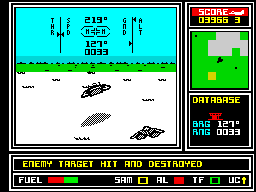
MACHINES: Spectrum/C64/Amstrad SUPPLIER: Digital Integration PRICE: £8.95 (tape), £12.95 (C64/Spec disc), £13.95 (Ams disc) VERSION TESTED: Spectrum Digital Integration take to the air again after toying in winter sports with the brilliant Bobsleigh simulation. Sad to say that ATF isn't one of DI's best releases, although it does offer a depth of play missing from many full-price games. It's just that we've come to expect more from the company who created Tomahawk and TT Racer. ATF is basically a shoot 'em up with some clever frills - not one of out and out flight-simulations that have made DI's name. The reason could be that the game is based on a jet fighter that won't fly until 1990! In reality the ATF is planned as the most technologically advanced aircraft ever built. It is being developed for the US Airforce by Lockheed, Boeing and General Dynamics. It will have an electronic co-pilot designed to take away many of the more mundane tasks currently performed by the pilot. The game attempts to simulate this electronic gizmo - but this means you have to spend as much time hitting the keyboard as flying with the joystick. Many of the controls are keyboard based. For example you have to select and fire missiles, access your onboard data-base and jam enemy missiles using the keyboard. Fortunately there is a sort of "automatic" pilot which, if engaged, guides your ATF over the terrain at an optimum height, avoiding natural hazards - you still have to deal with the man-made ones. The object of the game is to defend allied forces and installations against the enemy, maintaining the balance of power and maybe defeating them totally. At the beginning of each mission you can call up a war report which shows how the allies are doing against the baddies. You use this to select which targets you want to aim for. For example, if the enemy has established more bases than the allies it might be a good idea to take a few out, or perhaps they have suddenly overtaken your bosses in the communications stakes - then it's time to zap a few satellite stations. The war report will show gains and loses, the status of allied and enemy forces plus intelligence reports which may help you decide on your strategy. Remember you'll always need a base to land and refuel at - so protect them well. Good targets to aim for are communications centres and factories. Knock out communications and enemy forces won't be able to find out about your movements so quickly. Destroy factories and the replacement of war-machines will slow down. The same applies to the allies - so watch the gains and losses closely. Once you are airbourne this information is not available but land at a friendly base and you can call it up between flights, as well as being able to re-arm your ATF. Re-arming and refuelling is a simple joystick controlled action and is carried out at the start of each game, after one of your ATFs has been destroyed or when you land at a friendly base. You have a choice of weaponry - machine-guns and two sorts of missiles. There is a weight limit - so you have to select the right sort of firepower for the strategy you intend to follow. The cannons are used to un-down enemy interceptor aircraft while the missiles are good for ground targets. ASRAAM missiles can be guided via the joystick while they are in visual range - a fiddly business. Maverick missiles - the most powerful type much loved by the pilots in Top Gun - are computer controlled. You can lock them on to a target displayed on your on-board database and fire. They have a longer range than the ASRAAMs and I found them a lot easier to use. Once you've loaded up with weapons, it's time to fly into the dangerzone. The main display shows you a view of the ATF, plus a heads-up readout. Unlike other DI games you don't find yourself actually "in" the cockpit of the jet fighter, you see it sitting in front of you on the landing strip. The heads-up display shows thrust, speed, altitude and ground height - useful when you are indulging in a bit of high speed low flying under enemy radar. This display also shows you your current heading plus the bearing and range of any target currently selected in your on-board database, more about this later. At the bottom of the main display you see your fuel level, SAM missile warning light, automatic landing mode and terrain following mode indicators plus undercarriage status. Immediately above this is the in-flight message window. This tells you things relevant to enemy targets and incoming missiles - if you've managed to jam them or not! - while you are airborne. Bottom right of the screen you'll see a window which displays information from your onboard computer. You can call up a world map, weapon status, ATF status and the all important database. The world map shows you where you are and the position of the object currently selected in the database; the weapon status shows you just what's left to blast away with; the ATF status is really a damage report; the database is possibly the most important bit of kit you've got on board and deserves a longer explanation - so here goes. Once you've selected the database screen you can call up enemy or allied database mode using the D key. The allied database mode is useful for finding friendly bases to land at. Enemy database mode allows you to find and lock on to targets. There are five categories in each mode - dealing with bases, factories, communications, ground and sea forces. Key G will select the nearest target to the ATF but you can pick your own using the bearing and range co-ordinates shown on the database. Match these with your HUD and you're on the way to a kill. To enable you to react quickly to in-flight messages there is a database lock on key. For example, if you get a "enemy target" message, you can hit the lock-on key and the targets range and bearing is instantly displayed. All this without having to be in database mode. Above the computer screen is a short range scanner. This shows you instant info about your immediate surroundings. Interceptors appear as flashing dots, ground installations as steady dots. A new world is generated for each game and consists of sea, islands and polar regions. The islands consist of beach and scrubland. You can choose to see them as "computerised" terrain relief lines or "real" terrain with bushes and such like. I preferred the "computerised" style of graphics. The world "wraps around" - if you fly off one "edge" you end up on the other side. Useful to know if you are tracking enemy targets and want to calculate the shortest route. Each of the allied bases is surrounded by a catchment area. As soon as you enter one of these, the automatic landing indicator starts flashing. If you want to land you can hit the L key and you'll be guided gently down to the landing strip to refuel and re-arm.
ACE (Advanced Computer Entertainment) #7Apr 1988 · p.549/106/106/108/10956/1000956/1000
ACE (Advanced Computer Entertainment)
Graphics 9/10
Audio 6/10
IQ Factor 6/10
Fun Factor 8/10
Ace Rating 956/1000
Andy Wilton 956/1000
Digital Integration fly out. Lockheed fans must be having a fine old time of it just at the moment: scarcely have MicroProse got their F-19 game Project Stealth Fighter airborne when Digital Integration wheel this one out of the hangar. Based on the Advanced Tactical Fighter, the F-19's stealthy successor, the game's something of a departure for DI. Rather than producing another simulation in the mould of Tomahawk or Fighter Pilot, this time DI have gone for some very arcade-ish blasting action - combined with the strategic depth you'd more normally associate with them. The move away from slavish simulation takes you out of the cockpit so that you view your plane from above and behind. The viewpoint is fixed so that the horizon stays level no matter how you climb, dive or bank and is far enough back that you can see enemy interceptors on your tail. Aside from the joystick your only aircraft controls are the keys for throttle, undercarriage up or down, and two very handy auto-pilot modes. The first of these, terrain-following, makes landscape hugging a cinch while the second lands your plane automatically for you. Once you've got the hang of flying - steer, dodge opposing fire and don't fly too fast at low level - you're ready for the game's real guts: combat. The wrap-around game 'world' of sea, snow, beaches and scrubland is the setting for a full-scale war, your task being quite simply to swing the odds in your own side's favour. You won't be given mission objectives: you'll have to work out priorities from intelligence reports and your own sightings, arm up appropriately and get stuck in. Once you've loaded up with cannon shells for air-to-air combat, ASRAAM and Maverick missiles for surface targets and fuel to get you there, you can home in on a suitable foe taking your bearings from your onboard computer. Enemy interceptors will harass you along the way, pouncing on you from behind or bearing down on you from dead ahead, guns blazing. Cannon shells will finish them off nicely, but being of little strategic value interceptors are often best simply avoided. Your real targets are the enemy's ground and sea forces, air bases, communications centres and - most important of all - the factories he depends on to replace his losses. Once you're within 100 km or so of one of these you can let fly with a Maverick: they home in of their own accord, and can usually do the job without your ever actually seeing the target. If you've loaded up with ASRAAMs instead you'll have to close in until you can see the target, and then guide the missile in manually. This means a greater cost in fuel and (to start with) an awful lot of misses, but since they weigh far less ASRAAMS can be an attractive choice for short range heavy-duty missions. As you gain in experience you'll soon find that, even on the lowest of the game's eight levels of difficulty, you can't defeat the enemy simply by destroying the targets intelligence reports tell you about. The only way to make real progress in the game is to fly into known enemy hotspots - you can pinpoint these on the map before each sortie - and find the targets yourself. The onboard computer will inform you of enemy installations or forces as you approach them, and you can then proceed as before. Interceptor shots will decrease your engine power and damage other systems until you're forced to land for repairs or brought down altogether, but they aren't the only hazard. SAMs (Surlace-to-Air Missiles) will wreck you outright if you don't hit the jammer key in time, and since losing three planes ends the game regardless of the way the ground war's going it's vital that you stay alert. Though the size of the task is limited - the game world is always the same size whatever level you play on - the initial disadvantage you start at steps up from nothing on Rookie to drastic on the ATF Ace setting, giving plenty of lasting interest. It's got the same instant addiction and strategic depth of Durrell's old Combat Lynx wedded to state of the art graphics: very playable stuff! Reviewer: Andy Wilton RELEASE BOX Spec, £8.95cs, £12.95dk, Out Now C64/128, £8.95cs, £13.95dk, Imminent Amstrad, £8.95cs, £12.95dk, Imminent Predicted Interest Curve 1 min: 75/100 1 hour: 90/100 1 day: 90/100 1 week: 80/100 1 month: 70/100 1 year: 30/100
A bar graph shows the balance of power.
Arming up with Maverick homing missiles.
Out over the sea, flying past an enemy warship. Time to turn and strafe it?
Ready for take-off!
The state of the war, on Rookie level; you're purple, allied forces are green and the enemy's red.
There are enemy tanks 139km away - almost in range - but there's a fighter on your tail!
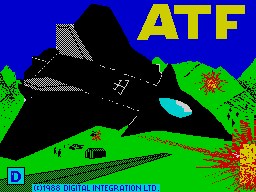
SPECTRUM VERSION The landscape rushes beneath you very impressively indeed, the ground targets are well-drawn and the 128K sound is spot on. A great all-rounder then, and a good move for DI.
Crash #50Mar 1988 · p.1787%92%85%85%89%96%85%85%
Presentation 87%
Graphics 92%
Playability 85%
Addictive Qualities 85%
Overall 89%
Bym Welthy 96%
Nathan Jones 85%
Paul Sumner 85%
Producer: Digital Integration Retail Price: £8.95 Author: Ian Beynon, Neil Coxhead and Kevin Bezant Lockheed's Advanced Tactical Fighter isn't even in production yet, and its already being acclaimed as the fighter of the next decade. So Digital Integration hits the runway yet again in its search for the simulated 'real thing' with a 3-D arcade/simulation game, ATF. Your ATF is at the forefront of futuristic technocombat when two factions go to war in a nameless 'world' of islands (a new world is generated for each game). Your attacks can destroy opposition land and sea forces and devastate their morale, disrupt their communications, destroy arms-producing industry, and obliterate the air bases where they rearm and refuel. But of course what you can do to them they can do to you... Your own refuelling and rearming is vital, and weaponry must be balanced against fuel supplies so that the ATF can fly within safe weight limits. (The composition of arms and fuel is shown on bar graphs.) The ATF can be loaded with three types of weapon: fast-firing cannon which can destroy incoming interceptors, visually-guided ASRAAM missiles, and more powerful Maverick missiles which can take out land targets. These Maverick missiles can be guided to targets outside visual range, selected from a database. Once you're armed and fuelled the main mission can begin. After a takeoff using maximum thrust, the ATF's speed must be kept up if the craft is not to stall, lose height and crash. (If you do stall, immediate thrust is essential.) Flying low over a vertically-scrolling landscape, the ATF comes under constant attack from enemy forces. It can bank to the left and right, increase and decrease thrust, dive and climb to avoid attack and home in on potential targets. Enemy radar can be avoided with terrain-following equipment, but this reduces your speed - and the craft's slow reactions could send you hurtling into a hillside. A head-up display superimposed on the main screen shows engine thrust, the ATF's speed, ground height and altitude. (It's bad news when ground height and aircraft altitude coincide...) The missile system available, the current direction of flight and a target's range and bearing are also shown. Beneath the main screen, further indicators show fuel level and undercarriage status, and warn of incoming missiles. An inflight message window gives vital information on your mission, and a short-range scanner to the side of the main screen shows the type terrain below and nearby enemy objects. Approaching ground-to-air SAM missiles register on a warning system, and with skill they can be jammed in time using the ATF's onboard jammer. Then there's the ATF's flight computer, showing enemy positions on a world map and the status of weapons systems and the ATF itself. The computer also holds a database for locking on to targets. An automatic landing light is activated when the ATF enters the catchment area surrounding allied bases. When a base has been chosen, an automatic landing sequence can be engaged. And a war situation report - giving a rundown of all recent gains and losses of allied and enemy bases, ground and sea forces, and communications and industrial complexes - is called up whenever the ATF returns to an allied base. This strategically valuable information can make all the difference between success or failure in war. COMMENTS Joysticks: Cursor, Kempston, Sinclair Graphics: the smoothly-scrolling landscape gives a powerful 3-D impression, and enemy fighters are tremendously detailed Sound: very simple white-noise effects Options: eight difficulty levels, sound on/off
'Powerful 3-D on a smooth-scrolling landscape'.
Three weapon systems and endless electronics keep the ATF ahead.
Sinclair User #72Mar 1988 · p.8810/1010/10
Overall 10/10
Chris Jenkins 10/10
Label: Digital Integration Author: Ian Benyon Price: £8.95 cassette, £12.95 disc Memory: 48K/128K Joystick: various Reviewer: Chris Jenkins Back with a bang, a whizz and a kerpow, Digital Integration's ATF is a stunning bit of work that'll have you pinned to your seat. Forget those simulations where you have to spend three hours reading the manual and a day-and-a-half working out how to take off; ATF is non-stop action, you may not find it realistic but golly it's fun. You are caught up in a bitter war between two superpowers. In order to defeat the evil baddies, you must use your Advanced Tactical Fighter to preserve your side's advantage in fighting forces, communications, industry and military bases. Each mission begins with a world map showing the distribution of forces. This is programmed into your plane's on-board computer for later reference. The War Situation report shows you the latest gains and losses in each of the categories; on this basis you decide the targets for your next mission. The next step is to arm your aircraft with cannon shells, guided missiles, smart missiles and fuel. You can choose your own combinations within the ATF's weight limit. The main display is a really zippy contoured-perspective map through which your plane zooms convincingly. Taking off is easy; just get up to full power and pull back on the stick. You can then fly manually, or engage the terrain-following mode by which the plane hugs the contours of the ground. The danger here is that if you fly too fast you might smack into the odd mountain. If you want to get rid of the contour markings you can have a more realistic plain display with waves on the sea; personally, I preferred the contours because they look more high-tech, although without them the game runs even faster. So it's AKKA-AKKA-AKKA as the enemy fighters zoom up behind you, and you blow them to bits with your cannon. You home in on targets using your radar display computer readout and compass; missiles blast through the air; surface-to-air missiles shoot up your behind; and once you've done a bit of mega-destruction you head for the nearest friendly base and press L for an automatic landing. Then you get another war report, refuel and re-arm, and it's back into the wild blue yonder again. In case it isn't obvious, I'm wildly enthusiastic about ATF; though it includes many of the aspects of a flight simulator, such as fuel gauges, undercarriage, weapons selection and mission profiles, it's really a very open-ended and hugely enjoyable shoot-'em-up. The scrolling contoured landscapes are fab, features such as the flight computer and weapons selection really add to the enjoyment rather than being a distraction, and because it's not limited to a certain number or type of mission there's an element of strategy involved too. Brill.
PLAYING TIPS The world map "wraps around", so in order to reach a distant target it may be quicker to fly the "wrong way". Maverick missiles are most effective against ground targets, but they weigh more than ASRAAMs so you can carry fewer of them. Use your on-board computer to step through the database of enemy targets before taking off. You won't have so much time to do it while you're fighting off enemy interceptors! If you are damaged and you put the undercarriage down too early, you may stall. So... don't. Destroying factories reduces the enemy's ability to replenish his forces; destroying communications towers reduces the co-ordination of his battle plan.
PROGRAMMERS Digital Integration's in-house team developed the strategy aspects of the game, while the bulk of the design was done by Ian Beynon. Ian's a keen musician and has worked on music software as well as playing in several bands. Softography: Orion (Software Projects, 1984), Astro Attack (Amsoft, 1985)
Flight Ace carries this game and has 14 references of its own.
Preview6
- MicroHobby #177Sep 1988 · p.14
- Your Sinclair #27Mar 1988 · p.11
- Crash #49Feb 1988 · p.110
- Sinclair User #71Feb 1988 · p.93
- Sinclair User #68Nov 1987 · p.113
- Sinclair User #66Sep 1987 · p.91
Tips4
- ACE (Advanced Computer Entertainment) #13Oct 1988 · p.42
- ACE (Advanced Computer Entertainment) #10Jul 1988 · p.85
- Your Sinclair #31Jul 1988 · p.23
- Crash #51Apr 1988 · p.61
Feature3
- Your Sinclair #58Oct 1990 · p.27
- ACE (Advanced Computer Entertainment) #13Oct 1988 · p.42
- Sinclair User #73Apr 1988 · p.32
Review3
- FIFO #51990 · p.29
- MicroHobby #179Oct 1988 · p.31
- Popular Computing Weekly #6Feb 1988 · p.20
Full-page ad3
- Your Sinclair #30Jun 1988 · p.20
- ACE (Advanced Computer Entertainment) #8May 1988 · p.6
- ACE (Advanced Computer Entertainment) #3Dec 1987 · p.113
News/Note3
- ACE (Advanced Computer Entertainment) #8May 1988 · p.106
- ACE (Advanced Computer Entertainment) #7Apr 1988 · p.115
- ACE (Advanced Computer Entertainment) #3Dec 1987 · p.12
Hack/Poke2
- Your Sinclair #36Dec 1988 · p.33
- Your Sinclair #35Nov 1988 · p.54
CompoResult2
- Sinclair User #76Jul 1988 · p.73
- Crash #52May 1988 · p.77
CompoEntry2
- Sinclair User #73Apr 1988 · p.44
- Crash #50Mar 1988 · p.114
Information1
- SSD-IISep 1999
Offer1
- Sinclair User #73Apr 1988 · p.30
Advert1
- C&VG (Computer & Video Games) #75Jan 1988 · p.41
Related
- Compilations
- Flight Ace, Load 'n' Run issue 50
- Ports
- (Amstrad CPC), ATF: Advanced Tactical Fighter (Commodore 64)
- Same entry at
- Spectrum ComputingZXInfo
Reviews from people here
Sign in to write about this, or make an account. It takes a minute and lets you correct the catalogue too.
No description recorded.
Sign in to correct or add to this.
Hold the rights to this and want it taken down?