
Marble Madness: The Construction Set
Arcade Game: Action · ZX-Spectrum 48K · 1 players · English
Melbourne House · 1986 · Pound sterling 8.95
Also known as Marble Madness (English), Marble Madness Construction Kit (English), Marble Madness Construction Set (English)
MarbleMadness, 1 of 2
.jpg)
Discussion
Nobody has started a thread about this yet.
- Control Option
- Kempston Joystick, Redefineable keys
Releases
- 1986Melbourne House Sold as Marble Madness, Marble Madness Construction Kit, Marble Madness Construction SetPound sterling 8.95
- 1988Dro Soft
Play
- MarbleMadness.tzx.zipTape image English35 KB
- MarbleMadness.tap.zipTape image English20 KB
- MarbleMadness(DroSoft).tzx.zipTape image English34 KB
Documents
- MarbleMadness.zipInstructions English8 KB
- MarbleMadness-TheConstructionSet(EN).pdfInstructions English156 KB
Other files
- Marble Madness (1986)(Melbourne House).pokPOK pokes file 0 KB
Files and rights
No permission is on record either way. Screens and pictures are copied here on a take-down basis: if you hold the rights and want something removed, say so and it goes.
Credits
- John F. CainCode
- John F. CainIn-game Graphics
- Consult Computer SystemsMusic
- Ricardo MachucaInlay/Poster Art
- Bill ScoldingInlay/Poster Art
Sign in to credit somebody, or say what these people did.
Awards
Scores
In the magazines
- Your Sinclair #121986 · Overall9/10
- Sinclair User #591987 · Overall5/5
- ZX Computing #341987 · OverallGreat
- Crash #361987 · Overall61%
Elsewhere on the web
- WorldOfSpectrum 21 votes7.47
In the magazines 14
Sinclair User #59Feb 1987 · p.305/55/5
Overall 5/5
Andy Moss 5/5
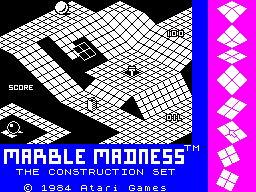
Label: Melbourne House Price: £8.95 Memory: 48K/128K Reviewer: Andy Moss Here it is! The ultimate frustrating telly bashing, making the blood pressure go through the roof type game that you can actually devise your own devilishly difficult telly-bashing design. Mnn-hm - that famed original Marble Madness is back as a construction set. I must admit a certain fondness for Marble Madness. The coin-op spawned so many small-screen lookalikes last spring - with the like of Gyroscope (hmm, wasn't that Melbourne House also?), Spindizzy, Bobby Bearing and even bits of Quazatron. What you get is this. An already-in-memory track of 10 screens, each one progressively harder with all the pitfalls - other marbles, holes where holes shouldn't be, topsy turvey logs, and anti-magnetic slopes. Then you can twiddle around and alter this track in any way by simple cursor movement, either that or you can add on additional tracks. When you load up you get a menu and it's from this that you can either change controls, Edit, Save/Load or Play. Choosing Edit puts you into the heart of the construction system and you can choose any of the 10 screens to work on. Simply move the cursor on to any of the shapes that are displayed at the side of the screen and press Fire. This throws up your selected piece on to the screen for you to place where necessary. Also in view and selected by cursor are colours for both background and track, a text facility, wall or hole pieces and various traps to decorate the game with. Go and get MMCS!
ZX Computing #34Feb 1987 · p.48ZX Computing GlobellaGreat
ZX ComputingZX Computing Globella
Overall Great
MELBOURNE HOUSE RELEASE A 'CUSTOMISE A COIN-OP CLASSIC' PACKAGE. Melbourne House £8.95 Marble Madness, the coin-op game was an original that like all good ideas has spawned numerous clone games in the same vein. Gyroscope (Melbourne House) and Spindizzy (Electric Dreams) have already appeared and the official Marble Madness game was released on the C64. But what of the Spectrum? Implementation problems mean that a pure conversion is out of the question. So if you are going to have to change the game a bit, why not change it a lot? The Melbourne House conversion, whilst retaining all of the spirit and playability of the original game, also has a lot of extras (and very few omissions). So much extra has been crammed in that you soon forget about the graphical differences with the original. The game is based on rolling a marble down an isometric 3D-ish landscape that has holes, slippery areas, barriers, lifts, drains, conveyor belts, vacuum cleaners, slime monsters, enemy marbles, bonus areas, acid, and of course the goal - which is the object of all your efforts. In the Melbourne House variant of the game some of these hindrances are missing - but it doesn't seem to help you any. Also the level system is worked out rather differently. Each level is composed of a static screen. Instead of smooth scrolling a long level up, the screen stays stationary and shifts up when you get to the bottom. After eleven of these screens you go back to the beginning and start again, but taking your time bonus with you. The timing system works in a similar way to the original, you start with a certain time limit in which to get to the bottom of the first screen. If you get to the bottom of the screen before time then your remaining amount gets added to your time for the next screen. Scoring is assessed on how much time you have left on your clock when you reach the bottom of the screen, and any bonuses that you have picked up on your trip down. Otherwise the game is very similar to Marble Madness in layout and all the fine detail, like the broken ball being brushed up, is all there. The construction part of the game lets you edit the screens as much as memory will allow. The editing system is remarkably simple, and fully icon driven with a two-thirds scale representation of the screen that you are working on with the rest of the screen taken up with the icons and chunks of isometric building blocks to manipulate. So you can move your joystick around and edit any screens that you want, to make them harder (!), easier, or just different. You can also test screens, and save/load the entire game to tape. This selection of the program makes the whole game that much more interesting, long after Commodore 64 owners will have completed the original game, Spectrum owners will be designing better and more fiendish screens for one another. The best implementation that could have been made of this well thought out game.
Crash #36Jan 1987 · p.18665%71%54%69%62%61%61%
Use of Computer 65%
Graphics 71%
Playability 54%
Getting Started 69%
Addictive Qualities 62%
Value For Money 61%
Overall 61%
Unknown
Unknown
Unknown
Producer: Melbourne House Retail Price: £8.95 Following the recent spate of Marble Madness clones, along comes the grand master himself in the form of a construction set from MELBOURNE HOUSE. Once more the hero of the game is Mr Spherical, a ball, who takes to the slippery slopes of the crooked palace of power. The game is split into two parts; firstly the game... life as a marble can't be an easy one; especially when you're trapped in a strange world of unreality, where the laws of physics that you once held true no longer apply. So, to pass the time Mr Spherical enters himself for the local races. The aim of these is a simple one - to reach the end of each level before your time runs out. With four directions at your disposal, you must keep Mr Spherical under control as he winds his weary way to the bottom of the racetrack. Racing over the flat planes isn't so bad, but the narrow ramps and bridges can prove extremely hazardous - one small roll out of place, and with a resounding scream poor old Mr Spherical plunges to his death in the murky swamplands which surround the track. Many creatures inhabit the swamplands, and some of these occasionally force themselves up onto the racetrack - in search of any slow-witted contestants who may fall prey to the difficult corners. The most notorious of the lot are the evil marbles who roll carelessly along the plains, they also bring with them their sproingy mates who move in a slinky fashion on the surface of the slopes. Contact with these, and any other of the various nasties leads to obliteration as well as a loss of time. If you become fed up with the preset patterns of the racetrack, there is an option on the title screen which allows you to construct your own. The construction process is controlled by the four standard direction keys plus a fire key Running down the right hand side of the construction screen is a selection of the various planes that can be used to make up your revised track. They include two angular planes, one flat, one vertical, a left and right slant and two steep slants. Along the bottom of the screen is a text option window. Using this, you can place oddments on the screen such as time displays, points scored, and marks of 100, 300 and 500. These can be put anywhere your heart desires. All of these options are accessed by moving your arrow cursor onto the one you want and pressing fire. Doing this allows you to move the item around the screen until you find a place to plonk it down. Once you have successfully completed the construction of a screen, select Test and a marble appears at the top - now it's time to see if your Great Design has worked, or like all the other Great Designs has it disappeared down the plughole... COMMENTS Control keys: redefinable, up, down, left, right, fire Joystick: Kempston, Cursor, Interface 2 Keyboard play: like nailing jelly to the ceiling Use of colour: monochromatic play area Graphics: detailed, with good animation Sound: excellent rendition of the arcade tune Skill levels: one Screens: 11
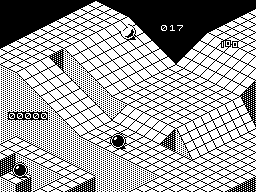
The game in action, it looks like Cameron's about to take a tumble.
The icon driven construction screen; Cameron obviously has a sick sense of humour.
Your Sinclair #12Dec 1986 · p.47Your Sinclair Megagame9/109/109/109/109/109/10
Your SinclairYour Sinclair Megagame
Graphics 9/10
Playability 9/10
Value For Money 9/10
Addictiveness 9/10
Overall 9/10
Phil South 9/10
Melbourne House £8.95 Reviewer: Phil South Wow! At last... something even those rarified air type Amiga owners want but cannot have... a blistering boll from the sky blue sky... Atari and Melbourne House link hands and swan dive into your Spectrum with a Marble Madness game creator! I don't believe it!!! (It's true!) Okay, I'll take it seriously if you will. What a brilliant game! Not only can you build a megasuperb and straight-up Marble Madness game of your very own, but you can play it too! Unlike so many game creation programs this is a very playable game, making even Gyroscope (itself a very addictive and tricky MM clone) look as exciting as a drawing pin spinning on the table. MM has the look of it's coin-up original with all your favourite baddies; green worms. acid slime, goals, red catapults, vacuum cleaners, all ready to chase you around the Marble Madness terrain. The baddies are all preprogrammed to react to whatever circumstances you care to put them in, and will surprise you in the amount of movement and intelligence they're capable of. You might think you can put them out of the way and cheat by positioning them so they can't get you, but they'll find a way! The Editor (No, not Ed, the MM Editor!) is a dream to use. You simply position items, like floor sections, baddies and extra points, using a pointer, and press the fire button to place them. Any position you choose isn't final, as you can reposition and erase any section whenever you feel like it. You can also alter the colour schemes, and although the choice is limited to two colours (as individual items are the same colour as the background), having different colour schemes for successive screens is very effective. The most useful thing in the Editor's repetoire is the Free Ram indicator. This tells you how much memory you've got left for screens and other data. Having put 15 screens in and still having mounds of memory left, I can see that the possibilities truly are endless! After you've finished designing your worst MM nightmare, the Speccy computes the movements for you and the baddies. plus it also fills in the light and shade on the side of the platforms. Is this the definitive Marble Madness on the Speccy? It's tough, it's changeable, it's addictive, it's cheap (it could have been £15 and still be value for money!), and you'd better buy it, or you'll never forgive yourself!
Having designed your mega-amazing screen, you then have the (dubious) pleasure of playing your own design. Beware! Even if you think you've made it easy for yourself , the game components (baddies to you) will find a way to get you. And don't be so sure that you've made it easy on the positioning of platforms, either. You'll discover that in most cases you've still painted yourself into a corner.
Here's the editor screen. Using your fancy pointer (expensive 68000 computers eat your mouse!) you indicate the function you want, and place the game element on the screen. Just click the pointer on the picture of the thing you want and position whatever it is where you want. (Psst! You can even change the size of your ball. Now there's a thing you don't see every day!)
Hack/Poke3
- Crash #59Dec 1988 · p.60
- YS Smash TipsAug 1988 · p.29
- Crash #39Apr 1987 · p.69
CompoEntry2
- C&VG (Computer & Video Games) #64Feb 1987 · p.80
- ZX Computing #33Jan 1987 · p.17
CompoResult1
- ZX Computing #38Jun 1987 · p.4
Full-page ad1
- Crash #36Jan 1987 · p.165
Review1
- Computer Gamer #22Jan 1987 · p.50
News/Note1
- C&VG (Computer & Video Games) #62Dec 1986 · p.10
Preview1
- Crash #34Nov 1986 · p.160
Licensed from
- Marble MadnessArcade coin-opAtari Games Ltd
Related
- Ports
- (Amstrad CPC), (Commodore 64), (NES), (Sega Master System)
- Same entry at
- Spectrum ComputingZXInfo
Reviews from people here
Sign in to write about this, or make an account. It takes a minute and lets you correct the catalogue too.
No description recorded.
Sign in to correct or add to this.
Hold the rights to this and want it taken down?