
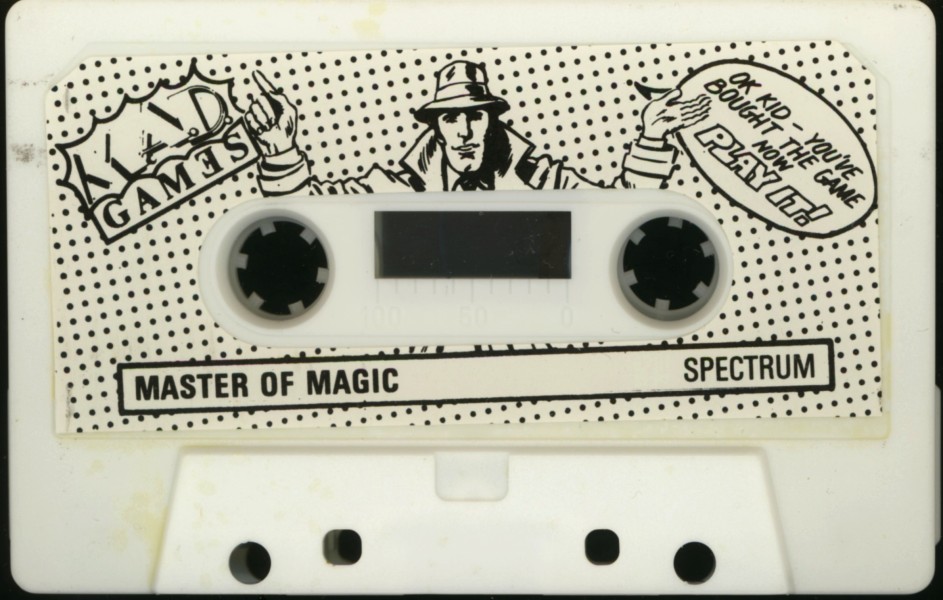
Master of Magic
Adventure Game: RPG · ZX-Spectrum 48K · 1 players · English
Mastertronic Added Dimension · 1986 · Pound sterling 2.99
Also known as The Master of Magic (English)
Discussion
Nobody has started a thread about this yet.
- Control Option
- Kempston Joystick, Redefineable keys
Play
- mmagic.rzxRZX playback file
- MasterOfMagic.tzx.zipTape image English20 KB
- MasterOfMagic.tap.zipTape image English24 KB
Documents
- MasterOfMagic.txtInstructions English1 KB
Other files
- Master of Magic (1986)(Mastertronic Added Dimension).pokPOK pokes file 0 KB
Files and rights
No permission is on record either way. Screens and pictures are copied here on a take-down basis: if you hold the rights and want something removed, say so and it goes.
Credits
- Tim Millercredited
- James Wilsoncredited
Sign in to credit somebody, or say what these people did.
Awards
Scores
In the magazines
- Sinclair User #541986 · Overall4/5
- Your Sinclair #91986 · Overall8/10
- ZX Computing #281986 · OverallGreat
- Crash #311986 · Overall86%
Elsewhere on the web
- WorldOfSpectrum 47 votes8.12
In the magazines 10
Sinclair User #54Sep 1986 · p.694/54/5
Overall 4/5
Gary Rook 4/5
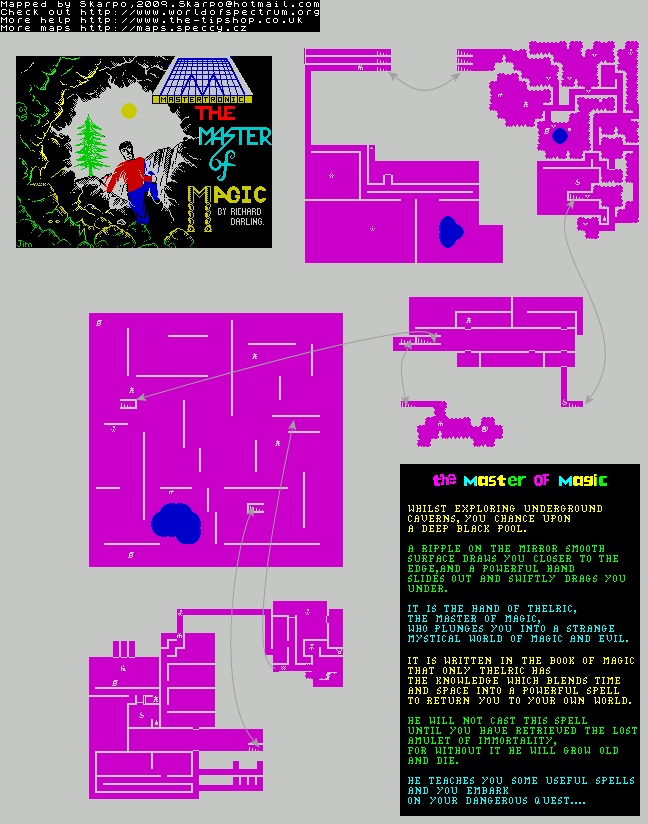
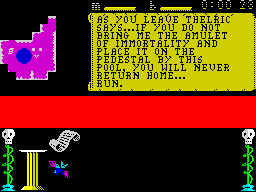
Label: MAD Price: £2.99 Memory: 48K/128K Reviewer: Gary Rook Mastertronic has produced some excellent games and Master of Magic could well turn out to be another winner. It's an adventure, but one with a difference. Firstly, to set the scene: you, an unfortunate explorer of underground caverns, have negligently strayed too close to a 'deep black pool'. A hand has dragged you under the water, and you have found yourself trapped in a land of mystery by Thelric, the Master of Magic. Only he can return you to your world, and before he does you must find the lost Amulet of Immortality for him. Once loaded and past the introductory pages, the screen is divided into four areas. The top half contains two windows: on the right is a scroll, which is used for descriptions of events - usually fights. On the left, you have a very small map of the immediate area you are in. This is a floor plan showing you what you can see - quite literally. You get a torchlight line-of-sight effect, which means that, standing by a door you can see down a corridor and part of a room; move into the room and you can see more, but you may not be able to see the corridor any more. You, by the way, are represented by a white pixel on the purple map background. Monsters are also represented in white, but usually you can tell which is which by the shape of the character - a bat is vaguely bat-shaped, etc. You control your movement either by joystick or by keyboard, and your little white pixel reacts accordingly. Below the map and the scroll is another window, about four or five lines deep. When you want to do something other than movement - cast spells, pick something up, attack something etc - you call up a menu of options and cycle through them. Below that window is yet another - the final window: this time a sort of display which give you 'close ups' of whatever else is in your immediate vicinity - skeletons, hellhounds, bats, vampires, etc. How about the game itself? I have to admit I was pleasantly surprised. It's really quite fine. It is very easy to get involved in the adventure and you tend to forget that you're actually controlling the destiny of a little white pixel and not some brawny Conan-type adventurer. Pretty soon, you're really into hacking down evil bats and slaughtering slavering hellhounds. OK, so maybe it's not so much fun having the life drained out of you by the vampire, but I'm sure I'll work out how to get the better of it at some point. And, so far, I've no complaints about programming, either. My only slight discontent is the map - I'd have liked it to have been bigger. In some ways, Master of Magic reminds me very strongly of a program I saw about 18 months ago - I can't remember the name of it, but it involved a very similar use of line-of-sight on a map much like the one in this game, except that a lot of the action took place outdoors. Master of Magic, however, is a far better game.
Your Sinclair #9Sep 1986 · p.707/108/109/109/108/108/10
Graphics 7/10
Playability 8/10
Value For Money 9/10
Addictiveness 9/10
Overall 8/10
Gwyn Hughes 8/10
Mad £2.99 Reviewer: Gwyn Hughes There's a grey area where adventures and arcade games meet - where role playing clashes with joystick jiggling - a place that people call... THE TWILIGHT ZONE! Mike Gerrard may also get Master Of Magic to review. For all I know the Ed may start a separate column for these hybrids... a separate magazine even! But for the time being it's landed with a splash in my soup plate so off we go into another endless maze of monsters and machinations. How best to describe M Of M? Remember Out Of The Shadows, the cult classic where the map around your little hero was only illuminated as far as he could see? Then what about Swords And Sorcery, the much delayed, menu-driven attempt to do a D & D in the depths of the Spectrum? Master masters the best features of both. The quest's the thing and this time it's for an amulet, but that's not important. What really matters is that there are several large levels of deadly dungeon in which dwell doomed souls and assorted creepy crawlies. You are a mere dot on the map as you move around, and you only get to see the objects, monsters and even the walls and doors as you approach them. Just to pep things up there's also a written description, which tells you when that smash with the mace missed or what the skeleton you've just reduced to rubble was wearing. Once you're underway it's time to select some orders from the menu which includes everything you can do at a certain time. Examine is always there, as is Cast a spell from your repertoire of four, though these drain your magical strength, shown by a bar chart up the top. If there's a nasty near enough you can always go for a blow. While the display is on the whole much clearer than in Swords And Scorcery and the menu system is generally easier to use, I wasn't too keen on the way that a vital command like Attack drifts about depending on how many other options there are before it. You need to have the GBH routine at your finger tips. On the whole though it's a lot of fun to play and to explore and you'll need some nifty timing to mash all the monsters, plus some map making to locate the armour and weapons. While it lacks the role playing and expandability of PSS's system, this is a most cheerful offering from the Mastertronic bargain basement - or should that be cheapo caverns?
An on-going live battle commentary scrolls by for those who can shatter a skeleton and read at the same time!
Finding out when you're close enough to Attack can be tricky, but once a monster appears go for blow after blow. You'll soon learn how many hits it can take - and which are impervious to physical force.
The subterranean radar thinks you're a real square but beware because that other figure's a far more detailed foe.
To aid ready recognition of the rotters, monsters appear here, as do doors, magic rings and the rest, which draws your attention to them pronto.
Your strength may wane but worry not because there's a healing potion - if only you can find it in time.
ZX Computing #28Aug 1986 · p.14ZX Computing GlobellaGreat
ZX ComputingZX Computing Globella
Overall Great
MAD Games £2.99 Walking along in the underground caverns I wondered what adventure I might confront this time. As I reached the deep black pool, my mind was thinking of other things... Suddenly a hand slid out of the water and grabbed me. As I slowly sunk to the bottom of the lake I realised I was entering a new world, and that I had been attacked by no less than Theiric, the Master of Magic. Once in this new world, Theiric explains that the only way for you to get home alive is to retrieve the lost Amulet of Immortality for him. To give you a chance, Theiric has given you the ability to cast spells, but apart from that you are on your own, in a very strange world indeed. When the game has finished loading, you are presented with three distinctly different areas. The lower half of the screen shows what creatures or objects are within your range (irrespective of whether they are alive or dead), and it is also used as the area in which you choose your spells and actions. The top left of the screen is an independently scrolling area which shows a section of your progress through the maze. Most importantly however is the top right 'Scroll', which shows you what action you have decided to take, and what - if any - creatures are attacking you. If you are unfortunate enough to be attacked, you can use one of your spells to kill your opponent, or if you have picked up a weapon, you can use that. Of your spells, the Magic Missile tends to be pretty useful against everything except the most hardy opponent. Your status is displayed on two meters, one for your life force, and one for your magic ability both of which diminish disturbingly quickly! What makes the game even more annoying is that some of the monsters, especially the Vampires, have limited intelligence. In practice this means that they chase after you for hours! The Master of Magic is a true arcade adventure, and although its graphics and sound are not outstanding, the game is extremely playable, and at £2.99, you must be MAD not to buy it!! (Sorry, but I had to get that in!!)
Crash #31Aug 1986 · p.7284%82%85%86%86%
Atmosphere 84%
Logic 82%
Addictive Quality 85%
Overall 86%
Derek Brewster 86%
DEREK BREWSTER'S ADVENTURE TRAIL CHICKEN AND EGGHEADS The 128K Spectrum has been around now for some time, and apart from some early commissioned software, and the exemplary efforts of Mastertronic, every software house old enough to remember computers like the Oric. Enterprise, and Memotech is saving its efforts until the 128 has a proven sales record. Admittedly, there have been question marks over the computer's future since the takeover by Alan Sugar, but everyone knows that it may take some time to produce a successor, and that when it arrives it will no doubt be fully compatible with the 128. May I just put forward the argument that if the successor is not compatible then this is a matter for Alan Sugar to worry about and not any potential 128 purchaser. There has been much advice on this issue in magazines and the general consensus is that the public should wait and see. All I can say is heaven knows what would have happened to the Sinclair phenomenon if such advice was offered in 1982 amid rumours of the 48K's unreliability. Presumably, everyone would have ended up with Atari microcomputers which were (and still are) superb value for money, and the home software industry might never have gained the poise and standing it has now earned for itself. Alan Sugar is caught in a marketing quandary over the positions of his Amstrad and Spectrum concerns. He claims far too much for the likes of the CPC 464 and its derivatives and is too dismissive of the huge Spectrum games world he has inherited. I suggest the potential micro purchaser keeps well clear of such political manoeuverings and simply goes out and buys the microcomputer which offers the best software backup at the most competitive price. If this be the 128 Spectrum then so be it. Sold in sufficient numbers, the 128 will ensure both software support in the near future, and hardware compatibility in the longer term - no matter who provides them. SOMETHING TO CROW ABOUT? Adventuring began with the mainframe Colossal Cavern and due to the inherent limitations of mainframes, text without pictures was the order of the day. Along came the ZX Spectrum in 1982 and, although many adventures remained text-only, mimicking the original, the first faltering steps were taken towards full-blown illustrations with the likes of The Hobbit and Fantasia Diamond. Some time later, graphics (as pictures on computers are invariably called) became quite sophisticated, and respectable even, as some specialist graphic computer artists got to grips with the Spectrum, most notably Banner of Interceptor (Jewels of Babylon, Warlord) and Teoman Irmak of the old Adventure International (Gremlins, Touchstones of Rhiannon). Now, you might think it a little hypocritical to mention these games. After all, when they were released I refused to be swayed simply by their graphics but instead reviewed the adventure as a whole - remember this was when Level 9 were releasing games with simple graphic styles but immense intricacies of plot and composition, and games as good and innovative as Sherlock and Lords of Midnight were about. The reason why good graphics could not co-exist with complexity of gameplay was simply the restriction on memory. Surely now with 128K, adventures can combine the two and produce something worth crowing about. MASTER OF MAGIC Producer: Mastertronic Retail Price: £2.99 Author: Tim Miller, Richard Darling The first time I saw this game was on the Commodore 64 where it had the most brilliant Ron Hubbard soundtrack accompanying it. Alas, the Spectrum version has no such treats, but is still a fair old game for the price. While exploring some underground caverns you chance upon a deep black pool. A ripple on the mirror-smooth surface draws you closer to the edge and a powerful hand slides out and swiftly drags you under. It is the hand of Thelric, the master of magic, who plunges you into a strange mystical world of magic and evil. It is written in the Book of Magic that only Thelric has the knowledge to blend time and space into a powerful enough spell to return you to your own world. He promises to cast the spell if you retrieve for him the lost amulet of immortality, for without it he will grow old and die. He teaches you some useful spells and you embark on your dangerous quest. As you leave, Thelric says 'If you do not bring me the amulet of immortality and place it on the pedestal by this pool you will never return home'. Shucks. After the game has loaded it automatically goes into demonstration mode where, we are told, there are less objects and monsters than in the game proper. I must admit I was a bit confused as to just where the demonstration mode ended and where the game started - easy to do when you're constantly tapping the FIRE button. On starting, a menu is displayed across the middle of the screen. The options shown always Include RUN, and often EXAMINE, PICK UP, DROP and so on. The cursor can be moved by joystick or via the keyboard, much as in Spellbound, with FIRE selecting the option. As with Spellbound, some selections can lead onto further menus and options. The screen is split into many different areas. In the top right is the major window which scrolls the text telling you what's going on. The window at top left is a kind of Out of the Shadows depiction of the terrain you are going through with the various caves, corridors, steps and rooms shown in a very simple, thumbnail sketch manner. The instructions tell that only your actual line of sight is shown which may be a way of getting round the fact that the programming here isn't awfully good. To make matters worse the whole thing scrolls in character blocks which just looks amazingly primitive. The display across the bottom of the screen reveals pictures of the creatures and objects you come across, and very fine representations they are too. The 'm' and the 'b' along the top represent your mind and body strength. Another curious admission in the instructions is the acceptance of the drawback of the time clock at top right stopping when the player accesses the menu which, as the instructions say, does provide time to choose carefully, but also allows a chance to stop attacking monsters in their tracks. Magic falls into the categories of casting spells, wearing rings and drinking potions. A MAGIC MISSILE produces a fiery arrow which can be directed at any live target in sight. It has a high chance of missing, but causes serious damage should it hit home. FIREBALL causes a 15 feet radius fireball to surround you and bum any creature in this area; your player remains unharmed. ENERGY DRAIN may be directed at any creature in sight and causes the instant loss of some of its body strength. MAGICAL SHIELD produces a shielding over your skin protecting you from attack. Like all the spells, it continually reduces your mind power and you should note that this spell lasts until Uncast. The outcome of physical combat is, naturally enough, determined by how skilled the attacker is and how well the defender is protected, but also by magical factors and luck. Once a blow meets its target the damage inflicted depends on the weapon used and the strength of the attacker - much as you'd expect in this type of game. Should a monster be slain, any of its possessions can be collected and used to further your goals. The monsters have some pretty nasty habits. Although they vary in intelligence, they are invariably hostile. Most alarmingly, they crave your meat to eat as well as taking a shine to your possessions while guarding their own treasure troves jealously. Some monsters are easily scared, others will search the last place they saw you and keep searching there for a while, while others hound you into an early grave. Given the asking price, Master of Magic is not such a bad game at all, and not so long ago would have commanded a much loftier price tag. Leaving aside the rather poor display of your terrain in the top left with its jerky scrolling, the look of the game is very appealing. The pictures of the objects and creatures you meet along the bottom are neat and effective with graphics of bats, vampires, skeletons and hellhounds brightening up the whole game. The menu system, similar in principle to the one used in Spellbound and other such games. works very well. The options given on the menu at any one point are a very good indicator of how you might proceed. After killing a skeleton or an orc (the result being the word DEAD boldly emblazoned across their picture at the bottom) you may be given the option to PICK UP, which might see you getting the dagger. Since you tend to only have enough mind power to cast two spells in the first instance you may think it wise to save killing spells for creatures who are carrying something you would like to retrieve from their dead bodies (bats use their teeth and spiders their sting so you are unlikely to get any weapons from these two). When by a door a check of the menu options reveals OPEN and, very useful when being pursued, CLOSE once you've passed through the portal. All in all, a game which grows on you the more you get into it and well worth the meagre three pounds. COMMENTS Difficulty: easy to play but takes a while to play well Graphics: overall good but map poor Presentation: attractive Input facility: best played with joystick
Review3
- MicroHobby #136Jul 1987 · p.16
- Popular Computing Weekly #25Jun 1986 · p.17
- Computer Gamer #12Mar 1986 · p.38
Solution1
- Crash #36Jan 1987 · p.152
News/Note1
- ZX Computing #27Jul 1986 · p.7
Preview1
- Sinclair User #51Jun 1986 · p.90
Licensed from
- Master of MagicSoftwareRichard Darling
Related
- Ports
- The Master of Magic (Commodore 64)
- Elsewhere
- Speccy Screenshot MapsWikipediaMobyGamesRZX ArchiveThe TipshopUVLModern ZX-Retro GamingRZX Archive - YouTubeSpectrum Computing RZX - YouTube
- Same entry at
- Spectrum ComputingZXInfo
Reviews from people here
Sign in to write about this, or make an account. It takes a minute and lets you correct the catalogue too.
No description recorded.
Sign in to correct or add to this.
Hold the rights to this and want it taken down?