
Micronaut One
Arcade Game: Shoot-em-up · ZX-Spectrum 48K · 1 players · English
Nexus Productions Ltd · 1987 · Pound sterling 7.95


Discussion
Nobody has started a thread about this yet.
- Control Option
- Interface 2 (right), Kempston Joystick, Redefineable keys
Play
- MicronautOne.tzx.zipTape image English26 KB
- MicronautOne.tap.zipTape image English26 KB
Documents
- MicronautOne.txtInstructions English5 KB
- MicronautOne(EN).pdfInstructions English618 KB
Other files
- Micronaut One (1987)(Nexus Productions).pokPOK pokes file 1 KB
Files and rights
No permission is on record either way. Screens and pictures are copied here on a take-down basis: if you hold the rights and want something removed, say so and it goes.
Credits
- Pete Cookecredited
- Ian Ellerycredited
- Robin CandyLevel Design
Sign in to credit somebody, or say what these people did.
Awards
Scores
In the magazines
- Sinclair User #641987 · Overall10/10
- Your Sinclair #211987 · Overall8/10
- Crash #431987 · Overall92%
Elsewhere on the web
- WorldOfSpectrum 50 votes7.97
In the magazines 32
Your Sinclair #21Sep 1987 · p.749/107/108/108/108/108/10
Graphics 9/10
Playability 7/10
Value For Money 8/10
Addictiveness 8/10
Overall 8/10
Rachael Smith 8/10
Nexus £7.95 Reviewer: Rachael Smith Astronauts swing their thing in space, aquanauts do it under water but micronauts...? The naughty 'nauts roam the tunnels which run through the organic, artificial brains of the biocomputers. And there's one very good reason for venturing into the grey matter of the galaxy - bugs! Not the sort of things that make a shoot 'em up crash every time you pass a zillion points... I mean real yucky nasties which hatch into grubs before growing into jellyflies. Jellyfiles? Well only if you throw it. If you zap it, it vanishes, which stops it spinning a web across the tunnels and laying eggs which hatch into more larvae and - you guessed it! Isn't nature wonderful in the way that it adapts to produce a parasite capable of living on the very highest tech level? These parasites go by the name of the Scrim and are descended from fruit flies. Their presence is far more than mere irritation because, for all the wonderful bio-engineering, the computers are highly unstable and the presence of impenetrable webs makes maintenance difficult, if not downright impossible. You can't just leave the biocomputer running or it'll overheat faster than a Commodore power supply. What you've got to do is reach one of the four Energy Transfer Units and either drain off or pump back some power. This means you're going to be a busy little micronaut, with bugs to kill and systems to stablize. How nice to have a game where the scenario makes some sort of sci-fi sense, but then again, Pete (Tau Ceti) Cooke has always been one for the credible plot. He's also a fine programmer, which means that your race round the passage is in just about the fastest, smoothest vector 3D seen on the Speccy. The three stages of the nasties are well animated too. I particularly liked - or rather, particularly didn't like - the crawling, maggot-like larvae. Definitely yucky! And be prepared for a top speed chase if you encounter a jellyfly. There are also roaming service droids - at least, I think that's what they are - which get in your way unless you zap them. The game's other elegant feature is its use of menu control complete with windows. You reach the options bar by pressing Break at any time during the game, and that's where the fun really starts. Your ship contains a lot helpful devices, first and foremost of which is a map of the tunnels. But this is more than an A to Z of the bio-brainbox. You can ask it to display a course to a sector, or perhaps one of the ETUs, and then an arrow on the control screen will indicate which way to go. There's also an ETU panel which lets you see the state of each of the Energy units, though impending overloads are also indicated by a scrolling message on the dashboard. You stabilize the ETU that you're docked with from this screen. Add to this a quick introduction to the Scrim - a sort of instant know-your-enemy guide - and a notepad for jotting down where potential hazards lie and you're all set for a deadly time. The game's greatest failing is killing things. It's too hard! Instead of a laser, plasma cannon or photon-blaster, your ship's equipped with a Van Der Graaf Generator. Unluckily this particular piece of kit puts a heavy drain on your power supply, and before you can say Mallory you'll be searching for an ETU to drain or perhaps a floating cloud of energy. The problem is that it takes several shots to zap even the vulnerable larvae, and despite the aid of a targetting computer, the damn things wouldn't die before my batteries did. I'm not sure whether this isn't a bit too tricky, but I'll give it the benefit of the doubt, because if you can beat the bugs on one level you head up to higher things, a greater menace and an even bigger brain... which is probably called Rachael!
C&VG (Computer & Video Games) #70Aug 1987 · p.28C+VG Game of the Month9/105/10 (for cheek!)9/109/10
C&VG (Computer & Video Games)C+VG Game of the Month
Graphics 9/10
Sound 5/10 (for cheek!)
Value 9/10
Playability 9/10
Tim Metcalfe
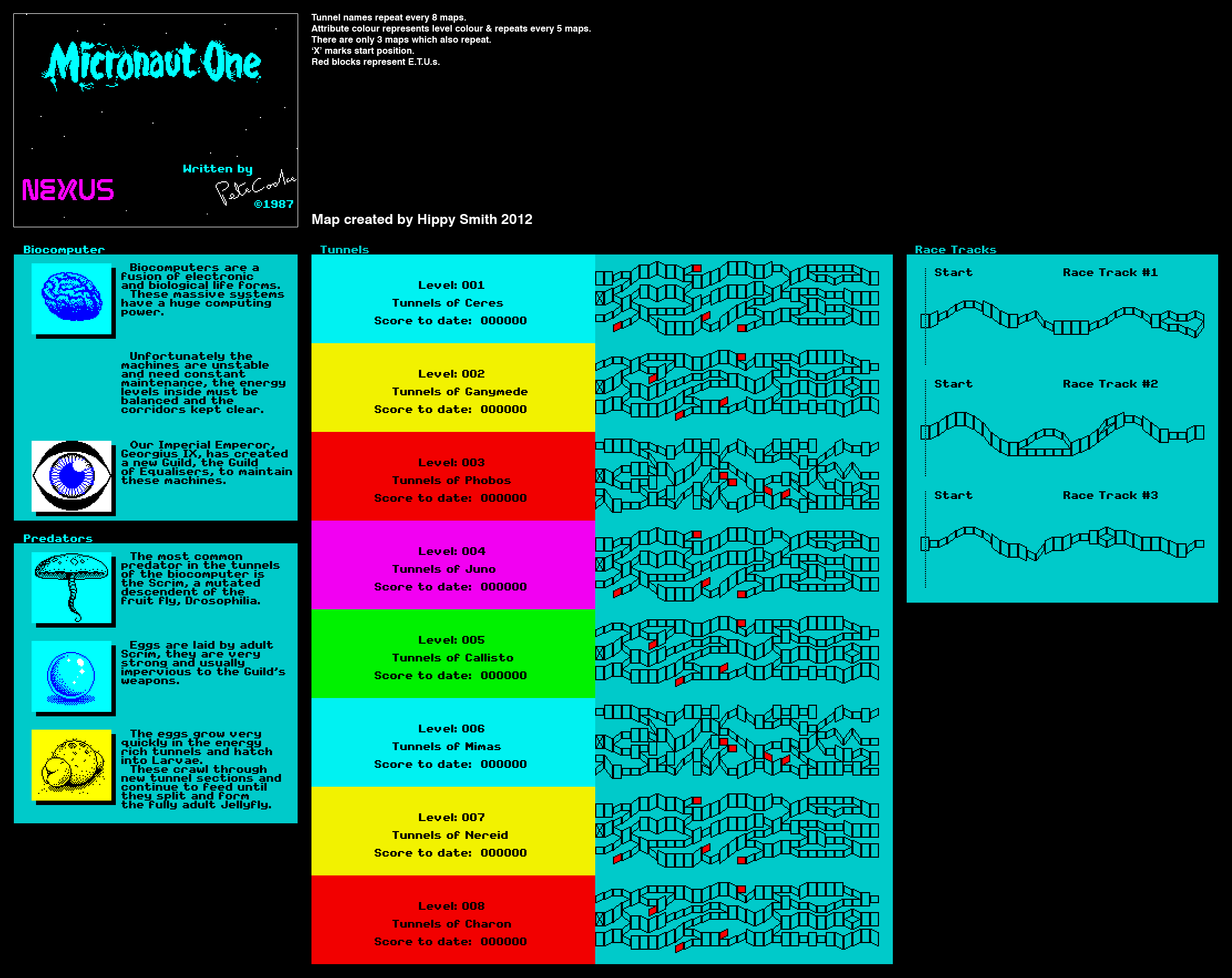
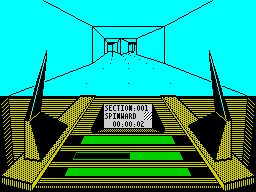
MACHINES: Spectrum SUPPLIER: Nexus PRICE: £8.95 Hey, there's something wrong here! This game isn't a coin-op conversion. It doesn't feature characters from a TV cartoon. It doesn't feature characters to do with a new film. Some mistake surely?! Tell you what though, it is a cracking mixture of action and strategy and features some of the most stunning 3D I've ever seen on the Spectrum. Peter Cooke can be relied upon to produce original and challenging games and he's done it again with Micronaut One - set inside a massive Biocomputer riddled with enough pests to keep Rentokill in business for at least a couple of light years. Play the game and you become a member of the Guild of Equalisers, formed to protect the asteroid based biocomputers from infestation. As with all systems, the biocomputer has predators, the Scrim, a mutated descendant of the fruit fly, Drosophilia. The Scrim live in the Tunnels, feeding on free energy and thriving on the warm and damp environment. As part of their work Guild must keep the tunnels clear of Scrim eggs and webs. The Scrim has a three stage life-cycle in the tunnels. Eggs are laid by adult Scrim. They are very strong and usually impervious to the Guild's weapons. The eggs grow very quickly in the energy rich tunnels and continue to feed until they split and form the fully adult Jellyfly. Jellyflyers are fast moving and will search for a section of tunnel to build an energy web and lay their eggs to begin one lifecycle all over again. The objective of the game is to rid the tunnels of any Scrim while maintaining the energy. When all the Scrim have been eliminated in a tunnel complex the Guild will transfer you to a more unstable and heavily infested area. To begin life as a Guild member, move the arrow to the Play option on the main menu and press fire. The screen will clear and a new set of options will appear, the game menu, You'll see View, Map, E.T.U., Info, Pad, and Misc, options at the top of the screen. Select the View option, The top of the screen, the viewscreen, will show you view of the tunnels. Now left, right, up and down will move you ship about through the tunnels and fire will fire the ships weapons. In addition the keys Q and W allow you to move up and down in the tunnel to avoid obstacles. Below the viewscreen are the ship's instruments. A small rectangular window, the scanner shows the tunnel section that you are in, the direction that you are facing, the time and whether your weapons are targetted. Below the scanner are three bars. The first shows the ship's speed, the second the ship's energy level and the third is a message window for information about the Biocomputer. The next menu is Map. This shows a map of the tunnels which wraps round the screen and can be scrolled from left to right. Your position is marked by a X and you can also set a marker to any section simply by pointing at it and pressing fire. These markers are used by the ships Navigational Locking System (Navlock on the map menu bars) to calculate a route for your ships to anywhere in the tunnels. The E.T.U. menu shows the energy levels of the four Energy Transfer Units in the tunnel complex. The Info menu simply gives an overview of the biocomputer and provides a valuable identification chart for the differing life stages of the Scrim. There are several extra options available on the main menu. Of course you can always work out your own routes to the ETU's if you reckon you know better than your on-board computer. The scrolling is amazingly fast for the Spectrum - you can make things move VERY rapidly. And then there's the terrific sense of being enclosed by the tunnel walls. All very atmospheric. Micronaut is Pete Cooke's best yet. And the blurb contains the best excuse why there's no real sound effects in a Spectrum game I reckon I've ever read. What is it? Well Pete says that because the tunnels are kept in a semi-vacuum condition you wouldn't be able to hear much. Nice excuse - great game.
Crash #43Aug 1987 · p.92Crash Smash96%91%89%93%92%
Presentation 96%
Graphics 91%
Playability 89%
Addictive Qualities 93%
Overall 92%
Mike Dunn
Richard Eddy
Robin Candy
Producer: Nexus Retail Price: £7.95 Author: Pete Cooke As a member of the Guild of Equalisers, you control a ship passing through the tunnel network of a biocomputer. The passageways are infested with Scrim - mutated fly-like predators, thriving on the computer's warmth and energy. Their eggs hatch into larvae and develop into web-spinning adult Jellyflies. Your craft can be guided along an intricate network of rectangular tunnelling, punctuated by junctions and projections, all shown on a split screen. A map of the tunnels can be called up, with your position shown. And you can set up markers as homing points for the ship's Navigational Locking System. The vehicle can move to avoid obstacles, take alternative routes, and stalk Scrim. Collisions cause interference on the viewing screen, and directional changes are indicated on a central window in terms of spin. You can only reverse when you hit an obstacle. Your craft is equipped with a targetable weapons system which throws forward energy tendrils. Killing parasitic Scrim may require persistent firing - and exhaust your energy. Passing through a nebulous energy swarm restores it, though. And the craft's energy must be kept within a narrow range. Energy can be transferred to and from the craft by docking at any of four Cyclopean stations, protected by periodically closing translucent doors. At each of these, energy can be pumped into or drained from the vehicle's corresponding Energy Transfer Units (ETUs). At a safe level the energy bar is green, otherwise it's red. If the energy level goes way beyond the limits - as it does if the craft is blocked in by Scrim webbing - the whole biocomputer complex could face explosive consequences. When all the Scrim on a level have been destroyed, the craft is automatically transported to the next - and worse infestation. Information on all alien life forms and the biocomputer can be accessed. And you can always cop out - by leaving the creature-infested passages and simply competing against time in a five-lap race through the tunnels. A pacer provides additional motivation. Micronaut One programmer Pete Cooke (Tau Ceti, Academy) reveals all - well, some - in the last CRASH. COMMENTS Control keys: definable Joystick: Kempston, Sinclair, Cursor Use of colour: monochromatic - but you can choose the ink colour Graphics: excellent vectors and a good score line Sound: limited spot FX Skill levels: two separate games: one easy, one very difficult
Flight is fast, death swift in Pete Cooke's Micronaut One.
Sinclair User #64Jul 1987 · p.76Sinclair User Classic10/1010/10
Sinclair UserSinclair User Classic
Overall 10/10
Tamara Howard 10/10
Label: Nexus Price: £9.95 Joystick: Kempston Memory: 48K/128K Reviewer: Tamara Howard Oh, alright, I admit it, when I first saw Pete Tau Ceti Cooke's latest, Micronaut One, the only thing that I could think was Ooer! And with good reason. Micronaut One defies any other sort of description. Not only that but it contains some of the most brilliant 3D graphics ever seen on the Spectrum. For the first time ever, as far as I'm aware, you've got solid 3D fast scrolling creating a brilliant illusion of travelling along tunnels. One recent point of reference would be Firebird's Hive. Don't even think about it - there's no comparison. Micronaut is real and solid - you'll believe you were there!! And also, Pete Cooke knows all about gameplay. It's the graphics and gameplay which matter here so the story behind Micronaut is simple. Civilisation has taken something of a turn for the worse. Mutations are rife, barbarism is the order of the day and society has built this computer. But not just any old computer. Due to the fact that metal is in such short supply, computers have to be formed out of (gulp) living biological organisms. The resulting biocomputer is a bit on the unstable side, and needs constant maintenance. And then, there's the Scrim to think about. The Scrim are the bad guys. Or, in this case, the bad flies. A mutated descendent of the common fruit fly, Scrim feed off the energy generated by the biocomputers. Owing to the fact that they lay eggs left, right and centre, and spin sticky webs all over the place, the scrim tend to block off access to the Energy Transfer Units (ETUs) leading to lack of maintenance, extreme instability, a short explosion and a nasty case of death for all concerned. Mass elimination of the Scrim is therefore the order of the day, making Micronaut One a sort of computerised, space-age version of Rentokil. Dealing with the Scrim is not easy. Flying around in your craft, armed only with a rather puny generator, it's important to keep up the energy levels, or else your generator won't kill anything. Scrim eggs are practically indestructible, and the larvae and adult jellyfliers are pretty, tough too. So you have to keep on topping up the energy levels of your own craft, as well as those of the biocomputer. Energy clouds are useful here. Don't, as I did, keep firing at the little swarm-like things that keep coming your way, they're not masses of Scrim, they're energy particles, and if you fly into them, you'll absorb them. (By the way, when you do come across a Scrim, you'll know about it). Scrim are huge. Great big umbrella shaped things that fly straight into your ship and make you go all wobbly. Huge wobbly larvae which head butt you and push you backwards for several feet. Golf-ball sized eggs which no amount of firing at, pushing about or swearing at will destroy. And thick, sticky webs which cling to the ship, and ripple gently as they pull away from the window. The graphics are astounding. The sensation is of flying through tunnels, things appearing around corners. Scrim flying out of nowhere, and larvae leaping out at you. The ETUs are huge, blinking eyes; solid graphics which seem to fill up half the screen. Attribute problems are avoided by the use of two colours. It's a triumph of programming, and a fiendishly difficult game.- There are several windows which you can summon from the main menu to help you. Maps, ETU energy displays, information about the Scrim. The skill lies in knowing which window to summon up when you get a message or a warning. A monitor will tell you where the webs are, and which of the ETUs is in danger. It's up to you to get there and sort it all out. And boy, is that hard. There's also a race game in here as well - if you really want it - which is five laps of the tunnel as fast as you can go. It doesn't appear to be very interesting, there's nothing to shoot at, or obstacles in the way. but as an exercise in learning the layout of the tunnels and learning to fly the ship, it's pretty useful. Micronaut One is pretty ingenious. It requires thought and strategy to get through it but instant oblivion is always around the corner. It's a really nice mix of blast and skill.
Tips6
- Die Speccy CDJan 1996
- Crash #66Jul 1989 · p.32
- YS Smash TipsAug 1988 · p.30
- Your Sinclair #23Nov 1987 · p.22
- Crash #45Oct 1987 · p.56
- Sinclair User #66Sep 1987 · p.12
News/Note6
- Crash #43Aug 1987 · p.8
- Popular Computing Weekly #27Jul 1987 · p.45
- C&VG (Computer & Video Games) #69Jul 1987 · p.12
- Computer Gamer #27Jun 1987 · p.4
- Your Sinclair #18Jun 1987 · p.104
- C&VG (Computer & Video Games) #67May 1987 · p.10
CompoEntry4
- Your Sinclair #20Aug 1987 · p.18
- Sinclair User #65Aug 1987 · p.35
- Crash #42Jul 1987 · p.48
- Your Sinclair #19Jul 1987 · p.10
Preview4
- Your Sinclair #19Jul 1987 · p.10
- Crash #41Jun 1987 · p.125
- Sinclair User #62May 1987 · p.103
- Crash #39Apr 1987 · p.129
CompoResult3
- Your Sinclair #27Mar 1988 · p.97
- Sinclair User #69Dec 1987 · p.47
- Crash #44Sep 1987 · p.115
Information1
- SSD-IISep 1999
Feature1
- Your Sinclair #90Jun 1993 · p.31
CoverGame1
- Crash #65Jun 1989 · p.6
Hack/Poke1
- Your Sinclair #36Dec 1988 · p.34
Full-page ad1
- C&VG (Computer & Video Games) #70Aug 1987 · p.121
Related
- Compilations
- Crash issue 65: Presents 1, Load 'n' Run issue 45
- Same entry at
- Spectrum ComputingZXInfo
Reviews from people here
Sign in to write about this, or make an account. It takes a minute and lets you correct the catalogue too.
No description recorded.
Sign in to correct or add to this.
Hold the rights to this and want it taken down?