
Millionaire
Strategy Game: Management · ZX-Spectrum 48K · 1 players · English
Incentive Software Ltd · 1984 · Pound sterling 5.50
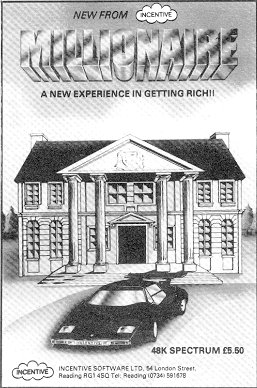
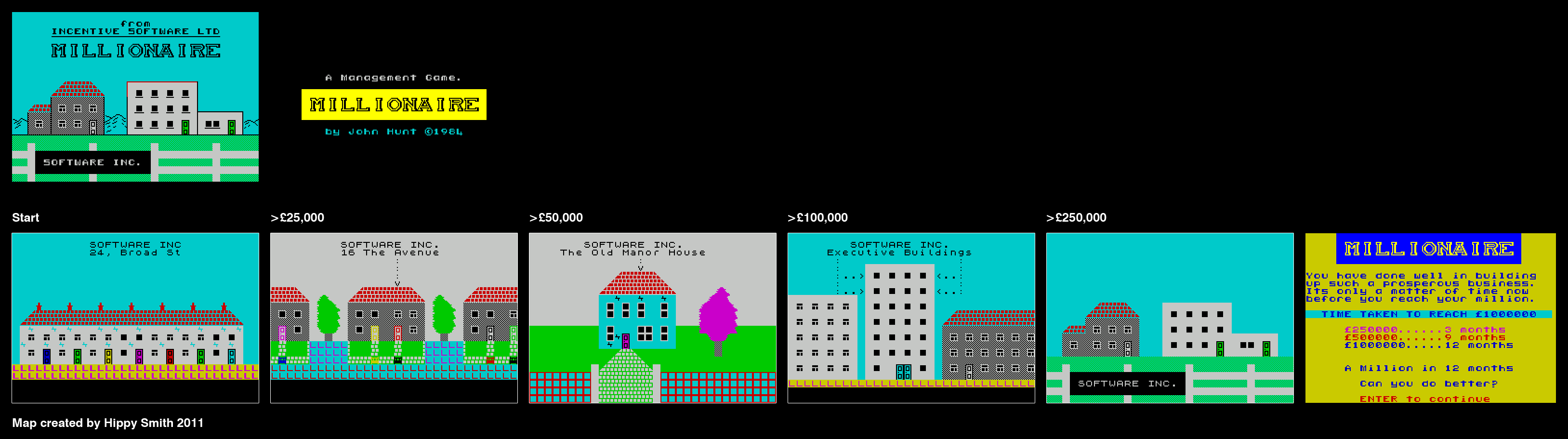
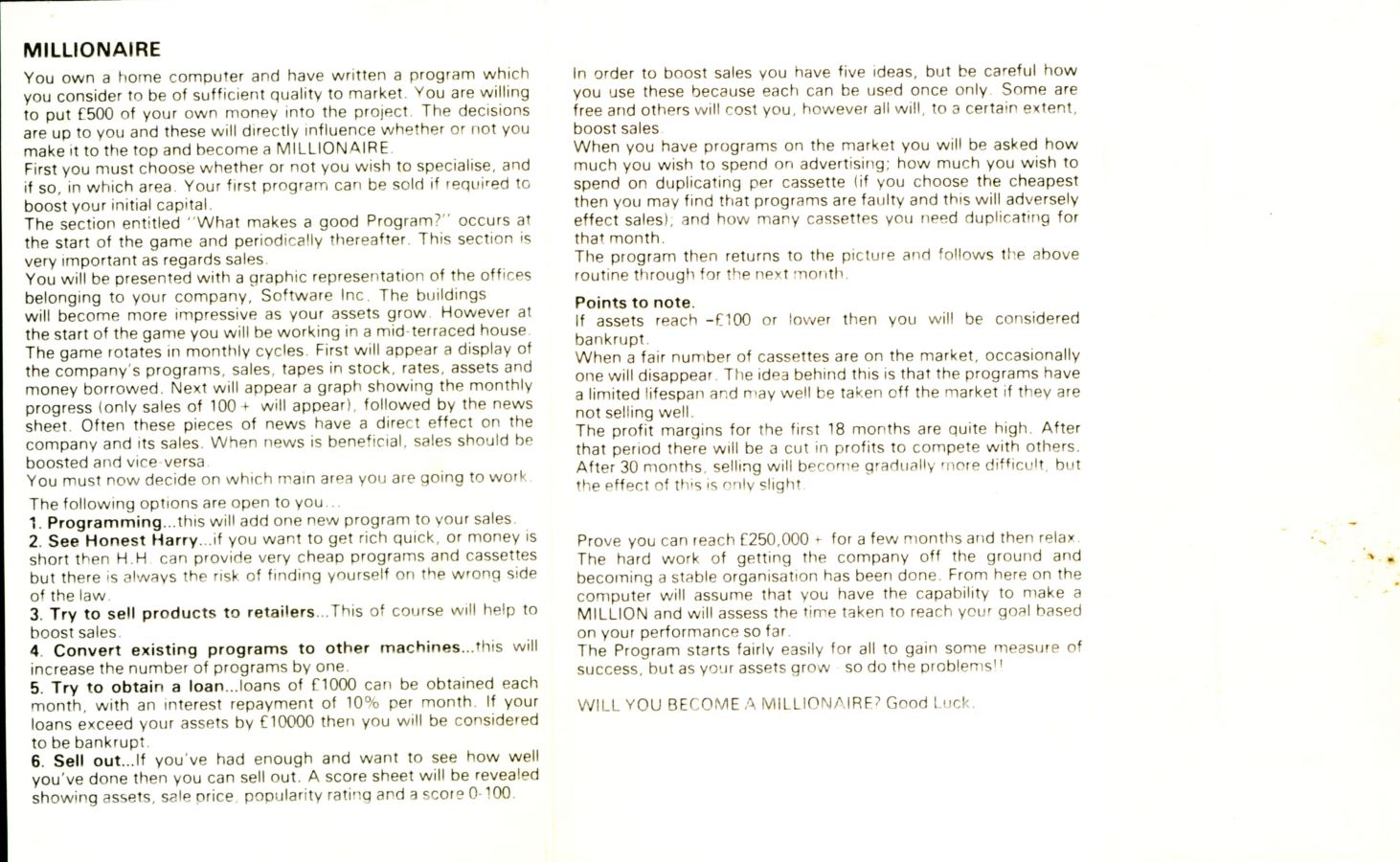
_Back.jpg)
.jpg)
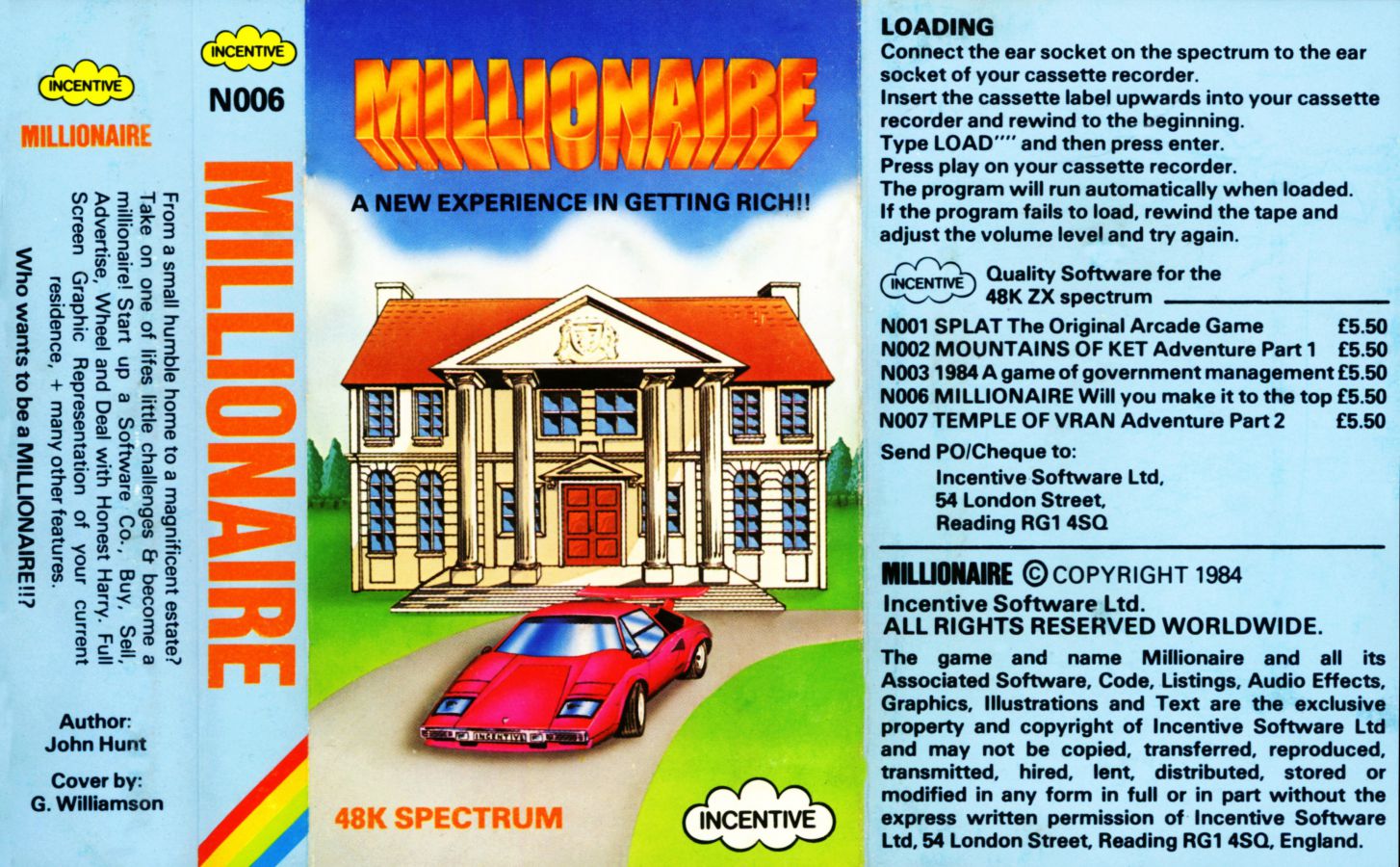
_Media.jpg)
Discussion
Nobody has started a thread about this yet.
Releases
- 1984Incentive Software LtdPound sterling 5.50
- 1984Currys
Play
- millionaire.zipRZX playback file
- Millionaire.z80.zipSnapshot image English17 KB
- Millionaire.tzx.zipTape image English25 KB
- Millionaire(Currys).tzx.zipTape image English16 KB
Documents
- Millionaire.txtInstructions English6 KB
Files and rights
No permission is on record either way. Screens and pictures are copied here on a take-down basis: if you hold the rights and want something removed, say so and it goes.
Credits
- John Huntcredited
- G. WilliamsonInlay/Poster Art
Sign in to credit somebody, or say what these people did.
Scores
In the magazines
- Sinclair User #281984 · Gilbert Factor7/10
- Crash #41984 · Overall80%
Elsewhere on the web
- WorldOfSpectrum 39 votes7.76
Awards and competitions
Crash Readers Awards 1984
- 2Best Strategy/Simulation
In the magazines 66
Your Spectrum #7Sep 1984 · p.45HITHITMISS
Frank Pelling HIT
Ian Hemmingway HIT
Phil Morse MISS
JOYSTICK JURY Your Spectrum is on the lookout for clubs to take part in Joystick Jury. Interested??? Just drop a line to Ron Smith, Joystick Jury, Your Spectrum, [redacted]. This month's joystick jurors are all members of the Stevenage Computer Club, [redacted]. They are: Ian Hemmingway, Phil Morse, Frank Pelling, Owen Pugh and Monty Trent. The club was formed about 18 months ago and currently has a membership of about 45, with members' ages ranging from eight to 70 years. It meets twice a month - at the Stevenage Library and the Leisure Centre. Membership costs £6 per year... half price for children and OAPs. For more details, phone Frank Pelling on [redacted] (evenings and weekends). MILLIONAIRE Incentive Software £5.95 Having just written what you consider to be a commercially viable program, your job now is to try and sell it. With just £500 of your own, the ultimate aim is to achieve millionaire status.
Sinclair User #28Jul 1984 · p.397/10
Gilbert Factor 7/10
IF YOU CAN'T BEAT THEM, JOIN THEM Memory: 48K Price: £5.50 It will take several months of play to reach your target in Millionaire for the 48K Spectrum from Incentive Software. The idea is to start a software house and then either sell your products to other companies for them to market or sell directly to the retail trade. The problem is that the scales of success incorporated into the game are such that it will take a long time to get anywhere near a million pounds or dollars in profit. During the game you can specialise in a specific type of software and you have to tell the program which qualities you desire most in a product. You will then be informed of your current financial position, depending on how well your software is selling and the amount you have had to pay in bills. Unfortunately you cannot make large profits quickly because of the low limit to numbers of program copies you can make by duplication. Another difficulty is that the game relies heavily on luck. You may put in one set of figures during one session and then enter them again during the next session and have completely different results. Despite the minor flaws in the program, Millionaire is one of the few addictive strategy games on the market. You may not become a millionaire or learn how to handle the business of a software house but you should find the experience engrossing.
Sinclair Programs #21Jul 1984 · p.30
June Mortimer
WANTED - RACING DRIVER, PILOT, PRIME MINISTER... Simulation programs are fun and educational . Among a selection of excellent games , many of them best-sellers , we find one leads the field . Spend your time playing Manic Miner or The Hobbit and, although you may gain remarkable proficiency on the Spectrum keyboard, the chances are that you will not feel any better-equipped for any real-life experiences of wandering beneath the streets of Surbiton, or controlling the movements of a recalcitrant dwarf. Spend your time playing simulation games and not only will you enjoy some of the best games on the market but also you will benefit from the educational qualities of simulation games. Whether your dream has always been to bring the government to its knees, form a successful rock band, become a millionaire or simply to get away from the city and take up sport in the countryside, there is a simulation game designed to help you achieve your dream in the comfort of your home. Simulation games put you into the place of another person, a jet pilot for example, provide some background information and instructions, and then allow you to make all the decisions. UNRIVALLED SUCCESS In the field of simulation games nothing has arrived in the Sinclair Programs office to rival The Forest - Phipps Associates, 48K Spectrum . It is a simulation of that sport seemingly least likely ever to be played on a microcomputer, orienteering. Orienteering is essentially a cross-country race across difficult terrain, to which has been added the extra dimension of navigational problems. Contestants are supplied with a map, on which is marked a number of points, each of which must be visited in order. Points are often separated by lakes or dense forest, so the quickest route is not necessarily a straight line but can be found only by a skilled map reader. An added complication is that the map, and the area, do not include roads, footpaths or streams, and so map and compass must be used throughout. Graham Relf, author of The Forest has, amazingly, made it possible to orienteer with a Spectrum and, more incredibly still, has fitted 11,200 sq. km. of map into the program. When the game is loaded, the scene is the start of the course, on the edge of the town and the forest. Objective number one lies around 100 metres to the north-east and is marked by a flag on arrival. The map shows that a direct route would not be too difficult; most of it is downhill and the forest through which a straight path would run is not too dense. It is difficult, however, to run even 100 metres through trees white trying to follow a compass bearing, so the booklet accompanying the program suggests that beginners first aim for the nearby lake and then for the small flag in the middle of the forest. The screen shows the view six metres in front of the player. It may be lake, tall trees, small trees, a town, or a selection of other types of terrain. Ten terrain symbols are shown on the screen at any time. Turning to right and left can be done by means of left and right cursor keys. Turning to face the way you have come is achieved by pressing the downward cursor key, and movement forward by pressing the upward cursor key. Each step you take is roughly one metre long although, as in real life, your steps will vary in length and you will move with much more difficulty uphill through thick trees than when running downhill across grass. A sight set in front of you shows where the ground directly ahead of you would be if the ground were completely level. That gives a clear indication as to whether you are running uphill or downhill. Running on a compass bearing is not possible with a computer. It is possible to estimate on which bearing you should walk, and for how far, but most players will find that a ruler and protractor make life easier. The forest is an extremely good educational aid for anyone wishing to reach or learn map reading, compass hearings, or simply the use of ruler and protractor. The map is very accurate and there is an immense sense of achievement to be gained from finding a flag after navigating through a kilometer of forest. The program also gives a clear idea of how contour lines marked on a map relate to hills and valleys. Experienced players will find that by following the curve of a hill as they run along, they can follow contour lines on the map, which can be very helpful when crossing large areas of forest. BEST-SELLING PROGRAMS Better-known simulation games are the flight simulation programs Flight Simulation - 48K Spectrum and 16K ZX-81, Sinclair Research - and Fighter Pilot - 48K Spectrum, Digital Integration - both best-selling programs. Flight Simulation allows the player to take off, fly and land an aeroplane. The aircraft controls are complex and so the long instructions should be read in full before any attempt at flying is made. Despite that, first flights tend to be unmitigated disasters. Experience quickly makes the controls and instrument panels sufficiently comprehensible to make taking-off and flying possible. The most difficult aspect of Flight Simulation is landing. There are 13 control keys to remember with which the aircraft can be controlled and even experienced simulator pilots tend to find that number is around 12 controls too many when trying to reduce height and speed at the appropriate rate, while keeping on course and keeping the aircraft level. Fighter Pilot gives the player a bigger range of options than Flight Simulation. The player can choose between being a trainee, squadron instructor or ace pilot. Flight, take-off and landing can be practiced with or without the effect of cross-winds and turbulence. As can be deduced from the program title, other options include not more complicated routes or aerial manoeuvres but the opportunity to kill as many other pilots like yourself as you wish. While both Fighter Pilot and Flight Simulation are excellent simulation programs, the wider range of options open to the player in Fighter Pilot provide a more lasting challenge. Chequered Flag - Sinclair Research, 48K Spectrum - is also a well-known example of a simulation game. The screen display is of the driver's view from a racing car. Before the game begins the driver can choose between three cars and a variety of the most famous racing circuits in the world. As in a real car, there are a variety of controls from which to choose, although in a real car drivers are not expected to steer, accelerate, brake and change gear all with their hands. Moving at high speed is hair-raising enough, without the added difficulty of having to search for the brake quickly among a group of very similar Spectrum keys. NOT A NOVEL EXPERIENCE As a simulation the game is not as successful as flight simulation programs, partly because the large number of its imitators make the idea of driving a car on your Spectrum seem stale. Driving a car or being driven in a car is not a novel experience for Spectrum owners and so differences from real life are much more apparent than when trying to fly an aeroplane. 1984 - Incentive Software, 48K Spectrum - gives the player control of the Government of Britain from 1984 onwards. All decisions on Government spending and allocation of resources are made by the player. Radical changes in spending will not be accepted by the computer and budgetary changes which leave certain departments short of money will be queried by the computer before they are accepted. MANAGEMENT GAME 1984 states that it is "a game of Government management" and so computer owners wishing to become involved in other aspects of British political activity, or to overthrow the Government and set up a different political system, will not find it suited to their needs. The cassette insert includes a complex diagram, demonstrating how different sections of the economy are linked and what effects budgetary changes in any area will have. Students of economics or government may find it a helpful game to play, although it is necessarily simplistic in some areas. It is a complex and well-thought-out simulation game. People using it for educational purposes, though, will find that the help of an experienced teacher would be necessary to indicate the problems which necessarily will arise when the player attempts to run the country on a microcomputer. Rather more frivolous is Millionaire - Incentive, 48K Spectrum. The game involves running a software company and the aim is to make a million pounds. It is fast-moving, easily comprehensible but necessarily repetitive with clear graphics on-screen. Decisions must be made as to which kind of software should be written, how much should be produced, how it should be advertised, and how it should be marketed. As profits increase, the size of your house, shown at the beginning of each round, will increase from being a small terrace to a large mansion. Production of cassettes cannot exceed a certain level each month, so once you have made all the correct decisions and are selling out of stock each month there is no chance of becoming an overnight success. Another problem with the game is the irritating over-use of a luck element throughout, so that making the same decisions two games running will produce very different results. Over-use of chance is always a flaw in a simulation game and in Millionaire it gives rise to the suspicion that success would be obtained as quickly by throwing dice to make decisions. BUSKING IN THE SUBWAY Along the same lines as Millionaire is it's Only Rock 'n' Roll - Virgin, 48K Spectrum. The aim is to make it as a rock star, "making it" being defined in this case as earning a million pounds and acquiring three status symbols. From busking in the subway it is possible to rise. to tours of Japan and the U.S., number one hit records and sold-out concerts at Wembley Stadium. All that takes time, however, and Virgin judges rock stars to be over the hill within five years of the start of the game, or fewer if you choose a more difficult level. It is necessary, therefore, tO take a few risks to achieve high popularity levels as quickly as possible. It is disappointing that once you have made it in the set time there is no winning display - you continue the game until you are over the hill and then finish. VERY SIMILAR SIEGES A similar lack of any appropriate ending is apparent in Jerico 2 - Elephant Software, 48K Spectrum. The game can be considered with Fort Apache - Contrast Software, 16K Spectrum - as, except in theme, the two games are remarkably similar in all respects. In both the player leads a siege, in one case on an Apache fort, in the other on the city of Jerico. Battles must be fought, weapons and equipment built and supplies fetched. Not the most accurate of simulations and not the most involving, either. Success can be obtained on Jerico 2 within half an hour, though Fort Apache is slightly more difficult. Despite the similarities of the games, Fort Apache is better than Jerico 2, as it makes full use of the ZX-81 facilities.
C&VG (Computer & Video Games) #31May 1984 · p.17
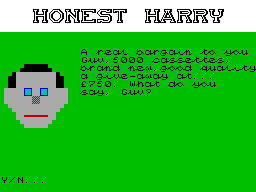
WHO WANTS TO BE A MILLIONAIRE? Computer games have always been good at producing simulations of flying a jet air craft or driving a rally car but, up to now, there's been one missing - how to get rich quick. Millionaire seems to have filled this gap quite well. The game places you in the shoes of a young hot shot programmer who wants to start up his own software company. With only £500 to start you off, your task is to build a highly profitable games empire. The game simulates all the demands of being in Britain's biggest growth industry. You must decide what quality your games are going to be, how long you should spend programming and whether it is wiser to develop new titles or to convert your present titles. You also have to arrange to borrow money from the bank and, if you're in financial difficulties, you can always pay Honest Harry a visit but - watch out - because he will rip you off if he can! The game also gives you graphic representations of your sales, profit and turnover figures and even draws a picture of the house you own. The game starts you off in a little terraced house and, if your business becomes a success, you could even end up buying yourself a stately home in the country. Millionaire is available from Reading-based Incentive Software for the 48K Spectrum and costs £5.50.
Crash #4May 1984 · p.9078%76%85%78%79%84%80%
Use of Computer 78%
Graphics 76%
Playability 85%
Getting Started 78%
Addictive Qualities 79%
Value For Money 84%
Overall 80%
Unknown
Unknown
Unknown
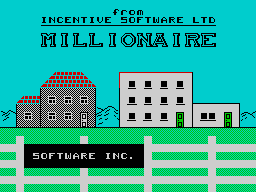
Producer: Incentive Software Memory Required: 48K Retail Price: £5.50 Author: John Hunt The title page of this new strategy game shows a millionaire's mansion next to a drab looking block of flats - rags to riches. When the loading is completed the screen clears and you hear a telephone ringing - could it be fame on the other end? As a home computer owner, you have written a program and are willing to invest £500 of your own money into marketing it. Can you make it to the top? First up comes the inevitable strategy option menu - in this case a choice of what the program is to be: arcade, adventure, board game, business/serious program, educational, management game, utility program, wargame or Other. Having made this decision you are told that every good program will consist of a) good writing b) good presentation, c) original ideas or d) should maintain interest. You have 20 points and you must allocate the points according to your thoughts on these four headings. When this is done you may choose to market the game yourself, or sell it to a software house to raise more capital. Should you sell there are a few offers (the biggest of a meagre bunch of bids coming from Incentive of course). If none are acceptable you can carry on yourself. The game presents most of the likely problems confronting a small software business and takes in such items as the cost of advertising and duplication. Decisions must be made regarding articles and PR in magazines, raising loan capital at the bank, writing new programs and whether to increase sales by adding short second programs to the other side of your tapes. Each month a chart shows your progress, how many tapes have been sold in the month, how many games on the market, total sales, tapes still in stock, and on the debit side - rates, phones etc, total assets and amount borrowed from the bank. Interspersed news items inform you of things such as weather condition affecting sales of games, or whether a magazine has published an article about your products. If the worst should come to the worst, you can always sell out... COMMENTS Control keys: mostly numeric keys, all screen prompted Keyboard play: very fast responses Use of colour: very good Graphics: effective text, detailed scenes Sound: average Skill levels: 1
Advert50
- C&VG (Computer & Video Games) #38Dec 1984 · p.23
- Popular Computing Weekly #47Nov 1984 · p.37
- Crash #7Aug 1984 · p.35
- Big K #5Aug 1984 · p.5
- Micro Adventurer #10Aug 1984 · p.22
- Popular Computing Weekly #32Aug 1984 · p.39
- Big K #4Jul 1984 · p.5
- Crash #6Jul 1984 · p.39
- Big K #3Jun 1984 · p.94
- Sinclair User #27Jun 1984 · p.107
- Crash #5Jun 1984 · p.39
- Crash #5Jun 1984 · p.29
- Personal Computer Games #7Jun 1984 · p.35
- Personal Computer News #63Jun 1984 · p.11
- C&VG (Computer & Video Games) #32Jun 1984 · p.83
- Your Spectrum #4Jun 1984 · p.81
- Your Spectrum #4Jun 1984 · p.66
- Personal Computer Games #6May 1984 · p.5
- Popular Computing Weekly #21May 1984 · p.25
- C&VG (Computer & Video Games) #31May 1984 · p.57
- Home Computing Weekly #63May 1984 · p.27
- Popular Computing Weekly #18May 1984 · p.35
- C&VG (Computer & Video Games) #31May 1984 · p.55
- Sinclair User #26May 1984 · p.56
- Sinclair User #26May 1984 · p.57
News/Note4
- ZX Computing #14Aug 1984 · p.36
- Games ComputingJul 1984 · p.7
- C&VG (Computer & Video Games) #31May 1984 · p.17
- Personal Computer News #57Apr 1984 · p.7
Feature3
- Your Computer #7Jul 1984 · p.56
- Sinclair Programs #21Jul 1984 · p.30
- Crash #4May 1984 · p.93
Review3
- Popular Computing Weekly #19May 1984 · p.20
- Home Computing Weekly #62May 1984 · p.13
- Popular Computing Weekly #16Apr 1984 · p.56
CompoEntry1
- Crash #4May 1984 · p.93
Related
Reviews from people here
Sign in to write about this, or make an account. It takes a minute and lets you correct the catalogue too.
No description recorded.
Sign in to correct or add to this.
Hold the rights to this and want it taken down?