
Mission Omega
Arcade Game: Maze · ZX-Spectrum 48K · 1 players · English
Mind Games · 1986
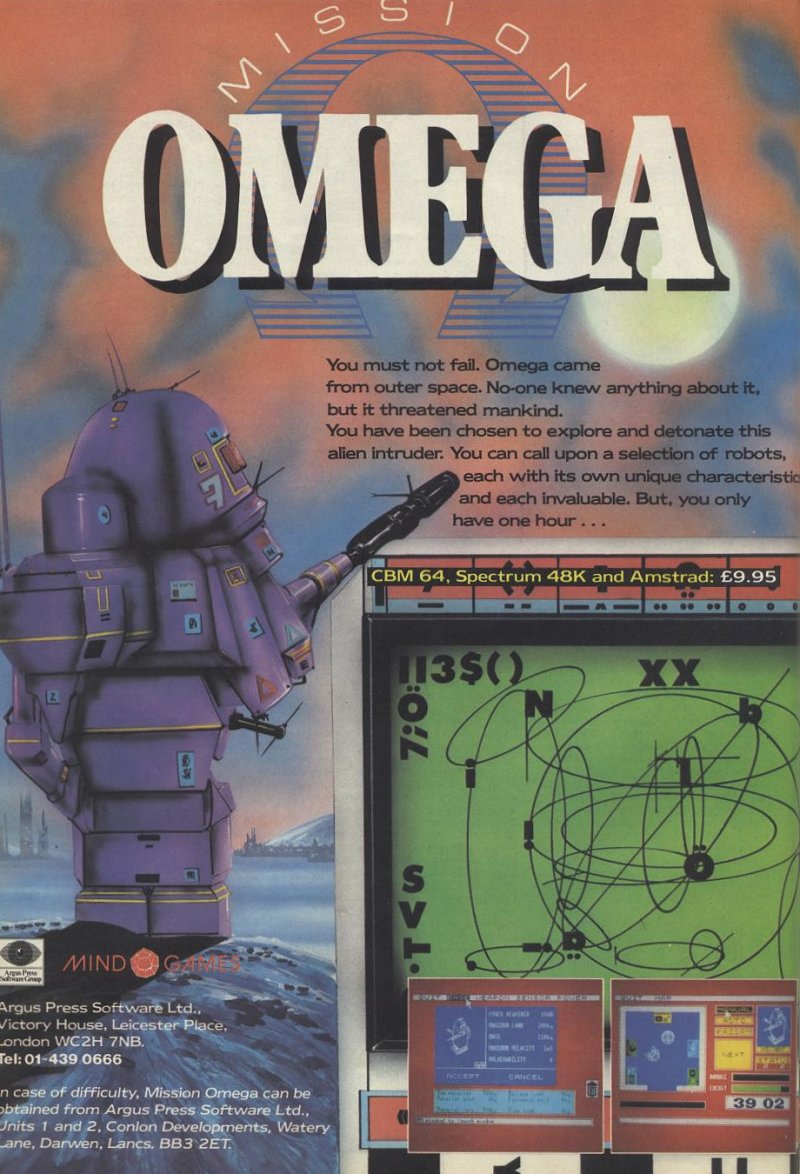
_Back.jpg)
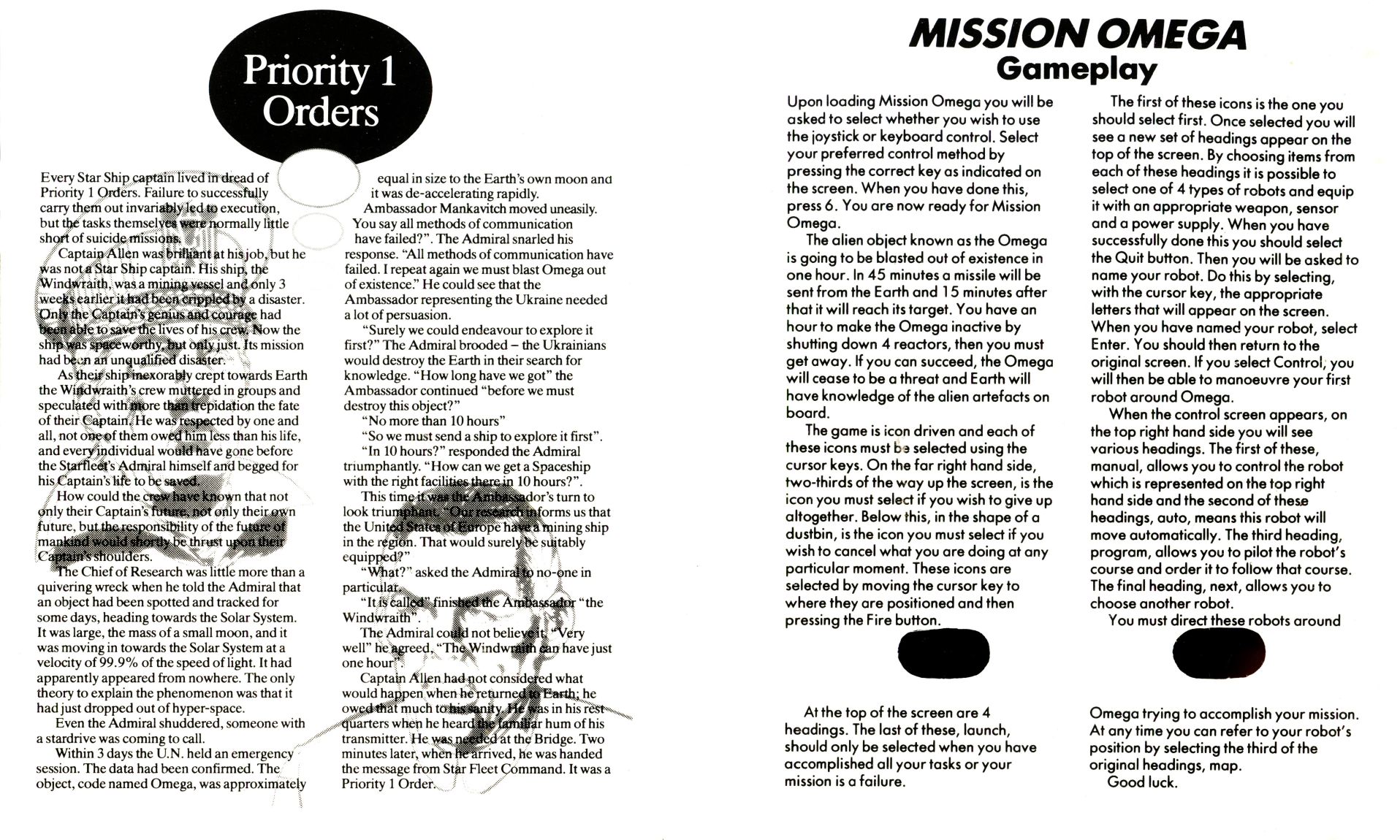
.jpg)
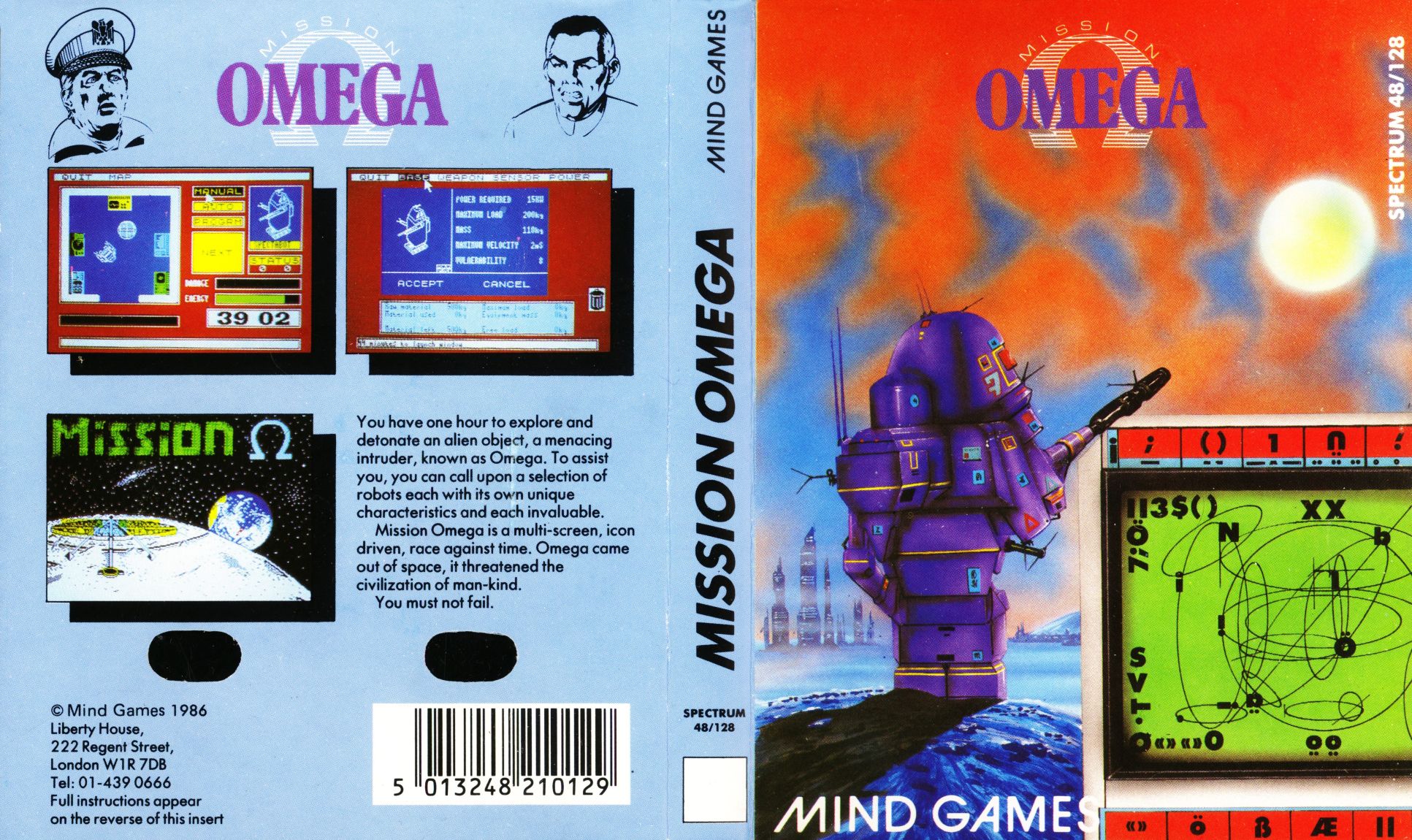
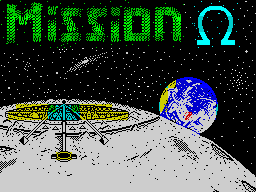
_Media.jpg)
Discussion
Nobody has started a thread about this yet.
- Control Option
- Cursor, Interface 2 (right), Kempston Joystick
Releases
- 1986Mind Games
- 1988Bug-Byte Software LtdPound sterling 1.99
Play
- MissionOmega.tzx.zipTape image English33 KB
- MissionOmega.tap.zipTape image English32 KB
- MissionOmega(Bug-ByteSoftwareLtd).tzx.zipTape image English33 KB
Documents
- MissionOmega.pdfInstructions English65 KB
- MissionOmega(Bug-ByteSoftwareLtd).txtInstructions English3 KB
Files and rights
No permission is on record either way. Screens and pictures are copied here on a take-down basis: if you hold the rights and want something removed, say so and it goes.
Credits
- Stephen Wardcredited
Sign in to credit somebody, or say what these people did.
Awards
Scores
In the magazines
- Sinclair User #551986 · Overall4/5
- ZX Computing #301986 · OverallGreat
- Crash #321986 · Overall75%
- Your Sinclair #191987 · Mission Omega6/10
- Your Sinclair #421989 · Overall2/10
Elsewhere on the web
- WorldOfSpectrum 12 votes7.58
In the magazines 13
Your Sinclair #42Jun 1989 · p.432/102/10
Overall 2/10
Marcus Berkmann 2/10
BARGAIN BASEMENT They're certainly cheap, but are they cheerful? Marcus Berkmann rootles around in the YS Lucky Dip... MISSION OMEGA Bug-Byte £1.99 Reviewer: Marcus Berkmann A weird one, this. Every so often you get a game which has more features that it knows what to do with, but not much game to speak of, and Mission Omega is a superb example. Essentially what you have to do is build a robot - on the initial pull-down-menu-driven screens, you get a choice of the various whizzo components you can use - and then guide it around an alien spaceship, trying to switch off four reactors within a time limit. Muck it up and a rocket will blow up the craft - do it properly and, well, you can go and play something more interesting. Trouble is, there's not much here of any interest at all. The ship's innumerable corridors and rooms all look exactly the same - dullsville - and the game's instructions are so sketchy that it's never made at all clear what is going on and what you are supposed to do. Even after you have worked it all out by trial and error, you wander around a bit and find yourself asking, "Is that it?" before throwing the Speccy out of the window. A total waste of time, I'm afraid - expensive even at two quid.
Sinclair User #55Oct 1986 · p.384/54/5
Overall 4/5
Graham Taylor 4/5
Label: Mindgames Price: £9.95 Joystick: various Memory: 48K/128K Reviewer: Graham Taylor The mindgames titles from Argus have often resulted in journalistic U-turns. Alien, for example was largely dismissed, until a couple of months later. As people began to play it the game slowly grew in status. So, perhaps it will be the same now with Mission Omega, which at first look seems relatively unexciting. Mission Omega is a maze puzzles game on a grand scale except that strategy and advance planning count for more than turn-on-a-sixpence instant reactions. As for plot, here's what Argus have to say: Codenamed 'Omega', it simply came out of space. No-one knew anything about it, but it threatened the civilisation of mankind! ignore all that stuff, here's the simplified version: baddie thing that looks like a giant maze; you have to use robots to search it because it's radioactive and try to shut down the reactor which will blow up within the hour. In Stage 1 you design a robot and throughout the game you must design additional robots and send them into the field. Robot design means careful consideration of what features are most important: firepower is useful but drains energy and may be heavy, different legs can support different loads and so on. As you play the game it so becomes apparent that at different points you will need different sorts of robot. Most of the maze is hidden from you until you actually trace your way though it using one of your robots. You can see what areas of the map have currently been uncovered by referring to a map where known areas and the current positions of your robots are indicated. Parts of the maze may be 'jumped' using matter transporters (well, flashing squares anyway), other parts are blocked by laser screens which can be switched off by blasting at switches (usually) located in the vicinity. Organising the robots and finding the routes through the maze. These are the prime elements to the game. If you enjoy planning and strategy games this is unusual and challenging. You even get to blast a few things as well, instrument panels. Sound is equally minimalist. Don't buy the game if these factors matter to you.
The four ready constructed robots supplied with the games. Use them or build your own. Each of the four has its own strengths and weaknesses.
GRAPHICS Visually the game is nothing too special, the icons are reasonably interesting, the maze absolutely plain, empty apart from occasional flickering.
ZX Computing #30Oct 1986 · p.57ZX Computing GlobellaGreat
ZX ComputingZX Computing Globella
Overall Great
TIME TO SAVE THE WORLD AGAIN AS A PLANET SIZED U.F.O. IS ON COLLISION COURSE WITH EARTH. Mind Game £9.95 Everyone dreaded ever receiving a Priority 1 order from Star Fleet Command. It was the regular nightmare of a certain Captain Allen. Thankfully, though, Captain Allen didn't control a big fighter, or a space carrier, so he wouldn't get a Priority, would he? So his mission had been a failure, even Star Fleet Command wouldn't execute a captain of a mining ship would they? Surely not. Flying back from the outer reaches of space, all these thoughts, together with many more, were skipping about Captain Allen's mind. How could he be expected to know that at that very minute, an unidentified flying object, roughly the size of earth's moon, was rushing at 99.9% the speed of light, towards his home, earth. He could also hardly have guessed that at a general council meeting, the Ambassador for the Ukraine had just passed a resolution stating that a small ship called The Windwraith should examine the object before it was blown apart by missiles. One thing Captain Allen did know was that his ship was called The Windwraith, and he had just received a priority 1 order. This is where you take control of the mission, now called Omega after the U.F.O. Having selected whether you wish to use joystick or keyboard, you are then ready to take on this challenge. You have one hour - in total - to make the Omega inactive, by shutting down all four reactors. As if this were not enough, you must then escape, with all your crew. If you succeed, you will probably be heralded as a hero given a Knighthood, two million pounds, etc. If you fail, well it could be worse, but not much. Mission Omega is Argus' latest attempt to have a hit, and they may just have cracked it. Unlike many games, it cannot be fairly categorised, as it combines arcade adventure, with strategy and shooting. And all this is icon driven. Most of these are pretty obvious, with a bin halting any intended moves, and the rest being labelled. At the top of the first screen are four icon headings, and to start with you must choose to build some robots, with which to map the Omega, and accomplish your increasingly difficult task. Once you have chosen to build a robot, you are given various different options Firstly you must choose the robot you wish to use as a base unit. Some are fast, but can only carry a little weight. Consequently there are others that can carry anything, but are very slow. Having chosen the robot, you must choose a weapon, a navigational device, and a power pack. Again, there are different choices in each category, with weight being the vital factor. However much you would like a fast robot with infrared sensors missiles and a nuclear battery, this is just not possible! Having decided on the first robot, you must name him. If you wish to start playing, you may however, build more than one robot. As you find out when you first embark into the spaceship having a few robots is a very necessary precaution. Controlling the robots is a matter of choice, and position. The three options are automatic, program, or manual. Using automatic is good very early on, but to get anywhere it is necessary to either program a previously used route, or to do it all manually. Getting lost is a very real problem, so sticking together and using the map is essential for the first few minutes. As the game is played, so the screen is updated depending on which robot you are currently controlling. At any time, you can swap from one robot to another, and indeed this is essential to allow each robot's batteries to recharge. Also displayed on screen is the ever decreasing amount of time you have to finish the mission, or die (mostly the latter). Most of the U.F.O. Is made up of separate rooms and corridors with the odd computer, and even some baddies who range from very easy to dispose of, to pretty impossible. Both the graphics and the sound are good, especially animation of the robots which enables them to be distinguished at first glance. Mission Omega is one of the best games to come from the Argus stable of companies, in this case Mind Games. It combines neat graphics with some excellent basic ideas and comes up with a game that should appeal to everyone willing to spend more than ten minutes trying to save the world from imminent destruction.
C&VG (Computer & Video Games) #60Oct 1986 · p.347/105/107/107/10
Graphics 7/10
Sound 5/10
Value 7/10
Playability 7/10
Tim Metcalfe
MACHINE: Spectrum/Amstrad SUPPLIER: Mind Games PRICE: £9.95 (Spectrum), £14.95 (Amstrad disc) This may well be a good game. Trouble is the instructions are so inadequate that it's hard to tell. The basic idea is fairly good. You have to construct - literally - a team of droids to explore a moon-sized UFO code-named OMEGA which is hurtling towards Earth and threatening to collide with our home planet. The military want to destroy it but scientists think it should be explored and possibly deactivated by a disposable team of droids. You have just one hour to complete your task. The first part of the game involves constructing your droids. You have a limited supply of materials to do this. Once out of the construct droid screen you find yourself actually on OMEGA. A window on the left shows a large plan view of your surroundings while the right hand side has various status and control windows accessed by an arrow cursor. It also shows a small picture of the droid you currently control. Then it's really all down to you. You have to guide your droid team around - attempting to find the four reactors which will shut OMEGA down before it is destroyed by a defensive missile strike from Earth. There is a map option which enables you to find out just where the members of your team are within OMEGA. It appears there are four quadrants and there are teleports which you can use to reach them. The map only operates when one of your team is in that particular quadrant. You'll also come across defence droids in OMEGA's many rooms and corridors who seem constantly hostile to you. The game is totally icon controlled. These work quickly and smoothly in both versions of the game. A nice touch is the "program" option which enables you to "tell" your droid how to move without having to guide him around manually via keyboard or joystick. I've a feeling that Mission Omega could well grow on you after prolonged exposure. But you're going to have to be a fan of this type of game to be prepared to give it that chance. Going back to the limited instructions for a moment - here's a little gem from them. "The first of these icons is the one you should select first." Yeah, OK! The packaging and instructions should always reflect the complexity of the game - in this case it doesn't.
Crash #32Sep 1986 · p.8281%36%75%79%N/A86%72%75%75%
Presentation 81%
Rules 36%
Playability 75%
Graphics 79%
Authenticity N/A
Opponent 86%
Value For Money 72%
Overall 75%
Sean Masterson 75%
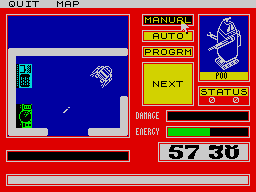
FRONTLINE With Sean Masterson HALF A PAGE OF SCRIBBLED LINES Yet another unduly shrunken episode in the unending saga of Frontline starts here folks. With the limitations on page space, I'm afraid that there is no room for the Forum. However, after a tremendous response to Peter Shields' letter last month (the one that suggested Rosetta and I go and join the four million), the benign and ever jolly Graeme has promised to allocate some extra letters space next issue. Keep your fingers crossed. This is of course that time of year when effort is directed towards putting last minute touches to software in time for The Show, panic sets in and software houses set up shop in Olympia at the PCW Show. I'm looking forward to this year's event. More and more, software developers are considering the way the American software market is progressing and introducing more strategic overtones to their games. No doubt the time will come when it will be very difficult to 'pigeon-hole' a game. Until that day, it should be interesting to watch the face of software gradually change. Go along and enjoy yourselves. MISSION OMEGA Producer: Mind Games Retail Price: £9.95 Latest in the Argus Press Software Mind Games range is Mission Omega, an arcade strategy game with some interesting aspects. The plot goes like this. You are Captain Men of the Windwraith, a mining vessel of the United States of Europe. Your ship has just survived a perilous mining mission, but fate is set to deal another blow. An unknown object with the mass of a small moon has entered the solar system with a velocity just less than the speed of light itself and a trajectory taking it ever closer to Earth. Attempts to contact it have failed and, out of fear, Earth's politicians have decided it must be deactivated. Windwraith is the only ship capable of reaching it in time. In fact you have one hour real time. After forty five minutes, the object (codenamed Omega) launches a missile towards Earth. Fifteen minutes later, it reaches its destination. Inside that hour, Omega's four reactors must be shut down and you must escape, thereby making the artefact safe. The fully icon driven game centres on the exploration of the vessel hurtling towards Earth. You need to construct several robots in order to start exploring, and up to eight may be built, each with a base, weapon, sensor and power pack. The number and type of robots are limited by the amount of resources carried by the mining craft. Several types of each of the four robotic components are available, making the actual choice of machines quite varied. Robot bases may be anti-gravity, tracked, legged or sphere (rather like a Terrahawks Zeroid). Weapons include small and large lasers, particle beam weapons and missiles. Sensors offer the choice of visual, audio or infra-red while power packs consist of two types of battery or a small nuclear reactor. The combinations may be limited by the fact that certain items need more power than others and each chassis can only support so many kilograms' mass. The computer will not allow robots that do not conform to the restrictions of their components to be assembled. However, seeing as they have to be built in real time, there is little room for error. Once your robots have been built and named, exploration may begin. This may take place in one of three ways. The first, and most obvious of these is by manual control of each robot one at a time. However, robots may be allowed to progress on automatic (though this is only possible for a short period of time) or may be programmed for a limited number of moves (and this was one option that did not seem to work). When a droid is under your control, its progress is displayed on an animated display to the left of the screen. To the right is a real time clock, status display for the droid, damage and energy displays, control options (manual, auto and programmed) and an icon to select the next droid for control. At the top of the screen the Quit and Map options are provided - the map only showing the part of Omega explored so far. At the base of the screen is a message window, used for communications with droids. Robot power packs gradually run down and eventually leave droids immobile, but a drained pack recharges if the droid is left alone for a while. More importantly, Omega is equipped with its own defence droids which are inevitably encountered from time to time. When they are, it's useful to have a droid with a powerful weapon and an accurate sensor unit! In fact a series of keys are required to allow access to each of the reactors. Keys are relatively easy to find. Reactors have to be found, identified and deactivated. Even then there are a lot of unanswered questions. How does the teleport work? (I can use them but not necessarily control them.) What is the purpose of the switches set sporadically across the complex and do they have anything to do with the apparently invulnerable force fields? Is there anywhere where new sources of raw materials to build replacement droids can be found? What Argus have managed to create here is an interesting, difficult but colourful and enjoy able hybrid game that should appeal equally to strategy and arcade fans. It isn't the best of its kind by any means but the chances are, you won't give up until it's successfully completed. The worst part of the game is the instruction inlay. It's a total waste of time. Apart from contradicting itself (at one point saying Omega has to be destroyed, then just deactivated), it doesn't even mention which keys are needed to do what. There is also no warning about the fact that the game is not Interface 1 compatible. Apart from the dreadful instructions, and the rather steep price, the game really is worth taking a closer look at. Now, I wonder how I'm going to disable those force fields...
Now Games 4 carries this game and has 8 references of its own.
Games Compendium carries this game and has 13 references of its own.
Review2
- Your Sinclair #19Jul 1987 · p.61
- Computer Gamer #18Sep 1986 · p.26
Full-page ad2
- Crash #31Aug 1986 · p.48
- Popular Computing Weekly #30Jul 1986 · p.17
CoverGame1
- Your Sinclair #78Jun 1992 · p.5
Feature1
- Crash #54Jul 1988 · p.61
Offer1
- ZX Computing #38Jun 1987 · p.48
News/Note1
- Popular Computing Weekly #34Aug 1986 · p.41
Related
- Ports
- (Amstrad CPC), (Commodore 64)
- Tags
- Robots
- Same entry at
- Spectrum ComputingZXInfo
Reviews from people here
Sign in to write about this, or make an account. It takes a minute and lets you correct the catalogue too.
No description recorded.
Sign in to correct or add to this.
Hold the rights to this and want it taken down?