
Monopoly
Game: Board · ZX-Spectrum 48K · 6 players · English
Leisure Genius · 1985 · Pound sterling 9.95
Discussion
Nobody has started a thread about this yet.
Remarks
ZXSR: Released on Mind-Stretchers Compilation: Others included Scrabble and Cluedo.
Play
- monopoly.rzxRZX playback file
- Monopoly.tzx.zipTape image English34 KB
- Monopoly(different).tzx.zipTape image English34 KB
- Monopoly.tap.zipTape image English44 KB
Documents
- Monopoly.txtInstructions English22 KB
- Monopoly(EN).pdfInstructions English324 KB
Files and rights
No permission is on record either way. Screens and pictures are copied here on a take-down basis: if you hold the rights and want something removed, say so and it goes.
Credits
- Mat Bucklandcredited
Sign in to credit somebody, or say what these people did.
Scores
In the magazines
- Sinclair User #421985 · Overall2/5
- Crash #191985 · Overall88%
Elsewhere on the web
- WorldOfSpectrum 16 votes7.38
In the magazines 36
Your Spectrum #20Nov 1985 · p.577/106/108/10
Dougie Bern 7/10
Rick Robson 6/10
Ross Holman 8/10
JOYSTICK JURY Are you ready for a software siege? It's time for our trusty panel of joystick jurors to line up all the latest and greatest games and put them through their paces! Let Ross Holman, Rick Robson and Dougie Bern lead you to the hottest arcade action around! MONOPOLY Leisure Genius £9.95 Rick: Does following the traumas of Uncle Clive in the market place put too much strain on the old ticker? Why not relax and put your greenbacks into where the real bunce is - simple low down, land and property. Leisure Genius's adaption of Waddington's classic board game Monopoly could be just the start you need - gazump your girlfriend, bankrupt your brother and mortgage your mother in this fun family game! As Monopoly imitates life, so leisure Genius has unerringly simulated it for the computer. Technically, nothing would appear to be missing from the original. And there are added bonuses - your snotty brother can't kick the board over 'cos he's 'the boot' again or 'cos he's landed on your Regent Street with 4 hotels for the eighth time (tee hee!). More importantly, there's a facility for playing by yourself for all you lonely hearts Monopoly fans. Trading with other players seems slower than in the board version - and not so much fun - it's hard to haggle and shout abuse on a TV screen (for some at least). I also missed the crackle of new £50 toy-town notes between my fingers - and piling up my placcy houses and hotels. Otherwise it's a worthy if hardly imaginative translation, staying loyal to the original but you probably expect a little more from your computer games.
Sinclair User #42Sep 1985 · p.242/52/5
Overall 2/5
Bill Scolding 2/5
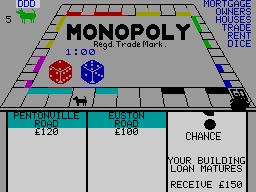
Publisher: Leisure Genius Price: £9.95 Memory: 48K Much of my misspent youth was devoted to playing Monopoly. It was never long before the board was awash with beer and property cards littered the floor. When the banker got bottled we all went to bed. Leisure Genius, in its official version, has done its best to depict board, dice and deed cards. Up to six people can play, or the computer can control as many players as you wish. The top two-thirds of the screen depict the board in 3D perspective over which the crudely drawn pieces move, often resulting in frightening colour clashes. Names are absent too, so you have to know the board by heart. Much better is the scrolling bird's eye view which takes place below. As the pieces move the relevant squares march from left to right. As you can't see what cards you or the other players hold, you have to call up the property menu to remind yourself that you really were foolish enough to buy the Electric Co. The same applies for finding how little money you have left. Trading is a farce. You must pinpoint the property you want to exchange, and the one you wish to gain, using a cursor which moves across the board. Again, as the squares are not named, you must remember exactly where your properties are, otherwise you will attempt to trade a property you might not even hold. Trading between two computer controlled players is virtually never successful, as the computer will offer ludicrously small cash incentives - £141 for Mayfair, in one instance. Buying houses and hotels is disappointing. As they do not appear on the board, you can't gloat over your row of terraced slum dwellings crowded on the Old Kent Road. Just about the only reason for playing computer Monopoly is if you are a lonely addict adrift amongst inveterate Trivial Pursuiters. Beating the Spectrum offers little solace, however. And it's very boring.
Crash #19Aug 1985 · p.12075%80%85%82%87%75%88%
Use of Computer 75%
Graphics 80%
Playability 85%
Getting Started 82%
Addictive Qualities 87%
Value For Money 75%
Overall 88%
Unknown
Unknown
Unknown
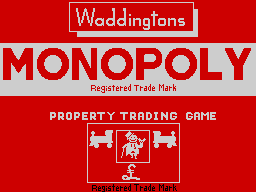
Producer: Leisure Genius Memory Required: 48K Retail Price: £9.95 Language: Machine code Author: Various At last it's arrived fifty years after Monopoly was first produced as a board game the Spectrum's very own, and official, version of Monopoly. An appropriate way to celebrate a fiftieth birthday! The game is played according to the rules laid down for the official version of the game and that's going to lead to more than a few surprises but it should stop the arguments. The game allows for between two and six players, any number of whom can be played by the computer. You could set up a game with you playing five opponents, all run by the computer which has six inbuilt personalities available for random allocation to the tokens it plays. The playing characteristics are meant to simulate different playing styles: Mean, Reckless, Greedy, Steady, Cautious and Entrepreneurial. Each computer-played token will act according to one of these personalities. The role of the bank is always taken by the computer - which plays impeccably fairly! Before the game begins you will be asked to enter the names of the players and which ones are to be played by the computer. Players are allowed to select the token they prefer. Next the program asks if you want to play a short game, which is played until the time limit (also prompted for by the computer) is reached. The player having the greatest worth at 'time up' will be the winner. The 'who starts first' question is resolved by the computer rolling some dice on screen. The player with the highest number starts. The game display splits the screen into two pans. The upper two thirds show a three-dimensional view of the board with the individual properties clearly marked according to colour groups. While a token is being moved, the lower third of the screen gives a bird's eye view of the property that the token is on and the two preceding properties. In this view the properties appear exactly as they do on the real board. When a token settles on a property the square changes to show the information normally held on the back of the real property cards. A prompt will appear asking if you want to buy the property or not. If you answer 'yes' the cost is deducted from your account. Answer 'no' and, according to the rules, the bank auctions the property. The bank handles all money transactions including the collection of rent. If an opponent lands on your property you must claim rent by pressing 'R', after that the bank takes over. Should the tenant not have enough cash the bank will automatically start selling or mortgaging the impoverished tenant's property to settle the debt. If a token lands on a Chance or Community Chest square the computer selects a card and displays that in the board square that's the end of taking the nasty ones out (Bunch of cheats round their Monopoly board, the Spencer family it seems! Ed.). All of the other transactions that the game allows, buying and selling houses and trading properties, can be initialised by keying in the appropriate command letter when the computer will prompt for details of the transaction. All prompts and general information appear on the lower part of the screen. At almost any point a player can request a list of the properties and who, if anyone, owns them. When the list is presented individual players can then ask for a portfolio and examine each property in detail. Key 'M' and the bank will set up mortgages, a player indicates the property by positioning the cursor over it. The bank deducts a ten percent fee for all mortgages. If a player becomes bankrupt, the bank will sort out his affairs and then retire his token. A 'long game' continues until all but one of the players have been retired or until someone terminates the game with CAPS/SHIFT SPACE whereupon the assets of each player will be displayed. COMMENTS Control keys: as required by prompts Joystick: N/A Keyboard play: very good Use of colour: very effective Graphics: make for a good, easy to follow board layout Sound: a few warning beeps Skill levels: can be played against 6 different personalities Lives: 'till your money runs out Screens: one, split into two
MONOPOLY. All the fun of the board game, without the argument. And you can't hide a five hundred pound note under the carpet for emergencies, either.
Mind-Stretchers carries this game and has 4 references of its own.
Advert20
- ACE (Advanced Computer Entertainment) #41Feb 1991 · p.31
- New Computer Express #16Feb 1989 · p.9
- The Games Machine #15Feb 1989 · p.95
- C&VG (Computer & Video Games) #87Jan 1989 · p.99
- ACE (Advanced Computer Entertainment) #7Apr 1988 · p.58
- The Games Machine #5Apr 1988 · p.26
- Your Sinclair #25Jan 1988 · p.102
- Sinclair User #69Dec 1987 · p.43
- C&VG (Computer & Video Games) #74Dec 1987 · p.129
- Computer Gamer #23Feb 1987 · p.64
- C&VG (Computer & Video Games) #63Jan 1987 · p.10
- C&VG (Computer & Video Games) #62Dec 1986 · p.12
- Popular Computing Weekly #1Dec 1985 · p.9
- Popular Computing Weekly #48Nov 1985 · p.41
- Popular Computing Weekly #44Oct 1985 · p.39
- Sinclair User #42Sep 1985 · p.2
- Popular Computing Weekly #38Sep 1985 · p.11
- Crash #20Sep 1985 · p.41
- Crash #19Aug 1985 · p.41
- Popular Computing Weekly #32Aug 1985 · p.8
Review3
- ACE (Advanced Computer Entertainment) #51Dec 1991 · p.122
- ACE (Advanced Computer Entertainment) #50Nov 1991 · p.112
- Home Computing Weekly #122Jul 1985 · p.19
News/Note3
- Games ComputingMar 1985 · p.8
- Popular Computing Weekly #18May 1984 · p.5
- Popular Computing Weekly #10Mar 1983 · p.5
CompoEntry2
- C&VG (Computer & Video Games) #83Sep 1988 · p.14
- Crash #19Aug 1985 · p.76
Full-page ad2
- Popular Computing Weekly #49Dec 1984 · p.27
- Popular Computing Weekly #48Nov 1984 · p.9
Information1
- SSD-IISep 1999
Feature1
- ACE (Advanced Computer Entertainment) #15Dec 1988 · p.36
CompoResult1
- Crash #21Oct 1985 · p.120
Licensed from
- MonopolyBoard/TabletopParker Brothers, Waddingtons Games Ltd
Related
- Compilations
- Mind-Stretchers
- Ports
- (Amstrad CPC), (BBC Micro), (Commodore 64), (MSX), (Sega Master System), (Thomson MO/TO), Waddingtons Monopoly (Commodore 64)
- Tags
- Turn based
- Same entry at
- Spectrum ComputingZXInfo
Reviews from people here
Sign in to write about this, or make an account. It takes a minute and lets you correct the catalogue too.
Everything ZXDB can hold about this is here.
Sign in to correct or add to this.
Hold the rights to this and want it taken down?