Auto Chef
Strategy Game: Management · ZX-Spectrum 16K · 1 players · English
CCS · 1982
Also known as Autochef (English)
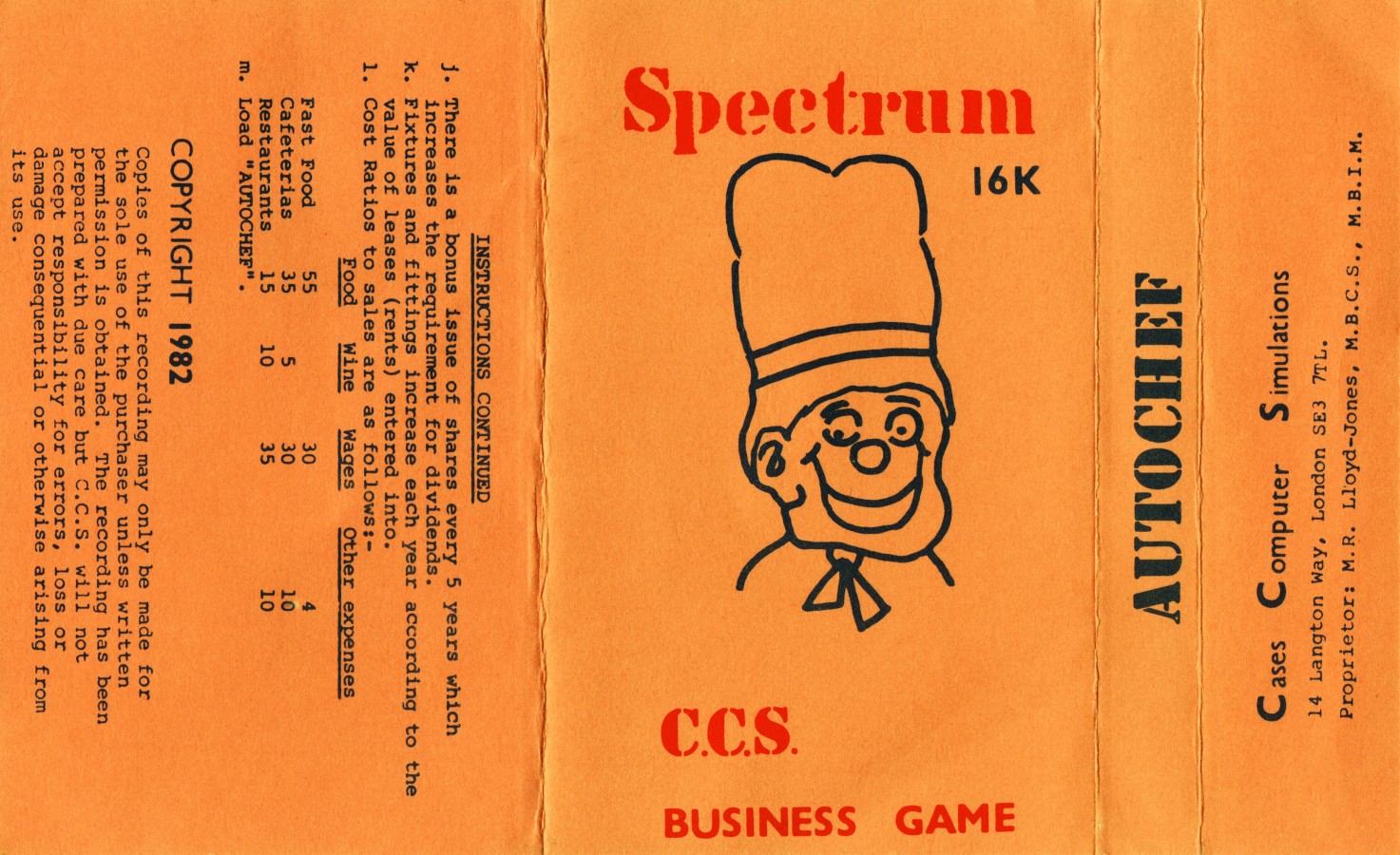
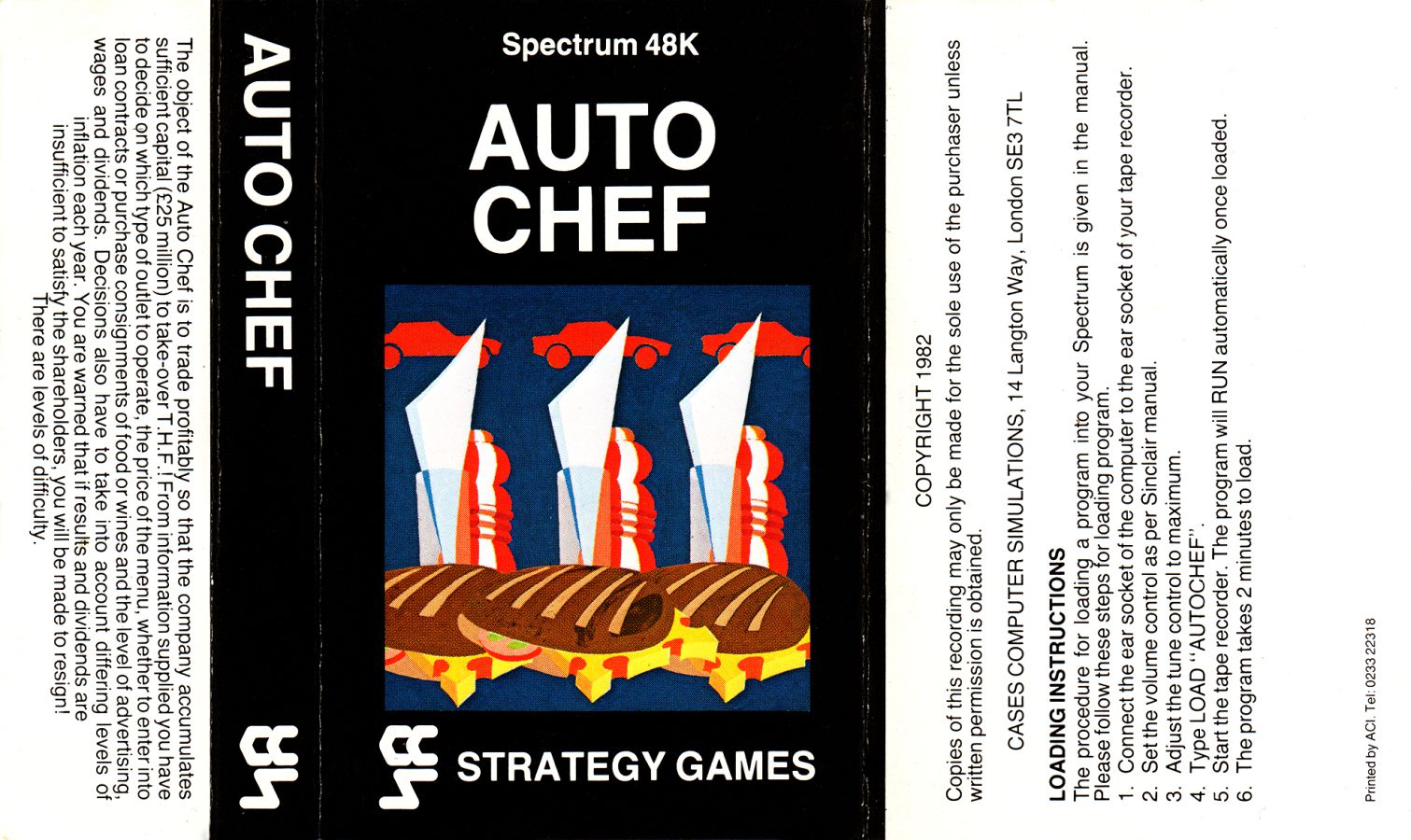
Discussion
Nobody has started a thread about this yet.
Releases
Play
- AutoChef(1982).tzx.zipTape image English9 KB
- AutoChef(1983).tzx.zipTape image English9 KB
- AutoChef.tap.zipTape image English5 KB
- AutoChef(RikoData).tzx.zipTape image English5 KB
Documents
- AutoChef.txtInstructions English4 KB
- AutoChef_3.txtInstructions English5 KB
Files and rights
Distribution permission is on record, granted to another archive rather than to this one. Screens and pictures are copied here; everything else links to the archive that holds it.
- AllowedCCS → WorldOfSpectrum
Scores
Elsewhere on the web
- WorldOfSpectrum 7 votes5.29
In the magazines 54
Crash #44Sep 1987 · p.95
Rosetta McLeod
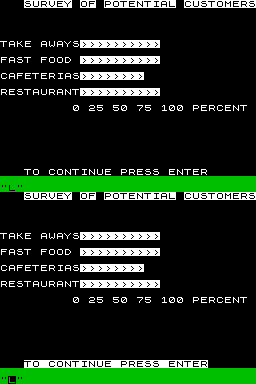
CRASH COURSE By Rosetta McLeod CRASH COURSE is back with a roundup of educational software for the new school year. And ROSETTA MCLEOD, who runs computer-assisted learning for the regional council in Aberdeen, will take the class in Crash every three months from now on. So the next Crash COURSE will be in issue 47, on sale 26 November. Read it - after all, there's never anything else for teachers to do around that time of year. In the meantime you may talk QUIETLY among yourselves. LEEDS UNIVERSITY physics student R L Navin has designed a very interesting adventure/arcade game for the 10-16 age group. The player must visit a series of locations, solving a physics-related problem in each. I've seen part of the design, and it has some potential - now Navin is looking for someone to program it with a view to marketing this educational game commercially. Anyone interested can write to me at Crash, and I'll forward the letters. FOR EVERYONE who's asked about catalogues of educational software very good catalogues are available from Rickets Educational Media, [redacted], and from Micro-Jenn Software, [redacted] (if writing to Micro-Jenn, specify that it's Spectrum software you're interested in). FRACTIONS 2 Producer: Key Software, [redacted] Retail Price: £4 on tape, £5.50 on microdrive Age Range: 9 to secondary-remedial level The first two programs on this tape are leaching programs, and the last tests the player's knowledge. Are They The Same? shows that when the numerator and denominator are equal the fraction must equal one, and that fractions such as 2/4, 3/6 and 4/8 are equal. Work Them Out extends this to the numerical concept of equivalent fractions. And Match Them sets some fraction problems. Overall, Fractions 2 is an excellent package, and the teaching sequences make very good use of graphics. Keyboard play: good Graphics: extremely good visual representations and clear colours General Rating: A very effective and attractive method of teaching fractions; it'll give the teacher/parent good information on the child's grasp of the concepts, too. DECIMALS Producer: Key Software Retail Price: £4 in tape, £5.50 on microdrive Age Range: 11 to secondary-remedial level Decimals tests a pupil's understanding of place-value series and the multiplication and division of decimal fractions by ten and 100. A question might ask, for example, 'what is 3.7 x 100?'. If the child gets it wrong a help window appears and the process is taught clearly and graphically, using the example in which the mistake was made. This very useful little program can be used to reinforce understanding of decimal fractions and place-value series. Keyboard play: very good Graphics: clear graphical representations in the help window, attractive colour General Rating: The help window is a particularly useful feature of this valuable program. LOOK SHARP! Producer: Mirrorsoft, [redacted] Retail Price: £7.95 Age Range: 7+ Author: Widgit Written by a head teacher, the two programs in this package are aimed at sharpening observation skills and visual memory. The first, Old MacDonald's Farm, contains three simple games. Memory challenges the player to reconstruct a farmyard scene from memory; Odd-One-Out tests observation with a spot-the-difference game, and Snap is the old favourite for one or two players. Look Sharp's second main program, S.O.R.T. (standing for Space Observer Recruitment Test), measures the player's readiness for a space mission to the Spiral Galaxy. After some practice SORTs, SORT 1 tests visual perception: two columns each made up of three picture elements appear on the screen and the player must spot when elements match. The next SORT deals with visual discrimination. This time, six versions of the same picture are shown, one slightly different from the others - the player has to pick the odd one out. The pictures are quite small with lots of detail, so it's not an easy task. And the final SORT tests visual memory - I discovered mine isn't very good! A picture with nine different elements is shown, and when it vanishes the player has to reconstruct the picture from memory, putting each element in the right place. Keyboard play: fast, but single-key commands make it ideal for very young children Graphics: very nice indeed General Rating: Very good value for money, with a strong fun element. MYSELF AND US Producer: Key Software Retail Price: £4 in tape, £5.50 on microdrive Age Range: 7 to secondary level These two were designed to provide a simple introduction to graphs, but they can also be used separately. Myself is a very simple program which provides the child with information about himself derived from his date of birth - the Chinese year of his birth, his age in years, star sign, number of days lived and day of birth, and an appropriate extract from the rhyme Monday's Child. All this can be printed out on a ZX-type printer. In the second program, Us, the user chooses a graph from one of the following categories: Starsign, Day Of Birth, Favourite Pet, Favourite Colour, Letters in First Name, Favourite Sport. Rooms in The House and Spare (which can be used for a topic of the teacher's choice). Up to 36 users can input information in each category, and then a graph of this information is displayed. So the relationship between the facts and their graphical representation is strengthened, and Myself And Us not only allows children to enter data about themselves but can also give such information as the day of the week on which an event happened or the star sign of a famous person. Keyboard play: very last, with clear screen instructions Graphics: the block, line and solid graphs are all clearly shown, with effective colour General Rating: Excellent and enjoyable. READ-RIGHT-AWAY Producer: H S Software, [redacted] Retail Price: £7.95 Age Range: 5 - 8 The two programs here aim to teach children to read using the phonic method - sounding out each letter of the word. Splashdown involves completing three-letter words. It takes place at sea; each player has a boat made up of three-letter words with one letter missing. If the correct letter is chosen, an aeroplane collects the letter and bombs the 'word boat', which then explodes and sinks into the player's underwater store, providing a visual record of the finished word. The menu allows you to set the skill level, and choose sequences of words which are similar (eg three all beginning with c and ending with t) or completely different (eg s-t, p-d). The position of the missing letter can also be selected. Firefight involves completing words with pairs of letters. This time, the player has to rescue the heroine from the top of a burning building by bridging holes in the building's floor with letters' Again, there's a choice of skill levels, and the letter pairs can be selected. Both games are very nicely presented and fun to play while providing practice in useful skills. Keyboard play: fast Graphics: very eye-catching and attractive, with effective colour. General Rating: Two enjoyable programs with built-in flexibility, so you can cater for each child. COUNT WITH OLIVER Producer: Mirrorsoft, [redacted] Retail Price: £7.95 Age Range: 4 - 7 Author: Marmalade Software These two games introduce young children to the basics of counting and simple addition and subtraction. In Toyshop, Oliver asks the player to count the toys in a shop window. Three different kinds of toys appear in three colours, and the program introduces the idea of sets as well as numbers. Toyshop is structured very well, becoming more difficult only when correct responses show the child's coping well. Lollipop gets further into simple arithmetic. First the prayer has to help Oliver buy lollipops of various colours from the shop; then the quantities of lollipops are added or subtracted. The second time you play the game in a session, two-digit numbers are introduced. Keyboard play: responsive Graphics: simple but attractive General Rating: Two well-structured, easy-to-handle programs which children will enjoy. WORDS AND PICTURES Producer: Chalksoft, [redacted] Retail Price: £9.95 Age Range: 3 - 7 Words And Pictures contains four programs which should encourage children to read. It uses 47 words common in early-reading schemes, and deals both with words and with sentences. In the two words programs, four colourful pictures are shown and a word is printed underneath in lower-case letters. The child must match it to the right picture. The two sentence programs are similar. A nice feature for classroom use: you can store a list of names and scores, and the computer will call each child to the program when it's his turn. The booklet is good, too. Keyboard play: good; single-key commands Graphics: very appealing, with excellent colour General Rating: An attractive package, making excellent use of graphics and sound, suitable for home and school. HOTLINE QUIZ Producer: Chalksoft, [redacted] Retail Price: £9.95 Age Range: 8 to adult This is one of the best quiz programs on the market. The player must repair the hotline telephone link between the world's leaders by correctly answering up to 20 questions. The question sets cover topics ranging from Holidays to Words to Cowboys to Monsters to Pirates. They're graded by difficulty, and new questions can be entered and saved. 11 children are allowed to research and word the questions and answers themselves, they'll be involved in a very effective learning process. Keyboard play: good; single-key commands Graphics: limited but attractive, with good colour General Rating: An excellent and flexible program which can be enjoyed by all the family. SETS Producer: AlphaPlus Educational Software, [redacted] Retail Price: £8.95 plus 90p postage and packing Age Range: GCSE and GCE O level students Sets is the first program in a series of mathematical software from Alphaplus, presenting a new approach to maths education - helping students develop confidence and a deeper understanding of mathematics. The series is based on the GCSE and GCE O level syllabuses. This attractive package includes an extremely comprehensive and well-produced 47-page manual with examples and problems to solve. (No cheating!) The menu offers six options covering sets and Venn diagrams. For the option DRAW VENN DIAGRAMS, for instance, the manual sets 12 problems for the student to solve on paper before using the program to check the answers. Keyboard play: good Graphics: clear and effective, with colour used sensibly to aid understanding General Rating: A very good, comprehensive package developed by experts and aimed at the serious student. AUTO CHEF Producer: Cases Computer Simulations, [redacted] Retail Price: £5.95 Age Range: older student/adults In Auto Chef you become Managing Director of a restaurant chain. The object of this simulation is to quickly increase your £1 million capital to £25 million and take over Trust House Forte! You can up business information onscreen, ranging from a balance sheet to a bar chart summarising a survey of customers' eating habits. And you have to remember there's a greater gross profit percentage on restaurants and cafeterias than on fast-food outlets and takeaways. Menu prices, too, must be considered - but if prices are too high, customers will be lost. Bulk purchase of food and wine, advertising costs, wages, fixtures and fittings... all these have to be taken into account, and all the time you need to keep the shareholders happy or they'll force you to resign! Keyboard play: fast, with simple control keys Graphics: clear bar charts and histograms, but limited colour General Rating: For business studies students, excellent practice in reading accounts and balance sheets. QUICK THINKING Producer: Mirrorsoft, [redacted] Retail Price: £6.95 Age Range: 6 - 12 Author: Widgit The Quick Thinking , cassette contains two early-learning programs, Sum Vaders and Robot Tables. Sum Vaders, for one or two players, gives practice in adding and subtracting a number appears on an Invading spaceship and another on the alien robot which it drops, and these two numbers must be added or subtracted before the robot lands. A wrong answer leaves the world defenceless against the robot invaders' In Robot Tables the player controls a machine manufacturing robots and has to make sure components are assembled in the right order. Again, several levels of difficulty are offered, and it's also possible to control the speed of the machine. At the fastest speed and the most difficult level this is quite a challenge, and the player really needs to know their multiplication tables. Keyboard play: responsive, with simple control keys Graphics: very attractive to children, with clear bright colours General Rating: A good, value-for-money package. PHOTOSYNTHESIS Producer: AVP Computing, [redacted] Retail Price: £10 Age Range: O level students Photosynthesis is a major topic in all biology syllabuses, and this program aims to give factual information and help revision. The menu offers four options: The Structure Of A Leaf, Adaptations Of A Leaf, Photosynthesis Experiments, and The Chemistry Of Photosynthesis. In the section on leaf structure, the user has to label correctly the diagram of a transverse section of a leaf - but before starting he can choose to see a correctly-labelled diagram. When the labels have been entered, the computer does the marking and presents the option of trying again, going on to another section, or seeing the correctly-labelled diagram. The leaf-adaptations option shows how leaves are designed to perform their functions efficiently. Again, the computer will demonstrate the various adaptations and the student is asked to match each adaptation to the role it plays - absorption of sunlight, transportation of gases and so on. Before starting the third section the student should have seen demonstrations of several photosynthesis experiments. The computer demonstrates the apparatus used to test a leaf for starch; to show that light, carbon dioxide and chlorophyll are necessary for photosynthesis; and to show that oxygen is produced. Each stage of an experiment is outlined in simple terms and illustrated with graphics, and then the result of the experiment is clearly stated. The user must match the apparatus to the right experiment. The final section of Photosynthesis, The Chemistry of Photosynthesis, contains a very clear demonstration of the reaction equation, and again the computer tests and marks the student's knowledge. Photosynthesis is a wide and complex topic, so this program doesn't attempt to cover every facet - but it's a very useful aid for O level. Keyboard play: good Graphics: simple, but used to good effect; limited colour General Rating: A useful aid which makes a very difficult topic much more accessible.
Crash #4May 1984 · p.68
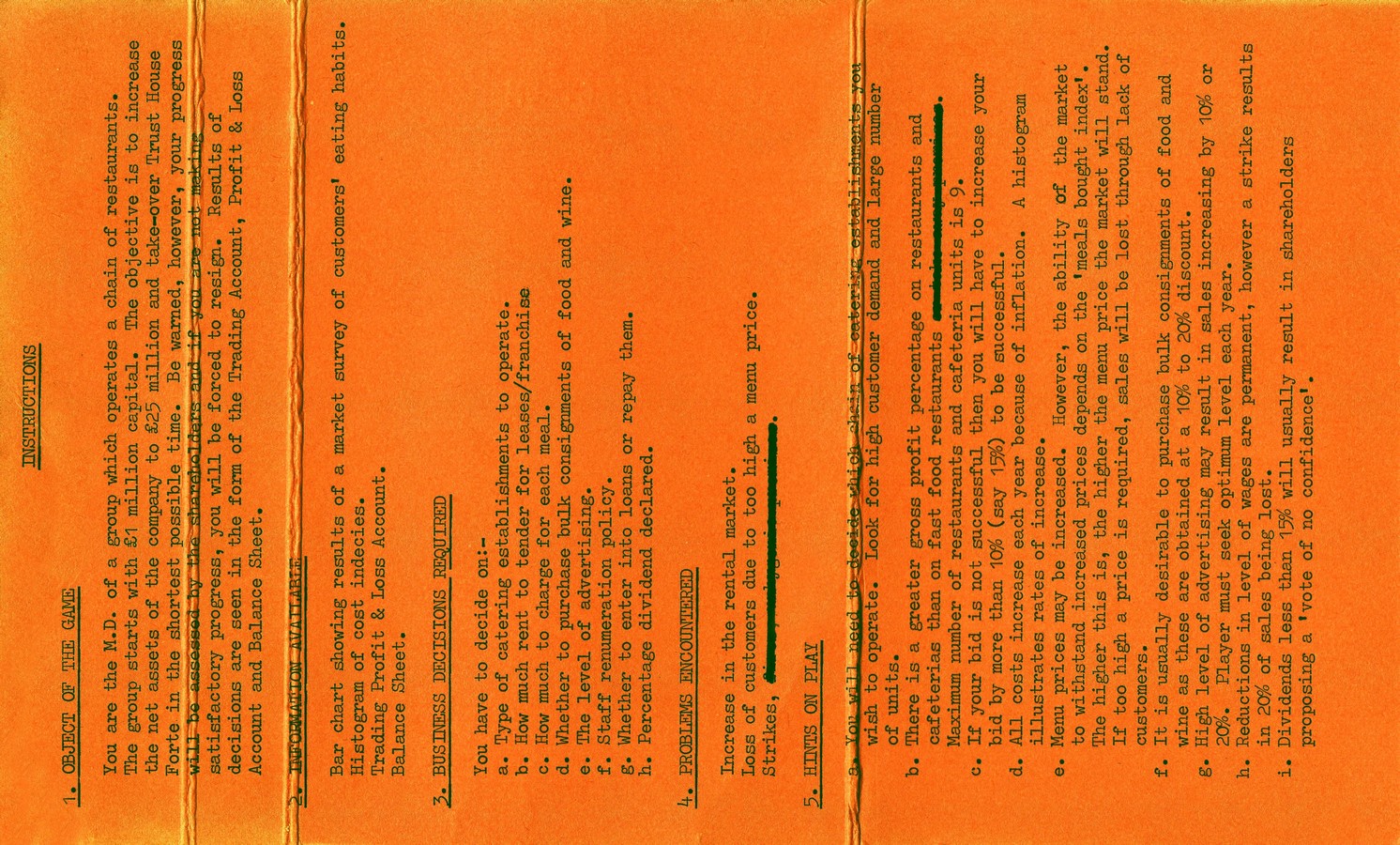
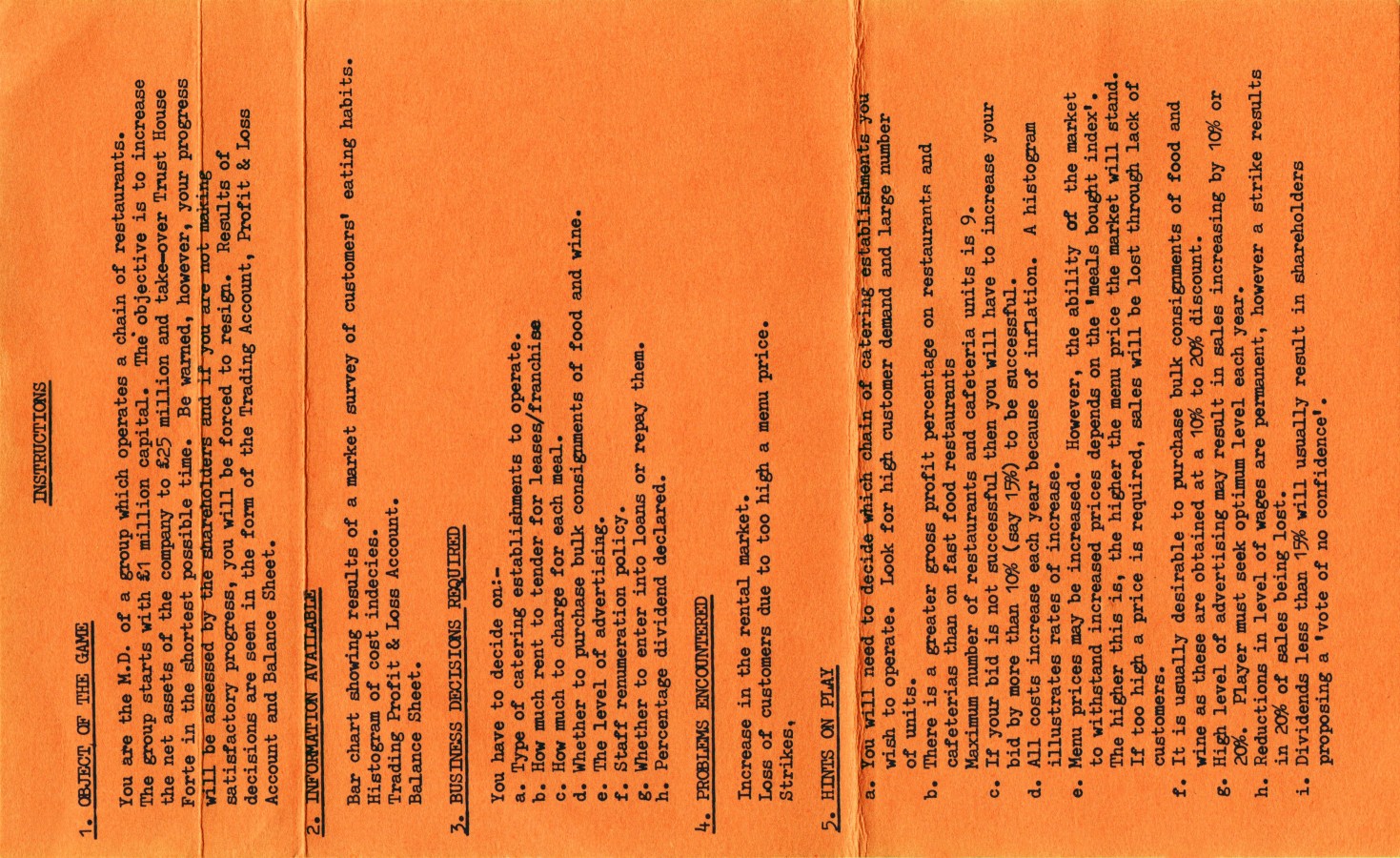
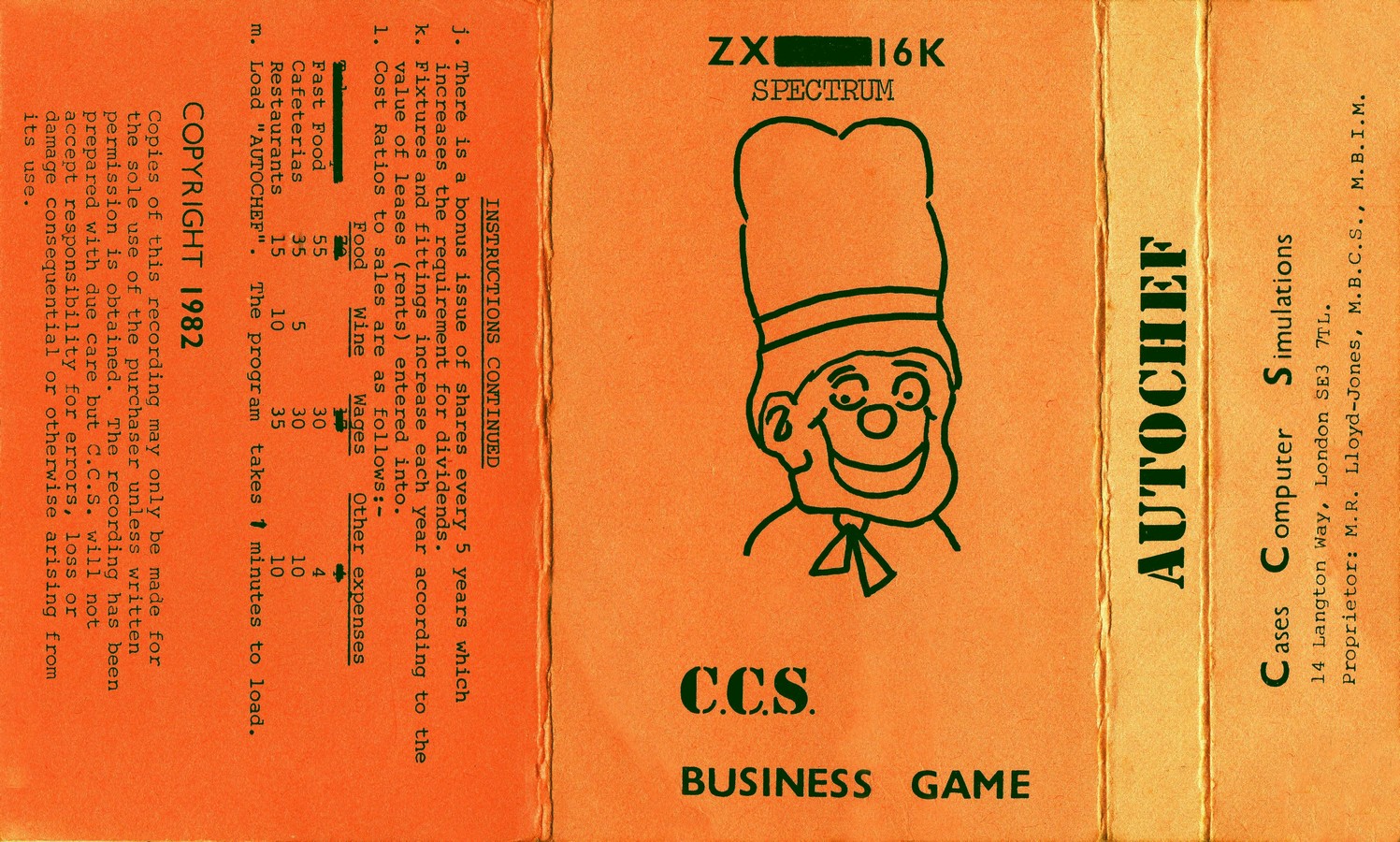
Producer: CCS, 16/48K £5/£6.00 You have a million in capital and must increase this to 25 million in the shortest possible time. The problems you must cope with include wary shareholders who are watching your every move, assessing your performance and who may even force you to resign if you're not doing well. Inflation, a sluggish economy and copious strikes are other problems you will face in this lively strategy from CCS. It's all very well eating fast food, but how fast is the money?
Crash #2Mar 1984 · p.63
Producer: CCS, 16/48K £5/£6.00 You have a million in capital and must increase this to 25 million in the shortest possible time. The problems you must cope with include wary shareholders who are watching your every move, assessing your performance and who may even force you to resign if you're not doing well. Inflation, a sluggish economy and copious strikes are other problems you will face in this lively strategy from CCS. It's all very well eating fast food, but how fast is the money?
Crash #1Feb 1984 · p.61
Producer: CCS, 16/48K £5/£6.00 You have a million in capital and must increase this to 25 million in the shortest possible time. The problems you must cope with include wary shareholders who are watching your every move, assessing your performance and who may even force you to resign if you're not doing well. Inflation, a sluggish economy and copious strikes are other problems you will face in this lively strategy from CCS. It's all very well eating fast food, but how fast is the money?
Your Computer #9Sep 1982 · p.28
Boris Allan
SURVEY SPECTRUM SOFTWARE Boris Allan examines the first software offerings designed specially for your Spectrum. Although the Spectrum was announced in April the machine has only become available in large numbers recently. For software suppliers it is still early days. We were therefore relieved to find that most of the programs we received worked first time and reasonably well even if some of them lacked originality. Most of the software we sampled was based on ZX-81 or arcade games but we also tried out some educational and utility programs. Loading the Spectrum was far less frustrating than the ZX-81. The machine performed well, producing particularly good colours but disappointing sound. The limitations of the internal speaker can at least be bypassed by taking the cassette out of the recorder, connecting the two Mic sockets and switching on the recorder. Tone and volume can then be controlled with the recorder's own controls. Games programs are strange things. Long complex programs can be much less enjoyable than a short snappy one incorporating a good idea. So long as the programs are relatively bug-free, as most of these Spectrum games were, then evaluation of any particular cassette is bound to be subjective. To give as objective an assessment as possible we tried out the games on all age groups - even a class of five-year olds. Both Bug-Byte's Spectral Invaders and Quicksilva's Space Invaders approach the standard of real arcade games. Spectral invaders is almost an exact copy of Space Invaders, complete with four different colours for invaders, a flying saucer and high score. Some effects are slightly slower than the Atari original but the graphics quality and the use of colour and sound is excellent. Quicksilva's Space Intruders also had a mutant invader that wobbled and was worth extra points and a hold facility to allow you to stop the game at any point. While the invader programs were written in machine code, Alien Command was written in Basic and was too slow and crude for a space game. Winged Avengers from Work Force is a Galaxian-type game in which waves of attackers move down the screen towards the player's missile firer, break formation, circle about and then attack again. Six speeds are offered and the action is fast. But with the exception of a formation of birds, which appear in the second attack phase flapping their wings very effectively, the display is a little dull. Chromasoft's three programs varied from the sublime to the ridiculous. Worm is a simple but clever idea. A worm on the screen has four segments, and the player has to direct the worm around the screen, eating up numbers. Each time a number is eaten, they flash up randomly, the length of the worm increases by that amount. As the worm gets longer, it becomes more difficult to navigate, because you are not allowed to leave the screen or to cross over yourself. One player reached about 125 segments, and could not find any space. The program is as simple as the display but the idea worked. Defined colours and graphics for the segments would be improvements but only cosmeticBomber is an uninspired rendering of Blitz. Golf is not only unexciting but bug-ridden. Amongst other things the game was unwilling to play the right number of holes. AVC's Fortune could be a useful stand-in for the crystal ball at children's parties. The company's Tables has a more educational objective. The tests of multiplication tables are quite competent but the program would be more useful as a means of generating interest and enthusiasm for mathematics rather than for teaching the tables themselves. Whoever designed it has a keen appreciation of the minds of primary school children, although AVC is stretching a point when it claims the program can be used to the age of 16. One clever ploy to generate interest was the use of the ZX-Printer to give each child a permanent record of its achievement. One kid described it as 'space-age paper'. This theme is reinforced by a countdown to the launch of a rocket each time you play. Time Bandits from Newsoft comprises six separate games on side 1 all combined in an Adventure-style game on side 2. Most of the games have pretty graphics but are rather elementary. Minotaur's Labyrinth is a matter of collecting objects in a maze and Napoleon's army is similar - but without the maze. In Titanic you rely on luck to avoid being sunk by an iceberg while Tower of London is at least distinguished by the appearance of random Beefeaters. Combination is just a matter of remembering a number but Castle of Evil is a little more out of the ordinary. You have to work out the best strategy to cross a web with hostiles converging on you - rather like the Adventure game which used to be shown on BBC 2. Most of the games had not been carefully thought out. It was sometimes possible for instance to offer bribes of minus amounts of money, and thus become richer. Backgammon from Keith Archer worked well enough but was easy to beat and again vulnerable to cheating. There was nothing to prevent you putting more than five counters on a point for instance. Richard Altwasser's Cambridge Colour Collection costs £9.90 for a book of 64 pages and a cassette. Though some of the programs are original, in that they use specific features of the Spectrum, many are not: Maze is marred by a poor algorithm. There is also Breakout, Nim, and most others, including a version of King called Kingdom. The cassette was unfortunately unloadable - the company has had to replace many of the cassettes. We reviewed two graphics packages. Phantasmagraphics plots 2D and 3D patterns and allows you to modify the patterns by entering height, width, perspective and distortion variables. The program is written in Basic and takes up to six minutes to draw a shape. The program contains a bug which causes it to be interrupted by an 'integer out of range' error message for large height and width values. Superdraw 16 is an exceptional program. For £5 you are supplied with an instruction booklet, a pad of screen design pads, and a cassette with a spoken commentary on one side, all in a polythene bag. No other program gave such value for money. The program is written in Basic and allows the user to design screens which can then be saved for incorporation in other programs, which make use of high- and low-resolution graphics, text, and user-designed alphabets of large letters. The 'slide-show' option automatically toads successive screens. High-resolution pictures of a bicycle and southern England among others flash up in turn very much like a slide-show for the unemployed. Two simulation games are available from Case Computer Simulations. Autochef allows you to work your way up as manager of a small catering company. At first you have to avoid being taken over by Trust House Forte - later if you survive you can try to take over Forte yourself. Airline is exactly the same as Autochef except that you are running a small airline.- The two assemblers were useful because they save you money by not buying at inflated prices books which disassemble the Spectrum ROM. Of the two the Campbell version is more attractive as it is written in Basic, and one can learn from studying the program listing - warts and all. The Artic version was difficult to follow, as the documentation had not been prepared, but if the Spectrum documentation is as good as the ZX-81 documentation then it will be terrible. Given the incomplete nature of both offerings, the cheaper price, and the ability to convert from hex to dec and vice versa, sometimes with amusing results, the Campbell Systems offering may be better value.
Advert42
- Sinclair User #28Jul 1984 · p.50
- Sinclair User #25Apr 1984 · p.66
- Sinclair User #24Mar 1984 · p.8
- Sinclair Programs #16Feb 1984 · p.43
- Sinclair User #23Feb 1984 · p.129
- Sinclair Programs #15Jan 1984 · p.26
- Sinclair User #22Jan 1984 · p.24
- Sinclair User1984 · p.94
- Sinclair User #21Dec 1983 · p.142
- Sinclair User #20Nov 1983 · p.30
- Sinclair User #19Oct 1983 · p.45
- Sinclair User #18Sep 1983 · p.42
- Sinclair User #17Aug 1983 · p.38
- Personal Computer News #24Aug 1983 · p.66
- Sinclair Projects #4Jun 1983 · p.23
- ZX Computing #7Jun 1983 · p.124
- Sinclair User #14May 1983 · p.26
- Sinclair Programs #7May 1983 · p.6
- Sinclair User #13Apr 1983 · p.53
- Sinclair Projects #3Apr 1983 · p.50
- C&VG (Computer & Video Games) #18Apr 1983 · p.113
- ZX Computing #6Apr 1983 · p.97
- Sinclair User #12Mar 1983 · p.52
- C&VG (Computer & Video Games) #17Mar 1983 · p.98
- C&VG (Computer & Video Games) #16Feb 1983 · p.114
Classified4
- Your Computer #2Feb 1983 · p.153
- Personal Computing Today #4Nov 1982 · p.114
- Sinclair User #6Sep 1982 · p.58
- Sinclair User #4Jul 1982 · p.66
News/Note1
- C&VG (Computer & Video Games) #13Nov 1982 · p.16
Feature1
- Your Computer #9Sep 1982 · p.28
Review1
- Your Computer #9Sep 1982 · p.30
Related
- Elsewhere
- UVL
- Same entry at
- Spectrum ComputingZXInfo
Reviews from people here
Sign in to write about this, or make an account. It takes a minute and lets you correct the catalogue too.
No credit, description, tag recorded.
Sign in to correct or add to this.
Hold the rights to this and want it taken down?