Napoleon at War
Strategy Game: War · ZX-Spectrum 48K · 1 players · English
CCS · 1986 · Pound sterling 8.95
Discussion
Nobody has started a thread about this yet.
Play
- NapoleonAtWar.tzx.zipTape image English25 KB
- NapoleonAtWar.tap.zipTape image English25 KB
Documents
- NapoleonAtWar(EN).txtInstructions English21 KB
- NapoleonAtWar(EN).pdfInstructions English381 KB
Files and rights
Distribution permission is on record, granted to another archive rather than to this one. Screens and pictures are copied here; everything else links to the archive that holds it.
- AllowedCCS → WorldOfSpectrum
Credits
- Ken Wrightcredited
- Jean-Baptiste MauzaisseInlay/Poster Art
Sign in to credit somebody, or say what these people did.
Awards
- ZX Computing GlobellaZX Computing33 · 1987
- Crash SmashCrash34 · 1986
Scores
In the magazines
- Sinclair User #571986 · Overall4/5
- Crash #341986 · Overall95%
- Your Sinclair #141987 · Overall8/10
- ZX Computing #331987 · OverallGreat
- ACE (Advanced Computer Entertainment) #31987 · Ace Rating920/1000
Elsewhere on the web
- WorldOfSpectrum 7 votes7.57
Awards and competitions
Crash Readers Awards 1986
- 2Best Strategy Game
In the magazines 15
ACE (Advanced Computer Entertainment) #3Dec 1987 · p.905/76/74/74/7920/1000920/1000
ACE (Advanced Computer Entertainment)
Opposition 5/7
Display 6/7
Ease Of Use 4/7
Game Depth 4/7
Ace Rating 920/1000
Andy Smith 920/1000
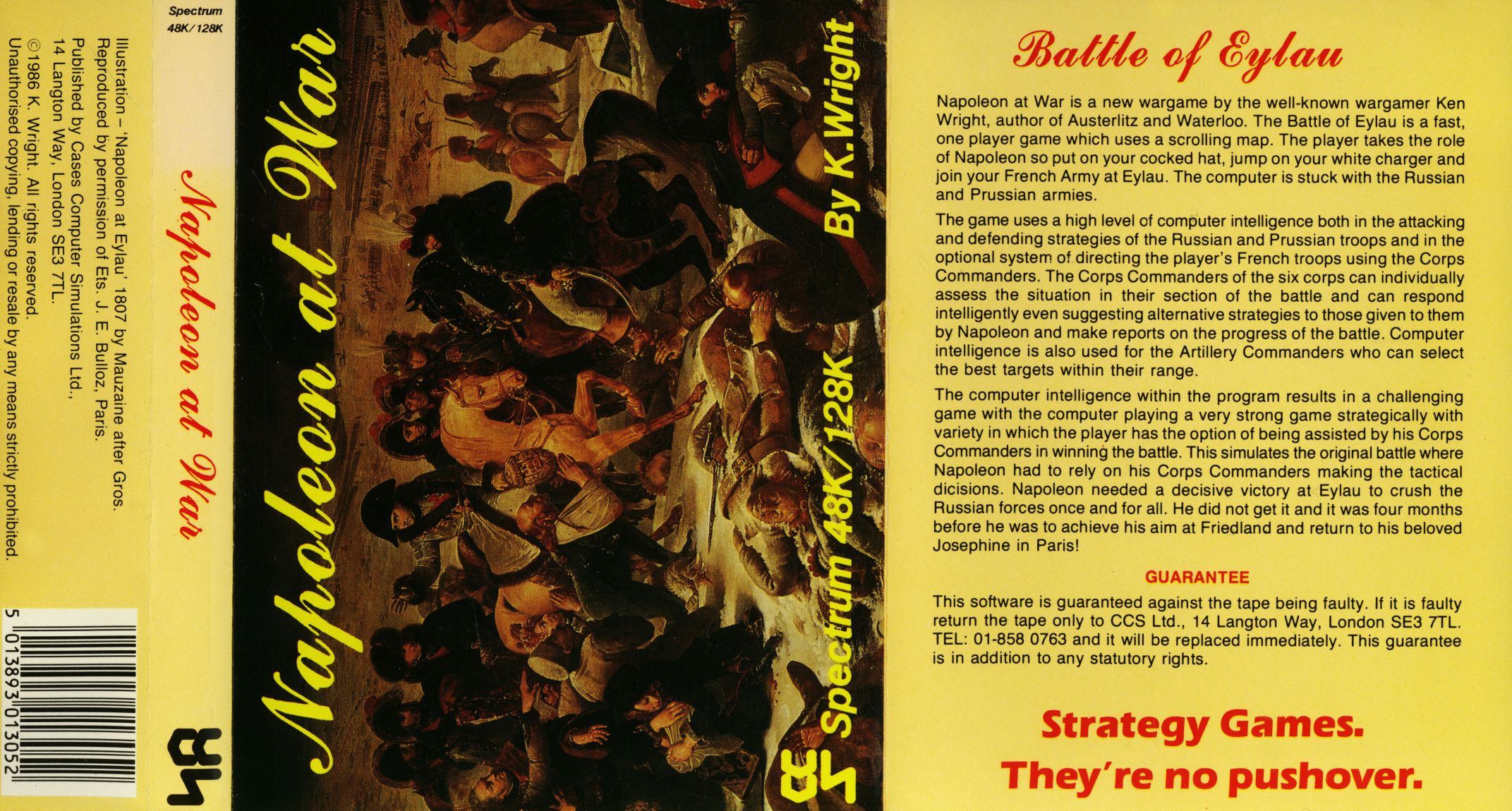
Spectrum, £8.95cs A one player wargame based on the Napoleonic battle of Eylau. The player takes charge of the French forces while the computer plays the part of the Russians and Prussians. The player controls the battle by issuing orders either directly to the units individually or to the Corp Commanders, who will either carry out your orders to the letter or will act on their own initiative. Each game turn is divided into two - the issuing of orders and the movement and combat that is a result of those orders. If you're a fan of this period of wargaming then Napoleon at War is a must, and even if you're not then it's still well worth a good hard look.
Your Sinclair #14Feb 1987 · p.776/107/108/109/108/108/10
Graphics 6/10
Playability 7/10
Value For Money 8/10
Addictiveness 9/10
Overall 8/10
Rick Robson 8/10
CCS £8.95 Reviewer: Rick Robson I knew when I grew up I'd want to play strategy simulation war games like this one from CCS. I spent hours as a wee 'un setting out me little Airfix men on the kitchen lino only for my mum to play Gulliver and tread on all their heads or wash them away in a tidal wave of Flash. No such problems here for a game in the collectable series that brought you Austerlitz. I say collectable with qualification. Shorties with no braces on their strides and proper war game freaks should find this a sound bet. Those new to square bashing may feel this not only looks like, but plays like, Austerlitz, so you're just getting more of the same. Eylau is not exactly the most well known and therefore the most marketable of Napoleonic nefariousness, but as a battle it's interesting since the various unit commanders had to take decisions even when they didn't know their colleagues, let alone their enemies' positions. And it's this element that the games tries to expand. You can control your own (ze French) forces totally, quite easy when the whole battlefield isn't much bigger than a single screen. However, this situation is most unlike a real battle with its lousy lines of communication. So you can choose to order around only certain elements - units of cavalry, artillery and foot solders - leaving the other units to move on their own initiative. Sometimes they'll stumble into disaster, or turn up like the US Cavalry, just in the nick of time! Ultimately, you'll have to take the crucial decisions if you want to force a result, or the simulation, like the actual battle, will veer towards stalemate. Otherwise everything is fine, and technically very smooth, though I'm sure CCS could've smartened up the graphics. All the keying in of orders will give you a throbbing finger, but somehow this is all part of a strategy's compulsion. One final quibble - how about getting some women into this male-dominated militarism? There's nothing some of us would like better than a good thrashing from Boadicea!
ZX Computing #33Jan 1987 · p.55ZX Computing GlobellaGreatGreat
ZX ComputingZX Computing Globella
Overall Great
Tony Hetherington Great
CCS HAS RELEASED THREE NEW CHALLENGES FOR SPECTRUM GENERALS. TONY HETHERINGTON REPORTS FROM THE FRONT. CCS is rapidly achieving the reputation as being THE wargamers. Three new games as different as the campaigns they simulate add to an impressive line up which already includes games such as Desert Rats and Arnhem. In this latest batch of blood 'n guts for the thinking gamer, prospective Generals play Napoleon at the battle of Eylau, replay the disastrous WW1 Gallipoli campaign and tangle with monsters and wizards in Swords of Bane. NAPOLEON AT WAR The battle of Eylau was close run affair between Napoleon and the combined Russian and Prussian forces and therefore ideally suited to conversion into a wargame. This simulation offers prospective Napoleons not only a computerised opponent but also digital commanders that will carry out your general orders as best as they can. If they run out of ideas or feel their position is impossible then they'll send you a message. Alternatively you can run the whole battle yourself as in a standard wargame but I preferred to use the Commanders which added a new dimension to a fascinating period of history. The game itself is a tricky ballancing act between holding onto the town of Eylau while striking at the advancing enemy. Sit back and wait for the attack and you'll be overrun but attack too much and you'll be left with no defense Napoleon at War definitely captures the atmosphere of the age of horse, cannon and musket. CONCLUSION Napoleon at War is my pick of the three games. It's relative simplicity will appeal to beginners who can take control from their computer Commanders as they feel ready then there's a further two levels to challenge the best. Gallipoli is a more complex game and reflects the painfully slow progress of WW1 campaigns (as compared to the free flowing which favourite wargaming periods). The number of troops involved and the tactics required to gain any ground at all saves this one for the experts. The sub game actually spoils the game but can be avoided. Finally Swords of Bane just didn't work. A good idea was there but it was smothered in lack of depth, variety and clumsy control system that had you ordering troops on a fraction of the battlefield without being able to see the rest. Gallipoli and Napoleon at War cost £8.95. Swords of Bane £7.95.
Napoleon at War.
C&VG (Computer & Video Games) #63Jan 1987 · p.1205/103/103/102/10
Graphics 5/10
Playability 3/10
Realism 3/10
Value 2/10
Dr Stephen Badsy
MACHINE: Spectrum SUPPLIER: CCS PRICE: £8.95 Ken Wright, author of Waterloo and Austerlitz, has moved from Lothlorien to CCS for his latest Napoleonic battle, the little-known draw against the Russians at Eylau on 8th February 1807. It uses similar mechanisms to his two previous games, but is improved by a few extra features. Artillery is represented separately this time, and on the big battlefield of Eylau the devolved command system, by which the player leaves Corps commanders in charge of their own forces, works rather better than in previous games. At least, the Marshals of France do fewer stupid things. But the game is still very limited, and rather poor value. You get no choice of scenario, no choice of terrain, no choice of side, no choice of starting position, and no re-run facility. All you have left is the chance to give the French side orders. Unfortunately, the combat mechanism seems to involve such a large random factor that whether they win or lose has almost nothing to do with the orders you do give them. One result of this is, oddly, to make Napoleon at War slightly more playable. Eylau was a confused battle, with re-inforcements for both sides arriving at odd moments throughout the day (this is not represented in the game, by the way). At the end it was a messy and hard-fought draw, which amounted to a strategic defeat for Napoleon, who needed to keep on advancing. The arbitrary nature of the combat system means that while Austerlitz, Napoleon's greatest victory, is virtually unwinable, Eylau, a battle he virtually lost, stands quite a good chance of being won.
STATE OF WAR British software houses have a poor reputation when it comes to producing war games, according to Dr Stephen Badsey, C+VG's own expert. Americans and Australians do it better. So stiffen your upper lip before reading Dr Badsey's challenging views on the state of computerised kriegspiel - that's war play. He also reviews the latest war games available. "Playing wargames? War isn't a game, you know!" I suppose that everyone who says that really believes he thought of it himself. Certainly, the brilliant German officer who invented the kriegspiel (war-play or wargame) training system over a hundred and fifty years ago had to put up with such comments. He often wished that he had called the kriegspiel something else. But it is quite true that war is not a game. Neither is war a book, or a film or a television programme. All these are ways of understanding war, and short of taking part in the same war (courtesy of a time machine) they are the only ways we have. The justification for calling a computer program a wargame, rather than a fantasy or adventure game, is that it tries to simulate the problems and perspectives of war in one place and time. What is worrying is that, at the moment, British commercial games houses have a poor reputation for doing this. Certainly, most serious wargamers that I know who use computers usually buy imports (often American) in preference to British material. I hope this article might inspire someone to try to change this. The big advantage of a wargame over other methods of understanding war is that it makes possible the "what if?", exploring the chances of what might happen. The challenge of a wargame, to its designer, is to take an existing event and separate the constants from the variables, showing what might have been different. Few people really believe that everything in history had to happen exactly as it did, but the current of history is a powerful force, and to divert it can take considerable effort. What would the history of Europe have been without Napoleon? Excellent wargames have been fought exploring such ideas as the Germans attacking Moscow, not Stalingrad, in 1942, or the Warsaw Pact invading western Europe in 1985. As long as it is consistent the data for such battles can even be entirely fictional. The Starship Enterprise may confront three Klingon warships in battle with great realism so long as it does not change its power plant and armory half-way through the game. What this means is that a good wargame must be "many branched", offering the player the chance to explore his own ideas about a historical event. For a computer wargame this means haying more than one scenario, and allowing as many changes in composition of force and circumstances as possible. An ideal wargames program would be one which allowed the player to design his own game, in the same way that a graphics package enables a non-specialist to draw. Something like this idea is already available to a limited extent in such games as Battlefrort (reviewed in this issue) but a complete package would cover, say, land operations from divisional to army group level in any theatre of World War Two. This would surely be a best-seller among wargames. Any offers? The completely fictitious wargame is in fact quite well known to board-garners, although it has yet to be touched by computer games firms. About ten years ago SPI produced a boardgame called Dixie. This was based on the idea of the South winning the American Civil War, and featured a re-match between the Union and Confederacy with light tanks and aircraft in the early 1930s. All the background information came from real studies of tank warfare at the time. Computer wargamers are familiar with 'World War Three" games based on a similar mixture of extrapolation and opinions - hopes? - as to what is likely to happen. If the World War Three that never happened can be put onto computer why not other wars that never happened as well? In every battle there ore different viewpoints, from the commander-in-chief to the men at the sharp end, and some of these viewpoints are a lot easier to translate into computer terms than others. It is most easy it the simulation depends upon machines, the performances of which can readily be reduced to numbers. Probably for this reason, the most successful form of computer wargame at the moment is the aerial combat flight simulator. Flying an aircraft requires constant attention - you just can't stop to think about anything else - and micros give the feel to this for more successfully than flip-books or boardgames. Actually, for navy pilots the most stressful moment, and hardest piece of flying, is not over the target nor in combat, but when trying to land back on the carrier after the mission (particularly at night!). I don't know of a computer game covering this, but I'd certainly like to see one which covers carrier operations from the pilot's viewpoint. Back in July I complained that no-one had produced a good tank simulator, but as you will see from the review PSS have done a reasonable job with Tobruk, so any offers on carriers? If the view of a carrier battle from the pilot's cockpit is fast-moving and constantly changing, that of the task-force commander is one of maps, information tables, occasional fragments of reports and a lot of time sitting around thinking out their implications. In mechanised war, on land or sea, the computer games now existing do well in taking over the role of a commander's staff, providing him with information. The Wargamers' Series of games from PSS tries to give the best of both worlds by having strategy games with - usually optional - arcade-style front line games built in, so that the player alternates between strategy and shooting. They are about to bring out a game on the Bismarck in which this actually makes sense, since the same man both planned the ship's strategy and commanded the ship in battle. But even with this series the frequent absence of training scenarios is a drawback. The kind of strategy game which is worth playing or which wargamers want to play more than once, cannot usually be played by a novice at all. The same is true of real battles at a certain scale, and it takes even the best time to learn how to do it. Frederick the Great, Montgomery and U. S. Grant all made a mess of their first campaigns. On the other hand, most wargamers can win given a second chance if exactly the same circumstances are offered to them and the element of chance and surprise is gone. While a very great writer might have described Waterloo, no one can describe the great battles of the two World Wars, for the simple reason that no one saw a thousandth part of any of them - they were just too big. Other than the experience of a single soldier, the only other viewpoint which makes much sense is a map with symbols moving across it, whether in a book or on a micro. It is just one way of coming to terms with the event, and in this particular way land warfare doesn't differ much from sea or air warfare. Unfortunately, there is in practice another major difference. Both sea and air war are conducted in a largely neutral environment, by machines which go where their commanders want them to go. In the middle of a battle the stoker in a battleship or the navigator in an aircraft can't run away. Land warfare contains far more variables, so many that they usually outnumber the constants in any major battle. Factors like the kind of ground being fought over, the weather, the attitude of the troops (which we call morale) and the actual, rather than theoretical, performance of their weapons are far more important than any fixed data in determining the outcome of a battle. The side with the most troops, for example, doesn't always win. Anyone who doesn't believe this, and who thinks land warfare is easy to model by computer, should read two books, Colin Wilson's Bomb and the Computer and Trevor N. Dupuy's Numbers, Predictions and War. Actually, anyone writing a wargames program should read them both anyway. Any wargame, like any other simulation, will contain a certain number of assumptions concerning the performance of forces in war, as well as a number of facts. Again, this is particularly true of land warfare, and is where computer game designers often fall down by failing to research the subject properly. That one aircraft flies faster than another is usually a matter of fact (although it may not do so under combat conditions), but whether one army fights better than another can only be a matter of opinion. Too many program writers seem happy to put forward simulations of "reality" which are unashamedly slanted in favour of one side. An outstanding example of this is SSI's Nam - (also reviewed) the declared aim of which is to reverse history and let the Americans "win" Vietnam. The first question tor a program writer is which viewpoint he is trying to represent. If he doesn't know, the chances of his game convincing anyone else are slight. The second thing he needs to know is what assumptions he is making, and why. It is remarkable how much games can differ in their assumptions. The Midway scenario from Carriers at War, for example, allows both sides to be played but makes scouting reports from observation aircraft poor and infrequent. Which side spots the other first is largely a matter of luck, and a player can do everything right but still lose (much as the Japanese actually did - Midway was a very close battle). The PSS game of Battle for Midway, in contrast, allows for vastly more effective American scouting, and the computer-controlled Japanese always approach on the same course. After a second or third attempt at the historical scenario it is virtually impossible for the Americans to lose. After playing them both, it is hard to believe that these games are actually about the same battle. Until writers become more concerned with these problems, and in particular until the difficulties of modelling land warfare are overcome, the computer wargame will not become, as it should, one of the main sources of inspiration for British wargamers. Naval and air argames are considerably more advanced. The best of the British flight simulators, like Digital Intergration's Tomahawk and Mirrorsoft's Strike Force Harrier will stand comparison with anything I've seen from any country. The best air strategy game I know is also British, Their Finest Hour from Century Communications. (But even as I write this I have been sent Europe Ablaze by the formidable Australians of the Strategy Studies Group, so we'll see.) The outstanding submarine game is the American Silent Service, and the best naval wargame for the very serious is Carriers at War - reviewed below - also from the Strategy Studies Group. For twentieth century land warfare CCS produce R. T. Smith's excellent Desert Rats, which is far ahead of any other British game I've seen, and better than many American offerings.
Sinclair User #57Dec 1986 · p.974/54/5
Overall 4/5
Gary Rook 4/5
Label: CCS Author: K Wright Price: £8.95 Memory: 48K/128K Reviewer: Gary Rook Napoleon at War - Eylau is the latest in a long line of interesting wargames from CCS. The company's last two Arnhem and Desert Rats - are two of the best strategy games that I've ever seen on the Spectrum, so I approached this one with high hopes. After playing it a couple of times through, my feelings towards the game are a trifle ambivalent. It's enjoyable. It plays very well. But it's very complex - perhaps too complex. You are Napoleon. So far so good. Now defeat the combined Russian and Prussian forces facing you across a landscape of streams, woods and frozen lakes. Your forces are concentrated about the village of Eylau, from which the battle takes it's name. You command infantry, cavalry and artillery forcess, and the enemy has the same types of troops at their disposal, but seem to outnumber you somewhat. The map is divided into squares showing terrain features. Type of terrain effects your troop movement: woods, frozen lakes, buildings etc slow them down. Cavalry move faster than infantry, which move faster than artillery. Artillery, however, can fire at the enemy, while the other arms have to move next to an enemy unit to attack it. Your troops are divided into corps. In game terms, what this means is that they can be given orders as corps, or as separate units. Each corps is composed of three units, and usually it is marked with a corps number. Give a corps an order and all the units in that corps will try to carry those instructions out. If you wish you can detach units from the command of a corps and give them separate orders though. Ordering troops about is a bit of a puzzle at first. Basically, you page through a set of menus and choose what instructions a corps or unit has from these. Tell a corps to move to a certain place. Or tell it to attack the enemy, to hold a position or to regroup. You can only tell a unit, it seems to move somewhere. Artillery are different, and have their own menu. Cannon can move, or they can fire. If they fire, you have to specify whether they are to fire against infantry or artillery. They have a range of five squares, and cannot fire over any of your other units. To tactics. Effectively, you have to try to hold on to the centre and defend Eylau, while your right flank destroys the forces facing it and then rolls up the enemy. You also have a corps under Ney, which enters on Game Turn 3 and acts as your left flank. At the beginning you can see where the Russian and Prussian forces are - this information comes from intelligence reports. As they move, however, they have a habit of disappearing. You only get shown where they are if one of your corps commanders tells you. This is an important point to remember - your troops will react to units which are not on the game board as far as you can see. Enemy forces may not be shown on the map, even if they fire on your troops, or engage in melee against them. I lost two artillery units in one game which ran away from Russians I couldn't see! Artillery, in fact, can be very vulnerable, and you'll probably lose a lot of guns before you work out how best to protect them. One way, as far as I can see, is to arrange units in a sort of draughts formation with the artillery stepped back and a couple of units of infantry in front and to each side. When you first start playing, don't try any fancy work - I did and I got wiped out. Just sit back, hold on to Eylau, and watch what the enemy does. Napoleon is certainly a challenging game, but I found some of the mechanics a little tedious. I couldn't help feeling also that a bit more thought at the design stage could have ironed most of them out. The cursor, for example, has a habit of disappearing when it moves on to a square containing either a terrain marker or a unit, so it's easy to forget where it is. Another problem is that units sometimes do some very odd things when they are trying to obey a corps order - including performing a little dance around their headquarters unit. It appears to be because they always try to get into the position relative to the headquarters unit which they held at the beginning of the game, so a unit which started to the right of its HQ will always try to be on the right. These few mechanical problems mar for me what is otherwise an excellent, one-player wargame. Even with them, I think it's well worth buying if you like strategy games. If you haven't played this sort of game before, but are looking for a good one to try out, though, I'd advise you started somewhere else and worked up to this one.
Crash #34Nov 1986 · p.91Crash Smash90%90%92%89%93%93%96%95%95%
Presentation 90%
Rules 90%
Playability 92%
Graphics 89%
Authenticity 93%
Opponent 93%
Value For Money 96%
Overall 95%
Sean Masterson 95%
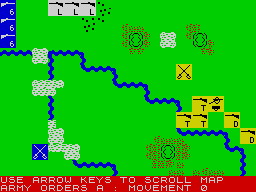
FRONTLINE With Sean Masterson THAT'S NOT YOUR FACE How many advertisements for new arcade games have you seen with blurb to the effect that, 'This game is a shoot em up with elements of strategy.' in recent months? I realised at the PCW Show that companies are not really going out of their way to make games more thought provoking or satisfying. Some reviewers have been taken in, almost quoting the blurb on game inlays when they announce that a game has 'strategic overtones'. I nearly was myself. Rubbish. Absolute drivel. Find me such a game. They don't exist and it's as simple as that. The software industry is paying lip service to an ever growing faction of gamers, instead of providing real diversity in their products. It's true that more crossover games have appeared in the mould of Lords of Midnight but arcade games have remained just that. Any use of 'strategy' in the blurbs must be in the most abstract sense only. I'm not claiming that the con is wholly intentional. It seems to be a case of the King's New Suit, with some software houses believing that any increase in the complexity of play must entail a 'strategic' element. What hasn't occurred to them is that what is required is a change in the style of play - not the detail. Anyway, moan over. Next month I hope to take a look at some home grown strategy games, supplied by FRONTLINE readers... NAPOLEON AT WAR Producer: CCS Retail Price: £8.95 Author: Ken Wright This new game from CCS, the first since Desert Rats, is written by Ken Wright, author of some of LOTHLORIEN's most successful titles including Waterloo and Austerlitz. Presumably, Mr Wright retained the copyright on the format of those games because this one works in exactly the same fashion. More of that later. The game is a reconstruction of Napoleon's confrontation with the Russian army under Bennigsen in a solitaire game that casts you as Napoleon. The game gives you control over five infantry corps and one cavalry corps - each with three divisions. At last, artillery is included in the scenario and it's good to see that Mr Wright has acted on the constructive criticism from the public and given the player three units in this game. Presentation is neat. After a passable loading screen, the player is presented with a scrolling map containing terrain symbols and unit markers which are uncluttered but obvious. Units are displayed as single character blocks annotated for unit type, Corps ID and Command ID if any. Cursor keys allow observation of the whale play area, and a menu at the base of the screen displays possible options as keypresses. The French are coloured blue, Russians are black on yellow and a single Prussian Corps (commanded by Lestocq) is displayed as black on white. You can analyse the strength and morale of your own units by asking for details when the cursor is above a unit. The marker then doubles in length to display the required information. As in the previous games of this format, units may be ordered as an entire corps by directly ordering the lead unit of that corps, or as individual divisions - though as Mr Wright points out in the notes, such detailed command was unheard of at the time of the original conflict. If the orders you give are suspect, a corps commander may send a message to suggest an alternative course of action. Original orders will still be followed if you insist, but it's advisable to take note of the suggestions to begin with. The game's three difficulty settings reflect the adaptability of the computer opponent. In a solitaire game, this has to be good. In Napoleon at War the opponent is nicknamed Charlie Oscar and the designer is evidently proud of his creation. Charlie O boasts unpredictability and sophisticated intelligence. Immediately the enemy forces start to move, hidden movement comes into play and opposing units begin to disappear from view. In fact the intelligence is a definite improvement on the earlier games and the advantages of this are manifold. If the enemy played in a similar fashion to Waterloo, my guess is that your artillery would hack most of them to pieces before they ever got close enough for melee. But it's good to see such a quality piece of programming. In the original battle, both Napoleon and Bennigsen were left claiming victory. One thing was obvious, the battle had gone in a way neither had anticipated or desired. The game does well in recreating this confused and unsatisfying flow, and victory conditions are correspondingly difficult for both sides to fulfill. Again, it's good to see such demanding restrictions in a solitaire game. The rules are straightforward and arrive on a glossy, fold out sheet. Apart from designer's and historical notes, the game includes a couple of useful battle maps and some new features such as the reorganisation of depleted units to maintain a coherent fighting force. Moans? Well, there are a few. Marshal Ney's 6th Corps and Lestocq's Prussians come into the game as reserves for both sides on Turn Four. Unfortunately, they are displayed on the map at their relevant entry points right at the start of the game. The result is a slightly annoying distraction but one that can be lived with. My copy of the game also appeared to be slightly bugged, preventing me on certain occasions from offering orders to divisional sized units. Hopefully, this was just a fault in my copy as the bug seemed intermittent and random. Finally, the game's now obligatory double cassette housing boasts compatibility with 128K machines. Try as we might, we could only get the program to load on a 48K or 48K Plus model. There is no joystick option for control - only an aesthetic omission but it would have been nice. Nearly a year after the appearance of Mr Wright's first Napoleonic games, he has entered the fray once more with a host of improvements on his original system. These are not necessarily dramatic or immediately obvious but, as I keep reminding people, the best parts of a strategy game are the bits you can't see. What choice do I have then, but to present this game with a well deserved CRASH Smash?
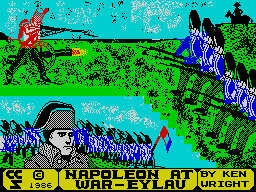
A formidable Russian force (dressed in yellow for the Spectrum screen) lies in wait on the right of a river. At the top left the entry point for the reserves is made visible - they don't arrive till a bit later on...
News/Note3
- Your Sinclair #13Jan 1987 · p.7
- Your Sinclair #11Nov 1986 · p.5
- ZX Computing #31Nov 1986 · p.6
Advert3
- Crash #35Dec 1986 · p.127
- Crash #34Nov 1986 · p.23
- Popular Computing Weekly #44Oct 1986 · p.39
Feature2
- Crash #54Jul 1988 · p.61
- ACE (Advanced Computer Entertainment) #3Dec 1987 · p.85
Review1
- Popular Computing Weekly #40Oct 1986 · p.19
Related
- Elsewhere
- Speccy Screenshot MapsMobyGamesUVL
- Same entry at
- Spectrum ComputingZXInfo
Reviews from people here
Sign in to write about this, or make an account. It takes a minute and lets you correct the catalogue too.
No description recorded.
Sign in to correct or add to this.
Hold the rights to this and want it taken down?